Published online November 27, 2014 (http://www.sciencepublishinggroup.com/j/ajac) doi: 10.11648/j.ajac.20140206.11
ISSN: 2330-8753 (Print); ISSN: 2330-8745 (Online)
Analytical methods for characterization of bile acids and its
application in quality control of cow-bezoar and bear bile
powder
Xiaoyuan Niu
1, Ying Xu
1, Qiaoling Yang
1, Xiaowen Tang
1, Li Yang
1, 2, *, Zhengtao Wang
11
The MOE Key Laboratory for Standardization of Chinese Medicines and The SATCM Key Laboratory for New Resources and Quality Evaluation of Chinese Medicines, Institute of Chinese Materia Medica, Shanghai University of Traditional Chinese Medicine, Shanghai 201203, China
2
Center for Chinese Medical Therapy and Systems Biology, Shanghai University of Traditional Chinese Medicine, Shanghai 201203, China
Email address:
[email protected] (X. Niu), [email protected] (Y. Xu), [email protected] (Q. Yang), [email protected] (X. Tang), [email protected] (L. Yang), [email protected] (Z. Wang)
To cite this article:
Xiaoyuan Niu, Ying Xu, Qiaoling Yang, Xiaowen Tang, Li Yang, Zhengtao Wang. Analytical Methods for Characterization of Bile Acids and Its Application in Quality Control of Cow-Bezoar and Bear Bile Powder. American Journal of Applied Chemistry.
Vol. 2, No. 6, 2014, pp. 96-104. doi: 10.11648/j.ajac.20140206.11
Abstract:
Bile acids as characteristic compounds of human and animal bile are major endogenous products of cholesterol and play very important roles in cholesterol homeostasis, lipid absorption and production of bile flow. At present, bile acids are useful biomarkers and signaling molecules for the diagnosis or treatment of many diseases in clinic. Various analytical methods, from overall to individual, qualitative to quantitative, have been developed for the determination of bile acids in biomedical samples and even bile-based medicinal materials. The most precious and commonly-used bile-based traditional animal medicines are cow-bezoar (CB) and bear bile powder (BBP), which regard bile acids as the main bioactive constituents and have extensive use for treating many diseases since thousands of years ago. However, extensive consumption of CB and BBP make their natural resource scarcity and price valuableness. Currently, artificial, in-vitro cultured substitutes and even worse adulterants or counterfeits mix in the medicine market and they have seriously compromised the therapeutic effects of these two traditional medicines. To guarantee the long-term development of ethnodrugs, many analytical approaches have been utilized in quality control of CB and BBP. In this paper, various analytical methods of bile acids are summarized and compared with each other.Keywords:
Bile Acids, Analytical Methods, Cow-Bezoar, Bear Bile Powder, Quality Control1. Bile Acids Structure and Function
Bile acids (BAs) are a group of amphipathic C24 steroids
with a pentanoic acid substituent at C17[1]. They are the
terminal endogenous catabolism products of cholesterol and play a critical physiological role in metabolic processes of human and animals. Cholic acid (CA) and chenodeoxycholic acid (CDCA), two primary bile acids, are primarily formed in hepatocytes from cholesterol and then further conjugate with amino acids (specifically glycine or taurine) before they are
excreted into bile[2-3]. In the intestine, a fraction of the
primary bile acids is converted to secondary bile acids via the deconjugation and dehydroxylation under the enzymatic action of bacterial phyla, principally deoxycholic acid (DCA)
and lithocholic acid (LCA)[3-5]. In addition, CDCA is partially
epimerized into tertiary bile acid called ursodeoxycholic acid
(UDCA), which represents a group of "minor" bile acids that
have significant importance[5]. Most of the primary and
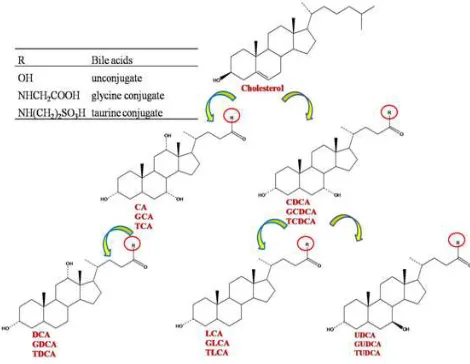
secondary bile acids through the intestinal wall are reabsorbed into the portal system and transported back to the liver to complete the well known enterohepatic circulation. Figure 1 shows the main bile acids structure and generation pathway[4-8].
BAs as characteristic compounds of human and animal bile are natural products of cholesterol and play very important roles in cholesterol homeostasis, lipid absorption
and production of bile flow[2,9-10]. In a normal adult,
approximately 500mg of cholesterol is converted into bile
acids per day[11]. At present, BAs are useful biomarkers and
such as hepatic and intestinal diseases, obesity[13], even the oesophageal adenocarcinoma (OA) which has been reported
in recent research[14]. Consequently, obvious changes in the
concentrations of total BAs and individual BAs in sera, urine, or feces can be observed and bring important biomedical information for the prognostic, diagnosis, follow-up of hepatic and intestinal diseases and other disorders involving
bile acids metabolism[8].
Figure 1. The main bile acids structure and generation pathway.
2. Bile-Based Drugs
With the growing interest on comprehensive study of BAs, various methods have been developed for the analysis of bile acids in biomedical samples including bile, serum, urine, feces and even bile-based drugs, from overall to individual, qualitative to quantitative. As bile-based drug, UDCA is a bile acid monomer and famous for the curative effect in liver diseases worldwide. To date, UDCA is used for the treatment of primary biliary cirrhosis (PBC) for which it is the only drug approved by the U.S. Food and Drug Administration
(FDA)[15]. Similarly, clinical studies reveal that 6-ethyl-
chenodeoxycholic acid (6E-CDCA) as a bile acid derivative is a farnesoid X receptor (FXR) ligand endowed with agonistic activity for treatment of cholestatic liver diseases
and other liver-related metabolic disorders[16-17]. The most
commonly-used and precious bile-based traditional animal medicines are cow-bezoar and bear bile powder. They regard bile acids as the main bioactive ingredients and have a wide range of pharmacological actions for treating many diseases in clinic in China. Cow-bezoar (CB) is the dry gallstone of
Bos taurus domesticus and is mainly used for fearful emergency disease including convulsion, serious fever, even coma, which based on its functions of sedation,
defervescence and detoxification[18]. Bear bile powder (BBP)
is the dried gallbladder with bile of selenarctos thibetanus
curvier or Ursus arctos L and the dried gallbladder with bile
from other species of Ursidae also seems to be used as bear
bile[19]. In traditional clinical practice, bear bile powder was
utilized in relieving heat, toxin, inflammation, and pain.
Modern researches indicate that bear bile powder has wide application in treating hepatic and biliary diseases profiting
from the pure compounds like characteristic UDCA[15,20]. In
fact, China was the first country utilizing CB and BBP, but this usage was adopted by Japan and Korea centuries ago[15,19,21]. In Japan, bear bile powder has been in widespread use as a folk medicine for the treatment of
hepatobiliary disorders from the mid-Edo period[15]. Likewise,
in cardioactive types of Japanese OTC drugs, 98.7% contain
cow-bezoar[22]. However, extensive consumption of CB and
BBP make their natural resource scarcity and price valuableness. To protect endangered medicinal resource, artificial synthesized and in-vitro cultured Calculus Bovis and bear bile powder have been developed as substitutes to
use in clinic in recent years[23-24]. While, chemical
composition difference between the substitutes and crude drugs may lead to the variation of curative effect. To be even worse, due to the remarkable difference in price, some other cheaper animal bile like cattle bile, pig bile, chicken bile as adulterants or counterfeits flow into the medicine market. It has seriously compromised the therapeutic effects of
traditional medicines[25]. Hence, to ensure the long-term
development of ethnodrugs, many analytical approaches have been used in their quality control.
3. Analytical Methods of Bile Acids
3.1. Enzymatic Methods
At present, enzymatic methods are widely used for the total bile acids determination in clinical laboratories. The methods are relatively simple, specific and rapid to reflect the obvious changes in the concentrations of total bile acids in
patients with liver diseases[2]. Thio-NAD and
3α-Hydroxysteroid dehydrogenase combined with UV or more sensitive fluorimetric assay are used in clinical
chemistry for analysis of total bile acids[26-35]. For example,
an enzymatic colorimetric assay of serum total 3a-hydroxy bile acids concentrations without prior extraction has been investigated and the results were in agreement with using
extraction assay[30]. Other dehydrogenases (3β-, 7α-, 7β- and
12α-hydroxysteroid dehydrogenases) have also been applied into analysis of groups of bile acids containing hydroxyl
groups at specific positions[27,35-36]. For instance, one
enzymatic fluorometric micro assay based on 3α-HSD and 7α-HSD was developed for measurement of ratio of primary to total bile acids for clinical characterization of patients with liver diseases[35].
abnormalities in bile acids profiles[27]. Thirdly, the enzymatic reaction is inhibited by structural changes of the bile acids like neighboring hydroxyl groups variation, glucuronidation
of a 6-hydroxyl group[37], and sulfation of a 7-hydroxyl
group.
3.2. Chromatographic Methods
Enzymatic methods are relatively specific and simple to detect total bile acids instead of individual bile acid in biological samples. However, individual bile acid also serve a kind of important physiological functions respectively. Some bile acids can be used in the clinical treatment like UDCA approved by the U.S. FDA for primary biliary
cirrhosis[15,38]. But some bile acids have high toxicity like
LCA considered to increase the risk of colon cancer[39] and
must control its concentrations. Thus, it is necessary to establish a highly selective, sensitive and reliable method for simultaneous measurement of the structural similar individual bile acid to better know the pathophysiological functions of individual bile acids in vivo.
3.2.1. Thin-Layer Chromatography (TLC)
Quantitative determination of bile acids and their conjugates was developed by thin- layer chromatography
with purified 3-α hydroxysteroid dehydrogenase[40]. A high
performance thin-layer chromatography (HPTLC) assay was also proposed for analysis of individual bile acid and their
glycine/taurine conjugates in duodenal juice[41]. Although
thin-layer chromatography technology is widely used in the field of pharmaceutical analysis, but it can only analyze part of bile acids due to the complex and similar structure of bile acids.
3.2.2. High Performance Liquid Chromatography (HPLC) In recent years, many reliant and sensitive high performance liquid chromatographic methods have been applied to analyze BAs in biological fluids. UV, fluorescence or evaporative light scattering detection (ELSD) coupled
with liquid chromatography (LC) have been
developed[24,42-53]. A research was done to determinate BAs in
five different animal bile power and compare their
chromatograms from each other by using HPLC-UV[45]. The
conjugated BAs in bear bile and cattle bile were determined by high performance liquid chromatography coupled with
ELSD[24]. In a present study, HPLC-ELSD method was
introduced to quantify the free and conjugated BAs in seven
different animal bile samples[50]. It is reported that HPLC
method was established for analysis of free and glycine/taurine conjugated bile acids in serum by using post-column reaction after group separation by ion-exchange chromatography on piperidinohydroxy propyl Sephadex
LH-20[54]. A improved HPLC method using paried-ion
chromatography was developed for determination of
conjugated bile acids in serum[55]. HPLC combined with
immobilized 3-α hydroxysteroid dehydrogenase methods
have always been applied into the analysis of bile acids[56-57].
With the recent development of LC, it seems to become
feasible choice for separation of bile acids in biological fluids and bile-based traditional medicines.
3.2.3. Gas Chromatography (GC)
Gas chromatography (GC) the same as LC is used in the
analysis of bile acids as a separation technique[27,58]. Over
recent years, GC are always combined with mass spectrometry (MS) applying into the research of BAs. In the past, GC methods were developed for quantitative analysis of
bile acids in bile, serum[59], urine, as well as stool[60] in
patients with primary biliary cirrhosis[61] or ileal resection[62].
An improved GC method coupled with radioimmunoassay technique was proposed for determination of serum bile acids
in diagnosis of hepatic and biliary diseases[63]. GC can
provide high resolution and detection sensitivity for individual bile acid analysis. Nevertheless, the sample pretreatment is complicated and time-consuming involving extraction, purification, hydrolysis of conjugates and
derivatization owing to the lack of chromophore[60,64-65].
3.3. Mass Spectrometry (MS)
MS is a powerful and useful technique to measure BAs because of its high sensitivity and providing abundant
structural information[1,9,66-68]. Currently, a number of
literatures have reported all sorts of MS ionization techniques including fast atom bombardment (FAB), atmospheric
pressure chemical ionization (APCI)[1,69-71] and electrospray
ionization (ESI)[1,72-77], which have been employed for the
detection of BAs coupled with various mass analyzers like
ion trap (IT)[1,72,74], triple quadrupole (QqQ)[1], time-of-flight
(TOF)[1,66]. For instance, a recent research has described
semiquantitative determination of 16 urinary BAs
metabolites by ESI-tandem mass spectrometry, which samples were prepared by solid-phase extraction and the total
analytical time was 2 min per sample[9]. One study has
interpreted fragmentation pathways of 18 free and conjugated BAs by using ion trap and triple quadrupole mass spectrometers, which may contribute to BAs clinical analysis
and metabolic studies[1]. However, MS techniques can not
differentiate BAs isomers from each other[8].
3.4. Advanced Hyphenated Techniques Analytical Methods
Recently, various advanced hyphenated techniques like GC–MS or LC-MS have been developed and reported in assessment of bile acids. GC–MS is highly selective and sensitive technique and is always regarded as the reference
method to ascertain BAs structure[12]. However, preparation
of samples including the cleavage of conjugates, the derivatization and so on before entering into the GC is tedious and perplexing. On the contrary, HPLC-MS or HPLC–MS/MS can provide the determination of both free and conjugated BAs avoiding tedious prior preparation. Thus, LC–MS seems to appear as the most suitable method to
assess the bile acids quantificationally[27]. UPLC developed
for quick determination of BAs, especially many isomeric
forms within a shorter time[8]. Table1 shows representative
hyphenated techniques analytical methods which have been applied into BAs analysis in recent years.
3.5. Other Methods
Radioimmunoassay, bioluminescence and NMR
spectroscopy assay have been applied to estimate bile acids for the diagnosis of diseases related to bile acids
metabolize[88-91]. Radioimmunoassay was described for
detection of BAs in serum in the diagnosis of vinyl chloride
hepatotoxicity[89]. A simple bioluminescence experiment
along with the glutamate pyruvate transaminase was used for analysis of serous bile acids in patients suffering from
hepatic injury[90]. One study clearly demonstrated that
1H-NMR spectroscopy can be applied to the quantitative determination of total and taurine-conjugated BAs in bile
without troublesome preparative steps[91].
Table 1. Representative hyphenated techniques analytical methods for BAs analysis
Type of hyphenated techniques Analyte Significance
GC-MS and GC-MS/MS[58,65,78] BAs and oxysterols To analyze the sterols and BAs in urine, feces and animal organs
LC-MS/MS[47,79-80] major BAs and their
glycine/taurine conjugates To quantify BAs in animal liver, bile, plasma, and urine
LC-MS/MS[12, 81-85] major BAs To quantify major BAs in human serum to give new insights in BAs metabolism.
LC-MS/MS[25] free and conjugated BAs To provide BAs profiles of bile-based traditional medicines like bear bile, snake bile,
cow-bezoar and so on, which could be used for their quality control.
UPLC-MS/MS[8,86-87] BAs To distinguish and quantify BAs with higher sensitivity and separation in biological
fluids and Traditional Chinese Medicines
4. Application of Bas Analytical Methods
in Quality Control of Cow-Bezoar and
Bear Bile Powder
One of the most important quality control methods for cow-bezoar and bear bile powder should depend on the concentrations of BAs, which are the main active constituents. Cow-bezoar approximately contains 8% BAs
and main components are CA, DCA, CDCA and their
taurine/glycine conjugates[92]. Bear bile powder principally
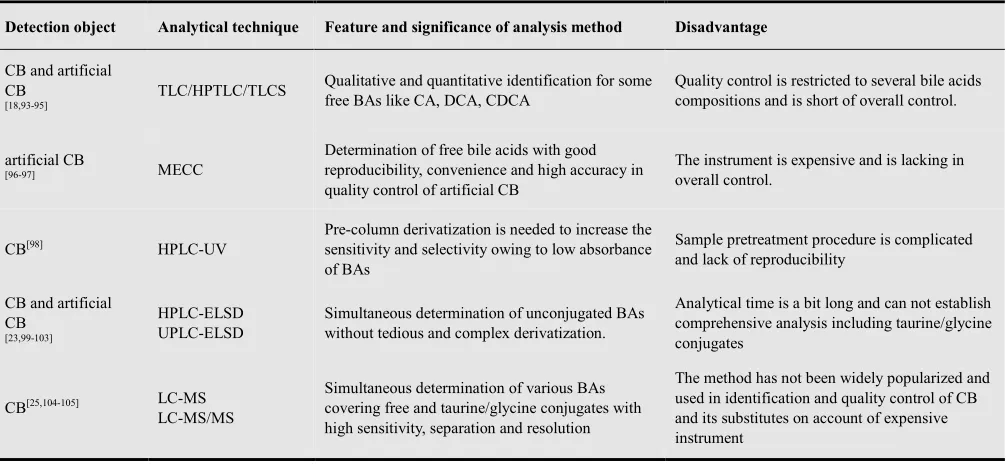
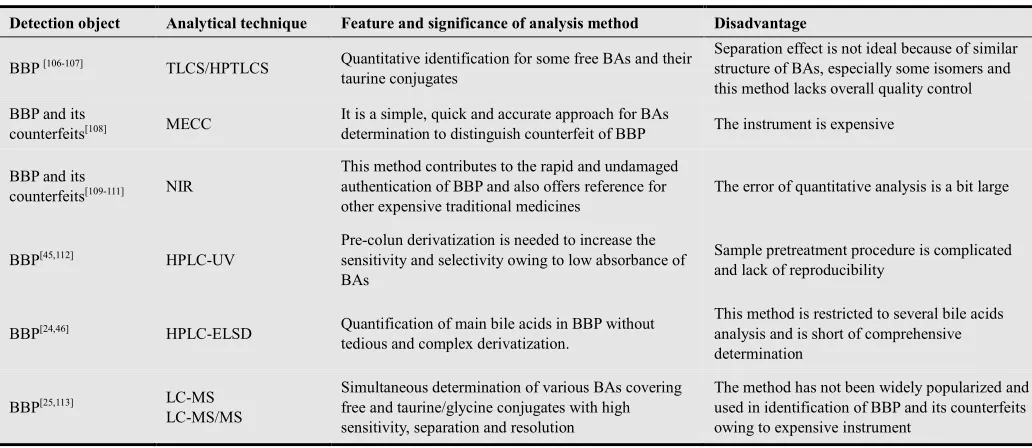
owns TUDCA , TCDCA, TCA, UDCA, CDCA and among them TUDCA, UDCA as the specific ingredients are implicated in the efficacy of BBP. Various analytical approaches have been developed to evaluate the quality of CB and BBP from total bile acids to individual bile acid, qualitative to quantitative. Table2 and Table3 show the main detection methods of BAs in CB and BBP.
Table 2. Application of BAs analytical methods in quality control of CB
Detection object Analytical technique Feature and significance of analysis method Disadvantage
CB and artificial CB
[18,93-95]
TLC/HPTLC/TLCS Qualitative and quantitative identification for some
free BAs like CA, DCA, CDCA
Quality control is restricted to several bile acids compositions and is short of overall control.
artificial CB
[96-97] MECC
Determination of free bile acids with good reproducibility, convenience and high accuracy in quality control of artificial CB
The instrument is expensive and is lacking in overall control.
CB[98] HPLC-UV
Pre-column derivatization is needed to increase the sensitivity and selectivity owing to low absorbance of BAs
Sample pretreatment procedure is complicated and lack of reproducibility
CB and artificial CB
[23,99-103]
HPLC-ELSD UPLC-ELSD
Simultaneous determination of unconjugated BAs without tedious and complex derivatization.
Analytical time is a bit long and can not establish comprehensive analysis including taurine/glycine conjugates
CB[25,104-105] LC-MS
LC-MS/MS
Simultaneous determination of various BAs covering free and taurine/glycine conjugates with high sensitivity, separation and resolution
Table 3. Application of BAs analytical methods in quality control of BBP
Detection object Analytical technique Feature and significance of analysis method Disadvantage
BBP [106-107] TLCS/HPTLCS Quantitative identification for some free BAs and their
taurine conjugates
Separation effect is not ideal because of similar structure of BAs, especially some isomers and this method lacks overall quality control
BBP and its
counterfeits[108] MECC
It is a simple, quick and accurate approach for BAs
determination to distinguish counterfeit of BBP The instrument is expensive
BBP and its
counterfeits[109-111] NIR
This method contributes to the rapid and undamaged authentication of BBP and also offers reference for other expensive traditional medicines
The error of quantitative analysis is a bit large
BBP[45,112] HPLC-UV
Pre-colun derivatization is needed to increase the sensitivity and selectivity owing to low absorbance of BAs
Sample pretreatment procedure is complicated and lack of reproducibility
BBP[24,46] HPLC-ELSD Quantification of main bile acids in BBP without
tedious and complex derivatization.
This method is restricted to several bile acids analysis and is short of comprehensive determination
BBP[25,113] LC-MS
LC-MS/MS
Simultaneous determination of various BAs covering free and taurine/glycine conjugates with high sensitivity, separation and resolution
The method has not been widely popularized and used in identification of BBP and its counterfeits owing to expensive instrument
5. Summary and Prospective
In summary, analytical methods of BAs have made progress constantly in recent years. Various modern analytical approaches can contribute to quality control of traditional medicines including CB and BBP. However, the similar structure of BAs especially isomers and other complex constituents in traditional medicines decide that high selective and sensitive, reliable and versatile analytical methods are still needed for comprehensive monitoring of BAs in CB and BBP. At present, our research group is using reversed phase thin layer plate to separate and detect BAs including isomers in bear bile powder. Currently, advanced hyphenated techniques will be ideal tendency for BAs analysis and quality control of traditional medicines owing to complementing each technology's advantages.
Acknowledgements
This work was supported by National Nature Science Foundation of China (grant number 81222053), Shanghai
Municipal Health Bureau Program (grant number
XYQ2011061), "Rising-Star Scholar" Project of Shanghai Municipal Science and Technology Commission (grant number 12QH1402200).
References
[1] Qiao X, Ye M, Liu CF, Yang WZ, Miao WJ, Dong J, Guo DA, 2012. A tandem mass spectrometric study of bile acids: interpretation of fragmentation pathways and differentiation of steroid isomers. Steroids 77(3): 204-211.
[2] Sharma KR, 2012. Review on bile acid analysis. Int J Pharm Biomed Sci 3(2): 28-34.
[3] Ding J, Lund ET, Zulkoski J, Lindsay JP, McKenzie DL, 2013. High-throughput bioanalysis of bile acids and their conjugates using UHPLC coupled to HRMS. Bioanalysis 5(20): 2481-2494.
[4] Chiang JY, 2002. Bile acid regulation of gene expression: roles of nuclear hormone receptors. Endocr Rev 23(4): 443-463. [5] Stamp D, Jenkins G, 2008. Chapter 1. An Overview of
Bile-Acid Synthesis, Chemistry and Function. 1-13.
[6] Monte MJ, Marin JJ, Antelo A,Vazquez-Tato J, 2009. Bile acids: chemistry, physiology, and pathophysiology. World J Gastroenterol 15(7): 804-816.
[7] Hofmann AF,Hagey LR, 2008. Bile acids: chemistry, pathochemistry, biology, pathobiology, and therapeutics. Cell Mol Life Sci 65(16): 2461-2483.
[8] Yang L, Xiong AZ, He YQ, Wang ZY, Wang CH, Wang ZT, Li W, Yang L,Hu ZB, 2008. Bile acids metabonomic study on the CCl4- and alpha-naphthylisothiocyanate-induced animal models: quantitative analysis of 22 bile acids by ultraperformance liquid chromatography-mass spectrometry. Chem Res Toxicol 21(12): 2280-2288.
[9] Haas D, Gan-Schreier H, Langhans CD, Rohrer T, Engelmann G, Heverin M, Russell DW, Clayton PT, Hoffmann GF,Okun JG, 2012. Differential diagnosis in patients with suspected bile acid synthesis defects. World J Gastroenterol 18(10): 1067-1076.
[10] Chiang JY, 2009. Bile acids: regulation of synthesis. J Lipid Res 50(10): 1955-1966.
[11] Russell DW, 2003. The enzymes, regulation, and genetics of bile acid synthesis. Annu Rev Biochem 72:137-174.
[13] Summers L, Hardie LJ, 2008. Chapter 7. Bile Acids and Obesity. 122-140.
[14] Jenkins G, Cronin J, 2008. Chapter 6. Bile Acids and Oesophageal Adenocarcinoma (OA). 100-121.
[15] Ishizaki K, Imada T,Tsurufuji M, 2005. Hepatoprotective bile acid ‘ursodeoxycholic acid (UDCA)’Property and difference as bile acids. Hepatology Research 33(2): 174-177.
[16] Fiorucci S, 2004. Protective Effects of 6-Ethyl Chenodeoxycholic Acid, a Farnesoid X Receptor Ligand, in Estrogen-Induced Cholestasis. Journal of Pharmacology and Experimental Therapeutics 313(2): 604-612.
[17] Fiorucci S, Cipriani S, Mencarelli A, Baldelli F, Bifulco G,Zampella A, 2011. Farnesoid X receptor agonist for the treatment of liver and metabolic disorders: focus on 6-ethyl-CDCA. Mini Rev Med Chem 11(9): 753-762.
[18] Chinese Pharmacopoeia Committee, 2010. Chinese Pharmacopoeia 2010(Part I). Chinese medical science and technology press, Beijing, 65—66.
[19] Feng Y, Siu K, Wang N, Ng KM, Tsao SW, Nagamatsu T, Tong Y, 2009. Bear bile: dilemma of traditional medicinal use and animal protection. J Ethnobiol Ethnomed 5(2): 1-9 [20] Borum M,Fromm H, 1990. Ursodeoxycholic acid in the
treatment of primary biliary cirrhosis: first controlled data. Hepatology 12(1): 172-173.
[21] Takahashi K, Azuma Y, Shimada K, Saito T, Kawase M,Schaffer SW, 2010. Quality and safety issues related to traditional animal medicine: role of taurine. Journal of Biomedical Science 17(Suppl 1): S44.
[22] Takahashi K, Azuma Y, Kobayashi S, Azuma J, Schaffer SW, Hattori M,Namba T, 2009. Tool from traditional medicines is useful for health-medication: Bezoar Bovis and taurine. Adv Exp Med Biol 643:95-103.
[23] Yan SK, Wu YW, Liu RH, Zhang WD, 2007. Comparative study on major bioactive components in natural, artificial and in-vitro cultured Calculus Bovis. Chem Pharm Bull (Tokyo) 55(1): 128-132.
[24] Watanabe S, Kamei T, Tanaka K, Kawasuji K, Yoshioka T,Ohno M, 2009. Roles of bile acid conjugates and phospholipids in in vitro activation of pancreatic lipase by bear bile and cattle bile. J Ethnopharmacol 125(2): 203-206. [25] Qiao X, Ye M, Pan DL, Miao WJ, Xiang C, Han J,Guo DA,
2011. Differentiation of various traditional Chinese medicines derived from animal bile and gallstone: simultaneous determination of bile acids by liquid chromatography coupled with triple quadrupole mass spectrometry. J Chromatogr A 1218(1): 107-117.
[26] Porter JL, Fordtran JS, Santa Ana CA, Emmett M, Hagey LR, Macdonald EA,Hofmann AF, 2003. Accurate enzymatic measurement of fecal bile acids in patients with malabsorption. J Lab Clin Med 141(6): 411-418.
[27] Griffiths WJ, Sjövall J, 2010. Bile acids: analysis in biological fluids and tissues. J Lipid Res 51(1): 23-41.
[28] Collins BJ, Watt PC, O'Reilly T, McFarland RJ, Love AH, 1984. Measurement of total bile acids in gastric juice. J Clin Pathol 37(3): 313-316.
[29] Tanghoj H, Foberg U, Fryden A, Kagedal B, Pettersson
L,Tobiasson P, 1985. Serum bile acid determination after different doses of orally ingested chenodeoxycholic acid. Evaluation of a simplified enzymatic method. Scand J Gastroenterol 20(10): 1221-1226.
[30] Qureshi MY, Smith SM,Murphy GM, 1984. Colorimetric enzymatic measurement of serum total 3 alpha-hydroxy bile acid concentrations without extraction. J Clin Pathol 37(3): 317-320. [31] Murphy GM, Billing BH,Baron DN, 1970. A fluorimetric and enzymatic method for the estimation of serum total bile acids. J Clin Pathol 23(7): 594-598.
[32] Barnes S, Gallo GA, Trash DB,Morris JS, 1975. Diagnositic value of serum bile acid estimations in liver disease. J Clin Pathol 28(6): 506-509.
[33] Bruusgard A, Pedersen LR, Sorenson H, 1979. Determination of total 3-α hydroxy bile acids in serum. Clin Chim Acta 93(1): 1-8. [34] Siskos PA, Cahill PT,Javitt NB, 1977. Serum bile acid analysis:
a rapid, direct enzymatic method using dual-beam spectrophotofluorimetry. J Lipid Res 18(5): 666-671.
[35] Ikawa S, Kawasaki H, Yamanishi Y, Mura T,Miyake M, 1985. Measurement of the ratio of primary to total bile acids in serum by enzymatic fluorometric microassay and its clinical significance in patients with liver disease. Tohoku J Exp Med 145(2): 185-195.
[36] Fausa O,Skalhegg BA, 1977. Quantitative determination of serum bile acids using a 7alpha-hydroxysteroid dehydrogenase. Scand J Gastroenterol 12(4): 441-447.
[37] Little JM, Zimniak P, Radominska A,Lester R, 1987. Hyodeoxycholate-6-O-glucuronide cannot be quantitated with 3 alpha-hydroxysteroid dehydrogenase. J Lipid Res 28(11): 1370-1372.
[38] United States Pharmacopoeia, 2007. USP30-NF25. United States Pharmacopoeia Convention, Rockville, MD, USA.3439.
[39] Makishima M, Lu TT, Xie W, Whitfield GK, Domoto H, Evans RM, Haussler MR, Mangelsdorf DJ, 2002. Vitamin D receptor as an intestinal bile acid sensor. Science 296(5571): 1313-1316. [40] Fausa O, Skålhegg BA, 1976. Quantitative determination of bile acids and their conjugates using thin-layer chromatography and a purified 3-α hydroxysteroid dehydrogenase. Scand J Gastroenterol 9(3): 249-254.
[41] Robb TA, Davidson GP, 1984. Analysis of individual bile acids and their glycine/taurine conjugates by high-performance thin-layer chromatography and densitometry. Ann Clin Biochem 21 (Pt2):137-140.
[42] Roda A, Piazza F,Baraldini M, 1998. Separation techniques for bile salts analysis. J Chromatogr B Biomed Sci Appl 717(1-2): 263-278.
[43] Gatti R, Roda A, Cerre C, Bonazzi D,Cavrini V, 1997. HPLC-fluorescence determination of individual free and conjugated bile acids in human serum. Biomed Chromatogr 11(1): 11-15.
[45] Zhang YH, Liu JZ, Peng X, Li ZQ, Zhang WJ, 2009. HPLC comparison of bile acids in Fellis Ursi powder, Fellis Suis powder, Calculus Bovis powder, Fellis Caprinus powder and FellisGalli powder. Chin J Pharm Anal 29(3):487-490. [46] Zhao Y, Zan LX, Sun WJ, 2006. HPLC-ELSD determination
of tauroursodeoxycholic acid and taurochenodeoxycholic acid in bear biliary drainage powder. Chin J Pharm Anal 26(1):127-129.
[47] Kakiyama G, Iida T, Goto T, Mano N, Goto J, Nambara T, Hagey LR, Schteingart CD,Hofmann AF, 2006. Identification of a novel bile acid in swans, tree ducks, and geese: 3alpha, 7alpha, 15alpha-trihydroxy-5beta-cholan-24-oic acid. J Lipid Res 47(7): 1551-1558.
[48] Torchia EC, Labonte ED,Agellon LB, 2001. Separation and quantitation of bile acids using an isocratic solvent system for high performance liquid chromatography coupled to an evaporative light scattering detector. Anal Biochem 298(2): 293-298.
[49] Li LM, Qian DG, Wang K, Ji S, 2009.Determination of Ursodesoxycholic Acid and Chenodeoxycholic Acid in Extract of Bear Biliary Drainage Powder by HPLC-ELSD. Chinese Journal of Pharmaceuticals 40(1): 39-40,51.
[50] Wang N, Feng Y, Xie TN, Su W, Zhu M, Chow O, Zhang Y, Ng KM, Leung CH,Tong Y, 2011. Chemical and biological analysis of active free and conjugated bile acids in animal bile using HPLC-ELSD and MTT methods. Exp Ther Med 2(1): 125-130.
[51] Roda A, Cerre C, Simoni P, Polimeni C, Vaccari C,Pistillo A, 1992. Determination of free and amidated bile acids by high-performance liquid chromatography with evaporative light-scattering mass detection. J Lipid Res 33(9): 1393-1402. [52] Yeh YH,Hwang DF, 2001. High-performance liquid
chromatographic determination for bile components in fish, chicken and duck. J Chromatogr B Biomed Sci Appl 751(1): 1-8.
[53] Ruben AT,van Berge-Henegouwen GP, 1982. A simple reverse-phase high pressure liquid chromatographic determination of conjugated bile acids in serum and bile using a novel radial compression separation system. Clin Chim Acta 119(1-2): 41-50.
[54] Onishi S, Itoh S,Ishida Y, 1982. Assay of free and glycine- and taurine-conjugated bile acids in serum by high-pressure liquid chromatography by using post-column reaction after group separation. Biochem J 204(1): 135-139.
[55] Hernanz A,Codoceo R, 1985. An improved high-performance liquid-chromatographic determination of conjugated bile acids in serum using paired-ion chromatography. Clin Chim Acta 145(2): 197-203.
[56] Kamada S, Maeda M, Tsuji A, Umezawa Y,Kurahashi T, 1982. Separation and determination of bile acids by high-performance liquid chromatography using immobilized 3 alpha-hydroxysteroid dehydrogenase and an electrochemical detector. J Chromatogr 239:773-783.
[57] Watanabe J, Arima T,Nagashima H, 1987. Application of 3 alpha-hydroxysteroid dehydrogenase column to the determination of bile acids fractionated by high-performance liquid chromatography: advantage of pretreating human bile acids with Seppak C18 and piperidinohydroxypropyl Sephadex LH-20. Acta Med Okayama 41(2): 47-54.
[58] Kumar BS, Chung BC, Lee YJ, Yi HJ, Lee BH,Jung BH, 2011. Gas chromatography-mass spectrometry-based simultaneous quantitative analytical method for urinary oxysterols and bile acids in rats. Anal Biochem 408(2): 242-252.
[59] Van Berge Henegouwen GP, Ruben A,Brandt KH, 1974. Quantitative analysis of bile acids in serum and bile, using gas--liquid chromatography. Clin Chim Acta 54(3): 249-261. [60] Batta AK,Salen G, 1999. Gas chromatography of bile acids. J
Chromatogr B Biomed Sci Appl 723(1-2): 1-16.
[61] Bloomer JR, Allen RM,Klatskin G, 1976. Serum bile acids in primary biliary cirrhosis. Arch Intern Med 136(1): 57-61. [62] Setchell KD, Harrison DL, Gilbert JM,Mupthy GM, 1985.
Serum unconjugated bile acids: qualitative and quantitative profiles in ileal resection and bacterial overgrowth. Clin Chim Acta 152(3): 297-306.
[63] Pennington CR, Baqir YA, Ross PE, Murison J,Bouchier IA, 1979. Measurement of serum primary bile acid ratio by gas liquid chromatography and radioimmunoassay. J Clin Pathol 32(6): 565-566.
[64] Bonazzi P, Calaresu C,Galeazzi R, 1984. Bile acid analysis: a rapid and sensitive gas-liquid chromatographic method. Pharmacol Res Commun 16(6): 549-558.
[65] Keller S,Jahreis G, 2004. Determination of underivatised sterols and bile acid trimethyl silyl ether methyl esters by gas chromatography-mass spectrometry-single ion monitoring in faeces. J Chromatogr B Analyt Technol Biomed Life Sci 813(1-2): 199-207.
[66] Bobeldijk I, Hekman M, de Vries-van der Weij J, Coulier L, Ramaker R, Kleemann R, Kooistra T, Rubingh C, Freidig A,Verheij E, 2008. Quantitative profiling of bile acids in biofluids and tissues based on accurate mass high resolution LC-FT-MS: compound class targeting in a metabolomics workflow. J Chromatogr B Analyt Technol Biomed Life Sci 871(2): 306-313.
[67] Johnson DW, ten Brink HJ, Schuit RC,Jakobs C, 2001. Rapid and quantitative analysis of unconjugated C(27) bile acids in plasma and blood samples by tandem mass spectrometry. J Lipid Res 42(1): 9-16.
[68] Lemonde HA, Johnson AW,Clayton PT, 1999. The identification of unusual bile acid metabolites by tandem mass spectrometry: use of low-energy collision-induced dissociation to produce informative spectra. Rapid Commun Mass Spectrom 13(12): 1159-1164.
[69] Hong YJ, Turowski M, Lin JT,Yokoyama WH, 2007. Simultaneous characterization of bile acid, sterols, and determination of acylglycerides in feces from soluble cellulose-fed hamsters using HPLC with evaporative light-scattering detection and APCI-MS. J Agric Food Chem 55(24): 9750-9757.
[70] Goto T, Shibata A, Iida T, Mano N,Goto J, 2004. Sensitive mass spectrometric detection of neutral bile acid metabolites. Formation of adduct ions with an organic anion in atmospheric pressure chemical ionization. Rapid Commun Mass Spectrom 18(19): 2360-2364.
[72] Rodríguez MA,Yost RA, 2000. Interpretation of electrospray/ion trap mass spectra of bile acids and other surfactants. Rapid Commun Mass Spectrom 14(15): 1398-1403.
[73] Griffiths WJ, Wang Y, Alvelius G, Liu S, Bodin K,Sjovall J, 2006. Analysis of oxysterols by electrospray tandem mass spectrometry. J Am Soc Mass Spectrom 17(3): 341-362. [74] Mitamura K, Hori N, Iida T, Hofmann AF,Ikegawa S, 2011.
Identification of bile acid S-acyl glutathione conjugates in rat bile by liquid chromatography/electrospray ionization-linear ion trap mass spectrometry. Steroids 76(1-2): 68-77.
[75] Guan F, Soma LR, Luo Y, Uboh CE,Peterman S, 2006. Collision-induced dissociation pathways of anabolic steroids by electrospray ionization tandem mass spectrometry. J Am Soc Mass Spectrom 17(4): 477-489.
[76] Bortolini O, Fantin G, Ferretti V, Fogagnolo M, Giovannini PP,Medici A, 2010. Relative acidity scale of bile acids through ESI-MS measurements. Org Biomol Chem 8(16): 3674-3677. [77] Bortolini O, Bernardi T, Fantin G, Ferretti V,Fogagnolo M,
2011. Relative acidity scale of glycine- and taurine-conjugated bile acids through ESI-MS measurements. Steroids 76(6): 596-602.
[78] Tsai SJ, Zhong YS, Weng JF, Huang HH, Hsieh PY, 2011. Determination of bile acids in pig liver, pig kidney and bovine liver by gas chromatography-chemical ionization tandem mass spectrometry with total ion chromatograms and extraction ion chromatograms. J Chromatogr A 1218(3): 524-533.
[79] Alnouti Y, Csanaky IL,Klaassen CD, 2008. Quantitative-profiling of bile acids and their conjugates in mouse liver, bile, plasma, and urine using LC-MS/MS. J Chromatogr B Analyt Technol Biomed Life Sci 873(2): 209-217.
[80] Huang J, Bathena SP, Csanaky IL,Alnouti Y, 2011. Simultaneous characterization of bile acids and their sulfate metabolites in mouse liver, plasma, bile, and urine using LC-MS/MS. J Pharm Biomed Anal 55(5): 1111-1119. [81] Steiner C, von Eckardstein A,Rentsch KM, 2010.
Quantification of the 15 major human bile acids and their precursor 7alpha-hydroxy-4-cholesten-3-one in serum by liquid chromatography-tandem mass spectrometry. J Chromatogr B Analyt Technol Biomed Life Sci 878(28): 2870-2880.
[82] Sergi M, Montesano C, Napoletano S, Pizzoni D, Manetti C, Colistro F, Curini R,Compagnone D, 2012. Analysis of Bile Acids Profile in Human Serum by Ultrafiltration Clean-up and LC-MS/MS. Chromatographia 75(9-10): 479-489.
[83] Murai T, Oda K, Toyo T, Nittono H, Takei H, Muto A, Kimura A,Kurosawa T, 2013. Determination of 3β-hydroxy-∆5-bile acids and related compounds in biological fluids of patients with cholestasis by liquid chromatography-tandem mass spectrometry. J Chromatogr B Analyt Technol Biomed Life Sci 923-924:120-127.
[84] Goto T, Shibata A, Sasaki D, Suzuki N, Hishinuma T, Kakiyama G, Iida T, Mano N,Goto J, 2005. Identification of a novel conjugate in human urine: bile acid acyl galactosides. Steroids 70(3): 185-192.
[85] Goto T, Myint KT, Sato K, Wada O, Kakiyama G, Iida T, Hishinuma T, Mano N,Goto J, 2007. LC/ESI-tandem mass
spectrometric determination of bile acid 3-sulfates in human urine 3beta-Sulfooxy-12alpha-hydroxy-5beta-cholanoic acid is an abundant nonamidated sulfate. J Chromatogr B Analyt Technol Biomed Life Sci 846(1-2): 69-77.
[86] García-Cañaveras JC, Donato MT, Castell JV, Lahoz A, 2012. Targeted profiling of circulating and hepatic bile acids in human, mouse, and rat using a UPLC-MRM-MS-validated method. J Lipid Res 53(10): 2231-2241.
[87] Xu Y, Chen CC, Yang L, Wang JM, Ji LL, Wang ZT, Hu ZB, 2011. Evaluation on hepatotoxicity caused by Dioscorea bulbifera based on analysis of bile acids. Acta Pharmaceutica Sinica 46(1): 39-44.
[88] Ejderhamn J, Samuelson K,Strandvik B, 1992. Serum primary bile acids in the course of celiac disease in children. J Pediatr Gastroenterol Nutr 14(4): 443-449.
[89] Liss GM, Greenberg RA,Tamburro CH, 1985. Use of serum bile acids in the identification of vinyl chloride hepatotoxicity. Am J Med 78(1): 68-76.
[90] Scholmerich J, DeLuca M,Chojkier M, 1984. Bioluminescence assays for bile acids in the detection and follow-up of experimental liver injury. Hepatology 4(4): 639-643.
[91] Ishikawa H, Nakashima T, Inaba K, Mitsuyoshi H, Nakajima Y, Sakamoto Y, Okanoue T, Kashima K,Seo Y, 1999. Proton magnetic resonance assay of total and taurine-conjugated bile acids in bile. J Lipid Res 40(10): 1920-1924.
[92] Peng C, Lv MY, Li G, Tian JX, Tian Y, Zhang ZJ, 2013. Research progress in analytical methods of cholic acids in Bovis Calculus and its substitutes. Chinese Traditional and Herbal Drugs 44(5): 632-636.
[93] Wang ZQ, Liu HJ, 2011. Comparison on the Contents of Cholic Acid in Natural Calculus Bovis and Calculus Bovis Artifactus Determined by Thin Layer Chromatography Scanning. China Journal of Chinese Medicine 26(10): 1217-1218.
[94] Ye BB, Pan L, Wang D, Wang BT, 2010. Simultaneous TLC-scanning determination of cholic acid and hyodeoxycholic acid in artificial Calculus Bovis. Chin J Pharm Anal 30(4): 706-709.
[95] Zhang Q, Li S, Cheng J, Yan K,Tian S, 1990. HPTLC densitometric determination of free bile acids in bezoar. Zhongguo Zhong Yao Za Zhi 15(6): 360-362, 384.
[96] Zheng JX, Zou DF, 2006. Determination of the Cholalic Acid in Artificial Bezoar by CE. China Pharmacy 17(23): 1817-1818.
[97] Hu Z, He LC, Zhang J,Luo GA, 2006. Determination of three bile acids in artificial Calculus Bovis and its medicinal preparations by micellar electrokinetic capillary electrophoresis. J Chromatogr B Analyt Technol Biomed Life Sci 837(1-2): 11-17.
[98] Ni KY, Wang J, Chen J, Yu J, Tu SZ, 1994. Determination of Bile Acids in Bezoar and Chinese Patent Medicines Containing Bezoar by Reversed Phase HPLC. Acta Pharmaceutica Sinica 29(8): 629-633.
[100]Kong WJ, Jin C, Liu W, Xiao XH, Zhao YL, Li ZL, Zhang P, Li XF, 2010. Development and validation of a UPLC-ELSD method for fast simultaneous determination of five bile acid derivatives in Calculus Bovis and its medicinal preparations. Food chemistry 120(4): 1193-1200.
[101]Kong WJ, Jin C, Xiao XH, Zhao YL, Liu W, Li ZL, Zhang P, 2010. Determination of multicomponent contents in Calculus bovis by ultra-performance liquid chromatography-evaporative light scattering detection and its application for quality control. J Sep Sci 33(10): 1518-1527.
[102]Kong WJ, Wang JB, Zang QC, Xing XY, Zhao YL, Liu W, Jin C, Li ZL, Xiao XH, 2011. Fingerprint–efficacy study of artificial Calculus bovis in quality control of Chinese materia medica. Food chemistry 127(3): 1342-1347.
[103]Kong WJ, Xing XY, Xiao XH, Wang JB, Zhao YL,Yang MH, 2012. Multi-component analysis of bile acids in natural Calculus bovis and its substitutes by ultrasound-assisted solid-liquid extraction and UPLC-ELSD. Analyst 137(24): 5845-5853.
[104]Zhao YH, Kong AY, Zhang ZQ, Ruan JX, 2009.Pharmacokinetics of bile acid in natural Calculus Bovis and Angongniuhuang Pills. Journal of Beijing University of [105]Traditional Chinese Medicine 32(5): 344-348.
[106]Peng C, Tian J, Lv M, Huang Y, Tian Y,Zhang Z, 2013. Development and Validation of a Sensitive LC-MS-MS Method for the Simultaneous Determination of Multicomponent Contents in Artificial Calculus Bovis. J Chromatogr Sci (Epub ahead of print).
[107]Wang FS, Xu LX, Zhao YJ, Liu AR, Jin LZ,Zhang XQ, 1989. Determination of bile acids in bear gall drainage by thin layer
chromatographic scanning. Acta Pharmaceutica Sinica 24(5): 397-400.
[108]Wang XZ, Deng CG, 1992. Determination of conjugated bile acids in bear bile powder by high thin layer chromatography scanning. Prim J Chin Mater Med 6(1): 21-23.
[109]Wang Y, Wu CM, Lu DP, 2006. Determination of Bear bile acids in Fel Ursi and Chick gall, Duck gall and Dog gall by Capillary Electrophoresis. Strait Pharmaceutical Journal 18(5): 61-63.
[110]Li WL, Xing LH, Xue DS, Qu HB, 2011. An Authentication Method of Bear Bile Powder Based on the Near Infrared Spectroscopy. Spectroscopy and Spectral Analysis 31(3): 673-676.
[111]Li WL, Liu SY, Xue DS, Qu HB, 2010.Rapid Analysis of Bear Gall Powder Extracts with Near Infrared Diffused Reflectance Spectroscopy.Chin Pharm J 45(19): 1500-1503.
[112]Zhong JL, Rao WW, Xiao C, 2011. A Fast Inspection of Bear Bile Powder by Near Infrared Spectroscopy. China Pharmacist 14(8): 1131-1133.
[113]Zheng X, Jin DR, 2010. Determination of tauroursodeoxycholic acid in bear bile powder by pre-column derivative RP-HPLC. Liaoning journal of traditional Chinese medicine 37(12): 2428-2429.