R E S E A R C H
Open Access
Design of an extensive information
representation scheme for clinical narratives
Louise Deléger
1,2, Leonardo Campillos
2, Anne-Laure Ligozat
2,3and Aurélie Névéol
2*Abstract
Background: Knowledge representation frameworks are essential to the understanding of complex biomedical processes, and to the analysis of biomedical texts that describe them. Combined with natural language processing (NLP), they have the potential to contribute to retrospective studies by unlocking important phenotyping information contained in the narrative content of electronic health records (EHRs). This work aims to develop an extensive information representation scheme for clinical information contained in EHR narratives, and to support secondary use of EHR narrative data to answer clinical questions.
Methods: We review recent work that proposed information representation schemes and applied them to the analysis of clinical narratives. We then propose a unifying scheme that supports the extraction of information to address a large variety of clinical questions.
Results: We devised a new information representation scheme for clinical narratives that comprises 13 entities, 11 attributes and 37 relations. The associated annotation guidelines can be used to consistently apply the scheme to clinical narratives and are https://cabernet.limsi.fr/annotation_guide_for_the_merlot_french_clinical_corpus-Sept2016.pdf.
Conclusion: The information scheme includes many elements of the major schemes described in the clinical natural language processing literature, as well as a uniquely detailed set of relations.
Keywords: Knowledge representation, Clinical natural language processing
Introduction
The progressive adoption of electronic health records (EHRs) is paving the way towards making available large amounts of data for research. Raw EHR data may be trans-formed into clinically relevant information and then be used in traditional or translational research [1]. Natural language processing is essential to phenotyping EHR data because of the amount of clinical information buried in the narrative content.
The path towards EHRs is nonetheless not free of chal-lenges [1]. One of the hurdles is the coexistence of several information models for representing clinical information available in EHRs. The Clinical Document Architecture (CDA) in the Health Level 7 (HL7) framework coexists
*Correspondence: [email protected]
2LIMSI, CNRS, Université Paris - Saclay, Rue John von Neumann, 91405 Orsay, France
Full list of author information is available at the end of the article
with the Clinical Element Model (CEM) [2] and other standards such as the openEHR [3] and the ISO 13606 [4]. Developing equivalent clinical models is a key element to achieve the semantic interoperability of EHR systems [5]. The Clinical Information Modeling Initiative (CIMI) [6] and the SemanticHealthNet (SHN) [7] initiative are international efforts towards this goal. It can be argued that information models rely on terminologies that specify the concepts used in the model [8]; for instance, medi-cations in RxNorm10 or clinical terms in SNOMED CT. However, information and terminology models tend to be designed by different groups with dissimilar data struc-tures. Some researchers have indeed attempted to validate the use of terminologies in EHR-based standards (e.g. SNOMED CT in the HL7 Clinical Document Architec-ture) [9].
In this paper we will focus on a text-based represen-tation of information that is text-anchored (i.e. mentions of clinical entities) or that may be derived from text data
(e.g. relations between entities identified in clinical texts). Addressing the unification of information models is out of our scope here. Our goal is to put forth a represen-tation scheme that will support secondary use of EHR data for conducting a large variety of retrospective studies. More specifically, we aim to support information extrac-tion from clinical narratives in order to answer clinical questions such as: “What is the prevalence of incidental findings in patients with suspected thromboembolic dis-ease?”, “What is the contribution of CT venography in the diagnosis of thromboembolic disease?” or “What are the types and grades of toxicities experienced by colon cancer patients receiving FOLFOX therapy?”.
Simple and fast low-level annotations have already yielded good results in mining large datasets, as exem-plified in LePendu et al.’s study on myocardial infarction adverse drug effects in rheumatoid arthritis [10]. Another study showed the benefit of exploiting medical concepts, modality and relations between concepts extracted from clinical narratives for accurate patient phenotyping [11]. Furthermore, recent research has shown that information extraction from unstructured clinical narratives is essen-tial to many clinical applications, including secondary use of EHRs for clinical trial eligibility [12].
Overall, the information representation landscape broadly includes two types of representations. First, ontologies or encyclopedic representations that are very detailed and removed from any direct application, with the goal of providing a formal representation of domain or subdomain knowledge. Second, a number of text-based representations of information that are very-well suited to an application they were designed for. Our need is for a representation scheme with a broad scope that remains close to applications grounded in clinical text. The goal is to identify a representation that may connect easily with major knowledge sources used in clinical Natural Lan-guage Processing, while covering many aspects of clinical knowledge covered in EHR narratives. We conducted a review of annotation projects and associated annotation schemes for clinical narratives. We found that while all existing schemes had merit, no single scheme covered all the aspects of knowledge representation that we sought, in particular with respect to fine-grained relations between clinical concepts. We then designed a new information representation scheme that related to existing schemes and attempted to integrate best representation practices.
This article describes a new information representation scheme devised from on-going analysis of clinical narra-tives. This scheme has been applied to annotate a large corpus of French clinical reports described in [13], but is intended to be generally applicable to clinical narratives in several languages and medical specialties. The contribu-tion of this paper is two-fold: first, we present an extensive review of annotation projects and associated annotation
schemes for clinical narratives. Second, we provide mate-rial for the annotation of clinical narratives, including a new annotation scheme, companion annotation guide-lines, and insight on how to devise an annotation method-ology for a new project.
Background
Representation of information in clinical text corpora Ethical issues need to be considered before carrying out research on clinical narratives. Privacy issues require sup-plementary measures to de-identify patient data before releasing the corpus for research. De-identification is usu-ally performed by removing or replacing Personal Health Identifiers with surrogates [14]. This is one of the reasons why clinical corpora are less available than corpora in the biological domain [15, 16].
Improvements in clinical information processing have been reported by adopting adequate annotation frame-works [11, 15, 17–19]. These have been developed in two levels of representation. A low-level annotation is concerned with linguistically and clinically grounded rep-resentations to use within a document. This level is con-cerned with defining (in annotation guidelines) mentions of clinical and linguistic interest, and then marking these instances in clinical text. Most annotation efforts in the biomedical NLP community have followed this trend, especially within the organisation of research challenges.
The second level of representation is a high-level annotation that prioritizes formally integrating all the annotated linguistic and clinical data. That is, this level prioritizes processing the annotated information for rea-soning over the whole EHR in a computationally action-able way. Within the context of the Strategic Health IT Advanced Research Project (SHARPn), [20] and [21] developed a higher-level formal (OWL) clinical EHR rep-resentation (implemented in cTAKES [22]). This repre-sentation is based on the low-level annotation framework explained in [23]. The SHARPn normalized data has been thus converted automatically to the Resource Descrip-tion Framework (RDF) format by using the CEM-OWL specification. The Biological Expression Language (BEL) [24] seems to be a mix between the low and high-level of annotation for life science text (vs. clinical).
Our work has carried out a low-level annotation, but our scheme can likely be compatible with a high-level repre-sentation in the long-run. In the following section, we will review other low-level annotation frameworks of clinical corpora.
Related work
applications or experiments, where the representation scheme or annotation work is not the main focus, are reported in [25–36] (inter alia). These will not be reviewed in detail herein, as we chose to provide an in-depth analy-sis of efforts providing rich annotation guidelines that we relied on to build our own scheme. We refer the readers to a recent review of the litterature in clinical NLP for a more complete overview of the field [37].
We review the annotation schemes outlined in Table 1, in chronological order. Note that we classified the anno-tations in the Informatics for Integrating Biology and the Bedside (i2b2) challenges as entities or attributes, in order to make clearer the comparison between schemes. How-ever, this distinction does not exist in some i2b2 references [38–42].
The Mayo Clinic group prepared a gold standard cor-pus of 160 clinical notes (47,975 words) [17]. Entity types were restricted to Disorders—Signs or Symptoms were excluded—and mapped to the Systematize Nomenclature of Medical Terms (SNOMED-CT). Three types of disease attributes were labelled: context (current, history of, and
family history of), status (confirmed, possibleandnegated) and a flag for conditions unrelated to the patient. The task involved four annotators in a pair-wise annotation workflow with consecutive rounds to achieve consensus annotations.
The Clinical E-Science Framework (CLEF) corpus [15] gathered anonymized cancer patient records (50 clini-cal narratives, 50 histopathology reports and 50 imaging reports). Around 25 annotators participated. Files in XML format included annotations of six types of entities ( condi-tion, intervencondi-tion, investigacondi-tion, result, drug or deviceand
locus) and three attributes (negation, forcondition; later-ality, forlocusorintervention; andsub-location, forlocus). The entity types were mapped to the Unified Medical Language System® (UMLS®, [43]) semantic types. Rela-tions between entities spanned over different sentences and involved five types:has target, has finding, has indi-cation, has location, andmodifies(to link attributes with entities). Temporal relations were also encoded between temporally located CLEF entities (TLCs) and time expres-sions (dates, times and durations), which were normal-ized following the TimeML TIMEX3 standard [44]. Time relations were marked as CTlink annotations with the following types:before, after, overlap, includes, ended-by, begun-by, is-includedandunknown.
The Informatics for Integrating Biology and the Bed-side (i2b2) challenges provided the community with richly annotated corpora of de-identified clinical texts (discharge summaries and progress reports). The i2b2 2009 task focused on extracting medication data (drug name, dosages, modes, frequencies, durations, reasons
andlist/narrative) [38]. The corpus contained 1243 dis-charge summaries [45]. In the i2b2 2010 competition [39],
problems, treatmentsandtestswere annotated (see more details in the guidelines, [40–42]). The 2010 data were 394 training reports, 477 test reports, and 877 unanno-tated reports. The 2012 call [46] widened the encoding of the aforementioned events toclinical department, evi-dentialandoccurrence. Thepolarity(positiveornegative) and themodalityof events (factual, conditional, possible
or proposed) were also considered. For problem anno-tations, assertions were marked and classified (present, absent, possible, conditional, hypothetical and not asso-ciated with the patient). Relations were encoded within the same sentence, between a treatment (T) and a prob-lem (P) (T improves P, T worsens P, T causes P, T is administered forP, or Tis not administered because of P), between a test and a problem (testrevealsP or testis con-ducted forP), and between two problems (PindicatesP). Pronominal and lexical coreference was annotated with relation to entities and persons in the form of corefer-ence pairs (concepts or pronouns from the same class). The i2b2 2012 competition involved the annotation of time expressions (in the TIMEX3 format) and marking of their type (date, time, duration and frequency), normal-ized value and modifier. Temporal relations (or temporal links,TLINKs) of seven types were annotated and finally merged into three (before,overlapandafter). Two types of section times were labelled (admissionanddischarge). The 2012 data consisted of 310 discharge summaries (178,000 tokens).
The THYME (Temporal Histories of Your Medical Events) project [47] is an ongoing effort to annotate temporal information in clinical data. The data reported in [48] consists of 1251 de-identified clinical notes on colon and brain cancer. The annotation guidelines [49] do not define specific entity types. Any event or state relevant to the patient’s clinical timeline was annotated (procedures, diseases, diagnoses, patient complaints or states). The annotation scheme regarding event attributes is rich. The DocTimeRel attribute encodes the tempo-ral relation between the event in question and the time when the record was authored (before, after, overlapor
before/overlap). The type attribute may bear a default
value or may beaspectualorevidential. There are other attributes marking polarity, degree, contextual modal-ity,contextual aspect, andpermanence. Time expressions were normalized following the TIMEX3 formalism and classified into six types: date, time, duration, quanti-fier, prepostexp(e.g.preoperative) andset(which is related to frequency). Temporal links (TLINKs) were annotated between two events or an event and a TIMEX3, applying the following values:before, contains, overlap, begins-on
Table 1 Annotated clinical corpora and/or annotation guidelines ( tks stands for tokens ) Reference Text type/size Entities/events Mapping Attributes Relations Temporal data Ogren e t al. [17] 160 clinical n otes (47,975 words) 1( disorder )S N O M ED 3 ( context, status, flag ) CLEF [15] Cancer p atient records (50 clinical n arratives, 50 histopathology and 5 0 imaging reports) 6( condition, locus, intervention, investigation, result, drug , device ) UMLS 3 ( negation, laterality, sub-location ) 5( has target, has finding, has indication, has location , modifies ) Derived from TimeML i2b2 [38–42, 46] 2009 data: 1,243 discharge summaries 2010 data: 1,748 discharge summaries and p rogress reports 2012 data: 310 discharge summaries (178,000 tks) 7 in the 2009 call ( drug n ame, dosage, m ode, frequency, duration, reason , list/narrative )3 in the 2011 call ( tests, treatments, problems )6 in the 2012 call ( tests, treatments, problems, clinical department, evidential, occurrence ) 6 values for assertion in the 2011 call ( present, absent, possible, conditional, hypothetical and not a ssociated with the patient ). In the 2012 call, attributes were type , polarity ( positive, n egative ) and modality ( present, proposed, conditional, possible ) 8 in the 2011 call ( improves, worsens, causes, is administered for, is not administered b ecause of, reveals, conducted , indicates ) Derived from TimeML IxA-Med-GS [19] 75 clinical reports (41,633 tks) 3( disorder, drug, procedure )2 ( negation, speculation )2 ( caused by, related with ) THYME [47–49] 1,251 clinical n otes (colon and b rain cancer) All e vents related to the p atient’s clinical timeline (e.g. procedures, diseases, diagnoses or patient complaints) 7( docTimeRel, type, polarity, degree, contextual modality, contextual aspect , permanence ) 5 types of temporal links ( TLINKs ) and 4 types of aspectual links ( ALINKs ) Derived from TimeML SHARP Annotation Templates [23] 7( diseases , signs / symptoms, procedures a nd methods, anatomical sites, medications, devices , labs )
UMLS (SNOMED and RxNorm)
General (13), lab (7), medication (13) and relation attributes (3) 13 ( affects, causes, complicates, contraindicates, d egree o f, diagnoses, disrupts, is indicated for, location of, treats, manifestation of, prevents , result of ) THYME g uidelines MiPACQ clinical corpus [18] Clinical narrative and pathology n otes (colon cancer, 127,606 tks) 17 (15 U MLS g roups + signs / symptoms + person UMLS 2 ( negation, status ) ShARe/CLEF eHealth labs [51, 52] 433 clinical reports (discharge summaries,
radiology, electrocardiograms, echocardiograms)
The SHARP Template Annotations [23] aim at nor-malizing relevant clinical mentions to the Clinical Ele-ment Model (CEM). Entities are mapped to UMLS Concept Unique Identifiers (hereafter, CUIs) through RxNORM (for drugs) and SNOMED (for everything else). Entities are restricted to a 7-category typology (diseases, signs or symptoms, procedures or methods, anatomical sites, medications, devices and labs) and their attributes are richly specified. There are 13 gen-eral attributes (e.g.body side, courseorseverity) together with seven lab-related attributes (e.g. value number
or lab interpretation) and seven medication attributes (e.g. dosage, strength or route). Relations are limited to entities inside sentence boundaries, and 13 types are contemplated:affects, causes, complicates, disrupts, con-traindicates, degree of, diagnoses, is indicated for, loca-tion of, manages/treats, manifestaloca-tion of, prevents and
result of. Relation attributes are also tagged ( condi-tional, negation and uncertainty). Pronominal and lex-ical coreference is encoded according to two types (identity and apposition). Lastly, the annotation of temporal information is compatible with the THYME guidelines.
There exists a de-identified corpus of 127,606 tokens of clinical narrative and pathology notes on colon cancer. It was gathered for developing the MiPACQ (Multi-source Integrated Platform for Answering Clinical Questions) question answering system [18]. A distinctive feature of the MiPACQ corpus is its layered annotations, featuring treebanking, predicate-argument structure (PropBank) and semantic entity labelling. Semantic annotation of enti-ties followed the UMLS typology of semantic groups [50], thereby avoiding the ambiguity between semantic types. An exception was the SignOrSymptom type, which was distinguished from Disorders. The Person category was also added to the scheme. Entity attributes comprised two slots:negation(trueorfalse) andstatus(possible, history of, family history of, ornone).
The ShARe/CLEF eHealth evaluation labs (2013-2014) [51, 52] fostered the annotation of disease mentions in 433 clinical reports (discharge summaries, radiology, electro-cardiograms and echoelectro-cardiograms). Entities in the Shared Annotated Resources (ShARe) scheme belonged to all semantic types in the disorder semantic group (except Findings) and had to be mapped to UMLS CUIs. The typology of attributes to provide was heterogeneous:
negationanduncertainty indicators,subject(i.e. the entity is related to the patient in question),course(i.e. the alter-ation or evolution of the condition),severity, conditional, generic (i.e. a non-specific mention of a disease), body location, docTime class (i.e. the time relation between a disease and the moment when the report was written) and
temporal expression defined according to the TIMEX3 TimeML standard (start date, durationandend date).
The more recent IxA-Med-GS corpus [19] contains 75 clinical reports in Spanish (41,633 tokens) annotated with adverse drug reactions (ADR).Disorder(including symp-toms), drug and procedure entities were labelled, with attributes for negation or speculation. ADR events are indicated ascaused byandrelated withrelations.
Finally, the Harvey corpus comprises 750 de-identified primary care notes (around 17,656 words, 22,914 tokens), which have been annotated with both syntactic chunks and semantic information [53]. Syntactic phrases bear Part-of-Speech (PoS, hereafter) tags. Semantic annotation is performed on four types of entities:quantity expres-sions, temporal expresexpres-sions, locative expressions and on examination expressions. For further references on PoS tagging of clinical records, we refer to [53, 54].
Comparison of annotation frameworks
As pointed out by Wu et al. in a study of negation accross four corpora [55], there are several levels of differences in annotations across guidelines: a level related to the classes of entities annotated (i.e. the semantic types considered), a level regarding the span of the annotation, and a level of presence/absence of overlapped annotations.
With regard to the elements annotated, these are gener-ally entities or events, relations between them, and their attributes or values. Depending on the granularity of the annotation—according to the task for which the corpus was devised—entities/events are mapped to the Unified Medical Language System, and assertion, aspectual, tem-poral and coreference information are also encoded. How-ever, the element types (i.e. entities, attributes or relations) used to encode the same information are not always sim-ilar across schemes. For example, the entitylocusin the CLEF scheme approximately corresponds to the attribute
Body_Location in the ShARe framework. Few corpora include tree-banking and predicate-argument structure (PropBank) (e.g. [18]), or annotation of syntactic chunks and Part-of-Speech (PoS, hereafter) (e.g. [53, 54]).
The rules for defining the type of text mentions marked as entity annotations can differ between frameworks. For instance, only noun phrases are annotated in MiPACQ. In contrast, the guidelines for the i2b2 challenge consider noun and adjective phrases (including articles or posses-sives). The annotation span can exclude function words in specific frameworks; e.g. MiPACQ does not include possessive adjectives. As a result, the phraseher chest x-raywould be annotated completely as a Test according to the i2b2 guidelines, while only the portionchest x-ray
would be annotated as a Procedure according to MiPACQ guidelines.
The THYME scheme rules out prepositions in tem-poral annotations (prepositions are regarded as signals
SHARP initiative considers the longest string matching UMLS terms—including disjoint annotations (e.g.his face was weak ≈ facial paresis, C0427055). This is similar to the ShARe Template annotations, which focus on the more specific terms (e.g.lung cancer instead ofcancer). Lastly, the Harvey corpus annotated syntactic chunks cor-responding to noun, adjective, adverbial and verb phrases. As for embedded annotations, the SHARP framework includes subspans of annotations belonging to different semantic types. The Harvey corpus considers embedded annotations only when a phrase chunk or a main verb is included in an expression (or vice versa) and excludes partial overlapping.
Finally, we can also compare annotation frameworks with regard to whether they take into account linguis-tic knowledge, domain knowledge (or expert annotation [30]), or both. Most initiatives do not rely on domain knowledge, because annotators are not health profession-als. For example, the SHARP or ShARe schemes rule out inferred relations (i.e. based on medical reasoning) unless authorized. There are nonetheless some excep-tions. Both clinicians and non-clinicians annotated the CLEF and IxA-Med-GS corpora, whereas only medical students annotated the i2b2 resources and the Harvey corpus.
Caveats and lessons learned from existing frameworks The review of prior work on existing framework and their use for annotating clinical narratives highlights specific features of frameworks and their applications that must be taken into account for the use of existing frameworks and annotated datasets, or the design of new material:
• Category definition. The definition of some concept categories varies between frameworks. One
prominent category that exhibits definition variation is a category refered to as Disorders or Medical problems. One source of One source of definition variation is whether any medical condition
experienced by patients should be included in a broad category of whether diagnosed Diseases should be separated from the clinical Signs or Symptoms leading to the diagnosis.
• Entity span. When translating a framework
representation to text instantiations of the framework elements, different levels of strickness are observed in the marking of entities. Markable entities are
sometimes restricted by linguistic categories, may cover continuous or discontinuous text spans, may overlap with other entity types from the framework, and so on.
• Attribute anchoring. When attributes associated to entities are marked, there may be a requirement to also mark a text clue or segment supporting the assigment of the attribute.
Overall, it seems that the more information can be encoded, the better information representation can be obtained, and the better the interoperability with other schemes. However, this may come at the expense of the time spent designing a framework and anticipating a vari-ety of use cases for it, as well as the time spent to carry out an annotation campaign.
Methods
The scheme built on prior work as much as possible while trying to avoid some of the caveats reported and adapt to the nature of our data.
One major source of biomedical knowledge we relied on is the UMLS. We specifically used the Semantic Network, which consists of a set of broad categories (or Semantic Types) that provide a consistent categorization of all con-cepts in the UMLS Metathesaurus, and a set of relation-ships (or semantic relations) that exist between semantic types. We also used the UMLS Semantic Groups, which are a coarser-grained set of Semantic Type groupings designed according to principles of semantic validity, par-simony, completeness, exclusivity, naturalness, and utility [50, 56]. The annotation scheme for entities relied on the UMLS Semantic Groups (hereafter, SGs) while relations were derived in part from the UMLS Semantic Network. The scheme for temporal annotation was derived from the TimeML standard [44] as well as previous temporal anno-tation in clinical data, such as i2b2 [39] and THYME [48]. The final scheme was intended to be suitable for many clinical subfields. In preliminary work, we tested its appli-cability to clinical notes covering a range of specialities, including foetopathology [57]. The annotation scheme was designed to provide a broad coverage of the clinical domain, in order to annotate medical events of interest mentioned in the clinical documents.
Results
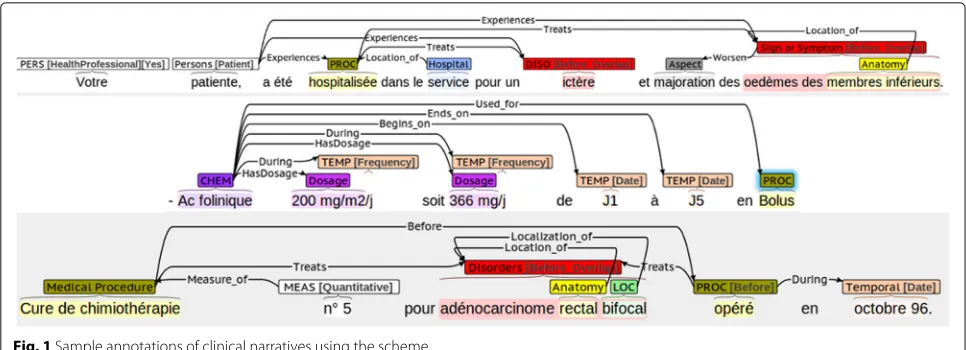
In this section, we describe the elements of the annotation scheme. Semantic annotations in the scheme include enti-ties, attributes, relations between entienti-ties, and temporal annotations. Figure 1 shows some examples of annotated clinical text.
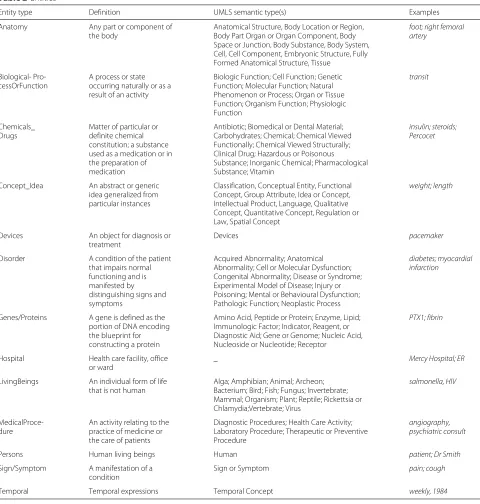
Entities
Fig. 1Sample annotations of clinical narratives using the scheme
created four additional categories for annotating elements of clinical interest:
• SignOrSymptom: according to prior work [18, 23], we split Signs and Symptoms and Disorders in separate categories.
• Persons: we created a separate category for human entities and excluded them from the Living Beings group (a choice also made in MiPACQ [18]) • Hospital: we added an item for healthcare
institu-tions [39]
• Temporal: we created a separate category for temporal expressions and excluded them from the Concept and Ideas group, in favor of specific representation of time [44].
We considered a subset of entities as events, namely: Disorder, SignOrSymptom, MedicalProcedure,
Chemical_Drugs, BiologicalProcessOrFunction and
Concept_Idea.Event entitiesare annotated with specific attributes (e.g. DocTime) and participate in temporal relations (with another event or a temporal expression).
We have not restricted the annotation to UMLS enti-ties or specific syntactic classes (e.g. noun or adjective phrases). When required, we have annotated verbs (e.g.
saigner, ‘to bleed’), mapping them semantically to UMLS concepts.
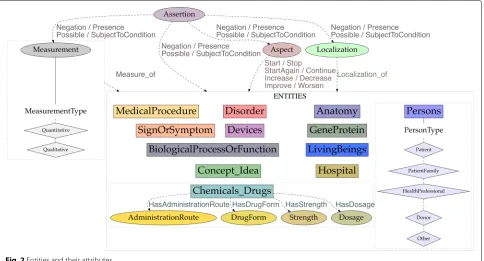
The annotation scheme also defines some attributes (Table 3), which are linked to entities and/or other attributes. Figure 2 shows entities and their attributes. Attributes may have a textual anchor (represented as ellipses) or may consist of a normalized value from a predefined list (represented as diamonds).
Attributes
Wherever possible, we have chosen to enable the marking of text segments that support the assigment of attributes.
As a result, some attributes are represented in our scheme as having both attribute and relation elements.
We have flagged abbreviations and acronyms as entity attributes for all entity types. For instance, the mention
HTAstanding forhypertension artérielle(‘hypertension’) can be represented as a disorder entity with the attribute “abbreviation”.
Some attributes can be related to any event entity, either directly (DocTime) or using specific relations (Aspects, Assertion):
• Aspect: They are anchors of aspect relations to entities (described below). Aspects are markers that indicate the presence of an aspectual relation. For instance, in the phraseintroduction de l’EPO le 12/04/2012 (‘EPO was introduced on 04/12/2012’) the mentionintroduction (‘introduced’) can be represented as an aspectual marker indicating the Start of the Chemicals_Drugs eventEPO, meaning that the patient started this drug therapy.
• Assertion: Textual anchors of assertion relations to entities (described below). For instance, in the phrase pas de douleur (‘no pain’), the mention pas de (‘no’) can be represented as a textual marker indicating the negation of the SignOrSymptom conceptdouleur (‘pain’).
• DocTime: temporal data of events with regard to the moment when the text was created: After, Before, Before_Overlap and Overlap (Fig. 3).
Another subset of attributes are specific to some entities:
Table 2Entities
Entity type Definition UMLS semantic type(s) Examples
Anatomy Any part or component of
the body
Anatomical Structure, Body Location or Region, Body Part Organ or Organ Component, Body Space or Junction, Body Substance, Body System, Cell, Cell Component, Embryonic Structure, Fully Formed Anatomical Structure, Tissue
foot; right femoral artery
Biological- Pro-cessOrFunction
A process or state occurring naturally or as a result of an activity
Biologic Function; Cell Function; Genetic Function; Molecular Function; Natural Phenomenon or Process; Organ or Tissue Function; Organism Function; Physiologic Function
transit
Chemicals_ Drugs
Matter of particular or definite chemical constitution; a substance used as a medication or in the preparation of medication
Antibiotic; Biomedical or Dental Material; Carbohydrates; Chemical; Chemical Viewed Functionally; Chemical Viewed Structurally; Clinical Drug; Hazardous or Poisonous
Substance; Inorganic Chemical; Pharmacological Substance; Vitamin
insulin; steroids; Percocet
Concept_Idea An abstract or generic
idea generalized from particular instances
Classification, Conceptual Entity, Functional Concept, Group Attribute, Idea or Concept, Intellectual Product, Language, Qualitative Concept, Quantitative Concept, Regulation or Law, Spatial Concept
weight; length
Devices An object for diagnosis or
treatment
Devices pacemaker
Disorder A condition of the patient
that impairs normal functioning and is manifested by distinguishing signs and symptoms
Acquired Abnormality; Anatomical Abnormality; Cell or Molecular Dysfunction; Congenital Abnormality; Disease or Syndrome; Experimental Model of Disease; Injury or Poisoning; Mental or Behavioural Dysfunction; Pathologic Function; Neoplastic Process
diabetes; myocardial infarction
Genes/Proteins A gene is defined as the
portion of DNA encoding the blueprint for constructing a protein
Amino Acid, Peptide or Protein; Enzyme, Lipid; Immunologic Factor; Indicator, Reagent, or Diagnostic Aid; Gene or Genome; Nucleic Acid, Nucleoside or Nucleotide; Receptor
PTX1; fibrin
Hospital Health care facility, office
or ward
_ Mercy Hospital; ER
LivingBeings An individual form of life
that is not human
Alga; Amphibian; Animal; Archeon; Bacterium; Bird; Fish; Fungus; Invertebrate; Mammal; Organism; Plant; Reptile; Rickettsia or Chlamydia;Vertebrate; Virus
salmonella, HIV
MedicalProce-dure
An activity relating to the practice of medicine or the care of patients
Diagnostic Procedures; Health Care Activity; Laboratory Procedure; Therapeutic or Preventive Procedure
angiography, psychiatric consult
Persons Human living beings Human patient; Dr Smith
Sign/Symptom A manifestation of a
condition
Sign or Symptom pain; cough
Temporal Temporal expressions Temporal Concept weekly, 1984
and dosage data are not split in atomic attributes for measurement units and values as can be seen on Fig. 1 (3rd sentence).
• Person attributes: we used a modified version of the subject attributes in SHARP (patient, family member, donor family member, donor other, and other) and thesubject class templates in ShARe. We added the HealthProfessional value and simplified donor types. Some examples can be seen on Fig. 1 (1st sentence).
Table 3Attributes
Attribute type Definition Involved entities Involved relation(s) Examples
Aspect A phrase that represents a
change or an evolution (movements of object are not covered)
All entities Start Stop StartAgain
Continue Increase Decrease Improve Worsen
started on; interrupted; relapse; continued; increase in;decreased
Assertion A phrase indicating a statement
of fact or possibility regarding an entity
All entities and Aspect, Measurement and Localization
Negation Presence Possible SubjectTo-Condition
no; presence of; suspected; in case of
Localization Precise area where an entity is
located (e.g. body side)
All entities Localiza- tion_of left; bilateral
Measurement A figure, extent, attribute or
amount obtained by measuring or observing, including subjective qualifications. Two subtypes: Quantitative and Qualitative
All entities Measure_of 3 cm; normal
PersonType Person entity type; the
predefined options are Patient, PatientFamily,
HealthProfessional, Donor and Other
Persons Experiences Dr. Colin
DocTime Temporal data of an annotated
event with regard to the moment when the document was authored; the predefined options are Before, After, Overlap and Before_Overlap
Events opération de 1984[Before]
TemporalType Type of temporal expression; the
predefined options are Date, Time, Duration and Frequency
Temporal Temporal relations 1981, deux fois par jour
Medication attributes
Administration Route Route or method of
administering a medication
Chemicals/ Drugs HasAdminis-trationRoute oral; IV
Dosage How many of each drug the
patient is taking
Chemicals/ Drugs HasDosage 3 tablets; two puffs
DrugForm Form of a medication Chemicals/ Drugs HasDrugForm tablet; cream
Strength Strength number and unit of a
prescribed drug
Chemicals/ Drugs HasStrength 10 mg; 5 mg/ml
makes it possible to remove these flags easily and include or exclude them as a feature according to the training needs of a specific machine learning system. • Measurements: Qualitative or quantitative
descriptions of entities (adverbs, relational and qualitative adjectives, and quantifiers). We also consider measurement units for results of clinical tests, items in theresult category from the Clinical E-Science Framework, and elements from thelab result semantic type within the phenomena class in the MiPACQ framework. Theseverity category (e.g. grave) lacks a specific label in our scheme, whereas the ShARe/CLEF eHealth labs and the SHARP Template Annotations encode it as an attribute. However, the measurement attribute in our scheme encompasses severity descriptors of entities together with other descriptions.
• Localization: This category expresses spatial details about entities (e.g.droite, ‘right’, or inférieur, ‘inferior’), which are often mapped to the UMLS Spatial concept type. This class subsumes attributes of SHARP (body side, dorsal or ventral, medial or lateral, superior or inferior, distal or proximal ), and thesub-location and laterality modifiers from the Clinical E-Science Framework.
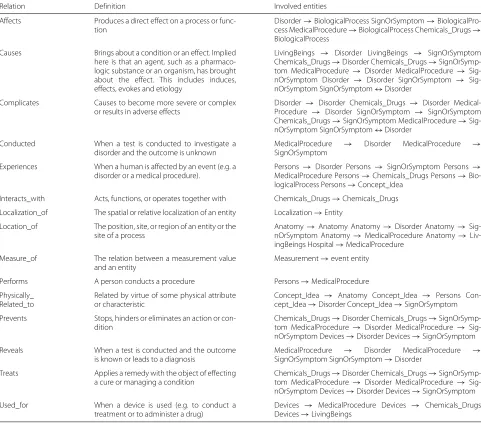
Relations
Our scheme has 37 types of relations (Tables 4 and 5, Figs. 4, 5 and 6):
Fig. 2Entities and their attributes
Table 4Event-related relations
Relation Definition Involved entities
Affects Produces a direct effect on a process or
func-tion
Disorder→BiologicalProcess SignOrSymptom→
BiologicalPro-cess MedicalProcedure→BiologicalProcess Chemicals_Drugs→
BiologicalProcess
Causes Brings about a condition or an effect. Implied
here is that an agent, such as a pharmaco-logic substance or an organism, has brought about the effect. This includes induces, effects, evokes and etiology
LivingBeings → Disorder LivingBeings → SignOrSymptom
Chemicals_Drugs→Disorder Chemicals_Drugs→
SignOrSymp-tom MedicalProcedure →Disorder MedicalProcedure→
Sig-nOrSymptom Disorder → Disorder SignOrSymptom →
Sig-nOrSymptom SigSig-nOrSymptom↔Disorder
Complicates Causes to become more severe or complex
or results in adverse effects
Disorder → Disorder Chemicals_Drugs→ Disorder
Medical-Procedure → Disorder SignOrSymptom → SignOrSymptom
Chemicals_Drugs→SignOrSymptom MedicalProcedure→
Sig-nOrSymptom SigSig-nOrSymptom↔Disorder
Conducted When a test is conducted to investigate a
disorder and the outcome is unknown
MedicalProcedure → Disorder MedicalProcedure →
SignOrSymptom
Experiences When a human is affected by an event (e.g. a
disorder or a medical procedure).
Persons → Disorder Persons →SignOrSymptom Persons →
MedicalProcedure Persons→Chemicals_Drugs Persons→
Bio-logicalProcess Persons→Concept_Idea
Interacts_with Acts, functions, or operates together with Chemicals_Drugs→Chemicals_Drugs
Localization_of The spatial or relative localization of an entity Localization→Entity
Location_of The position, site, or region of an entity or the
site of a process
Anatomy→Anatomy Anatomy→Disorder Anatomy→
Sig-nOrSymptom Anatomy→MedicalProcedure Anatomy→
Liv-ingBeings Hospital→MedicalProcedure
Measure_of The relation between a measurement value
and an entity
Measurement→event entity
Performs A person conducts a procedure Persons→MedicalProcedure
Physically_ Related_to
Related by virtue of some physical attribute or characteristic
Concept_Idea → Anatomy Concept_Idea → Persons
Con-cept_Idea→Disorder Concept_Idea→SignOrSymptom
Prevents Stops, hinders or eliminates an action or
con-dition
Chemicals_Drugs→Disorder Chemicals_Drugs→
SignOrSymp-tom MedicalProcedure →Disorder MedicalProcedure→
Sig-nOrSymptom Devices→Disorder Devices→SignOrSymptom
Reveals When a test is conducted and the outcome
is known or leads to a diagnosis
MedicalProcedure → Disorder MedicalProcedure →
SignOrSymptom SignOrSymptom→Disorder
Treats Applies a remedy with the object of effecting
a cure or managing a condition
Chemicals_Drugs→Disorder Chemicals_Drugs→
SignOrSymp-tom MedicalProcedure →Disorder MedicalProcedure→
Sig-nOrSymptom Devices→Disorder Devices→SignOrSymptom
Used_for When a device is used (e.g. to conduct a
treatment or to administer a drug)
Devices → MedicalProcedure Devices → Chemicals_Drugs
Devices→LivingBeings
events in the THYME scheme, andstatus change or course class attributes in SHARP. For instance, in the phraseintroduction de l’EPO le 12/04/2012 (‘EPO was introduced on 04/12/2012’), the mention introduction (‘introduced’) characterizes a status change with respect to the EPO therapy, as explained above. The relation Start further qualifies the change experienced. This is an information different in nature compared to the temporal information found in the second part of the phrasele 12/04/2012 (‘on 04/12/2012’), which anchors the therapy event on a timeline. Therefore, the second part of the phrase is annotated with a Temporal entity with the modality Date (12/04/2012 ) and a Begin_on relation can be used to represent the temporal link between the
Chemicals_Drugs eventEPO and the Date 12/04/2012.
• Assertion relations: Negation, Possible, Presence and SubjectToCondition. These are a subset of the i2b2 assertion challenge, but we removed theNot
Table 5Aspect, assertion, drug-attribute and temporal relations
Aspect Definition Involved entities
Continue Shows the continuation of an event
Aspect→event entities
Decrease A lowering value (e.g. of dose)
Improve An improvement (e.g. in condition)
Increase A rising value (e.g. of dose)
Recurrence_ StartAgain Indicates that an event begins occurring again
Start Indicates the initiation of an event
Stop Indicates the ending of an event
Worsen A negative change (e.g. in health)
Assertion Definition Involved entities
Negation An event is negated.
Assertion→event entities
Possible An event may occur.
Presence An event occurs.
SubjectToCondi- tion An event may occur on condition that another event occurs
Drug-attribute Types Involved entities
HasAdministrationRoute
HasDosage Chemical_Drugs→drug attributes
HasDrugForm HasStrength
Temporal Definition Involved entities
Before An event precedes another event/temporal expression
Begins_on The event starts on an event or temporal expression Event entity→Event/Temporal entity
During The temporal span of an event is completely contained within
the span of another event or temporal expression
Ends_on The event finishes on an event or temporal expression
Overlap An event happens almost at the same time, but not exactly, as
another event/temporal expression
Simultaneous An event happens at exactly the same time as another
event/temporal expression
have an explicit textual marker to anchor the relation is Presence. When a textual marker is found, the relation can be represented: e.g.présence de (‘presence of’) in the phraseprésence de marisques (‘presence of hemorrhoidal tags’). When there is no textual marker, no relation can be represented— however, it is likely that entities without an explicit assertion are implicitly asserted as Presence.
Unlike the i2b2 challenge, assertions can be made on any entity (as in [23]).
• Drug-attribute relations: four types of links to medication attributes: HasAdministrationRoute, HasDosage, HasDrugForm and HasStrengh. • Temporal relations: six types of chronological
relationships: Before, Begins_on, During, Ends_on, Overlap and Simultaneous (Fig. 3).
Fig. 5Relations starting from MedicalProcedure, Chemical_Drugs and Device entities
• Event-related relations: there are 15 types (Table 4).
Time representation
The temporal scheme for annotation was derived from TimeML [44], and comprises four types of Temporal Expressions (encoded with the attribute TemporalType): Date, Time, Frequency and Duration. Event entities may be related to other events or to temporal expressions by means of the temporal relations described above. Finally, temporal data is also encoded for each event entity by means of the DocTime attributes.
Figure 3 represents the temporal elements in our scheme.
Sample application
We applied the annotation scheme described herein to the development of a large French clinical corpus as detailed in [13]. The BRAT [60] configuration files for the anno-tation schemes are available for the research community. Temporal representation in this corpus differs slightly from TimeML in that signals were annotated together with temporal expressions instead of being annotated sep-arately. For instance, the entire expression il y a 5 ans
(‘five years ago’) was annotated as a time expression of the type duration, while strict TimeML guidelines would require 5 ans (‘5 years’) to be annotated as a Duration andil y a(‘ago’) to be annotated as a signal. This minor
divergence was initially implemented as a shortcut to limit the burden of carrying out complex annotations in the course of an annotation project relying on the complete scheme. However, later work that focused on time anal-ysis could easily revert to standard TimeML and show a compatibility between the representations [61, 62].
Discussion
Characteristics of existing information schemes
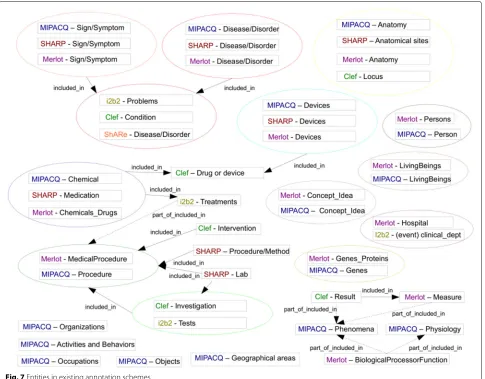
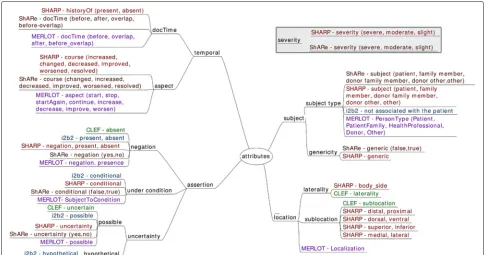
One important criterion to consider in the choice of an information scheme is undoubtedly whether it covers the immediate information needs of the project. Depending on the expected growth of the work-flow, the evolution or life cycle of the scheme should also be taken into account. Our analysis of existing annotation schemes pro-vides an overview of the entities, attributes and relations covered in the literature. It can be seen that MIPACQ is one of the most extensive with regard to entities (Fig. 7); ShARe and SHARP provide a very refined set of attributes (Fig. 8); and our scheme offers a large set of relations, including temporal relations (Fig. 9 and Tables 4 and 5). Nevertheless, an essential in ontologies or infor-mation schemes is whether they have been designed as application-dependent, application-semidependent or application-independent [63]. As we illustrate below, our information scheme was built with an application-semidependent perspective.
Fig. 7Entities in existing annotation schemes
Quality of the information representation
Our scheme is rather robust to cope with gastro-enterology as well as other specialities, including foe-topathology or nephrology, as tested in preliminary work [57, 61]. The overall inter-annotator agreement observed over 11 annotator pairs is 0.793 for entities and 0.789 for relations in a recent annotation campaign using this annotation scheme [13]. The soundness of our scheme was further assessed by the review of a medical doctor, who applied the scheme to a small set of training docu-ments. He achieved an F-measure of 0.720 with regard to the consensus annotations of entities and 0.740 for rela-tions, which was in the range of F-measure values for the rest of annotators. Overall, the inter-annotator agree-ments obtained using the scheme are good, demonstrating that the information representation encoded is robust and can be applied consistently.
Use cases and information extraction scenarios
Our goal is to put forth a representation scheme that will support secondary use of EHR data for conducting
a large variety of retrospective studies. More specif-ically, we aim to support information extraction from clinical narratives in order to answer clinical questions such as: “What is the prevalence of incidental
findings in patients with suspected
thromboem-bolic disease?”, or “What are the types and grades of toxicities experienced by colon cancer patients receiving FOLFOX therapy?”. The first type of ques-tion fits the document-level classificaques-tion scenario. That is to say, relevant documents within patient records will need to be classified as consistent with
incidental finding and thromboembolic disease
Fig. 8Attributes in existing annotation schemes
Other teams have already made valuable contributions after using annotation schemes to describe the informa-tion within the clinical narrative [64]. All have reported positive results, especially with regard to increasing anno-tation agreement, recognizing document sections where specific information is communicated, and improving clinical information retrieval.
An example is the scheme devised by [26], which encodes both syntactic and semantic (domain knowl-edge) descriptions of clinical conditions (linguistic form, modifier types and medical concepts). They applied it to improve the indexing of clinical conditions in emer-gency department reports, and observed that using the annotation scheme significantly increased agreement in annotations as compared to a baseline scheme [27].
For its part, the scheme developed by [28] com-prised entities and attributes to encode phenotypic information of inflammatory bowel disease. With the help of the scheme, this team identified the types of information structure and section types in EHRs where the highest number of concepts were expressed.
Finally, several teams have made positive contributions when transposing an annotation scheme to a knowl-edge representation for clinical information retrieval. Some schemes have been applied for creating gold stan-dard corpora to develop and evaluate clinical informa-tion extracinforma-tion tools [15] and entity recogniinforma-tion sys-tems [17, 18]. These reference corpora have also been used for relation extraction; an example is the work
on mining adverse reactions by means of machine learning reported by [19]. The scheme devised by [11] was used to both define the features for statisti-cal classification models—which improved performance over bag-of-word approaches—and describe implicit data within the clinical narrative. For example, the diag-nosis method was not explicitly written in radiology reports, but rather had to be inferred from the type of exam.
Limitations of the representation scheme
A limitation in our scheme is the fact that it does not fully integrate the same level of granularity for annotating certain entities or attributes as other frameworks do.
An example is the localization category in our
scheme, which is a broad class subsuming the
Fig. 9Relations in existing annotation schemes
data, but CLEF and SHARP allow the automatic extrac-tion of localizaextrac-tion details in a more specific and direct way.
Another example is theseverityattribute in the ShARe and SHARP guidelines, which lacks a label in our scheme, but is subsumed in a broader category (Measurement). Refining these categories is important to specify and describe more relation types. This would permit our scheme to provide a better representation of information across clinical areas and text genres in more robust man-ner. For example, radiology reports especially require fine-grained categorizations of location relationships. These shortcomings need to be addressed and explored in the future.
Our annotation scheme could also be improved fur-ther to encode coreference and anaphoric relations in a more precise manner. We could build on annotation frameworks already existing in the clinical [65] and the biological domain [66].
Despite the aforementioned weaknesses, we would like to highlight the robustness and coherence of our annota-tion framework. In future endeavours, this will allow us to integrate our scheme into computer-readable encoding standards (e.g. XML), as current research teams have carried out [67]. We devised the scheme in atraditional annotation framework [30]—i.e. guidelines were devel-oped and refined through training and double annotation, and after consecutive rounds of annotations and con-sensus. However, the conceptual model could be used in other annotation frameworks based on crowd-sourced annotation [68] and community annotation [45].
Conclusion
covers most of the information also described in other frameworks, and especially features a rich range of rela-tions. The scheme and companion material (annotation scheme and configuration files) are freely available to the community.
Acknowledgements
The authors would like to thank Cyril Grouin, Thierry Hamon and Pierre Zweigenbaum for fruitful discussions on the design and representation of the scheme. The authors also thank the Biomedical Informatics Department at the Rouen University Hospital for providing access to the LERUDI corpus for this work. The authors specially wish to acknowledge Dr. Griffon for his critical appraisal of the annotation scheme and its application to the corpus.
Funding
This work was supported by the French National Agency for Research under grant CABeRneT ANR-13-JS02-0009-01.
Availability of data and materials
The BRAT configuration files for the annotation schemes are available at https://cabernet.limsi.fr/MERLOTscheme.zip. The associated annotation guidelines are available at https://cabernet.limsi.fr/annotation_guide_for_ the_merlot_french_clinical_corpus-Sept2016.pdf.
Authors’ contributions
LD, AN, ALL devised the annotation scheme and the figures comparing annotation schemes. LD wrote a first draft of the related work section and LC wrote the main sections of the manuscript. AN supervised the full design and annotation work as well as the writing of the article. All authors read and approved the final manuscript.
Ethics approval and consent to participate
The LERUDI corpus used in this study was anonymized prior to the study and the quality of anonymization was validated by the CNIL (Commission de l’Informatique et des Libertés), an independent French administrative regulatory body whose mission is to ensure that data privacy law is applied to the collection, storage, and use of personal data.
Consent for publication
The authors have read an approved the final version of the manuscript.
Competing interests
The authors declare that they have no competing interests.
Publisher’s Note
Springer Nature remains neutral with regard to jurisdictional claims in published maps and institutional affiliations.
Author details
1French National Institute for Agricultural Research (INRA), Domaine de Vilvert, Jouy en Josas, 78352 Paris, France.2LIMSI, CNRS, Université Paris - Saclay, Rue John von Neumann, 91405 Orsay, France.3ENSIIE, 1 square de la résistance, 91025 Évry Cedex, France.
Received: 10 November 2016 Accepted: 26 July 2017
References
1. Hripcsak G, Albers DJ. Next-generation phenotyping of electronic health records. J Am Med Inform Assoc. 2013;20:117–21.
2. Clinical Element Model (CEM). www.clinicalelement.com. Accessed 11 Oct 2016.
3. openEHR. www.openehr.org. Accessed 09 Jan 2017. 4. ISO13606. www.en13606.org. Accessed 09 Jan 2017.
5. del Carmen Legaz-García M, Menárguez-Tortosa M, Fernández-Breis JT, Chute CG, Tao C. Transformation of standardized clinical models based on OWL technologies: from CEM to OpenEHR archetypes. J Am Med Inform Assoc. 2015;22(3):536–44.
6. Clinical Information Modeling Initiative (CIMI). www.opencimi.org. Accessed 11 Oct 2016.
7. SemanticHealthNet (SHN). www.semantichealthnet.eu. Accessed 11 Oct 2016.
8. Tao C, Jiang G, Oniki TA, Freimuth RR, Zhu Q, Sharma D, Pathak J, Huff SM, Chute CG. A semantic-web oriented representation of the clinical element model for secondary use of electronic health records data. J Am Med Inform Assoc. 2013;20(3):554–62.
9. Heymans S, McKennirey M, Phillips J. Semantic validation of the use of SNOMED CT in HL7 clinical documents. J Biomed Semant. 2011;2(1):1. 10. LePendu P, Iyer SV, Fairon C, Shah NH. Annotation analysis for testing
drug safety signals using unstructured clinical notes. J Biomed Semant. 2012;3(1):1.
11. Pham A, Névéol A, Lavergne T, Yasunaga D, Clément O, Meyer G, Morello R, Burgun A. Natural language processing of radiology reports for the detection of thromboembolic diseases and clinically relevant incidental findings. BMC Bioinforma. 2014;15:266.
12. Raghavan P, Chen J, Fosler-Lussier E, Lai A. How essential are unstructured clinical narratives and information fusion to clinical trial recruitment? In: AMIA Jt Summits Transl Sci Proc. San Francisco; 2014. p. 218–3.
13. Campillos Llanos L, Déléger L, Grouin C, Hamon T, Ligozat AL, Névéol A. A French clinical corpus with comprehensive semantic annotations. Development of the Medical Entity and Relation LIMSI annOtated Text corpus (MERLOT). Lang Resour Eval. 2017. in press.
14. Grouin C, Névéol A. De-identification of clinical notes in French: towards a protocol for reference corpus development. J Biomed Inf. 2014;50: 151–61. doi:10.1016/j.jbi.2013.12.014.
15. Roberts A, Gaizauskas R, Hepple M, Demetriou G, Guo Y, Roberts I, Setzer A. Building a semantically annotated corpus of clinical texts. J Biomed Informa. 2009;42:950–66.
16. Cohen KB, Demner-Fushman D. Biomedical Natural Language Processing. Natural Language Processing Series. Amsterdam: John Benjamins; 2014. 17. Ogren P, Savova G, Chute C. Constructing evaluation corpora for
automated clinical named entity recognition. In: Proceedings of the 6th Int. Conference on Language Resources and Evaluation (LRECŠ2008). Marrakech: ELRA; 2008. p. 3143–50.
18. Albright D, Lanfranchi A, Fredriksen A, Styler W, Warner C, Hwang J, Choi J, Dligach D, Nielsen R, Martin J, Ward W, Palmer M, Savova G. Towards comprehensive syntactic and semantic annotations of the clinical narrative. J Am Med Inform Assoc. 2013;20(5):922–30. 19. Oronoz M, Gojenola K, Pérez A, de Ilarraza AD, Casillas A. On the
creation of a clinical gold standard corpus in Spanish: Mining adverse drug reactions. J Biomed Inf. 2015;56:318–32.
20. Wu S, Kaggal V, Dligach D, Masanz J, Chen P, Becker L, Chapman W, Savova G, Liu H, Chute C. A common type system for clinical natural language processing. J Biomed Semant. 2013;4(1):1.
21. Tao C, Jiang G, Oniki T, Freimuth R, Zhu Q, Sharma D, Pathak J, Huff S, Chute C. A semantic-web oriented representation of the clinical element model for secondary use of electronic health records data. J Am Med Inform Assoc. 2013;20(3):554–62.
22. Savova GK, Masanz JJ, Ogren PV, Zheng J, Sohn S, Kipper-Schuler KC, Chute CG. Mayo clinical Text Analysis and Knowledge Extraction System (cTAKES): architecture, component evaluation and applications. J Am Med Inform Assoc. 2010;17(5):507–13.
23. Savova G, Styler W, Albright D, Palmer M, Harris D, Zaramba G, Haug P, Clark C, Wu S, Ihrke D. SHARP template annotations: Guidelines. Technical report, Mayo Clinic. 2012. http://informatics.mayo.edu/sharp/ images/0/08/SHARP_annotation_guidelines_March6_2012.pdf. 24. Biological Expression Language (BEL). www.openbel.org. Accessed 11
Oct 2016.
25. Fiszman M, Chapman WW, Aronsky D, Evans RS, Haug PJ. Automatic detection of acute bacterial pneumonia from chest X-ray reports. J Am Med Inform Assoc. 2000;7(6):593–604.
26. Chapman WW, Dowling JN. Inductive creation of an annotation schema for manually indexing clinical conditions from emergency department reports. J Biomed Inf. 2006;39(2):196–208.
28. South BR, Shen S, Jones M, Garvin J, Samore MH, Chapman WW, Gundlapalli AV. Developing a manually annotated clinical document corpus to identify phenotypic information for inflammatory bowel disease. BMC Bioinforma. 2009;10(9):1.
29. Yetisgen-Yildiz M, Gunn ML, Xia F, Payne TH. Automatic identification of critical follow-up recommendation sentences in radiology reports. In: AMIA Annual Symposium Proceedings, vol. 2011. Chicago: American Medical Informatics Association; 2011. p. 1593.
30. Xia F, Yetisgen-Yildiz M. Clinical corpus annotation: challenges and strategies. In: Proceedings of the 3rd Workshop on Building and Evaluating Resources for Biomedical Text Mining (BioTxtMŠ2012). Istanbul: ELRA; 2012.
31. Afzal Z, Pons E, Kang N, Sturkenboom MC, Schuemie MJ, Kors JA. ContextD: an algorithm to identify contextual properties of medical terms in a Dutch clinical corpus. BMC Bioinforma. 2014;15(1):373.
32. Skeppstedt M, Kvist M, Nilsson GH, Dalianis H. Automatic recognition of disorders, findings, pharmaceuticals and body structures from clinical text: an annotation and machine learning study. J Biomed Inform. 2014;49:148–58.
33. Spasi´c I, Zhao B, Jones CB, Button K. KneeTex: an ontology–driven system for information extraction from MRI reports. J Biomed Semant. 2015;6(1):34.
34. Toepfer M, Corovic H, Fette G, Klügl P, Störk S, Puppe F. Fine-grained information extraction from German transthoracic echocardiography reports. BMC Med Inform Decis Making. 2015;15(1):91.
35. Xu D, Zhang M, Zhao T, Ge C, Gao W, Wei J, Zhu KQ. Data-driven information extraction from Chinese electronic medical records. PloS ONE. 2015;10(8):0136270.
36. Viani N, Tibollo V, Napolitano C, Priori SG, Bellazzi R, Larizza C, Sacchi L. Information extraction from Italian medical reports: first steps towards clinical timelines development. In: AMIA Annual Symposium Proceedings, vol. 2016. Chicago: American Medical Informatics Association; 2016. p. 148–9.
37. Velupillai S, Mowery D, South B, Kvist M, Dalianis H. Recent advances in clinical natural language processing in support of semantic analysis. Yearb Med Inform. 2015;10(1):183–93.
38. Uzuner Ö, Solti I, Cadag E. Extracting medication information from clinical text. J Am Med Inform Assoc. 2010;17(5):514–8.
39. Uzuner Ö, South BR, Shen S, DuVall SL. 2010 i2b2/va challenge on concepts, assertions, and relations in clinical text. J Am Med Inform Assoc. 2011;18(5):552–6.
40. Informatics for Integrating Biology and the Bedside (i2b2) 2010 Challenge, Concept Annotation Guidelines. www.i2b2.org/NLP/Relations/assets/ Concept%20Annotation%20Guideline.pdf. Accessed 12 Jan 2017. 41. Informatics for Integrating Biology and the Bedside (i2b2) 2010
Challenge, Relation Annotation Guidelines. www.i2b2.org/NLP/Relations/ assets/Relation%20Annotation%20Guideline.pdf. Accessed 12 Jan 2017. 42. Informatics for Integrating Biology and the Bedside (i2b2) 2010 Challenge,
Assertion Annotation Guidelines. www.i2b2.org/NLP/Relations/assets/ Assertion%20Annotation%20Guideline.pdf. Accessed 12 Jan 2017. 43. Bodenreider O. The unified medical language system (UMLS): integrating
biomedical terminology. Nucleic Acids Res. 2004;32(suppl 1):267–70. 44. Pustejovsky J, Castano JM, Ingria R, Sauri R, Gaizauskas RJ, Setzer A, Katz G,
Radev DR. TimeML: Robust specification of event and temporal expressions in text. New Dir Quest Answering. 2003;3:28–34.
45. Uzuner Ö, Solti I, Xia F, Cadag E. Community annotation experiment for ground truth generation for the i2b2 medication challenge. J Am Med Inform Assoc. 2010;17(5):519–23.
46. Sun W, Rumshisky A, Uzuner O. Evaluating temporal relations in clinical text: 2012 i2b2 challenge. J Am Med Inform Assoc. 2013;20(5):806–13. 47. Temporal Histories of Your Medical Event (THYME) Project. https://clear.
colorado.edu/TemporalWiki/index.php/Main_Page. Accessed 12 Oct 2016. 48. Styler IV W, Bethard S, Finan S, Palmer M, Pradhan S, de Groen P,
Erickson B, Miller T, Lin C, Savova G, Pustejovsky J. Temporal annotation in the clinical domain. Trans Assoc Comput Linguis. 2014;2:143–54. 49. Temporal Histories of Your Medical Event (THYME) Guidelines. http://
clear.colorado.edu/compsem/documents/THYME_guidelines.pdf. Accessed 12 Jan 2017.
50. McCray AT, Burgun A, Bodenreider O. Aggregating UMLS semantic types for reducing conceptual complexity. In: Proc of MedInfo. Amsterdam: IOS Press; 2001. p. 216–0.
51. ShARe/CLEF eHealth Evaluation Labs (2013-2014). https://sites.google. com/site/shareclefehealth/. Accessed 11 Oct 2016.
52. ShARe/CLEF eHealth Guidelines. https://drive.google.com/file/d/0B7oJZ-fwZvH5ZXFRTGl6U3Z6cVE/edit. Accessed 12 Oct 2016.
53. Savkov A, Carroll J, Koeling R, Cassell J. Annotating patient clinical records with syntactic chunks and named entities: the Harvey corpus. Lang Resour Eval. 2016;50:523–548.
54. Pakhomov SV, Coden A, Chute CG. Developing a corpus of clinical notes manually annotated for part-of-speech. Int J Med Inform. 2006;75(6): 418–29.
55. Wu S, Miller T, Masanz J, Coarr M, Halgrim S, Carrell D, Clark C. Negation’s not solved: generalizability versus optimizability in clinical natural language processing. PloS ONE. 2014;9(11):112774. 56. Bodenreider O, McCray AT. Exploring semantic groups through visual
approaches. J Biomed Inform. 2003;36(6):414–32.
57. Deléger L, Grouin C, Ligozat AL, Zweigenbaum P, Névéol A. Annotation of specialized corpora using a comprehensive entity and relation scheme. In: Proceedings of the 9th International Conference on Language Resources and Evaluation (LREC’14). Reikjavik: European Language Resources Association (ELRA); 2014.
58. Mork J, Bodenreider O, Demner-Fushman D, Islamaj Dogan R, Lang F, Lu Z, Névéol A, Peters L, Shooshan S, Aronson A. Extracting rx information from clinical narrative. J Am Med Inform Assoc. 2010;17(5):536–9. 59. Névéol A, Kim W, Wilbur W, Lu Z. Exploring two biomedical text genres
for disease recognition. In: Proceedings of the NAACL HLT 2009 BioNLP 1051Q11 Workshop. Boulder, Colorado: ACL; 2009. p. 144–52. 60. Brat Rapid Annotation Tool. http://brat.nlplab.org. Accessed 21 Oct 2016. 61. Tapi Nzali MD, Tannier X, Neveol A. Automatic extraction of time
expressions accross domains in French narratives. In: Proceedings of the 2015 Conference on Empirical Methods in Natural Language Processing. Lisbon: Association for Computational Linguistics; 2015. p. 492–8. https:// aclweb.org/anthology/D/D15/D15-1055. Accessed 12 Aug 2017. 62. Tourille J, Ferret O, Névéol A, Tannier X. Extraction de relations
temporelles dans des dossiers électroniques patient. In: Proceedings of Traitement Automatique de la Langue Naturelle (TALN) 2016. Paris: ATALA; 2016. p. 459–66.
63. Fernandez Lopez M. Overview of methodologies for building ontologies. In: Proceedings of the IJCAI-99 Workshop on Ontologies and
Problem-Solving Methods (KRR5). Stockholm, Sweden, August 2, 1999, vol. 18. Amsterdam: CEUR Publications; 1999. p. 4–1413.
64. Meystre SM, Savova GK, Kipper-Schuler KC, Hurdle JF, et al. Extracting information from textual documents in the electronic health record: a review of recent research. Yearb Med Inform. 2008;35:128–44. 65. Savova GK, Chapman WW, Zheng J, Crowley RS. Anaphoric relations in
the clinical narrative: corpus creation. J Am Med Inform Assoc. 2011;18(4): 459–65.
66. Cohen KB, Lanfranchi A, Corvey W, Baumgartner Jr WA, Roeder C, Ogren PV, Palmer M, Hunter L. Annotation of all coreference in biomedical text: Guideline selection and adaptation. In: Proceedings of 2nd Workshop on Building and Evaluating Resources for Biomedical Text Mining (BioTxtM 2010). Valletta: ELRA; 2010. p. 37–41.
67. Rebholz-Schuhmann D, Kirsch H, Nenadic G, Rebholz-Schuhmann D, Kirsch H, Nenadic G. Iexml: towards an annotation framework for biomedical semantic types enabling interoperability of text processing modules. BioLink, SIG, ISMB. 2006.