© 2018 IJSRST | Volume 4 | Issue 2 | Print ISSN: 2395-6011 | Online ISSN: 2395-602X Themed Section: Science and Technology
Knowledge Based Deep Learning Collaborative Filtering (KBDLCF)
E. Sandeep Krupakar1, Dr. A. Govardhan2
1Research Scholar, Department of Computer Science & Engineering, Rayalaseema University, Kurnool, India
2Professor & Rector, Department of Computer Science & Engineering, JNTUH, Hyderabad, Telangana, India
Abstract: Since from past few years huge volume of users are interacting with website for their day to day transactions are being going up. In this regards numbers of companies are encroaching towards internet to tell their products and services. This revolutions towards E-Commerce has changed, Conventional way of doing business this rapid expansion has resulted in new challenges to both companies as well as customers. Thus customers are overloaded with multiple choices for individual product which results in a confused and lost state. It has become a trivial for the webmasters to evaluate whether products and services are provided are catering the needs of customer or not. Recommender system has been playing a more vital and essential role in various information access systems to boost business and facilitate decision-making process.in this paper we proposed Knowledge Based Deep Learning Collaborative Filtering has been presented. The use of this approach joining the advantages of fuzzy logic and neural networks in order to improve CF recommender system that recommends items to the active user on the basis of fuzzy rules. The exe cution of neural networks for collaborative filtering recommendations was enlightened by an example real world dataset of movies and Reviews rated by user i.e Netflix. Results of a simulation study using various similarity measures and recommendation methods show that the KBDLCF model performs better than other conventional techniques. The experimental results reveal that forming ambiguity using fuzzy logic and neural networks mends the performance of personalized recommender systems.
Keywords: E-Commerce, fuzzy logic and neural networks, Knowledge Based Deep Learning Collaborative Filtering
I.
INTRODUCTIONNow a day’s several internet users using web to perform day to day transactions are increasing. In this regards numbers of companies are encroaching towards internet to tell their products and services. This revolutions towards E-Commerce has changed, Conventional way of doing business this rapid expansion has resulted in new challenges to both companies as well as customers. Thus customers are overloaded with multiple choices for individual product which results in a confused and lost state. It has become a trivial for the webmasters to evaluate whether products and services are provided are
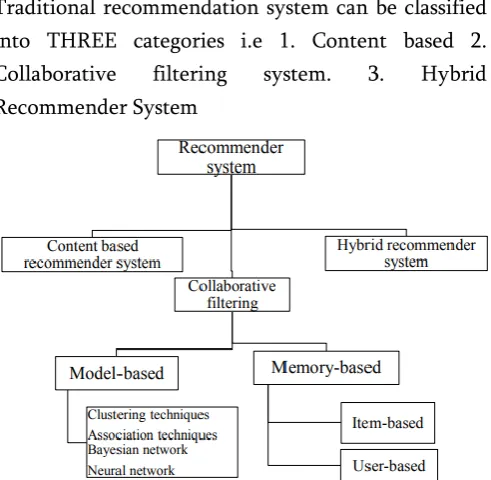
Traditional recommendation system can be classified into THREE categories i.e 1. Content based 2.
Collaborative filtering system. 3. Hybrid
Recommender System
Figure 1. Anatomy of recommendation techniques
Content Based system
Takes into consideration product attributes to generate recommendations, Content based filtering methods are based on a description of the item and a profile of the user’s preference. In a content-based recommender system, keywords are used to describe the items; beside, a user profile is built to indicate the type of item this user likes. In other words, these algorithms try to recommend items that are similar to those that a user liked in the past (or is examining in the present). In particular, various candidate items are compared with items previously rated by the user and the best-matching items are recommended. This approach has its roots in information retrieval and information filtering research.
Collaborative filtering system make use customer – product interaction and ignore other attributes to
generate recommendations despite significant
progress and widespread usage of the
recommendations system suffers from following limitations.
1. Scalability : Consumer cum Products increases in
numbers ,it slows down neighbor selection per second
2. Binary transaction (Clickstream) data: Most of
the recommendation system make use of binary transaction data i.e. whether a specific item is purchased or not. However many times they are unable to exploit intrinsic characteristics of these data , that can be used to provide better recommendation
3. Retargeting : Providing the customer with same
product that is already purchased
Hybrid Recommender System
Hybrid recommendation system is a method which combines content based with collaborative filtering techniques to gain better prediction or recommendation performance better prediction or recommendation performance. Hybrid approaches can be implemented in various ways: Implement collaborative and content-based methods individually and aggregate their predictions, Integrate some content-based characteristics into a collaborative
approach, Comprise some collaborative
characteristics into a content based approach, and Construct a general consolidative model that integrate both content based and collaborative characteristics. Cold start and the sparsity are common problems in recommender systems which are resolved by using hybrid methods.
Our proposed framework uses a Knowledge Based Deep Learning Collaborative Filtering (KBDLCF) that makes usage of data and integrates it with user, sales data to provide better recommendations to all the visitors of E-Commerce sites.
II.
RELATED WORKG. Castellano et al.[1] presented a neuro-fuzzy strategy that combines soft computing techniques to
develop web recommendation system that
dynamically suggest interesting URLs for the current user. User access logs are analysed to identify user sessions as a preliminary step. The groups of user's common browser behaviour are discovered by applying a fuzzy clustering algorithm to the user sessions. Finally, a knowledge extraction process is carried out to derive associations between user profiles and relevant web pages to be suggested to users. In order to derive knowledge from session data and represent it in the comprehensible form of fuzzy rules a hybrid approach based on the combination of the fuzzy reasoning and connection paradigm has been proposed by this author.
G. Castellano et al. [2] proposed the use of a neuro-fuzzy strategy to develop a Web personalization framework for the dynamic suggestion of URLs retained interesting for the currently connected users. In particular, a hybrid strategy exploiting the combination of the fuzzy logic with the neural paradigm is proposed in order to discover useful knowledge from session data identified from the analysis of log files and represent it in a set of fuzzy rules expressed in an interpretable form.
De Campos et al. [3] proposed a model by combining Bayesian network for governing the relationships between the users and fuzzy set theory for presenting the vagueness in the description of user's ratings.
Soheila Ashkezari-T et al. [4] contribution using genre based information in a hybrid fuzzy-Bayesian network collaborative RS is suggested. The interest to the different genres is computed based on a hybrid user model. They calculated similarity of likeminded users according to the fuzzy distance and also Pearson correlation coefficient is involved in a Bayesian network. The author call the RS uses as Bayesian network RS (BNRS), use Pearson for
similarity computations named it PBNRS and using fuzzy distance for similarity computation called it FBNRS.
Maral Kolahkaj et al. [5] presented the fuzzy-neural network for finding users movement pattern using fuzzy clustering technique and web usage mining. The author has presented a method to deal with limitations of conventional methods. Their system finds useful movement pattern of users and also presents user's future requests by using fuzz-neural network.
Collaborative Filtering
Goldberg et al. [6] proved that Collaborative Filtering CF is very successful in both research and practice. Most of the existing systems use CF as its base algorithm for providing recommendation. In 1994 the GroupLens system [67] has implemented a CF algorithm. The author noted that the recommendations are generated based on the users' similarities for the formation of the nearest neighbours, it is nowadays known as userbased collaborative filtering algorithm.
John S. Breese et al. [8] classified CF algorithms into two major types: memory based and model based. Memory based algorithms predictions are based on the similarity of the previously rated items by the users. Model based algorithms predicts based on the collection of ratings by learning the designed model. This model is used to make predictions of recommendations of a new active user.
Deepa Anand [7] proposed methods to enrich the set of user connections obtained using measures such as Pearson Correlation Coefficient(PCC) and
Cosine Similarity(COS).Their experiments
comparing various global similarity schemes show that different similarity schemes perform best under different circumstances.
3.1 Proposed Framework
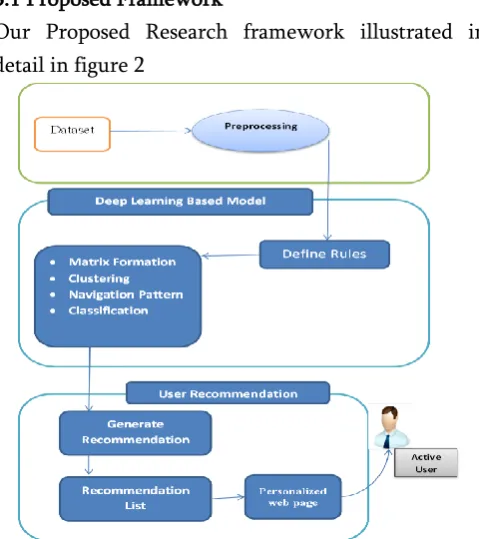
Our Proposed Research framework illustrated in detail in figure 2
Figure 2. Proposed Knowledge Based Deep Learning Collaborative Filtering (KBDLCF)
3.2 Methodology
Knowledge Based Deep Learning Collaborative Filtering (KBDLCF) Model approach is separated into three sub phases. The First phase is pre-processing. In this phase data is processed using various pre-processing techniques such as feature selection, normalization and data reduction. In the Second phase deep learning modeling is constructed. Active user's knowledge about the data such as profile and preferences are defined and applied in terms of fuzzy
rules (crisp rules) on effectiveness matrix.
Personalized Artificial Bee Colony algorithm (PABCA) is deploying to determine the web user pattern or to cluster similar users. Once the user navigation patterns are recognized using clustering the active user's best matching cluster is predicted
using BPN classification to generate
recommendations. Final phase is obtaining business intelligence i.e. recommendation generation process for the active user is performed online process.
3.2.1 Data Pre-processing
The essential pre-processing steps discussed in the earlier chapters such as feature selection i.e.
Minimum Redundancy Maximum Relevance
Feature Selection (mRMR) technique has been applied to select relevant features and samples. The feature selection algorithm is designed with different approaches broadly fall into three categories: Filter, wrapper and embedded models.
The Filter model relies on the general
characteristics of data and evaluates features without involving any learning algorithm. The wrapper model requires a predetermined learning algorithm and uses its performance as evaluation criterion to select features. Algorithms with embedded model Incorporate variable selection as a part of the training process, and feature relevance is obtained analytically from the objective of the learning model.
Bringing all of the ideas together into one algorithm there is mRMR feature selection. The idea behind this algorithm is that you want to minimize the redundancy of features while maximizing the relevancy. To do this, we have Equations for calculating relevancy and Redundancy.
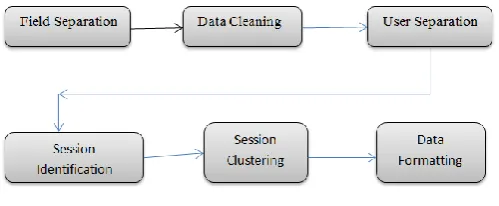
Session Provide us with complete set of activities done by the user in specific time period. Finally in data formatting stage we place the data in tabular form.
Figure 3 Steps for Pre-processing Field separation: It focuses on separating individual fields by making use of separator character such as space.
Data cleaning: Data cleaning is a process of filtering out irrelevant and outliers’ data [9]. It eliminates all irrelevant items by checking the suffix of the URL name. Therefore, all log entries with filename suffixes such as gif, jpeg, GIF, JPEG, and JPG are removed. All records of failed HTTP status code i.e. Status code less than 200 and greater than 299 are eliminated. For the present study, we consider only the GET and POST methods. Data cleaning reduces the total number of records and also log file size. User differentiation: It is important to distinguish between different users for analysing different user access behaviour patterns. A different user ID will be assigned to different IP address. In case of same IP
address referrer information and browser details will be used to distinguish among different web users. Session identification: A session is defined as an ordered sequence of web pages visited by a user. A new session is constructed based on new IP address. Each new IP addresses implies (correspond) to a unique user. A maximum session time limit is considered to be 30 minutes.
Data formatting: Finally data will be formatted to appropriate tabular format for further analysis.
3.2.2 Deep learning Model Construction
In this second level, Knowledge Based Deep Learning Collaborative Filtering (KBDLCF) is made using Fuzzy Logic and Artificial Neural Networks. This stage has three steps, knowledge base step is used to filter of users and/or items using procedures, clustering of user-item rating matrix using Minimum Redundancy Maximum Relevance Feature Selection (mRMR) and predicting BMC of active user using
Back Propagation Neural Network (BPN)
classification.
Knowledge Base
In the first step, the active user's knowledge information such as profile and preferences are presented in the form of if-then rules and applied. Users or items in the dataset are filtered based on knowledge defined in terms of these crisp/fuzzy rules to identify the user's navigation pattern.
using Minimum Redundancy Maximum Relevance Feature Selection (mRMR).
In this second stage, the user-item rating matrix is clustered to identify the group of similar users. Since the dataset contains multidimensional data with more number of features and user, neural network based mRMR clustering is used to group the users to find the users navigation patterns.
Identifying BAC using BPN
Finally, active user's Best Alike Cluster (BAC) is identified using back propagation neural network classification technique. Resilient back-propagation (RPROP) is a neural network training algorithm is used to identify matching cluster of active users. The steps are involved in KBDLCF classification.
3.2.3 KBDLCF Algorithm
Knowledge Based Deep Learning Collaborative Filtering (KBDLCF), algorithm is presented in this section. This algorithm demonstration the pseudo code of the KBDLCF Model.
The time complexity of this algorithm is
O(n+K)+O(W3)+ O(m2+m) where K is total number of
neurons. The space complexity of the algorithm is O(1).
Input: Training Dataset D and Test dataset TD.
The number of clusters k.
N = Potential number of recommendation.
Output: Recommendation List
{ , , , ... }
I I I I
1 1 1 1I
n ofTop-N items.
II Phase I: Pre-processing
Select relevant features using Feature Selection. Replace missing values using NN.(if any) Perform Normalization.
Do Dimension Reduction using PCA. II Phase II: Deep learning Model Construction KBDLCF Based crisp rules (if any) for user preferences and/or profiles. //Formulate the fuzzy rules (FR).
Outline the linguistic variables and
terms (initialization).
Construct the membership functions
(initialization).
Construct the rule base
(initialization).
Convert crisp input data to fuzzy values using membership functions.
// Fuzzification of attributes/user preferences.
Compute ps(ai) where j = 1 to m.
// Fuzzification of samples/user profile features.
Compute
s(
p
j)
where j = 1 to m .Define KBDLCF fuzzy rules for user preferences and/or profiles
Apply rules and generate the resultant dataset. If New User // Cold-Start Problem Register and Login. Go to Step 2 of Phase III. Else
Clustering of utility matrix using mRMR
//Predicting Best Alike Cluster (BAC) of active user. For each Active user in TD do
Find the Best Alike Cluster (BAC) using resilient
back-propagation (RPROP). End
TMAE <— Evaluate Matching Cluster End If
//Phase III: Recommendation For each Active user in TD do
Identify items from Best Alike Cluster (BAC) of users. Calculate the frequency count and rank the items.
Select and recommend top-N items.
End
IV.
Experimental ResultsThis section presents comprehensive
using Silhouette Index. Second, the results of prediction evaluation using MAE are presented. Third, recommendation quality evaluation with different parameters is presented. KBDLCF model has been experimentally simulated and evaluated with two real-world benchmark datasets namely Netflix and MovieLens 1M data set with different active users profile and preferences.
4.1Clustering Quality Analysis
The outcome of different numbers of clusters k=2 to N/2 on clustering prominence is examined. The finest numbers of are usually verified between 2 and N/2. The Table 1. Shows Mean Silhouette Index value for k=2 to N/2 number of clusters deliberate using mRMR and Fuzzy C Means (FCM) Clustering algorithm.
Table 1. Mean Silhouette Index of SOM and FCM clustering
Dataset mRMR
Clustering
FCM Clustering
MovieLens 0.40 0.30
Netflix 0.45 0.39
The investigated result indications that there is a
substantial variance in mRMR
Clustering and FCM is clustering. The mean Silhouette Index of Deep learning based mRMR Clustering is 10% better quality panel based FCM clustering using MovieLens dataset. The Mean Silhouette Index of deep learning based mRMR clustering is 8% better Quality panel based FCM clustering using Netflix dataset. Hence, the mRMR clustering is capable of handling large volume of dataset with better accuracy.
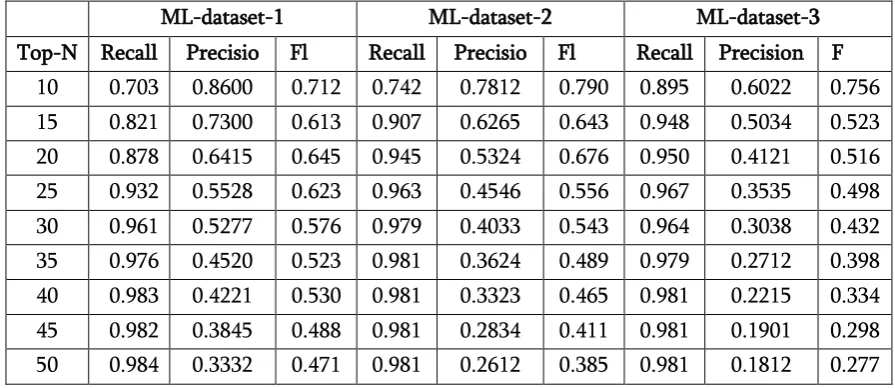
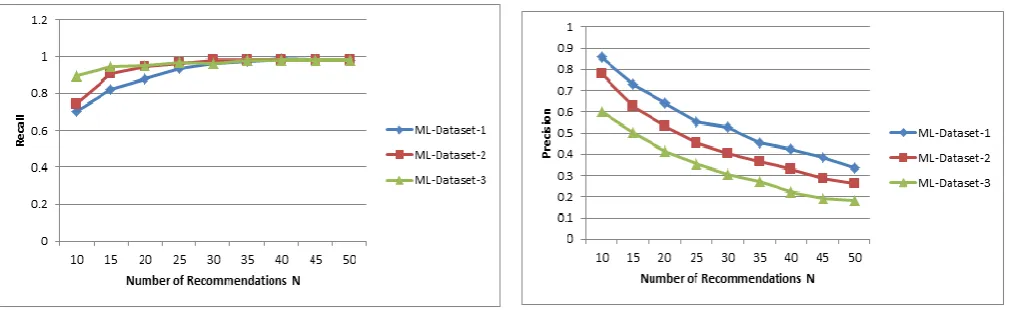
4.2 Recommendation Quality Analysis on MovieLens Dataset
The KBDLCF model is tested by compelling range of recommendations using MovieLens dataset from 10 to 50 in the step of 5 and 5 to 30 in the step of 5 using Netfix dataset for top-N=10.
Table 2. Mean Recall, Precision and Fl Measures of KBDLCF model using MovieLens dataset.
ML-dataset-1 ML-dataset-2 ML-dataset-3
Top-N Recall Precisio
n
Fl Recall Precisio
n
Fl Recall Precision F
l
10 0.703
2
0.8600 0.712
4
0.742 1
0.7812 0.790
8
0.895 6
0.6022 0.756
5
15 0.821
0
0.7300 0.613
4
0.907 2
0.6265 0.643
2
0.948 5
0.5034 0.523
4
20 0.878
8
0.6415 0.645
6
0.945 4
0.5324 0.676
5
0.950 7
0.4121 0.516
5
25 0.932
5
0.5528 0.623
4
0.963 2
0.4546 0.556
4
0.967 3
0.3535 0.498
5
30 0.961
6
0.5277 0.576
3
0.979 1
0.4033 0.543
1
0.964 4
0.3038 0.432
0
35 0.976
7
0.4520 0.523
5
0.981 6
0.3624 0.489
9
0.979 6
0.2712 0.398
8
40 0.983
4
0.4221 0.530
0
0.981 6
0.3323 0.465
4
0.981 0
0.2215 0.334
7
45 0.982
4
0.3845 0.488
0
0.981 6
0.2834 0.411
2
0.981 0
0.1901 0.298
9
50 0.984
4
0.3332 0.471
0
0.981 6
0.2612 0.385
6
0.981 0
0.1812 0.277
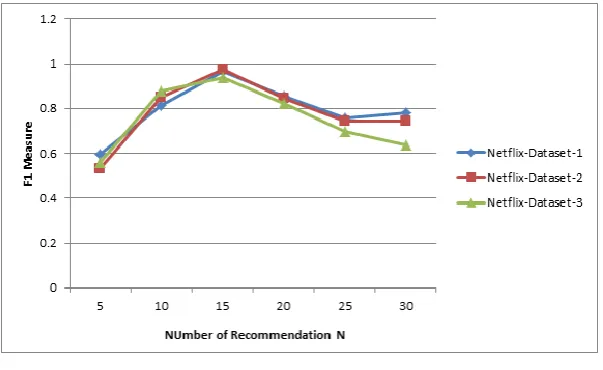
4.3 Recommendation Quality Evaluation Netflix dataset
The experiment is repeated with range of N values from 5 to 30 in the step 5 and calculated the mean Recall, Precision and Fl-Measure using Jester dataset. The
Table 3. Shows the mean Recall, Precision and Fl Measures of KBDLCF model using Netflix dataset.
TOP-N Netflix dataset - 1 Netflix dataset - 2 Netflix dataset - 3
Recall Precision Fl Recall Precision Fl Recall Precision Fl
5 0.3651 0.9765 0.5965 0.3748 0.9850 0.5326 0.3908 0.9859 0.5600
10 0.6814 0.9758 0.8124 0.7500 0.9788 0.8500 0.7750 0.9789 0.8798
15 0.9916 0.9701 0.9658 0.9723 0.9866 0.9770 0.9598 0.8781 0.9377
20 0.9865 0.7598 0.8546 0.9890 0.7291 0.8450 0.9594 0.6599 0.8245
25 0.9856 0.5987 0.7598 0.9859 0.5936 0.7440 0.9606 0.5247 0.6988
From the table, it is observed that the maximum mean Fl measure of KBDLCF model is 87% and the corresponding mean recall and precision are 77% and 97% respectively for top-N=10.
4.4 Comparison with Conventional Approaches
This division enlightens the comparison of KBDLCF model with conventional k-Nearest Neighbor (k-NNBM) Approach using MovieLens and Ant Based Recommender System (ARS), k-nearest neighbor based Mean Squared Distance
Netflix datasets with commonly compared top-N
value as 10.
Comparison using MovieLens dataset
The Table 4. Shows the comparison of Mean Fl measure between KBDLCF model and
conventional models using MovieLens dataset for
top-N=10.
Table 4 Mean Fl of KBDLCF with conventional methods using MovieLens.
The results listed in the table shows that, the accuracy of KBDLCF model is better than k-NNBM, k-NNBM (w),GAC and k-NNBM (PCC) algorithms.
model. Therefore the performance of the KBDLCF is more significant than the conventional methods.
V.
CONCLUSION
In this paper Knowledge Based Deep Learning Collaborative Filtering has been presented. The use of this approach joining the advantages of fuzzy logic and neural networks in order to improve CF recommender system that recommends items to the active user on the basis of fuzzy rules. The execution of neural networks for collaborative filtering recommendations was enlightened by an example real world dataset of movies and jokes rated by users. Results of a simulation study using various similarity measures and recommendation methods show that the KBDLCF model performs better than other conventional techniques. The experimental results reveal that forming ambiguity using fuzzy logic and neural networks mends the performance of personalized recommender systems.
VI.
REFERENCES
[1]. G Castellano, A.M. Fanelli, P. Plantamura, M.A.
Torsello, A Neuro-Fuzzy Strategy for Web Personalization, Proceedings of the
Twenty-Third AAAI Conference on Artificial
Intelligence 2008.
[2]. G Castellano, A.M. Fanelli, M.A. Torsello, A
neuro-fuzzy collaborative filtering
Science,1992-6669 (Print) 1992-6677(Online) Global
Information Publisher,Vol.1,No.1,28-39,2007.
[3]. De Campos LM, Fernandez-Luna JM, Huete JF.
A collaborative recommender system based on probabilistic inference from fuzzy observations. Fuzzy Sets Systems 159(8):1554-1576, 2008.
[4]. Soheila Ashkezari-T, Mohammad-R,
Akbarzadeh-T, Fuzzy-Bayesian Network
Approach to Genre-based Recommender
Systems, 978-1-4244-8126-2/10 ©IEEE 2010.
[5]. Maral Kolahkaj,Ali Harounabadi,Mehdi Sadegh
Zade, A Recommender System for Web Mining using Neural Network and Fuzzy Algorithm, International Journal of Computer Applications (0975 – 8887) Volume 78 – No.8, September 2013.
[6]. D Goldberg, D. Nichols, B. M. Old, and D. Terry,
Using collaborative filtering to weave an information tapestry, Communications of the ACM, vol. 35, no. 12, pp. 61-70, 1992.
[7]. Deepa Anand, Enhancing Accuracy of
Recommender Systems Through Various
Approaches to Local and Global Similarity Measures, PhD Thesis, Jawaharlal Nehru University, July 2011.
[8]. John S. Breese, David Heckerman, and Carl
Kadie, Empirical Analysis of Predictive
Algorithms for Collaborative Filtering,
TechReport, Microsoft Research, Morgan
Kaufmann Publishers, 1998.
[9]. Resnick, P., Iacovou, N., Suchak, M.,