© 2017 IJSRST | Volume 3 | Issue 7 | Print ISSN: 2395-6011 | Online ISSN: 2395-602X Themed Section: Science and Technology
Higher Education on Global Platform
Dr. Man Singh
Associate Professor, Iswar Saran P.G. College, Allahabad, Uttar Pradesh, India
ABSTRACT
Internationalization is a concept, it means diminishing importance of national border and strengthening of identities, that stretch beyond those rooted in a limited locale in terms of particular country or region. it can also be defined as intensification of worldwide social relations which link distant localities in such a way that local happening is shopped by events occurring at any distant place ad vice versa. It is this construction of
time-space compression that has given rise to the popular notion of “One-world”, “Global-village” etc
Internationalization through has contributed for rise in living standards, improvement in health, education and technology, advancement, especially in the area of communication and computers during this period.
Keywords: Global-village, UNESCO report, CBR, UCS
I.
INTRODUCTIONWe are living through a revolution. We call it knowledge revolution. It is the third important revolution that has shook the world, the first two being agricultural revolution. The new revaluation has place knowledge at the centre stage of the replaced land capital, natural resources and financial capital by knowledge capital as the most important agent of development. In a path breaking study in mid 1950s, noble laureate economist Robert Solow showed that seven eighth of the growth of US from 1900 to 1950 was accounted for technical progress, while any one eighth as driven by capital. A study by Dension, of factors contributing to the growth of the us economy from 1929 to 1982, attributes 94% of that growth of factors relating to knowledge generation and dissemination. 64% of this is linked to advances in knowledge generation (i.e. R & D) and another 30% to advances in education while the agricultural revolution was spread over thousands of year and the industrial revolution over hundred of years, the
knowledge revolution has come into neurite with in a few decades. It indicates that development in future is linked up with acquisition, production and dissemination of knowledge. We know material resources are condemned when they are utilized, however, knowledge resources increases when shared, it is easily transportable at rapid speed and can be stored at negligible cost.
The district characterization of knowledge as a resource marks it possible, for the first time, to spread and share a crucial resource among the entire population, with the development of modern media that brings sound and video images into every household and with the advent of the internet that enables us to reach out to sources of knowledge around the world, we could utilize the opportunity to close the development gap that separates the worlds most prosperous communities from the cousius.
condition for development today. Whereas the developed countries have crossed the 50%, India still lages behind at around %. The dream of becoming a knowledge super power by 2020 is mirage unless there is massification of higher education and technological empowerment of the working class.
UNESCO report “Learning’ envisages the following
role for universities education. Universities should be central to the higher level of the system. Even if as in the case of many countries, there are other non universities establishment of higher education, Universities would have vested in them four key functions.
1. To prepare students for research and teaching. 2. To provide highly socialized training courses
adapted to the needs of economic and social life. 3. To be open to all, to as to cater to the many
aspects of lifelong education in the widest sense. 4. International Co-operation.
There is growing tendency at homogenization of education by blindly initiating western models. That can be seen both in the design of the curriculum and in the standards adopted for assessing quality. While there can be little doubt over the need to ensure quality its own criteria for assessment of quality on the basis of its perceived national and social goals.
The thrust of Internationalization is expected to push higher education to face for reaching challenges. According to the Spanish sociologist Manuel Castells
‘effect on the university will be more drastic than
industrialization, Urbanization and secularization combined, it is the biggest challenge that the university has ever faced for more than a century and a half.
II.
METHODS AND MATERIALMETHODS
Red soil was collected and it was subjected to air dried to carry the whole study. The whole study was carried in 3 phases.
In phase 1, preliminary tests like Specific gravity, Liquid limit, Plastic limit, differential free swell were conducted on existed soil.
In phase 2, Compaction characteristics of Red soil along with different percentages of G.G.B.S and JUTE fibre were studied. OMC and MDD were calculated through proctor test.Maximum values are obtained for the proportion having 10% GGBS.
In phase 3, at 10% GGBS, Jute Fibre was added by 0%, 0.25%, 0.50%, 0.75%, and 1% in random inclusion manner. Total 6 samples were prepared and those are presented in Table – 1. Several tests like, Modified Compaction, CBR, UCS and Consolidation were carried on these samples.
Table 1 : Types of Samples Prepared & Tested .
Several Tests were conducted on these samples and the testing methods carried were explained in following section.
LABORATORY TESTS CONDUCTED
the samples and the testing procedure followed are explained in below sections.
A. Index Properties
Liquid Limit, Plastic Limit, Specific Gravity, and Differential Free Swell (DFS) tests were carried on collected soil by following IS standard procedures. IS: 2720 - Part 5 (1985) was used to determine the Liquid and Plastic limits. By using these and plasticity chart, the type of soil was classified. Pycnometer method described in IS: 2720 – Part 3 (1980) was used to determine the Specific gravity. DFS was measured as per IS 2720 – Part 11 (1977).
B. Compaction Characteristics
The Compaction Characteristics of soil samples with different percentages of GGBS and Jute Fibre were determined by using Modified (Heavy) Compaction method as per IS: 2720 – Part 8 (1983). By using this test, the relationship between the OMC and MDD for different samples was evaluated.
C. California Bearing Ratio (CBR)
The standard procedure mentioned in IS: 2720 – Part 16 (1979) was followed to determine the CBR value. The CBR test was conducted on Red Soil with different percentages of GGBS and Jute fibre in both Unsoaked and Soaked conditions. In order to calculate the soaked CBR, sample was immersed in water for 96hrs.
D. Unconfined Compressive Strength (UCS)
UCS Test was carried on cylindrical soil samples with different percentages of GGBS and Jute Fibre. Split mould was used to prepare the sample, and test was conducted on samples as per IS: 2720 – Part 10 (1991). UCS was calculated on samples at 0, 3, 7, 14, 28 days curing periods.
E. Consolidation Characteristics
Consolidation Characteristics of soil samples were determined as per IS: 2720 – Part 15 (1986). The pressure applied on consolidometer assembly are 0.1, 0.2, 0.4, 0.8, 1.6 kg/cm2. From this test, Coefficient of
Compressibility (av), Compression Index (cc) and
Coefficient of Volume Change (mv) were calculated
and their variation with different percentages of GGBS and Jute fibre in Red soil was analyzed.
The above mentioned tests were carried on different types of soil samples (as mentioned in Table – 1) and their test results were presented in below section. MATERIALS
Different types of materials used in this study are Red Soil, Jute Fibre, GGBS and their details along with properties are explained in below sections.
A. Red soil
Red soil also called as red earth contains kaolinite type clay along with silt & fine sand. It has got its red color due to the presence of considerable quantities of iron oxide. It is less clayey and siltier in nature, and has low humus content. This soil is acidic in nature and is not able to retain moisture. The content of nutrients like nitrogen, phosphorous and lime is very small. Stabilization of soil using cement or lime is well established. Our aim here is to study the effect on engineering properties of soil and its stabilization by using blast furnace slag (an industrial waste). In this study, experimental investigations are done to know the effect of ground granulated blast furnace slag on Red soil along with small percentages of jute fibre.
B. Jute Fibre
Jute is a vegetable fibre. It is very cheap to produce, and its production levels are similar to that of cotton. It is a bast fibre, like hemp, and flax. Coarse fabrics made of jute are called hessian, or burlap in America. Like all natural fibres, Jute is biodegradable."Jute" is the name of the plant or fibre that is used to make burlap, Hessian or gunny cloth.
Properties of Jute Fibre:
1. Jute fibre is 100% bio-degradable and recyclable and thus environmentally friendly.
2. Jute is a natural fibre with golden and silky shine and hence called The Golden Fibre.
3. Jute is the cheapest vegetable fibre procured from the bast or skin of the plant's stem.
4. It is the second most important vegetable fibre after cotton, in terms of usage, global consumption, production, and availability.
5. It has high tensile strength, low extensibility, and ensures better breathability of fabrics. Therefore, jute is very suitable in agricultural commodity bulk packaging.
Figure 1. Jute Fibre
C. Ground Granulated Blast Furnance Slag (GGBS)
Ground-granulated blast-furnace slag (GGBS or GGBFS) is obtained by quenching molten iron slag (a by-product of iron and steel-making) from a blast furnace in water or steam, to produce a glassy, granular product that is then dried and ground into a
fine powder. The blast furnace slag is considered as a waste disposal which can be used in the construction material like pavement, road, landfills, railway ballast, etc. Different types of slag produce depending on the method used to cool the molten slag. The blast furnace slag (BFS) is immerse the sulphur as of the charge comprises about 20% of iron product. There are different forms of slag produced depending on the methods used to cool the molten slag
The product involved air cooled blast furnace slag are
• Air cooled blast furnace slag(ACBFS)
• Expanded or foamed blast furnace slag(EBFS)
• Pelletized blast furnace slag(PBFS)
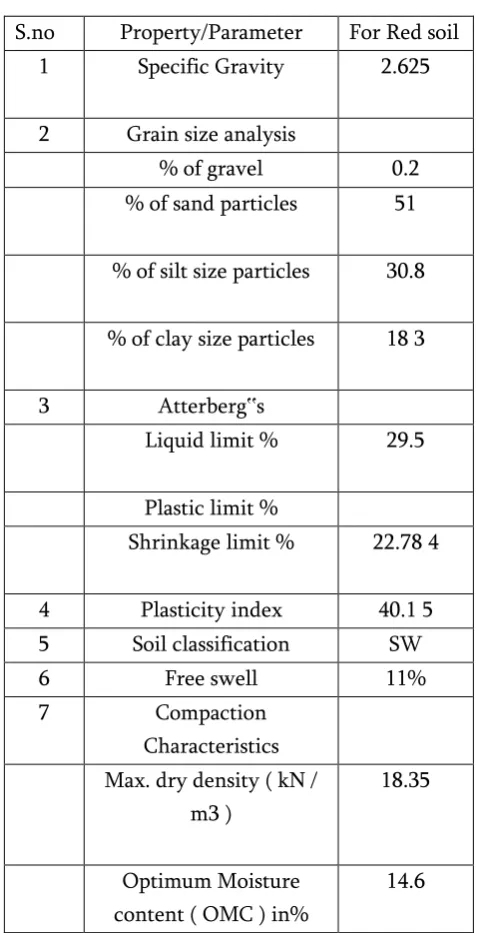
• Granulated blast furnace slag(GBFS) S.no Property/Parameter For Red soil
1 Specific Gravity 2.625
2 Grain size analysis
% of gravel 0.2
% of sand particles 51
% of silt size particles 30.8
% of clay size particles 18 3
3 Atterberg‟s
Liquid limit % 29.5
Plastic limit %
Shrinkage limit % 22.78 4
4 Plasticity index 40.1 5
5 Soil classification SW
6 Free swell 11%
7 Compaction
Characteristics Max. dry density ( kN /
m3 )
18.35
Optimum Moisture content ( OMC ) in%
III.
RESULTS AND DISCUSSIONEffort of Industrialization of higher Education:
Today we are seeing that each country is trying to present educationist, scientist to be available on online. Each person is free to purchase any thing by this modes, as
1. Commodification- The use of knowledge as a purchasable and saleable good.
2. Alternative providing with the profit motive of higher educations landscape that are engaged in the transmissing of knowledge using information and communication technologies. At here it is arises the seller & customer tradition. Then the dynamics of internationalization no doubt a challenge as well an opportunity.
Higher education today, is no more constrained by geographical boundaries. Innovative forms of translocation and transnational education have become a possibility. Multi campus institutions,
“franchised institution learning centers providing
university degree, off campus education, distance learning, internet based distance education, virtual universities merging of part studies to combine into whole for obtaining national as well as international degrees are few model as examples. As far as higher education is concerned an enthused and well informed student has many choices, for the first time
in the history of education to access for a ‘global market place”.
GATS & WHO have interest entry in the field of international education. its concept are linked to all countries at same level. The general procedure of
commitment under GATS is that “Countries submit
their schedules under five sub sectors are : Primary Education, Secondary Education, Higher Education, Adult Education and other Education. The four modes of supply of education are cross border supply Consumption Abroad, Commercial presence / Franchisee ad training programmes. The idea behind
this is the creation of an open, global market place where services, like education, can be traded on higher educational systems are not extremely rare, almost all the worlds educational systems fall under the GATS umbrella. In India, we cannot get exemption in education from the application of GATS because level is not entirely free (i.e. some fee has to be paid).
Present Scenario of higher Education in India.
The centre, state, institutions and regulatory bodies have taken initiatives in order to face the challenges of globalization. The national policy on education 1986 ad the revised policy 1992 has mode no reference to the operating of foreign universities in India or promotion of Indian higher education abroad. Infact present govt. evolving a policy on these aspects of transnational education. Present central govt. announced that central universities will be open in that state where need of this ITT, AIMS are also expanding in different states. Govt. announces that public-private sector involving is very necessary in education. Govt. invited the different countries that they can open their institution in India. Who will benefited by this? Distance education is also a medium by which we are breaking the binderies. IGNOU branches are opened in too many countries. Govt. of India MHRD has evolved a mechanism to screen the application of such institution is for approval and promotion of internationalization of higher education through COFIE. COFIE is also expected to promote Indian higher education abroad. The scheme is expected to grant approval to only genuine foreign universities to operate in India.
common wealth and such other organizations. All these are aimed at bilateral transaction and aimed at quality improvement.
At last we can say internationalization concept gives emphasis to person. If he/she is able to learn the knowledge, no body boundaries will come in this path. At here as rule follows.
A : Any one, any time, any where. This is the concept of e-learning. E-learning is a best way by which internationalization of higher education will be fulfill.
IV.
REFERENCES[1]
Guy Neave and Frans Van Vught, (ed)“Conclusion” in Promethneus Bound : The
changing relationship between Government and higher Education in Western Europe.