569 | P a g e
MODELING EQUILIBRIUM AND KINETICS OF ZINC
UPTAKE FROM AQUEOUS SOLUTION USING
COCONUT SHELL
AhmadAshfaq
1, Anwer Ali
2, Shobha Ram
3,
Najm Us Saqib
41
Civil Engineering Section, Faculty of Engineering & Technology, A.M.U., Aligarh.
2
Department of Chemistry, D.S. College, Aligarh, Dr. B. R. A. University, Agra (U.P)
3, 4
Department of Civil Engineering, Gautam Buddha University, Greater Noida (U.P)
ABSTRACT
In the current work coconut shell is used as an alternate cost effective adsorbent to determine its application for
the removal of Zn(II) ions from aqueous solutions. The adsorbent was analysed for moisture content, volatile
content and pore volume to get an idea of physical properties associated with coconut shell. Batch studies were
conducted to determine the optimum pH & adsorbent dose, and to study the effect of metal ion concentration,
contact time and temperature so as to design an efficient and optimum condition for maximum removal of Zn(II)
ions. The equilibrium data obtained was fitted to various equilibrium models like Langmuir, Freundlich, Temkin
& D-R isotherm to find out the nature and the behaviour of adsorption process. Kinetic models like Pseudo first
order, Pseudo second order and Intra-particle diffusion were also employed so as to relate the adsorbate uptake
rate with bulk concentration. It was found that adsorption of Zn(II) ions on coconut shell was pH-dependent
with maximum adsorption (81.6 %) occurring at pH 6. It was found that 0.3 g of dose of coconut shell was
found to be optimum for the removal of Zn(II) ions from wastewater with an adsorption capacity (qe) of 4.78
mg/g. For equilibrium studies it was observed that equilibrium data was best fitted to the Langmuir model with
correlation coefficient (R2) value 0.9936 and monolayer adsorption capacity (qm) was found to be 7.9554 mg/g
indicating the surface of adsorbent to be homogeneous. For kinetic models, it was observed that pseudo first
order model best depicted the adsorption process. The above obtained results clearly indicated that the coconut
shell has high potential for removing Zn(II) from metal loaded wastewater.
Keywords: Adsorption, Batch Studies, Coconut Shell (CS), Kinetics, Isotherms etc.
I.
INTRODUCTION
Water pollution raises a great concern now-a-days since water constitutes a basic necessity in life and thus, is
essential to all living things. Among other issues, water contaminations by heavy metals are more pronounced
than other pollutants especially when heavy metals are exposed to the natural ecosystem. ‘Heavy metals’ refers
to any elements with the atomic weights between 63.5 and 200.6 and a specific gravity greater than 5.0 [1].
Pollution through heavy metals from the effluents is one of the most serious environmental problems [2]. These
metals cannot be degraded or destroyed [3]. The risks of exposure, for instance, may contribute to adverse
570 | P a g e
and there are many sources of zinc pollutions. Generally, any process or container using zinc may contaminatethe products such as food, water, drink etc. although zinc is essential to human life is potentially toxic like other
heavy metals [5]. Heavy metal removal from inorganic effluent can be achieved by conventional treatment
processes. Removal of heavy metals from industrial wastewaters can be accomplished through various treatment
including chemical precipitation, coagulation, ion exchange, solvent extraction, foam flotation, membrane
operationsand conventional adsorption [6-7]. Adsorption on low cost absorbent for removal of toxic metals from
waste water has been investigated extensively [8]. The use of coconut shell as an absorbent material showed
strong potential due to its high content of lignin and cellulose [9]. In the same contest this study was conducted
to utilize coconut shell for the removal of Zn(II) ions from aqueous solution.
II.
METHODOLOGY
2.1 Collection and Preparation of adsorbent
Coconuts were purchased from the fruit seller and brought to laboratory. First coconuts have been washed
thoroughly with tape water to remove dirt and other adhering impurities and kept in sunlight for drying. The
coconut shell was then removed, crushed and grinded into fine particles. These particles were sieved through
300µ size ASTM sieve to get particles of uniform diameter. The obtained particles were again dried in oven at
about 50 °C and stored in an air tight container to be utilized as adsorbent in the removal of Zn(II) ions from
aqueous solutions.
2.2
Adsorbate solution
Stock solution of 1000 mg/L for Zn(II) ions was prepared by dissolving required amount of zinc sulphate salt in
double distilled water in a 1000 ml standard flask. This stock solution was used to prepare the working solutions
of desired concentrations for different experiments. The pH value of the solutions was adjusted by adding 0.1
mol/L NaOHor 0.1 mol/L HCl.
2.3 Determination of point of zero charge
The point of zero surface charge of the coconut shell was determined by the solid addition method [10]. A series
of five 100 ml conical flasks was taken of containing 40 ml of 0.1N KNO3 each. The initial pH (pHi) of the
solutions in each flask was roughly adjusted to 2, 4, 6, 8 and 10, respectively, by adding either 0.1N HCl or
0.1N NaOH. The total volume of the solution in each flask was adjusted exactly to 50 ml by adding KNO3 of the
same strength. Initial pH (pHi) of the solution was then accurately noted with the help of pH meter. 0.5 g sorbent
was then added to each flask and then allowed to equilibrate for 24 hours with intermittent manual shaking. The
final pH (pHf) of the supernatant liquid was noted. A graph of the difference between initial pH (pHi) and final
pH (pHf) values (∆pH = pHi– pHf) was plotted against pHi. The point of intersection of the resulting curve with
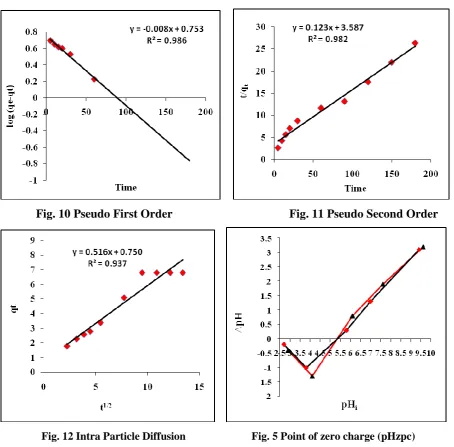
abscissa at which ∆pH = 0, gave Zero point charge (pHzpc) Fig. 5.
2.4 Batch adsorption studies
Batch studies have been conducted at room temperature in which an accurately weighed (0.5 gm) of adsorbent,
coconut shell was placed in 100 ml stoppered conical flask containing known volume (50 ml) of metal ions
solution of known concentration (50 mg/L). This solution was shaken in a rotary shaker for about 30 min and
kept for 2 hours to attain equilibrium with intermittent manual shaking. All the operations were conducted at
571 | P a g e
effect of concentration in which 5 to 200 mg/L metal ion concentration solutions were used. The solutions werefiltered to separate the adsorbent from supernatant liquid. The residual concentration of metal ions was
determined by Atomic Absorption Spectrophotometer model GBC 902 using air Acetylene flame. The removal
percentage (R%) of metal ions and adsorption capacity or amount of metal ions adsorbed per unit mass of
adsorbent (qe) were calculated for each run by the following expression
R% = X 100 qe = X V
Where, Ciis the initial concentration of metal ions in the solution, Ceis the final concentration of metal ions in
the solution, V is the volume of the solution and m is the mass of the adsorbent.
III. RESULTS AND DISCUSSION
3.1 Adsorption studies
3.1.1 Effect of pH
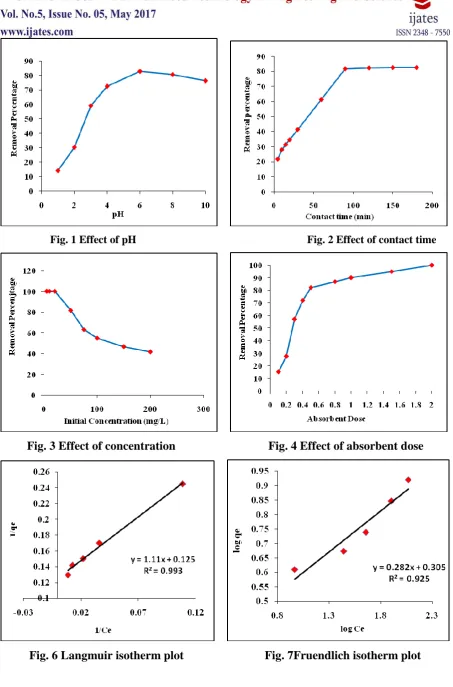
Effect of pH solution containing Zn(II) ions on adsorption of zinc by coconut shell is shown in Fig. 1. It has
been observed that Zn(II) uptake by coconut shell is strongly affected by pH of the solution. The amount of
Zn(II) adsorbed was found to increases from 14.2 % to 81.6 % on increasing pH from 1 to 6 and then decrease
slowly up to 76.2 % at pH 10. The variation in the adsorption of Zn (II) with respect to pH can be explained by
considering the initial pH (pHi), final pH or equilibrium pH (pHf) and speciation of metal ions in the solution. At
pH 1, Zn2+ ions compete with H+ ions for binding sites of adsorbent, therefore the adsorption of Zn(II)ions was
less (14.2%) at low pH. When the initial pH of the solution raises up to 6 the adsorption percentage increases
quickly up to maximum of 81.6 %, possibly due to little less competition of Zn2+ ions and H+ ions. Further
increase in pH of the solution up to pH 8 results slightly decreases in the adsorption of Zn (II) ions
(80.5%).Moreover, the point of zero charge (PZC) has an important influence on adsorption processes. The
surface of adsorbent was positive when pH < PZC, neutral when pH = PZC and negative at pH > PZC. The data
plotted in fig.5 indicated that the PZC value of coconut shell was 5.3, showing that the surface was negatively
charged above this pH and hence fairly large amount of Zn (II) ions (81.6 % at pH 6) were adsorbed.
3.1.2 Effect of contact time
The effect of interaction time of Zn(II) ions with the surface of coconut shell on adsorption of Zn(II) ions is
shown in Fig 2.The contact time reached to equilibrium was found to be dependent on initial concentration of
Zn (II) up to 50 mg/L and then became independent at higher concentration. This may be due to the fact that
vacant sites of adsorbent adsorbed Zn(II) ions rapidly at lower concentration but at higher concentration
adsorption of copper occurred by slower process (diffusion) into the inner sites of adsorbent. The equilibrium
time for the maximum removal of Zn (II) ions from aqueous solution was found to be 90 minutes at
concentration 50 mg/L. But at higher concentration it will require more contact time for the maximum removal
of Zn (II) ions.
3.1.3 Effect of concentration
The influence of initial Zn(II) concentration on adsorption of Zn(II) on coconut shell is shown in fig. 3. It was
found that adsorption capacity of coconut shell as usual increases with an increase in initial Zn (II) ions
concentration. It may be due to the fact that increase in concentration gradient between the bulk solution and
572 | P a g e
adsorption capacity of coconut shell at equilibrium was found to be 0.5, 1, 2, 4.08, 4.73, 5.48, 7.05, and 8.34mg/g at initial Zn(II) ions concentration of 5, 10, 20, 50, 75, 100, 150 and 200 mg/L, respectively. It is also
evident from the fig 4 that adsorption percentage of Zn(II) ions decreases from 100 to 41.7% with the increase
of initial concentration of copper from 5 mg/L to 200 mg/L. It may be due to the saturation of active sites of
adsorbent at certain metal ions concentration
.
3.1.4 Effect of adsorbent dose
The effect of dose of coconut shell on adsorption capacity and percentage adsorption of Zu(II) is shown in Fig.
4. The adsorption percent increased while adsorption capacity, qe (mg/g) decreased when adsorbent dose
increased from 0.1 to 1.5 g. The adsorption percentage increases up to 95% at 1.5 g of adsorbent dose. This
might be due to the increase in the number of sites available for adsorption [16]. The adsorption capacity
decreases from 4.7 mg/g to 1.59 mg/g on increasing adsorbent dose from 0.1 g to 1.5 g. The decrease in
adsorption capacity with increasing adsorbent dose might be due to the fact that at lower adsorbent dose almost
all the adsorption sites are saturated by the Zn(II) ions but at higher adsorbent dose, the adsorption sites would
be excessive for the adsorption reaction since the concentration Zn(II) ions as well as the volume of the solution
are constant. Thus, amount of Zn(II) adsorbed per unit mass of adsorbent was decreased [17].
3.2 Adsorption isotherms studies
Adsorption of Zn(II) ions on coconut shell was carried out at concentration ranging from 5 to 200 mg/L at pH 6
for 90 minutes of equilibrium time and obtained data was anaylsed with Langmuir, Freundlich, Temkin and
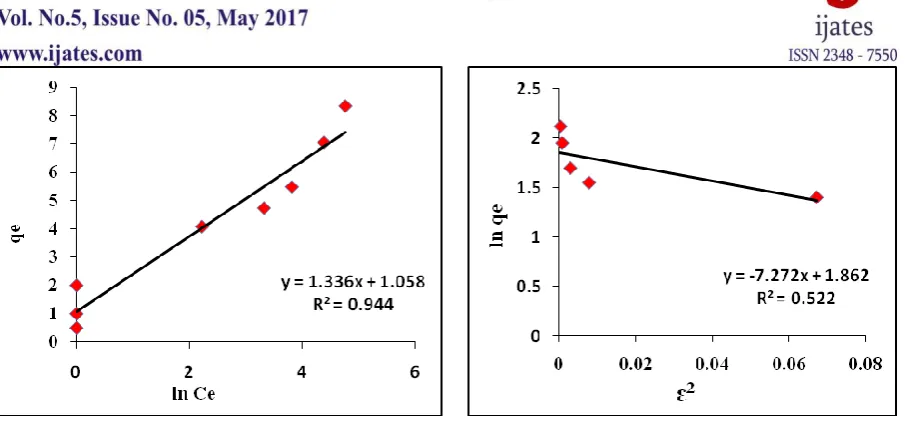
Dubinin-Redushkeuich adsorption isotherms. The graphs plotted for these isotherms are shown in Fig. 6, 7, 8
and 9. The value of R2 and other parameters of adsorption isotherms indicated that adsorption of Zn(II) onto
coconut shell was best fitted to Langmuir isotherm model (R2 = 0.9936) and the obtained value of monolayer
adsorption capacity qm was 7.955 mg/g. Moreover the higher value of correlation coefficient for Freundlich
(R2=0.925), and Temkin (R2=0.9445) listed in table 1, indicated that adsorption of Zn(II) ions on coconut shell
occurs on heterogeneous surface of coconut shell by formation of monolayer followed by multilayer of Zn(II)
ions with uniform heat of adsorption [20], [21].
The essential characteristic of the Langmuir isotherm is expressed in terms of a dimensionless constant
separation factors or equilibrium parameter, RL.
RL= 1/(1 + b Co)
Where, b is the Langmuir constant, Co is the initial concentration.
The value of RL between 0 and 1 indicates favourable adsorption of adsorbate on adsorbent. RL for Zn(II) ions
573 | P a g e
Fig. 1 Effect of pH
Fig. 2 Effect of contact time
Fig. 3 Effect of concentration Fig. 4 Effect of absorbent dose
574 | P a g e
Fig. 8Temkin isotherm plot Fig. 9Dubinin-Radushkevich isotherm plot
Table: 1 Langmuir, Freundlich, Temkin& D-R isotherm constants
3.3 Kinetic Studies
The values of correlation coefficient, R2 and other kinetic parameters are mentioned in table 2. It had been
observed from plots shown in fig. 10, 11 and 12that values of R2 for pseudo first order (R2 ≈ 0.9863), pseudo
second order (R2 ≈ 0.9827) and intra particle diffusion (R2 ≈ 0.9374) that adsorption of Zn(II) ions by coconut
shell was best described by pseudo first order kinetic model which showed that adsorption occurs chemically
having correlation coefficient value (R2 ≈ 0.9863) and involves valency forces through ion sharing or exchange
of electron between the adsorbent and ion adsorbed on it. Also the Pseudo-second order model showed very
close correlation coefficient value (R2 ≈ 0.9827) to pseudo-first order model which suggests that Zn(II) ions
adsorption occurs in a monolayer fashion and which relies on the assumption that chemisorptions or chemical
adsorption is rate limiting step. Zn(II) ions react chemically with the specific binding sites on the surface of
adsorbent.
Table: 2 Pseudo first, Pseudo second order & Intra-particle Diffusion constants
Metal Langmuir isotherm Freundlich isotherm
Zn+2
qm b R2 RL 1/n n KF R2
7.9554 0.113 0.993 0.15 0.2821 3.5448 2.02 0.925
Temkin isotherm D-R isotherm
A B R2 qm β R2
3.535 1.0585 0.9445 6.441 7.2724 0.5223
Metal Pseudo- First Order Model Pseudo- Second Order Model
Zn+2
qe k1 R2 qe k2 R2
5.667 0.0193 0.9863 8.130 0.00421 0.9827
Intra-Particle Diffusion
Kd I R2
575 | P a g e
Fig. 10 Pseudo First Order Fig. 11 Pseudo Second Order
Fig. 12 Intra Particle Diffusion
Fig. 5 Point of zero charge (pHzpc)
IV. CONCLUSION
In this study a simple and cost effective treatment procedure was adopted for the removal of heavy metals
through adsorption on coconut shell. Adsorption is a strong choice for removal of heavy metals from
wastewater. From batch adsorption studies it was found that maximum removal of zinc takes place at pH 6 with
removal efficiency of 81.6%. Also the 0.3 g of coconut shell was found to be optimum dose for Zn(II) ions
having maximum adsorption capacity of 4.78 mg/g. The effect of contact time showed that the adsorption
process increases steadily for 20 minutes and then it reaches for saturation limit at 90 minutes. The equilibrium
sorption data fitted best into the Langmuir isotherm model. The correlation coefficient for Langmuir isotherm
was found to be 0.9936 showing monolayer adsorption capacity, qm was 7.955 mg/g and the value of b and RL
was found to be 0.1132 and 0.15 respectively. Kinetic studies showed that the experimental data obeyed better
by Pseudo first order model as compared to Pseudo second order model and Intra-particle diffusion. The R2
value obtained from pseudo first order model was found to be 0.9863 and obtained adsorption capacity value
576 | P a g e
be 0.9827 and the value of qe and K2 was 8.13 mg/g and 0.00421. The above results clearly indicated that thecoconut shell has high potential for removal of Zn(II) ions from Zn(II) loaded wastewater.
REFRENCES
[1.] Srivastava, N.K. and C.B. Majumder, Novel biofiltration methods for the treatment of heavy metals from
industrial wastewater, J. Hazard. Mat., 151(1), 2008, 1-8.
[2.] Bissen, M. and F.H. Frimmel, Arsenic —a Review. Part I: Occurrence, Toxicity, Speciation,
Mobility,Actahydrochimicaethydrobiologica,Vol. 31, 2003, 9-18.
[3.] Bhatti, H.N., B. Mumtaz, M.A. Hanif and R. Nadeem, Removal of Zinc ions from aqueous solution,
Adsorption Technologyfor Air and Water Pollution using MoringaOleifera Lam. (Horseradish
tree),Process Biochem. J., 2007, 547-553.
[4.] Rao, M.M, D.H.K.K Reddy, P. Venkateswarlu and K. Seshaiah, Removal of mercury from aqueous
solutions using activatedcarbon prepared from agricultural by product/waste, J. Environ. Manag. 90(1),
2009, 634-643.
[5.] Vijayaraghvan, K, J.R. Jegan, K. Palanivelu and M. Velan, Copper removal from aqueous solution by
marine green algae Ulva reticulate, Electronic J. Biotech., 7(15), 2004, 61-71.
[6.] Maity, H., Protein hydrogen exchange mechanism: local fluctuations. Protein Science, 12(1), 2003,
153-160.
[7.] Ho, Y.-S. and G. McKay, Pseudo-second order model for sorption processes. Process Biochem.,34(5),
1999, 451-465.
[8.] Akaninwor, J.O., M.O. Wage, I.U. lba,. Removal of Iron, Zinc and Magnesium from polluted waste
samples using thioglycolic acid modified oil-palm, Afr. J. Biochem. Res. 1(2), 2007, 11-13.
[9.] Carrijo, O.A, R.S. Liz, N. Makishima, Fiber of green coconut shell as agriculture substratum, Braz.
Hortic. 20, 2002, 533-535.
[10.] Lataye D.H., I.M. Mishra, I.D. Mall, Removal of pyridine from aqueous solution by adsorption of
bagasse fly ash, Ind. Engg. Chem. Res. 45, 2006, 3934-3943.
[11.] Wang, R., Q. Li, D.Xie, H. xiao, H. Lu, Synthesis of NiO using pine template and adsorption
performance of lead from aqueous solution, Appl. Surf. Sci., 279, 2013, 129-136.
[12.] Yongjie, X., H. Haobo and Z. Shujiing, Competitive adsorption of Cu(ii), Pb(ii) and Zn(II) onto basic
oxygen furnace sludge, J. Hazard. Mater., 162, 2009, 391-401.
[13.] Hutson, N. D. and R.T. Yang, Adsorption, J. Colloid Interf. Sci., 2000, 189.
[14.] Gunay, A., E. Arslankaya and I. Tosun, Lead removal from aqueous solution by natural and pretreated