MDA as a Research Method of Generic
Musical Analysis for the Social Sciences:
Sifting Through Grime (Music)
as an SFT Case Study
Monique Charles
1Abstract
Using Grime as a case study, I employ the analytical framework I created, that is, Musicological Discourse Analysis (MDA) as a holistic mode of analysis to contextualize Grime sociologically and musicologically. This method retheorizes genre, providing a more specific, useful, and detailed musical classification system; the sonic footprint timestamp (SFT). The MDA framework provides a generic mode of musical analysis for research projects in sociology, cultural studies, and the social sciences fields. This article evaluates key musical influences in the evolution of Grime as both (i) a musical form and (ii) an analysis of influences in relation to its social context. It evaluates the global, local, historical, technological, political, lyrical themes, and sonic properties (sounds) found in Grime. Significantly, this framework is very much concerned with the voices in the Grime scene, and therefore respondent experiences are central to this analytical method—incorporating in-depth interviews, observation (physical and online), and immersive listening.
Keywords
community-based research, case study, discourse analysis, ethnography, methods in qualitative inquiry, observational research, oral histories, performance-based methods
In this paper, I introduce the framework Musicological Dis-course Analysis and the concept of the Sonic Footprint Time-stamp. Both are innovations in musical analysis for the sociology, social sciences and cultural studies fields. To date, these disciplines have been ill equipped to analyse music beyond lyrical content. Simultaneously, music studies, often focuses on practice or explores music devoid of social or cultural context. This is a longstanding issue owing to the construction of respective disciplines focusing inward. Inter-disciplinary approaches enable new ways to explore address the musical and the social for holistic musical analysis.
Since European Enlightenment, the Western study of mod-ern music has been rooted in the Romantic era and classical music, including the idea of individual musical creative genius.
. . .during the Enlightenment the ear (by which he means not only the outer acoustical ear but the inner ear), through which one hears the voice of God, was relegated to the danger zone of irrationality—outside the bounds of universal reason. (McClure, 2011, p. 4)
As a result, sound received less and less focus in Eurocentric discourse and was largely relegated to the realms of irration-ality. Sight was foregrounded as the apparatus of rationirration-ality. Bull and Back (2003) identify the trajectory of the eye taking precedence over and above technologies of the ear:
. . .orally based cultures were progressively supplanted by print-based cultures, and the world became increasingly “silent” as sight (reading) replaced speech. (Bull & Back, 2003, p. 7)
This discourse has endured into modern times (Gilbert, 2012; McClure, 2011). Contemporarily, this is exemplified by the structures in place around music that can be written down, that
1
University of West London, London, United Kingdom
Corresponding Author:
Monique Charles, University of West London, Ealing Site, St. Mary’s Road, London W5 5RF, United Kingdom.
Email: [email protected]
Volume 17: 1–11
ªThe Author(s) 2018 Article reuse guidelines: sagepub.com/journals-permissions DOI: 10.1177/1609406918797021 journals.sagepub.com/home/ijq
is, lyrics and scores, having primacy over other musical pro-duction as objects worthy of legal protection and study (Rose, 1994). This legacy still influences how music is categorized, interpreted, understood, and aesthetically valued contempora-rily. Chernoff argues there is “profound European misunder-standing of Afrodiasporic rhythm pragmatics” (cited Goodman, 2010, p. 116) and other musics not rooted in the Eurocentric classical framework.
This is evident today in the general inability to articulate sound and its impact in everyday life, in the same way visual disciplines are coded. The field of music semiotics is an under-researched area in Britain. Kennett (2003) explores the analysis of popular music. He proposes sound as an object and a semiotic analysis of sound. Music semiotics is a crucial area to the analysis of music. However, it is inaccessible for those who do not read music or have an understanding of musical terms or theory; concepts linked to previous modes of analysis prioritizing sight. It also fails to analyze music in broader social and cultural contexts.
Academia is only beginning to address sound (that cannot be written down) as a factor of consideration (including how to protect it) in a more systematic way. It is beginning to engage with sound, the aural, and soundscapes (e.g., sonic fiction/Afro-futurism, audio culture, sound design studies, and popular music studies), approaching music, in sociological and cultural ways. To date, many music research projects in sociology and cultural studies focus on lyrics, style (Hebdige, 1979), or the aesthetics (Bramwell, 2011) of a subcultural practice; all of which are linked to the visual. Goodman (2010) argues the ear is more finely tuned than the eye. This new sound “knowledge space” opens a new territory and expands the current trajectory of musical under-standing in Eurocentric music frameworks. It opens up space for new methods to engage with sound in an academic context.
For example, Bull and Back’s (2003) edited volume in audio culture explores this new territory, the link between sound and its impact on the body, physically and physiologically. Labelle (2010) explores natural acoustics of spaces and places. These areas of exploration are useful when brought into the field of sociology because they enable the analysis of soundscape and environment on the development of musical styles and the human body. These exemplify approaches to open up new ways to engage with musical analysis (this article proposes a frame-work of research methods to explore this new space).
My framework, Musicological Discourse Analysis (MDA), is a series of research methods employed to enable those in the sociology and cultural studies fields to engage more fully in the analysis of music (from various vantage points). This article applies MDA to Grime music. The case study and framework assist in retheorizing genre and produce a more specific Sonic Footprint Timestamp (SFT), a more useful and detailed musi-cal classification system. I propose the MDA framework is a generic mode of musical analysis.
Introduction
I propose a framework for musical analysis that I have called MDA (Charles 2016b). It enables a deep level of
engagement with music (partly through elicitation meth-ods), obtained through immersive listening to Grime, inter-views, and observations (physical and online), but also in its wider social and historical contexts. The framework retheorizes genre and produces a more specific, useful, and detailed musical classification system, the SFT. The SFT illustrates that music is actually a reflection of a specific place, time, historical, social, political, and technological context. The MDA framework is an innovative and experi-mental method created for analyzing both lyrics and sonic properties in music, what they signify, and their impact on the listener. Musicological elements of music are largely lost when studied in sociology or cultural studies; often reduced to lyrics or image analysis (i.e., semiotics), sub-cultures, class/spectacular/symbolic resistance, or style (Hall & Jefferson, 1989; Hebdige, 1979). With this frame-work, the music/song itself becomes the site of analysis, song as object. Sonic properties such as frequency (bass/ treble), beats per minute (bpm), pitch, rhythm, layering, volume, aural manipulations (e.g., echo, reverb), and con-structions such as “the drop,” “the break,” accelerando, crescendo, and syncopation are some of the identifiable and quantifiable characteristics analyzed to explore connotation and signification, which form part of a broader musical analysis. This framework draws from elements of audio culture that establish connections between the physiologi-cal, physiphysiologi-cal, and psychological effects experienced when listening to music. Allett’s (2012) technique, which elicits thick descriptions of the respondent’s listening experience and their attachments (“feelings,” “emotions,” and “love”) in relation to music, also supports this method as inter-views, observation (physical/online), and immersive listen-ing (song as object) are central to the framework.
Significantly, the MDA framework examines subcultural experience and what it does for/means to respondents. It ana-lyzes social, cultural, political, technological, and historical contexts from which the music emerged to establish social, political, and musical norms and sensibilities. It uncovers a specific language/speech community and sonic habitat/audio ecology. The result is a clear mapping, understanding, useful, and detailed musical classification system, an SFT, which is a more accurate account (and theorization) for genre.
Research Methods
I approached 42 people for in-depth semistructured interviews in total. The response rate was approximately 74%(31). How-ever, only 40%(17) of those approached resulted in an inter-view. The 17 respondents had ranging involvement and capacity in the Grime scene and can be categorized within the scene in clusters I have named:
cultural producers (producers, musicians, MCs/rappers, entertainers),
consumers (fans),
cultural commentators (journalists, bloggers), creative managers (editors, marketers), and
creative administrators (legal, business owners, label owners).
Each category has a specific role in the circuit of meaning (Johnson, 1986) that constitutes cultural signification. Grime MCs and cultural producers occupy a distinctive place within Grime subculture—both as music makers/performers/entrepre-neurs and also as fans. They are key arbiters, definers, consu-mers, and disseminators of Grime culture. As such, they occupy multiple places on the circuit of meaning—or their role in the circuit changes over time. This is an important factor of consideration in the retheorization of genre.
Participant observation involved immersion in a key area of Grime subcultural practice: live performance. Immersion is particularly important for the analysis of affective dimensions of Grime. As Allett (2012) has suggested, musical subcultural research tends to underestimate or sidestep the centrality of its aural/experiential character. This means that while spectacular dimensions of musical subculture have been widely examined, their musicality and affect have been significantly underesti-mated and undertheorized. Participant observation enabled me to embed myself in the performance contexts of Grime’s sub-cultural experience and observe fan engagement and embodi-ment. I observed and documented movement, dialogics, expressive acts of emotion and utterance as text, and my own firsthand experiences.
In total, I attended 15 events (November 2012–June 2015), 7 were live performance (concerts, clubs), 7 were talks/panels, and 1 was at the Houses of Parliament.
In conjunction with physical observation, I used online research (Hine, 2005) to conduct observation. I embedded myself in two intersecting subcultural spaces: live/panel events and web-based fan communities. I used Twitter owing to the self-categorizing function of the hashtag (#) to immerse myself online. The hashtag enables searchable ways to locate and collect Twitter users’ data in relation to a particular phrase or key word. I used the Twitter hashtags that coincided with live performance events I attended. I searched these # the day after the event and searched through the hashtags backward to the day before the event took place. Using the hashtag in this way, I increased the likelihood of accurate searches and relevance of the data obtained. This method was one way I could identify a percentage of those talking about the event quickly in an online observation capacity. I focused the # searches on seven live performance events attended (March 2013–December 2014). The events attended were a combination of events I chose myself, and others that were respondent-led.
I also looked @artists’ Twitter pages over the same time period for data. Using physical and online observation methods together, I documented my observations at events with online fans’ comments about their concert experiences with a view to explore fan practices, affective investments, communal and personal identifications, subversion, and subcultural meaning in a pioneering way.
Owing to the detail involved in analyzing songs as object, I selected four principal songs for analysis; these were led by respondent interviews and the songs that drew the largest responses during observations:
Ms Dynamite’s Boo (https://www.youtube.com/watch? v¼hnauS1rnDiI) (Sticky, (featuring Ms. Dynamite) 2001)
It’s Wiley’s (Showa Eski) Eskimo Riddim (https://www. youtube.com/watch?v¼5pxk-EfNQxY) (Wiley (Cowie) 2011)
Dizzee Rascal’s I Luv U (https://www.youtube.com/ watch?v¼YH0KWX2a8zY) (Rascal 2003)
Lethal Bizzle’s POW (https://www.youtube.com/watch? v¼nlmhlWECMUk) (Bizzle 2004)
The triangulation of the selected three research methods1 produces a field of theoretically rich data that serve multiple but interconnected modalities of analysis owing to the inter-disciplinary nature of this project. The measurable output (data) of Grime as the site of analysis is triangulated through (i) observation—how people react to it in live performance settings (physical), talk about it socially (panel events), and share their experience (online); (ii) interviews exploring feel-ings and attachments to music (music elicitation) subcultural practices, mainstream British reaction to Grime, making music, and so on; and (iii) song as text/song analysis.
I applied thematic analysis to respondent data, that is, inter-views and tweets to detect whether there were any collectively shared experiences with music engagement. I sought out mean-ing, implicit and explicit, and thematically codified the data found in the sounds, lyrics, and symbolism present in Grime.
It is important to note that my principal academic training is not in musicology or music studies. I have a sociology/political science/psychology background. However, my interdisciplin-ary approach enables the interrogation of music in its social and cultural context, which is a significant advancement in explora-tions into music academically. The MDA framework and resulting theory that produce a more focused answer, that is, SFT, can be employed as an analytical tool in these fields.
The components of the MDA framework are musicological (sonics, auralities, lyricism), subcultural (modes of identity work, intersubjective practices, spectacular-ritual elements), technolo-gical and historical–political–sociolotechnolo-gical narratives (personal narratives and official narratives), principally of the African Dia-spora, in the postindustrial British context. This approach draws modes of meaning making (comparable to Allett’s, 2012, extreme metal analysis) and affective attachment into analytical consid-erations. Constitutinggenreas a classification system based on respondent experience (through analysis of interviews, observa-tion, and immersive listening/song as object), their on-the-ground debates, perspectives, and conversations about the genre location of their art is in itself an innovation on genre theory and a tool of methodological analysis.
alongside texts that construct their musicality in the context of social and cultural norms, such as Rose (1994) and Machin (2010), provide frameworks with which to analyze musical meaning and connotations. When used in conjunction, they stabilize the analysis and resulting concepts proposed, espe-cially when mapped onto respondent data.
Presently, genre is characteristically constituted of musical formalism (and a degree of subcultural practice in some cases). As it is currently understood, genre is a method of musical categorization and in many cases, it is an empty signifier to enable one “type” to be distinguished from another. Genre is simultaneously a tool for social organization and categorization. It serves to order and organize both musical and social worlds (i.e., people). They cannot be divorced from one another. The MDA framework considers social and cultural factors giving them equal standing with the musical components.
Using Grime and the MDA framework, I rework how genre is identified as a musical form and highlight the subcultural dimen-sions to its generic character. I argue that genre is a specific constellation, an SFT,2formed through a contextualized under-standing of subculture and subcultural practice (in the three over-arching areas of genealogy, genre, and subculture).
Subcultural elements (i.e., a combination of race and heri-tage—including sonic characteristics) and local soundscapes contribute toward the uniqueness of the Grime sound. There-fore, I propose that the combination of the global and local and the past and present are influential points of consideration when examining genre more broadly.
Grime: The Case Study
New Genre, New Sensibility
The naming (or not) of a genre, to make something distinctive, is crucial. It depends upon the objectives and intentions of the person making the music.
A producer respondent was unable to classify or name his early 21st century “genre bending” music as anything other than Gar-age music (a popular UK music genre and predecessor to Grime) because his priority was to have his music heard and establish himself as a pioneer in the UK subculture. Only when his “gray area/genre bordering” sound became established as sonically dis-tinct or different by the subculture itself (i.e., Dark/Grimy Gar-age), could producers and artists who came shortly after him with a similar sound, declare that they do not make Garage and cemen-ted the distinctiveness of Grime from its “parent” genre.3
The new genre boundary shifts knowledge and discourse about the new genre both musically and socially. It provides a new space for its creators to have a modicum of influence over its new sensibilities and trajectory. This illustrates that defining a genre is more than just sonic distinctiveness but includes a socio-logical and ideosocio-logical context, outlook, or shift.
In addition to ideological considerations, genre should also be explored teleologically, paying particular attention to the social and cultural aspects significant to these ideological shifts. Lena
(2012) teleologically identifies four phases a genre goes through in an AgSIT full life cycle (not achieved by all genres):
Avant-garde (Ag) is considered new and sonically dis-tinct from other musical forms and shared/followed by a core group of people. I argue this is where a new sensi-bility/ideology/outlook and trajectory is established. Scene-based (S) is where niche knowledge, practice,
culture, and sensibilities develop normative values and meaning. I argue this is where new trajectories stablize and become subcultural norms.
Industry-based (“I”) is where subcultural practice and knowledge become commodified and devoid of original meaning. I argue this is where subcultural norms become dominated by external and more powerful forces.
Traditionalist phase (T) is concerned with preserving Ag and S stages. I argue this is where boundaries are policed to preserve, reinforce, or reignite stabilized subcultural norms as a measure of authenticity.
Interrogation of the Ag stage is significant as it gives insight into wider sociological issues that inform genre. Lena’s (2012) research found Ag music often occurred in low-income areas, where artists, musicians, and creatives could live cheaply and in close proximity to one another. For Grime, at its earliest Ag stage, the music was made, shared, and followed by a core group of people who resided in London’s inner cities that were experiencing fast social change, that is, gentrification.
Grime transitioned from Ag to S phases through its connection to the Garage raving scene (initially—becoming Grimy/Dark Garage, Sublo). However, its ideology was different (Lester, 2010). Technologies of pirate radio and Bluetooth, entrepreneur-ial “on road” activities such as selling and/or distributing CDs and eventually the Internet, assisted this transition. Subculturally, its institutions and practices were closely connected to Garage.
Respondent data about scene-based involvement (and elicita-tion) enable it to be understood holistically through those who know and understand it experientially. Teleologically, Grime is now spoken of in waves,4first wave, second wave, third wave, to reflect the changes to the sound (and sensibilities) over time. Talk of “waves,” old skool and classic Grime secures the idea that there have been sonic, cultural, social, political, and tech-nological shifts along Grime’s evolution along the AgSIT cycle. When examining musicological elements of genre specifi-cally, however, Lena (2012) refers to genres as communities of sounds found within “streams.”
Some musical styles, over the course of decades, spawn a number of variants. These families of music retain their coherence through shared institutions, aesthetics and audiences. I call these sets of styles “streams” through which a number of genres may flow. (Lena, 2012, p. 8)
rhizomatic nature of music influences, sound families can be traced or linked to identifiable sonic groupings.
Music of the African diaspora has identifiable sonic charac-teristics, distinct sounds, and patterns (Beckford, 2006; Du Bois, 2007; Eshun, 1998; Gilroy, 1993; Goodman, 2010; Per-kinson, 2005; Reed, 2003; Rose, 1994) that can be referred to as signatures. Signatures can be identified (genealogically) throughout musicological traditions. Afrodiasporic sound sig-natures include the low-frequency drum, polyrhythm, call and response, interactivity (Rose, 1994, p. 66), improvisation, and montage in communication (Gilroy, 1993). These are given primacy or central focus within the music itself.
I draw upon these to identify signatures that assist in quali-fying Grime as a “Black” music and belonging to a specific Afrodiasporic or Black “music stream” (Charles, 2016a, 2016b; Lena, 2012). I am also presenting Grime as a Black music in agreement with respondents’ data, observation, and immersive listening/song as object.
Again, audio ecologies and Bahktinian concepts of speech and aural communities were used as theoretical resources to further validate the empirical research used (interviews, observations, and immersive listening/song as object). Therefore, elicitation aspects of this framework enabled me to tap into an existing community/subculture governed by its own “rules,” speech com-munity, and etiquette. Modes of discourses came through in the content of the interviews, tweets, and lyrical content (and illus-trate how people are embedded in a speech community and audio ecology). It enabled the development of two frameworks I could use as points of consideration within the overarching MDA framework: Narrative Insight Lyrical Analysis (NILA5) and Sonic Locational Soundscape Analysis (SLSA6), to be discussed in the Sifting Through Grime, an MDA section.
This uncovered three overarching areas of interest that simul-taneously inform Afrodiasporic musical genres, such as Grime.
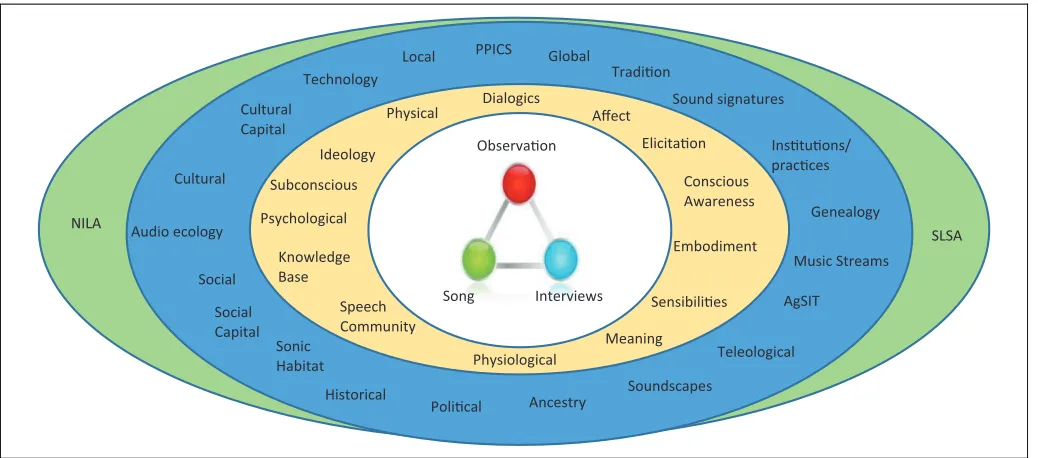
These are diasporic, political, and locational sets of experiences, perceptions, and reference points. Afrodiasporic music takes on historical and musicological elements, using diasporic musical conventions, locational, and political influences, which will be demonstrated more fully in the Sifting Through Grime section. Figure 1 illustrates the MDA framework.
This retheorization of genre shows those in the scene central to its theorization. The access to meaning in music is through elicitation, a speech community, and interaction with cultural artifacts (song). These findings are contextualized within mul-tiple factors of consideration in the second and third concentric rings, some of which operate and influence below respondents’ levels of consciousness. SLSA and NILA frameworks (outer ring) consider all knowable factors in the analytical process, while linking to respondent (central data). The result of apply-ing the MDA framework is a more nuanced reworkapply-ing of genre, by locating an SFT. Having outlined the content of the MDA framework in theoretical and visual terms, I will now show how it is applied by conducting an in-depth analysis of Grime before producing a visual diagram to illustrate the factors of consid-eration that constitute its SFT.
Sifting Through Grime, an MDA
What Does Grime Sound Like?
The Grime sound, often compiled of electronic sounds, is typi-fied by synths of the 80s, PlayStation and video game music (Palma˚s & Von Busch, 2008; Wilson, 2016), in addition to the complex programming often found in Jungle music (Bradley, 2012). Grime is typically characterized by music that is typi-cally four beats to a bar and comprising of 8 or 16 bar cycles. It is one of the reasons why Grime was unofficially called 8 bar or 16 bar very early on (Grime, 2012).
Technology
Instuons/ pracces Tradion
Genealogy
Music Streams NILA
SLSA Elicitaon
Sound signatures
Social
Polical Historical
Teleological Observaon
Interviews Song
Soundscapes Ancestry
Knowledge Base
Global Local PPICS
Audio ecology Cultural
Speech Community
Physical
Physiological Dialogics
Psychological
Embodiment Cultural
Capital Affect
Sensibilies
Sonic Habitat
Conscious Awareness Subconscious
Social Capital
Ideology
Meaning
AgSIT
Grime, particularly early Ag Grime, has lo-fi quality sounds; this means the sounds are not crisp or clearly defined; listeners are unable to trace sounds to a specific location or source. This quality and rawness has been likened to Punk (Machin, 2010; Reynolds, 2007). It is also resultant from the low-end technol-ogy used to make the music. Grime includes the juxtapositions of intense heavy baselines, (i.e., low frequencies; Bradley, 2012; Henriques, 2011; Sullivan, 2013) and vastness of space with futuristic and “nonmusical” sounds. Another key feature of Grime is its tempo. It has an average tempo of 140 bpm (Grime, 2012), which is at the faster end of the musical tempo spectrum. MCs “chat” or “spit” over a beat with relentless velocity in a similar style to Reggae Dub toasting or American MCs rapping.
To evaluate Grime more fully than is outlined in the current literature and the public domain and begin applying the MDA framework, I first unpack two elements within the framework: NILA, which examines the mind-set and outlook of those active in the scene and the social value systems of the subculture, and
SLSA to assess the significance of the local soundscape in shaping Grime’s sonority.
These two frameworks work alongside genealogical inter-rogation. Genealogy enables both sonic and subcultural analy-ses of historical influences and practice that inform musical streams (Lena, 2012). It works alongside considerations around the technology of the period and political climate.
NILA
The lyrics of the songs7selected for immersive listening/song as object were often directed toward rival MCs, revealing a com-petitive element within the genre and the desire to demonstrate lyrical dexterity and superiority. The narratives of the lyrics were individualized stories. Lyrics predominantly involved MCs introducing and announcing themselves to listeners and cement-ing their position as the best. Lyricists speak in a declarative format. MCs have power, authority, and agency in their lyrics, particularly with regard to things that have materialized (i.e., being “top of the game,” listing the venues performed at, radio shows attended, and occasionally the things they own). They even present as having a degree of agency, even when the story they are presenting may involve external forces impacting upon them. Grime lyrical content was predominantly material and literal, that is, doing something tangible or relational to position themselves and their achievements as superior to others and authenticate their alpha position. MCs compared themselves to well-known people who are socially accepted as being the best in their field to validate themselves as being of equivalent stand-ing. Bragging or boasting about lyrical dexterity and the ability to hype the crowd, male sexual prowess, or their ability to con-trol bodies (i.e., by accessing sex from women at will or getting people moving to music) were examples to affirm their alpha position. Placing NILA in its broader MDA context, this
narrative makes sense given the hyper individualism of contem-porary British/Western society and social media, where people compare and want to be seen as leaders, celebrity, and having agency, often modeling themselves on other people.
Genealogically speaking, and making links to wider social and cultural contexts, this style of lyrical narrative also has strong links with Black Atlantic (male) oratory practice. This pattern of earning stripes through challenges with other orators by crowd consensus can be linked to The Dozens (Kelley, 2004), now calledcypheringin the United States,toastingand sound clash(Bradley, 2012; Henriques, 2011; Sullivan, 2013) in Jamaican oratory practice or competing for the title Calyp-sonianin the Caribbean (Leu, 2000).
. . .competitions known as “clashes” began to take place. These were a partial continuation of the competitive performance tradi-tions of many West African cultures such as those in Trinidad and Brazil. (Sullivan, 2013, p. 16)
Lyrical narratives in these musical styles include being a leader/gatekeeper, soldier/regulator, originator, the person to get people hype (i.e., dancing/enjoying themselves), to impart knowledge for others to take heed from and speaking to the existential realities of peers. It forms a continuum in the Black music stream tradition of oratory practice.
Inadvertently, the lyrics suggest that, in the contemporary British context, crews (friendship groups/collectives) and indi-viduals feel it necessary to defend themselves against unfami-liar people, hostile environments, or uncertain situations. It uncovers a tendency for mistrust. Lyrics are defensive, preemp-tively so, and the notion of a pecking order and fearlessness appear to be paramount. This ties in with Gunter’s (2010) research in relation to the desire to seek out the safety of being in a crew/gang/collective for young people in East London. NILA of Grime gives particular insight into young people’s ideas of what constitutes masculinity and the expectations young men place on themselves and each other in contempo-rary times and locations, while exhibiting clear connections to sonic/musical and subcultural traditions.
The explicit desire to lyrically emphasize where one is from, their safe space, was also present in the data, for example, referring to East London or being from “the endz.” Ties to the local are a significant contributor to identity, respectability, and cultural capital.
These perspectives are shaped by historical lyrical tech-niques, ideologies, and contemporary societal changes of post-industrial Britain (past and present) and suggest a normative outlook and sensibility in the scene. This was reaffirmed through respondent data. Lyrics and respondent data reflect subcultural perspectives of society, peers, realities faced, humor, and subcultural ideology.
SLSA
come from, to assess the significance of soundscapes and audio ecologies on Grime’s sound.
Rose (1994) argues music becomes the “. . .space where contemporary issues and ancestral forces are worked through simultaneously” (p. 59), and I argue this is done sonically as well as lyrically (and subculturally). Here, I examine Grime’s sound in its locational and contemporary context.
Labelle’s (2010) work illustrates the significance of sounds-capes in everyday life. Soundssounds-capes and audio ecologies are the sonic landscape or habitat of a place/space. As illustrated in NILA, young people in recent years have developed strong attachments to their “area”/“endz” (Gidley, 2007). I propose the soundscapes of their locational spaces inform their music making (sub/consciously), as one’s audio ecology forms part of their sonic sensibilities (soundscape norms). I propose that the soundscapes (Machin, 2010) and audio ecologies (LaBelle, 2010) comprise of what I term PPICS:
Public (e.g., the street, inner city), Private (e.g., homes and domestic spaces),
Informal Community (e.g., youth centers, churches, school playgrounds, raves) and
Semi-public spaces (e.g., the top of tower blocks, precincts)
PPICS are significant components to the makeup of Grime sound. These spaces are, where possible, replicated in Grime music through the use of technology.
The city soundscape/audio ecology, I argue, is utilized as a form of cultural and social capital in identity formation, belong-ing, and authenticity. It is the (sub/conscious) replication of these sounds in music that make “sonic sense” (Charles, 2017), assert-ing one’s authenticity identity and belongassert-ing. The Grime aes-thetic includes lo-fi quality sounds, which Machin (2010) describes as typical of the sounds of modern urban cities. Lo-fi soundscapes comprise of multiple sounds at any given time, both in close proximity and further away. When a lo-fi soundscape is applied to music, Machin (2010) emphasizes the merging of sounds within a song and sounds being absorbed by other sounds. Respondent data suggested more peculiar sound combina-tions (and soundscapes) are found in the hidden PPICS spaces of densely populated inner cities from which Grime emerged. They are also found within the physical home and “home” of the crew (i.e., friendship collective) and all contribute to the authenticity of Grimes’s sound. These are spaces that are unheard by the majority of Britons who live outside these locales. And, this helps explain the unusualness of the early Grime sound to those from outside PPICS spaces.
Technology available made it possible to enlarge and fore-ground the soundscape, that is, one’s identity (and sonic sensibil-ities) through the music. Goodman (2010) and Labelle (2010) discuss ways sound effects can give the perception of depth and space in music. Labelle (2010) argues that the echo provides a sense of space and has a disorienting sensation reminiscent of hidden and underground lifeworlds. Physically, in the UK, “underground” subcultures are often found in dense inner cities
that have peculiar PPICS soundscapes. These sonic effects in tracks/songs represent PPICS and, as such, become a place where fears and hopes are projected. They are places of familiarity, vulnerability, protection, resistance, or projection into wider social and cultural contexts—a footprint of sound at a particular time, an SFT. Sonically Grime is also grand, cinematic, and can sound eerie in anticipation of something unexpected, again rep-resenting the physical spaces so intimately tied to identity. The vastness of space found in Grime can connote a sense of isolation or comfort within the fast pace of the music itself.
The unpolishedness and rawness of Grime’s sound, the sonic disparities of space/vastness, and intense envelopment of sound (through bass or lyricism) reflect the soundscapes of the PPICS inner city. They are a reflection of the multidirec-tional cacophony of sounds and experiences of everyday life from the hidden soundscapes. The soundscapes most likely to be heard in high-density areas, where sound is all around, all the time. Grime is technological as opposed to organic sound-ing—postindustrial, chaotic, offbeat, yet synchronized.
It has an average tempo in the range of 136–140 bpm (Grime, 2012). This tempo very much reflects the fast pace of a London inner city metropolis. Grime’s origins began at the turn of the 21st century, it emerged at a time of fast-paced gentrification and the development of the “world’s financial centre” in the East (central) London region (Gunter, 2010).
The vocal style of spittin’ popularized by Dizzee Rascal (i.e., fast-paced and high-pitched) can connote the struggle to keep pace with inner-city life or attempting with great effort to be heard above the city soundscape. It clearly pierces through all other sounds. MCs spit in local British accents and dialects, yet peppered with Jamaican patois and phraseology. Genealo-gically, this elucidates Britishness, its colonial past, and the cultural capital that an affiliation to Jamaicanness affords those from London’s inner cities. Vehicles, particularly motorbikes were referred to lyrically but also sampled in some of the songs analyzed. This connotes the fast life, swiftness, mobility, and maneuverability. It foregrounds being nimble and having to balance priorities and speed to keep afloat and keep moving.
The Grime sound, described as cold by respondents, had another unofficial name in initial stages, Eski. The cold sounds could convey the sense of isolation or coldheartedness (Future Shorts, 2004; Wot Do U Call it, 2004)), the architectural nature of the blunt “concrete,” lifeless or angular objects of the inner city (Eshun, 1998), or one’s precarious position in relation to gentrification in inner-city London (Gunter, 2010).
This framework of analysis reveals that Grime is more than music, it is a culture bearer. These analytical tools (NILA & SLSA) that contribute to the MDA framework can be applied to other conventional genres of music for examination for a wider contextual analysis.
Genre and the Genealogical
Inflection—Musical Streams
empty signifier, primarily to identify features influential to Grime. Going forward, I analyze the genres identified by respondents, using the MDA framework to construct an in-depth genealogy of Grime. This analytical task exemplifies the complexity that should be taken into consideration when ana-lyzing genre or more specifically, identifying an SFT. Musical genres that respondents referred to fell into these groupings:
Dance and electronic music Experimental
Punk
Rap and hip-hop Jamaican music
Dance and Electronic Music
Garage and Grimy Garage
The majority of respondents made a direct link between UK Garage (UK dance music) and Grime, that is, UK Garage being Grime’s immediate predecessor. Bassline and Dubstep were also mentioned. Garage was presented as the music that mul-tiple variants spawned from at the turn of the 21st century.
Garage is melodic and is designed to dance (and sing along) to. Sonically, the music is cyclical in nature (i.e., repetitive and pre-dictable melodies). It was popular in the London nightclub scene in the latter half of the 1990s and had a large and committed following that originated in South London (O’Hagan, 2005).
Garage is participatory in nature and in live performance settings (i.e., rave or clubbing), DJs and MCs interact with the crowd/ravers in a call and response fashion. MCs lyrical style is slow in pace and included common phrases that ravers could say alongside the MC.
As the sound changed, respondents recalled it being referred to as Grimy Garage, Sublo, or Dark Garage because of the way the Garage sound had become darker, grimier, or grittier. Sonically, this meant Garage began incorporating more bass and space within a track and the melodic elements were stripped back. The music had fewer vocal singing styles and reverted back to the spoken word (but faster paced). More nonmusical sounds were introduced—such as speeding motor-bikes, dialling tones, dripping water, barking or growling dogs, and so on.
Genealogically, the continuity from Garage to Grime occurred through technology and subcultural practice. Initially, Garage instrumentals (in CD format) provided space for respondents to “spit” (rap) over and, over time, accessible technology enabled the modification of the sound and aesthetic making it more suit-able for spittin’ and more representative of PPICS. The subcul-tural (i.e., raving) aspect of Garage directly informed Grime as well as the participatory nature of Garage. Early in Grime, the crowd could join in with what the MC was saying through call and response when lyricists used the same last word of each line (as exemplified by the track “Countdown”—Young, 2005).
Jungle
Jungle was mentioned as another predecessor of Grime during my observation at Eskimo Dance (attended 2013). A veteran MC took the opportunity to educate the crowd (where the aver-age aver-age range appeared to be late teens to early 20s—younger than myself and the performer). He told them that Jungle is where Grime music originated from and that that was the music he grew up listening to. Chronologically, Jungle precedes Gar-age, it is an underground British sound that peaked in the mid-90s (Melville & Hesmondhalgh, 2001). Several respondents mentioned Jungle as a scene they were involved in or were aware of before their engagement with Grime. Jungle is a fast-tempoed music with intensive percussive polyrhythms over half time (slower) often heavy basslines and is Dance-hall/Ragga influenced (Bradley, 2012). MCs would “chat” very quickly over the beat, often with Jamaican accents. Genealo-gically, the fast lyrical styles, fast bpm, and the use of halftime heavy basslines of Jungle inform Grime. Again, this was another musical style often consumed in live performance club-bing and raving settings.
Dubstep
One respondent mentioned Dubstep and stressed that sonically Grime and Dubstep were the same thing. This genre is sonically sparse but features bass and dub centrally in its instrumentation. Significantly, Dubstep is an instrumental genre. It does not have MCs or vocalists. Comparatively, it isn’t always completely cyclical or repetitive in nature (i.e., melodically or rhythmically predictable). Both Dubstep and Grime genres came about at similar times (Bradley, 2012) and are offshoots of Garage. It is another genre linked to the rave/clubbing culture.
Experimental
Two respondents linked Grime to Experimental music. Experi-mental music can be very free-form, not following “normal” socially or culturally accepted musical structures (e.g., four beats to a bar, verse-chorus-verse) and include nonmusical sounds. Genealogically, the vastness of space present in many experimental forms of music is found in Grime.
Although there are elements of offbeatness and experimen-tation particularly in early Ag Grime tracks, there are conven-tional song structures in place, particularly for the more commercially successful songs. Dizzee Rascal’s “I Luv U” revealed that its polyrhythms were not uniform to each other at all times. This caused a sense of offbeatness; however, over-all, they do in fact, fall into a structure and adhere to musical convention. This sonic effect could speak to Grime’s desire to push against the social boundaries of subalternity and makes its presence known.
Punk
unpolished nature of the sound and its lo-fi qualities. Signifi-cantly, the energy of Punk was described as similar to that of Grime. Comparisons with Punk were mainly in relation to the social and cultural aspects of the genre. The ways in which young people responded to:
fast and often detrimental social change,
class woes brought about through postindustrialism and neoliberalism,
government divestment away from inner city working-class areas, and
Self-taught, i.e., ‘Do-It-Yourself’(DIY) and technologi-cal responses to these changes.
The DIY nature of music making, the rule breaking, and intense energy (principally the disregard of musical convention, unpolished, unrefined sound, and energy) is found in both genres experiencing comparable social and political hardships. This draws attention back to the importance of ideology in the for-mation of genre and its wider social–cultural–political context.
Rap and Hip-Hop
Respondent data highlighted American rap music and hip-hop culture as influential contributors to Grime; particularly with regard to the lyricism, clashing/cyphering, or the entrepreneur-ial business element to the music. This connection may be due to the significant amount of American hip hop, rap, and RnB entering mainstream British music charts through cultural imperialism(Rose, 1994). Hip hop has the elements of DJing, MCing, The Knowledge, graffiti, and break dancing. Grime adopts the MCing element and elements of The Knowledge in some cases, alongside the DJing element.
The Britishness of Grime, and therefore its uniqueness, was outlined by respondents. Genealogically, the lyrical/oratory element of Grime appeared to be the main factor that respon-dents used to make links between the two genres. Sociological elements from rap and hip hop culture, for example, cyphering and spectating were also mentioned.
Jamaican Music
Respondents from Afrodiasporic backgrounds were more forth-coming and vocal when identifying Grime with Jamaican music. This suggests that Grime is a locus (effect/culture bearer, etc.) of a larger story (i.e., events/politics) for Black Britons.
Jamaican musics, such as Dub, Reggae, Ska, Dancehall/ Bashment, all heavily utilize Bass and Dub in their sonic makeup. This element heavily features in Grime music. Respondents who self-identified as being of (African) Carib-bean descent, and/or those of any other background with knowledge of Jamaican music specifically, spoke matter-of-factly about where Grime came from. They based this knowl-edge on having first hand, embodied, experiential knowlknowl-edge, that is, growing up in and around Reggae/Dancehall/Bashment music, and/or sound system culture in Britain or abroad. They immediately identified cultural setups in live/event settings and
musical patterns prevalent in the early stages of the Grime scene as Jamaican in origin. I observed a prominent British Dancehall DJ present the argument that Grime is British Dan-cehall at the Buma Rotterdam Beats, plenary session confer-ence (November 2012).
As a result of Jamaican settlement in the Britain after World War II (the largest proportion of Afrodiasporic people), Jamai-can language, culture, and music had a signifiJamai-cant impact on British life and music culture (Back, 2000; Hewitt, 1986; Jones, 1988). Grime collective Boy Better Know recorded their jour-ney to Jamaica to pay homage to the significance Jamaican music has contributed to Grime as part of Red Bull’s Culture Clash promotional material (Kingwell & Read, 2014). Sound clash (i.e., competition between DJs/MCs and Selectas/DJs) is also an aspect of Jamaican sound system culture that has been co-opted by Red Bull and can be found in Grime.
The use of genealogy and music streams, AgSIT teleology, interviews, observation, immersive listening/sound as object, NILA and SLSA and explanations into wider social, cultural, political, and technological contexts foreground insider knowl-edge with regard to cultural and social capital that respondents experientially and instinctively understand. Significantly, it enables the data to contribute to the theorizing of genre from within.
Article Summary and Genre Concept
In this article, I have outlined a new theoretical approach for genre through the MDA framework (i.e., analysis through var-ious vantage points). I present genre as multilingual multispa-tial metalanguage, informed by tangible and intangible aspects, (e.g., musical and subcultural practice, drawing from preexist-ing genres musically and subculturally); some of which are outlined as points of consideration for this analytical tool more explicitly in Figure 2 (Charles, 2016c):
culture, and how they will, or will not, affectively invest in it. Institutions and practice are crucial; they incorporate the cul-tural and locational elements and generate affective invest-ments, and from this position, personal meaning can be drawn from the genre.
The MDA framework enabled me to retheorize genre. Genre should do more than catalog, signify, and classify. The SFT captures the constellation of history, the contemporary, inter-sectional narratives, demography, the global, local soundscapes and speech communities, institutions and practice, technology, and social/political climate. It captures experiential, embodied knowledge, and elicitation provides thick descriptions. In the case of Grime, NILA and SLSA, particularly the vastness of space, intensity of bass, fast tempo, and fast lyrics, illustrate the alternative existence marginalized inner city youth felt at the turn of the 21st century. Lost in vastness (space), determined to be heard (agency, boasting) and clinging to the familiar (secu-rity). Eerily alone in space but consumed by claustrophobic dread (bass). The offbeatness attempts to break boundaries and conventions (possibility, futurism). The potency of the bass and urgency of the lyrics in particular are being physically and emotionally pushed to the fore for transmission. Technology has made it possible to communicate this more effectively than ever before. Communicating collective existence, that is, rea-lities, pastimes, comedy, and aspirations but also disorienta-tion, fear, and dread in an uncertain and fast, ever changing
social environment. From a marginalized position, all the fac-tors considered here, that constitute Grime, foreground collec-tive Afrodiasporic and/or classed (and often gendered) existence through familiar cultural practices, and significantly, asserts alternative Britishness and belonging.
Declaration of Conflicting Interests
The author(s) declared no potential conflicts of interest with respect to the research, authorship, and/or publication of this article.
Funding
The author(s) received no financial support for the research, author-ship, and/or publication of this article.
ORCID iD
Monique Charles http://orcid.org/0000-0002-9634-0127
Notes
1. Interviews, observation, Musicological Discourse Analysis. 2. Sonic Footprint Timestamp.
3. For example, Wiley’s Wot Do U Call It, Dizzee’s I Luv U videos. 4. A term used within the Grime speech community.
5. Pronounced NEE-LAH 6. Pronounced SALSA.
7. 1. Sticky feat. Ms. Dynamite—Booo!, 2. Wiley—Its Wiley (Showa Eski), 3. Dizzee Rascal—I Luv U, 4. Lethal Bizzle—POW! (Forward)
References
Allett, N. (2012). “As soon as that track starts, I feel. . .” Unravelling attachments to extreme metal music with “Music Elicitation.” In S. Heath & C. Walker (Eds.),Innovative youth research(pp. 21–36). Basingstoke, England: Palgrave McMillan.
Back, L. (2000). Voices of hate, sounds of hybridity: Black music and the complexities of racism.Black Music Research Journal, 20, 127–149.
Beckford, R. (2006).Jesus dub: Theology, music and social change: Faith culture and social change. Abingdon, England: Routledge. Bizzle, L. (2004).POWexcl; (Forward). London, England: Relentless
Records.
Bradley, L. (2012).Sounds like London: 100 years of Black music in the capital. London, England: Serpent’s Tail.
Bramwell, R. (2011).The aesthetics and ethics of London based rap: A sociology of UK hip-hop and grime. PhD thesis, The London School of Economics.
Bull, M., & Back, L. (Eds.). (2003). The auditory culture reader (Sensory formations series). Berg.
Charles, M. (2016a). Grime central!: Subterranean ground-In grit engulfing manicured mainstream spaces. In K. Andrews & L. Pal-mer (Eds.),Blackness in Britain(pp. 89–100). Abingdon, England: Routledge.
Charles, M. (2016b).Hallowed be thy grime? A musicological and sociological genealogy of Grime music and its relation to Black Atlantic religious discourse (PhD thesis). Warwick University, Coventry, England.
Charles, M. (2016c).Figure 2. Factors of consideration for the Sonic FootPrint Timestamp in 8 My concept of genre Hallowed be Thy Grime?; A musicological and sociological genealogy of Grime music and its relation to Black Atlantic religious discourse(PhD thesis). (pp. 161). Warwick University, Coventry, England. Charles, M. (2017).Reggae remix¼Grime time: Recontextualising
cultural aurality through new soundscapes. Presentation. AHRC Translating Cultures. Reggae Research Network. Liverpool, Eng-land: Liverpool University.
Du Bois, W. (2007).Souls of Black folk. Oxford, England: Oxford University Press.
Eshun, K. (1998). More brilliant than the sun: Adventures in sonic fiction. London, England: Quartet Books.
Gidley, B. (2007). Youth culture and ethnicity: Emerging youth inter-culture in South London. In P. Hodkinson & W. Deicke (Eds.),
Youth cultures: Scenes, subcultures and tribes(pp. 145–160). Lon-don, England: Routledge.
Gilbert, J. (2012). Capitalism, creativity and continuity in the sonic sphere. Available at: http://www.culturalstudies.org.uk/ creativity%20and%20continuity%20.pdf (Accessed 18 November 2013) now accessible at: https://www.opendemocracy.net/ourking dom/jeremy-gilbert/capitalism-creativity-and-crisis-in-music-industry.
Gilroy, P. (1993). The Black atlantic: Modernity and double-con-sciousness. Brooklyn, NY: Verso.
Goodman, S. (2010).Sonic warfare: Sound, affect, and the ecology of fear. Cambridge: Massachusetts Institute of Technology Press. Grime, B., & How UK Hip-hop Found Its Voice. (2012).Directed by
Powell, A. The south bank show. Brentford, England: Sky Arts. Gunter, A. (2010).Growing up bad? Black youth, “road” culture and
badness in an East London neighbourhood. London, England: Tufnell Press.
Hall, S., & Jefferson, T. (Eds.). (1989).Resistance through Rituals. Abingdon, England: Routledge.
Hebdige, D. (1979). Subculture: The meaning of style. Abingdon, England: Routledge.
Henriques, J. (2011).Sonic bodies: Reggae sound systems, performance techniques and ways of knowing. London, England: Continuum. Hewitt, R. (1986).White talk Black talk: Inter-racial friendships and
communication amongst adolescents. Cambridge, England: Cam-bridge University Press.
Hine, C. (Ed.). (2005).Virtual methods: Issues in social research on the internet. Berg.
Johnson, R. (1986). What is cultural studies anyway?Social Text,16, 38–80. Available at: http://www.jstor.org/stable/466285 (Accessed 18 June 2013).
Jones, S. (1988).Black culture White youth. Basingstoke, England: Palgrave MacMillan.
Kelley, R. (2004). Looking for the “real” nigga. In M. Forman & M. Neal (Eds.), That’s the joint!: The hip-hop studies reader(pp. 119–136). London, England: Psychology Press.
Kennett, C. (2003). ‘Is Anybody Listening?’. In: A. Moore (Ed.) Ana-lyzing popular music(pp. 196–217). Cambridge University Press. Kingwell, T., & Read, C. (2014). Jamaica better know. Red Bull Media House/Gramafilm. Retrieved September 9, 2014, from
http://www.redbull.com/uk/en/music/stories/1331677543217/uk- Grime-collective-and-red-bull-culture-clash-stars-boy-better-know-feature-in-new-film-jamaica-better-know
Labelle, B. (2010).Acoustic territories: Sound culture and everyday life. London, England: Bloomsbury.
Lena, J. (2012).Banding together: How communities create genres in popular music. Princeton, NJ: Princeton University Press. Lester, P. (2010).Bonkers: The story of Dizzee Rascal. London,
Eng-land: Omnibus Press.
Leu, L. (2000). Raise yuh hand and get on bad!: New developments in soca music in trinidad.Latin American Music Review /Revista de Musica Latinoamericana,21, 45–58.
Machin, D. (2010). Analysing popular music: Image, sound, text. Thousand Oaks, CA: Sage.
McClure, J. (2011) Mashup Religion: Pop music and theological invention. Baylor University Press.
Melville, C., & Hesmondhalgh, D. (2001). Urban breakbeat culture: Repercussions of hip hop in the United Kingdom. In T. Mitchell (Ed.),Global noise: Rap and hip hop outside the USA. Middle-town, CT: Wesleyan University Press.
O’Hagan, C. (2005). Sounds of the London underground: Gospel music and Baptist worship in the UK garage scene. In G. St. John, (Ed.),Rave culture and religion(pp. 185–196). Abingdon, England: Routledge.
Palma˚s, K., & Von Busch, O. (2008). Hail to the auteur? Why “aesthetic management” cannot save design management. Inter-national DMI Education Conference. Retrieved October 31, 2010, from http://www.dmi.org/dmi/html/conference/academic08/s/Pal mas%20and%20Busch/Palmas_von_Busch_DMI.pdf
Perkinson, J. (2005).Shamanism, racism, and hip hop culture: Essays of White supremacy and Black subversion (Black religion/woma-nist thought/ social justice). Basingstoke, England: Palgrave Macmillan.
Rascal, D. (2003).I luv U. Boy in da corner. London, England: XL Recordings.
Reed, T. (2003).The holy profane: Religion in Black popular music. Lexington: University Press of Kentucky.
Reynolds, S. (2007). Bring the noise. London, England: Faber and Faber.
Rose, T. (1994).Black noise: Rap music and Black culture in contem-porary America. Middletown, CT: Wesleyan University Press. Sticky, (featuring Ms. Dynamite). (2001). Booo!London, England:
Full Frequency Range Recordings (FFRR).
Sullivan, P. (2013).Remixology: Tracing the dub diaspora. London, England: Reaktion Books.
Wiley, (Cowie, R.). (2011). It’s Wiley (Showa Eski).Wiley (2) Showa Eski EP. Kingston, Jamaica: Prodigal Entertainment.
Wiley, (Cowie, R.). (2004).Wot Do U Call It?London, England: XL Recordings.
Wilson, S. (2016). The world’s “first” grime instrumental has been found in a 90’s Wolverine video game. Fact Mag online. Retrieved March 22, 2017, from http://www.factmag.com/2016/07/27/wol verine-adamantium-rage-first-grime-instrumental/
Wot Do U Call It? (2004). Directed by Smith, A. Channel 4. Future Shorts. Retrieved September 11, 2016, from https://www.youtube. com/watch?v¼xiMZAPIfZxI