A Novel Malicious Node Detection in Wireless
Sensor Network Based on Reliable Cluster Head
Revathi A, Dr. S.G.Santhi
Abstract— Abstract: Wireless Sensor Network (WSN) is a promising technology with an ability to revolutionize communication technology and their applications are wide spread to intelligent transportation service, critical military mission, disaster management and so on. One of the major limitations of WSNs are a variety of outsider and intruder attacks on a wireless sensor network that make it difficult to detect and protect themselves against the attacks. Especially, when a node within the WSN becomes a malicious node. The impact of insider attack is high in clustered based WSN than the distributed WSN. Therefore, in this paper, a novel Hybrid Cluster Head Malicious Node Detection (CHMND) protocol is proposed for cluster based WSNs which effectively identify malicious node. The proposed CHMND protocols assist the Cluster Head to monitor the clusters member transaction by maintaining smaller cluster size. The novelty in the proposed protocol is that it considers both the security and the lifespan of a network. The simulation outcomes specify that the proposed protocol can distinguish the malicious node accurately and efficiently when compared with LEACH (Low Energy Adaptive Clustering Hierarchy) and Hybrid Energy Efficient Distribution (HEED) protocols.
Index Terms— Wireless Sensor Network, Clustering, Sensor node, Malicious Node, Energy. —————————— ——————————
1 I
NTRODUCTION WSN is a collection of spatially scattered and dedicated sensor for monitoring and recording the physical environment in which it is deployed. Recently, there have been advancements in Micro-Electro-Mechanical Systems (MEMS) which led to the advancement in WSN consists of small portable devices. WSN consists of sensor nodes which are battery powered and consists of data processing unit, limited storage memory and a short-range communication medium. These sensor nodes are deployed randomly either in a distributed environment or cluster-based environment.Cluster based WSNs is considered to be most prominent architecture due to its high energy-saving qualities and its adaptability to highly scalable networks, Clustering provides one of the best communication solutions for sensing networks. Cluster based WSN consists of base station, Cluster Head and cluster members. The cluster members are responsible for observing the environment in which it is deployed and transmits the sensed data to base station. Cluster Head is responsible for aggregating the data from sensor node and transmitting to base station and maintain the cluster. Figure 1 shows a sample Cluster based WSN architecture. The major issue in Cluster based WSNs is it needs special safety because compromising a single sensor node could crash the entire clustered network and due to the unmonitored nature of sensor networks; a sensor node can be attacked beyond being detected.
For instance previously in literature, there are attacks number of attacks such as ―flooding attacks [1], sink hole attacks [1], Sybil attack [2], black hole attack [3], worm hole attacks [4], or DDoS attacks [5]‖ on WSNs for some of which there exists solutions. Therefore, cluster-based sensor network should be robust against attacks which remain as a major issue. Another major issue of current cluster based WSNs is energy efficiency. In order to transmit data and to form cluster communication models such as broadcast, unicast and Multicast are utilized. At certain situation the number of message transmissions and the amount of computation
consumes higher energy which decreases node lifespan. Hence there is a need of efficient protocol which identifies malicious node with minimum message transmission. Henceforth, this paper proposes a novel ―Hybrid Cluster Head malicious node detection protocol‖ for identifying malicious nodes in WSNs in order to improve the performance
The rest of this paper is organized as follows: In section 2.1 ―Related work‖ is discussed were we briefly initiate related work with focus to security protocols. We describe the details of our proposed protocol in ―System Design and Problem Definition‖ at section 3.1. In section 4.1 the proposed ―Hybrid Cluster Head malicious node detection protocol‖ is briefly discussed. At section 5.1, the simulation results are shown and the outcomes are discussed regarding the performance evaluation of our method. Finally, we finish this paper in ―Conclusions‖ at section 6.1.
Fig.1 Cluster based WSN Architecture
IJSTR staff will edit and complete the final formatting of your paper.
2 R
ELATEDW
ORKS5606 topic. Several researchers have contributed to various methods
to build a robust WSN. Louet al. [6] proposed a system in which if a node trusted by its neighbouring node, then the node also trusted globally and locally. As the system uses a minimum of trustworthy nodes, it does not extend to sensor networks where the nodes are distributed randomly. Preethi et al. [7] have used a malicious node recognition technique to improve their performance in large WSN. The observed data were coupled with the identification code and sent to remote units to prevent unknown nodes or malicious nodes from accessing the data. The researchers achieved an energy consumption of 65.1 mJ, a throughput of 56,192 bits / s, and a delay of 5.86 ns to detect and mitigate malicious or hideout nodes. The technique to identify and minimize abnormal nodes activity within WSN was developed by Pires et al. [8]. The activity of all nodes in the WSN was constantly tracked by sensing system agents and this information was transmitted to the base unit to improve the performance of the WSN by removing malicious nodes.
Curiac et al. [9] recommends a malicious node identification method inspired by "Byzantine problem" by comparing the output to an aggregated value but the major drawback is that it involves expensive calculation. Du et al also proposed a solution for the localized detection of anomalies in a node group. Every node receives the location data from the neighbouring nodes, and also measures the location data and compares both values. If the disparity is minimal enough, the node determines that the position problem is not triggered by an adversary.
Marti et al. [10] proposed the Watchdog mechanism and Chen-Yang et al. [11] designed a neighbour-based monitoring mechanism. These methods utilize trust value to identify malicious node. Liao and Ding [12] proposed the hybrid continuous strategic forward-looking monitoring game, a confidential method to identify and delete malicious nodes between the sending node and its one-hop nearby nodes, and can effectively reduce the rate of packet loss detection on unreliable radio channels. Currently there are methods and algorithms supported to solve the security problem in WSNs but there is very few technique which focus on cluster based WSNs. Also, there are limited techniques which consider both security and energy consumption simultaneously. Therefore, in this paper a novel ―Hybrid Cluster Head Malicious Node Detection protocol‖ is proposed to identify malicious nodes.
The contribution of this research paper is a novel ―Hybrid Cluster Head Malicious Node Detection protocol‖ is proposed, which organize sensor into clusters, again each cluster is formed with smaller size so that the Cluster Head is reached within two hops so that it minimizes the energy
consumption and effectively identify malicious nodes.
3 S
YSTEMD
ESIGN ANDP
ROBLEMS
TATEMENT3.1 Problem Statement
The objective of this research is to design a robust malicious node detection protocol for cluster based Wireless Sensor Networks. Since the sensor nodes within the cluster are with limited energy, the security protocol should consume low energy and should not burden the nodes with control message transmission.
3.2 System Model
The system considered in this research, considers that all sensor nodes have similar hardware, software and data processing unit. The entire sensor have identical amount of energy and cannot be refuelled at initial stage. Subsequently, after deployment of sensor nodes, they are logically divided into clusters. For each cluster a Cluster Head is elected which is responsible for aggregating and transferring the data to base station. The system considers the base station is fixed within the network. The proposed system considers hierarchical fashion of transmission as shown in figure 2. Meanwhile, the clusters should be arranged so that the Cluster Head should reached within two-hops.
Fig.2 Communication Model
4 P
ROPOSEDH
YBRIDC
LUSTERM
ALICIOUSN
ODED
ETECTION(CHMND)
This section discusses the proposed CHMND protocol elaborately. The proposed protocol is a hierarchical cluster-based protocol which identifies malicious node within the cluster. The proposed CHMND works into three phases namely cluster formation phase, malicious node detection phase and Energy Efficiency phase which are elaborately discussed below
4.1 Cluster Formation Phase
The proposed CHMND, initially randomly deploys the sensor nodes and assumes nodes into two isomorphic nodes such as member node and Cluster Head. Initially a cluster is formed by broadcasting cluster formation message. Upon receiving the message, the sensor sends an acknowledgment message with location and energy level.
The two-hop distance obtained by the simple method provides the limited area of two-hop distance for a particular set of two hop distances, that is,
tdij = tdik + tdkj
In the equation, the two-hop tdij is considered as distance between the node i and j, both nodes k and j are placed inside the radio range area of the node i and j.
The steps for cluster formation are shown below. The ————————————————
Revathi A is currently pursuing Research in Computer and Information
Science in Annamalai University, India,. E-mail: [email protected]
Dr.S.G.Santhi is currently working as an Associate Professor in
Department of Computer Science and Engineering, Annamalai University. E-mail: [email protected]
clusters created dynamically. Nodes within themselves elect a reliable Cluster Head based on the remaining energy level. Hence the number of Cluster Heads elected is equal to the number of clusters. The Cluster Heads either directly transfers the data to base station either through direct transmission or through multi-hop transmission. Figure 3 gives the formation of clusters and election of Cluster Head that is explained in detail as following.
B1,2 =Btransmit∗ K ∗ d + Breceive∗ K ∗ Nn + BReceiveClusterHead∗ K
Btransmit is the node’s energy for transmission, Nn is the number of the nodes in the cluster, Breceive is the nodes energy while receiving packet which is K-bit, BReceiveClusterHead is the energy in the cluster’s transmitting with low power and nearby distance to receive K bits of data and which express the wireless channel at distance d.
Fig.3 Formation of cluster and election of Cluster Head
The steps in order to form clusters and to elect Cluster Heads are the following:
1. The base station creates a TDMA schedule in order to requests the sensor to advertise them after deployment. 2. Upon receiving, each sensor nodes has an acknowledgement by advertising its energy level and its location
3. Considering the broadcasted information, the nodes
which are nearer in location forms a cluster.
4. Once cluster are formed and Cluster Head is selected, data transmission between the members, Cluster Heads and base station begins. The Cluster Head aggregates the data from member nodes and transmits it to the base station.
5. Once a round of data transmission completed, the proposed CHMND continues from step 1 in case if there is topological change due to node death.
6. The performance of the CHMND protocol is ended as soon as the nodes in the network run out of energy.
4.2 Malicious Node identification
The detection of malicious nodes is one of WSN's dynamic challenges. If member of a cluster is malicious, the data sent to the Cluster Head is corrupted at the end the entire cluster fails. Therefore, it is very important to identify malicious nodes. The proposed CHMND detects the malicious nodes based on Cluster Head (Self-test) to efficiently identify malicious nodes. The Cluster Head inspect the routing table of its cluster to check whether any node has sent data to any other node without its knowledge and set that node as a malicious node. The primary node is used to store the information about nodes and used to identify the malicious node which is transmits the data from one cluster to another cluster. Another way is, if any other node receives data from other member node, it sends a message to Cluster Head with node id to inspect the node. The Cluster Head inspect the node and finds whether it is malicious node. The proposed system assumes a node to be malicious if it transmits data to any other node without knowledge of Cluster Head. The algorithm 1 gives the steps for identifying malicious nodes.
4.3 Energy Efficiency Phase
5608
5 P
ERFORMANCEA
NALYSISIn the existing works, the malicious node in cluster based WSNs are identified using LEACH and HEED. In the proposed Hybrid Cluster Based Malicious Node Detection protocol, the simulation experiment is conducted using NS2 to evaluate the effectiveness of the proposed protocol. The protocol is implemented with the simulation parameters as
given in the Table 1. The base station is in the centre of the sensing field, an area of 100*100 m with 100 nodes.
Table 1 Simulation Parameters
Parameters Values
No. of nodes 30
No. of sink nodes 1
Number of mobile nodes 5
Number of clusters 5
Network Area 100m* 100m
Initial power 100 joules
Queue type Drop-Tail
Transmitting power 30mJ
Simulation Time 500 Sec
Round Length 20 sec
Data Size 500 bytes
The outcome of the proposed protocol, Hybrid Cluster Head Malicious Node Detection (CHMND) protocol is compared with the existing methods using performance metrics namely:
Energy consumption with respect to the simulation time Throughput with respect to the cluster rounds
Packet Delivery Ratio with respect to the simulation time End-to-End Delay with respects to the simulation time
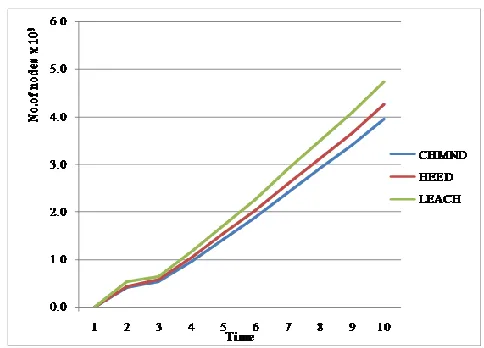
The energy consumption is the amount of energy consumed by the transmitter, receiver, processing unit and memory of a sensor node. It is directly proportional to the lifespan of the network.
Fig. 4 Energy Consumption (Time) Algorithm 1
Set node N={N1, N2,...Nn}
2 hop neighbouring Cluster Formation
tdij = tdik + tdkj Distance calculation
Td
tx= d
0x
1 𝛼𝑝0
𝑅𝑋𝑡ℎ 𝑟𝑒𝑠 ℎ
//Tdtx is a transmission distance //d0 is a distance
//p0 is received power at the distance //RXthresh Received power initialization Energy calculation
Energy = power * time Cluster Head selection
If R<T(n)
Node is considered as Cluster Head Else
Node is declared as normal
For each cluster C // C is the number of clusters Cluster Heads CH inspect routing table RT For every time interval T
If member node transmits data to Cluster Head CNpacket_transmissionCHReceived_packets //CN is a member node //CH is a Cluster Head Set as trusted node
Else
The node is malicious //Energy Efficiency
Set Node Energy = 100 Joules Start Packets transmission
Packets transmitted to Cluster Head If packet size = 0
Packet is dropped by Cluster Head Else
Packets are sent to base station //Dead node Identification
Dn = NE– (TPp +TPAck) = 0 //Dn is Dead node //NE is Node Energy //TP is Transmission power
//p is packet and Ack is Acknowledgement
Fig. 5 Energy Consumption (Nodes)
The graph in figure 4 and figure 5 shows the comparison of the energy consumed by different protocols. The energy consumption is relatively low 28% when compared to other methods, LEACH 35% and HEED 38% which leads to extended life span of 68.5% compared to other protocols.
Fig. 6 Comparison of Throughput (Time)
Fig. 7 Comparison of Throughput (Nodes)
Figure 6 and figure 7 shows a steady throughput of around in spite of the presence of malicious node. The throughput keeps on increasing with the number of rounds and reaches a maximum of 1Mb/s.
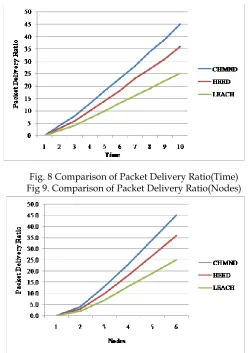
Fig. 8 Comparison of Packet Delivery Ratio(Time) Fig 9. Comparison of Packet Delivery Ratio(Nodes)
5610 Fig. 10 Comparison of Delay (Time)
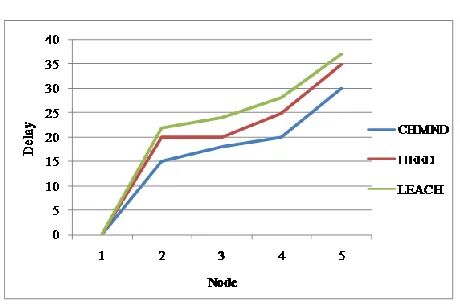
Fig.11 Comparison of Delay (Nodes)
Figure 10 and 11 shows the node on Delay of the proposed method with respect to simulation time. Since the CHMND predicts the node using the routing table information of the Cluster Head, the proposed protocol.
4
C
ONCLUSIONOne of the most critical issues in WSNs is that the security of the clusters amidst the malicious nodes. In this proposed work, detects the malicious node into a novel Hybrid Cluster Head Malicious Node Detection (CHMND) protocol. The protocol uses Cluster Head information was improved the effectiveness in malicious node detection. The proposed security protocol not only detects the malicious node accurately but also increases the life span of the network. The experimental result shows that the proposed methods outperforms the previous approaches, LEACH and HEED protocol.
R
EFERENCES[1] Karlof, C. and Wagner, D., 2003, May. ―Secure routing in wireless sensor networks: Attacks and countermeasures‖. In Proceedings of the First IEEE International Workshop on Sensor Network Protocols and Applications, 2003. (pp. 113-127). IEEE.
[2] Newsome, J., Shi, E., Song, D. and Perrig, A., 2004, April. ―The Sybil attack in sensor networks: analysis &defences‖. In Third international symposium on information processing in sensor networks, 2004. IPSN 2004 (pp. 259-268). IEEE.
[3] Wu, K. and Pooch, U.W., ―Secure Routing Against Black-hole Attack in Mobile Ad Hoc Networks‖ Bo Sun Dept. of Computer Science Texas A&M University.
[4] Hu, Y.C., Johnson, D.B. and Perrig, A., 2003. ―SEAD: Secure efficient distance vector routing for mobile wireless ad hoc networks‖. Ad hoc networks, 1(1), pp.175-192.
[5] Du, W., Fang, L. and Ningi, P., 2005, April. ―LAD: Localization anomaly detection for wireless sensor networks‖. In 19th IEEE International Parallel and Distributed Processing Symposium (pp. 15-pp). IEEE.
[6] Luo, H., Zerfos, P., Kong, J., Lu, S. and Zhang, L., 2002, July. ―Self-securing ad
hoc wireless networks‖. In ISCC (Vol. 2, p. 567).
[7] Preethi M , Rashmi Purad, Kavya D S, Chandrakala H ,2018, June. ‖ A Technique for Malicious Node Detection for Adaptive Data Fusion in Wireless Sensor Networks‖, International Journal of Scientific and Research Publications, . 8, Issue 6.
[8] Pires, W.R., de Paula Figueiredo, T.H., Wong, H.C. and Loureiro, A.A.F., 2004, April. ―Malicious node detection in wireless sensor networks‖. In 18th International Parallel and Distributed Processing Symposium, 2004. Proceedings. (p. 24). IEEE.
[9] Curiac, D.I., Banias, O., Dragan, F., Volosencu, C. and Dranga, O., 2007, June. ―Malicious node detection in wireless sensor networks using an auto regression technique‖. In International Conference on Networking and Services (ICNS'07) (pp. 83-83). IEEE.
[10] Marti, S., Giuli, T.J., Lai, K. and Baker, M., 2000, August. ―Mitigating routing misbehavior in mobile ad hoc networks‖. In Proceedings of the 6th annual international conference on Mobile computing and networking (pp. 255-265). ACM.
[11] Tseng, C.Y., Balasubramanyam, P., Ko, C., Limprasittiporn, R., Rowe, J. and Levitt, K., 2003, October. ―A specification-based intrusion detection system for AODV‖. In Proceedings of the 1st ACM workshop on Security of ad hoc and sensor networks (pp. 125-134). ACM.