IJEDR1701016
International Journal of Engineering Development and Research (www.ijedr.org)93
Effluent Treatment Plant using Modified Version of
Trickle Filter
1Darshan Girase, 2Priyanka Mahajan, 3Dr. A. R. Lokhande,
1&2B.E. Student, Department of Chemical Engineering, SSBT’s COET, Bambhori, NMU Jalgaon, India. 3Associate professor, Department of Chemical Engineering, SSBT’s COET, Bambhori, NMU Jalgaon, India.
4Principal SSBT’s COET, Bambhori, NMU Jalgaon, India.
Abstract - Industries are one of the major issue causing water pollution. In INDIA industry generates about gallons of waste water processed depending upon the process employed and product manufactured. The effluent was feed to the pilot scale trickle filter in two feeding modes, continuously and as a sequencing batch reactor (SBR)[1]. The two-stage
modified trickle filter packed with PVC shredding was tested to treat a mixed waste water with pharmaceutical personal care products, endocrine disrupters and illicit drugs which was discharge from pharmaceutical factories and passed through a sequence processes [2]. Biofilms are used in the trickle filter unit to reduce the biological impurity present in the
treated water. The waste water is treated in several steps to control parameters like BOD, COD, oil and grease, TDS, TSS, pH, chloride, turbidity, conductivity, hardness, and dissolved oxygen (DO).The COD, BOD’s, at 20°C and TSS removal efficiency of ETP were 96%,95% and 94% respectively, which are in the acceptable range of disposal into water bodies.
Keywords - Sequencing batch reactor (SBR), Trickle filter, Pharmaceutical personal care products (PPCP), endocrine disrupters and illicit drugs
________________________________________________________________________________________________________ I. INTRODUCTION:
Effluent Treatment Plants or (ETPs) are used by leading companies in the pharmaceutical and chemical industry to purify water and remove any toxic and nontoxic materials or chemicals from it. These plants are used by all companies for environment protection.
An ETP is a plant where the treatment of industrial effluents and waste waters is done. The ETP plants are used widely in industrial sector, for example, pharmaceutical industry, to remove the effluents from the bulk drugs.
During the manufacturing process of drugs, varied effluents and contaminants are produced. The effluent treatment plants are used in the removal of high amount of organics, debris, dirt, grit, pollution, toxic, nontoxic materials, polymers etc. from drugs and other medicated stuff. The ETP plants use evaporation and drying methods, and other auxiliary techniques such as centrifuging, filtration, incineration for chemical processing and effluent treatment.
The treatment of effluents is essential to prevent pollution of the receiving water. The effluent water treatment plants are installed to reduce the possibility of pollution; biodegradable organics if left unsolved, the levels of contamination in the process of purification could damage bacterial treatment beds and lead to pollution of controlled waters. The ETPs can be established in the industrial sectors like Pharmaceuticals, Chemicals and Leather industry and tanneries.
II. Materials and Methods A. Materials
The effluent was collected from a MacLeod’s Pharma Pvt. Ltd, Gujarat Industrial Development Corporation (G.I.D.C) area, Vapi, (Gujarat state).
All solvents used were of analytical grades. Diethyl ether, petroleum ether, ethanol, diethanolamine, HCl, H2SO4, NaOH, and KOH etc. were obtained from S.D. Fine Company and Qualigen Company, Mumbai.
PVC Shredding was obtained from Jain Irrigation Pvt. Ltd, Jalgaon (M. S.) B. Wastewater Characterization:
A detailed characterization was carried out on two-gram sample of mixed stream waste water taken at two different operation periods of the pharmaceutical industry. An average sample was subsequently formed by combining the individual sample (1.1 ratio). The measured parameters included: pH, total suspended solids (TSS), Total chemical oxygen demand (TCOD) and Dissolved oxygen demand (DCOD), 5-day biological oxygen demand (BOD), Total Kjeldahl nitrogen (TKN) and concentrations of specific metals (Fe, Mn, Cu, Pb, Zn, Cr). All analysis was carried out as described in standard methods [3].The basic characteristics of seven main waste water stream with low COD contain around or less than 3500 mg/L. With the highest organic strength that contributes to the formation of the final mixed wastewater and account for approximate one tenth of the total effluent flow rate 800 m3 per day were also assessed.
III. Experimental Process A. Graters
IJEDR1701016
International Journal of Engineering Development and Research (www.ijedr.org)94
Bar screens come in many designs. Some employ automatic cleaning mechanisms using electric motors and chains, some must be cleaned manually by means of a heavy rake. Items removed from the influent are collected in dumpsters and disposed of in landfills[6]. As a bar screen collects objects, the water level will rise, and so they must be cleared regularly to prevent overflow B. LimeHydrated lime's chemical name is calcium hydroxide, and its chemical formula is Ca(OH)2. When purifying water, adding hydrated lime to the water for pH adjustment is a part of the process.
Filter alum is an acidic salt that lowers the pH of water undergoing purification. Adding hydrated lime to this process between the sedimentation and filtration steps at the rate of 10 to 20 milligrams per liter neutralizes the effect of filter alum on the processing water[7].
C. Aluminum Sulfate
The chemical formula for aluminum sulfate is Al2(SO4)3. Frequently, it is known as filter alum. In water purification, a mixture of 48 percent filter alum in a water solution is combined with the raw incoming water at a rate of 18-24 milligrams per liter[7]. Alums are found in many household products such as deodorant and baking powder.
However, in water purification processes it is as a coagulant. A coagulant binds extremely fine particles suspended in raw water into larger particles that can be removed by filtration and settling.
This allows for the removal of unwanted color and cloudiness (turbidity). Additionally, the process removes the aluminum itself. D. Sedimentation
Sedimentation is a physical water treatment process using gravity to remove suspended solids from water[8].Solid particles entrained by the turbulence of moving water may be removed naturally by sedimentation in the still water of lakes and oceans. Settling basins are ponds constructed for removing entrained solids by sedimentation[9]. Clarifiers are tanks built with mechanical means for continuous removal of solids being deposited by sedimentation[10].
The limit sedimentation velocity of a particle is its theoretical descending speed in clear and still water. In settling process theory, a particle will settle only if:
1. In a vertical ascending flow, the ascending water velocity is lower than the limit sedimentation velocity.
2. In a longitudinal flow, the ratio of the length of the tank to the height of the tank is higher than the ratio of the water velocity to the limit sedimentation velocity
E. Pilot Trickle Filter
A schematic diagram of the pilot scale trickling filter that was used in our study as shown in figure(a). The trickle filter consists of a Plexiglas tube with inner diameter of 12cm and a total height of 210cm. The supporting material for bacteria growth were gravels with the mean of 10 mm mesh size and PVC shredding. The filter had a porosity of 0.36. At a top of the filter, a fixed flow distributer was installed to facilitate a uniform distribution of the wastewater fed to the filter free surface. The waste was feed to the reactor after being stirred in a storage tank, which was kept in a refrigerator at 4˚C at the bottom of a filter an air pump or blower was connected for supplying air to the system.
F. Trickle Filter Operations
Trickle bed reactors are packed bed reactors in which the gas phase is a continuous phase. The reactor consists of a vessel packed with the packing material (such as PVC shredding, gravels, sand, coconut shell, cotton, Iodine).The liquid phase (Wastewater) is introduced from the top of the reactor and trickle over the wetted packing. The space between the packing is occupied by the gas phase that flows either upward or downwards. The packing serves the dual purpose of immobilizing the biomass graving on its surface producing a high gas –liquid contact area enhances gas-liquid mass transfer. The important application of trickle bed reactor is in the aerobic treatment of waste water and are referred as trickling filters. They are concrete vessel shaving a circular shape and an open top. The packing material used are gravels, sand, PVC shredding, coconut shell, cotton, iodine. Gravels typically have the diameter of 25-100 mm a void space of 40-60mm are packed to heights varying between 0.9 to 2.5 m commonly used packing height is 1.8m. For plastic packaging (structure),The void space is about 94-97% & height of packing is varying from 4-12m.Therefore, this are operated at muse higher loading. A distribution mechanism is provided at the top of reactor for dispersing wastewater. The water trickle down the bed and the effluent water is collected by and under drain system. Air is circulated through the bed either by natural convection or force convection. During the operation, there is growth of biofilm and thickness is increases. As no air now become available from microbes they enter a phase of endogenous respiration and lose their ability to remain attached to the packing. This detachment of portion of biofilms required the presence of clarifier at the downstream to remove the suspended solids from the effluent. Effluent recycle can also by use in the operation of trickling filter to dilute the concentration of the pollutants in the incoming streams. Sedimentation tank is employed prior to trickling filter, the detention time for which is reduced to 1.5 hours only due to addition of reagents. This enhances the overall efficiency of treatment plant apart from satisfying space constraints in a typical industry setup. Again, proving to be more economical and cost effective solution. The sedimentation tank designed is of the hopper type.
G. Clarifiers
Clarifiers are settling tanks built with mechanical means for continuous removal of solids being deposited by sedimentation[11]. A clarifier is generally used to remove solid particulates or suspended solids from liquid for clarification and (or) thickening. Concentrated impurities, discharged from the bottom of the tank are known as sludge, while the particles that float to the surface of the liquid are called scum.
IJEDR1701016
International Journal of Engineering Development and Research (www.ijedr.org)95
IV. Batch Experiment
After the basic operational treatments, such with lime and alum a small scale experimentation took place using a fluidized pack bed reactor. Mechanical stirrer for mixing process and air compressor was used for the complete action of trickle filter.
V. Method of analysis:
The waste water sample were treated using the following qualitative and quantitative analysis. A. Chloride content
The method is suitable for the analysis of chloride ion concentration in relatively clean water 0.15 to 10 mg of Cl is present in the portion titration.
The titration is a standardized solution of AgNO3. Chloride ions are quantitatively precipitated as AgCl before the silver chromate precipitate formed[12].
Ag⁺(aq) + Cl ֿ (aq) → AgCl (s) 2Ag⁺(aq) + CrO₄² ֿ (aq) → AgCrO₄ (s)
IJEDR1701016
International Journal of Engineering Development and Research (www.ijedr.org)96
Organic and inorganic oxidized by standard potassium dichromate solution in an acidic medium. Oxidation is facilitated by silver sulphate which acts as a catalyst. Oxidation of chlorine is inhabited by the addition if mercuric sulphate which forms more stable mercuric chloride complex. Oxidation reaction involved by dichromate is illustrated by the following reaction. Considering potassium hydrogen phthalate as an oxidable matter contributing to COD[13].41H₂SO₄+10K₂Cr₂O₇+ 2KC₈H₅O₄→ 10Cr₂(SO₄) ₃ + 11K₂SO₄ + 16 CO₂ + H₂O. Because 1 mole of K₂Cr₂O₇=3[O] i.e. 1.5 moles of oxygen
Therefore 10 moles of K₂Cr₂O₇=30[O] i.e. 15 moles of O₂ the equivalent reaction will be 2 KC₈H₅O₄ + 15 O₂ +H₂SO₄→ 16CO₂ + 6H₂O + K₂SO₄
C. Dissolve Oxygen
The idometric test is the most precise and reliable. Titrimetric procedure for DO analysis. It is based on the addition of divalent manganese solution, followed by strong alkali, to the sample in a glass Stoppard bottle. DO rapidly oxides an equivalent amount of the dispersed divalent manganous hydroxide precipitate to hydroxides of the higher valance states. In the presence of iodine ions in an acidic solution, the oxidized manganese reverts to the divalent state, with the liberation of iodine equivalent to the original DO content. The iodine is then titrated with a standard solution of thiosulfate.
The titration end point can be detected visually, with a starch indicator. Experienced analysts can maintain a precision of +50g/L with visual end point[12].
D. pH
The basic principle of electrometric pH measurement is determination of the activity of the hydrogen ions by potentiometric measurement using a standard hydrogen electrode and a reference electrode. The hydrogen electrode consists of a platinum electrode across which hydrogen gas is bubbles at a pressure of 101 kPa. The electromotive force produce in a glass electrode system varies linearly with pH. This `linear relationship is described by plotting the measured EMF against the pH of different buffer. Sample pH is determined by extra potential[12].
E. Electric Conductivity
Electrical conductivity in water sample is determined by Conductivity Cell Potentiometric method[12]. F. Turbidity
This method is based on the comparison of the intensity of the light scattered at right angle by sample under defined conditions with the intensity of light scattered by standard solution under the same conditions. The higher the intensity of scattered light the higher is the turbidity[12].
G. Hardness
Ethylene diamine tetra acetic acid and its sodium salt (abbreviated EDTA) from a chelated soluble complex with added a solution of certain metal cations. If a small amount of dye such as eriochrome black T is added to an aqueous solution containing calcium and magnesium ions at the p of 10.0 + 0.1, the solutions become wine red. If EDTA is added as titrate, calcium and magnesium will be complexed and when all the calcium and magnesium has been complexed the solution turn into red to blue marking the end point of titrations[12].
H. Total Solids
A well-mixed sample is evaporated in a weighted disk and dried to constant weight in an oven at 103° to 105° C. The increase of weight over the empty disk represents the total solids. The result may not be represented by weight of actual dissolved and suspended solids in waste water sample[12].
Detectable range: range up to 20,000 mg/L. I. Dissolve Solids
A well-mixed sample is filtered through a standard glass fiber filter, and the filtrate is evaporated to dryness in a weighed disk and dried to constant weight at 180°C. The increase in disk weight represent the dissolved solids. The procedure may reduce for drying at other temperature[12].
J. Total Suspended Solids
A well-mixed sample is filtered through a standard glass fiber filter, and the residue retained on the filter is dried at a constant weight at 103° to 105° C. The increase in the weight of the filter represent the total suspended solids. To obtained the estimate of the total suspended solids calculate the difference between the total dissolve solids and total solids[12].
K. BOD
IJEDR1701016
International Journal of Engineering Development and Research (www.ijedr.org)97
L. Oil and GreaseHigh solubility of oil and grease in organic solvent is the basic of the estimations. Light petroleum ether is boiling in between 40 -60°C is the most suitable solvent.
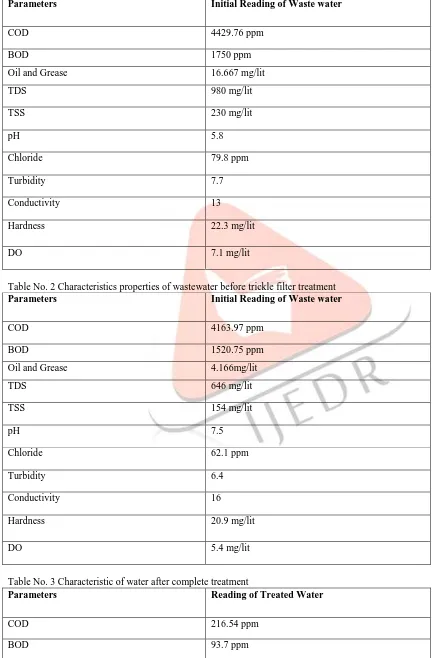
Table No. 1 Characteristics properties of wastewater before treatment
Parameters Initial Reading of Waste water
COD 4429.76 ppm
BOD 1750 ppm
Oil and Grease 16.667 mg/lit
TDS 980 mg/lit
TSS 230 mg/lit
pH 5.8
Chloride 79.8 ppm
Turbidity 7.7
Conductivity 13
Hardness 22.3 mg/lit
DO 7.1 mg/lit
Table No. 2 Characteristics properties of wastewater before trickle filter treatment
Parameters Initial Reading of Waste water
COD 4163.97 ppm
BOD 1520.75 ppm
Oil and Grease 4.166mg/lit
TDS 646 mg/lit
TSS 154 mg/lit
pH 7.5
Chloride 62.1 ppm
Turbidity 6.4
Conductivity 16
Hardness 20.9 mg/lit
DO 5.4 mg/lit
Table No. 3 Characteristic of water after complete treatment
Parameters Reading of Treated Water
COD 216.54 ppm
IJEDR1701016
International Journal of Engineering Development and Research (www.ijedr.org)98
Oil and Grease 2.443 mg/lit
TDS 450 mg/lit
TSS 89 mg/lit
pH 7.1
Chloride 5.8 ppm
Turbidity 5.6
Conductivity 18
Hardness 18.4 mg/lit
DO 4.7 mg/lit
RESULT AND DISTRIBUTION
The proposed solution is a cost effective and affordable treatment technology, waste re-use at its core, this solution addresses the current need of the industries. The experiment was performed at laboratory level in batch mode.
In the present investigation, initial characterization of the effluent showed (Table 1) varying level of various physicochemical parameters where effluent along with unpleasant odour were observed. The pH of pharmaceutical effluent was observed acidic. Electrical conductivity was also recorded to be higher. In general, more total solids were observed in effluent (1210 mg/lit), the turbidity was 7.7 NTU (Nephelometric turbidity unit), indicating higher solids and organic. Hardness of effluent was 22.3 mg/lit. Gradually different parameters are decreased at different stages. The treated water obtained after the primary clarifier is can be further used in the Gardening as well as Coolant water.
CONCLUSION:
The proposed design offers better prospects for full scale industrial application. It offers value-added benefits like BOD reduction even at filtration stage, eliminating need for large aerators. No necessity for advanced techniques like ultra-filtration, RO, UV, etc. Longer service life than most available products or plants in the Market.
REFERENCES
[1] M. Kornaros, , G. Lyberatos (2006) Biological treatment of wastewaters from a dye manufacturing company using a trickling filter.
[2] Barbara Kasprzyk-Hordern, Richard M. Dinsdale, Alan J. Guwy (2010)Erratum to “The removal of pharmaceuticals, personal care products, endocrine disruptors and illicit drugs during wastewater treatment and its impact on the quality of receiving waters” Water Research, Volume 44, Issue 6, Page 2076
[3] A.D. Eaton, L.S. Clesceri, A.E.Greenberg (Eds.)(1995) Standard Methods for the Examination of Water andWastewater, 19th ed., Washington D.C.
[4] Streicher, Dennis(2012) "Waste Water Treatment Plant Elmhurst, Illinois A Virtual Tour". [5] Spellman, Frank R. (2010). Spellman's Standard Handbook for Wastewater Operators, Volume 3.
[6] Ragsdale, Fred. Wastewater System Operators Manual (PDF). Ragsdale and Associates Training Specialists, LLC. [7] Puja Mondal Types of Wastewater Treatment Process: ETP, STP and CETP
[8] Omelia, C (1998). "Coagulation and sedimentation in lakes, reservoirs and water treatment plants". Water Science and Technology.
[9] Franson, Mary Ann. (1975) Standard Methods for the Examination of Water and Wastewater. 14th ed. Page no. 89–98 [10] Hammer, Mark J. (1975)Water and Waste-Water Technology. John Wiley &Sons. Page No. 223–225