University of Pennsylvania
ScholarlyCommons
Publicly Accessible Penn Dissertations
2018
Combinatorial Optimization On Massive Datasets:
Streaming, Distributed, And Massively Parallel
Computation
Sepehr Assadi
University of Pennsylvania, [email protected]
Follow this and additional works at:
https://repository.upenn.edu/edissertations
Part of the
Computer Sciences Commons
This paper is posted at ScholarlyCommons.https://repository.upenn.edu/edissertations/3090
Recommended Citation
Assadi, Sepehr, "Combinatorial Optimization On Massive Datasets: Streaming, Distributed, And Massively Parallel Computation" (2018).Publicly Accessible Penn Dissertations. 3090.
Combinatorial Optimization On Massive Datasets: Streaming,
Distributed, And Massively Parallel Computation
Abstract
With the emergence of massive datasets across different application domains, there is a rapidly growing need to solve various optimization tasks over such datasets. This in turn raises the following fundamental question:
How well can we solve a large-scale optimization problem on massive datasets in a resource-efficient manner?
The focus of this thesis is on answering this question for various problems in different modern computational models for processing massive datasets, in particular, streaming, distributed, and massively parallel
computation (such as MapReduce) models.
The first part of this thesis is focused on graph optimization, in which we study several fundamental graph optimization problems including matching, vertex cover, and connectivity. The main results in this part include a tight bound on the space complexity of the matching problem in dynamic streams, a unifying framework for achieving algorithms that improve the state-of-the-art for matching and vertex cover problems in all the mentioned models, and the first massively parallel algorithm for connectivity on sparse graphs that improve upon the classical parallel PRAM algorithms for a large family of graphs.
In the second part of the thesis, we consider submodular optimization and in particular two canonical
examples of set cover and maximum coverage problems. We establish tight bounds on the space complexity of approximating set cover and maximum coverage in both single- and multi-pass streams, and build on these results to address the general problem of submodular maximization across all aforementioned models.
In the last part, we consider resource constrained optimization settings which require computation over data which is not particularly large but still imposes restrictions of similar nature. Examples include optimization over data which can only be accessed with limited adaptivity (e.g. in crowdsourcing applications), or corresponds to private information of agents and is not available in an integrated form (e.g., in auction and mechanism design applications). We use the toolkit developed in the first two parts of the thesis to obtain several new results for such problems, significantly improving the state-of-the-art.
A common theme in this thesis is a rigorous study of problems from both an algorithmic perspective and impossibility results. Rather than coming up with ad hoc solutions to problems at hand, the goal here is to develop general techniques for solving various large-scale optimization problems in a unified way in different models, which in turns requires further understanding of the limitations of known approaches for addressing these problems.
Degree Type Dissertation
Degree Name
Doctor of Philosophy (PhD)
Graduate Group
First Advisor Sanjeev Khanna
Keywords
Combinatorial Optimization, Communication Complexity, Distributed Computing, Massively Parallel Computation, Streaming
COMBINATORIAL OPTIMIZATION ON MASSIVE DATASETS:
STREAMING, DISTRIBUTED, AND MASSIVELY PARALLEL COMPUTATION
Sepehr Assadi
A DISSERTATION in
Computer and Information Science
Presented to the Faculties of the University of Pennsylvania in
Partial Fulfillment of the Requirements for the Degree of Doctor of Philosophy
2018
Supervisor of Dissertation
Sanjeev Khanna
Henry Salvatori Professor
Computer and Information Science
Graduate Group Chairperson
Rajeev Alur
Zisman Family Professor
Computer and Information Science
Dissertation Committee
Sampath Kannan (Chair), Henry Salvatori Professor, Computer and Information Science Aaron Roth, Class of 1940 Bicentennial Term Associate Professor, Computer and
Information Science
Val Tannen, Professor, Computer and Information Science
COMBINATORIAL OPTIMIZATION ON MASSIVE DATASETS:
STREAMING, DISTRIBUTED, AND MASSIVELY PARALLEL COMPUTATION
COPYRIGHT
2018
Sepehr Assadi
Acknowledgements
First and foremost, I would like to express my deepest gratitude to my advisor Sanjeev Khanna for his perfect guidance, caring, engagement, patience, and support. Sanjeev and I spent countless hours meeting (literally) every day for the past few years on topics ranging from highly technical discussions on our joint projects or perhaps a cute problem one of us had recently encountered, to interesting research directions, and then to broader career and life advice. Sanjeev’s utter commitment to my professional and personal development and countless hours of devotion to our work on one hand, and the freedom he gave me in my research on the other impacted me significantly. Being Sanjeev’s student is the most cherished experience of my academic life and I am thankful every day for the privilege I had in having him as my advisor. I cannot thank you enough Sanjeev!
I am immensely grateful to Michael Kapralov, Val Tannen, and Omri Weinstein for additional mentoring over the last few years. Working with Michael and learning from him had a great impact on me and I had a lot of fun throughout our collaborations. Val has always been an endless source of advice, support, and encouragement since the early days of my academic life at Penn. Omri’s support and never-ending commitment in general and his enthusiasm and great taste in choosing meaningful problems to work on in particular made collaborating with him one of my most rewarding experiences.
I want to further express my gratitude to Sampath Kannan, Michael Kapralov, Aaron Roth, and Val Tannen for devoting their time and serving on my thesis committee, and for their frequent advice and suggestions. I am also indebted to CS department staff at Penn, specially Mike Felker, Cheryl Hickey, and Lily Hoot, for all their help.
I would like to thank MohammadHossein Bateni and Vahab Mirrokni for being my mentors during a summer internship at Google Research, and Krzysztof Onak, Baruch Schieber, and Shay Solomon for hosting me during a short but fruitful visit to IBM research.
I further thank Mohammad Ghodsi, Mohammad Izadi, and Hamid Zarrabi-Zadeh for their help and support at the beginning of my academic life as an undergraduate at Sharif University and for forming my interest in theoretical computer science.
A big thank you to my friends in the last five years at Penn: Nimit, Shahin, Alyssa, Mahyar, Hoda, Rachel, Jamie, Steven, and Justin. Special thanks to Nimit for being my friend right from the start of my new life away from home, to Alyssa for countless hours of wandering around in Philly, and to Shahin for being super helpful with everything and introducing me to indoor rock climbing. Many thanks also to Eric, Manolis, Naman, Sadra, Thodoris, Zelda, and other interns at Google for their invaluable friendship. I also like to thank a few of my friends over the years that certainly made their marks on my life: to Ashkan, Ehsan, Nooshin, and Saeid for being the greatest friends one could ever hope for and for always being there for me even though life had kept us mostly apart.
ABSTRACT
COMBINATORIAL OPTIMIZATION ON MASSIVE DATASETS:
STREAMING, DISTRIBUTED, AND MASSIVELY PARALLEL COMPUTATION Sepehr Assadi
Sanjeev Khanna
With the emergence of massive datasets across different application domains, there is a rapidly growing need to solve various optimization tasks over such datasets. This raises the following fundamental question: How well can we solve a large-scale optimization problem on massive datasets in a resource-efficient manner? The focus of this thesis is on answering this question for various problems in different computational models for processing massive datasets, in particular, streaming, distributed, and massively parallel computation models.
The first part of this thesis is focused on graph optimization, in which we study several fundamental graph optimization problems including matching, vertex cover, and connectivity. The main results in this part include a tight bound on the space complexity of the matching problem in dynamic streams, a unifying framework for achieving algorithms that improve the state-of-the-art for matching and vertex cover problems in all the men-tioned models, and the first massively parallel algorithm for connectivity on sparse graphs that improve upon the classical parallel PRAM algorithms for a large family of graphs.
In the second part of the thesis, we consider submodular optimizationand in par-ticular two canonical examples of set cover and maximum coverage problems. We establish tight bounds on the space complexity of approximating set cover and maximum coverage in both single- and multi-pass streams, and build on these results to address the general problem of submodular maximization across all aforementioned models.
In the last part, we consider resource constrained optimizationsettings which re-quire computation over data which is not particularly large but still imposes restrictions of similar nature. Examples include optimization over data which can only be accessed with limited adaptivity (e.g. in crowdsourcing applications), or corresponds to private informa-tion of agents and is not available in an integrated form (e.g., in aucinforma-tion and mechanism design applications). We use the toolkit developed in the first two parts of the thesis to obtain several new results for such problems, significantly improving the state-of-the-art.
Table of Contents
Acknowledgement . . . iv
Abstract . . . vi
List of Tables . . . x
List of Illustrations . . . xi
Chapter 1 : Introduction . . . 1
1.1 Computational Models for Processing Massive Datasets . . . 3
1.2 Overview of the Previous Research . . . 12
1.3 Our Main Contributions . . . 15
1.4 How to Read this Thesis . . . 24
Chapter 2 : Background . . . 25
2.1 Notation and Preliminaries . . . 25
2.2 Matching and Vertex Cover . . . 27
2.3 Ruzsa-Szemer´edi Graphs . . . 29
2.4 Set Cover and Maximum Coverage . . . 31
2.5 Submodular, XOS, and Subadditive Functions. . . 31
2.6 Information Theory . . . 33
2.7 Communication Complexity . . . 36
2.8 Information Complexity . . . 45
I Graph Optimization on Massive Graphs 50 Chapter 3 : Maximum Matching in the Streaming Model . . . 51
3.1 Background . . . 52
3.2 Our Results and Techniques . . . 53
3.3 Preliminaries . . . 57
3.4 An α-Approximation Algorithm for Matching . . . 60
3.5 A Space Lower Bound forα-Approximation of Matching . . . 65
3.6 Space Lower Bounds for α-Estimating Matching Size . . . 70
3.7 Space Lower Bounds for (1 +ε)-Estimating Matching Size . . . 80
Chapter 4 : A Framework for Optimization on Massive Graphs . . . 89
4.1 Background . . . 90
4.2 Our Results and Techniques . . . 91
4.3 Preliminaries . . . 97
4.4 Simple Randomized Composable Coresets . . . 98
4.5 Lower Bounds for Randomized Composable Coresets . . . 107
4.6 Improved Randomized Composable Coresets. . . 110
Chapter 5 : Massively Parallel Algorithms for Matching and Vertex Cover with Linear Memory Per Machine . . . 119
5.1 Background . . . 120
5.2 Our Results and Techniques . . . 120
5.3 Preliminaries . . . 122
5.4 MPC Algorithms for Matching and Vertex Cover . . . 122
Chapter 6 : Massively Parallel Algorithms for Connectivity on Sparse Graphs . . . 133
6.1 Background . . . 134
6.2 Our Results and Techniques . . . 135
6.3 Preliminaries . . . 138
6.4 Technical Overview of Our Algorithm . . . 141
6.5 Step 1: Regularization . . . 144
6.6 Step 2: Randomization. . . 149
6.7 Step 3: Connectivity in Random Graphs . . . 156
6.8 Putting Everything Together . . . 167
6.9 A Mildly Sublinear Space Algorithm for Connectivity . . . 170
6.10 A Lower Bound on Well-Connected Graphs . . . 171
II Submodular Optimization on Massive Datasets 175 Chapter 7 : Coverage Problems in the Streaming Model . . . 176
7.1 Background . . . 177
7.2 Our Results and Techniques . . . 178
7.3 Preliminaries . . . 181
7.4 A Single-pass Lower bound for α-Approximate Set Cover . . . 182
7.5 Technical Overview of Multi-pass Streaming Lower Bounds . . . 189
7.6 Space-Approximation Tradeoff for Multi-Pass Set Cover . . . 191
Chapter 8 : Submodular Maximization in the Distributed
Communication Model . . . 207
8.1 Background . . . 208
8.2 Our Results and Techniques . . . 209
8.3 Technical Overview . . . 211
8.4 A Framework for Proving Distributed Lower Bounds . . . 214
8.5 A Distributed Lower Bound for Maximum Coverage . . . 227
8.6 Distributed Algorithms for Maximum Coverage . . . 233
8.7 Applications to Other Models of Computation. . . 243
III Applications to Resource Constrained Optimization Problems 245 Chapter 9 : Interaction in Combinatorial Auctions . . . 246
9.1 Background . . . 247
9.2 Our Results and Techniques . . . 248
9.3 Preliminaries . . . 249
9.4 The Lower Bound . . . 251
Chapter 10 : Learning With Limited Rounds of Adaptivity . . . 256
10.1 Background . . . 256
10.2 Our Results and Techniques . . . 258
10.3 Preliminaries . . . 259
10.4 A Tight Round-Query Tradeoff for Coin-tossing. . . 260
List of Tables
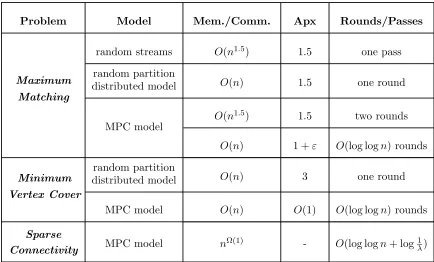
TABLE 1 : A sample of our algorithms for graph optimization on massive graphs 19
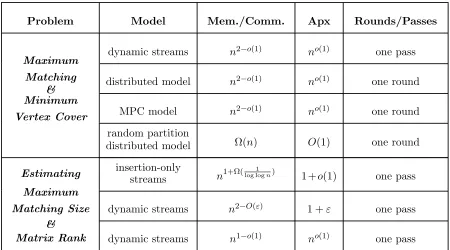
TABLE 2 : A sample of our impossibility results for graph optimization on
mas-sive graphs . . . 20
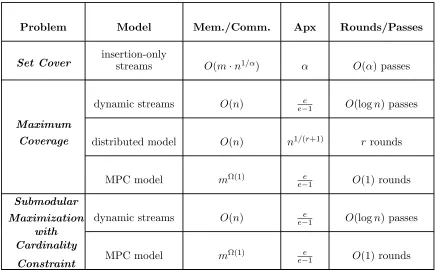
TABLE 3 : A sample of our algorithms for submodular optimization over mas-sive datasets . . . 22
TABLE 4 : A sample of our impossibility results for submodular optimization
List of Illustrations
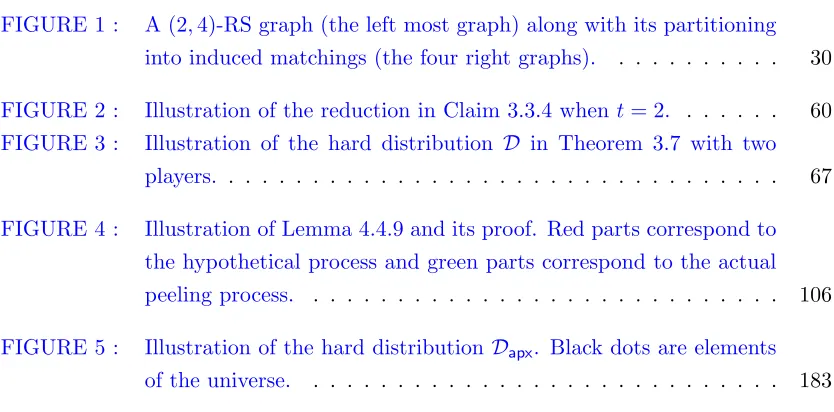
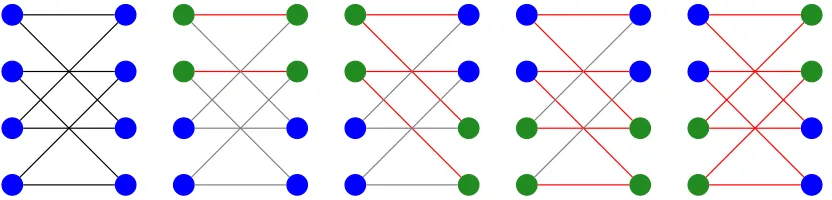
FIGURE 1 : A (2,4)-RS graph (the left most graph) along with its partitioning into induced matchings (the four right graphs). . . 30
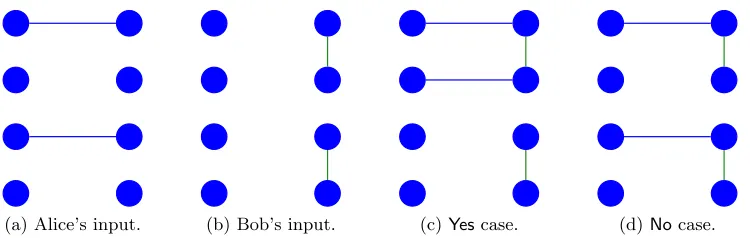
FIGURE 2 : Illustration of the reduction in Claim 3.3.4 whent= 2. . . 60
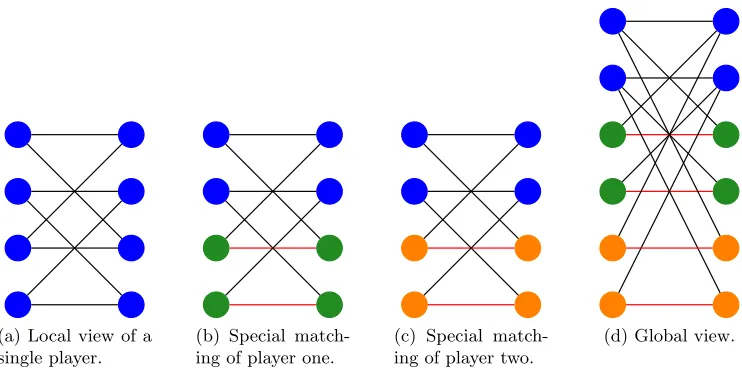
FIGURE 3 : Illustration of the hard distribution D in Theorem 3.7 with two players. . . 67
FIGURE 4 : Illustration of Lemma 4.4.9 and its proof. Red parts correspond to
the hypothetical process and green parts correspond to the actual peeling process. . . 106
FIGURE 5 : Illustration of the hard distribution Dapx. Black dots are elements
Chapter 1
Introduction
Massive datasets abound. For instance, Google has been processing more than 20 Petabytes of data on a day-to-day basis for nearly a decade now [115], Facebook graph has contained more than trillion edges for quite some time [100], and in some applications, we now need to process streams of data at a rate of Gigabytes per second [91]. The need to process such massive datasets necessitates rethinking the task of algorithm design as the traditional computational models do not capture these scenarios accurately. For instance, it is no longer realistic to assume the standardrandom access model where the data can be accessed in an arbitrary order and that each data access has unit cost. As a result, we are now encountering a paradigm shift toward modern computational models that can more accurately capture the essence of computation on massive datasets.
A salient challenge in processing massive datasets is that the entire input is orders of magnitude larger than the amount of storage on one processor. To address this chal-lenge, several different computational models have been introduced, each focusing on certain additional resources needed to solve large-scale problems. Examples include the stream-ing model, the distributed communication model, and the massively parallel computation (MPC) model that is a common abstraction of MapReduce-style computation. The main target resources in these models are the (internal)memoryin case of streaming algorithms, the communication in distributed algorithms, and both memory and communication, as well as number of rounds of computation, for MPC algorithms.
The research presented in this thesis stems from pursuing the above questions for two general family of combinatorial optimization problems, namelygraph optimization and sub-modular optimization.
Massive graphs are ubiquitous. For example, both the web graph and models of the human brain use around 1010nodes [242]. Analyzing massive graphs via classical algorithms can be challenging given the sheer size of these graphs. As such, there has been extensive interest in studying graph optimization problems in different models of computation over massive datasets. Submodular optimization also encompasses a wide variety of problems in combinatorial optimization including set cover, maximum coverage, minimum/maximum cut, to name a few. These problems have various applications in different areas including in machine learning, operations research, information retrieval, data mining, and web host analysis. As a result, submodular optimization has also received quite a lot of attention in models of computation over massive datasets.
We describe new techniques for developing algorithms and impossibility results for graph optimization and submodular optimization problems on massive datasets, with the following broad consequences:
• a general algorithmic approach for graph optimization applicable to all three models discussed above that bypasses the impossibility results known for prior techniques;
• the first MPC algorithm for a graph problem that breaks the well-known linear-memory barrier in this model;
• the first non-trivial impossibility result for a graph or submodular optimization prob-lem in dynamic streams that can be solved “easily” in insertion-only streams;
• a new framework for proving impossibility results for multi-round distributed algo-rithms and multi-pass dynamic streaming algoalgo-rithms.
Using these techniques we analyze a variety of central optimization problems in modern computational models for processing massive datasets and closely related models, and obtain improved algorithms and impossibility results for the following:
• the maximum matching problem;
• the minimum vertex cover problem;
• the graph connectivity problem in undirected graphs;
• the problem of estimating rank of a given matrix;
• the set cover problem;
• constrained submodular maximization;
• welfare maximization in combinatorial auctions;
• best arm identification in stochastic multi-armed bandits;
• ranking from pairwise comparisons;
A common theme in this thesis is a rigorous theoretical study of the problems from both an algorithmic perspective and impossibility results. Rather than coming up with an ad hoc solution to each problem at hand, the goal here is to develop general techniques for solving large-scale optimization problems in a unified way in different computational models. This can only be achieved by understanding the powers and limitations of current algorithmic approaches for solving these problems to know when and why these techniques fail and how a new approach can circumvent such limitations.
In the rest of this section, we elaborate more on our results and backgrounds. We start by formally defining the modern computational models that we work with in this thesis in Section1.1. In Section 1.2, we review some of the research that has been done in this area in the past. Section1.3next describes our main contributions in this thesis. A short outline of the remainder of this thesis appears in Section1.4.
1.1. Computational Models for Processing Massive Datasets
The three main computational models that we consider in this thesis are streaming, dis-tributed communication, andmassively parallel computation (MPC)model. We define these models below and review some basic backgrounds about each. We then describe some of the main connections between these models and general algorithmic approaches that are applicable to all these models simultaneously.
1.1.1. The Streaming Model
Data streams are ubiquitous. Examples include the network traffic flowing past a router, files read from an external memory device, or data transmitted by a satellite. The streaming model abstracts the main algorithmic constraint when processing such data: sequential access to data and limited working memory.
large. In this setting, having a streaming algorithm that is able to process the data in these files as a stream of sequential accesses, while using a limited working memory (that resides on the main memory of a computer) can lead to a dramatic boost in the efficiency.
We now define the streaming model formally. For our purpose, we simply consider a data stream as a long sequence of data items, A = ha1, . . . , ami where each data item ai
comes from some large universe U. Depending on the application, this universe U can be, say, numerical values in some range, a collection of subsets of a known ground-set, or edges of a graph, to mention a few. The goal is to compute a known function of the data stream, which in the context of the examples above can be, number of distinct elements in A, a minimum set cover of the ground-set using the sets in A, or a maximum matching in the graph defined byA. In order to do this, the algorithms are allowed to make (preferably) one or a few passes over the stream A, while using a limited memory which is (much) smaller than bothAandU. The algorithm outputs the solution after the last pass over the stream. As is clear from the discussion above, the main resources of interest in streaming al-gorithms are number of passes over the input and memory requirement or space complexity of the algorithm. In different settings the limits on these resources vary. For instance, in external memory applications, multiple passes over the input maybe feasible, whereas processing the traffic flow of a router inherently requires a single-pass streaming algorithm; additionally, in the former example, a working memory that is, say, quadrati-cally smaller than the input size may be accommodated while in the latter application one typically needs algorithms with space complexity exponentially smaller than the input size. We remark that for typical optimization problems in the streaming model—the focus of this thesis—the former setting of parameters, i.e., allowing multiple (yet small) number of passes over the input and memory requirement which is smaller only by a polynomial factor from the input size is the main setting of interest.
Stream order. One important facet of the streaming model is how the items are ordered in the data stream. A common approach here is to make no assumption about the ordering of the items arriving in data stream, a setting often referred to as adversarially-ordered
streams. However, this approach is often too pessimistic and may limit the power of algo-rithms to the point of ruling out any non-trivial theoretical guarantees. As such, depending on the underlying application, it is sometimes preferable to considerrandom order streams in which the ordering of the m items in data stream is chosen uniformly at random from all m! possible orderings.
streams) in which both insertion and deletion of items are allowed in the stream, and the goal is to solve the problem on the final set of data items present. More formally, each entry of the data stream is a pair (a,∆) fora∈ U and ∆∈ {−,+}, and the interpretation is that the item ais inserted to input whenever ∆ = + and is deleted otherwise. We assume that no item is ever deleted in the stream before being inserted (a model known asstrict turnstile model). It is immediate to verify that dynamic streams is a generalization of insertion-only streams. We study both models in this thesis.
The streaming model evolved primarily over the course of three papers [17, 179, 141] although it has its root in several older papers [251,253,145]. We refer the interested reader to a survey by Muthukrishnan [254] for more details.
1.1.2. The Distributed Communication Model
Oftentimes a massive dataset is distributed across multiple machines, which are inter-connected by a communication network, and to process the data, the machines need jointly compute a function defined on the union of their inputs by exchanging messages with each other. For instance, social network graphs are usually stored on many different machines and to answer queries such as whether the whole graph is connected, we have to synthesize data from all the machines. The distributed communication model is a common abstrac-tion of computaabstrac-tion in these scenarios, focusing primarily on the amount ofcommunication
between machines, and the number ofrounds of communication (under various constraints on what messages can be sent by each machine in each round).
We now define this model formally. Let A= (a1, . . . , am) be a collection of input data
items chosen from a universe U. As before, these items can be anything ranging from numerical values to edges of some graph. The input A is partitioned across k machines
P(1), . . . , P(k)sometimes referred to as players. We assume additionally that there exists an additional party, called the coordinator, who receives no input. Players can only commu-nicate with the coordinator and not with each other directly. The addition of coordinator is only for simplifying the model: instead of playerP(i) sending a message xto player P(j)
directly,P(i) can simply send the message (x, j) to the coordinator and the coordinator can relay this message to P(j)1. Communication happens over synchronous rounds. In each round, all players simultaneously send a message to a central coordinator who then commu-nicates back to all machines to guide the computation for the next round. We sometimes refer to distributed algorithms asprotocolsalso. We make the standard assumption that the players in this model have access to public randomness, i.e., a shared tape of randomness bits that they can all access.
1
Similar in spirit to the assumptions made on the ordering of data streams in the stream-ing model, here also one can make different assumptions about thepartitioning of the input across different machines. Two common assumptions areadversarial partitions, where data items can be partitioned arbitrarily, andrandom partitions, where each item is sent to one of the machines chosen uniformly at random.
The main computational resources of interest in the distributed communication model areround complexity andcommunication complexity, which are respectively, the to-tal number of communication rounds, and the toto-tal communication by players measured in the number of bits communicated. It is easy to see that communicationlinear in input size always allows for solving the problem in one round of communication. Alas, such a commu-nication is prohibitively expensive in case of massive inputs—the focus of this thesis—and hence in this model we are interested in protocols with (much) smaller communication complexity than the input size.
We note that, depending on the application, different variations of the distributed communication model we defined above have been studied in the literature (the model that we adopt is typically referred to as the coordinator model in the literature, see, e.g. [268]). The choice of this particular model in this thesis is tailored specifically towards large-scale optimization on massive datasets to capture the necessity of obtaining protocols with low-cost communication complexity that are “fast” i.e., finish the computation in a small number of parallel rounds of communication.
1.1.3. The Massively Parallel Computation Model
For over a decade now, we have witnessed the emergence of various parallel computing platforms such as MapReduce, Hadoop and Spark for processing massive datasets (see, e.g. [115,299,309]). A key differentiating feature of these platforms from previous (theoret-ical) models of parallel computation is that they interleave sequential and parallel computa-tion by allowing much more local computacomputa-tional power and storage to processors compared to classical settings such as PRAM. The massively parallel computation (MPC) model has been proposed in the theory community to capture this key feature of these platforms to allow an algorithmic approach to these platforms.
LetA= (a1, . . . , am) again be a collection of input data items chosen from some known
universe U. In the MPC model, we have pmachines each with local memory s. The input is originally partitioned across the machines in a load balanced way. It is required that both the number of machines and the local memory of each machine to be at most m1−δ
for some constant δ >0, and that the total memory of the system be at most Oe(m), i.e., proportional (within logarithmic factors) to the total input size2. The motivation behind
2
these constraints is that the number of machines, and local memory of each machine should be much smaller than the input size to the problem since these frameworks are used to process massive datasets.
Computation in this model proceeds in synchronous rounds. During a round, each machine runs a local algorithm on the data assigned to it. No communication between machines is allowed during a round. Between rounds, machines are allowed to communicate so long as each machine send or receive a communication no more than its memory. Any data output from a machine must be computed locally from the data residing on the machine (this data includes the previous messages received and stored by the machine as well). The primary resource of interest in the MPC model is the total number of rounds, referred to as theround complexity of the algorithm.
The MPC model was initially introduced by Karloffet al. [213] and was further refined in a series of work [161,23,53]. In this thesis, we adopt the most stringent (as well as the most popular) definition of this model due to Beameet al. [53].
We point out that the MPC model is a special case of the Bulk-Synchronous-Parallel (BSP) model [294], but has the advantage of having fewer parameters. This makes algorithm design more “coarse-grained” and streamlines the search for efficient algorithms, as evident by the omnipresence of this model in practice.
Comparison with PRAM algorithms. Before we move on from this section, it is imperative to compare the power of MPC algorithms with the classical parallel algorithms in the PRAM model. It was first shown in [213] that one can simulateT steps of an EREW PRAM algorithm by an MPC algorithm inO(T) MPC rounds. Subsequently, it was show in [161] how to simulateT steps of CRCW PRAM algorithms (the most general family of PRAM) in O(T ·logsM) MPC rounds where s is the per-machine memory of the MPC algorithm andM is the total memory used by the PRAM algorithm. Finally, in [277], it is shown that even “weak” lower bounds on the round complexity of MPC algorithms would imply “strong” lower bounds in the PRAM model. We defer the exact technical details of this result to later chapters but mention that this result implies that any ω(1) round lower bound in the MPC model when machines have memory which is only polynomially smaller than the input size would imply thatNC1 (P, a major breakthrough in complexity theory which seems way beyond the scope of current techniques.
1.1.4. Connections Between These Models
The three models above, along with their seemingly different target resources, turn out to be closely related. Below, we describe some of the obvious and not-so-obvious connections
between these models. We start by reviewing some general algorithmic techniques that tar-get all these models simultaneously and then present some results that extend impossibility results in one model to another ones.
General Techniques for One Round/Pass Algorithms
A basic and abstract algorithmic approach to large-scale optimization is as follows: partition the data into multiple pieces, compute a representation or a summary of each piece, merge the summaries together and recover the solution from the merge without further accessing the original input. The main (and the most non-trivial) step in this approach is the second one that constructs representations that are on one hand “small” and on the other hand “mergeable” and allow for recovering an approximate solution to the original problem. One can implement this idea in each of the models above to obtain efficient algorithms:
• Distributed communication model: The data is already partitioned into multiple pieces in this model. Each machine can thus compute a small and mergeable representation of its input and send it to the coordinator. The coordinator can then merge these summaries and recover the solution from them. It is immediate that the communica-tion complexity of this protocol is proporcommunica-tional to size of the representacommunica-tions and that this protocol isround optimal, i.e., only requires one round of communication.
• MPC model: The idea here is quite the same as above. By partitioning the data into multiple pieces, we can ensure that each piece would fit the small memory of each machine, and by ensuring the size of representations are small, we can fitall the representations on a single machine and solve the problem.
• Streaming model: The application to streaming is slightly more subtle but still quite simple. This time, we partition consecutive parts of an insertion-only stream into multiple pieces. Next, we read one piece of the stream at a time and store it entirely in the memory and then compute its representation. After that we store this repre-sentation in the memory and discard the stored piece of stream and read the next one. As a result, the memory requirement of this algorithm is proportional to size of
one piece of the stream, and the total size of small representations.
We point out that a key feature of this approach is that it can be implemented with a
minimal number of rounds or passes, i.e., onlyone, in the aforementioned models.
sub-sets of the input that suitably preserve properties of the input data, and they are said to be composable if the union of coresets for each input piece yields a coreset for the union of the pieces. We now define each technique in more detail.
Linear sketches. Let A = (a1, . . . , am) be a collection of items from a universe U with
sizen. The frequency vector of A is ann-dimensional vector fA∈Nn where the i-th entry denotes the number of times the i-th item of U appears inA. Let M ∈Rd×n be a matrix
(possibly chosen randomly). Then, thed-dimensional matrixM·fAis called alinear sketch
of fA (or A). The goal is to design a distribution over matrices M such that the solution
to a particular problem on A, say the number of distinct elements in A, can be recovered from the linear sketchM ·fA with no further access to A. It is easy to see that by setting
M to be then×nidentity matrix this task can be done trivially. However, linear sketches are interesting when the parameterd, i.e., the number of rows of the sketching matrixM is much smaller thann, and hence the resulting sketch is much smaller thanfA (throughout,
we always assume that the bit-representation of entries of M areO(logn)).
The approach explained earlier in this section can be used to obtain efficient distributed communication, MPC algorithms, and streaming algorithms using linear sketches. However, one can in fact use linear sketches in a more clever way to obtain even more efficient streaming algorithms in the most general variant of the model, i.e., dynamic streams. The algorithm picks a sketching matrixMat the beginning of the stream and upon any incoming update (ai,∆i) of the dynamic stream, the linear sketch is updated toM·fi =M·fi−1+ ∆·
M·1a wherefiis the frequency vector of the underlying input at this point, fi−1 is the one
before receiving thei-th update, and1ais ann-dimensional vector which is only one for the
entry corresponding to itema∈ U. This way, the algorithm can maintain a linear sketch of the underlying input and at the end of the stream use it to solve the problem. The memory requirement of this algorithm is O(d) to store the linear sketch plus the space needed to (implicitly) store the matrix M—typically much smaller by a careful careful choice of the sketching matrix with limited independence).
We refer the interested reader to surveys by McGregor [242] and Woodruff [301] for further applications of linear sketches and more details.
Composable coresets. Composable coresets were first introduced by Indyk et al. [186]. Let U be a universe of n items. We say that an algorithm ALG outputs a composable coreset for some fixed optimization problem, if given any A ⊆ U, ALG outputs a subset
ALG(A) ⊆ A in a way that for any collection A1, . . . , Ak of subsets of U, the optimal
solution on ALG(A1)∪. . .∪ALG(Ak) is (approximately) equal to the optimal solution on
A1 ∪. . .∪Ak. Intuitively speaking, this means that the ALG(A) preserves the optimal
ALG(A∪B), i.e., is “composable”. A trivial composable coreset would be to store A as its coreset, however, similar to linear sketches (and all other representations), the interesting case is when the size of coreset is much smaller than the size of the original input.
Let us give an example of a composable coreset in the context of graph optimization problems for the minimum spanning tree problem. We defineALGas an algorithm that given any graph G(V, E), outputs an arbitrarily minimum spanning tree of G as ALG(G). We argue thatALGindeed outputs a composable coreset for the minimum spanning tree problem that allows for recovering an exact optimum solution. ConsiderALG(G1)∪. . .∪ALG(Gk) for
any collection ofkgraphsG1, . . . , Gkon the same set of vertices and letG:=G1∪. . .∪Gk.
A minimum spanning tree ofGcan be found using only the edges inALG(G1)∪. . .∪ALG(Gk)
by picking any arbitrary minimum spanning tree of this subgraph ofG(this can be proven easily by, for example, by considering the execution of the Kruskal’s algorithm on G and noticing that it never needs any edge outside the union of the coresets). We point out that various other fundamental graph problems such as connectivity, sparsifiers, and spanners admit similar natural composable coresets.
We note that in addition to linear sketches and composable coresets, techniques such assampling ormergable summaries introduced by Agarwalet al. [5] are also related to the approaches discussed in this section, but are less applicable to optimization problems.
General Techniques for Multi-Round/Pass Algorithms
One can extend the general approach in the previous part to multi-round/pass algorithms in all the three models discussed in this thesis. The high-level idea is, instead of recovering a solution directly from the merged representations, use the representations gathered in the first round/pass to guide our choice of the next set of representations. For example, in the application to the distributed communication model, after receiving the representations from all the machines, the coordinator sends back a summary of these messages to every machine so as to guide the construction of representations for the next round.
Sample-and-prune. A more concrete instantiation of this idea is the sample-and-prune
technique of Kumar et al. [223] for implementinggreedy algorithms in these three models and its special case for graph problems, referred to asfiltering, by Lattanziet al. [225]. We describe this technique in the distributed communication model, but extending this idea to both MPC and streaming models is straightforward.
coordinator then run the greedy algorithm on these items to pick a partial solution and this partial solution is shared with the machines. In the round, the machines discard all items that no longer can be picked by the greedy algorithm given this partial solution and repeat the sampling process again, until the coordinator is able to append its partial solutions obtained over rounds to a complete solution. We refer the interested reader to [223] for further details and extension of this idea to streaming and MPC models.
Adaptive linear sketching. Another widely used technique following this general ap-proach isadaptive linear sketching. As in the previous part, we describe this technique in the distributed communication model while noting that extending it to MPC or streaming algorithms is straightforward.
In this technique, the machines first jointly pick a sketching matrix M using public randomness, and each machine P(i), sends the linear sketch M ·fAi to the coordinator,
where fAi is the frequency vector of the input set Ai on this machine. This way, the
coordinator can computeM·fAforA:=A1∪. . .∪Ak, i.e., the linear sketch for the whole
input set (by linearity of the sketches). This sketch is then shared with all machines. The machines then pick another sketching matrix adaptively from the distribution of matrices conditioned on the first linear sketch. This process is repeated over multiple rounds until the coordinator outputs the final solution. We refer the interested to [10] and [209] for some instantiations of this technique and further details.
Connections Between Impossibility Results Across Models
One can establish many simple (but perhaps not so useful) connections between these three models. For instance, it is easy to see that any streaming algorithm withsbits of memory leads to a distributed algorithm withO(s·p) communication per machine (pis the number of passes of the streaming algorithm) and the total number of rounds equal to ptimes the number of machines. We leave establishing similar-in-spirit connections between streaming and MPC algorithms or between distributed protocols and MPC algorithms as an exercise.
impossibility results in the distributed communication model also imply impossibility results in the dynamic streaming model. This is a highly non-trivial fact and can be exploited to prove impossibility results in the dynamic streaming model which are not achievable by previous techniques. We use this direction of these results in multiple places in this thesis. Finally, by the remark made at the end of Section 1.1.3, achieving similar connection for establishing impossibility results in the MPC model seems quite unlikely.
1.2. Overview of the Previous Research
Designing algorithms for optimization problems on modern computational models for pro-cessing massive datasets has been a highly active area of research for more than a decade now. In what follows, we give a brief overview of the research that has been done in this area. In subsequent sections and chapters, we shall go into further detail about some of the work that is directly relevant to the results presented in this thesis. We emphasize that what follows is by no means a comprehensive list of all results in this area. We further point out due to different connections between these models discussed in Section 1.1.4, many of the results in one model can be translated to the other models as well and hence we may not explicitly repeat these results again for each model.
1.2.1. Streaming Algorithms
Traditionally, the main focus in the streaming model was onnumerical estimation problems such as frequency moment estimations, quantiles, heavy hitters, and many others, and this still remains an active area of research in this model (we refer the reader to [254] for a survey of initial results). However, in the last decade or so, extensive attention in the streaming model have been dedicated to optimization problems as well.
many more. We refer the reader to these papers and references therein for more information.
The results mentioned above all targeted insertion-only streams. The next wave of results started with two papers by Ahn, Guha, and McGregor [11,12] that introduced for the first time the idea of graph sketching, i.e., linear sketches for graph problems. This resulted in a flurry of results extending previous algorithms in insertion-only streams to dynamic graph streams (recall that linear sketches immediately imply efficient streaming algorithms for dynamic streams); see, e.g. [11,12,13,209,208,102,61,169,243,182] and references therein for dynamic streaming algorithms for a wide range of problems such as connectivity, minimum spanning tree, sparsification, spanners, subgraph counting, etc.
Different problems in the family of submodular optimization have also been studied extensively in the streaming model. For instance, Saha and Getoor initiated the study of the set cover problem in the streaming model [281] which evolved into an active area of research [281, 108, 128, 116, 187, 174, 90, 50]. Another widely studied set of problems is submodular maximization under various constraints such as cardinality, matroids, p -systems, etc; see, e.g. [223,87,40,93,129,247] and references therein.
1.2.2. Distributed Communication Algorithms
The distributed communication model presented in Section 1.1.2 has been studied exten-sively in recent years (see, e.g., [268,67,302,303,304,183], and references therein). Tradi-tionally, the focus in this model has been on optimizing the communication cost and round complexity issues have been typically ignored. However, in recent years, motivated by ap-plication to big data analysis, there have been growing interest in studying round efficient protocols in this model as well (see, e.g., [11,12,209,186,165,249,112,166]).
Both graph optimization and submodular optimization problems have been studied considerably in the distributed communication model. For instance, it was shown in [268] and [183] that solving connectivity problem or even a weak polylog(n)-approximation to matching, respectively, requires Ω(nk/polylog(n)) communication regardless of number of rounds (nis the number of vertices in the graph andkis the number of machines). Another example is the results of [186,249,112] for constrained submodular maximization.
It is also worth mentioning that while strong tools and techniques are developed for proving communication complexity lower bounds in this model (see, e.g. [268, 302, 67] and references therein), not much progress is made in the literature toward proving round complexity lower bounds in this model. On this front, Alonet al. [19] proved lower bounds for the bipartite matching problem in the setting where each machine receives the edges incident on a single vertex in the left side of the graph (this is related to the welfare maximization problem in unit-demand auctions which we elaborate more on in Section1.3
in [73] to obtain tight bounds. However, these results focus on the regime of communication complexityn per machine (where nis the number of vertices in the graph) and are not applicable to the setting of parameters we consider for optimization on massive graphs in which we allow at least Ω(n) communication per machine and are hence interested in super-linear in n communication lower bounds. As was nicely pointed out by Guruswami and Onak [170], proving super-linear lower bounds requires embedding a difficult problem into the “space of edges” as opposed to the “space of vertices”, which turns out to be a much more difficult task in many cases.
1.2.3. Massively Parallel Algorithms
As stated in Section 1.1.3, classical parallel algorithms for the PRAM model typically give rise to MPC algorithms without incurring any asymptotic blow up in the number of rounds. As such, one can readily translate the large body of work on PRAM algorithms to the MPC model. The interesting question here is then to exploit the additional power of the MPC model (more local storage and computational power) over PRAM to achieve algorithms with much smaller number of rounds than the ones “inherited” from the PRAM model.
The first such improvement over PRAM algorithms in context of graph optimization was achieved by Karloff et al. [213] who developed algorithms for graph connectivity and minimum spanning tree in O(1) MPC rounds on machines with local memory n1+Ω(1) (n
is the number of vertices in the graph). This improves upon the Ω(logn) rounds needed in PRAM model (and their direct MPC simulation) for these problems. Since then, numerous algorithms have been designed for various graph optimization problems including matching and vertex cover, minimum cut, densest subgraph, etc., that achieveO(1) round complexity withn1+Ω(1) per machine memory (see, e.g., [225,223,11,9,42] and references therein).
The next set of improvements reduced the memory per machine toO(n) (possibly at the cost of a slight increase in the number of rounds). For example, anO(1) round algorithm for connectivity and minimum spanning tree using only O(n) memory per machine has been proposed in [197] building on previous work in [156, 178, 235] (see also [11, 55, 228] for further related results). A very recent result of [111], have also achieved anO((log logn)2 )-round algorithm for the maximum matching problem when the memory per machine is
O(n) or evenn/(log logn)O(log log (n).
Alas, this progress has came to a halt at the truly sublinear inn regime, i.e., n1−Ω(1)
space per-machine. This setting of parameter is particularly relevant tosparse graphs with
O(n) edges, as in this scenario, Ω(n) memory per-machine allows to fit the entire input on a single machine, thereby trivializing the problem.
instance, Kumar et al. [223] developed a method to implement the greedy algorithms for constrained submodular maximization in O(logm) MPC rounds on machines of memory
mΩ(1) where m is the number of items in the input. This was subsequently improved
dra-matically by [113] toO(1) MPC rounds and asymptotically the same memory per machine. Another line of research also considered achieving algorithms with small approximation ratio for constrained submodular maximization and its special cases such as maximum coverage, in a very small number of rounds, i.e., in only one or two MPC rounds [186,249,112].
Finally, as pointed out already in Section1.1.3, proving round complexity lower bounds in the MPC model turns out to be a challenging task (see, e.g., [277] for implication of such lower bounds to long standing open problems in complexity theory). As a result, most previous work on lower bounds concerns either communication complexity in a fixed number of rounds or specific classes of algorithms (for round lower bounds); see, e.g., [3,53,269,189] (see also [277] for more details).
1.3. Our Main Contributions
We now presents our main contributions in this thesis and the background for each one. We start by presenting our results for graph optimization. Tables 1 and 2 contain, respectively, a summary of our algorithms and impossibility results in this part.
Chapter3– Maximum Matching in the Streaming Model. We saw in Section1.2.1
that for nearly all graph problems studied in insertion-only streams, researchers were able to subsequently obtain algorithms with similar guarantees in the dynamic streaming model as well. A curious omission from the list of successes was the prominent problem ofmaximum matching in single-pass dynamic streams. This was quite surprising given that matching is one of the most studied problems in the graph streaming literature. Achieving algorithms for the matching problem in dynamic streams was a main open problem in this area (for example, it featured prominently in “List of Open Problems in Sublinear Algorithms” [59]).
In this thesis, we fully settle the space complexity of the maximum matching problem in single-pass dynamic streams. As a corollary of this result, we obtain that any single-pass dynamic streaming algorithm that achieves even a weak approximation ratio ofno(1) to the maximum matching problem requiresn2−o(1) space (herenis the number of vertices in the graph). This is the first lower bound on the space complexity of any natural graph opti-mization problem in dynamic stream which is “easy” in insertion-only streams (maximum matching admits a simple 2-approximation in O(n) space in insertion-only streams).
dynamic streams. We show that while this problem provably requires less space than finding approximate matchings in both models, achieving a near optimal solution, i.e., a (1 +ε )-approximation, still requires (almost) quadratic in n space. As a corollary of this result, we also obtain that estimating the rank of a given matrix in data streams requires (almost) quadratic space. Our results constitute the first super-linear lower bound (in number of vertices of the graph or rows of the matrix) for both problems, addressing open questions posed by Kapralov et al. [205] and Li and Woodruff [232].
The materials in this chapter are based on two papers, one with Sanjeev Khanna, Yang Li, and Grigory Yaroslavtsev [35] in SODA’16, and another one with Sanjeev Khanna and Yang Li [33] in SODA’17 (also invited to “Highlights of Algorithms” conference, HALG’17).
Chapter 4 – A Framework for Graph Optimization on Massive Graphs. Inci-dentally, our results in [35, 33] can also rule out applicability of existing general-purpose algorithmic approaches for designing one round/pass streaming, distributed, and MPC al-gorithms such as linear sketching and composable coresets (discussed in Section 1.1.4) for solving matching and the closely related vertex cover problems. This suggests that to address these problems in a unified way in these models, new techniques are needed.
To address this issue, we develop a new framework for designing algorithms for graph optimization problems, in particular matching and vertex cover, in the three models above. Our main insight is that the intractability of matching and vertex cover is inherently connected to the adversarial ordering/partitioning of the underlying graph in these mod-els. Building on this, we propose a general approach that can achieve significantly bet-ter algorithms for these problems under the assumption that the input is randomly or-dered/partitioned (this assumption isnot even needed for MPC algorithms).
We further use this approach to design a single unified algorithm that improves the state-of-the-art in all the three models studied in this thesis simultaneously. For example, in random arrival streams, our algorithm computes an (almost) 3/2-approximate matching in a single pass with O(n1.5) space (here n is the number of vertices); this significantly improves upon previous single-pass algorithms using subquadratic space, and is the first result to present strong evidence of a separation between random and adversarial order for matching. Another example is in the MPC model: Given O(n1.5) space per machine, our algorithm computes an (almost) 3/2-approximate matching in only two MPC rounds; this significantly improves upon all previous results with a small constant number of rounds.
Chapter 5 – Massively Parallel Algorithms for Matching and Vertex Cover
with Linear Memory Per Machine. One of the most natural and practical choice of memory per machine in the MPC model when processing massive graphs isO(n·polylog(n)), i.e., near-linear in the number of vertices (similar-in-spirit to restrictions in other models such as semi-streaming). Unfortunately however, previousround-efficient algorithms in the MPC model for most graph optimization problems, including matching and vertex cover, all required n1+Ω(1) memory per machine. This situation was somewhat remedied very recently by a result of Czumaj et al. [111] in STOC’18 that achieved an O((log logn)2 )-round algorithm for the maximum matching problem on machines with memory O(n), even in fact slightly sublinear in n, i.e.,O(n/polylog(n)). The authors of [111] conjectured that the number of rounds in this result can be reduced to O(log logn) MPC rounds and furthermore posed the question of obtaining similar algorithms for the minimum vertex cover problem as an open problem.
We build on our techniques in the previous part to design an algorithm that achieves anO(1)-approximation to both matching and vertex cover in onlyO(log logn) MPC rounds andO(n/polylog(n)) memory per machine, hence settling the conjecture of [111] in affirma-tive, and resolving their open question regarding vertex cover. Perhaps more importantly, we achieve these improvements using a fairly simple algorithm and analysis (both the algo-rithms and analysis in [111] were quite complicated).
The materials in this part are based on a (solo-author) manuscript [26], and a paper with Hossein Bateni, Aaron Bernstein, Vahab Mirrokni, and Cliff Stein [29] in SODA’19.
Chapter 6 – Massively Parallel Algorithms for Connectivity on Sparse Graphs.
Massive graphs that appear in practice are believed to be typically sparse, i.e., have only
O(n) edges, where nis the number of vertices in the graph. One natural example is social networks, in which most participants are likely to have a bounded number of friends. Despite this, most computational models for studying massive graphs including the streaming and distributed communication models are inherently not suited to process sparse graphs. The reason is that for most problems of interest, it is easy (often even trivial) to prove an Ω(n) lower bound on the space or communication complexity in these models (even for sparse graphs), and on the other hand allowing O(n) space or communication “trivialize” the problem in case of sparse graphs as the whole input can be stored or communicated.
n1−Ω(1) memory per machine, require Ω(logn) rounds which is prohibitively large in prac-tice. This is also quite unfortunate from the theoretical point of view as algorithms with such performance can be achieved by simple MPC simulation of classical O(logn)-round PRAM algorithms that have been known in the literature for more than three decades. In other words,current algorithms cannot benefit from the additional power of the MPC model over PRAM algorithms (more local storage and computational power) on sparse graphs.
The research in the MPC model has identified a captivating algorithmic challenge for breaking the linear-memory barrier in the MPC model: connectivity on sparse undirected graphs. However, despite the great attention this problem has received in the last few years (see, e.g. [213, 271, 218, 23, 277] and references therein), no better than o(logn)-round algorithm for this problem has yet been achieved. This led some researchers to conjecture that such algorithms may not even exist [53,271,23,277,307] and in fact use sparse graph connectivity as a hardness assumption for proving conditional lower bounds in the MPC model for other problems; see [23, 307] and references therein for further details (recall that by the remark at the end of Section1.1.3, achieving even “weak”unconditional lower bounds in the MPC model seems beyond the reach of current techniques).
In this thesis, we take an opportunistic approach to the sparse connectivity problem, which exploits the connectivity structure of the underlying graph. In particular, we use
spectral gapas a quantitative measure of “connectedness” of a graph and design an algorithm for connectivity with improved performance guarantee depending on the spectral gap of the connected components of the underlying graph. For example, when connected components of the graph have large spectral gap, say Ω(1) or even Ω(1/polylog(n)), our algorithm only requires O(log logn) MPC rounds while using nΩ(1) memory per machine and O(n·
polylog(n)) total memory. Examples of such graphs include random graphs and expanders (see also [239, 159] for real-life examples in social networks). This constitutes the first
non-trivial improvement on the standardO(logn)-round algorithms for connectivity in the MPC model when the memory per machine isnΩ(1) for a general family of input graphs.
This chapter is based on a joint work with Xiaorui Sun and Omri Weinstein [36].
We now present our results forsubmodular optimizationover massive datasets. Tables3
and 4contain, a summary of our algorithms and impossibility results in this part.
Problem Model Mem./Comm. Apx Rounds/Passes
Maximum
Matching
random streams O(n1.5) 1.5 one pass random partition
distributed model O(n) 1.5 one round
MPC model
O(n1.5) 1.5 two rounds
O(n) 1 +ε O(log logn) rounds
Minimum
Vertex Cover
random partition
distributed model O(n) 3 one round
MPC model O(n) O(1) O(log logn) rounds
Sparse
Connectivity MPC model n
Ω(1) - O(log logn+ log 1
λ)
Table 1: A sample of our algorithms for graph optimization on massive graphs. The third column measures the space in case of streaming algorithms, communication per machine in case of distributed algorithms, and memory per machine in case of MPC algorithms. Heren is the number of vertices andλ(in the last row) is a lower bound on the spectral gap of every connected component of the input graph. For simplicity of exposition, logarithmic factors are omitted in the third column (similarly (1+ε) factors in the approximation ratio column when appropriate).
algorithms for these problems. However, a shortcoming of all these algorithms for the streaming set cover problem was that they either required strictly more than one pass over the stream, or achieved very large approximation ratios ofO(√n) (where n is the number of elements in the universe). As such, obtaining single-pass streaming algorithms for set cover with sublinear space over the stream was a main open problem in this area (cf. [187] and its follow-up version in [174]).
Problem Model Mem./Comm. Apx Rounds/Passes
Maximum
Matching & Minimum
Vertex Cover
dynamic streams n2−o(1) no(1) one pass distributed model n2−o(1) no(1) one round
MPC model n2−o(1) no(1) one round random partition
distributed model Ω(n) O(1) one round
Estimating
Maximum Matching Size
& Matrix Rank
insertion-only
streams n1+Ω( 1
log logn) 1 +o(1) one pass
dynamic streams n2−O(ε) 1 +ε one pass dynamic streams n1−o(1) no(1) one pass
Table 2: A sample of our impossibility results for graph optimization on massive graphs. The third column measures the space in case of streaming algorithms, communication per machine in case of distributed algorithms, and memory per machine in case of MPC algorithms. Heren is the number of vertices in the graph or rows of the matrix.
We further study the space-approximation tradeoff for multi-pass streaming algorithms for both set cover and coverage problems. We (slightly) improve the state-of-the-art algo-rithms for set cover that are allowed multiple passes over the stream and more importantly also prove that the space-approximation tradeoff achieved by this algorithm is information-theoretically optimal. Qualitatively similar results for maximum coverage are also presented.
This chapter is based on a joint work with Sanjeev Khanna and Yang Li [32] in STOC’16, and a (solo-author) paper [27] in PODS’17 (recipient of “best student paper award”).
Chapter8– Submodular Maximization in the Distributed Communication Model.
Submodular maximization subject to cardinality constraint and its illustrative example, maximum coverage, have been studied extensively in models of computation for mas-sive datasets including in distributed communication model (e.g., [186,249]), MPC model (e.g., [99,223]), and the streaming model (e.g. [50,247]).
number of rounds (e.g., [40,247]), or round efficient protocols that incur a large communi-cation cost (e.g. [223]). For the maximum coverage problem, these two categories amount toOe(n) communication and Ω(k) rounds in one case, andO(1) rounds andk·mΩ(1) com-munication in the other case (here m and n are respectively the number of sets and size of the universe in the input instance and k is the number of machines). This state-of-the-affairs raised the following natural question: Does there exist a truly efficient distributed protocol submodular maximization and in particular maximum coverage, that is, a protocol that simultaneously achievesOe(n) communication cost,O(1)round complexity, and gives a
constant factor approximation?
We refute the possibility of this optimistic scenario in this thesis. We present a tight tradeoff between the three main measures of efficiency in this model: the approximation ratio, the communication cost, and the number of rounds for any algorithm for the maximum coverage problem. This proves that for the maximum coverage problem in particular and constrained submodular maximization in general, one is always handicapped with either a large communication cost or a large number of rounds in the distributed communication model. To prove this result, we provide a general framework for proving communication lower bounds forbounded-round protocols hence also partially addressing the shortcoming of previous techniques for proving round complexity lower bounds in this model (recall the discussion at the end of Section 1.2.2).
As a corollary of our results, we also obtain lower bounds on the number of passes needed to solve these two problems in dynamic streams. This is the first multi-pass lower bound for any optimization problem that is specific to dynamic streams, i.e., does not fol-low from a fol-lower bound in insertion-only streams. Interestingly, these impossibility results also guides us to develop a very simple MPC algorithm for submodular maximization sub-ject to cardinality constraint with performance guarantee that matches the state-of-the-art algorithms in the MPC model [113].
This chapter is based on a paper with Sanjeev Khanna [31] in SODA’18.
We further consider optimization in settings where the goal is to perform computation over data which may not be particularly large but still imposes restrictions of similar nature, the setting which we refer to asresource constrained optimization. We use the toolkit developed in the first two parts of the thesis to obtain several algorithms and impossibility results for problems of this nature, settling multiple open questions in the literature.
Problem Model Mem./Comm. Apx Rounds/Passes
Set Cover insertion-onlystreams O(m·n1/α) α O(α) passes
Maximum
Coverage
dynamic streams O(n) e−e1 O(logn) passes
distributed model O(n) n1/(r+1) r rounds
MPC model mΩ(1) e−e1 O(1) rounds
Submodular Maximization
with Cardinality
Constraint
dynamic streams O(n) e−e1 O(logn) passes
MPC model mΩ(1) e−e1 O(1) rounds
Table 3: A sample of our algorithms for submodular optimization over massive datasets. The third column measures the space in case of streaming algorithms, communication per machine in case of distributed algorithms, and memory per machine in case of MPC algorithms. Heremandnare respectively the number of sets (items) and size of the universe. For simplicity of exposition, logarithmic factors are omitted in the third column (similarly (1 +ε) factors in the approximation ratio column when appropriate).
and Oren [119] as the following simple market scenario: mitems are to be allocated among
n bidders in a distributed setting where bidders valuations are private and hence commu-nication is needed. The commucommu-nication happens in rounds: in each round, each bidder, simultaneously with others, broadcasts a message to all parties involved. The central plan-ner computes an allocation solely based on the communicated messages.
Problem Model Mem./Comm. Apx Rounds/Passes
Set Cover insertion-onlystreams
Ω(m·n/α) α one pass
O(1p ·m·n1/α) α p passes
Maximum
Coverage
insertion-only
streams Ω(1p ·m/ε2) 1 +ε p passes
dynamic streams nω(1) O(1) o(logn) passes
distributed model nω(1) o(n1/2r) r rounds
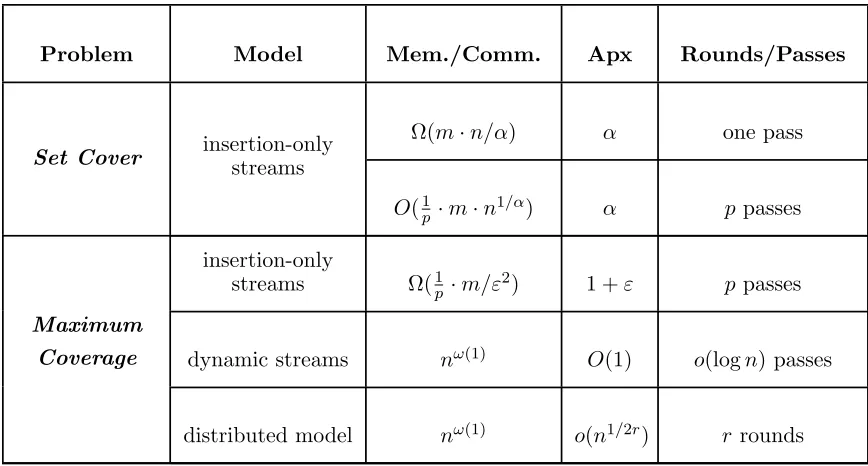
Table 4: A sample of our impossibility results for submodular optimization over massive datasets. The third column measures the space in case of streaming algorithms, communication per machine in case of distributed algorithms, and memory per machine in case of MPC algorithms. Heremandnare respectively the number of sets (items) and size of the universe. For simplicity of exposition, logarithmic factors are omitted in the third column. As maximum coverage is a special case of submodular maximization with cardinality constraint, all lower bounds for maximum coverage clearly hold for the latter problem as well.
perspective, lower bounds in this setup [of combinatorial auctions] are more compelling, since player valuations require exponentially many bits to encode, hence interaction has the potential to reduce the overall communication from exponential to polynomial”.
We resolve this fascinating question by providing an almost tightround-approximation
tradeoff for this problem, when the players are communicating only polynomially many bits (inn and m). As a corollary, we prove that Ω(log loglogmm) rounds of interaction arenecessary
for obtaining any efficient allocation (i.e., a constant or even a polylog(m)-approximation) in these markets. Our proof builds on the similarity between this problem and the distributed communication model and the lower-bound framework we provide in Chapter 8.
The materials in this chapter are based on a (solo-author) paper [25] in EC’17.
is to be completed within a certain time frame, this effectively limits the number of rounds of interaction. Similarly, in marketing applications, one can actively request feedback by sending surveys to customers, but there is typically a waiting time before survey responses are received; again, if the marketing campaign is to be completed within a certain time frame, this effectively limits the number of rounds of interaction.
We study the relationship between query complexity and adaptivity in identifying the
kmost biased coins among a set ofncoins with unknown biases. This problem is a common abstraction of many well-studied problems, including the problem of identifying thekbest arms in a stochastic multi-armed bandit, and the problem of top-k ranking from pairwise comparisons. Our main result establish an optimal lower bound on the number of rounds adaptivity needed to achieve the optimal worst case query complexity for all these problems. In particular, we show that, perhaps surprisingly, no constant number of rounds suffices for this task, and the “correct” number of rounds of adaptivity is log∗(n) (an upper bound of log∗(n) rounds was also established in a joint work with Agarwal, Agarwal, and Khanna [4]). The materials in this chapter are based on a joint paper with Arpit Agarwal, Shivani Agarwal, and Sanjeev Khanna [4] in COLT’17.