RELIABILITY PARAMETER ESTIMATION AND
ANALYSIS FOR ELECTRICAL UPS SYSTEM
Upendra Joshi
1, Taranjeet Singh Huda
2, Sumeet Sehrawat
3 1, 3EEE Department, Amity School of Engineering and Technology, Noida, (India)
2
ECE Department, Patel College of Science and Technology, Indore, (India)
ABSTRACT
This paper mainly concentrates on reliability analysis of electrical components. The scope of reliability is not
limited to any one ofthe engineering discipline as it is a multi-disciplinary subject. In this paper reliability
analysis is included with probability and statistics to provide better understanding of reliability, stress and risk
analysis. Also some conventional methods have been used to frame proper estimation of practical performance
analysis of replaceable and repairable electronics components. Reliability is the key feature of achieving high
performance of any system. This paper is useful to calculate overall performance of a reliable system in both
was i.e. quantitatively and qualitatively.
Keywords: Reliability Analysis, Failure Mechanism, Risk Analysis, Estimation, Performance
Analysis
I. INTRODUCTION
Reliability Engineering is the systems probability of performing adequate function for a particular operating
time, under operating conditions. It is concerned at high risk conditions. The achievements of reliability are
derived from reliability engineering. The integration of reliability engineering with other engineering disciplines
add throughout the systems overall development. Reliability prediction provides a quantitative baseline to assess
reliability engineering in various disciplines. By focussing on reliability prediction after selecting a design we
can predict rate of failures and its stress analysis completely.
II. FAILURE MECHANISMS FOR ELECTRICAL DEVICES
It is usually divided into three type’s i.e. electrical stress, intrinsic and extrinsic. Higher voltage level causing
damage to electrical devices or due to any human error is involved in damage then it is considered as electrical
stress failure. If poor manufacturing or design procedure error takes place then it is categorised as intrinsic
failure. If any error in device packaging or interconnections takes place along with environmental effects on
electrical devices then it is termed as extrinsic failure.
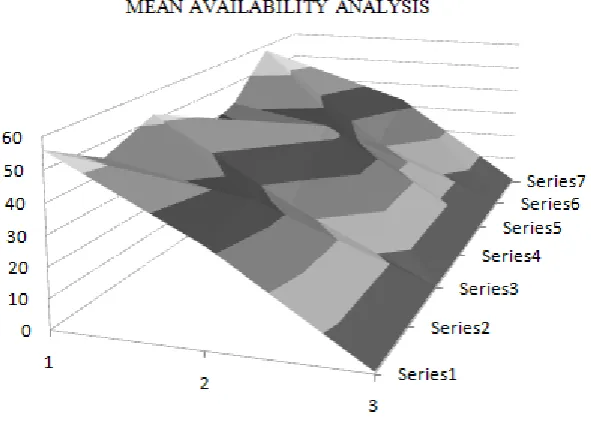
III. AVAILABILITY ANALYSIS
It is performed to verify operational probability of a system. Here we consider inherent availability of different
Where ‘u’ is the mean uptime during time T and d is the mean downtime during time T, T= u + d.
u d A
56 32 0.636364
45 36 0.555556
52 24 0.684211
36 44 0.45
42 31 0.575342
58 21 0.734177
28 33 0.459016
Table 1 Availability Data of a Power UPS System Components
IV. ESTIMATING PARAMETERS VIA ARRHENIUS MODEL ANALYSIS
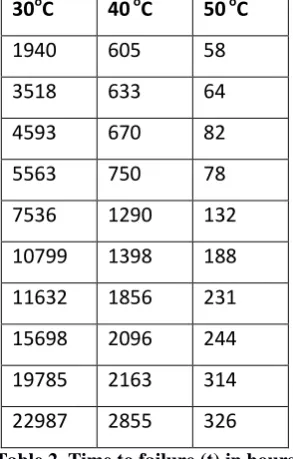
Let us consider an electronic device to be tested under elevated temperatures of 30oC, 40oC and 50oC. Now we
30
oC
40
oC
50
oC
1940
605
58
3518
633
64
4593
670
82
5563
750
78
7536
1290
132
10799
1398
188
11632
1856
231
15698
2096
244
19785
2163
314
22987
2855
326
Table 2. Time to failure (t) in hours
According to Arrhenius model we have,
[2]
S.no.
30
oC
40
oC
50
oC
1
7.570443 6.405228 4.060443
2
8.165648 6.45047
4.158883
3
8.432289 6.507278 4.406719
4
8.623893 6.620073 4.356709
5
8.927447 7.162397 4.882802
6
9.287209 7.242798 5.236442
7
9.361515 7.526179 5.442418
8
9.661289 7.647786 5.497168
9
9.892679 7.679251 5.749393
10
10.04268 7.956827 5.786897
Σ E[ln(t)]/10
8.99651
7.119829 4.957787
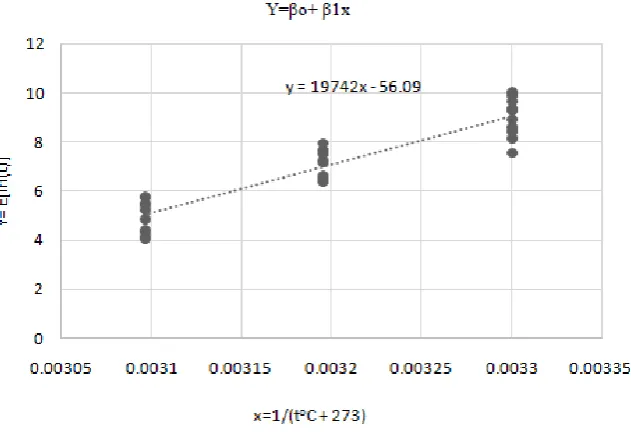
Using transformations Y=ln t, x=1/T, βo=A, β1=B we have,
Y=E[ln(t)] t oC x=(t oC+273)-1
8.99651
30
0.0033
7.119829
40
0.003195
4.957787
50
0.003096
Table 4 Data Transformation of Arrhenius model
Now by using above transformed data and line equation Y=βo+ β1x we can find estimates of parameters A and B
as,
Â=exp (β1)= exp (-56.091) =
4.36504* 10
-25h
-1and =
19742oK[3]
V. PROBABILITY RISK ASSESSMENT
PRA is a systematic procedure to investigate operational and building aspects of complex systems. By
estimating and reducing major errors we can increase strength of any system. To analyse these errors we follow
this process. Here are some major changes in this approach which have been taken place while studying this
system:
1. Objectives and methodologies
2. Familiarization information
3. Logic modelling
VI. CONCLUSION
Hence we have estimated parameters A and B using Arrhenius model and after analysis of Arrhenius model we
can approach for risk assessment analysis and follow the above approach related to PRA. After PRA this
detailed analysis can be combined with system reliability confidence limits based on component failure data.
For this using Lloyed-Lipow method or Maximus method we can predict uncertainity of the system. System
reliability statics via trends in observed failure events can be calculated through binomial distribution method. In
future aspects we can determine Root cause analysis of the observed data and perform risk analysis of this
system.
REFERENCES
[1] Reliability Engineering and Risk Analysis, A Practical Guide (CRC Press), by Modarres, Kaminskiy and
Krivtsov, published 2010
[2] Military Handbook, Reliability Prediction of Electronic Equipment, Department of Defense, USA,
published 2 December 1991
[3] Accelerated Testing: Statistical Models, Test Plans and Data Analyses (Wiley Series in Probability and
Mathematical Statistics-Applied Probability), by Wayne Nelson, Published 1990
[4] Analysis of Failure and Survival Data, by Peter J. Smith, Published 2002
[5] Applied Life Data Analysis, by Wayne Nelson, Published 1982
[6] Applied Reliability (Second Edition) by Paul A. Tobias and David C. Trindade, Published 1995
[7] Burn-In Testing: Its Quantification and Optimization (Reliability Engineering), by Dimitri Kececioglu and
Feng-Bin Sun, Published 1997
[8] Effective FMEAs: Achieving Safe, Reliable and Economical Products and Process Using Failure Mode
and Effects Analysis), by Carl Carlson, Published 2012
[9] Environmental Stress Screening: Its Quantification, Optimization and Management, by Dimitri Kececioglu
and Feng-Bin Sun, Published 1995
[10] Handbook of Reliability Engineering and Management, 2nd Edition, by William Grant Ireson, Clyde F.
Coombs and Richard Y. Moss, Published 1995
[11] Maintainability, Availability and Operational Readiness Engineering Handbook, by Dimitri Kececioglu,
Published 1995
[12] Methods for Statistical Analysis of Reliability and Life Data (Wiley Series in Probability and
Mathematical Statistics), by Nancy R. Mann, Ray E. Schafer and Nozer D. Singpurwalla, Published 1974
[13] Practical Reliability Engineering, 4th Edition, by Patrick D. T. O'Connor, Published 2002
[14] Recurrent-Events Data Analysis for Product Repairs, Disease Recurrences, and Other Applications, by
Wayne Nelson, Published 2003