Testing of Neutron Data for Fe, Cr, Ni based on Integral
Experiments
V. N. Koshcheev1,a, G. N. Manturov1, M. Yu. Semenov1, A. M. Tsibouliya1
1IPPE, Obninsk, Russia 249033
Abstract. In this work the modern evaluated nuclear data for structural materials such as Fe, Cr, Ni are considered, and comparison between the RUSFOND data file library and other libraries is done. Criticality calculations for a set of selected fast uranium and plutonium benchmarks are performed, and calculation results are compared with experimental data. Monte Carlo calculations were performed using continuous energy cross-sections corresponding to different data libraries.
1 Introduction
National neutron data libraries were recently modified in USA, Europe, Japan, China and Russia. These data libraries are now being tested for further use in applications. The neutron data were mainly tested using criticality calculations for the benchmarks selected by a special procedure from the ICSBEP Handbook. Other tests included 1) calculations of average cross sections on standard and some specially selected spectra, and 2) calculations of the cross sections of neutron removal under the thresholds of detector reactions such as (n,fis)U-238, (n,fis)Np-237, (n,p)Al-27, etc. These results are presented in this work.
2 Neutron data libraries
The following neutron data libraries were used: the Russian library ROSFOND presented in 2008 and corrected in 2010 [1]; the Japanese library JENDL-4.0 presented in 2011 [2]; the US library ENDF/B-VII.1 presented in 2011 [3]; the European library JEFF-3.1.1 presented in 2009 [4].
Iron, Chrome and Nickel were selected as the materials to be tested in this work, for they are basic components of structural materials in fast breeder reactors.
3 Benchmarks used
The Mughabghab evaluation of resonance integrals (the spectrum of ~1/E) was used as a reference [5]. The typical LMFBR specter is used as a φ(LMFBR). Average cross sections calculated on the
a e-mail: [email protected]
C
U-235 and Cf-252 fission spectra as well as removal cross sections from the EXFOR Library were taken as reference values [6].
The input data and corresponding benchmark criticalities for selected benchmarks were taken from ICSBEP Handbook [7].
The benchmark selection was made by the tools of the DICE database [8].
The criteria for selecting benchmark were 1) a relatively high fission rate above 100 keV, 2) a relatively high absorption rate above 100 keV which is related to absorptions by structural nuclides.
29 models with structural materials influencing mainly on neutron leakage, and 8 models with structural materials influencing mainly on the absorption rate were selected. This allows one to separate two basic effects due to presence of structural materials.
4 Results
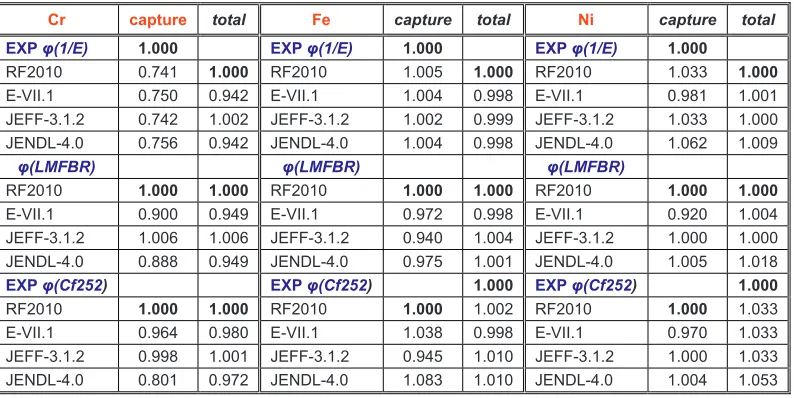
The comparison of the results on resonance integrals (the spectrum of ~1/E) for Cr, Fe and Ni are presented in Table 1.
Table 1. The comparison of the one group cross sections for various library neutron data.
Cr capture total Fe capture total Ni capture total
EXP φ(1/E) 1.000 EXP φ(1/E) 1.000 EXP φ(1/E) 1.000
RF2010 0.741 1.000 RF2010 1.005 1.000 RF2010 1.033 1.000
E-VII.1 0.750 0.942 E-VII.1 1.004 0.998 E-VII.1 0.981 1.001
JEFF-3.1.2 0.742 1.002 JEFF-3.1.2 1.002 0.999 JEFF-3.1.2 1.033 1.000
JENDL-4.0 0.756 0.942 JENDL-4.0 1.004 0.998 JENDL-4.0 1.062 1.009
φ(LMFBR) φ(LMFBR) φ(LMFBR)
RF2010 1.000 1.000 RF2010 1.000 1.000 RF2010 1.000 1.000
E-VII.1 0.900 0.949 E-VII.1 0.972 0.998 E-VII.1 0.920 1.004
JEFF-3.1.2 1.006 1.006 JEFF-3.1.2 0.940 1.004 JEFF-3.1.2 1.000 1.000
JENDL-4.0 0.888 0.949 JENDL-4.0 0.975 1.001 JENDL-4.0 1.005 1.018
EXP φ(Cf252) EXP φ(Cf252) 1.000 EXP φ(Cf252) 1.000
RF2010 1.000 1.000 RF2010 1.000 1.002 RF2010 1.000 1.033
E-VII.1 0.964 0.980 E-VII.1 1.038 0.998 E-VII.1 0.970 1.033
JEFF-3.1.2 0.998 1.001 JEFF-3.1.2 0.945 1.010 JEFF-3.1.2 1.000 1.033
JENDL-4.0 0.801 0.972 JENDL-4.0 1.083 1.010 JENDL-4.0 1.004 1.053
The experimental values of the removal cross sections presented in Table 2 were taken from Ref. [11].
Table 2. The comparison of the removal cross sections for various library neutron data.
Cr Np237(n,f) U238(n,f) (n,p)Al27 Fe Np237(n,f) U238(n,f) (n,p)Al27 Ni Np237 (n,f) U238 (n,f) (n,p) Al27
EXP EXP 1.000 1.000 1.000 EXP 1.000 1.000 1.000
RF2010 1.000 1.000 1.000 RF2010 0.826 0.902 1.071 RF2010 1.061 0.982 1.075
E-VII.1 1.087 1.065 1.016 E-VII.1 0.837 0.919 1.058 E-VII.1 1.111 1.030 1.091
JEFF-3.1.2 0.993 0.998 1.000 JEFF-3.1.2 0.831 0.912 1.080 JEFF-3.1.2 1.060 0.982 1.075
JENDL-4.0 1.124 1.077 1.017 JENDL-4.0 0.899 0.965 1.098 JENDL-4.0 1.043 0.945 1.015
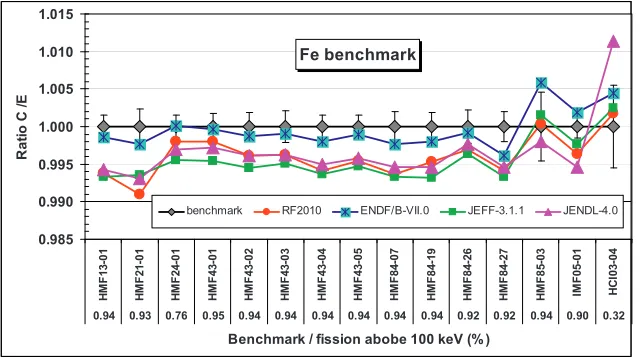
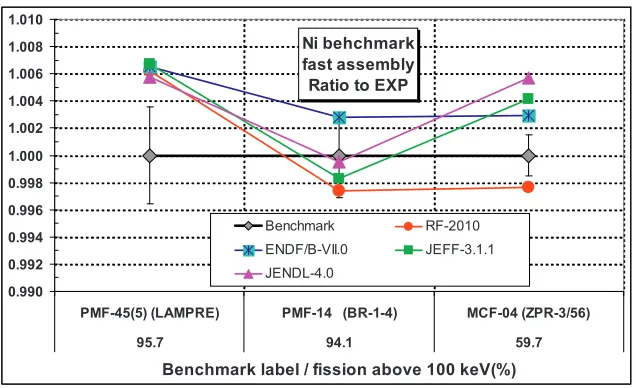
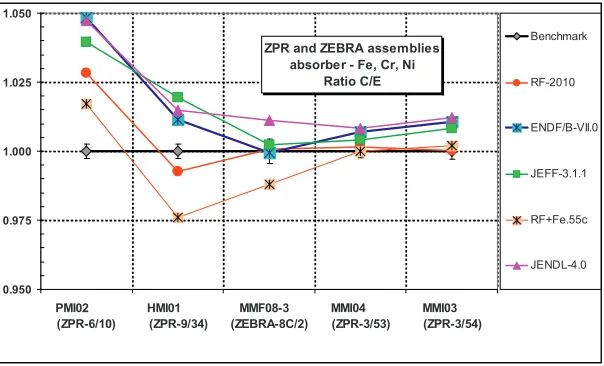
The comparison between calculation and benchmark values for Fe, Cr and Ni (with mentioning which type of their properties, reflection or absorption, is the most essential one in each particular case) is presented in Figs. 1-6.
Fe Benchmark 0.985 0.990 0.995 1.000 1.005 1.010 1.015 P M F 15-01 P M F 25-01 P M F 26-01 P M F 28-01 P M F 32-01 P M F 42-02 P M F 42-03 P M F 42-04 P M F 42-05 P M F 42-06 P M F 42-07 P M F 42-08 P M F 42-09 P M F 42-10 P M F 42-11 P M F 42-12 P M F 42-13 P M F 42-14 P M F 42-15 P M F 45-02 P M F 45-03 P M F 45-06 P M F 45-07
0.95 0.98 0.97 0.96 0.97 0.77 0.78 0.79 0.80 0.81 0.82 0.82 0.82 0.82 0.83 0.83 0.83 0.83 0.84 0.95 0.96 0.94 0.94
Benchmark / fission above 100 keV (%)
Ra
tio
C
/ E
benchmark RF2010 ENDF/B-VII.0 JEFF-311 JENDL-4.0
Fig. 1: Fe benchmarks with Pu fuel for various library neutron data
Fe benchmark 0.985 0.990 0.995 1.000 1.005 1.010 1.015 HM F 13 -0 1 HM F 21 -0 1 HM F 24 -0 1 H M F 43-01 HM F 43 -0 2 HM F 43 -0 3 H M F 43-04 H M F 43-05 H M F 84-07 H M F 84-19 H M F 84-26 H M F 84-27 H M F 85-03 IM F 05-01 H C I03-04
0.94 0.93 0.76 0.95 0.94 0.94 0.94 0.94 0.94 0.94 0.92 0.92 0.94 0.90 0.32
Benchmark / fission abobe 100 keV (% )
Ra
ti
o C
/E
Ni benchmark simple spherical assembly
Ratio to EXP
0.985 0.990 0.995 1.000 1.005 1.010 1.015
HMF-84(22) HMF-84(10) HMF-03
1.27 2.54 20.32
Benchmark label / reflector thickness (cm)
Benchmark RF-2010 ENDF/B-VII.0 JEFF-3.1.1 JENDL-4.0
Fig. 3: Ni simple benchmarks for various library neutron data.
Ni behchmark fast assembly Ratio to EXP
0.990 0.992 0.994 0.996 0.998 1.000 1.002 1.004 1.006 1.008 1.010
PMF-45(5) (LAMPRE) PMF-14 (BR-1-4) MCF-04 (ZPR-3/56)
95.7 94.1 59.7
Benchmark label / fission above 100 keV(%)
Benchmark RF-2010
ENDF/B-VII.0 JEFF-3.1.1 JENDL-4.0
KBR assemblies absorber - Fe, Cr, Ni
Ratio C/E
0.800 0.850 0.900 0.950 1.000 1.050 1.100 1.150 1.200
HCI05-1 (KBR-7) HCI05-2 (KBR-9) HCI05-3 (KBR-10) HCI05-4 (KBR-15)
Benchmark
RF-2010
RF+Fe.55c
RF+Cr.50c
JEFF-3.1.1
ENDF/B-VII.0
JENDL-4.0
Fig. 5: HCI05 (KBR) benchmarks for various library neutron data.
ZPR and ZEBRA assemblies absorber - Fe, Сr, Ni
Ratio C/E
0.950 0.975 1.000 1.025 1.050
PMI02 (ZPR-6/10)
HMI01 (ZPR-9/34)
MMF08-3 (ZEBRA-8C/2)
MMI04 (ZPR-3/53)
MMI03 (ZPR-3/54)
Benchmark
RF-2010
ENDF/B-VII.0
JEFF-3.1.1
RF+Fe.55c
JENDL-4.0
Fig. 6: ZPR and ZEBRA benchmarks for various library neutron data.
5 Discussion
According to Table 1, in the last Mughabghab compilation resonance properties were considerably reevaluated for Cr. For other structural nuclides only minor changes took place.
The evaluation of inelastic scattering agrees with experimental data for Ni only. The removal cross sections of other structural nuclides differ from experiment data (for each type of detector reaction) except for the JENDL-4.0 library.
According to the benchmark values, the reflector properties of Fe are described in the best manner by the ENDF/B-VII.1 library. The results for the PMF042 series contradict with the results for the benchmarks with U fuel.
The problem of calculation description of the KBR assemblies (the HCI005 series) is known for a long time [12]. This problem was discussed on the ND2010 conference [13]. The capture process is underestimated in the modern evaluations of Fe, Cr and Ni nuclear data as can be seen from Fig. 5. Use of the ENDF/B-V.2 data for Cr and Fe (in this evaluation results on integral experiment were taken into account) leads to the opposite effect. So, the truth lies somewhere in between.
Conclusion
The Fe elastic scattering evaluation by Fu, Perrey et al. (adopted in ENDF/B-VII.1) allowed to describe the Fe-reflected benchmarks from the ICSBEP Handbook in the best way.
Reevaluation of capture cross sections of the Cr isotopes is desired. It is expected that capture properties should be effectively increased in accordance with the Mughabghab recommendations. To reproduce benchmark values corresponding to the HCI005 series some increase of capture cross sections of Fe and Ni (along with Cr) is expected.
References
[1] ROSFOND-2010 Library, Institute of Physics and Power Engineering, Obninsk, Russia (2010). Available online at http://www.ippe.ru/podr/abbn/libr/rosfond.php.
[2] K. Shibata et al., “JENDL-4.0: A new library for nuclear science and engineering,” J. Nucl. Sci. Technol.. 48, pp. 1–30, 2011.
[3] M.B. Chadwick et al., “ENDF/B-VII.1 Nuclear data for science and technology: cross sections, covariances, fission product yields and decay data,” Nuclear Data Sheets, v.112, 12, 2011 [4] The JEFF-3.1.1 Nuclear Data Library, JEFF Report 22, NEA No. 6807, OECD 2009. [5] S.F. Mughabghab, “Atlas of Neutron Resonances: Thermal Cross Sections and Resonance Parameters”, Elsevier Publisher, Amsterdam, 2006.
[6] Experimental Nuclear Reaction Data (EXFOR / CSISRS), http://www.nndc.bnl.gov/exfor/exfor00.htm
[7] International Handbook of Evaluated Criticality Safety Benchmark Experiments, OECD/NEA, NEA/NSC/DOC(95)03 (September 2009 Edition)
[8] Ali Nouri, Pierre Nagel, J. Blair Briggs, Tatiana Ivanova. DICE: Database for the International Criticality Safety Benchmark Evaluation Program Handbook, Nucl. Sci. Engin., 145, 2003, p. 11-19.
[9] B.B. Forrest, T.E. Booth et al. “MCNP-A General Monte Carlo N-Particle Transport Code, Version 5, Overview and Theory, Volume I”, LA-UR-03-1987, LANL, (2003)
[10] R.E. MacFarlane et al. NJOY97.0 Code System for Produsing Pointwise and Multigroup Neutron and Photon Sections from ENDF/B Data. RSIC Peripheral Shielding Routine Collection, PSR-368.
[11] Bethe N.A., Beyster J.R., Carter R.E. Inelastic Cross Sections for Fission Spectrum Neutrons – IV, J. Nucl. Energy, 1957, v. 4, p. 147 (EXFOR, subent 11461000).
[12] T.Ivanova, V.Koscheev, M.Nikolaev et al., Calculations of k-infinity of Benchmark
Experiments for Compositions of U-235 with Various Structul Matetials. Journal of Nuclear Science and Technology, Proc. of Int. Conf. ND2001, Tsukuba, Japan, 2001