
Novel application of hydrotropic solubilization in the analysis of some NSAIDs and their solid dosage forms
6
0
0
Full text
(2) www.ijpsonline.com. flurbiprofen, Froben and Froben–SR (RPG Life Sci. Ltd.) and naproxen, Naprosyn (RPG Life Sci. Ltd.) and Xenar-CR (Elder Health Care Ltd.) were procured from local drug stores. Other chemicals and solvents were of analytical grade. Preliminary solubility studies of ibuprofen, flurbiprofen and naproxen: Solubilities of ibuprofen, flurbiprofen and naproxen were determined at 28±1°. An excess amount of drug was added to screw capped 30 ml glass vials containing different aqueous systems viz. distilled water, buffer (pH 8.2) and 2 M sodium benzoate solution. The vials were shaken mechanically for 12 h at 28±1° in orbital flask shaker (Khera Instrument Pvt. Ltd., India). These solutions were allowed to equilibrate for next 24 h and then centrifuged for 5 min at 2000 rpm (Remi, India).The supernatant of each vial was filtered through Whatman filter paper no. 41 and filtrates were analyzed for drug contents to determine the solubilities.. Analysis of flurbiprofen drug sample by the proposed method: Accurately weighed (500 mg) flurbiprofen drug sample was transferred to a conical flask. The flask was shaken for 5 min after adding 50 ml of 2 M sodium benzoate solution (to solubilize the drug). Titration was performed with 0.1 M sodium hydroxide using phenolphthalein solution as indicator. Blank determination was carried out and necessary correction was made to calculate the drug content (Table 1). Analysis of flurbiprofen drug sample by the method of Indian Pharmacopoeia (1996)21: Accurately weighed (500 mg) flurbiprofen drug sample was dissolved in 100 ml of ethanol (95%) previously neutralized to phenolphthalein solution as indicator and titrated with 0.1 M sodium hydroxide solution and drug content was calculated (Table 1).. m rf o d ns a lo tio n a w c i o of bnaproxen l Analysis drug sample by the d proposed method: u . (200 mg) naproxen drug sample e Pweighed Analysis of ibuprofen drug sample by the Accurately e ) rwas transferred f proposed method: to a conical flask. After adding 50 ml w m o benzoate solution, the flask was shaken Accurately weighed (400 mg) ibuprofen drug sample wasor of 2 o M sodium c f n . transferred to a conical flask. The flask was shaken for 5 solubilization of drug. Titration k 5 minwfor complete e dfor l min after adding 100 ml of 2 M sodium benzoate solution was performed with 0.1 M sodium hydroxide solution o1 ml of phenolphthalein solution as indicator. b (to solubilize the drug). Titration was performedawith 0.1 e using n l M Blank k determination was carried out and necessary M sodium hydroxide solution using i0.2 ml of d a y phenolphthalein solution as indicator. Blank b ecorrection was made to calculate the drug content av determination was carried out and necessary correction wasddone to m (Table 1). e w. calculate the drug content (Table 1).is t s w F Analysis of naproxen using the method of British o D Analysis of ibuprofen drug sample by the method Pharmacopoeia (2002) : w h: ( P (1996) of Indian Pharmacopoeia Accurately weighed (200 mg) naproxen drug sample was e t s i i Accurately weighed (400 mg) ibuprofen sample was dissolved in a mixture of 25 ml of distilled water and 75 ml s anddrug hethanola (95%) dissolved in 100 mlTof titrated with 0.1 of methanol and titrated with 0.1 M sodium hydroxide M sodium hydroxide solution using 0.2 ml of solution using 1 ml of phenolphthalein solution as 22. 20. phenolphthalein solution as indicator. Blank determination was performed and necessary correction was made to calculate the drug content (Table 1).. indicator. Blank determination was carried out and necessary correction was made to calculate the drug content (Table 1).. TABLE 1: ANALYSIS DATA OF BULK DRUG SAMPLES OF IBUPROFEN, FLURBIPROFEN AND NAPROXEN Drug Ibuprofen Flurbiprofen Naproxen a. Amount of drug taken (mg). Method of analysis. Amount estimated a (mg) (mean±SD). % Coeff. of variation. Standard error. 400 400 500 500 200 200. PMb IP c PMb IP c PMb BPd. 398.9±0.63 398.3±0.70 496.2±1.13 496.1±1.46 198.4±0.59 197.7±0.77. 0.63 0.70 1.14 1.47 0.59 0.78. 0.36 0.40 0.65 0.84 0.34 0.44. Mean (n=3), bProposed method, cMethod of IP (1996), dMethod of BP (2002). 102. Indian Journal of Pharmaceutical Sciences. January - February 2007.
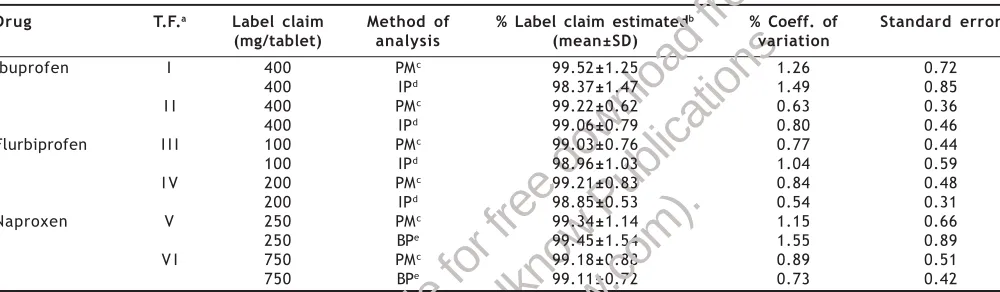
(3) www.ijpsonline.com. Analysis of ibuprofen tablets by the proposed method: Twenty tablets of ibuprofen were weighed and powdered. Powder equivalent to 500 mg of ibuprofen was accurately weighed and transferred to a conical flask. After adding 100 ml of 2 M sodium benzoate solution, the flask was shaken for 10 min (to solubilize the drug). Titration was performed with 0.1 M sodium hydroxide solution using phenolphthalein solution as indicator. Blank determination was carried out and necessary correction was made to calculate the drug content (Table 2). For recovery studies,. same procedure was repeated using 40 mg and 60 mg of ibuprofen drug as the spiked drug together with the tablet powder equivalent to 500 mg of ibuprofen. The results of analysis are presented in Table 3. Analysis of ibuprofen tablets by the method of Indian Pharmacopoeia (1996)20: Tablet powder equivalent to 500 mg of ibuprofen was accurately weighed and extracted with 60 ml of chloroform for 15 min and filtered. Residue was washed with three quantities each of 10 ml of chloroform.. m rf o d ns a lo tio n a w c i do ubl e P ). e fr w m r fo kno .co le ed ow b la M dkn i a by e v a si ted w.m s w F o PD te h (w is si h T a. TABLE 2: ANALYSIS DATA OF TABLET FORMULATIONS WITH STATISTICAL EVALUATION a. Drug Ibuprofen. T.F.. Label claim (mg/tablet). Method of analysis. % Label claim estimated (mean±SD). % Coeff. of variation. Standard error. I. 400 400 400 400 100 100 200 200 250 250 750 750. PM c IP d PM c IP d PM c IP d PM c IP d PM c BPe PM c BPe. 99.52±1.25 98.37±1.47 99.22±0.62 99.06±0.79 99.03±0.76 98.96±1.03 99.21±0.83 98.85±0.53 99.34±1.14 99.45±1.54 99.18±0.88 99.11±0.72. 1.26 1.49 0.63 0.80 0.77 1.04 0.84 0.54 1.15 1.55 0.89 0.73. 0.72 0.85 0.36 0.46 0.44 0.59 0.48 0.31 0.66 0.89 0.51 0.42. II. Flurbiprofen. III IV. Naproxen. V. VI. a. b. Tablet formulation, bMean (n=3),. cProposed method, dMethod of IP (1996), eMethod of BP (2002), I- Brufen (Knoll Pharmaceuticals Ltd.), II- Ibugesic (Cipla Ltd.), III-Froben, IV- Froben-SR, V-Naprosyn (RPG Life Sci. Ltd.), VI- Xenar-CR (Elder Health Care Ltd.). TABLE 3: RESULTS OF RECOVERY STUDIES OF TABLET FORMULATIONS WITH STATISTICAL EVALUATION Drug. Z. T.F.a. I. II. Y. Drug in preanalyzed tablet powder (mg). Amount of drug (mg). Me thod of a nalysis. % Recovery estimated b (mean±SD). % Coeff. of variation. Standard error. 500 500 500 500 500 500 500 500 400 100 400 100 400 100 400 100 400 50 400 50 400 50 400 50. 40 40 60 60 40 40 60 60 30 10 50 20 30 10 50 20 30 10 50 20 30 10 50 20. PM c IP d PM c IP d PM c IP d PM c IP d PM c IP d PM c IP d PM c IP d PM c IP d PM c BPe PM c BPe PM c BPe PM c BPe. 99.21±0.83 98.37±‘1.47 99.09±0.92 98.83±1.35 99.11±0.72 98.93±0.67 99.45±0.54 98.85±0.53 99.03±0.76 99.20±1.43 98.37±0.47 99.09±0.92 99.31±0.88 98.83±1.34 98.93±0.69 99.11±0.72 98.96±0.73 99.18±0.88 98.22±1.38 98.61±0.73 99.22±0.61 98.77±0.58 98.37±0.82 99.30±0.49. 0.84 0.49 0.93 1.36 0.73 0.70 0.55 0.54 0.77 1.44 0.48 0.93 0.89 1.36 0.69 0.73 0.74 0.89 1.41 0.74 0.61 0.59 0.83 0.49. 0.48 0.85 0.53 0.78 0.42 0.39 0.31 0.31 0.44 0.83 0.27 0.53 0.51 0.77 0.40 0.42 0.42 0.51 0.80 0.42 0.35 0.33 0.47 0.28. III. IV. X. V. VI. a. Tablet formulation, bMean (n=3),. cProposed method, dMethod of IP (1996), eMethod of BP (2002), X-ibuprofen, Y-flurbiprofen, Z-naproxen, I- Brufen (Knoll Pharmaceuticals Ltd.), II- Ibugesic (Cipla Ltd.), III-Froben, IV- Froben-SR, V-Naprosyn (RPG Life Sci. Ltd.), VI- Xenar-CR (Elder Health Care Ltd.). January - February 2007. Indian Journal of Pharmaceutical Sciences. 103.
(4) www.ijpsonline.com. Chloroform was evaporated in a current of air. Residue was dissolved in 100 ml of ethanol (95%) previously neutralized to phenolphthalein solution and titrated with 0.1 M sodium hydroxide solution. Drug content was calculated (Table 2). For recovery studies, same procedure was repeated using 40 mg and 60 mg of ibuprofen drug as the spiked drug together with the tablet powder equivalent to 500 mg of ibuprofen and the results of analysis are presented in Table 3. Analysis of flurbiprofen tablets by the proposed method: Twenty tablets of flurbiprofen were weighed and powdered. Powder equivalent to 400 mg flurbiprofen was accurately weighed and transferred to a conical flask. After adding 100 ml of 2 M sodium benzoate solution the flask was shaken for 5 min for solubilization of the drug. Titration was performed using 0.1 M sodium hydroxide solution using phenolphthalein solution as the indicator. Blank determination was carried out and necessary correction was made to calculate the drug content (Table 2). For recovery studies, same method was repeated using 30 mg and 50 mg flurbiprofen drug as the spiked drug together with the tablet powder equivalent to 400 mg of flurbiprofen. The results of analysis are presented in Table 3.. solution with phenolphthalein solution as indicator. Blank determination was carried out and necessary correction was made to calculate the drug content (Table 2). Recovery studies were conducted repeating the operation using 30 mg and 50 mg naproxen drug sample as the spiked drug together with the tablet powder equivalent to 400 mg of naproxen. Results of analysis are shown in Table 3. Analysis of naproxen tablets by the method of British Pharmacopoeia (2002)23: Tablet powder equivalent to 50 mg of naproxen was shaken with 70 ml of methanol for 30 min. Sufficient methanol was added to produce 100 ml. After filtration, 10 ml filtrate was diluted to 50 ml with methanol. Absorbance of this solution was measured at 331 nm using spectrophotometer. Drug content was calculated (Table 2) from the absorbance obtained by repeating the operation using a 0.01% w/v solution of naproxen drug sample in methanol. Same procedure was repeated for recovery studies using 10 mg and 20 mg naproxen as the spiked drug together with the tablet powder equivalent to 50 mg of naproxen. Results of analysis are presented in Table 3.. m rf o d ns a lo tio n a w c i do ubl e P ). e fr w m r o co fo RESULTS n . AND DISCUSSION k e w l ed o b By performing the solubility studies, it was found that n a l M k i Analysis of flurbiprofen tablets by the method of in aqueous solubilities of ibuprofen, d a by eenhancements Indian Pharmacopoeia (1996) : flurbiprofen and naproxen in 2 M sodium benzoate v Tablet powder equivalent to 100 mg a drug was shaken m solution were more than 80, 110 and 120 fold, d . respectively as compared to their solubilities in distilled s e i with 60 ml of 0.1 M sodium hydroxide solution for 5 min t w s hydroxide F and diluted to 100 ml with 0.1 M sodium There was negligible effect on solubilities of w to water. o solution. After filtration, 10 mlD of the filtrate was diluted these drugs in buffer of pH 8.2 and such enhancements w h Absorbance ( 100 ml with 0.1 M sodium P hydroxide solution. solubilities of these drugs in 2 M sodium benzoate e at 247 nm by insolution t s noted i i of this solution was could therefore be attributed to hydrotropic s A). Drug content was solubilization h a 160 spectrophotometer T (Model-UV phenomenon and not due to change in calculated taking 802 as the value of A (1%, 1 cm) at 247 pH. Hence, it was thought worthwhile to solubilize these 21. nm (Table 2). For recovery studies same method was repeated using 10 and 20 mg of flurbiprofen drug sample as the spiked drug together with the tablet powder equivalent to 100 mg of flurbiprofen. Results of analysis are presented in Table 3. Analysis of naproxen tablets by the proposed method: Twenty tablets of naproxen were weighed and powdered. Powder equivalent to 400 mg naproxen was accurately weighed and transferred to a conical flask. After adding 100 ml of 2 M sodium benzoate solution, the flask was shaken for 5 min for solubilization of the drug. Titration was performed using 0.1 M sodium hydroxide 104. drugs in 2 M sodium benzoate solution to carryout titrimetric analysis precluding the use of organic solvents. Table 1 shows that amounts of ibuprofen estimated in the drug sample were 398.9±0.63 and 398.3±0.70 mg by the proposed and pharmacopocial methods, respectively. Similarly, the amounts of flurbiprofen estimated in the bulk drug sample were 496.2±1.13 and 496.1±1.46 mg by the proposed and pharmacopoeial methods, respectively. In case of naproxen bulk drug sample, the amounts estimated by proposed and pharmacopoeial methods were 198.4±0.59 and 197.70±0.77 mg, respectively. The amounts of the drugs estimated by. Indian Journal of Pharmaceutical Sciences. January - February 2007.
(5) www.ijpsonline.com. both the proposed and pharmacopoeial methods are very close to each other and comparable indicating the accuracy of the proposed methods of analysis. Validation of the proposed methods is further confirmed by the low values of standard deviation, percent coefficient of variation and standard error. Table 2 shows the results of analysis of tablet formulations. Percent label claims of ibuprofen tablets formulations estimated by the proposed and pharmacopoeial methods ranged between 98.37±0.47 and 99.52±0.25. Similarly percent label claims of flurbiprofen tablet formulations estimated by the proposed and pharmacopoeial methods ranged between 98.85±0.53 and 99.21±0.83. In case of naproxen tablet formulations, the values of percent label claims estimated by the proposed and pharmacopoeial methods ranged between 99.11±0.72 and 99.45±0.54. Thus, the percent label claims of ibuprofen, flurbiprofen and naproxen tablet formulations estimated by the proposed and pharmacopoeial methods are very comparable and close to 100 indicating the accuracy of the proposed methods. Validation of the proposed methods of analysis is confirmed statistically by low values of standard deviation, percent coefficient of variation and standard error.. tablets involves the use of methanol. However, in the proposed methods 2 M sodium benzoate solution has been used as hydrotropic solubilizing agent for solubilization of drugs to carryout titrations with sodium hydroxide solution. There is no involvement of organic solvents. The proposed methods are comparable to official methods and have been validated with statistical evaluation. Also a sophisticated instrument is not required in analysis of flurbiprofen and naproxen tablet by proposed methods. The commonly used excipients in the formulation of tablets and the hydrotropic agent, sodium benzoate did not interfere in the analysis of tablets.. m o r f that the proposed methods of Thus, it may be concluded d analysis are new, simple, environmentally s a ocost-effective, n friendly, safe,oaccurate and reproducible. Decided l ti solvents are precluded but not advantage isn that organic a Certainly there is further at the expense ofcaccuracy. w i l benzoate solution as solubilizing scope ofo2 M sodium d b agent for theutitrimetric analysis of other poorly watere drugs. . method is worth adopting in soluble P The proposed e ) rf the respective w opharmacopoeias. m r o o f ACKNOWLEDGEMENTS n .c k le by ed ow Recovery studies (Table 3) were also carried out b spiking the previously analyzed fine powdersaof tablet nauthors acknowledge M/s Alkem Laboratories l theM The k i formulations at two levels to further ascertain Limited, (India) for generous supply of the gift d ofMumbai a byThe esamples accuracy and precision of the proposedvmethods. ibuprofen, flurbiprofen and naproxen. values of percent recoveries estimatedaby the d proposed is valuesteobtainedwby.m REFERENCES methods compared very well with the s The percent the corresponding pharmacopoeial methods. F w of o recovery values are close D to 100 and the values w hdeviation,( percent statistical parameters viz.Pstandard e t error are significantly s standard i coefficient of variation iand s h methods low. Thus, the proposed T a of analysis are very well validated. 1. 2. 3. 4.. 5.. Indian Pharmacopoeial method for the analysis of ibuprofen drug sample involved the use of alcohol for dissolution of drug to carryout the titration with sodium hydroxide solution. Similarly Indian Pharmacopoeial method for the analysis of ibuprofen tablets requires extraction of ibuprofen by chloroform. Chloroform is removed by air-drying which is responsible for pollution and toxicity and it is a costlier solvent too. Residue is re-dissolved in alcohol to carryout titration. Official methods for the analysis of flurbiprofen and naproxen drug samples involve the use of alcohol and methanol, respectively. Methanol is also a toxic solvent. Method of British Pharmacopoeia for the analysis of naproxen January - February 2007. 6. 7. 8. 9. 10. 11. 12. 13. 14. 15. 16. 17.. Maheshwari, R.K., Asian J. Chem., 2006, 18, 393. Maheshwari, R.K., Asian J. Chem., 2006, 18, 1572. Maheshwari, R.K., Indian Pharmacist, 2005, IV, 55. Maheshwari, R.K. Chaturvedi, S.C. and Jain, N.K., Indian Drugs, 2005, 42, 760. Maheshwari, R.K. Chaturvedi, S.C. and Jain, N.K., Indian J. Pharm. Sci., 2006, 68, 195. Maheshwari, R.K., Chaturvedi, S.C. and Jain, N.K., Int. J. Pharm Excip., 2005, 4, 84. Maheshwari, R.K., Asian J. Chem., 2006, 18, 640. Maheshwari, R.K., Indian Pharmacist, 2005, IV, 63. Maheshwari, R.K., Chaturvedi, S.C. and Jain, N.K., Indian Drugs, 2005, 42, 541. Maheshwari, R.K., Chaturvedi, S.C. and Jain, N.K., Indian Drugs, 2006, 43, 516. Jain, N.K., Agrawal, R.K., and Singhai, A.K., Pharmazie, 1990, 45, 221. Jain, N.K. and Patel, V.V., Eastern Pharmacist, 1986, 29, 51. Agrawal, S., Pancholi, S.S., Jain, N.K. and Agrawal, G.P., Int. J. Pharm., 2004, 274, 149. Ueda, S., Chem. Pharm. Bull., 1966, 14, 2. Saleh, A.M. and Daabis, N.A., Pharmazie, 1974, 29, 525. Poochikian, G.D. and Cradock, J.C., J. Pharm. Sci., 1979, 68, 728. Miyahara, M. and Takahasi, T., Chem. Pharm. Bull., 1982, 30, 288.. Indian Journal of Pharmaceutical Sciences. 105.
(6) www.ijpsonline.com. 18. Badwan, A.A., El-Khordagui, L.K. and Khalil, S.A., Int. J. Pharm., 1983, 13, 67. 19. Ibrahim, S.A., Ammar, H.O., Kasem, A.A. and Abu-zaid, S.S., Pharmazie, 1979, 34, 809. 20. Indian Pharmacopoeia Vol. I, Government of India, Ministry of Health and Family Welfare, the Controller of Publications, New Delhi, 1996, 387. 21. Indian Pharmacopoeia Vol. I, Government of India, Ministry of Health and Family Welfare, the Controller of Publications, New Delhi, 1996, 328. 22. British Pharmacopoeia Vol II, Her Majesty’s stationary office, London, 2002, 1200.. 23. British Pharmacopoeia Vol II, Her Majesty’s stationary office, London, 2002, 2337.. Accepted 6 February 2007 Revised 13 July 2006 Received 10 August 2005 Indian J. Pharm. Sci., 2007, 69 (1): 101-106. m rf o d ns a lo tio n a w c i do ubl e P ). e fr w m r fo kno .co le ed ow b la M dkn i a by e v a si ted w.m s w F o PD te h (w is si h T a. 106. Indian Journal of Pharmaceutical Sciences. January - February 2007.
(7)
Figure

Related documents
Our dynamic equilibrium simulation for Antarctica demon- strates the ability of PISM-PIK to reproduce large-scale dy- namic features of the Antarctic ice sheet-shelf system, in-
More specifically, can the federal govern- ment set standards of performance, encourage experi- mentation in the delivery o f health care, coordinate existing
Assessing the Impact of Biodiversity Conservation in the Management of Maize Stalk Borer (Busseola f
Field experiments were conducted at Ebonyi State University Research Farm during 2009 and 2010 farming seasons to evaluate the effect of intercropping maize with
These data, the first to examine several critical aspects of how providers experience, view and make decisions about unconventional reproductive arrangements, sug- gest that
The program also offers 20 courses of Bachelor’s Degree in Education to students, namely Curriculum and Pedagogy, Malay Language Education, Islamic Education, TESL,
on deeply held misconceptions and fears of people who hold different beliefs, strategies of conceptual change theory, most often found in science education, were
Centers for Disease Control and Prevention; EHR: Electronic health record; EMR: Electronic medical record; GHC: Group health centre; ITS: [Niagara Region] information
AIRWAYS ICPs: integrated care pathways for airway diseases; ARIA: Allergic Rhinitis and its Impact on Asthma; COPD: chronic obstructive pulmonary disease; DG: Directorate General;
