Fiagbe et al. World Journal of Engineering Research and Technology
COEFFICIENT OF FRICTION OF COMPONENTS OF MUNICIPAL
SOLID WASTE
Yesuenyeagbe A. K. Fiagbe* and Emmanuel W. Ramde
Department of Mechanical Engineering, Kwame Nkrumah University of Science and
Technology, Kumasi.
Article Received on 23/02/2019 Article Revised on 13/03/2019 Article Accepted on 03/04/2019
ABSTRACT
Engineering properties of materials includes friction coefficient and
these properties are basic in design performance of various systems.
This paper presents estimate of friction coefficient of municipal solid
waste components. The components of the municipal solid waste
include paper, plastic, organic and others. The friction coefficient is
very important in design of handling tool for optimal design. Various
types of handling tools and equipment are designed to be used at
various stages of disposal and treatment of Municipal Solid Waste (MSW) and friction
coefficient is one critical property. The estimation of the coefficient of friction of municipal
solid waste was done using an inclino-tribometer. Waste from 16 sample locations were used
with 6 different surfaces which are presumed to be of relevant in waste disposal systems. Site
specific method was used in waste classification. It was estimated that Formica surface has
the least coefficient of friction values and range from 0.269 and 0.312 with ‘others’ – formica
surface tribosystem being the least. It was also found out that painting a wooden surface with
oil paint would increase friction as compared to painting the same wooden surface with
emulsion. The study pointed out that polishing with vanish is the best way to reduce friction
in wood surfaces. It was observed that painting metal surfaces with oil paint will increase the
friction than when the same metal was left unpolished or unpainted.
KEYWORDS: Municipal solid waste, friction coefficient, waste components, tribometer.
World Journal of Engineering Research and Technology
WJERT
www.wjert.org
SJIF Impact Factor: 5.218*Corresponding Author Yesuenyeagbe A. K. Fiagbe
Department of Mechanical
Engineering, Kwame
Nkrumah University of
Science and Technology,
INTRODUCTION
Waste generation is of human nature and it is a result of most activities. In all communities
over the world, the management of waste generated within communities usually refer to as
municipal solid waste has been a challenge. It is however managed very well in most
developed countries. In developing countries, the challenge is yet to be overcome. The
municipal solid waste (MSW) is a complex material and consist of various components. Just
as materials have some properties, MSW also has same. Although waste is heterogeneous,
many of the studies show that municipal solid waste has mechanical properties that vary in a
consistent and predictable way (e.g. with respect to stress state and method of placement)
(Dixon, N. et al, 2005). Most of the properties that are known for various materials are
usually of relevant for some purpose. The coefficient of friction is one of the relevant
engineering properties that is used in design. Cho et al (2010) estimated proportional effect of
food waste on the friction coefficient in the MSW and found that to be directly proportional.
The friction coefficient becomes very relevant in waste handling and disposal related designs.
Friction is generally described as the resistance to motion when two surfaces slide against
each other. In most cases friction is a useful phenomenon making many ordinary things like
walking and braking of car possible. On the other hand friction can also cause undesirable
effects which mostly leads to attempt to eliminate such as much as possible. It can therefore
be said that frictional effect may or may not be desirable depending on where it exist and
function. In solid waste handling and disposal situation, friction may be desirable at a point
and undesirable at another point of application.
In handling equipment design, one of the important properties of interest is the coefficient of
friction. It is to be noted that coefficient of friction is not a property of the material but that of
the tribosystem surfaces in contact and in relative motion. Blau, P.J. (2001) conceptually
defined coefficient of friction as the ratio of two forces acting, respectively, perpendicular
and parallel to an interface between two bodies under relative motion or impending relative
motion. The coefficient, which is dimensionless quantity turns out to be convenient for
depicting the relative ease with which materials slide over one another under particular
circumstances. Despite the fact that both static and kinetic friction coefficients can be
measured with little difficulty under laboratory conditions, the time- and condition-dependent
characteristics of friction coefficients associated with both clean and lubricated surfaces have
In specific problems in mechanical design or failure analysis, coefficient of friction
parameters are very important and useful in optimum performance of systems. This paper
presents the relative coefficient of friction of the components of municipal solid waste in
respect to some selected surfaces.
MATERIALS AND METHODS
The forces that resist sliding occur in the regions near and between solid surfaces. The
problem of establishing exactly which attributes of the contact conditions and the materials
contribute most to the friction force is a major one for developing friction tests and analytical
friction models. Models for friction have used geometric arguments (surface roughness and
asperity interlocking), mechanical properties-based arguments (shear properties of the solids
and of the substances between the surfaces), fluid dynamics approaches, considerations of
electrostatic forces between surface atoms, and chemical compatibility arguments (Blau P.J.,
2001). Since the number of potential friction-affecting factors is large, it is necessary to
identify the set of key variables applicable to each particular case in order to select the
appropriate test methods or simulations. If friction tests are more applications-oriented, then
the tribosystem of interest must be analyzed and its friction-related variables identified to
effect a valid simulation.
Municipal Solid Waste is a complex material and can be difficult to handle. There is therefore
the need to characterise the waste by composition. The municipal solid waste was initially
characterised and components separated. The characterisation was into six classes, namely:
organic, plastic, metal, paper, textile and ‘others’. Representative communities were selected
such to represent various classes of communities that satisfy all kinds of municipal solid
waste generation. The communities were within and around a University. A tribometer was
designed and built for the measurement and six different surfaces of interest prepared. The
sample areas, tribometer and the surfaces are further discussed in the following sections.
Sampled Area
The type of waste generation varies from community to community based on various factors.
These factors include socio-economic status of individuals as well as the community in
general, either urban or rural location. The sample areas were in and around a University
community. It is observed that the University community is an area made of a cluster of
various categories of habitation which can be classified based on the socio-economic status of
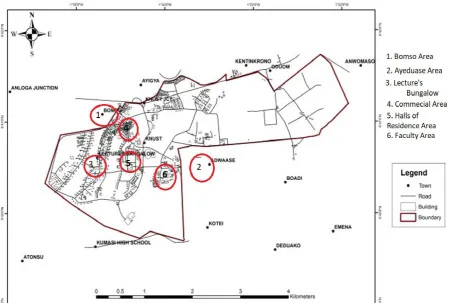
Faculty area, Halls of residence area, Lecturers’ bungalow area and Commercial area. This is
done to capture various level of socio-economic status of the people. The commercial area of
the KNUST community is where commercial activities including market, shops and banking
takes place and the waste generated in this area reflect as such. The faculty area is also where
teaching and learning activities happen and the waste generated in this area is expected to be
paper dominant. The lecturers’ bungalows area is of high status community and waste
generation within the area will reflect and represent that class. The various socio-economic
status of the individuals are therefore captured in the sample area. The map of figure 1 shows
the indicated localities of choice.
Figure 1: Map showing the sample location within the KNUST community.
The Tribometer
Friction in solid mechanics is the force resisting the relative motion of solid surfaces in
contact and sliding against each other. Its effect is usually seen indicated by friction
coefficient. The coefficient of friction in general can be said to be a value that indicates the
relationship between the force of friction between two surfaces and the normal reaction
between the objects that are involved. Old time observations lead to some findings that are
applied load (Amontons 1st Law) 2. The force of friction is independent of the apparent area of contact (Amontons 2nd Law) and 3. Kinetic friction is independent of the sliding velocity (Coulomb's Law) (Muser at el, 2001). These laws are however attributed to dry friction only,
as it has been well known since ancient times that lubrication modifies the tribological
properties significantly.
The first mathematical approach to tribology was undertaken by Leonard Euler (1707-1783)
with a geometrical resistance theory of "dry" friction – the Interlocking Asperity Theory.
Euler's theory provides two terms for static and dynamic friction. The static friction
coefficient is provided by the tangent of the asperity angle, i.e., µ=tan, while the dynamic
friction coefficient is reduced by the kinetic term 2s/gt2cos. The angle is called angle of repose or angle of inclination. The angle of repose between any two surfaces is normally
between 0 and 45 degrees and mostly the coefficient of friction is between 0 and 1.
If a body is at rest or moving with a constant velocity, it is in equilibrium and the vector sum
of all forces acting on the body is zero. It is also true that, if all forces acting on a body are
resolved into horizontal and vertical components, the sum of vertical component and sum of
horizontal components are the same. From this it follows that if a body is moving with a
constant velocity along a horizontal surface in the direction of reaction force, the force of
friction is equal and opposite to the reaction force. The force of friction always opposes
motion and they are always opposite in direction.
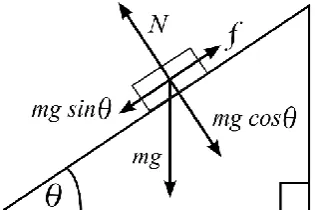
Considering an incline plane as shown in figure 2, the force, N, normal to the plane’s surface
is equal and opposite to the weight component, mgcos. It is experimentally found that the
force of friction f, is proportional to the normal component N of the plane’s reaction.
Fig 2: A body moving on an inclined plane.
Also Frictional Force
Hence: frictional force ƒ = µN =µmgcosθ
Therefore: mgsinθ = µmgcosθ
This implies that µ = cosθsinθ µ = ten
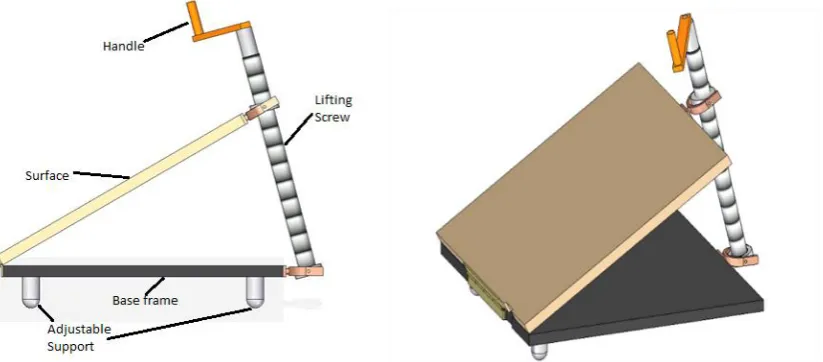
This lead to the design of inclino-tribometer shown in figure 4 for the estimation of the
angle .
In friction measurement, equipment that is commonly used is the tribometer. The tribometer
is usually designed based on the parameters of interest as well as the materials involve. In this
research, an inclino-tribometer was designed for the purpose. The CAD model is illustrated in
figure 3 while the manufactured tribometer is shown in Figure 4. The tribometer consists of
an incline plane in which measurable parameter of interest is angle of inclination, . It has a
lifting screw with handle connected to surface of interest that is hinged to a base with
adjustable footing for levelling. The angle of inclination is measured with an electronic
protractor that is attached to the surface as well as a build in protractor.
Figure 4: Manufactured Inclino-Tribometer used.
The Surfaces
The research considers six types of surfaces. These are illustrated in figure 5. The surfaces
are chosen as they have high possibility of being used in various applications of MSW
handling. The surfaces are Formica surface, Emulsion painted Wood surface, Oil paint
painted Wood surface, Oil paint painted Metal surface (Steel), Mild Steel metal surface with
no paint, Vanish polished Wood surface. These are sized 76.4cm×58cm to fit the tribometer.
Figure 5: Sample Surfaces prepared for the Experiment.
RESULTS AND DISCUSSION
The data was collected from 6 community groupings. With these localities, 16 locations were
sampled and coefficient of frictions were measured for various classes of waste. The
classification of the waste are organic, plastic, metal, paper, textile and ‘others’. The class
‘others’ are for the miscellaneous item collections such as glass, sand, etc. The coefficient of
considered to be in possible use in various applications. This means that each waste
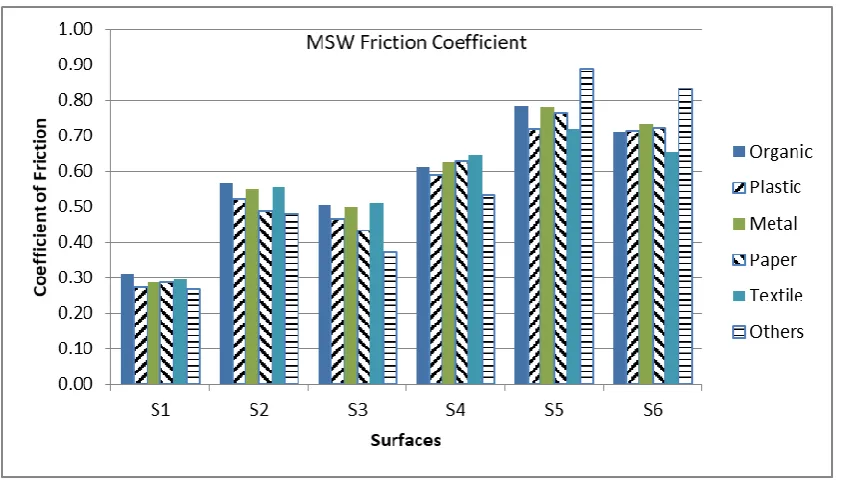
component and a surface type form a tribosystem. Six surfaces were considered and
designated appropriately. These surfaces are Formica, S1; Vanish polished wood surface S2;
Plain metal surface S3; Emulsion paint painted wood surface S4; Oil paint painted metal
surface S5; and oil paint painted wood surface S6. The Formica surface give lowest
coefficient of friction with all classes of MSW ranging from 0.269 to 0.3126. The lower value
being for ‘others’ classified MSW and higher being associated with organic class. The higher
range of coefficient of friction is observed to be from 0.72 to 0.886 for oil paint steel surface
finished. This is followed by oil paint painted wood surface with value range of 0.65 to 0.83.
The highest value applied to ‘others’ class. These results are illustrated in figure 6.
Figure 6: Coefficient of friction with various surfaces.
The standard deviation which indicates the spread of the data value with respect to the mean
are such that for the formica surface with organic waste component that resulted in an
average value of 0.312 friction coefficient, the standard deviation is 0.0393; for vanish
polished wood surface with organic waste component with mean friction coefficient value of
0.565, the standard deviation is 0.0301. The standard error of 0.0098 is observed with respect
to the organic waste-formica surface tribosystem. The standard error of 0.0098 is an
indication that the coefficient of friction value of 0.312 for the organic waste-formica surface
tribosystem can be accepted as working value. In the case of organic waste – vanish polished
is 0.051 corresponding to ‘others’ waste - oil paint painted wood surface with a coefficient of
friction value of 0.833.
CONCLUSION
Handling of municipal solid waste is influenced by frictional effect. The frictional effect can
be quantified by the coefficient of friction which is a property of the tribosystem of interest.
Municipal solid waste is a complex and hence segregated into components of organic, plastic,
metal, paper, textile and ‘others’. The coefficient of friction were estimated based on waste
component – surface tribosystem. Generally, the coefficient of friction is observed to vary
from 0.269 to 0.886. The variation is dependent on the kind of waste component and the
surface that make up the tribosystem. The Formica surface gave the least friction resistance
with ‘others’ component class of waste. The highest value is observed for ‘others’ – oil paint
painted metal surface.
ACKNOWLEDGMENT
The authors will like to acknowledge the contribution of Daniel Donkor, Elorm Obed
Voryee, Nana George Bright Asare, and Joshua Nyebuchi Onyekwewe of Department of
Mechanical Engineering who undertook the experiment at various locations as their final year
student project.
REFERENCES
1. Peter J. Blau the significance and use of the friction coefficient, Tribology International,
2001; 34(9): 585–591.
2. Neil Dixon, D. Russell and V. Jones Engineering properties of municipal solid waste
Geotextiles and Geomembranes, 2005; 23(3): 205–233.
3. Van Geffen V. A study of friction models and friction compensation. DCT 2009.118,
Technische Universiteit Eindhoven, Department Mechanical Engineering, Dynamics and
Control Technology Group, Eindhoven, December, 2009.
4. Ludema K.C. Friction, Wear, Lubrication A Textbook In Tribology, The University of
Michigan, Ann Arbor,CRC Press LLC, 1996;
5. Simple Martin H. Müser, Ludgar Wenning, and Mark O. Robbins Microscopic Theory of Amontons’s Laws for Static Friction, Volume 86, Number 7 Physical Review Letters 12