Volume-6 Issue-2
International Journal of Intellectual Advancements
and Research in Engineering Computations
Data transfer using lifi technology
1B.Pavithra, 2P.Karthika, 3V.Rajeswari, 4 E.Aarthi, 5Dr.M.Anto BennetUG students1,2,3,Professor4,Department of Electronics and Communication Engineering VEL TECH,Chennai-60
Email: [email protected] ,& [email protected]
ABSTRACT
Lifi stands for LIGHT FIDELITY. The technology is very new and was proposed by German physicist Harald Haas in 2011.Lifi is a wireless optical networking helps in the transmission of the data from on place to the other by using LED bulbs that varies in the intensity faster than the human eye can follow. The term Lifi refers to visible light communication (VLC) technology that uses as medium to deliver high speed communication. Lifi provides better bandwidth, efficiency, availability and security than the wifi technology has provided. The datas that are transmitted through the Lifi technology cannot be hacked that much easily as in wifi.
Keywords: Light Fidelity; LED; visible light communication (VLC); Bandwidth
I. INTRODUCTION
Lifi can be regarded as the light based wifi that is instead of the radio waves it uses light to transmit data. In place of the wifi modems, Lifi would use transceivers fitted with LED lamps that could light a room as well as transmit and receive information. Lifi can be considered better than wifi because there are some limitations in wifi. Wifi uses 2.4-5GHZ radio wave frequencies and its bandwidth is about 50-100Mbps[1].When the number of hotspot connection in the wifi technology increases and if the wifi traffic increases there is a possibility that the signal strength becomes very weak at a particular point. The other reason for entering into the Lifi technology is that the wifi technology has become vulnerable to the hackers which are completely avoided in the Lifi technology as it provides better security than the wifi technology. The following are the limitations of the wifi technology which could be overcome by Lifi technology. The radio waves used by the wifi technology is limited as well as expensive, as we have now arrived at the 4G technology the amount of the spectrum is running out.
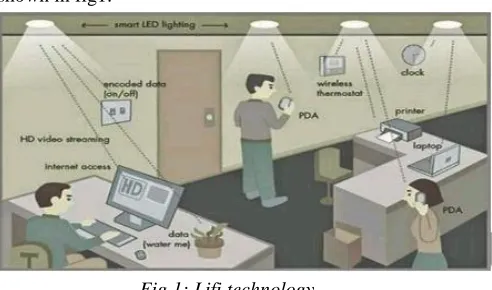
There are about 1.4 million cellular masts worldwide[2]. These masts consume a lot of energy which are used only for cooling the station instead of transmitting the radiowaves.The efficiency provided by these stations are only about 5%.Radio waves cannot be used in all environments for example we do not receive the radio waves in the airplanes, chemicalnpowerplants and in the hospitals. The radio waves utilized in the wifi technology can penetrate through the walls,this leads to many security concern as they can be easily intercepted shown in fig1.
Fig 1: Lifi technology
II. LITERATURE SURVEY
Lifi developments at Fraunhofer Institute for photonic Microsystems in Dresden, Germany, has said that Lifi can achieve the same data rates as USB cables which is challenging for wireless technologies such as Bluetooth and wifi[3,4].
III. PROPOSED SYSTEM
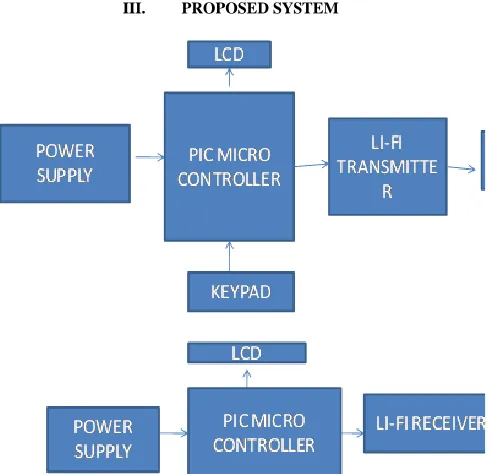
Fig 2: Block diagram of Lifi technology
POWER SUPPLY:
In Fig1, most of the power supplies are designed to convert the high voltage AC mains electricity to a low voltage supply for the particular device. The power supply performs mainly the function of the RECTIFICATION in most of the devices as well as in this device which converts the AC to DC but the DC output is varying shown in fig3.
Fig 3: Basic power supply circuit
PIC MICROCONTROLLER:
Various microcontrollersoffer different kinds of memories FLASH, EEPROM, EPROM, etc.are some of the memories of which FLASH is the most currently developed. Technology that is used in the pic microcontroller 16F877A is flash technology, so that data is detected even when the power is switched off. Easy programming and Erasing are the other attributes of PIC16F877A shown in fig4.
Fig 4 : Pic microcontroller
LCD (liquid crystal display):
The LCD is mainly used for the display of the data that is either to be transmitted or to be received. Whatever is typed in the keypad should be known by the sender to check whether it is correct or not for this purpose it is useful to the sender and for knowing what is the information that is received it is useful to the receiver shown in fig5.
Fig 5: LCD display
KEYPAD:
displaying of the alphabets from A to Z. The fourth is for displaying the alphabets in the reverse order from Z to A and the fifth is for transmitting the data shown in fig6.
Fig 6: Keypad
LIFI TRANSMITTER:
The Lifi transmitter will transmit or send the information to the other side which is the receiver by using the LED that falls on it. In this transmitter there will photodiode which will sense the amount of the light that falls on it. If it does not sense the light properly then there will be a problem in the transmission of the data shown in fig7.
LIFI RECEIVER:
The Lifi receives the data that is sent from the
transmitter. In the receiver side also there must be proper intensity of the LED that is used; otherwise there will be a problem in the reception. In the receiver also there will be a use of the photo diode which will sense the amount of the intensity of the light that falls on it shown in fig 7.
Fig 7: Lifi Receiver and Transmitter section
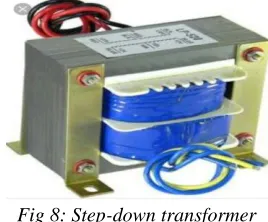
TRANSFORMER:
Basically transformers are used for the purpose of either increase or decrease the voltage levels. In this
transformers are used for decreasing the voltage hence STEPDOWN transformers are used shown in fig 8.
Fig 8: Step-down transformer
LED (Light emitting diode):
LED is the two-lead semiconductor light source. It uses a effect called the ELECTROLUMINESCENCE (a material emits light in response to the passage of the electrical current). In this data transmission does not take place without the LEDs. It provides the light with the maximum intensity for the data to be transmitted as quickly as possible. It provides a speed of 224Gigabits per second shown in fig9.
Fig 9: LED in Lifi technology
IV. EXPERIMENTAL RESULTS:
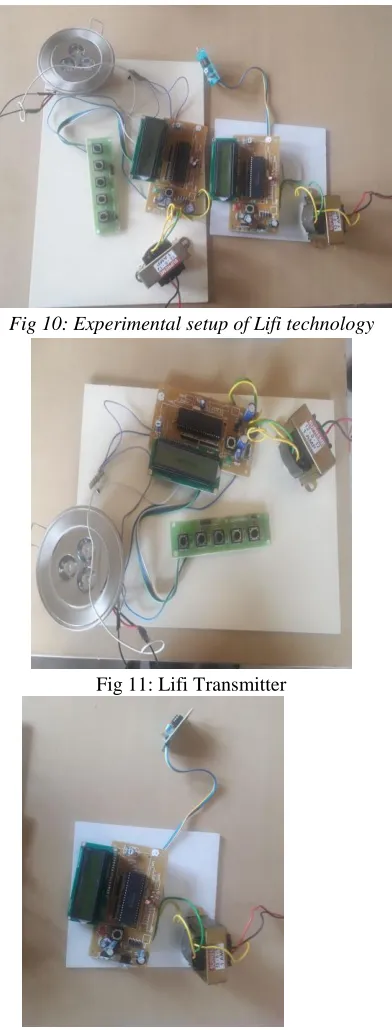
transmitter and the receiver together, the fig 11 is the setup of the transmitter alone and fig 12 is the setup of the receiver separately. The fig 10 and 11 is just for the understanding that both the transmitter and receiver are placed separately and shown.
Fig 10: Experimental setup of Lifi technology
Fig 11: Lifi Transmitter
Fig 12: Lifi Receiver
The components are connected and then the power supply is switched ON. The LED which is present will
glow so that the light falls on the photodiode which detects the photons present in the light rays. The data that is to be transmitted is typed in the keypad and then transmitted. The keypad provided in this setup works in such a way that the first button key is for appearing of the cursor and also for clearing of the screen. The second key is for moving the cursor forward. The third key is responsible for displaying the alphabets from A to Z. The fourth key is displaying the alphabets in the reverse order from Z to A. The last key is for the transmitting of the data that is being typed. To know the information that is being typed there is a LCD display used. The data that is typed will be displayed on the LCD display; once the transmitting key is pressed the data will be displayed on the LCD provided in the receiver side. In this setup a maximum of eight bit data can be transmitted. If the LED that is present in between the transmitter and receiver is hide by some obstacles then the data cannot be transmitted. The intensity of the light rays must be good in both the transmitter and the receiver side. If a new data is to be transmitted then clear or reset the LCD display type the data to be transmitted and press the last key that is provided.
V. CONCLUSION:
Although there is a still long way to go to make this technology a commercial success, it promises a great potential in the field of wireless internet. A significant number of researchers 15 and companies are currently working on this concept, which promises to solve the problem of lack of radio spectrum, space and low internet connection speed. By deployment of this technology, we can migrate to greener, cleaner, safer communication networks. The very concept of Lifi promises to solve issues such as, shortage of radio frequency bandwidth and eliminates the disadvantages of radio communication technologies. Lifi is the upcoming and growing technology acting as catalyst for varying other developing and new inventions/technologies. Therefore, there is certainly of development of future applications of the Lifi which can be extended to different platforms and various walks of human life.
VI. REFERENCES:
1.Harsur A.,Chitra M.Voice Based Navigation System
for Blind People Using Ultrasonic
Sensor.IJRITCC.2017;3:4117-4122.
2.Redmon J.,Divvala S.,Girshick R., Farhadi A.You Only Look Once:Unified,Real-Time Object Detection;proceedinds of the 2016 IEEE conference on computer vision and pattern Recognition (CVPR);LAs VegasmNV,USA.27-30 June 2016;pp.779-788.
3. Pranjali R Phrinke et al., “location finding for blind people using voice navigation stick”, international journal of engineering and technical research (IJETR) ISSN:2321-0869 vol-3, issue-1, pp212.1216, jan-2015. 4. Dr.AntoBennet, M , Sankaranarayanan S, Ashokram S ,Dinesh Kumar T R,“Testing of Error Containment
Capability in can Network”, International Journal of Applied Engineering Research, Volume 9, Number 19 (2014) pp. 6045-6054
5. Dr.AntoBennet, M, SankarBabu G, Natarajan S, “Reverse Room Techniques for Irreversible Data Hiding”, Journal of Chemical and Pharmaceutical Sciences 08(03): 469-475, September 2015.