Optimization of Process Parameter in Wirecut
EDM Machine on Al-Si Carbide Material
Using Response Surface Method
Essakidurai A1, Manikandan S1, Igneshprabhu S1 , Kasirajan U1 , Lakshmipathy J2
U.G. Student, Department of Mechanical Engineering, Francis Xavier Engineering College, Vanarpettai, Tirunelveli,
Tamil Nadu , India1
Associate Professor, Department of Mechanical Engineering, Francis Xavier Engineering College, Vanarpettai,
Tirunelveli, Tamil Nadu, India2
ABSTRACT: In wirecut EDM various techniques are applied to improve the Material Removal Rate (MRR). However, the machining parameters are also effective while machining. In our project, an experiment is performed to analyze the effect of machining parameters like discharge current (Ip), pulse on time (Ton),pulse off time(Toff), Servo
voltage (v) over the responses of MRR. For this copper electrode is used while the work piece chosen as Al-SIC which is utilized for manufacturing of various products in our daily life. We found that discharge current is most significant factor after that pulse on time over response of Material Removal Rate. For analysis and explanations Response Surface Methodology software is used.
KEYWORDS: Copper Electrodes, Material Removal Rate, Discharge current (Ip), Pulse on time (Ton),Pulse off
time(Toff) ,Servo Voltage (v).
I.INTRODUCTION
Wirecut Electrical Discharge Machining (EDM) is a thermo-electrical process in which material is eroded by a series of sparks generated between the work piece and electrode tool. Work piece and the electrode are immersed in a dielectric fluid. In EDM, dielectric fluid acts as a coolant and to maintain a constant gap between the work piece and electrode.
Modern technology has placed increasing demands on materials. This need for better Materials is particularly acute in the area of dynamic structure. Where not only high strength is required but also light weight. The efficiency of dynamic structures such as aircraft, high speed manufacturing machinery, power generating equipment could be affected by an improvement in the structural efficiency of the materials. The structural efficiency of materials is becoming even more important as hardware and capital equipment become larger and larger.
II.LITERATURE REVIEW
Mr.Somnath M. Kale, Mr.D.S.Khedekar et al. (2012)
parameter is surface Roughness. Taguchi’s Technique, Anova Table, Regression analysis method is used to find the optimal combination of process parameters affecting the Surface Roughness. They did this paper for the future scope. They conclude that the pulse off time, Pulse on time has the least significance among all the process parameters in effecting the surface roughness.
D. K. Ojha1, S. Panda , D.Mishra et al. (2012)
In this peper et al studied the author analyze the effect and percentage contribution of various machining parameters on output parameters is studied using Taguchi’s method and ANOVA analysis on AISI 304L Stainless steel. A hybrid Taguchi based grey relational analysis is proposed for multi objective optimization of performance variables like high material removal rate, low tool wear rate, better surface finish with lower dimensional tolerance. Further a regression analysis can be used for finding the model equations for various performance parameters. The input parameters considered in this study are dielectric flow rate, discharge current, Pulse on time (Ton) and Pulse off time (Toff). The tool
material used is copper. Analysis of variance is used to study the significance of process variables on Material Removal Rate (MRR), Tool Wear Rate (TWR), Surface Roughness (Ra), Dimensional Tolerance (DT). The analysis using Taguchi method reveals that discharge current significantly affects Material Removal Rate, Dimensional Tolerance and Surface Roughness where Tool Wear Rate is mostly affected by flow rate of the dielectric used. A comparison of the hybrid approach and Taguchi analysis is presented in this study. The confirmation test supports the result of the proposed hybrid Grey-Taguchi analysis.
III. PREPARATION OF SAMPLES
For carrying out this work, the aluminium and silicon carbide has been chosen for preparing composite structure. Epoxy resin has been selected as matrix materials. The mechanical properties of the selected aluminium and silicon carbide materials have been tabulated below in table 3.1.
Grade Symbol Tensile
Strength [Mpa] . Atomic Weight [gms] . Melting point [oC]
Coefficient of linear
expansion
Specific weight[If/cm3]
6061 Al 310 26.09 660 0.000024 2.7
Table 3.1: Mechanical properties of aluminium material
Symbol Tensile
Strength [Gpa]. Atomic Weight [gms] Melting point [oC]
Coefficient of linear
expansion
Specific weight[If/cm3]
Sic 0.137 24.034 2730 0.000023 7.3
Table 5.1.2Mechanical properties of Silicon carbides
Composite material fabrication can be broadly classified into following categories:
Hand lay up
Vacuum bag moulding
Compression moulding
Figure:3.2 split moulding
Composites are formed by placing AL-sic impregnated in resin on to female mould and applying pressure using a male mould to eliminate any excess resin form the ACM compression moulding is useful for fabrication such as boat hulls. In this project compression moulding process is used for fabrication of composite. The size of the composite sheet that is to be fabricated is 300*150*5 the materials used for fabrication are:
Die- 300*150*5
Epoxy LY556& hardener HY951
Aluminium sheet
Silkicon carbide
The die is used to fabricate the composite in the cross section of 300*150*5. Initially the grease is applied over the female die. After that OHB sheet is placed over it. The hardener grade 951 will be added to the epoxy resin. Which is used to increase the hardness of the epoxy resin.
Figure: 3.3 preperation of die
V. EXPERIMENTAL ANALYSIS
Mechanical properties like ultimate its mechanical behaviour such as Copper Electrodes, Material Removal Rate, Discharge current (Ip), Pulse on time (Ton),Pulse off time(Toff) ,Servo Voltage (v). absorption test will be evaluated.
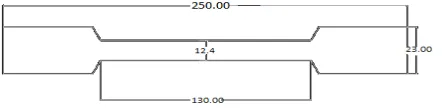
Tensile test: Tensile testing, also known as tension testing, is a fundamental materials science and engineering test in which a sample is subjected to a controlled tension until failure. Properties that are directly measured via a tensile test are ultimate tensile strength, breaking strength, maximum elongation and reduction in area.
Figure 5.1: Tensile ASTM A378
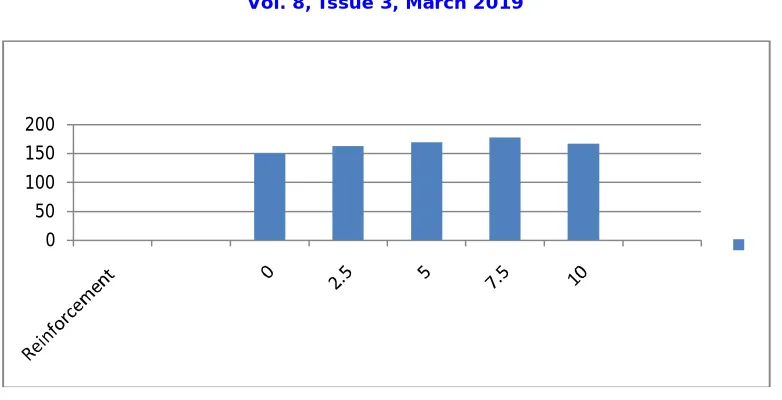
S.NO Reinforcement
percentage
Diameter of indentation (d)
BHN=
P/(Πd(D-÷√(D-d)/2)
1 0 2.88 150
2 2.5 2.78 163
3 5 2.73 169
4 7.5 2.63 178
5 10 2.75 167
Figure 5.2: brinell hardness value for AL-SIC
The above chart shows the effect of reinforcements on UTS of the Fibers reinforced composites as can clearly see the increase in the ultimate tensile strength in single layer carbon fiber composite. A1,B1,C1 are the single flax and carbon layer samples which are tested under the different load. The graph is plotted between load vs elongation of specimen i.e .displacement.
Impact test:
The apparatus consists of a pendulum of known mass and length that is dropped from a known height to impact a notched specimen of material. The energy transferred to the material can be inferred by comparing the difference in the height of the hammer before and after the fracture.
Figure 5.3: Impact test ASTM standard
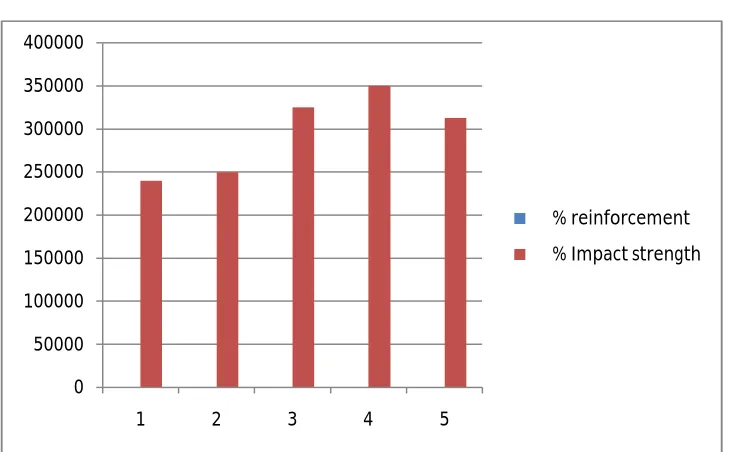
S.NO %
reinforcement
Energy absorbed by the specimen in J
Impact strength In N/M
1 0 19.2 240000
2 2.5 20 250000
3 5 26 325000
4 7.5 28 350000
5 10 25 312500
Table 5.2: Impact test result
Wirecut edm test:
Mechanism behind material removal of EDM process is based on the conversion of electrical energy to thermal energy that categorized it to electro thermal process. During machining both the surfaces may have present smooth and irregularities causes minimum and maximum gap in between tool and work piece. At a given instant at minimum point suitable voltage is developed produces electrostatic field for emission of electrons from the cathode there electrons accelerated towards the anode. After getting velocity of electrons collides with the dielectric molecules breaking them into negative and positive ions. Because of that spark is generated with high temperature causes melting and vaporization of material from the workpiece shape of tool on to the workpiece.
S.NO Pulse On
Time(Ton), mins
Pulse OffTime(Toff), mins
Discharge current (Amp)
Servo Voltage (volt)
Machining Time (mins)
Wt. of the material before machining(gra ms)
1 29 1 8 50 150 32
2 32 3 12 53 120 32
3 36 5 16 56 90 32
4 38 6 18 59 60 32
5 40 8 21 65 45 32
6 42 10 24 80 30 32
Table 5.3:wirecut edml test result
The graph was drawn between the load and displacement. From the above graph the load increases the flexural strength decreases. The above graph is the single layered flax/carbon fiber sample which is tested.
0 50000 100000 150000 200000 250000 300000 350000
1 2 3 4 5
% reinforcement
VI. CONCLUSION
By comparing Tensile stress Results of Experimental Analysis and numerical analysis. From the test results of carbon fiber composites based on mechanical tests conducted a conclusion is reached from the study. All the result are compared to various proposition of flax and carbon fiber to increase the strength. From the study it’s concluded that the composites used in aerospace and aeronautical applications abundant and highly reliable. Flax/carbon fiber composite material result of tensile strength [67MPa] is increase with increase of carbon fiber layer .
REFERENCES
[1]Mr.Somnath M. Kale, Mr.D.S.Khedekar(1), “Optimization of Process parameters in EDM for Machining of Inconel 718 using Response Surface Methodology”, International Journal of Innovations in Engineering and Technology (IJIET).
[2]Ch. Maheswara Rao1 and K.Venkatasubbaiah, “Effect and Optimization of EDM Process Parameters on Surface Roughness for En41 Steel”, International Journal of Hybrid Information Technology Vol. 9, No. 5 (2016), pp. 343-358
[3] D. K. Ojha1*, S. Panda2 , D.Mishra3, “A Study on Effect of EDM Process Parameters on AISI 304L Stainless Steel” 5th International & 26th All India Manufacturing Technology, Design and Research Conference (AIMTDR 2014) December 12th–14th, 2014, IIT Guwahati, Assam, India. [4] Prof. S.R.Nipanikar, “Parameter Optimization Of Electro Discharge Machining Of AISI D3 Steel Material BY Using TAGUCHI METHOD”, Journal of Engineering Research and Studies.
[5] Shaaz Abulais, “ Current Research trends in Electric Discharge Machining(EDM):Review”, International Journal of Scientific & Engineering Research, Volume 5, Issue 6, June-2014
[6] A.Hemantha Kumar1 Prof. G. Krishnaiah2, “Optimization of Process Parameters And Dielectric Fluids on Machining En 31 By Using Topsis”, Int. Journal of Engineering Research and Application ISSN : 2248-9622, Vol. 6, Issue 9, ( Part -4) September 2016.
[7] Tarun Modi, Shaileshbhai sanawada, Jignesh Patel, “A review paper on Optimization of process parameter of EDM for air hardening tool steel”, l Int. Journal of Engineering Research and Applications ISSN : 2248-9622, Vol. 5, Issue 1( Part 1), January 2015.
[8] Dr. M.Indira Rani 1 , Ketan2, “Optimization of Various Machining Parameters of Electrical Discharge Machining (EDM) Process on AISI D2 Tool Steel Using Hybrid Optimization Method”, International Journal of Application or Innovation in Engineering & Management (IJAIEM) Volume 3, Issue 9, September 2014
[9] Pratik N.Chhaniyara1 , Neeraj P. Badola2 , Akash.B.Pandey3 , A.V.Sata4, “A Review Paper on EDM and ECM of Stainless Steel”,International journal of engineering Development and Research Volume 2, Issue 4,2014.
[10] Harmanpreet1 , Manpreet Singh2 , Bipendeep3, “OPTIMIZATION OF EDM PROCESS PARAMETERS USING TAGUCHI METHOD: A REVIEW”, International Journal of Research in Engineering and Technology.
[11] G. Lakshmikanth1 Nirmal Murali2 G. Arunkumar3 S. Santhanakrishnan4, “Investigation on Optimization of Machining Parameters in Wire EDM using Taguchi Technique”, International Journal for Scientific Research & Development| Vol. 1, Issue 9, 2013.
[12] R.Sankara Doss*, B.Kumaraguruparan, “OPTIMIZATION OF PROCESS PARAMETERS IN EDM OF INCONEL 718 BY USING ROBUST DESIGN”, International Conference on Energy Efficient Technologies For Automobiles (EETA’ 15) Journal of Chemical and Pharmaceutical Sciences.
[13] Vishal Kesarwani, “Investigation on Electric Discharge Machine for optimization of Surface Roughness using Response Surface Methodology approach”, International Journal for Scientific Research & Development| Vol. 3, Issue 9, 2014.