ECCLESIOLOGY TODAY
ECCLESIOLOGY TODAY
© Copyright the authors 2012. All rights reserved.
ISSN: 1460-4213
Published 2012 by the Ecclesiological Society c/o The Society of Antiquaries of London Burlington House
Piccadilly London WIV 0HS
The Ecclesiological Society is a registered charity. Charity No. 210501.
www.ecclsoc.org
Ecclesiology
Today
Issue 46 for July 2012 published December 2012
Journal of the
Ecclesiological Society
C
o n t e n t s
Chairman’s letter 2
The lure of ‘The Arts & Crafts church’: a prodigious priest and his saintly architect at St Christopher’s,
Haslemere, Surrey (1900–1903)
by Alec Hamilton 3
British church sites on the World Wide Web
by Phil Draper 23
Change and continuity: reflections on five years service on the Cathedrals Fabric Commission for England
by Paul Velluet 43
Recording angels: forty years of NADFAS Church Recording
by Alison Wakes Miller 54
NADFAS Church Trails
by Frances Moule 59
Review Essay
by Graham Parry 63
Dear Fellow Member
How do we recognise an Arts & Crafts church? Is such a category meaningful? These are the questions with which Alec Hamilton opens his article on the church of St Christopher, Haselmere, Surrey, built in the early years of the twentieth century. At the end of the article, having described the church and how it was built and furnished, he bravely hints at some answers. Will you agree with him? - you will only know by reading his fascinating account.
We then jump more than a hundred years forward, to an article about churches on the world wide web - specifically, websites which catalogue and describe church buildings in the various British counties. Phil Draper, the author, has not only attempted a complete list of such websites, but gives an anecdotal account of how they have developed over the past fifteen years. He captures a fundamental shift in the way we now look to obtain basic information, and particularly our growing expectation that we will be able to find a picture of any interesting church somewhere on the web. Here is an article which would have seemed like science fiction thirty years ago. Will it feel hopelessly old-fashioned in twenty years time?
For our next article, Paul Velluet kindly agreed to write about his experience as a member of the Cathedrals Fabric Commission for England, a body whose deliberations have a major impact on the appearance of these very public buildings. Whilst generally supportive of the Commission's approach, and mentioning with enthusiasm a number of recent major works in cathedrals, he does not shy away from suggesting some changes of emphasis.
Our final two articles describe the involvement of NADFAS (the National Association of Decorative and Fine Art Societies) with churches. Alison Wakes Miller describes how NADFAS Church Recorders have recorded in detail the contents of more than 1,600 churches, and explains how an online index now makes their work accessible. Frances Moule shows how NADFAS can interest children in church buildings and furnishings by setting up individual church ‘trails’, providing solid information in a way which appeals to youngsters.
This is the July 2012 edition of Ecclesiology Today, though it will not feel like it, as we are still somewhat behind in our production cycle. Eventually we will catch up. But here, late or not, is an intriguing medley of articles to welcome the New Year.
Trevor Cooper Chairman of Council
THE NOTION of ‘The Arts and Crafts church’ is seductive. We feel we know – or ought to know – what we mean by the term, perhaps because we can visualise Arts and Crafts (A&C) design motifs overlaid on a church. Surely if there are A&C houses – and Baillie Scott, Voysey and Lutyens, amongst many others, bequeathed us no shortage – there ought to be, must be churches.
The Arts and Crafts church
In recent years two scholars – Alan Crawford and Gavin Stamp – have given lectures on Arts & Crafts churches. Alan Crawford’s lecture was developed and published as an important chapter in a set of essays published in 2011.1These, together with numerous studies of individual churches by other writers, have created an emerging canon.The ‘Top Three’ are probably these: Holy Trinity, Sloane Street (1888–90), blessed/cursed by Betjeman as ‘the cathedral of the Arts & Crafts’;2 All Saints, Brockhampton, Herefordshire (1901–1902), hailed by Pevsner as W. R. Lethaby’s ‘most impressive work of architecture’,3 and St Andrew’s, Roker, Sunderland (1905–1907), canonised in Phaidon’s ‘Arts & Crafts Masterpieces’ series in 1999, alongside Mackintosh’s Glasgow Art School and Maybeck’s First Church of Christ Scientist, Berkeley, California. These three – and their architects: John Dando Sedding, Lethaby and E. S. Prior – have begun to feel defining.
The cognoscenti will also name St Edward the Confessor, Kempley, Gloucestershire (Randall Wells, 1902–3);The Wisdom of God, Lower Kingswood, Surrey (Sidney Barnsley, 1891–2); Holy Trinity, Dodford, Worcestershire (Arthur Bartlett, 1907–8); St Mark’s, Brithdir, Gwynedd (Henry Wilson, 1895–8), and perhaps St Bartholomew, Brighton, with its Byzantine interior by Wilson (1897–1908). Others which might be cited are St Mary the Virgin, Great Warley, Essex (Charles Harrison Townsend and William Reynolds-Stephens, 1902–4), but with the uneasy suspicion that is ‘really’ ‘Art Deco’, with its pewter screen and aluminium foil apse. Or the Mortuary Chapel at Compton, Surrey (Mary Seton Watts, 1895) – but perhaps that is really ‘Art Nouveau’? Or Queen’s Cross church, Glasgow (C. R. Mackintosh, 1896–9) – though maybe that is something else again.
Alec Hamilton is researching a DPhil on Arts & Crafts influences on church building in Britain 1888–1918, at Kellogg College, Oxford. He has recently published a book on the architect Charles Spooner.
The lure of ‘The Arts & Crafts church’:
a prodigious priest and his saintly architect at
St Christopher’s, Haslemere, Surrey (1900–1903)
It is all very difficult – A&C itself is hard enough to define: its Protean nature makes discussion problematic, as Alan Powers has argued. And what exactly is ‘A&C architecture’? Even with Peter Davey’s magisterial Arts and Crafts Architecture to guide us, its boundaries and defining characteristics remain far from clear.4
An inclination to classify is almost irresistible to architectural historians. But, with churches at least, it rather sets the problem on its head. What is interesting is not whether a church ‘qualifies’ as A&C or not, but what is going on in church-building in Britain in the decades around 1900, and whether examining it through the lens of A&C ideas illuminates the issues.
Whilst researching A&C influences on church building in Britain, I have considered a number of churches which seem to fit the bill of ‘being A&C’. But that tells only part of the story: the genesis of each church is always more nuanced than any bare classification implies. These churches might be better considered as ‘Post-Victorian’ (even though some were built before Victoria’s death). In a few cases they amount to ‘anti-Victorian’. Or perhaps they are best thought of as simply ‘Not-Victorian’. (And if the reader feels I must mean ‘Edwardian’, then I suggest mildly that word evokes – to me at least – architects like Fellowes Prynne, and Basil Champneys: it is not hard to see the pitfalls of labels in the period.)
St Christopher, Haslemere
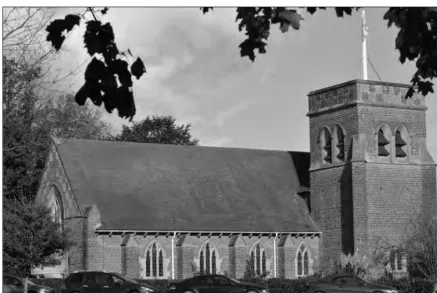
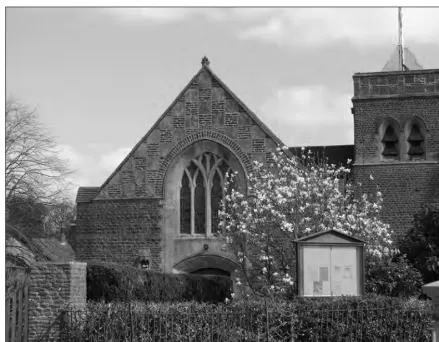
So – and if it is a meaningful question – is St Christopher, Haslemere Arts & Crafts (Figs 1–4)?
Church architecture does not happen in an artistic or stylistic vacuum. In the decades around 1900 it takes two (at least) to build a church. The religious ideas of the opinionated, forceful, usually rich, and frequently ‘arty’ clients shaped aesthetic outcomes every bit as much as the artistic sympathies, inclinations and affiliations of their architects.
Even just looking at the building can mislead: which may be why Ian Nairn, in his entry for St Christopher’s in the 1962
Buildings of England: Surrey (‘Pevsner’), got it so wrong. His
judgement that the church was ‘missing any form of religious conviction’ falls a good way short of the mark.5 Like most of us, he knew little of Charles Spooner, its saintly architect, and still less of George Aitken, its forceful priest.
Artists and artisans
In 1900 Haslemere was a rural backwater with social problems. Iron foundries once drove the local economy, but they had long
since closed: there was unemployment and poverty, and a deep gulf between rich and poor – each at their own end of a long, thin parish.
The arrival of the railway in 1859 created an influx of smart weekenders: the ‘Hilltop Writers Colony’ was founded around 1860, and by 1914 more than 60 writers had come to live and work in the area, among them Tennyson, Christina Rossetti, George Eliot, Conan Doyle, H. G.Wells, Arthur Wing Pinero and George Bernard Shaw. He, typically, was scornful: ‘Our Hindhead and Haslemere population makes an almost oppressive parade of its devotion to art’.6
The newcomers were rich as well as artistic: they found in Haslemere a fecund outlet for their many enlightened interests. Maude King founded a hand-weaving works with her husband Joseph in 1894.7 Haslemere Peasant Arts Society was founded by Godfrey Blount (Winchester and Cambridge)8and his wife Ethel Hine9in 1898, to further ‘the revival of a true country life where handicrafts and the arts of husbandry shall exercise body and mind and express the relation of man to earth and to the fruits of earth’.10 The Blounts’ tenant Therese La Chard observed their ‘unswerving faith in handweaving’ and meals of ‘salads and haricot beans eaten with horn spoons’.11
In a nearby hamlet, cousins Ursula Hutchinson and Hilda Woods set up the Inval Weavers.12 A pottery was founded at Hammer Vale by James Radley Young in 1901; Romney Green set up a woodworking shop in 1902.13
Into this milieu came in 1897 the Revd George Herbert Aitken (Fig. 5), an energetic Scot, trained as an Anglican priest in the cheerless East End parishes of London. In 1900 the Haslemere
Parish Magazine (vigorously edited by Aitken, and unusually with
a complete surviving run) reported that St Bartholomew’s, the
Fig. 3: Statue of St Christopher in a niche by the west door, by Minnie Dibdin Spooner. It was stolen in1998. This photograph is from a book published in 1911, Recent English
Ecclesiastical Architecture, discussed
in the text.
Fig. 4: Ground plan of St Christopher’s, from Recent English Ecclesiastical
Architecture (1911).The nave and
medieval parish church, was increasingly inadequate for the town’s needs: ‘The church on Sunday mornings is quite full, and sometimes overfull’.14
St Bartholomew’s, the medieval church, stands at the better end of the parish: the other end, with its largely working-class population, was served only by a church mission without its own premises.The mission’s activities seem to have been the only form of entertainment – other than pubs and the annual fair – which local workers had access to: ‘The services are bright and hearty... an attraction to the men of the neighbourhood’. The local paper noted the Wesleyans were building a chapel of their own nearby.15 Anglican opinion demanded the poor end of town ought to have its own church:‘The distance of the homes of many of the people, and the dislike the poorer classes feel for trying to find room in a church crowded with their wealthier neighbours should also be considered’.16
Aitken was clear: ‘I suppose there is no higher work on earth to which we can put our hands than this of being Church builders’. Besides, he had optimism: ‘the number of Church goers… may be increased almost indefinitely if space is ample and our Church life real and active’.17
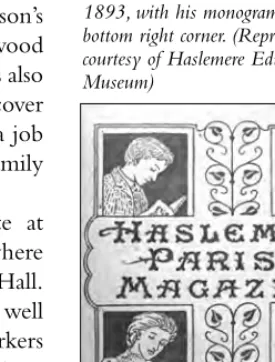
In May 1901 he reported that a Building Committee had been appointed to, amongst other things, ‘find an architect’.18The man chosen was Charles Spooner.19 We do not know why. Spooner was gradually becoming established as a church architect (St Christopher’s was his fifth church). It is probably significant that his cousin, Edith Tait, was married to Aitken’s bishop – Randall Davidson, later Archbishop of Canterbury. Mrs Davidson was to lay the church’s foundation stone. One of Davidson’s archdeacons was Charles Sumner, father of the designer Heywood Sumner (1853–1940), who reinvented sgraffito work, and was also a friend of Spooner. In 1898 Sumner designed a new front cover for Aitken’s parish magazine (Fig. 6). How an architect gets a job is always intriguing: the inter-relationships of friends and family connections here is layered and complex.
Another possible link is this: Aitken had been curate at St Jude’s,Whitechapel, in London’s East End (1886–1893), where the senior curate was Canon Barnett, founder of Toynbee Hall. Aitken seems to have lodged at the Hall itself, where he may well have met Walter Crane, later to be Master of the Art Workers Guild 1888–9, and another friend of Spooner. The architect C. F. A.Voysey had connections in Haslemere too, where he built a house for the publisher Sir Algernon Methuen: Voysey and Spooner were founding members of a sketching club, the Quarto Imperial Club, in 1889.
Fig. 5: The Revd G. H. Aitken (Frontispiece to G. H. Aitken, Fellow
Workers with God: Sermons of G. H. Aitken (London, 1921))
The driving force – indefatigable social energy
The new church was only one of scores of activities led by Aitken: he rebuilt the parish schools, established a cottage hospital, set up charitable bodies to relieve the poor, organised clubs for girls and boys: outings, fetes, parades, concerts, amateur theatricals – Aitken was a lively director; he was also a local councillor and effected the re-drawing of the parish boundaries. Before the coming of the welfare state, the parish and its priest – as here – took, if the need arose, responsibility for the physical well-being of parishioners as well as their spiritual needs. For Aitken, the two were not separate. Though never overtly describing himself as a Christian Socialist, Aitken was an active Liberal from his university days.20 Liberalism was a powerful force locally: Joseph King became Liberal MP for nearby Guildford in 1904; there was even a Liberal Cycling Club.21 The egalitarian ideas of the Rochdale-based Co-operative Society were embraced, and there was a Haslemere Co-op branch by 1903.22
But within the parish, the notion of building a new church was not the subject of debate, let alone controversy – ‘No hand being raised to the contrary sense’.23Nor was the two year project timescale ever regarded as heroic. Aitken galvanised the town into fundraising the necessary £4000: the church was consecrated free of debt through an anonymous last-minute cash donation of £400.
Aitken was not merely meeting the needs of a poor parish or responding to the counter-attractions of the Methodists or the pub. For the artistic newcomers were bringing with them new, and possibly dangerous religious ideas. In 1908 Godfrey Blount launched The Country Church of the New Crusade:
The purpose of this church is to interpret Christianity in a Spiritual and Symbolical manner. It believes that, so far from removing religion to an abstract and unpractical sphere, this idea makes all true work Sacramental and unites it with the highest thought and feeling. On the religious side the New Crusade seeks to make worship beautiful and uplifting, by devoting to its use what is noblest and most imaginative in our Art; and on the material side it seeks to restore real country life, that life of agriculture and handicraft, which it believes alone can save our land, and restore it to true welfare and happiness.24
A remarkable reredos
Aitken’s instincts were, I think, ‘High’. There is much suggestive detail: the altar was originally raised six steps above the chancel, while the pulpit is set modestly low, and lacks any elevating stairs (Fig. 7). A vestry was converted into a Lady Chapel by 1930. But there was never any suggestion that St Christopher’s was a Ritualist church.
Aitken’s sympathies can perhaps be seen best in the reredos painting at St Christopher’s (Figs. 8 & 9 and rear cover). The triptych is intended to depict ‘the worship of man’: a storybook group of High Church heroes and heroines paying homage to a mild, beneficent Christ. Jesus’ devotees include Edward King, Bishop of Lincoln, who in 1887 was tried before the Archbishop of Canterbury for ‘ritualist practices’. Here too are Sir Thomas More, ‘perhaps the finest type of saintly Englishman’;26 John Keble, Gordon of Khartoum, Florence Nightingale, St Margaret of Scotland, St Catherine of Siena, St Martin (who gave his cloak to a beggar), Simon de Montfort (not a saint!), St Francis of Assisi, ordinary soldiers and children. The subject matter shows a liking for humanitarians, and Christian principles practically applied.
The painter was Minnie Dibdin Spooner (seemingly known as Dinah), wife of the architect, and an illustrator of children’s books. St Margaret and St Hugh of Lincoln, who figure in the reredos, also appear in her book Our Island Saints (1912).27 Her retable panels (Fig. 10) show eight further good men and women,
Fig. 9: The reredos (see the rear cover for colour illustration)
including St Antony, St Lewis (King of France), Mary Magdalen and St Stephen.
Andrew Saint comments, ‘The eye is chiefly drawn to Mrs Spooner’s “modern” reredos – a very bold thing for 1912 and a kind of climax to the sequence of revived painted reredoses in Anglo-Catholic churches going back to the 1870s’.28
Comparison with examples of painted reredoses elsewhere suggests that Dinah seems indeed to have moved away from a cautious, pious formalism employed by artists consciously emulating renaissance models. In 1858 J. P. Seddon had Dante Gabriel Rossetti paint a quattrocento Adoration at Llandaff Cathedral,‘The Seed of David’. In 1861 Bodley used Burne-Jones for a conventional Adoration reredos at St Paul’s, Brighton. The next year Leighton painted a lush and reportedly fresco reredos at St Michael and All Angels, Lyndhurst, Hampshire for William White.
All these looked to the past for composition, iconography and palette. The same remained true for other reredoses almost contemporary with Haslemere, such as at St Mary le Tower, Ipswich, (c 1900) and Fellows Prynne’s at Armagh Cathedral (1913). Dinah Spooner’s informal, asymmetrical composition has little in common with these, in either treatment and colouring. It is perhaps a foretaste of what Phoebe Anna Traquair was to
achieve at All Saints, Thorney Hill, Hampshire in 1922.29 The reredos woodwork was made to Spooner’s design by the firm of J. A. Robinson – he used them often – but it stood empty from the time the church was consecrated until Dinah’s reredos paintings were installed in 1913 (Fig. 11).
A saintly architect
Charles Spooner was unusual among A&C architects: he was a regular and devout churchman, and ‘On most Sundays when he was at home, he was in his place at the 10 o’clock Mass’.30 He attended St Nicholas, Chiswick, and became its architect (in the days before churches were obliged to have one). He and his wife were responsible for decorating the Lady Chapel there, and he designed a silver ciborium; replaced a broken aumbry; advised on lighting; and prepared structural reports for the church council.
Religious engagement went deep into his architectural work. In 1909 he was appointed to the Consulting Architects Committee of the Incorporated Church Building Society, the body which examined and critiqued architects’ plans for new church buildings or extensions in order to make financial grants. Spooner served until his death in 1938. In 1911 he was chosen by Mervyn Macartney to be one of the two preface authors (the other was Charles Nicholson) for Recent English Ecclesiastical
Architecture, an overview, in the Caxton Technical Journals series,
of church building since the death of Bodley.
Spooner’s A&C credentials were impeccable too: he was an early member of the Art Workers Guild (elected 1887) and of the Arts and Crafts Exhibition Society (elected 1890), and he was appointed by Lethaby to teach furniture design at L. C. C. Central School of Arts and Crafts in 1899: he did so for 30 years.
Fig. 11: The altar arrangements before the introduction of the painted reredos, as illustrated in Recent English
Spooner built seven churches, and repaired many more. St Christopher’s is one of his smallest – only 88 ft long x 30 ft wide internally – and feels domestic, even homely. From the outside, it has the appearance of a late medieval Surrey church. Spooner’s hand is more or less invisible: there are no obtrusively self-conscious stylistic quirks – just one affectation. Or is it? The mortar is speckled with small dark stones – ‘galleting’ – in a traditional local manner. (Fig. 12) Was this a romantic concession to past methods, or a self-conscious attempt to be vernacular? Or is it merely the way things had always been done in Surrey? In short, is it old world or ‘Olde Worlde’? Retrospective gestures like this can appear contrived, and tip the Arts & Crafts into what B. F. L. Clarke criticised as ‘sophisticated simplicity’. (Alan Crawford touches on the same tendency in his phrase ‘mock humility’.)31However, at the nearby village of Hascombe, where many of the medieval cottages are galleted, Henry Woodyer has galleting too, in his robustly Gothic church of 1851.
In Spooner, Aitken knew he had something special: ‘in Mr Spooner we have had an architect who has shown himself all through, if I may say so, an artist, a Christian, and a Churchman, and who has built all those qualities into our Church’. Spooner was valued as much for his aesthetics as his professional skills: ‘Mr Spooner is personally superintending the designing of all furniture and fittings down to the smallest.We thus have the great advantage of his taste and experience right through, and the Church will show harmony in its details’.32
But artists can be vague. Spooner made a number of visits during the building work, and held meetings with the parish. One revealing anecdote shows his unworldly nature: ‘Dr Ardagh: Can you give us any idea of the cost of the colouring [of the ceiling]? The Rector:Whenever I ask Mr Spooner the cost, he always says, “Oh, about £100”’.33
Craftsmanship in furnishings
The furnishings at St Christopher’s were at first sparse.The textile designer Luther Hooper, who lived in Haslemere, described the process: ‘At the first opening of the church the fine oak Holy Table… and the polished steel altar cross were the only furniture of the east end provided…. Other furnishings followed from time to time’. The result is that ‘there is nothing commonplace or ordinary, and at the same time nothing is bizarre or out of harmony…. From the first, the committee wisely resolved not only to entrust the design of the fabric to [Spooner], but to take his advice on all matters of detail and furnishing’.34 A later connoisseur of church interiors, Peter Anson, thought ‘The candlesticks, and the pulpit (English oak, steel and leather) all express the spirit of plain living and high thinking’.35 (Anson meant the lectern – the pulpit is all wood.)
The roof is a barrel vault (Fig. 13) – the first Spooner designed (he made another at St Hugh of Lincoln, Letchworth, Hertfordshire in 1907–8). It was a device employed by other Arts & Crafts architects, usually in smaller churches: for example, Sidney Barnsley at Lower Kingswood. It offers a simple, uncluttered, all-embracing, enclosing shelter, and, when as here painted white, adds to a sense of light and clarity. It is sad to recall
Fig. 14: Haslemere, St Christopher: furnishings and their details, all designed by Spooner
Opposite page: 14a: Detail of altar rail 14b: Pulpit detail 14c: Lighting fixtures, with ceiling painting behind 14d: South aisle window
that Ian Nairn dismissed the roof as ‘pathetic’.36Whatever can he have meant? The chancel ceiling was painted to Spooner’s design – red, blue and gold – in 1928–9: his drawing for it survives, framed in the church.
The church interior is full of refined craftwork. (Fig. 14) (A detailed list is given at the end of this article.) The effect is never overwhelming, never overpowering – because the scale is always human.The mood is easy and relaxed: an unfussy room for friendly, sociable contact. But at the same time the space is deeply serious, with the intense focus on the dazzling reredos and altar, visible from all parts (Fig. 7).
In Spooner’s scheme the east window was intended to complement its depiction of ‘human worship of Christ [and] represent the Worship of Heaven. Unfortunately the window part of the scheme was not carried out’.37 Spooner’s idea was to base the window on the Book of Revelation:‘the Lamb, the book with seven seals, the four beasts, the seven candlesticks, and the dragon falling from heaven… I think it will have a fine rich effect, somewhat mysterious’.38
But this striking scheme was not to be.At a meeting following the installation of the reredos Spooner rather oddly advised ‘that the east window should be permanently concealed by a curtain’, presumably so as not to detract from it. In the event, the window was not completed until 1928, in a geometric pattern ‘in very subdued colours in order to avoid clashing with the colours of the Triptych’.39 (Fig. 15) Tradition holds that it is made of glass from the studio of Spooner’s friend Christopher Whall, who died in 1924.40 Whall and his family had lodged with Spooner in the 1890s.
Unsurprisingly, in a parish whose priest was a dynamic force for social good, St Christopher’s is a church of humane Anglicanism: religion on a personal scale, not over-concerned with mystery and crucifixion, but with compassion, brotherly love, and good works.The effect is rather magical.
But is it ‘Arts & Crafts’?
Spooner was Arts & Crafts through and through. Quite apart from belonging to the right organisations, he was a practitioner (of cabinet-making) as well as a designer; a maker and teacher as well as an architect. He was ‘hands-on’, and ‘He could not use assistance readily, for the very good reason that he felt his work so intensely that he could not bear any detail falling short of the high standard he had set himself ’.41 He never delegated to a Clerk of Works.42 He subscribed to ‘a professional ethic of diffidence… espoused by many (not all) A&C architects, artists and designers…He did not regard himself, indeed had no wish to be regarded, as a major artistic figure in any conventional sense’.43
Aitken gave the church his whole-hearted approval. And he summed up the experience of working with Spooner in a paragraph that may stand as a sort of A&C manifesto for Christian building – almost a definition of that elusive creature, the ‘Arts & Crafts church’:
Helped by Mr Spooner, the Committee resolved from the first that they would not be content to put into our little House of Prayer anything cheap or ordinary. Each piece of furniture as it has come has been specially designed and made, and, with hardly a single exception, all those machine-made articles, which may be seen by the dozen in the catalogues of Church Shops, have been excluded. ‘Only the best,’ we have said, ‘for the Service of God’s House’.44
Appendix: church furnishings
Of the furnishings, the main items of interest are as follows: 1. Holy table (still in place at east end) and sanctuary chair: A.
Romney Green, 1903–4
2. Lectern:W. Bainbridge-Reynolds, 1904 (possibly designed by Spooner). Bainbridge-Reynolds was also responsible for ‘the whole of the wrought-iron work in strap hinges and handles and the tower cross’ (Builder, 10 December 1904, 606). 3. Font: 1904 (probably designed by Spooner)
4. Prayer desk: designed by Spooner, 1904
5. Altar rails: designed by Spooner, 1904 (subsequently moved in 1970s reordering)
6. Ewer: unknown designer, 1904
8. Organ case: Spooner, 1905 (the organ has subsequently been altered)
9. Pulpit: designed by Spooner, made by J. A. Robinson, 1905? 10. Lettering on retable: Eric Gill, 1908
11. North nave window: Mary Lowndes, 1910
12. One surviving altar frontal was designed by Edmund Hunter, and made by St Edmundsbury Weavers (c. 1906). There were also (in 1911) textiles by Luther Hooper, including sanctuary curtains, though none seems to survive.
13. Electric fittings and sanctuary lamp: Spooner, 1913–14 14. Choir stalls: designed by Spooner in 1914, but not made and
installed until 1927, and moved in the 1970s reordering 15. Chancel south window: Martin Travers, 1935
16. Suspended chancel cross: Martin Travers, 1941?–1950 (one source suggests it is to Spooner’s design, but this seems unlikely, and I have been unable to verify it)
17. The statue of St Christopher in the niche by the west door (2000) replaces the original, designed by Minnie Dibdin Spooner, which was stolen in 1998
Acknowledgements
My thanks to Frankie Gaiter (sometime Churchwarden at St Christopher’s), Catherine Eyre (‘Peasant Arts – Haslemere’ blog), Greta Turner (Haslemere Educational Museum) and Gerald Sexton. Comments on and corrections to this article can be sent to [email protected]
A longer and fuller account of the church, including some of this original material, will be found in Alec Hamilton's book on Spooner: Charles
Spooner: Arts and Crafts Architect (Shaun Tyas, Donington, 2012),
76–93.
Notes
1 G. Stamp,‘The Arts and Crafts church’, Rewley House, Oxford, 15 May 2005; A. Crawford, ‘Arts and Crafts churches’,Victorian Society, 24 October 2006. A. Crawford, ‘Arts and Crafts churches’ in A. Saint and T. Sladen (eds.), Churches
1870–1914 (Victorian Society, 2011), 63–80.
2 Quoted in P. Skipwith, Holy Trinity, Sloane Street (London, Trinity Arts and Crafts Guild, 2002), 7. Alan Crawford notes, ‘The phrase seems to have been coined by John Betjeman in Betjeman (ed.) Collins Guide to English Parish Churches, London 1958, p. 255’ (Crawford, ‘Arts & Crafts churches’ (2011), 78 fn12).
3 N. Pevsner, ‘Lethaby’s last’, Architectural Review, 130 (1961), 354–57.
4 A. Powers, ‘A movement of the mind’, Crafts, 166 (September/October 2000), 40–43; P. Davey, Arts and Crafts Architecture (London, 1995).
5 I. Nairn, and N. Pevsner, The Buildings of England: Surrey (London, 1962), 305. 6 Farnham, Haslemere and Hindhead Herald, 15 July 1899.
7 ‘The Wheel and Spindle Guild’, later Haslemere Weaving Industries.
8 ‘He had thought at one time of entering the church, and at another of becoming a doctor, but a great friend … assured him he was meant to be an artist, and it was to art that he devoted his great talents’. Obituary of Blount, Farnham, Haslemere
by a local early twentieth-century journalist, W. A. Sillick, now at Haslemere Educational Museum. The cutting is dated 26 August 1922, but Blount died in 1937.
9 Ethel Blunt and Maude King were sisters, daughters of Henry Hine, a landscape painter (W.Trotter, The Hilltop Artists (Book Guild, 1996), 80).
10 Haslemere Peasant Arts manifesto, quoted at www.utopia-britannica.org.uk/ pages/Ashbee.htm (accessed 3 Jan 2009).
11. Trotter, Hilltop Artists, 81.
12 L.Walker, and C. Sanger,‘The Inval Weavers’, Crafts Chronicle, Summer 1981, 2–6. 13 ‘The church of St Christopher has just been presented with a handsome sanctuary chair ... designed and made by Mr Romney Green’, Farnham, Haslemere and
Hindhead Herald, 20 February 1904, 8. The altar table at St Christopher’s was
also made by Green. A chest of drawers by him, dated 1905, is in the vestry of St Bartholomew’s.
14 Haslemere Parish Magazine, November 1900, 3; the run is held by Haslemere Educational Museum.
15 Farnham, Haslemere and Hindhead Herald, 3 December 1898, p. 8, and 31 March 1900, p. 8.
16 ICBS file 10384 (Lambeth Palace Library). 17 Haslemere Parish Magazine, May 1901, 2. 18 Haslemere Parish Magazine, May 1901, 2. 19 Haslemere Parish Magazine, October 1901, 2.
20 V. F. Storr, preface to Fellow-workers with God, and other sermons of George Herbert
Aitken (London, 1921), 20. In May 1908 Aitken was one of the contributors to a
debate on Socialism ‘arranged under the joint auspices of the Haslemere branch of the Independent Labour Party and the Church of England Men’s Society’ (pamphlet ‘Debate on Socialism . . . May 11th, 1908’, discussed by Catherine Eyre at http://peasant-arts.blogspot.co.uk/2012/11/haslemere-independent-labour-party.html (accessed 17 November 2012)).
21 Farnham, Haslemere and Hindhead Herald, 18 July 1903, n.p.
22 A. Booth, Haslemere in Old Picture Postcards (Zaltbommel, Netherlands, European Library, 1995), 57.
23 ‘It was moved that it be a mandate from the meeting to the new Church Council ... that they should forthwith take into consideration the question of building a church for the Foundry Road district of the Parish, and should make suggestions as to the best way of raising the necessary funds, no hand being raised to the contrary sense’ (Haslemere Parish Magazine, February 1901).
24 Undated cutting in Sillick’s bound collection of newspaper cuttings at Haslemere Museum.
25 Farnham, Haslemere and Hindhead Herald n.d. (but 1937), n.p., in the Sillick cuttings collection.
26 From an early twentieth-century card found in the church, explaining the reredos and other paintings, probably written by Charles Spooner.
27. Our Island Saints (London,T. C. & E. C. Jack, 1912). She illustrated four children’s books for Jacks in the period.
28 Saint, A., External Examiner’s report on the present author’s MA dissertation on Spooner, A Gracious Touch of Strangeness… (University of Gloucestershire, 2009). 29 This brief survey is very far from exhaustive: there must be many other
examples.However, the present writer is not aware of any scholarly survey of the history of painted reredoses in England in the nineteenth century.
30 St Nicholas, Chiswick, Parish Magazine, February 1939, n.p. (The eucharist is still referred to as Mass at this church, which remains, as it was in Spooner’s day, ‘High’).
31 B. F. L. Clarke,‘Edwardian ecclesiastical architecture’, in A. Service (ed.), Edwardian
Architecture and its Origins (Architectural Press, 1975), 291; A. Crawford, ‘Arts and
Crafts churches’ (2011), 74.
32 Haslemere Parish Magazine, August 1903, 3–4.
34 L. Hooper, ‘Art of to-day. Fine and Otherwise: Art in the Church’ Art Journal (London), February 1911, 47–52 and March 1911, 83–87. Hooper (1849–1936?) was the author of Handloom Weaving, Plain and Ornamental in the ‘Arts and Crafts’ series edited by W. R. Lethaby (John Hogg, 1911). He lectured on textile subjects at the RSA,V&A, and Central School.
35 P. Anson, Fashions in Church Furnishings 1840–1940 (London, 1960), 294. 36 Nairn and Pevsner, Surrey, 305.
37 Anon (probably the Revd G. Shelford, then vicar), A Short History of the Church of
St Bartholomew and St Christopher in the Parish of Haslemere (1952), 22.
38 Haslemere Parish Magazine, February 1908, n.p. 39 Shelford, Short History, 23
40 Anon (but F. Gaiter), A Guide to St Christopher’s Church, Haslemere (Friends of the Parish: n.d. (?2005)), 4.
41 Knapp-Fisher, A., Obituary of Spooner, RIBA Journal, 23 January 1939, 311. 42 ‘If you have a trustworthy firm of builders, a Clerk of Works will not be
necessary’. Letter from Spooner to the Revd K. W. Sibley, St Paul East Ham, 11 November 1925 (St Paul, East Ham archive).
43 Saint, A, Examiner’s Report.
THE PURPOSE of this article is to highlight online resources which cover churches here in Britain and to guide the reader to those sites where it may prove more fruitful to research (or idle away a few hours). I have chosen to focus on sites which deal with churches in their entirety within a geographical area (mostly counties) rather than one particular aspect of churches (such as stained glass or wall paintings or the work of individual architects). In passing, I will also try and give a flavour of how church sites have developed over the past fifteen years.
I have included a table of county sites, all of which were online in mid-September 2012. The references in the text are to that table.This list will be put up on the Society’s website (under ‘links’) to make it easier to click through and explore the various sites.
Church guidebooks vary in quality and accuracy, and the same can be said for the information presented online, especially as many sites rely on information derived from secondary sources. I certainly do not accept everything that I find there (I have, of course, not personally read everything on each of these websites). The sites vary. Some sites offer little more than photographs, some offer information that is concise and factual, rather like a rehash of a ‘Pevsner’ entry, whilst others are comprehensive and more like the official Listed Building Record. In a number of cases they provide information not easily available elsewhere. Others offer a more personal slant, the experience of the writer on visiting this particular church, and the inclusion of dates and factual information is somewhat incidental.
The early days and the increasing use of images
Up until the late 1990s I visited churches with pen and notebook, plus a camera for one or two general photographs to remind me of the building. At home I would quickly write up my notes whilst the visit remained clear in my mind.Today for me the pen and paper is largely a thing of the past, and the digital camera means I can take anything from ten to sixty pictures (and sometimes more) per church, even snapping some small detail such as a stained glass artist’s signature or an information board.
The same change applies to the internet. I can remember sitting in front of a computer, excited to find a picture of a church online and waiting for that picture to download, seductively revealing itself slowly from top to bottom as the electronic data
Phil Draper has had a life-long interest in churches. He is editor of Church
Crawler, the Society’s newsletter.
British church sites on the World Wide Web
was received. Uploading a picture to the internet was even slower: you must admire people who set up these early sites.
With broadband, downloading is now almost instantaneous and whilst uploading remains much slower it does not mean you have to go off and make a coffee whilst a picture uploads.
So I make no apology for including some sites which are primarily a filing cabinet of photographs with virtually no text, for example that of the Staffordshire Historic Churches Trust, (Ref. 38, Fig 1). Others have minimal, scene-setting text such as Gloucestershire (Ref. 17, Fig. 2) or Northumberland-Cam (Ref. 30, Fig. 3) or the rather different Kent churches site (Ref. 22, Fig. 4). A complete contrast is the site for Sussex, which is packed with thorough research, but has small images (Ref. 40, Fig. 5).
My own website, ‘ChurchCrawler’, (Ref. 4, Fig. 6) was born in 1995 and grew painfully slowly.At first all photos were scanned with a black and white hand scanner from printed photographs, but that changed when I purchased a desktop scanner which could scan colour photographs. Digital cameras became usable in around 2000 but took pictures at a low resolution and small size; my early pictures were taken with a one megapixel camera and are quite horrible when viewed today.
At this time there were a few other sites which became ‘favourites’, bookmarked on my computer. Two of those covered the churches of Essex and Hertfordshire (Refs 16 & 21), offering a single exterior photograph, often by Ian Rose, of almost every church in Essex and a selection from Hertfordshire. Some photographs looked awkward as they were made by joining of two or three photographs to make a single one showing the whole building; the occasional picture had some descriptive text. Both sites remain online, and Ian has now turned his attention to bird-watching photographs.
Someone stole my digital camera in 2001, and when it was replaced I learnt that mainstream digital cameras had progressed to three megapixels and were producing good, usable photographs. Other sites began to appear and many of the site owners became my friends through the establishment of the ChurchCrawling Email group and the mutual sharing of links to our sites.
The Web matures
built a resource that included every Church of England church in the county, and many of the Catholic ones. He scorned the use of digital cameras, preferring to take 35mm photos and scan them into his computer. The photos were always a personal selection and often not standard views, but even more personal and evocative were the words which accompanied them. They made the reader experience the visit, warts and all, sometimes with the frustration of a locked building and the unhelpful locals (though this was an experience very much in the minority).
Once the site was near-complete Simon was ribbed that he would soon produce a sister site for Norfolk, which he always denied. Time passed, devoted to family life, but then suddenly there it was, ‘The Norfolk Churches Site’ appeared (Ref. 28) and Simon was off once more with another 800 churches as targets. The sites differed in character, the Norfolk entries became smothered with photos (Simon had finally discovered digital cameras!) and the entries are more factual than experiential.With Norfolk nearing completion, Simon has turned his attention back to Suffolk and the revision of the oldest entries to match the style of the Norfolk site. The achievement to date is that for the two counties there are now approaching 1600 detailed pages on East Anglian churches. Even more remarkable is that Simon does not drive.
Surprisingly, the rest of East Anglia is also well covered with Mark Ynys-Mon’s and Ben Colburn’s Cambridgeshire churches site (Ref. 7) plus a second more comprehensive site for Essex by John Whitworth (Ref. 15, Fig. 8).The former site is more skewed towards a written description with a selection of photos; the latter has been through many changes in appearance as web design progresses and is mainly photographs, with a growing number of churches covered in depth. John also has a site devoted to the churches of Walter Tapper (www.sir-walter-tapper-churches.co.uk) which grew from his fascination with St Erkenwald’s Church in Southend on Sea and its demolition.
complete resource for historic churches in Clwyd and Powys (Ref. 52, Fig. 11), mainly full descriptive text with a small photo of the church.
Scotland’s principle resource is an extensive church tourism site, now under the management of the Scotland’s Churches Trust (Ref. 48, Fig. 12), but there is also a collection of photos for Dumfries & Galloway (Ref. 46) on a genealogy website, a site for the diocese of Dunblane and Dunkeld with detailed historical notes on about one hundred churches (Ref. 47), and an attempt to list (and eventually describe) every church there has ever been in Scotland at the ‘Scottish Church Heritage Research’ site (Ref. 49).
Many local sites can be found and I give as an example one of the best I have found: ‘Parish Churches in and around Peterborough’ (Ref. 54), another individual’s work of experiential text and photographs. Churches also lurk on sites where you might not at first think of visiting, such as bell-ringing and genealogy resources. Mention must also be made of incredible efforts being made by Colin Hinson to cover every church of any denomination past and present in Yorkshire on GENUKI, a genealogy site. For many years Colin has been adding photos (mainly exteriors) to his pages covering the old counties of Yorkshire (Ref. 45, Fig. 13), and in recent years the same has been happening in Lancashire (Ref. 23, Fig. 14) where some descriptive historical text is included for every church or chapel, past and present. Both counties have a vast Victorian legacy of churches and chapels, making this a huge task.
Disappearing sites
Search engines and other sources
Aside from the sites already mentioned above, the first points of call for many are the internet search engines. These will often throw up a site devoted to the particular church, as a large number of active churches have an online presence today. However the content of these sites does vary. Some have full histories, photo galleries, and a few even offer a virtual tour. However their prime existence is to publicise the mission of the church, the times of services, meetings of groups and contact information, and a visit to such a website can be disappointing for those people who are researching the history, architectural features and fittings of the building, when little of this is offered and even a photograph of the church is not available.
If little more than a photo is required, a search engine offering an image search facility can be used, although sometimes the results are quite random. Alternatively one can use Geograph (Ref. 57), a photo resource linked to Ordnance Survey maps. It is rare not to find at least one picture of a particular village church on the site.There is also Steve Bulman’s ‘Churches of Britain and Ireland’ site which has an ever-growing number of church photos (Ref. 55).
Flickr is another photo site which not only has perhaps the largest photo pool online but also offers a group option (Ref. 56, Fig. 15) which can be searched, and most counties and countries have a churches group on the site where members can add photos. However the accuracy of a few descriptions and the tags added can be questionable, and the search engine will find both the good and the bad photos on the site, as some people upload everything they have taken. Serious researchers do use Flickr, as do publishers, and it is also a wonderful place to tour around the churches of the world, where what seems to be half an hour online can actually be hours! Many of the pictures can also be enlarged.
Finally I will mention Cameron Newham’s project to build a photographic library of (mainly) churches covering the whole of England.This project continues apace, as reported in the previous issue of Ecclesiology Today. You can follow his work at The ‘Digital Atlas of England Foundation’ site, which includes his blog (Ref. 59, Fig. 16), a cracking good read augmented by his fine photos. A by-product of this work is a useful resource of maps by county showing whether a church is open, locked with / without listed keyholder, or converted. Although many of the maps were compiled during his visits up to twelve years or so ago, in the main they are still remarkably accurate.
Fig. 1 (Ref. 38), opposite page, top: Staffordshire Historic Churches Trust. A simple page with clickable thumbnails which open to larger versions in ‘lightbox’ fashion over this page. Press ‘ESC’ to return to thumbnails. More than 200 churches are shown, one image, usually external, per church.
Fig. 2 (Ref. 17), opposite page, bottom: Gloucestershire.This site is largely photos, often a random choice, and incapable of enlargement.The front page (not shown here) has a little red dot along side each parish name; clicking on the red dot brings up the sort of montage shown here.There are about 350 churches on the site.
Fig. 4 (Ref. 22), opposite page, top: Kent Churches. John Vigar’s site consists mainly of interior shots, including both modern photos and (as here) archive postcards, including churches long demolished.There is a brief text for each church, including church attendance and number of seats in 1851.
Fig. 5 (Ref. 40), opposite page, bottom: Sussex Churches. John Allen’s site is impressively full and inclusive of all Anglican churches, chapels of ease, and mission churches in East and West Sussex.The pictures are small but the text, based on very thorough research, more than makes up for this.
Fig. 7 (Ref. 39), opposite page: Suffolk Churches. Soon all Simon Knott’s Suffolk pages will look like this one. His Norfolk Churches follow a similar style.The coverage is complete; the entries are personal, recording his experiences and impressions on his visits.The smaller pictures can usually be enlarged but may take you ‘off site’ to the Flickr repository of photographs, where many of the images are very high resolution (as here, with the image of All Saints, Frostenden).
Fig. 9 (Ref. 8), opposite page, top: Cheshire Churches. A collection of photographs by Bill Moston, mainly exteriors, accessed by a panel on the left once the desired letter is selected. Online for 10 years or so, and shows some 450 churches. Some of the images are of archive photographs.
Fig. 10 (Ref. 32), opposite page, bottom: Southwell Diocese (for Nottinghamshire).There is so much information on this impressive site it is difficult to select what to show.This is a history page with archive photos but the links on the left show the full information available. More than one hundred churches are described in detail on the site, and work is ongoing.
Fig. 12 (Ref. 48), opposite page, top: the website of Scotland’s Churches Trust. About 1300 churches are members, each with an ‘open door’ policy, and details of each of these are shown, including practical information such as location, opening times and facilities.The site is unusual in including a drawing of each church, rather than a photograph.
Fig. 13 (Ref. 45), opposite page, bottom: GENUKI - Yorkshire. An example page listing available pictures for churches in Bridlington, plus links to any church’s own website (visible at the foot of this image). Each of the underlined entries indicates an image is available.There is very full coverage.
Fig. 15 (Ref. 56), top: Flickr. One of the group pages in this repository of images; this one (for Oxfordshire churches) is quite active with discussions and a regular supply of new photos (for this group, more than 14,000 photos at present).The thumbnail takes you to the photographer’s photostream with a larger photo which can often be enlarged further again to provide a high resolution image.
THE SIGHT OF long-running programmes for the repair, consolidation and replacement of external stonework and the repair and conservation of stained glass will be familiar to many visiting our great cathedrals. However over recent years both visitors and regular worshippers will have become increasingly aware of the implementation of major schemes for the liturgical re-ordering, re-seating and re-lighting of cathedral interiors, for the provision of enhanced facilities for visitors and education, and for the creation of improved facilities for cultural performance.We have probably seen a greater degree of change to cathedral interiors than at any time since the major ‘restorations’ of the nineteenth century. Many of these alterations deserve the same careful attention and assessment by ecclesiologists as the generally very much more radical changes effected during the nineteenth century.
It is no coincidence that such projects have been realised at a time when attendance at services in Anglican cathedrals has seen a major increase – in contrast to attendance at services in Anglican and other local churches, which have generally declined – and when the funding of many cathedral churches, particularly those without established endowments or income from entrance-charges, depends increasingly on their use for revenue-raising cultural performance and other secular purposes.
The control of changes to cathedral interiors
Such changes to cathedral interiors, like repairs and alterations to cathedral exteriors, are controlled by the Cathedrals Fabric Commission for England (CFCE) or the Fabric Advisory Committee (FAC) for the respective cathedral; statutory bodies established in March, 1991 under The Care of Cathedrals Measure,
1990 (as amended by The Care of Cathedrals (Amendment) Measure, 2005). Such legislative provisions apply to all Church of England
cathedrals in England except for Christ Church, Oxford. Material external alterations to all cathedrals also require Planning Permission in the same way as external alterations to any secular historic building. Under the Measure, as amended, a cathedral chapter must seek and obtain approval before implementing, or consenting to the implementation of any works of alteration, repair or maintenance, on, above or below ground, on land that would materially affect the architectural, archaeological, artistic or
Paul Velluet is a chartered architect. Since qualification in 1975, he has worked extensively in the conservation field in both private practice and the public sector, including English Heritage. Between 2006 and 2011 he served as a member of the Cathedrals Fabric Commission for England and currently serves on the Commission’s Technical Group, the Guildford Cathedral Fabric Advisory Committee and the Diocese of Westminster Historic Churches Committee. He is a member of the Society’s Council.
Change and continuity: reflections on five years service
on the Cathedrals Fabric Commission for England
historic character of the cathedral church, or any other building within its precinct in use for ecclesiastical purposes.
Under the Measure, the individual FAC may decide all applications unless they involve certain defined works that fall to the CFCE to determine or have been ‘called-in’ by the Commission. These include any permanent alteration to the fabric of the cathedral church, the demolition of any part of the cathedral church, and the disturbance or destruction of any archaeological and human remains, and any other proposal that raises such special considerations of archaeological, artistic, or historical importance that justify being determined by the CFCE. The Chairman of the CFCE, presently, the Rt Hon Frank Field, MP, the Vice-Chairman, and seventeen members of the Commission are appointed by the Archbishops of Canterbury and York on the nomination of, or in consultation with, a number of other bodies; and five members are elected by the General Synod from among its members. All members of the commission are appointed for a term of five years and may be re-appointed for one further such term. The nominating or consulted bodies include the Secretary of State for Culture, Media and Sport, the Archbishops’ Council’s Appointments Committee, the Deans’ Conference, The House of Bishops, the Liturgical Commission, the Council for the Care of Churches, the Royal Institute of British Architects, the Royal Institution of Chartered Surveyors, the Ecclesiastical Architects and Surveyors Association, the Institution of Structural Engineers, the Institution of Civil Engineers, the Royal Academy of Art, English Heritage (EH), the Council for British Archaeology, the Society of Antiquaries of London, and the Royal School of Church Music.The work of the Commission, not only in relation to the control of changes to cathedrals but in many other fields, is supported most effectively by a modest number of permanent staff in the Cathedral and Church Buildings Division at Church House.
My experience of the work of the CFCE
From April 2006 to March 2011, I was privileged to serve on the CFCE as a member appointed in consultation with EH. On standing down, I was asked to report to EH’s Places of Worship Forum on my experiences in serving on the Commission, and a few months later was invited by the Ecclesiological Society to contribute these reflections, given the ecclesiological significance of many of the proposals that came before the Commission over those five years.
My first and significant impression of the working of the Commission was that of the breadth, coherence and relevance of the expertise of its membership in the fields of architecture, building construction, repair and conservation, art and architectural history, archaeology, church furnishings, theology, liturgy and church music; considerably greater than would be available to local planning authorities and EH in their operation of the secular development and listed building control regimes, or to the national conservation bodies in their role as consultees.The second and similarly significant impression was that of the considerable benefits accruing from the scope to consider proposals at a very early stage and offer advice, well before definitive proposals might be drawn up and formal applications submitted. Such a process allows effective dialogue between promoters of change and decision-makers at the critical pre-application stage; an arrangement which is conspicuous by its absence in the secular planning system, and where pre-application consultation incurs heavy charges in addition to planning fees.
One of my expressed aims when first appointed to the CFCE, and very much borne out of my experience of working for EH in previous years, was to establish and maintain close liaison with relevant staff within EH’s ‘regional’ teams. Whilst I had been appointed to the Commission in consultation with EH, it was not my role to act as the organisation’s ‘representative’ or to convey or reinforce the views of EH on key issues. However, frequently, I found that my own professional views aligned closely with those of EH staff and the formal representations submitted by EH.
Certain types of work tended to dominate the agendas.These included programmes for the repair, consolidation and replacement of external stonework; the repair and conservation of historic stained glass (and the installation of isothermal protective glazing); the implementation of new or improved access measures for those with disabilities; the realisation of energy-saving measures; the installation or upgrading of external flood-lighting; landscaping and public-realm improvements; and, as noted above, major schemes for the liturgical ordering, seating and re-lighting of cathedral interiors, for the provision of enhanced facilities for visitors and education and for the creation of improved facilities for cultural performance.
Whilst much of the work that came before the Commission during my five years service, particularly works of repair and conservation of historic building fabric, and practical works of improvement, were substantially uncontentious, it was disappointing that a significant number of schemes of re-ordering – generally involving the introduction or renewal of movable altars, platforms, sedilia and choir stalls at the eastern ends of naves – were poorly or inadequately conceived liturgically as first advanced and presented, and without a clear and sound definition of the theological context in which they were promoted. Often, such schemes seemed to be primarily shaped by the desire to provide a flexible performance space, rather than a demonstratively sacred space at the very heart of a cathedral. In this, there is an interesting contrast with the re-ordering of Catholic cathedrals over recent years. Commendably, the CFCE has sought to address this deficiency and with the Liturgical Commission organised a very successful and well attended conference at Norwich Cathedral on the subject in November 2010. Importantly and commendably too, in the last year the chapter at Winchester Cathedral has organised early and wide discussion about potential re-ordering at an early stage.
I was particularly disappointed by the lack of appreciation shown by some cathedral chapters for the mid and late twentieth-century work of architects such as Stephen Dykes Bower and George Pace.Whilst surviving fittings and furnishings dating from the years before the late nineteenth century are generally held in high or reasonable regard today, works carried out in the twentieth century seem to be significantly less valued, and this has led to some highly regrettable and unnecessary losses. Once again, the CFCE sought to address this deficiency and organised a very successful and well attended conference at St. Michael’s College in Llandaff in November 2009.
raised by SPAB in the belief that the organisation’s critical comments about particular programmes of stonework repair were not given sufficient weight in a number of key cases considered by the CFCE. However, from my own observations across that period, it was clear that the Commission consistently addressed such issues in depth and detail and that discussion was usefully informed by the advice of cathedral architects serving on the Commission with substantial expertise and experience in the field. Indeed, a major conference on stone conservation in cathedrals was organised by the CFCE held at Peterborough Cathedral in July 2008. Clearly, the stone conservation policy for any one cathedral needs to be shaped primarily by those professionally charged with responsibility for making sound judgements and difficult decisions on complex, significant and long-term repair and replacement issues based on the particular durability and weathering characteristics of the stone used, its position and function, its accessibility or otherwise for further repair and replacement, and the frequency and affordability of major repair campaigns.
My final and very positive impression of my time on the CFCE was the readiness to accept a bold and contemporary approach to change when well informed by, and based on, sound conservation principles. Exemplary schemes supported by the Commission and completed during my five years service on the Commission include Tom Denny’s stunning new Bishop Michael Ramsey Memorial Transfiguration Window in the south aisle at Durham Cathedral, Hopkins Architects’ Hostry Visitor and Education Centre and Song School at Norwich Cathedral, and William Pye’s new font in Salisbury Cathedral (overleaf Figs 1–3, and front cover).The last two of these and other fine projects are beautifully illustrated in English Heritage’s Creativity and Care:
New Work in English Cathedrals.
Fig. 1: The Transfiguration Window in Durham Cathedral
Fig. 2: The new Hostry building at Norwich Cathedral
Fig. 3: The new font in Salisbury Cathedral
NEXT YEAR, NADFAS (the National Association of Decorative and Fine Art Societies) Church Recording celebrates its fortieth anniversary. With over 1600 churches recorded, the organisation has come a long way from a casual conversation on a train!
In 1971, Shirley Bury then Assistant Keeper in the Metalwork department of the V&A was organising an exhibition entitled Victorian Church Art. Meeting with Helen Lowenthal, Vice President of NADFAS, on a train, she mentioned the confused state of the parish churches she had visited in search for items for the exhibition. By Common Law each church within the Church of England has to keep a record of its contents but these were rarely kept up to date, were often inaccurate and very brief. After a meeting in Hambledon Church, three teams of volunteers were set up and staff from the V&A agreed the format of the records on the line of the Royal Commission set up in 1911.
By 1974 a clear brief had been developed for the Church Recorders which still applies today: to catalogue every item of
Fig. 1: An example of a Record produced by the NADFAS Church Recorders.This one is for All Saints, South Lynn, Norfolk
Recording angels: forty years of NADFAS
Church Recording
furnishing within a church (Fig. 1). This includes metalwork, stonework, woodwork, textiles, documents and registers, paintings and windows, musical instruments memorials and monuments and monuments (Figs 2 & 3). The format, which includes a description of the object, the material it is made of, its measurements, history, maker and any inscription on it has been the basis of the Record ever since. Every possible detail of the age,
Fig. 2: Textiles are carefully examined and recorded
history, design or manufacture, and donor is researched using the libraries of the V&A, the Council for the Care of Churches, local diocesan archives, parish records and magazines. So what is being produced is a historical record.
Each item is measured (unless it is inaccessible) and silver is weighed. The state of preservation is noted and most items are photographed (Fig. 4). The first Records were paper and photographic prints, but now the images are digital and laser printed on to the paper copies.The financial costs of printing and photography are borne by the supporting NADFAS society.
Digital images are stored at the English Heritage Archive at Swindon, with the complete Record containing the laser printed images. Other copies are held by the church, the Diocesan Archive, the V&A and the library of the Cathedrals and Church Buildings Division of the Church of England. Some are stored on archival discs.
This year an Online Index has been launched, free to access, which will be of particular value to academics and architects, church personnel and researchers as well as those investigating their family history. Insurance companies and the police will also make use of the Index when tracking items that have been misappropriated.The Index does not contain text or photographs from the Records but acts as a signpost to the contents of UK churches which have been recorded by NADFAS. After initial consultation of the Index further research can be undertaken by studying the relevant printed copy of the Church Record. The Index facilitates searches by diocese, church, and type of item or dedication.The information includes the names of at least 18,000 artists and manufacturers, such as Victorian firms of stained glass makers. It also holds about 80,000 names of commemorated individuals as well as the subjects of stained glass and wall paintings. However items of silver, gold or other precious materials are not included. You can visit the Index online at
http://tinyurl.com/Church-Records-Index.
The volunteers in 183 Church Recording Groups are working throughout the British Isles to ensure the contents of our churches are not lost for the next generation. As well as recording large numbers of churches in routine use for worship, records have been requested for some of the churches no longer used for regular worship which are looked after by the Churches Conservation Trust, and in Scotland, the NADFAS Churches at Risk Project has been set up which creates reports on the stained glass windows of churches at risk of closure.
Fig. 4: Recording items photographic-ally as well as by means of a written description has always been a significant feature of the Records, and with the advent of digital photography photographs can now be more closely integrated with the text
Fig. 5: There are thousands of ledgerstones in churches, and many of them have never been properly recorded
follow, a full record can be completed. It is hoped that some London churches may be recorded this way. In addition, NADFAS church recorders are also working in Europe, Australia and New Zealand where there are many Victorian churches whose contents need recording.
people. There is a challenge in keeping up with new technology but learning new skills and knowing our Records will be available and accessible adds to the sense of achievement.
Last year at All Saints church in Swallowfield a wooden chest was opened and a King James Bible printed in 1613, was found, with the third volume of Foxe’s Book of Martyrs, presented to the church in 1636. The chest, according to the churchwarden, had not been opened in living memory. In the same year at Aswarby in Lincolnshire a section of the nave floor collapsed while the church was being recorded and a rare ‘saddle type’ boiler, part of a Victorian heating system, was uncovered.
In 2011 the bust of Elizabeth Borrett was stolen from Shoreham church (with the church wheelchair!). Thanks to the detailed description taken from the Record done in 1996 publicised in the Antiques Trade Gazette, the bust was discovered at Sothebys and returned.
Church Recorders are also carrying out ledgerstone surveys (www.lsew.org.uk) and have, for example, identified many ledgerstones in Norfolk inscribed by a Kings Lynn stonecutter with a distinctive style (Fig. 5).
There is so much satisfaction in finding something old and often neglected that it has been said that each visit to the church can be a treasure hunt. It has also been said that recording needs patience, willingness to double check facts, the skill to write unambiguous English and a supply of warm underwear!