• No results found

The non-negative $Q_1$-matrix completion problem

N/A
N/A
Protected

Academic year: 2020

Share "The non-negative $Q_1$-matrix completion problem"

Copied!
8
0
0

Loading.... (view fulltext now)

Full text

(1)

The non-negative

Q

1

-matrix completion problem

Kalyan Sinha

Abstract

A matrix is a Q1-matrix if it is a Q-matrix with positive diagonal entries. A matrix is a nonnegative matrix

if it is a matrix with nonnegative entries. A digraph D is said to have nonnegative Q1-completion if every

partial nonnegativeQ1-matrix specifyingDcan be completed to a nonnegativeQ1-matrix. In this paper, some

necessary and sufficient conditions for a digraph to have nonnegativeQ1-completion are provided. Later on the

relationship among the completion problems of nonnegativeQ1-matrix and some other class of matrices are

shown. Finally, the digraphs of order at most four that include all loops and have nonnegative Q1-completion

are singled out.

Keywords

Partial matrix, NonnegativeQ1-matrix, Digraph, Matrix completion, NonnegativeQ1-completion problem.

AMS Subject Classification 15A48.

Department of Mathematics, A. B. N. Seal College, Coochbehar, India-736101.

Corresponding author: [email protected]

Article History: Received 12 April 2019; Accepted 8 August 2019 c2019 MJM.

Contents

1 Introduction. . . 651 1.1 Digraphs . . . 651 1.2 Digraphs with matrices . . . 652

2 Partial nonnegative Q1-matrix and the nonnegative

Q1-matrix completion problem. . . 652

3 Digraphs and the nonnegative Q1-completion

prob-lem. . . 653 3.1 Sufficient conditions for nonnegativeQ1-matrix

com-pletion . . . . 654

3.2 Necessary conditions for nonnegativeQ1-matrix com-pletion . . . . 655

4 Relationship theorems. . . 655 4.1 Q-completion and nonnegativeQ1-completion 655

4.2 NonnegativeQ-completion and non-negativeQ1 -completion . . . 656 4.3 PositiveQ-completion and nonnegativeQ1-completion

656

5 Classification of digraphs of small order having non-negativeQ1-completion. . . 657

References. . . 657

1. Introduction

A real n×n matrix B= [bi j] is a Q1-matrix if all diagonal

entries are positive and for every k∈ {1,2, . . .,n}, Sk(B)>0, where Sk(B)is the sum of all k×k principal minors of B. The

matrix B is a Q-matrix if for every k∈ {1,2, . . . ,n}, Sk(B)>0. A nonnegative Q1-matrix is a Q1-matrix in which all off

di-agonal entries are nonnegative. A partial matrix is a rectan-gular array of numbers in which some entries are specified while others are free to be chosen. A partial matrix M is

fully specified if all entries of M are specified, i.e., if M is a

matrix. A partial nonnegative (positive) matrix is a partial matrix whose specified entries are nonnegative (positive).

For a subsetα ofhni={1,2, . . . ,n}, the principal

par-tial submatrix M(α)is the partial matrix obtained from M by deleting all rows and columns not indexed byα. A principal

minor of M is the determinant of a fully specified principal

submatrix of M. For a given classΓof matrices (e.g., Q, Q1

-matrices) a partialΓ-matrix is a partial matrix for which the

specified entries satisfy the properties of aΓ-matrix. A

com-pletion of a partial matrix is a specific choice of values for

the unspecified entries. A matrix completion problem asks which partial matrices have completions with a given prop-erty. AΓ-completion of a partialΓ-matrix M is a completion of M which is aΓ-matrix.

A number of researchers studied matrix completion prob-lems for different classes of matrices ([5–13]). In 2009, DeAlba

(2)

liter-ature survey and complete updated results, one can see [3].

1.1 Digraphs

Any standard reference, for example, [1] and [4] can be use for graph theoretic terminologies. A directed graph or

di-graph D= (VD,AD)of order n>0 is a finite nonempty set

VD, with|VD|=n of objects called vertices together with a

(possibly empty) set ADof ordered pairs of vertices, called

arcs. We write vD (resp.(u,v)∈D) to imply vVD(resp. (u,v)∈AD). If x= (u,u), then x is called a loop at the vertex

u.

A (directed) u-v path P of length k0 in D is an al-ternating sequence(u=v0,x1,v1, . . . ,xk,vk=v)of vertices

and arcs, where vi, 1≤ik,are distinct vertices and xi= (vi−1,vi). Further, if k2 and u=v, then a u-v path is a cycle

of length k. The vertices viand the arcs xiare said to be on P.

We then write Ck=hv1,v2, . . . ,vkiand call Cka k-cycle in D. A digraph without any cycle is said to be acyclic. A 1-cycle consists of a vertex v and a loop at v.

A cycle C is odd (resp. even) if its length is odd (resp. even). A digraph H= (VH,AH) is a subdigraph of order

k of the digraph D if|VH|=k and VHVD, AHAD. A

subdigraph H of D is an induced subdigraph if AH= (VH×

VH)AD (induced by VH) and is a spanning subdigraph if

VH=VD. A digraph D is said to be connected (resp. strongly

connected) if for every pair u,v of vertices, D contains a u-v

path (resp. both a u-v path and a v-u path). The maximal connected (resp. strongly connected) subdigraphs of D are called components (resp. strong components) of D.

The complement of a digraph D is the digraph D, where

VD=VDand(u,v)∈ADif and only if(u,v)∈/AD. A digraph

D is said to be symmetric if (u,v)∈D implies (v,u)∈D.

On the other hand, D is asymmetric if (u,v)∈D implies

(v,u)∈/D. A complete symmetric digraph on n vertices,

de-noted by Kn, is the digraph having all possible arcs (including

all loops).

Two digraphs D1= (V1,A1)and D2= (V2,A2)are

iso-morphic, if there is a bijectionφ : V1→V2such that A2= {(φ(u),φ(v)):(u,v)∈A1}. An unlabelled digraph is an

equivalent class of isomorphic digraphs. Choosing a particu-lar member of an unlabelled digraph is referred as a labelling of the unlabelled digraph.

1.2 Digraphs with matrices

Letπ be a permutation of a nonempty finite set V . The di-graph Dπ= (V,Aπ), where Aπ={ v,π(v)

: vV}is called a permutation digraph. Clearly, each component of a permu-tation digraph is a loop or a cycle. The digraph Dπ is said to be positive (resp. negative) ifπis an even permutation (resp. an odd permutation). It is clear that Dπis negative if and only if it has odd number of even cycles.

A permutation subdigraph H (of order k) of a digraph D is a permutation digraph that is a subdigraph of D (of order k). A digraph D is stratified if D has a permutation subdigraph of order k for every k=2,3, . . . ,|D|.

Let B= [bi j]be an n×n matrix. We have

det(B) =

(sgnπ)b1π(1)· · ·bnπ(n)

where the sum is taken over all permutationsπofhni.

2. Partial nonnegative

Q

1

-matrix and the

nonnegative

Q

1

-matrix completion

problem

A partial nonnegative matrix is a partial matrix in which all specified entries are nonnegative. A partial Q1-matrix is a

partial Q-matrix with all specified diagonal entries are posi-tive. Thus, a partial nonnegative Q1-matrix is a partial

non-negative matrix M with all specified positive diagonal entries and Sk(M)>0 for every k∈ {1,2, . . . ,n}, whenever all k×k

principal submatrices are fully specified. Now, a partial non-negative Q1-matrix is characterized as follows.

Proposition 2.1. Suppose M= [ai j]is a partial nonnegative matrix. Then M is a partial nonnegative Q1-matrix if and

only if exactly one of the following holds:

(i) At least one diagonal entry of M is unspecified, all speci-fied diagonal entries are positive.

(ii) All diagonal entries are specified and positive; at least one off-diagonal entry is unspecified.

(iii) All entries of M are specified and M is a nonnegative Q1-matrix.

For any partial nonnegative Q1-matrix M, a completion

B of M is called a nonnegative Q1-completion of M, if B is a

nonnegative Q1-matrix. Since permutation similarity of a

ma-trix to a nonnegative Q1-matrix is a nonnegative Q1-matrix, it

is quite clear that if a partial nonnegative Q1-matrix M has a

nonnegative Q1-completion, so does any partial matrix which

is permutation similar to M.

One can easily verify that any partial nonnegative matrix

M with all unspecified diagonal entries has nonnegative Q1

-completion. By choosing sufficiently large values for the unspecified diagonal entries, a nonnegative Q1-completion

can be obtained. Suppose M be a partial nonnegative Q1

-matrix in which the diagonal entries at (i,i) positions(i=

k+1, . . .,n)are unspecified. If M[1, . . . ,k]is fully specified,

M may not have a nonnegative Q1-completion. For example,

the partial nonnegative matrix,

M=

0.1 0.1 0.1 0.1 0.1 0.1 0.1 0.1 ?

,

where ? denotes an unspecified entry, does not have nonneg-ative Q1-completion. In fact for any completion B of M,

S3(B) =0. On the other hand, if M[1, . . . ,k]has an unspeci-fied entry and has a nonnegative Q1-completion, then M has

a nonnegative Q1-completion. A completion of M can be

(3)

Theorem 2.2. If a nonnegative matrix M omits all diagonal

entries, then M has nonnegative Q1-completion.

Proof. Suppose M= [ai j]be a partial nonnegative Q1-matrix.

For any s>1, consider a completion B= [bi j]of M by setting all diagonal entries equal to s and rest of the off diagonal entries to be equal to zero. Then, any r×r principal minor

will be of the form sr+p(s), where p(s)is a polynomial of degree≤r1. Now by choosing s large enough, we have

Sr(B)>0 for all r×r principal minors of B. Since only

finitely many principal minors are to be considered, thus for sufficiently large s, M has nonnegative Q1-completion.

Theorem 2.3. Suppose M be a partial nonnegative Q1-matrix

in which the diagonal entry at(r+1,r+1)position is un-specified. If the principal submatrix M[1, . . . ,r]of M is not fully specified and has nonnegative Q1-completion, then M

has nonnegative Q1-completion.

Proof. Suppose M= [ai j]be a partial nonnegative Q1-matrix

which omits the diagonal entry at(r+1,r+1)position. Then,

M is of the form,

M=

M11 M12

M21 M22

,

where, M11=M[1, . . . ,r]and M22=M[r+1,r+1].

Consider B1be the nonnegative Q1-matrix completion of

M[1, . . . ,r]. Then,

M0=

B1 M12

M21 M22

,

is a partial nonnegative Q1-matrix, since M22has an

unspec-ified diagonal entry. Now for s>0, consider a completion

B= [bi j]of M0 obtained by choosing bii=s, i=r+1 and

bi j=0 against all other unspecified entries in M0. Then B is

of the form,

B=

B1 B12

B21 s

.

Since B1is a nonnegative Q1-matrix, Si(B1)>0 for 1≤ir.

For 2≤jr+1,

Sj(B) = Sj(B1) +sSj−1(B1) +sj,

where sjis a constant. Now Sj(B)>0 for sufficiently large

values of s and clearly B is nonnegative Q1-matrix.

Corollary 2.4. Suppose M be a partial nonnegative Q1-matrix

in which the diagonal entries at(i,i)positions(i=r+1, . . . ,n)

are unspecified. If the principal submatrix M[1, . . . ,r]of M is not fully specified and has nonnegative Q1-completion, then

M has nonnegative Q1-completion.

The following example shows that the converse of Corol-lary2.4is not true.

Example 2.5. Consider the partial nonnegative matrix,

M=

    

d1 a12 ? a14

a21 d2 ? ?

? a32 d3 ?

a41 ? a43 ?

    

,

where ? denotes the unspecified entries. Here we have di>0,i=1,2,3. We show that for any choice of values of the

spec-ified entries M has nonnegative Q1-completions, but there

are occasions when M[1,2,3]does not have nonnegative Q1

-completion. For x>0, consider the completion B(x)of M defined as follows:

B(x) =

    

d1 a12 1x a14

a21 d2 1 0

0 a32 d3 x12 a41 x4 a43 x

    

.

Then,

S1(B(t)) = x+

di,

S2(B(t)) = x(d1+d2+d3)−

a43

x2 +f0(x),

S3(B(t)) = a14a21x4+x2+f1(x),

S4(B(t)) = a14a21d3x4+d1x2+f1(x),

where fi(x) is a polynomial in x of degree at most i, i=

0,1. Consequently, B(x)is a nonnegative Q1-matrix for

suffi-ciently large x, and therefore M has nonnegative Q1-completion.

On contrast, the partial nonnegative Q1-matrix

M[1,2,3] =

1 10 ? 10 1 ? ? 0 1

,

with unspecified entries ? is the principal submatrix of M induced by its diagonal{1,2,3}. Now one can verify that M[1,2,3]does not have nonnegative Q1-completion, because

S2(M)<0 for any completion of M[1,2,3].

3. Digraphs and the nonnegative

Q

1

-completion problem

An n×n partial matrix M specifies a digraph D= (hni,AD)

if for 1≤i,jn,(i,j)∈ADif and only if the(i,j)-th entry

of M is specified. For example, the partial nonnegative Q1

-matrix M in Example2.5specifies the digraph D in Figure1. We say that a digraph D has nonnegative Q1-completion, if

every partial nonnegative Q1-matrix specifying D can be

com-pleted to a nonnegative Q1-matrix. The nonnegative Q1-matrix

completion problem aims at studying and classifying all

(4)

The property of being a nonnegative Q1-matrix is

pre-served under similarity and transposition, but it is not in-herited by principal submatrices, as it can easily be verified. Also it is clear that if a digraph D has nonnegative Q1-completion,

then any digraph which is isomorphic to D has nonnegative

Q1-completion.

Theorem 3.1. Suppose M is a partial nonnegative Q1-matrix

specifying the digraph D. If the partial submatrix of M in-duced by every strongly connected inin-duced subdigraph of D has nonnegative Q1-completion, then M has nonnegative Q1

-completion.

Proof. We prove the result for the case when D has two strong

components D1and D2. The general result will then follow

by induction. By a relabeling of the vertices of D, if required, we have

M=

M11 M12

X M22

,

where Miiis a partial nonnegative Q1-matrix specifying Di,i=

1,2, and all entries in X are unspecified. By the hypothesis,

Miihas a nonnegative Q1-completion Bii. Consider the

com-pletion

B=

B11 B12

B21 B22

,

by choosing all entries in X as well as all unspecified entries in M12as 0. Then, for 2≤k≤ |D|we have,

Sk(B) =Sk(B11) +Sk(B22) + k−1

r=1

Sr(B11)Skr(B22)≥0,

Here, we mean Sk(Bii) =0 whenever k exceeds the size of Bii.

Thus M can be completed to a nonnegative Q1-matrix.

The proof of the following result is similar.

Theorem 3.2. Suppose M is a partial nonnegative Q1-matrix

specifying the digraph D. If the partial submatrix of M in-duced by each component of D has a nonnegative Q1-completion,

then M has a nonnegative Q1-completion.

Consider the digraph D in the Figure 1. We show that

D has nonnegative Q1-completion, but the subdigraph D1

induced by vertices{1,2,3}does not have nonnegative Q1

-completion (See Example2.5). The property of having

non-b

4

b

3

b

2

b

1

Figure 1.The Digraph D

negative Q1-completion is not inherited by induced

subdi-graphs. This can be also seen from the Example2.5.

3.1 Sufficient conditions for nonnegativeQ1-matrix completion

Theorem 3.3. If a digraph D6=Knof order n has

nonnega-tive Q1-completion, then any spanning subdigraph D0of D

has nonnegative Q1-completion.

Proof. Suppose MD0be a partial nonnegative Q1-matrix

spec-ifying the digraph D0. Consider a partial matrix MDobtained

from MD0 by specifying the entries corresponding to(i,j)∈ AD\AD0 as 0 and(i,i)∈AD\AD0 as 1. Since D6=Kn, MD

is a partial nonnegative Q1-matrix specifying D (By

Proposi-tion2.1). Suppose B be a nonnegative Q1-completion of MD

which is also nonnegative Q1-completion of MD0. Hence the

result follows.

Theorem 3.4. A digraph has nonnegative Q1-completion if

it does not contain an cycle of even length.

Proof. Suppose M be a partial nonnegative Q1-matrix

spec-ifying a digraph D which has no cycles of even length. For

t>0, consider a completion B of M by assigning all the un-specified diagonal entries as t and all unun-specified off diagonal entries as 0. Then for each 1≤kn, Sk(B)contains a pos-itive constant. On the other hand, for each k∈ {1,2, . . . ,n},

Sk(B)contains no negative terms, because D does not contain an even cycle. Hence the result follows.

Corollary 3.5. An acyclic digraph has nonnegative Q1

-completion.

However the converse of the Theorem3.4is not true which can be seen from the Example3.6.

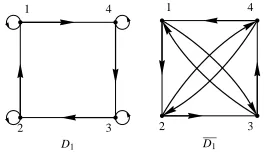
Example 3.6. Consider the digraph D1 in Figure 2. Now

b

2

b

3

b

4

b

1

D1

b

2

b

3

b

4

b

1

D1

Figure 2.The digraph D1having nonnegative

Q1-completion

consider a partial nonnegative Q1-matrix

M=

  

d1 ? ? a14

a21 d2 ? ?

? a32 d3 ?

? ? a43 d4

  

specifying the digraph D1with unspecified entries as ?. Now

being a partial nonnegative Q1matrix M, all the specified

off-diagonal entries are nonnegative and di>0, ∀i=1,2,3,4.

(5)

putting all unspecified entries as zero, we get the desired re-sult. Suppose a21a14a43a326=0. For t>0, consider a

com-pletion

B==

  

d1 0 t a14

a21 d2 0 0

0 a32 d3 0

0 0 a43 d4

  

,

of M. Then we have a positive term ta32a21 in S3(B) and

d4ta32a21 in det B. By choosing t sufficiently large, we have

S3(B)>0 and S4(B)>0. Again for positive diagonal entries

di,i=1, . . . ,4, we have S1(B)>0 and S2(B)>0. Hence the

result follows.

Now we have the following result:

Theorem 3.7. Suppose D6=K4be a digraph with all loops

and without any 2-cycle. Suppose D has one even cycle C of length 4. If D contains a 2-cyclehu,visuch that either C+ (u,v)or C+ (v,u)has a 3-cycle, then D has nonnegative Q1-completion.

Proof. Suppose M= [ai j]be a partial nonnegative Q1-matrix

specifying the digraph D. Suppose(u,v)forms a 3-cycle in

C+ (u,v). For t>0, consider a completion B= [bi j]of M as follows:

bi j=

   

  

ai j, if(i,j)∈D t, if(i,j) = (u,v)∈D

0, otherwise.

It can be easily seen that S1(B)and S2(B)are positive. If any one of the specified off diagonal entries are zero, then we are done. If not, then S3(B)contains a positive term tai jajk

specifying the 3-cycle of C+ (u,v). Again S4(B)contains a positive term dltai jajkas well as a negative term∏i6=jai j. By

choosing t sufficiently large, we have Sk(B)>0 for k=3,4. Hence the result follows.

The digraph D1in Figure2satisfies the Theorem3.7. The

digraph D1contains a 4 cycle C=h1,4,3,2i. Also the

di-graph D contains a 2-cycleh1,3i. Now C+ (3,1)contains a 3-cycleh1,4,3i. Hence D1has nonnegative Q1-completion

by Theorem3.7.

3.2 Necessary conditions for nonnegativeQ1-matrix completion

Theorem 3.8. If a digraph D6=Knof order n2 contains

two vertices v1and v2with indegree or outdegree n, then D

does not have nonnegative Q1-completion.

Proof. Suppose a digraph D of order n≥2 contains two ver-tices v1and v2with indegree or outdegree n. Consider a

par-tial nonnegative Q1-matrix M specifying D with all specified

entries are exactly 1. Then two columns or rows of M are equal and for any completion B of M, we have det B=0. Hence the result follows.

Theorem 3.9. Suppose D6=Knbe a digraph which includes

all loops and has nonnegative Q1-completion, then D does

not have a 2-cycle.

Proof. Suppose that D has a 2-cyclehv1,v2i. Consider a

par-tial nonnegative Q1-matrix M= [ai j]specifying D such that

aii=1 (1≤in)and av1v2av2v1 >

n

2

and rest of all specified entries are zero. Let B= [bi j]be any completion of

M. Then

S2(B) =

i6=j

biibj j

i6=j

bi jbji < −

i,j∈{/ v1,v2}

bi jbji < 0,

and, therefore, B is not a nonnegative Q1-matrix.

Example 3.10. Consider the digraph D2in Figure3. Here

D2has a 2-cycleh1,3i. Thus by Theorem3.9, D2does not

have nonnegative Q1-completion. To see this consider a

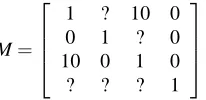
par-tial nonnegative Q1-matrix

M=

  

1 ? 10 0 0 1 ? 0 10 0 1 0 ? ? ? 1

  

,

specifying the digraph D2. Then for any completion B of M,

we have S2(B)<0. Hence, M cannot be completed to a

non-negative Q1-matrix.

b

4

b

3

b

2

b

1

b

4

b

3

b

2

b

1

Figure 3.The Digraphs D2and D2

Remark 3.11. If a digraph D of order n includes all loops

has nonnegative Q1-completion, then D has less than12n(n+1)

arcs. In case D has more than12n(n+1)arcs, then D must have a 2-cycle.

Theorem 3.12. Let D6=Knbe a digraph of order n that

in-cludes all loops and contains an even cycle C of length 4. If D has nonnegative Q1-completion, then D has a 2-cycle.

Proof. Suppose M= [ai j]be a partial nonnegative Q1-matrix

specifying the digraph D. For t>1, consider the partial non-negative Q1-matrix M(t)with the specified entries as follows

ai j=

   

  

t, if(i,j)∈AC

1, if(i,i)∈AD

(6)

Let B= [bi j]be a completion of M(t), where bi j=xi j≥0 for (i,j)∈/AD. Now we have,

0 < S2(B) =6−

bi jbji,

and this implies each of xi jto be bounded above by 6. On the

other hand we have,

S4(B(t)) =−t4+p(t,xi j),

where p(t,xi j)is a polynomial and have degree at most 3 in

t. Consequently, for a large value of t, S4(B(t))<0 for any nonnegative choices of xi j within their bounds. For such a

value of t, B(t)is not a Q1-matrix.

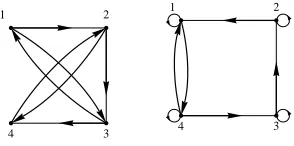
Example 3.13. Consider the digraph D3and its complement

D3in Figure 4. The digraph D3 satisfies the conditions of

the Theorem3.12. Hence it does not have nonnegative Q1

-completion.

b

4

b

3

b

2

b

1

b

4

b

3

b

2

b

1

Figure 4.The Digraphs D3and D3

4. Relationship theorems

4.1 Q-completion and nonnegativeQ1-completion

It is easily seen that a nonnegative Q1matrix is a Q-matrix

but not vice versa. However their completion problems are not related.

(i) Consider the digraph D4and its complement D4in

Fig-ure5. Here D4is acyclic and contains all loops. Hence

by Corollary 3.5, D4 has nonnegative Q1-completion.

On the other hand D4is not stratified, thus it does not

have Q-completion. (See Theorem 2.8, [2]).

b

1

b 3

b

2

b

1

b 3

b

2

Figure 5.The Digraph D4and its complement D4

(ii) Consider the digraph D5and its complement D5in

Fig-ure 6. Here the digraph D5 does not have

nonnega-tive Q1-completion (by Theorem3.9). But since D5is

weakly stratified, D5has Q-completion (See Theorem

2.12, [2]).

b

4

b

3

b

2

b

1

b

4

b

3

b

2

b

1

Figure 6.The Digraphs D5and D5

4.2 NonnegativeQ-completion and non-negativeQ1 -completion

Although a nonnegative Q1-matrix is a nonnegative Q-matrix,

but their completion problem are partially different. Now we have the following:

Proposition 4.1. If a digraph D has nonnegative Q-completion

then it has nonnegative Q1-completion.

Proof. Suppose M= [ai j]be a partial nonnegative Q1-matrix

specifying the digraph D. Then M is also a partial nonnega-tive Q-matrix specifying the digraph D. Since M has nonneg-ative Q-completion, thus M can be completed to a nonnega-tive Q-matrix B by assigning the unspecified diagonal entries (if any) as a positive real number t. Clearly B is a nonnegative

Q1-completion of M.

However the converse of the Proposition4.1is not true. The digraph D6in Figure7has nonnegative Q1-completion

but does not have nonnegative Q-completion. Consider a

par-b

1

b

2

Figure 7.The Digraph D6

tial nonnegative Q-matrix

M=

1 0 ? 0

,

specifying the digraph D6. It is easily seen that M cannot be

completed to a nonnegative Q-matrix since for any comple-tion B of M we have det B=0. On the other hand, the digraph

D6has nonnegative Q1-completion by Theorem3.4.

4.3 PositiveQ-completion and nonnegativeQ1-completion

In this subsection, we will compare the nonnegative Q1-completion

problem with the positive Q-completion problem.

Proposition 4.2. If a digraph D has nonnegative Q1-completion,

then D has positive Q-completion.

Proof. Suppose M= [ai j]be a partial positive Q-matrix spec-ifying the digraph D. Then M is a partial nonnegative Q1

(7)

of M. Then, perturbing the zero entries in B by small posi-tive quantities, a posiposi-tive Q-completion of M can be obtained.

However, the converse is not true which can be seen from the following example.

Example 4.3. Consider the digraph D7in Figure8. The

com-plement of the digraph D7i.e. D7contains a 2-cycleh2,4i

such that the arc(4,2)in D7satisfies the Theorem 2.10,[12].

Hence the digraph D7 has positive Q-completion. On the

b

5

b

3

b

2

b

1

b 4

Figure 8.The Digraph D7

other hand, consider a partial nonnegative Q1matrix

M(t) =

    

1 t 1 1 x1

x2 1 t x3 x4

x5 x6 1 0 t

x7 x8 x9 1 1

t 1 x10 x11 1

    

,

specifying the digraph D7, where t>1 and xiare unspecified

entries. Now for any completion B(t), we have

S2(B(t)) =

5 2

t

xi+

xi+x3x8

>0, (4.1)

which implies that xiand x3x8are bounded by

5 2

.

How-ever x3and x8can take any arbitrary values. Again we have,

S4(B(t)) =−t4+c1t2+c2t+c3+x3(−t2+c4)+x4(−c6t2+c7),

(4.2)

where cr are polynomials in xi. Consequently, for large

val-ues of t, S4(B(t))<0 for any completion B(t)of M(t)

5. Classification of digraphs of small

order having nonnegative

Q

1

-completion

In this section we will classify all the digraphs of order at most four as to nonnegative Q1-completion. For this purpose

we will apply the previously obtained results on the digraphs. The nomenclature of the digraphs has been considered from the list in [4, Appendix, pp. 233]. Here, Dp(q,n)is the one obtained by attaching a loop at each of the vertices to the n-th member in n-the list of digraphs win-th p vertices and q (non-loop) arcs in the list.

Now permutation similarity of nonnegative Q1-matrix

im-plies that if a digraph D has nonnegative Q1-completion, then

any digraph which is isomorphic to D has nonnegative Q1

-completion. Thus any digraph which is obtained by labelling the unlabelled digraph associated to D has nonnegative Q1

-completion.

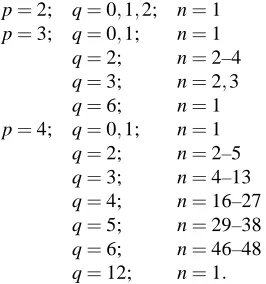
Theorem 5.1. For 1p4, the digraphs Dp(q,n)which are listed below have nonnegative Q1-completion.

p=2; q=0,1,2; n=1

p=3; q=0,1; n=1

q=2; n=2–4

q=3; n=2,3

q=6; n=1

p=4; q=0,1; n=1

q=2; n=2–5

q=3; n=4–13

q=4; n=16–27

q=5; n=29–38

q=6; n=46–48

q=12; n=1.

Proof. It can be easily seen that Dp(q,n)has nonnegative Q1

-completion if q=0 or it is a complete digraph.

The digraphs D2(q,n),q=1,n=1; D3(q,n),q=1,n=

1; q=2,n=2–4; q=3,n=2,3 , D4(q,n),q=1,n=1; q=

2,n=2–5; q=3,n=3–13; q=4,n=17–27; q=5,n=

29,30,31,33–38; q=6,n=46–48 do not contain a cycle of even length and hence each of the digraph has nonnegative

Q1-completion by Theorem3.4.

Each of the digraph D4(q,n),q=4,n=16; q=5,n=

32; q=6,n=45 satisfies the statement of the Theorem3.7, and hence each digraph has nonnegative Q1-completion.

The digraph D4(q,n),q=6,n=45 satisfies the statement of the Theorem3.12, hence it does not have nonnegative Q1

-completion.

The rest of digraphs Dp(q,n); 3≤p≤4, contains a 2-cycle and they do not have nonnegative Q1-completion.

References

[1] G. Chartrand and L. Lesniak, Graphs and Digraphs,

Fourth Edition, Chapman and Hall/CRC, London, 2005.

[2] L. M. Dealba, L. Hogben and B.K. Sarma, The Q-Matrix

Completion Problem, Electronic Journal of Linear

Alge-bra, 18:176–191, March 2009.

[3] L. Hogben and A. Wangsness, Matrix Completion

Prob-lems, in Handbook of Linear Algebra, L. Hogben, Editor,

Chapman and Hall/CRC Press, Boca Raton, 2007.

[4] F. Harary, Graph Theory, Addison-Wesley, Reading, MA,

1969.

[5] C.R. Johnson and B.K. Kroschel, The Combinatorially

Symmetric P-Matrix Completion Problem, Electronic

(8)

[6] L. Hogben, Graph theoretic methods for matrix

com-pletion problems, Linear Algebra and its Applications, 319:83–102, 2000.

[7] C. Jordan, J.R. Torregrosa, and A.M. Urbano,

Com-pletions of partial P-matrices with acyclic or non-acyclic associated graph, Linear Algebra and its Applications,312:25–51, 2000.

[8] J.Y. Choi, L.M. DeAlba, L. Hogben, M.S. Maxwell,

A. Wangsness, The P0-matrix completion problem,

Elec-tronic Journal of Linear Algebra, 9:1–20, 2002.

[9] J.Y. Choi, L.M. DeAlba, L. Hogben, B. Kivunge,

S. Nordstrom, M. Shedenhelm, The Nonnegative P0

-Matrix Completion Problem, Electronic Journal of

Lin-ear Algebra, 10:46–59, 2003.

[10] L. Hogben, Matrix Completion Problems for Pairs of

Related Classes of , Linear Algebra and its Applications, 373:13–29, 2003.

[11] S.M. Fallat, C.R. Johnson, J.R. Torregrosa, and A.M.

Ur-bano, P-matrix Completions under weak symmetry as-sumptions, Linear Algebra and its Applications, 312:73– 91, 2012.

[12] B.K. Sarma and K. Sinha, The positive Q-matrix

comple-tion problem, Discrete Mathematics, Algorithms and

Ap-plications,7,2015. DOI-10.1142/S1793830915500524.

[13] K. Sinha, The Q

1-matrix completion problem, Malaya

Journal of Mathematik,6(2):443-450 2018.

[14] A. Wangness, The matrix completion problem regarding

various classes of P0,1- matrices, Ph.D Thesis, Iowa State

University, 2005.

? ? ? ? ? ? ? ? ?

ISSN(P):2319−3786 Malaya Journal of Matematik

ISSN(O):2321−5666

Figure

Figure 2. The digraph D1 having nonnegativeQ1-completion
Figure 3. The Digraphs D2 and
Figure 6. The Digraphs D5 andD5
Figure 8. The Digraph D7

References

Related documents

The Republic of Macedonia as a small country with limited development opportunities is forced to use all resources that are available. Studies related to the

• We have shown that our mixed-membership stochastic block model in general outperforms the item-item algorithm and matrix factorization, both in terms of accuracy and in mean

In the as machined condition, test results showed that fatigue life is surface roughness dependent and that fatigue life decreases with an increase in surface roughness and this

ﻪﻛ ﺪﻧﺪﻴﺳر ﻪﺠﻴﺘﻧ ﻦﻳا ﻪﺑ ﻲﺘﺧﺎﻨﺷ يﺎﻫدﺮﻛرﺎﻛ ﺮﺑ ﻲﮔدﺮﺴﻓا رد لﺎﻌﻓ ﻪﻈﻓﺎﺣ دﺮﻜﻠﻤﻋ هﮋﻳو ﻪﺑ ﻲﻳاﺮﺟا يﺎﻫدﺮﻛرﺎﻛ ﺶﺨﺑ ود ﺮﻫ. ﻲﻣ ﻪﺟاﻮﻣ ﻞﻜﺸﻣ ﺎﺑ هدﺮﺴﻓا نارﺎﻤﻴﺑ رد يراﺪﻳد

Reviewing the relevant literature showed that no research has yet been undertaken to consider simultaneously the risk and greenness (environmental aspects) components

Ph.D., P.E., is the traffic signal systems engineer for the City of Chattanooga, TN, USA, and serves as intelligent transportation system (ITS) program manager overseeing

Some authors indicated that the concentration of leptin in seminal plasma of men with normal semen sample is significantly lower than pathological groups (4)

As part of the reporting exercise corresponding to 2005, the European Monitoring Centre for Drugs and Drug Addiction's network of national focal points set up in the 27 European