International Journal of Modern Trends in Engineering and
Research
www.ijmter.com
A Survey on Various Learning Styles Used in E-Learning System
Mr. T. Gopalakrishnan1, Ms. V. S. Gowthami2, Ms. M. Kavya3
Assistant Professor1, PG Scholar2,3 Department of IT1,2,3
Bannari Amman Institute of Technology1,2,3
Abstract— Personalized E-learning seeks to provide each individual learner with the right and
sufficient content they need according to learners level of knowledge, behavior and profile. The performance of the learners can be enhanced by posting the suitable E-learning contents to the learners based on their learning styles. Hence, it is very essential to have a clear knowledge about various learning styles in order to predict the learning styles of different learners in E-learning environments. However, predicting the learning styles needs complete knowledge about the learners past and present characteristics. The core objective of this survey paper is to outline the working of the existing learning style models and the metrics used to evaluate them. Based on the existing models, this paper identifies Felder–Silverman learning style model as the appropriate model for E-learning so that it can enrich the performance of the E-learning system.
Keywords— E-learning, E-learning contents, E-learning environment, Learning styles, Learners
I. INTRODUCTION
E-Learning adopts modern educational technology to implement an appropriate learning environment. E-learning had gained lots of attention since it greatly reduces the drawbacks of the traditional learning educational setting environment (Chen et al. 2004). The effectiveness in the design of an E-learning system is based on the common rules and features of the learners to be engaged in the learning process. Therefore, the success of E-learning environments is greatly influenced by the factors like learning objects, content delivery, relevant information retrieval, performance evaluation and the maintenance of the psychological level through identification of the individual learning styles of the learners (Vranic et al. 2007). This paper depicts the different learning styles which are available in the literature and provides a comparative analysis among them. In addition, it suggests the use of Fuzzy logic for handling uncertainty in Felder–Silverman learning style model.
Therefore, the contents developed for the E-learning system could be modified based on the learners learning styles in such a way that all the learners could be well benefited so that the objective of the E-learning system could be satisfied. Hence, a deep understanding of the learners is necessary in predicting their learning style in E learning environment
II. PASTLEARNINGSTYLEMODELSANDINSTRUMENTS
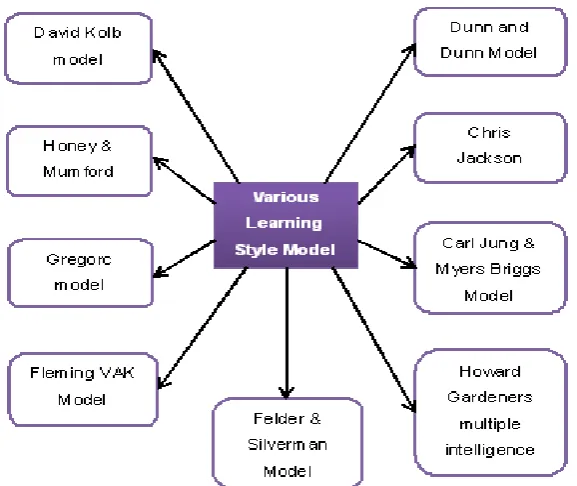
Learning styles are different kinds of methods and characteristics used in learning. The major objective of identifying the learning style is, to well educate the performance level of the learners and aiding them to find their best position to fit in the outside environments. Especially, in an E-learning environment, the impact of the learning style causes a greater effect on the performance of the learners and in the design of the E-learning systems. Several learning style assessment models and instruments are available online to effectively assess the learning style (Hawk and Shah 2007; Brokaw and Merz 2000; Coffield et al. 2004). The generic categorization of the learning styles fall under four categories namely Synthesis Analysis, Methodical Study, Fact Retention and Elaborate Processing. Among these, the Synthesis Analysis deals with the processing of information and organizing them into taxonomy. Methodical Study deals with careful study and completion of academic assignments. Fact Retention is the analysis of the correct output instead of understanding the logic behind it. Elaborate Processing is the application of new ideas to the existing knowledge. The categorization of learning styles is helpful to group the learners and to provide relevant assistance in learning.
Figure 1. Various Learning Style model
2.1 Kolb Learning Style Indicator
observation and active experimentation. These experiences have been defined as follows Cornwell and Manfredo (1994).
1) Concrete Experience: A new experience of situation is encountered, or a reinterpretation of existing experience.
2) Reflective Observation: A new experience. Of particular importance are any inconsistencies between experience and understanding.
3) Abstract Conceptualization: Reflection gives rise to a new idea, or a modification of an existing abstract concept.
4) Active Experimentation: The learner applies them to the world around them to see what results.
From these categories, it can be observed that the first three experiences shown in this model namely sensing, planning and watching others must be strengthened and the fourth one must be improved. Moreover, David Kolb developed a Learning Style Inventory (LSI) in the year 1971, to assess the individual Learning Styles based on Experiential Learning Theory. Using LSI the individuals were tested and four types of learners were recognized. They are
1) Diverging: Its main learning abilities are Concrete Experience (CE) and Reflective Observation (RO).
2) Assimilating: Its main learning abilities are Abstract Conceptualization (AC) and Reflective Observation (RO).
3) Converging: Its main learning abilities are Abstract Conceptualization (AC) and Active Experimentation (AE).
4) Accommodating: Its main learning abilities are Concrete.
5) Experience (CE) and Active Experimentation (AE): This learning style is important for effectiveness in action-oriented careers such as marketing or sales.
This categorization helps to develop learning materials to the learners based on their experience and learning styles.
2.2 Honey and Mumford’s Learning Styles Questionnaire
This model deals about the general behavioral tendencies. The Learning Style questionnaire of this model is derived from David Kolb’s LSI. This model probes the learners to indicate their general behavior tendencies rather than directly asking their behavior through questionnaires. Their reasoning is most people have never consciously considered how they really learn. According to this model, learners are classified into following four types.
1) Reflectors: Prefers to learn from activities that allow them to watch, think, and review (time to think things over) what has happened.
2) Theorists: Prefers to think problems through in a step-by-step manner like lectures, analogies, systems, case studies, models and readings.
3) Pragmatist: Prefers to apply new learning to actual practice to monitor if they work.
4) Activist: Prefers the challenges of new experiences, involvement with others, assimilation and role-playing.
The learners’ general behaviors are examined in this model whereas they are attained from the questionnaires in the Kolb’s model.
2.3 Gregorc Style Delineator
this cognitive model, the existence of perceptions leads to the notions of different kinds of learning styles. Therefore, this model describes two kinds of perceptual qualities namely Concrete and Abstract and two kinds of ordering abilities namely Random and Sequential. In addition, the individuals also possess different kinds of perceptual and ordering abilities like
1) Concrete Sequential: Learning with hands-on experiences.
2) Abstract Random: Receive instruction in an unstructured manner. 3) Abstract Sequential: Use logic to grasp situations.
4) Concrete Random: Prefers trial and error approach.
2.4 Fleming VAK Model
The VAK learning styles model suggests that most people can be divided into one of three preferred styles of learning namely Visual, Auditory and Kinaesthetic.
1) Visual learning style involves the use of seen or observed things, including pictures, diagrams, demonstrations, displays, handouts, films, flip-chart, etc.
2) Auditory learning style involves the transfer of information through listening: to the spoken word, of self or others, of sounds and noises.
3) Kinesthetic learning involves physical experience - touching, feeling, holding, doing, and practical hands-on experiences.
These categories are helpful in developing efficient machine learning techniques for effective E-learning
2.5 Dunn and Dunn Learning Style
This model defines learning style as the way in which individual learners begin to concentrate on, process, and retain new and difficult material. It is a combination of many biological and experiential characteristics that work on their own or together as a unit to contribute to learning. According to this model, the following learning style preferences need to be considered when instruction is created and implemented:
1) Environmental: Noise level, lighting, temperature, and furniture/seating design. 2) Emotionality: Motivation, responsibility, persistence, and need for structure.
3) Sociological: Learning groups, presence of authority figures, varied working patterns, and adult motivation (LSI only).
4) Physiological: Perceptual strengths, time-of-day energy levels, intake, and mobility.
5) Processing inclinations: Right or left, global or analytic and impulsive or reflective (Dunn and Dunn 1989).
2.6 Chris Jackson Model
This model incorporates a new type of learners called Deep Learning Achiever which takes motivation from the experimental model of learning (e.g. Kolb 1984). The hybrid model considers four types of personalities.
1) Sensation Seeker: The learners with measuring exploration and curiosity.
2) Goal Oriented Achiever: This type of learner has mastery on long term and hard outcomes 3) Conscientious Achiever: It deals with perseverance and responsibility.
5) Deep Learning Achiever: This type of learners provides well thought out and well-constructed outcomes.
This psychological modeling helps to understand the learners’ behavior which in turn can be used to develop a suitable intelligent agent for providing tutoring in E-learning.
2.7 Carl Jung and Myers Briggs Type Indicator
Myers–Briggs Type Indicator (MBTI) is initially established by Carl Jung. The learning style assessment in this kind of indicator is resolved using different aspects inclusive of psychological, decision-making, information gathering and actions (Brokaw and Merz 2000). The models of learning styles are as follows
1) Judging vs Perceiving: Attention towards the external world/things or internal world/things. 2) Thinking vs Feeling: Perceive world directly or perceive through impressions/imaging
possibilities.
3) Sensing vs Intuition: Learners taking decisions through logic or through mere human values. 4) Extroversion vs Introversion: Learner looking the world as a structured, planned environment or
as a spontaneous environment.
The major application of this indicator was using among the companies in order to enhance the inter-personal relations among the employees by obtaining their psychological behavior.
2.8 Howard Gardeners Multiple Intelligence
This is based on multiple intelligences and was developed during 1983 at Harvard University. The intelligence of an individual was tested using I.Q. testing, which is far limited. A broader range of human potential was found in eight different notions of intelligence (Gardner and Moran 2006). Gardener’s theory has emerged from recent cognitive research and hence a learner can learn, remember and perform well in different ways (Gardner 2004). Different kinds of intelligences were observed as different styles of learning which are as follows
1) Linguistic intelligence: This category of learners has extremely developed auditory skills and often thinks in terms of words. It can be taught effectively by motivating them to read lots of articles, books and papers.
2) Logical–Mathematical intelligence: This characteristic involves high interest in reasoning and calculating and can be taught through logic games, investigations, unrevealing mysteries and problem solving skill.
3) Visual–Spatial intelligence: This category of learners is well aware of the environments. It can be taught by drawings, verbal and physical imagery.
4) Bodily-Kinesthetic intelligence: This type of intelligent learners is keen about body awareness and can be taught through physical activities, hands-on experiences and role playing.
5) Musical intelligence: This category of learners is highly sensitive to music and rhythm and can be taught by turning lessons into lyrics and speaking rhythmically.
6) Interpersonal intelligence: This deals with learners who have interaction with others and can be taught by conducting group discussions.
7) Intrapersonal intelligence: The learners who shy away from others and do not interact with others fall under this group and can be taught by independent study and introspection.
The theory of multiple intelligences provides a broader thinking approach to different styles of learning as compared to traditional levels of learning styles (Gardner 2004). Gardener challenges that everyone can learn the same material and show their efficiency when they are taught according to their interest as indicated above. This kind of teaching will effectively suit the broad spectrum of students with varying capabilities and interests
2.9 Felder–Silverman Index of Learning Styles
This learning style model (Felder and Silverman 1988) often used in technology enhanced learning and designed for traditional learning. Additionally, Felder–Silverman learning style model defines the learning style of a learner in more detail and distinguishing between preferences on four dimensions. This model provides four dimensions of learning based on psychological aspects of the learners which is found to be important in an E-learning environment. The learning styles proposed by Felder–Silverman for categorizing the learners are:
1) Active/Reflective: Active learners learn by doing something with information. Reflective learners learn by thinking about information.
2) Sensing/Intuitive: Sensing learners favor to take in info that is concrete and practical. Intuitive learners favor to take in info that is original, abstract and oriented towards theory.
3) Visual/Verbal: Visual learners prefer visual presentations of material - pictures, diagrams, flow-chart and graphs. Verbal learners prefer explanations with words – includes both written and spoken.
4) Sequential/Global: Sequential learners prefer to organize information in a linear, orderly fashion. Global learners prefer to organize information more holistically and in a seemingly random manner without seeing connections.
Since most learners fall in the category of either active or reflective for the first dimension, this model is more suitable to evaluate the learners in an E-learning environment.
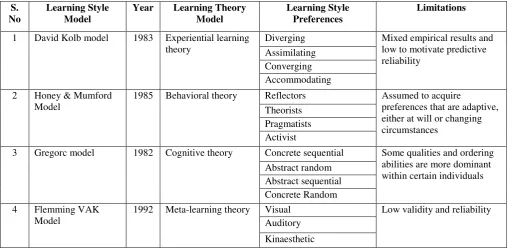
Table 1. Comparison of Various learning style model
S. No
Learning Style Model
Year Learning Theory Model
Learning Style Preferences
Limitations
1 David Kolb model 1983 Experiential learning theory
Diverging Mixed empirical results and low to motivate predictive reliability
Assimilating Converging Accommodating
2 Honey & Mumford Model
1985 Behavioral theory Reflectors Assumed to acquire
preferences that are adaptive, either at will or changing circumstances
Theorists Pragmatists Activist
3 Gregorc model 1982 Cognitive theory Concrete sequential Some qualities and ordering abilities are more dominant within certain individuals Abstract random
Abstract sequential Concrete Random 4 Flemming VAK
Model
1992 Meta-learning theory Visual Low validity and reliability Auditory
5 Dunn and Dunn 1989 Biological & Experimental theory
Environmental Criticized for not considering the differences among the individuals
Emotionality
Sociological
Physiological
Processing inclinations 6 Chris Jackson/2002 2002 Neuro-psychological
theory
Sensation Seeker Contextual differences in the dependent variable
Goal oriented achiever Conscientious achiever Emotionally intelligent Achiever
Deep learning achiever
7 Carl Jung and Myers Briggs type indicator
1988 Personality theory Judging vs perceiving Lacks convincing validity data
Thinking vs feeling Sensing vs intuition Extroversion vs introversion 8 Howard Gardeners
multiple intelligence
1983 Intelligence theory Linguistic intelligence Detecting additional intelligences is not easy and is not well suited for all types of individuals Logical–mathematical intelligence Visual–spatial intelligence Bodily-kinesthetic intelligence Musical intelligence Interpersonal intelligence Intrapersonal intelligence Naturalist intelligence 9 Felder–Silverman
Index of learning styles
1988 Psychological theory Active–reflective Dependencies between two styles exist and hidden dimensions present in dataset produces a greater impact on identification
Sensing–intuitive
Visual–verbal Sequential–global
III. CATEGORIZATIONOFEDUCATIONALSYSTEMS
The use of internet in education has provided a new revolution known as E-learning or web based learning (Myller et al. 2002). In the traditional offline learning system, instructors and the learners were directly involved in the teaching-learning process (Vranic et al. 2007). In such a scenario, they used the course materials and discussed them through teaching and dialogues. On the other hand, in the current internet world, E-learning is another important area that is to be strengthened since most of the learners prefer to read web contents and web-based course materials for learning (Myller et al. 2002). Subsequent to E-learning, the learning activities are enhanced by providing intelligent tutoring systems. In a web-based learning system, the learners understanding is measured based on the reproduction of the material studied by them. Artificial Intelligence techniques such as page ranking, rules, agents and machine learning algorithms are used to classify and improve the performance of the learners by providing suitable E-learning documents (Chen et al. 2004).
based on their learning styles. Therefore, iLessons is an important contribution for E-learning through the identification of learners as active or reflective. The work done by Bergasa-Suso et al. (2005) promptly followed an algorithm in identifying the first dimension and classified the users into two kinds as either Active or Reflective. From his works it is understood that the learners belonged to either of the dimensions crisply. It is evident from their experiments that the classification accuracy for identifying such learners was 71% when considering the first dimension of Felder–Silverman learning style model.
Sanders and Bergasa-Suso (2010) proposed an intelligent E-learning system with an effective user interface. The main advantage of this intelligent E-learning system is that it is capable of performing deductive inference to obtain the learning style of learners. They followed Felder–Silverman learning style model and developed an E-learning system that can infer the learning styles in real time and provided recommendations for selecting suitable E-learning contents. This is a significant achievement in the area of E-learning since; it uses Artificial Intelligent techniques for classifying the learners based on their learning style into three categories namely active or reflective or unknown. He categorized in such a way, since the users may not fall into one category virtually all the time and most learners tend towards a particular dimension in course of time, environmental factor, mood, need and psychological changes. The accuracy of classifying the learners Sander’s et al has increased to 81% compared to the earlier work done by Bergasa. One of the important contributions of Sanders et al. is the inclusion of unknown sets in addition to the active and reflective categories of learners.
Juan Yang et al. (2014) proposed a new dynamic learning style prediction method based on a pattern recognition technique. This method functions as a form of middleware that can be applied to other intelligent tutoring systems, while it can process topic-dependent data to make predictions and update learning style profiles in a recursive manner. This prediction mechanism is middleware but it still needs a benchmark to indicate its functionality and effectiveness. In this, they introduce the benchmark system, which is a prototype system called “Programming in Java” (PIJ). The main function of PIJ is to collect data on learning behaviors using log files. To improve the computational efficiency and to decrease the complexity, the organization of learning objects (LOs) in PIJ follows three distinct rules.
1) The overall content comprises a series of topics in a given order, which is consistent with their prior/ subsequent constraints.
2) Each topic must contain a sufficient number of LOs to provide the various types of LOs demanded by learners.
3) The construction of the LOs within a single topic follows the star topology.
The learning style used is that proposed by Felder & Silverman for engineering students, which distinguishes between learning preferences based on the following five dimensions.
• Sensing/Intuitive: The way learners perceive information • Visual/Verbal: The way learners acquire information
• Inductive/Deductive: The way learners organize information • Active/Reflective: The way learners process information • Sequential/Global: The way learners understand information
Min f(X),
f(X) = var(M, )
=
Where X is a vector X = ( ), and t is the dimensionality of the learning styles. The above formula is used to identify the key learning style similarity matrix that represents the current collective learning behaviors. After identifying the key learning style dimension, where the learning information of the subject has the highest projected value in the multidimensional space, the learning style dimension k should be used as a scale tool to cluster the new learners according to their learning behaviors. This clustering process is simple compared with the clustering processes used in previous studies because the multi label classification problem has been transformed into a single label classification problem. The learning information pattern evolves dynamically in different learning contents. Thus, learning information pattern recognition should be processed recursively for different learning topics to obtain a more accurate learning style prediction result.
They used the ILS to survey 50 sample students who were majoring in computer science. These were second year students from three different schools: Sichuan Normal University, Southwest University, and Chongqing University of Posts and Telecommunications. The students helped us to construct their learning style preference patterns and learning information patterns. Thus, the average accuracy of the predictions in the present study was about 75 percent which was relatively high compared with previous methods.
IV. CONCLUSION
In this paper, a survey of on different learning styles which were identified by various researchers with suitable discussions on them has been provided. For this purpose, both the traditional offline learning and E-learning works have been considered and their methods are analyzed for highlighting their salient features. From this analysis, it has been found that Felder– Silverman style is more suitable learning method for adopting in E-learning. In addition, an intelligent E-learning system that can handle uncertainty effectively has been proposed and compared with the related work. The survey of learning methods provided in this paper helps to develop effective course wares and intelligent tutoring systems. Further works in this direction can be the provision of a survey on the use of machine learning techniques which will be helpful for enhancing the learning materials provided in web based learning.
REFERENCES
[1] Bergasa-Suso J,SandersDA,TewkesburyGE (2005) Intelligent browser-based systems to assist Internet users. IEEE Trans Educ 48(4):580–585
[2] Burr L, Spennemann DH (2004) Pattern of user behavior in university online forums. Int J Instr Technol Distance Learn 1(10):11–28
[3] Butler K (1986). A learning and teaching style in theory and practice. Learner’s Dimension, Columbia Carver CA, Howard RA, Lane WD (1999) Enhancing student learning through hypermedia courseware and incorporation of student learning styles. IEEE Trans Educ 42(1):33–38
[4] Chen S-M, Chang Y-C (2011) Weighted fuzzy rule interpolation based on GA-based weight-learning techniques. IEEE Trans Fuzzy Syst 19(4):729–744
[5] Chen Y, Weng C (2009) Mining fuzzy association rules from questionnaire data. Knowl Based Syst J 22(1): 46–56 [6] Duff A (2002) Approaches to learning: factor variance across gender. Person Individ Differ 33(6):997–1110
[7] Dunn R (1990) Understanding the Dunn and Dunn learning style model and the need for individual diagnosis and prescription. Read Writ Learn Disabil 6:223–247
[9] Garcia E, Romero C, Ventura S, Castro C (2009) An architecture for making recommendations to courseware authors using association rule mining and collaborative filtering. User Model. User-Adapted Interaction. J Person Res 19:99–132 [10]Hwang WY, Chang CB, Chen GJ (2004). The Relationship of Learning Traits, Motivation and Performance Learning
Response Dynamics. Comput Educ J 42:267–287
[11]Honey P, Mumford A (2000). The learning styles helper’s guide. Peter Honey Publications Ltd, Maidenhead
[12]Jegatha Deborah L, Baskaran R, and Kannan A (2011a) Construction of ontology using computational linguistics for E-learning: In: Proceedings of the 2nd international conference on visual informatics, Kualalumpur.
[13]Kim J, Chern G, Feng D, Shaw E, Hovy E (2006) Mining and assessing discussions on the web through speech act analysis. In: Proceedings of AAAI workshop web content mining human language technology
[14]Kolb D (1984). Experiential learning: experience as the source of learning and development. Prentice-Hall, Englewood Cliffs
[15]Kolb AY, Kolb DA (2005) Learning styles and learning spaces: enhancing experiential learning in higher education. Acad Manag Learn Educ 4(2):193–212
[16]Lu F, Li X, Liu Q, Yang Z, Tan G, He T (2007) Research on personalized E-learning system using fuzzy set based clustering algorithm. In: Proceedings of international conference on computer science, Beijing, pp 587–590
[17]Sanders DA, Bergasa-Suso J (2010) Inferring learning style from the way students interact With a computer user interface and the WWW. IEEE Trans Educ 53(4):613–620
[18]Siadaty M, Taghiyareh F (2007) PALS2: In: 7th IEEE international conference on advanced learning technologies (ICALT 2007), pp 616–618
[19]Tian F,Wang S, Zheng C, Zheng Q (2008) Research on E-learning personality group based on fuzzy clustering analysis. In: Proceedings of international conference on computer. Supported Cooperative Work Design, Xian, pp 1035–1040 [20]Zhang L, Liu X, Liu X (2008) Personalized instructing recommendation system based on web mining. In: Proceedings of
international conference on young computing science, Hunan, pp 2517–252.