E-ISSN 2308-9830 (Online) / ISSN 2410-0595 (Print)
Resource Allocation Strategy on the Basis of Particles Swarm and
Intelligent Water Drops Algorithms in Cloud Computing
Environment
Shokoh Abdoli Hossein Abadi1, 2 and D.r Hamid Haj Seyed Javadi3
1
Department of Computer Engineering, Science and Research Branch, Islamic Azad University, Boroujerd, Iran
2
Department of Computer Engineering, Boroujerd Branch, Islamic Azad University, Boroujerd, Iran
3
Department of Applied Mathematics, Faculty of Mathematics and Computer Science, Shahed University, Tehran, Iran
E-mail: 1, 2shokoh.abdoli.1981 @gmail.com, [email protected]
ABSTRACT
Cloud computing points to programs and services executed in a distributed network and using virtual resources. As the result of this virtualization, it is felt that the resources are unlimited, but this is not true. In addition, these resources are accessible through common internet protocols and network standards. The purpose of most studies and researches carried out in this regard is to obtain an efficient model of resource allocation in cloud computing environment. In fact, resource allocation is a hierarchical and analytical process, and is a process performed after resource scheduling. Since cloud computing is a commercial field, the price and service quality is the main factor of this field. Our purpose is to dedicate resources to the users of cloud environment in a way that when a resource is available, no user waits for that resource. This dedication is considered with high precision and processing speed. This study is compared with genetic algorithm whose results are investigated and studied, and with our proposed algorithm, particles swarm algorithm that is one of the nature oriented algorithms. In this study, our purpose is to distribute interfaces in cloud computing environment in a way that they are useful to optimize resource allocation and to reach the main purpose of this research; that is, to reduce energy consumption. By creating an abstract layer on all physical resources, resources can be managed dynamically by the help of virtualization. Selecting an appropriate and efficient algorithm is required for resource allocation due to dynamic resources and various user requests in cloud technology to increase efficiency.
Keywords:
Cloud Computing, Resource Allocation, Nature-Oriented Algorithm, Interface Energy.
1 INTRODUCTION
Nowadays, cloud computing by internet has made it possible to process large volume of data all over the world. Allocating virtual machine is one of the most important issues in cloud computing, and refers to optimal determination of virtual machines in physical servers of cloud data center in a way that minimum number of physical servers is on. By optimal allocating of virtual machines to physical hosts, energy consumption can be reduced, and the quality of providing service can be improved. In
and efficient algorithms can result in detecting desirable results.
Evolutionary procedure of computing is one of the essentials of today's life. In this case, the users of cloud environment try to access it on the basis of their requirements and regardless of this fact that where the service is located or how it can be delivered (Pearson, 2009). Cloud computing attempts to provide serviced in networked virtual machines dynamically so that users can access to required application programs all over the world (Chandrashekharat et al, 2012).
2 EXPLAINING INTELLIGENT WATER DROPS ALGORITHM
It’s an algorithm used for optimizations and is based on swarm intelligence. This algorithm is performed in groups, and it is a nature-inspired algorithm. This algorithm can be used for combinatorial optimization. However, it may be adapted for continuous optimization too. This algorithm was first introduced for travelling salesman problem in 2007. Since then, multitudes of researches have focused on improving the algorithm for different problems.
Almost, IWD algorithm is composed of two parts: a graph that plays the role of distributed memory on which soils of different edges are preserved, and the moving part of the IWD algorithm which as a few number of intelligent water drops. These intelligent water drops both compute and cooperate to find better solutions, and by changing soils of the graph, the paths to better solutions become more reachable. IWD-based algorithms need at least two IWDs to work.
The characteristics of the water drop
1) It carried some soils in each moment, soil (IWD)
2) Velocity of movement, velocity (IWD) The value of both characteristics may change with the current of water drop in the environment.
The water drop attracts some soils during the movement.
The velocity of the water drop increases on the basis of nonlinear inverse proportion to the amount of soil between two places. The amount of the coil added to water drop has direct relation with its velocity, when the water drop has to choose one path among several passes from the source to destination, it prefers the easier path.
When are meta-heuristic and innovative methods used?
• Simple problems with too large samples (due to large dimensions of the problem, solving it precisely it costly).
• Simple problems with much real time limitations (dynamic optimization problems). • Optimization problems with objective
funct-ions or time-consuming limitatfunct-ions (high computing cost in precise methods).
• Non-analytical models • Complex simulation problems
• Control problems (such as traffic managem-ent in which decisions are in the range of the seconds)
3 THE RESEARCH METHOD
In this research, about 50 references have been firstly studied, but about 35 references have been used in this study, and we studied researches and studies that have been carried out up to now. These result of these studies showed that the subject entitled resource allocation by intelligent water drops and proposed by Hossein Shah Hosseini has not been taken into account. With regard to special characteristics of this algorithm, I have decided to study the proposed algorithm on the basis of intelligent water drops or IWD.
Since there are special methods and techniques for virtualization, we have tried to use some techniques for resource allocation. The purpose is to reduce energy consumption. We will explain our criteria to select these techniques in next sections.
Since there is no suitable position to observe our research results, we had to use simulator software of Cloud Sim in cloud computing environment. This simulator software is very stronger than CloudAnalyst and Cloud Reports.
4 THE NECESSITY OF RESOURCE ALLOCATION
resources are required, and each program requires them to complete the required programs of a user. The order and time of resource allocation are considered in an optimization algorithm (Vinotina et al, 2012). There are some potential features in cloud such as reliability, security, accessibility, execution time and etc. Our purpose is to allocate the resources to the users in a cloud. Through resource allocation, energy consumption can be optimized, and the user does not endure any delays for obtaining the required resources (Balshwar Govil et al, 2013).
5 THE FRAMEWORK OF RESOURCE
ALLOCATION ON THE BASIS OF VIRTUALIZATION
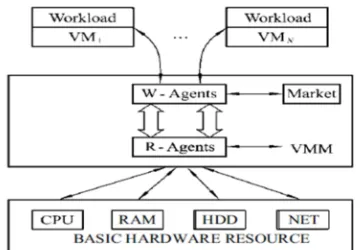
There is a framework in resource allocation in cloud computing. We will explain it in this article. Cloud computing by the help of networked virtual machines can be taken into account as a new method to create dynamic new generation of data centers. In this way, computing world moves toward developing softwares that are accessible for millions of persons as a service. Cloud computing system is managed on the basis of virtual machines. In fact, virtual machines are special software that can simulate the system hardware. The operating system can execute an application program on virtual machines, and can transfer a package to others. Resource allocation on the basis of virtual machines in a cloud computing environment has been shown in the following figure. In fact, W-agent is an W-agent for all workloads. R-Agent is in fact an agent for all kinds of hardwares. Workloads are executed on a virtual machine. They seek the highest quality, and consult with R-Agents to reach this level of W-Agent quality. They shave the required information. The algorithms of resource allocation perform on the basis of virtual machines that have been shown in cloud computing environment (Xi Fu et al, 2013).
Fig. 1. The framework of resource allocation on the basis of virtualization in the cloud
6 MANAGING ENERGY CONSUMPTION
BY VIRTUAL MACHINES
In this regard, three following problems are proposed, and they will be explained in the following sections.
1) When should virtual machines migrate? The answer of this question is that virtual machines must migrate in two times. This will be explained in the following sections.
6.1 Host Overload
When the virtual machine is allocated to a host more than its capacity, Host Overload occurs and SLA agreement is violated. Hence, in such situations, migration of virtual machines is surely essential. In order to identi-fy this event on time and before violating SLA agreements, some algorithm are proposed in terms of Host Overload Detection Algorithms (Oct, Jayasnghe, 2012). In this study, the met-hods used widely are explained. These methods are divided into two groups. The first group is related to algorithms depending on a threshold of resource consumption. In fact, these methods are determined as a limit of threshold. If the resources of virtual machines are used more than this threshold limit, then Host Overload occurs for that first. This group is called Adaptive utilization threshold based algorithm. The second group is algorithms based on regression, and are known as regress-ion based algorithms. Some of these methods will be explained in the following sections.
7 ADAPTIVE UTILIZATION THRESHOLD BASED ALGORITHMS
1) A static CPU utization Threshold:
One of the simplest methods of detecting Host overload is using static threshold method. In this method, a threshold is defined. When host processor is used more than threshold, then host overload detection algorithm detects that host overloading has occurred for this host.
1. Adaptive utilization threshold based algorithms
2. median absolute Deviation algorithm (MAD)
7.1 Host under load
Much studies such as the article of [Butta 220] show that when services are on in free times, they consume 70% energy in peak time of the work. Hence, it seems that when the server with low loud volume is on, it is not economical. The methods used to detect idle servers are considered in the fields of Host overload detection algorithms.
2) Which virtual machine migrates?
After detecting migration time of virtual machines must be selected for migration (Yan Piao,2010). The methods answering this question are known as VM selection. In this section, three methods will be explained. These methods are the most well-known and widely used methods.
7.2 Minimum Migration time policy (MMT)
In this method, the virtual machine is selected among a set of virtual machines, and its migration time is lesser than others. In order to estimate the required time of a virtual machine’s migration, the following equation can be used:
VVJaVJ ,
( )
( )
In this equation, Vj is a set of virtual
machines located on a host. we are going to select one or more machines for migration, NET j refer to free bandwidth of j host that can be used to transfer the virtual machine.RAM u(V) and RAM u(a) point to the main memory used in virtual machines of a and Vo. According to these equations, the
virtual machine that can obtain the minimum volume is selected for migration.
7.3 Random Selection Policy (RS)
In this method, one of the virtual machines is randomly selected for migration. There is no parameter for comparison and investigation, and it is selected randomly.
3) The selected machines migrate to which hosts?
In this research, in order to answer this question, IWD algorithm, which is an innovative, meta-heuristic and nature-oriented algorithm, and optimization algorithm based on swarm intelligence are presented.
8 INVESTIGATING ENERGY
CONSUMPTION BY CONSIDERING IQR AS HOST OVERLOAD DETECTION ALGORITHM
In table 1, energy consumption has been taken into account by considering IQR as Host overload detection algorithm and by using RS and MMT algorithms as VM selection algorithms. The proposed algorithm has been performed along with PSO and GA algorithms in ten random executions. Execution coverage of ten rounds has been shown in two last columns on the basis of W/H and KW/H. As it can be observed, the average energy consumption is 27 W/H in the proposed algorithm by using MMT algorithm, and the proposed algorithm has the minimum energy consumption in comparison to GA and PSO algorithms. In addition, our proposed algorithm has 45 w/H energy consumption by using RS algorithm, and it has minimum energy consumption in comparison to two other algorithms.
Tablet 1: Energy consumption by considering IQR as Host Overload detection algorithm
Roun d 1
Roun d 2
Roun d 3
Roun d 4
Roun d 5
Roun d 6
Roun d 7
Roun d 8
Roun d 9
Roun d 10
AVG(K W/H)
AVG( W/H)
Energy
M M T
IWD 0.02 0.04 0.03 0.02 0.02 0.02 0.04 0.01 0.03 0.04 0.027 27 GA 0.09 0.05 0.06 0.06 0.01 0.01 0.02 0.04 0.02 0.05 0.041 41 PSO 0.04 0.03 0.03 0.03 0.13 0.02 0.02 0.08 0.05 0.1 0.053 53 R
S
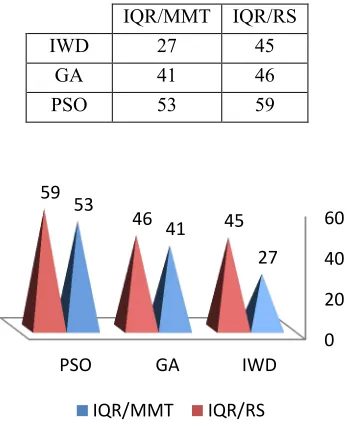
In table 2, the average of energy consumption has been separately demonstrated in ten rounds when IQR algorithm is considered as Host overload detection algorithm.
Table 2: The average of energy consumption by considering IQR algorithm as Host Overload detection algorithm in ten rounds.
IQR/MMT IQR/RS
IWD 27 45
GA 41 46
PSO 53 59
Fig. 2. The average of energy consumption by considering IQR as Host overload detection algorithm in ten rounds
In graph of figure 2 obtained on the basis of table 2, it can be observed that IWD algorithm has the least amount of energy consumption in comparison to particles swarm and genetic algorithms. IWD algorithm by using RS algorithm as VM selection has better performance than GA algorithm. By using MMT algorithm, it has better performance than PSO and GA algorithms. In this graph, vertical axis shows energy consumption, and its unit is w/H.
9 INVESTIGATING THE AMOUNT OF ENERGY CONSUMPTION BY CONSIDERING MAD AS HOST
OVERLOAD DETECTION ALGORITHM
In table 5, energy consumption has been taken into account by considering MAD as Host overload detection algorithm and by using RS and MMT algorithm as VM selection algorithms. The proposed algorithm is randomly executed with GA and PSO algorithm in ten rounds. The average of executing these ten rounds has been shown in two last columns on the basis of W/H and ICW/H. According to the obtained numbers, it can be observed that the proposed algorithm with energy consumption average of 45 W/H has the minimum amount of energy consumption by using MAD algorithm in comparison to GA and PSO algorithms. Also, the proposed algorithm with average of 47 w/H has the minimum amount of energy consumption by using RS algorithm in comparison to other two algorithms.
Table 5: Energy consumption amount by considering MAD as Host Overload detection algorithm
Roun d 1
Roun d 2
Roun d 3
Roun d 4
Roun d 5
Roun d 6
Roun d 7
Roun d 8
Round 9
Round 10
AVG(KW /H
AVG( W/H)
Energy
M M T
IWD 0.01 0.08 0.06 0.05 0.07 0.01 0.02 0.03 0.05 0.07 0.045 45
GA 0.03 0.01 0.03 0.09 0.09 0.07 0.01 0.02 0.13 0.04 0.052 52
PSO 0.11 0.01 0.06 0.13 0.04 0.03 0.02 0.03 0.11 0.06 0.06 60
RS IWD 0.03 0.03 0.08 0.01 0.04 0.05 0.05 0.05 0.05 0.08 0.047 47
GA 0.01 0.06 0.08 0.02 0.11 0.05 0.05 0.1 0.01 0.05 0.054 54
PSO 0.11 0.07 0.05 0.05 0.01 0.03 0.08 0.04 0.15 0.02 0.061 61
0 20 40 60
IWD GA
PSO
27 41
53
45 46
59
The average of energy consumption has been separately shown in ten rounds in the following table.
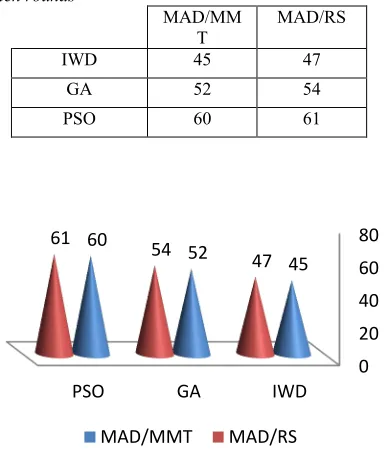
Table 6: The average of energy consumption by considering MAD as Host overload detection algorithm in ten rounds
MAD/MM T
MAD/RS
IWD 45 47
GA 52 54
PSO 60 61
Fig. 4. The average of energy consumption by considering MAD as Host Overload detection algorithm in ten rounds.
In the graph of figure 4 obtained on the basis of table 6, it can be observed that the proposed algorithm has minimum energy consumption in comparison to PSO and Genetic algorithms. GA algorithm has better performance than PSO algorithm by using MAD and RS algorithms. In this graph, vertical axis shows energy consumption on the basis of W/H.
10 CONCLUSION
Optimal energy consumption is not only economical but also is considered as a task and duty. As it has been considered in different cultures and religions, human cannot violate the rights of generation. This issue has been ignored in the history, so today's societies and environment have been seriously damaged. With regard to the fact that there are many users and resources in cloud computing, the researches and studies that have been carried out up to now show that some purposes can be achieved by virtualization such as reducing energy consumption of data centers, optimal usage of software and resources in cloud computing and optimal usage of hand width. Much
research can be carried out in this regard, but it is difficult to reach optimization become there are many conclusion parameters in this regard. studies show that using various methods of virtualization, combining these techniques and using evolutionary strategies in applying these techniques result in detecting new algorithms. These new algorithms present acceptable results in optimization of energy consumption in cloud computing. In these graphs, it can be observed that the proposed method has better conditions in terms of optimal energy consumption of 27 W/H in comparison to IWD algorithm along with IQR algorithm to detect the overload of physical host and MMT algorithms to select virtual machine. The proposed method has 45.71 percent of energy consumption optimization in comparison to two other algorithms.
11 REFERENCES
[1] Arfeen.A, Pawlikowski.K,& Willig. A (2011).A Framework for Resource Allocation Strategies in Cloud Computing Environment. 2011 35th IEEE Annual Computer Software and Applications Conference Workshops, 262-263.
[2] Andreas Berl1, Erol Gelenbe, Marco di Girolamo, Giovanni Giuliani, Hermann de Meer1, Minh Quan Dang and Kostas Pentikousis. (2009). Energy-Efficient Cloud Computing. Published by Oxford University Press on behalf of The British Computer Society.
[3] Abu Sharkh. M, M. Jammal, A. Shami, and A. Ouda. (2013). Resource Allocation in a
Network-Based Cloud Computing
Environment: Design Challenges. IEEE Communications Magazine.
[4] Anshul Rai, Ranjita Bhagwan, Saikat Guha. Generalized Resource Allocation for the Cloud.
[5] BeloglazovAnton , Jemal Abawajy, Rajkumar Buyya. (2012). Energy-aware resource allocation heuristics for efficient management of data centers for Cloud computing. Future Generation Computer Systems 28.755–768. [6] Asha. N, Dr. G. Raghavendra Rao. (2013). A
Review on Various Resource Allocation Strategies in Cloud Computing. International Journal of Emerging Technology and Advanced Engineering. Volume 3, Issue 7. [7] Byun Jinsung, Insung Hong, Zion Hwang, and
Sehyun Park. (2013). An Intelligent Cloud-based Home Energy Management System
Based on Machine to Machine
0 20 40 60 80
IWD GA
PSO
45 52
60
47 54
61
Communications in Future Energy Environments.The Eighth International Conference on Systems.
[8] BuyyaRajkumar, James Broberg, Andrzej Goscinski .(2011). Cloud ComputingPrinciples and Paradigms.
[9] Baleshwar GovilSaumitra, Karthik. T, Karthikeyan. S, Vijay. K and Chaurasiya, Santanu Das. (2012). An Approach to Identify the Optimal Cloud in Cloud Federation . International Journal of Cloud Computing and Services Science (IJ-CLOSER) Vol.1, 35-36. [10]Chandrashekhar S. Pawar and
R.B.Wagh.(2012). A review of resource allocation policies in cloud computing. World Journal of Science and Technology, 2(3):165-167.
[11]Chunlin Li and Layuan Li. (2013). Resource allocation in cloud computing: model and Algorithm. Int. J. Web and Grid Services.Vol. 9.No. 2.
[12]Ergu D, Kou G, Peng Y,& Shi Y( 2013). The analytic hierarchy process: task scheduling and resource allocation in cloud computing environment. Spring Science, 837-839.
[13]Guilherme Arthur Geronimo, Jorge Werner, Carlos Becker Westphall, Carla Merkle Westphall, Leonardo Defent. (2013). Provisioning and Resource Allocation for Green Clouds. The Twelfth International Conference on Networks.
[14]Gouda. K C, Radhika. T V, Akshatha M. (2013).Priority based resource allocation model for cloud computing. International Journal of Science, Engineering and Technology Research (IJSETR)Volume 2, Issue 1.
[15]Goudarzi Hadi and Massoud
Pedram.Maximizing Profit in Cloud Computing System via Resource Allocation. [16]Shah-Hosseini Hamed. (2009). The intelligent
water drops algorithm: a nature-inspired swarm-based optimization algorithm. Int. J. Bio-Inspired Computation, Vol. 1, Nos. ½. [17]Lei Ying, Siva Theja Maguluri and R.
Srikant.Heavy Traffic Optimal Resource Allocation Algorithms for Cloud Computing Clusters.
[18]Lotfi A. Zadeh.(1999). From Computing with Numbers to Computing with Words—From Manipulation of Measurements to Manipulation of Perceptions. IEEE TRANSACTIONS ON CIRCUITS AND SYSTEMS—I: FUNDAMENTAL THEORY AND APPLICATIONS. VOL, 45. NO: 1 [19]Michael Armbrust. Armodo Fox. Rean Gridh.
Anthony D. Randy H and Devid A.
(2009).Above the Clouds: Aberkeley View of Cloud Computing. University of California. [20]Mohamed Abu Sharkh, Manar Jammal,
Abdallah Shami, and Abdelkader Ouda, Western University.Resource Allocation in a
Network-Based Cloud Computing
Environment: Design Challenges.
[21]Mayanka Katyal and Atul Mishra.(2014). Application of Selective Algorithm for Effective Resource Provisioning In Cloud Computing Environment. International Journal on Cloud Computing: Services and Architecture (IJCCSA) .Vol. 4, No. 1.
[22]Pratik P. Pandya, Hitesh A. Bheda. (2014). Dynamic Resource Allocation Techniques in Cloud Computing. International Journal of Advance Research in Computer Science and Management Studies. Volume 2, Issue 1. [23]Person.S. (2009).Taking Account of Privacy
when Designing Cloud Computing Service. IEEE Computer Socienty Washington. DC, USA, pp 44-52.
[24]Dino Quintero, Rodrigo Ceron, Murali Dhandapani, Rodrigo Garcia da Silva, Amitava Ghosal,Victor Hu, Hua Chen Li, Kailash Marthi, Shao Feng Shi, Stefan Velica. (2013). IBM Technical Computing Cloud.International Technical Support Organization.
[25]RamMohan.N.R, Baburaj.E (2012).Resource Allocation Techniques in Cloud computing-Research Challenges for Applications. International Conference on Computational Intelligence and Communication Networks, 555-558.
[26]Ronak Patel, Sanjay Patel. (2013). Survey on Resource Allocation Strategies in Cloud Computing. International Journal of Engineering Research & Technology (IJERT).Vol. 2, Issue 2.
[27]Vinothina. V, Dr. Shridaran. R and Dr. Padmavathi Ganpathi. (2012). A Survey on Resource Allocation Strategies in Cloud Computing. International Journal of Advonced Computer Science and Application.Vol 2, 97-104.
[28]Wei-hua Yuan, Hong Wang and Zhong-yong Fan.(2014). Research on Optimization of Resources Allocation in Cloud Computing Based on Structure Supportiveness.Springer Science.
[30]Xiaoying Wang, Zhihui Du, Yinong Chen.(2012). An adaptive model-free resource and power management approach for multi-tier cloud environments. The Journal of Systems and Software85. 1135–1146.