Send Orders for Reprints to [email protected] The Open Cybernetics & Systemics Journal, 2015, 9, 639-647 639
1874-110X/15 2015 Bentham Open
Open Access
The Virtual Machine Resource Allocation based on Service Features in
Cloud Computing Environment
Liu Yan
*and Guo Chenxian
College of Information Engineering, Zhongzhou University, Zhengzhou, 450044, P.R. China
Abstract: This paper presents the virtual machine resource allocation algorithm based on business characteristics under a cloud computing environment. In this algorithm, is defined to describe the user service characteristic time delay factor and price factor and other parameters, resource scheduler computing data center according to the user on the business charac-teristics of the description and the status of cloud calculated the cost of the business index, and according to the cost index distribution of cloud computing resources. First introduced the system model of the algorithm, and then the model is es-tablished according to the corresponding problem of the system model, and then put forward the corresponding resource allocation scheme, finally, the performance of the algorithm is verified by simulation. The simulation results show that the proposed algorithm in cloud computing platform to improve the utilization rate of resources at the same time, significantly reduce the computational characteristics of different business users of cloud use cost, improve the cloud user service expe-rience.
Keywords: Business characteristics, cloud computing, resource allocation, virtual machine.
1. INTRODUCTION
With the development of cloud computing, more and more users will business migration to the cloud service pro-viders of cloud computing flat Station, a virtual machine running in the cloud computing platform, become the cloud user. Cloud service providers according to the specific needs of the cloud user business distribution of its corresponding virtual machine configuration and quantity.
Using the current resource allocation method can im-prove the rate of cloud resources better, and increase the cloud service provider revenue. However, from the cloud user's point of view, these methods can not bring much bene-fit to the cloud user, or even reduce the user experience, from a long-term point of view, the long-term income of a cloud service provider will also have a negative impact. As the business characteristics of different cloud of different users, to the virtual machine resource price, delay and resource deployment and other requirements also each are not identi-cal. So we in the process virtual machine resource allocation, allocation is necessary for virtual machine resources accord-ing to the characteristics of the cloud user service, thereby reducing the cost of low cloud users, and improve the cloud user service experience, and then realizes maximum cloud service providers of long-term income [1]. In this paper we from the cloud user perspective issued, put forward the vir-tual machine allocation algorithm based on a cloud comput-ing business characteristics, in order to improve the utilization rate of the platform in cloud computing resources at the same
*Address correspondence to this author at the College of Information Engi-neering, Zhongzhou University, Zhengzhou, Henan, 450044, P.R. China; Tel: 13803770071; E-mail: [email protected]
time, reduce the cloud user cost, improve the cloud user service experience.
2. THE SYSTEM MODEL
Consider a computing platform consists of distributed in a plurality of different geographic location data center to form clouds, each data center capacity, delay performance and virtual machine resource prices are not the same. Cloud service providers according to the user's requirements for the allocation of cloud resources corresponding virtual machine, operation of cloud users of virtual machine in the data center [2]. In order to understand, we do the following definitions:
Definition one: a resource scheduler, running state of computing data center according to the user's requirements and the cloud cloud virtual machine resource allocation cor-responding to the cloud user, a data center resource sched-uler itself runs in cloud computing platform on the.
Definition two: data center status monitoring process, running on each data center, running state real-time monitor-ing data center, the amount of residual resources includmonitor-ing data center and virtual machine resource price information, status information and to the resource scheduler sends loca-tion data center.
Definition three: data center status table, data storage center state information for resource scheduler module, ac-cording to the state information center data process state monitoring reports are updated in real time, including the data center of the residual amount of resources, time delay and resource price information.
According to the above definition, the system
In Fig. (1), Ri
(
li,ni,ci)
said the cloud user submitted to the resource scheduler resource request, wherein(
, , ,)
i i
l =l f m h b represents a cloud user i for virtual
ma-chine configuration, including the processor f, memory m, external memory bandwidth h and b; in represents a number
of cloud user i needed for virtual machine;
c
i says businesscharacteristics the cloud user i; Ln t, , Pn t, , Dn t, respectively represents the amount of remaining resources data center n report data center status monitoring process to a resource scheduler, resource price and time delay estimation informa-tion, wherein, the resource price Pn,t =P f
(
n,t,mn,t,hn,t,bn,t)
,including processor computing resource price fn t, , resource in
memory m
n,t, external storage resource
h
n t, and bandwidthresource bn,t; in order to simplify the system model, we
as-sume that a cloud users with only one type of business [3].
3. MODEL CONSTRUCTION AND PROBLEM DE-SCRIPTION
3.1.Description of Service Features
For the specific business, such as massively multiplayer online game business, the business of large amount of inter-nal information interaction, virtual machine deployment for the use of centralized deployment mode, and highly sensitive to the delay, resource price has little influence on it; and as micro-blog social business, with strong regional characteris-tics, the smaller amount of internal business information interaction, more suitable for virtual machine deployment adopting distributed deployment mode, at the same time de-lay this kind of business the sensitivity is low, price sensi-tive. The difference of business of cloud users leads to its business characteristics also vary, according to the virtual machine deployment requirements, time delay factor and price factor, we can use to describe the business characteris-tics of cloud user i.
ci =
(
si,!i,"i)
(1)3.2. Status Updates of Data Center
On the pricing model of resource price data center and cloud provider, in the system model, taking into account the equalization of multiple data center load demand, we use dynamic pricing model based on the residual amount of
re-sources. Specifically, data center resources price
P
k t, by thedata center status monitoring process according to the for-mula calculated.
Pk,t =!1Pk,o+!2f L
( )
k,t (2)In the formula, k represents the data centre number, t said the current time, !i as weighting factor,
"
!i=1, Pk,o is a reference price of resources data center k, is constant,f L
( )
k,t is the function associated with the residual amount of resources.Time delay estimation of data center renewal process: re-source scheduler periodically Xiang Yun computing data center sending delay test signal, and record the response time
delay dk t, the test signal, sending periodic testing signal for
d
t
, and whenever a resource scheduler receives the stateinformation from the data center will also sent to the data center of an experiment the test signal. Delay of data center is obtained by the formula:
Dk,t = dk,t
I
i=1 I
!
(3)where I represents the most recent I signal, namely the mean response delay time delay I recently a test signal to the data center estimation.
3.2.Description of the Problem
In order to influence the intuitive description of data cen-ter delay and resource price on the business, we put forward
The Virtual Machine Resource Allocation based on Service Features The Open Cybernetics & Systemics Journal, 2015, Volume 9 641
the concept of business cost index, resource scheduler ac-cording to the cloud user service cost index for the allocation of resources to the corresponding business. Cost index can be calculated by the following formula:
, , , , ,
i k t i k t i i k t
T =
!
D +"
P (4)Among them, Ti k t, , says the cloud user i arrived at t
mo-ment of its business with respect to data center k cost index,
, , ,
i k t k t i
P =P l says the user i in the data center k is deployed on
a virtual machine configured the requirements of cost, the
same cloud users of its business delay factor ! and price
factor ! is constant. From the type set, on the same cloud user service, different data centers and different time, its cost index are not the same.
According to business characteristics of cloud users as-sign virtual machine resource, minimum cloud user cost, cost index minimization problem is equivalent to solving a cloud users, therefore, our objective function can be described as follows: min Ti,t = Ti,k,t k=1 K
!
xi,k,t s.t. xi,k,t k=1 K!
=ni (5) xi,k,tli !Lk,t,"k=1, 2,...,KAmong them, Ti t, said the total cost of the cloud user i, t
says the cloud user i service request arrival time, xi k t, , said the virtual machine allocation index, said t users of i virtual machine in k data center is the upper department number. The first restriction represents a number of virtual machine resources allocated to the virtual machine scheduler total user i should be equal to the user i required; second limiting conditions indicates that the data center on k allocated to the virtual machine resources required of user i should be less than the total amount of resources available to the data center k.
Known by the first limiting conditions, the objective function is equivalent to:
min Ti,t =ni xi,k,t ni Ti,k,t k=1 K
!
(6)In the formula, for a particular user service, the number
of virtual machine needs ni in is determined, and the cost of
index Ti k t, , user service relative to a particular data center is the fixed value. So we can through the water filling algo-rithm to solve the optimization problem [4]. The steps are as follows:
1) According to the cost index to sort the data center,
re-member the ranked set for the DT virtual machine, the
ini-tialization allocation index: xi,k,t =0;
2) Select the data center, cost index Ti k t, , minimum DT if
* *
, , i , i k t k t
x l !L , then data center for the user service agency, a
virtual machine, * *
, , , , 1
i k t i k t
x =x + , and more new ni=ni!1
and * * * , , , , i k t k t i k t L =L !x l, if xi k t, ,* li >Lk t*, , then * T T D =D !k , excute step 1);
3) If DT=!, indicates that the current cloud computing platform does not have sufficient resources to provide
serv-ices, for the user allocation failure, end; if x
i,k*,t =ni and the distribution end, otherwise executing step 2);
Through many times of iterative water filling algorithm, can find the best virtual machine user I deployment strategy.
4. RESOURCE ALLOCATION ALGORITHM BASED ON BUSINESS CHARACTERISTICS
According to the system model and the analysis of the problem, we propose a virtual machine resource allocation
algorithm based on business characteristics, The specific
process as shown in Fig. (2).
The concrete steps of the proposed virtual machine allo-cation algorithm is as follows:
Step one, the user to submit a request for a resource allo-cating resources Ri
(
li,ni,ci)
;Step two, if the user's virtual machine deployment strat-egy of si =1, executestep three; if si =v,
(
v>1)
, thenexecute step four;
Step three, centralized way for user
i
to the virtualma-chine resource allocation, the specific method for:
1) Resource scheduler queries the data center *
k status
table, elected to meet the needs of the user
i
resources datacenter R l ni
(
i, i)
, must satisfy Lk*,t !nili, and constitutes the candidate data center seti
Gof user
i
.2) If the candidate user
i
set data center Gi is null,repsents the current cloud computing platform not enough sources were allocated to the user I, resource scheduler
re-fused to user
i
request, step five; otherwise, the calculationof candidate data center cost index Ti k t, ,,k G! i relative cloud
users I collection of Gi in each data center;
3) Select the candidate data center Gi collection cost
in-dex and the lowest in Ti,k,t data center
k
* for useri
de-partment cloud virtual machine;4) Remaining resources state of
L
k t, on the selected datacenter are updated, execute step five;
Step four, adopting distributed deployment of virtual
1) Resource scheduler queries the data center status table, select the resource requirement R l ni
(
i, i)
to meet the useri
data centerk
*, must satisfyL
k t*,!
n l
i , wherein,L
k t*, isthe surplus resources,
n
i said the number of useri
neededfor virtual machine,
l
i says the cloud user desired virtual machine configuration, v says the user requirements will be virtual machine are deployed in v data center, the data centerof a candidate data center user
i
in the seti
G;
2) If the candidate data center Gi collection of data center
i
G <v number, represents the current data are not adequate
to meet the cloud center user
i
resource requirements,re-source scheduler refused to user
i
requests for resources,step five; otherwise, the calculation of the candidate set each
data center in Gi phase to the cloud user
i
cost of index, ,
,
i k t iT
k G
!
;3) In the candidate set Gi consisting of a collection of data center cost index Ti k t, ,,k minimum v data center is
se-lected in *
i
G in the *
i
G collection of the data center are user
i
virtual machine deployment.4) The remaining resource state
L
k t, on the selected datacenter are updated, step five;
Step five, the virtual machine assignment complete, the resource scheduler to the cloud user I feedback results.
Compared with the water filling algorithm standards, the above algorithm considering the strategy requires the user to business to the virtual machine deployment, with some
The Virtual Machine Resource Allocation based on Service Features The Open Cybernetics & Systemics Journal, 2015, Volume 9 643
formance loss, but it still significantly reduces the user's cloud computing cost, especially to require the use of cen-tralized virtual machine deployment strategy users, the better performance [5].
5. SIMULATION AND PERFORMANCE ANALYSIS 5.1. Establishment of the Simulation Model
In practice, the data center with delay and price resource utilization rate, therefore, we first define the utilization data
center resources !, t moment data center k resources
utiliza-tion rate calculautiliza-tion formula is as follows: !k,t =µ1fk,t+µ2mk,t+µ3hk,t+µ4bk,t
µ1fk+µ2mk+µ3hk+µ4bk (7)
In the formula, µi represents the corresponding to the
data center resources influence factor, delay of
0<µi <1, µi
i
!
=1; the denominator indicates the totalamount of resources data center k, the denominator repre-sents the use of a corresponding amount of resources in the t time.
According to the utilization rate of data center resources, we define the relationship between delay and resource utili-zation rate in the simulation model are as follows:
Dk,t =Dk,0exp 1 1!"k,t !e # $ % % & ' ( ( (8)
In the formula, Dk,0 reference delay data center k, ac-cording to the formula, when the resource utilization rate is less than 70%, with the resource utilization rate increases slowly with increasing, when the resource utilization rate is higher than 70%, with the increase of resource utilization rate increased rapidly [6].
Similarly, we define the rate relationship by the price of resource and resource data center in the simulation model are as follows:
Pk,t = 1
1!"k,t
Pk,o+Pk,o (9)
Among them, Pk o, said the benchmark price of resources
data center k, can be seen from the above equation, with the increase of resource utilization, resource price data center also gradually increases.
5.2. The Results of Simulation Analysis
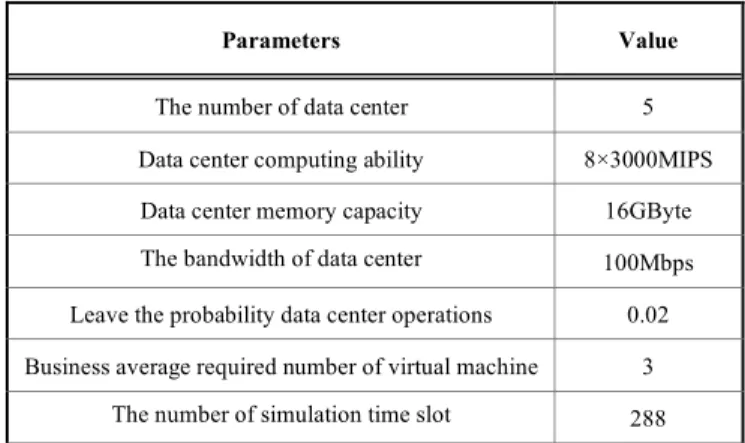
Consider a distributed cloud computing platform consists of five different geographic location data is formed in the center of each data center, all have the same capacity, but its reference resources price and reference delay are not the same. In each time slot, the business needs a number of vir-tual machine and the corresponding business characteristics of randomly generated, executed in a data center business leave with a certain probability, the specific simulation
pa-rameters as shown in Table 1.
Table 1. The simulation parameters.
Parameters Value
The number of data center 5 Data center computing ability 8×3000MIPS Data center memory capacity 16GByte The bandwidth of data center 100Mbps Leave the probability data center operations 0.02 Business average required number of virtual machine 3
The number of simulation time slot 288
Figs. (3) and (4), respectively, indicates that the resource
price five data center (Fig. 3) and delay (Fig. 4) in the 100th
time slot to slot changes among the 200th. In the simulation model, the load is proportional to the price of resources and
time delay and data centers, i.e. the larger the load, the
higher the price of resources, and the delay is large. Five data center benchmark price and the reference delay are not the same, from the data center I to V, the benchmark price lower reference delay increased.
Fig. (5) shows the five data centers in the 100th to 200th
time slot resource utilization curves, as can be seen from the graph, resource allocation algorithm is proposed in this pa-per, five data center load difference, the proposed price model algorithm with balanced load effect. According to the simulation model and simulation, the average load of five data center is 60%, while the load in Fig. (5) data center is between 40%-70% fluctuation, demonstrate that the pro-posed algorithm can achieve better load balancing data cen-ter between the target [7].
In Fig. (6), we give the relation graph of rate and delay,
resource price data center utilization III resources, as can be seen from the graph of time delay and resource prices and resource utilization rate is proportional to, and has a high correlation, consistent with the simulation model theory, illustrates the correctness of simulation [8].
We will delay factor !more than 0.7 business as delay
sensitive traffic, the price factor !more than 0.7 business as
price sensitive business, were statistical different virtual ma-chine deployment strategy of delay sensitive traffic delay and resource cost and price sensitive business accumulated
value, Fig. (7). Among them, the first act of distributed
vir-tual machine deployment delay and price different character-istics under the business strategy, it can be seen from the figure, for delay sensitive traffic, the cumulative delay value is far less than the price sensitive business Fig. (7a), this is because the business office delay sensitive business require-ments of smaller physical and time delay, and price sensitive business to business processing delay is not a strict requiment; on the contrary, the time delay sensitive service re-source cost accumulation is greater than the price sensitive
service Fig. (7b), this is because the price sensitive business
requirements of resource price as low as possible, while the price of delay sensitive business to resource is not strict; Fig.
Fig. (3).Resource price curves of five data center.
Fig. (4). Time delay curve of five data center.
The Virtual Machine Resource Allocation based on Service Features The Open Cybernetics & Systemics Journal, 2015, Volume 9 645
Fig. (6). Diagram of the relationship between resources utilization and rate,time delay in data center III(DCIII).
Fig. (7a). Time delay of different service under distributed VM deployment strategies.
Fig. (7c). Time delay of different service under centralized VM deployment strategies.
Fig. (7d). Resource cost ofdifferent service under centralized VM deployment strategies.
Fig. (7). Cost and time delay curve of the different characteristics business under different virtual machine deployment strategys.
and resource price business strategies under the different characteristics of the cumulative curve, the result is similar to Figs. (7a) and (7b), that no matter how the user virtual machine deployment strategy, the proposed algorithm can be calculated using the corresponding cost reduce users of cloud. The centralized virtual machine deployment strategy users, differences between different types of traffic delay and resource prices more obvious, the results show that the pro-posed algorithm has better to adopt centralized virtual ma-chine deployment strategy users return. In general, the Fig.
(7) shows the virtual machine resource allocation algorithm
based on business characteristics can be allocated resources for users according to business characteristics of users, thus reducing the cost of the user [9, 10].
CONCLUSION
From the above-mentioned content, resource allocation algorithm based on business characteristics mainly intro-duces a cloud computing environment proposed, this algo-rithm can according to the characteristics of user service, to allocate appropriate resources for users, thus reducing the user cost, load balance and can achieve a cloud computing platform. This chapter first introduces the system model of the algorithm, and then the model is established according to the corresponding problem of the system model, and then put forward the corresponding resource allocation scheme, fi-nally, the performance of the algorithm is verified by simula-tion. The simulation results show that the proposed algo-rithm can according to the characteristics of user service for
The Virtual Machine Resource Allocation based on Service Features The Open Cybernetics & Systemics Journal, 2015, Volume 9 647
a particular resource allocation to users, significantly reduce the cost to the user, and implement a distributed cloud data center computing platform under different load balancing.
CONFLICT OF INTEREST
The authors confirm that this article content has no con-flict of interest.
ACKNOWLEDGEMENTS
This work was financially supported by the Liaoning Doctor Star-up Foundation (20111041).
REFERENCES
[1] L. Xu W. Chen and Z. Wang, “A strategy of dynamic resource scheduling in cloud data center,” In: Proc. of IEEE Cluster Work-shops, pp. 120-127, Sep. 2012.
[2] V. Jalaparti, and G. D. Nguyen, “Cloud resource allocation games,” Dept of Computer Science, Tech. Rep, Dec. 2010. [3] Kuilin Chen, C-RAN White Paper, version 2.5, China Mobile
Research Institute, Oct. 2011.
[4] L. Guangjie, Z. Senjie and Y. Xuebin, “Architecture of GPP based, scalable, large-scale C-RAN BBU pool,” In: Proc. of IEEE GC Workshops, Dec. 2012, pp. 267-272.
[5] Z. B. Zhu, P. Gupta, and Q. Wang, “Virtual base station pool: towards a wireless network cloud for radio access networks,” In: Proc. of the 8th ACM International Conference on Computing Frontiers April 2011, p. 34,.
[6] G. Bhanage, I. Seskar, and R. Mahindra, “Virtual basestation: architecture for an open shared WiMAX framework,” In: Proc. of the 2nd ACM SIGCOMM Workshop on Virtualized Infrastructure Systems and Architectures, Sep. 2010, pp. 1-8.
[7] S. Namba, T. Warabin, and, S. Kaneko, “BBU-RRH switching schemes for centralized RAN,” In: Proc. of IEEE CHINACOM, Aug. 2012, pp. 762-766.
[8] S. Bhaumik, S. P. Chandrabose, and M. K. Jataprolu, “CloudIQ: a framework for processing base stations in a data center,” In: Proc. of the 18th Annual International Conference on Mobile Computing and Networking, Aug. 2012, pp. 125-136.
[9] X. F. Tao, Y. Z. Hou, and K. D. Wang, “GPP-based soft base sta-tion designing and optimizasta-tion,” Journal of Computer Science and Technology, vol. 28, no. 3, pp. 420-428, 2013.
[10] Y. Chen, X. Li and F. Chen, “Overview and analysis of cloud com-puting research and application,” In: Proc. of IEEE ICEE, May 2011, pp. 1-4.
Received: April 02, 2015 Revised: May 23, 2015 Accepted: June 06, 2015 © Yan and Chenxian; Licensee Bentham Open.
This is an open access article licensed under the terms of the Creative Commons Attribution Non-Commercial License (http://creativecommons.org/-licenses/by-nc/3.0/) which permits unrestricted, non-commercial use, distribution and reproduction in any medium, provided the work is properly cited.