Detection of Skew and Mirror Images in
Vehicle Number Plates using Radon Transform
and Geometric Moments
Veena M.N
P.E.T Research Foundation P.E.S. College of EngineeringMandya, Karnataka , India
Shruthi S.J
Dept of CS & E,Maharaja Institute of Technology, Mysore, Karnataka, India,
Vasudev.T
Dept of CS & E,Maharaja Institute of Technology, Mysore, Karnataka, India,
Abstract: The efficiency of an automatic vehicle number plate recognition is high if the necessary preprocessing methods give results effectively. An essential and important preprocessing in automatic number plate recognition system is correction of skewed number plates in vehicle images which is mainly due to position of camera while capturing the vehicle image. This is also true while capturing a vehicle image from mirror instead directly. The skewed number plate affects badly on the accurate character segmentation and recognition. Once the number plate is segmented from the vehicle image, the plate has to be checked for skewness and the same has to be corrected for future processing. A Radon transformation is applied to estimate the angle of skew in the segmented number plate and is counter rotated by the estimated angle to correct the skew. Further, the proposed work check the number plate is a mirror image or not, using 1st order geometric moments and is corrected if it is mirror image. The performance of the proposed work has been tested on live captured vehicle number plate images. The proposed work gives better preprocessing task and yields considerably good results in vehicle number plate recognition applications.
Keywords – Number Plate, Skew, Mirror Image, Radon Transform, GeometricMoments
I. INTRODUCTION
Vehicle Number Plate Recognition(VNPR) system is an image processing application, developed to track the information about vehicles through the number plates. This application is gaining popularity in security and traffic monitoring systems. The number plate recognition system is important for variety of applications like automatic traffic congestion charge system, access control, tracing of stolen vehicles and identification of vehicles for traffic rules violations. The VNPR system plays a major role in automatic monitoring of traffic rules and maintains law enforcement on public roads. A VNPR system goes through a series of preprocessing task for efficient automatic reading. A major problem encountered in the system is skew in number plates which is due to the position of capturing the image. The skew causes major effect on character segmentation and recognition. Good number of methods have been proposed by many researchers for the detection of skew in vehicle number plate [1] in order to increase the performance of OCR system such as using principal component analysis [2], Fourier transform [3], Hough transform [4], nearest neighbor connectivity [5], method of extreme points [6] and moments [7,8].
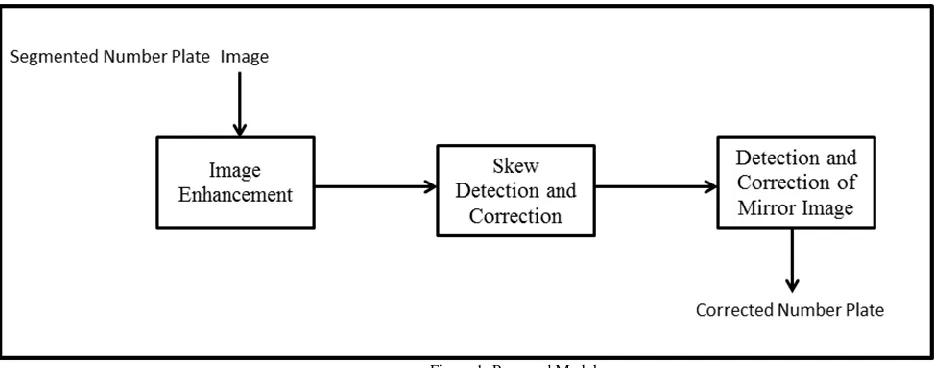
The work presented in this paper focuses on implementation of skew detection and correction of vehicle number plate including mirror image. The rest of the paper is organized as follows section II gives brief survey about related research work. Section III presents the model designed for detection of skew and mirror image of vehicle number plate. Section IV discuss about the experimental results and a brief conclusion is provided in section V.
II. LITERATURE SURVEY
In literature sufficient quantum of works are reported on text skew detection. The work in [9] proposed a modified approach of Hough transform for skew detection and correction of document images, the algorithm is computationally less efficient. The work in [10] proposed an integrated skew detection and correction using Fourier transform and DCT which is also computationally less efficient. Many different methodologies to detect skew a given document page [11] were discussed. A traditional projection profile approach is proposed in [12]. In this approach features are extracted from each projection profile to determine the skew angle and it is quite cost effective. The improved nearest-neighbor based document skew detection method is proposed in [13] to estimate skew in documents respective to skew angle limitation. Another approach uses k-NN [14] clustering of the connected components. This approach has a relatively high accuracy but has a large computational cost, independent of the detection range. A skew detection method using the cross correlation between the text lines at a fixed distance [15] is based on the fact that the correlation between vertical lines in an image is maximum for a skewed document, is presented. It is found that the proposed method is computationally expensive and gives lesser accuracy. A bottom up technique for skew estimation based on nearest neighbor clustering is proposed in [16]. In this method, nearest neighbors of all the connected components are determined. Since only one nearest neighbor connectivity is made for each component, connection with noisy sub parts of characters would reduce the accuracy of the method. The above reported techniques have some limitations and depends on the factors like, speed, suitable only for small text. Few techniques provide accurate results but slow in processing and other few techniques are cost effective but efficient in speed and accuracy. Hence, a more optimal skew angle detection method is required for number plate recognition system and this requirement made us to explore a suitable method to find skew detection in number plate images using Radon Transform.
To the best of our knowledge, we could not find literature specific to research works on detection and correction of mirror image number plate of vehicles. In certain situations, a mirror image may available instead of the normal image, in such cases the mirror image number plate affects badly on the accurate character recognition. Once the number plate is segmented from the vehicle image and skew corrected, the plate has to be checked for mirror image and the same has to be corrected for future processing.In the real world, mirror reflection generally appears in three different ways: horizontal reflection, vertical reflection, and combined reflection which is horizontally and vertically reflected. Reflection detection has been used in many different fields such as text detection and positioning [17], face analysis [18], crystal structure [19], medical image analysis [20], reconstruction [21-23], digital paper cutting [24], Symmetry based vehicle and aircraft detection [25]. Since little or no work is reported in literature on mirror image number plates, an initial attempt has been made to come out with a model to detect mirror image number plates and the same is discussed in the subsequent section.
III. PROPOSED MODEL
Figure 1. Proposed Model 3.1. Preprocessing
The input image is converted into a grayscale image for easy analysis as it consists of only two color channels. The preliminarily preprocessing is carried out to remove noise using median filtering [26] from the input image. Median filter is a non-linear filter, which replaces the gray value of a pixel by the median of the gray values of its neighbours. A 3 × 3 mask is used to get eight neighbours of a pixel and their corresponding gray values. The gray value of the centre pixel of the mask is replaced by the median of the gray values of the pixels within the mask. This operation removes salt-and-pepper noise from the image. Figure 2 (a), (b) and (c) show the input, gray scale converted and filtered images respectively.
Figure 2. (a). Input Image (b). Gray Scale Image (c) Median Filtered Image
3.2. Skew Detection and Correction
The skew angle detection is done based on Radon Transform [27]. The resulting image is subjected to estimate the angle of skew in number plate. The radon transformation for a continuous function is given by the equation (1). ∞ ∞
R(r, θ)[ f(x, y)] = ∫ ∫ f(x, y)δ(r-x cos θ- y sin θ)dx dy (1) -∞ -∞
Radon Transform for discrete function is given is the equation (2) for a line,
, (2)
where,
and
is the Dirichlet Kernel with m=2n+1 where,
=
to estimate the angle of skew. Finally the image is counter rotated by the estimated angle. Figure 3 (a) and (b) shows the skewed number plate, skew corrected number plate respectively.
Figure3. (a). Skewed Number Plate (b). Skew Corrected Number Plate 3.3. Detection of Mirror Image using First Order Geometric Moments
Geometric Moments are extensively used in many applications of image processing specifically in classification problems. The moments are geometrical features obtained from the image based on pixel distribution. Seven orders of moments are derived from geometrical features that are invariant to translation, scaling and rotation. The characteristic of geometric moments is, higher the order of moments, greater is the classifying range of values. These moments characteristics are extensively used in texture classification problems.
Since the number of classifications are two in the problem, just lower order geometric moments itself exhibit considerable classification range and the detection model is developed limiting to 1st order geometric moments. In the proposed work for image classification, good results are achieved using first order moments. The computed values of these texture measures [28] remain same for a specific type of mirror image at any scaling and translation. The texture features of mirror image is calculated based on 1st order geometric moments. The first order geometric moments m00, m10, m01 are evaluated using computation indicated in equations (3), (4) and (5). The term M[x][ y], H and W indicate the intensity value of the image at (x,y) coordinate, height and width of the input image number plate of vehicle respectively.
m00 (3)
m10= (4)
m01= (5)
Using the training inputs of mirror image number plates of vehicles, first order moments are obtained. Multilevel decision tables are constructed for classification based on the values computed for m00, m10 and m01 from training samples. A first level classification is made using m00 and the decision shown in Table 1.1
Table 1.1. Decision Table for 1st level Classification
The conflict cases of 1st level are subjected for second level classification using m10 as shown in Table 1.2. Table 1.2. Decision Table for 2nd level Classification
m10 Normal Image Mirror Image Conflict Case
50-81 Yes No No
82-897 No No Yes
Above 897 No Yes No
The conflict cases of 2nd level are further subjected for a third level classification using m01 as shown in Table 1.3 Table 1.3 Decision Table for 3rd level Classification
The conflict cases after 3rd level classification are considered as rejection cases.
m00 Normal Image Mirror Image Conflict Case
>4 No Yes No
=4 No No Yes
m01 Normal Image Mirror Image Conflict case
168-185 Yes No No
185-1596 No No Yes
3.4. Correction of Mirror Image
The identified mirror image number plate of is next subjected to a correction procedure. The equation (6) shows the transformation used for correcting a mirror image.
Nij=Mi (w+1-j) (6)
The N(i,j) is the normal image, M(i,j) is the mirror image H and W height and width of the mirror image number plate respectively. The Figure 4 (a) and (b) shows mirror image and corrected image respectively.
Figure 4. (a). Mirror Image (b). Corrected Mirror Image
IV. EXPERIMENTAL RESULTS
The designed method is implemented using MATLAB R2010 on Intel(R) Core 2 Duo processor @ 2.20 GHz and RAM 2 GB. The experiments are conducted on 216 detected vehicle number plate images containing normal and mirror number plates. The vehicle number plate images are taken under different environment conditions. The Figure 5 (a), (b) and (c) shows the samples of another input image and corresponding outputs.
Figure 5 (a) Segmented Number Plate (b). Skew Corrected Image (c). Corrected Mirror Image
The results of skew detection after mirror image detection shows 97.22% for correct skew estimation with 2.78% of failure cases and the results are tabulated in Table.2.1. The main reasons for failure case in skew detection due to the presence of noise, are in detection of larger line and estimation of angle in the input image.
Table 2.1. Results of Skew Correction
The results of mirror image detection is tabulated in Table.2.2 The results show an efficiency of 89.52% as correct classification and miss classification as 6.67% with 3.81% of rejections in detection of mirror images. The main reasons for misclassification in mirror image due to the presence of noise, illumination condition and large orientation in the input image.
Table 2.2 Results of Detection and Correction of Mirror Image
The result of overall efficiency of proposed method is 87.04% and same in Tabulated in Table 2.3. Table 2.3. Results of Overall Efficiency
No. of Input Images considered for Skew detection
No. of Skew Detection
% of Skew Detection
No. of Failure cases % of Failure cases
216 210 97.22% 6 2.78%
No. of Input Images
No. of correct Mirror image classification
No. of Miss classification
No. of Rejection
% of correct classification
% of Miss classification
% of Rejection
210 188 14 8 89.52% 6.67% 3.81%
No. of Input Images
No. of Successful Case
% of Successful Case
V. CONCLUSION
The work presented performs an essential preprocessing in a VNPR system. The skew estimation is performed based on radon transform and shows an efficiency of 97.22% in skew estimation. Next to detect a number plate is mirror image or not and corrects the same. The detection of mirror image is done using first order geometric moments. The method shows 89.52% correct classification of mirror. The overall efficiency of proposed method is 87.04%. However there is much scope to explore higher order geometric moments for more accurate detection of mirror images which is under investigation
REFERENCES
[1] Rajeev N, Verma, Dr.Latesh G Malik “Review on skew detection and correction techniques”IJCEA,September 14.
[2] Rajesh Bodade, Ram Bilas Pachori, Aakash Gupta, Pritesh Kanani, Deepak Yadav, “A Novel Approach for Automated Skew
Correction of Vehicle Number Plate Using Principal Component Analysis” 2012 IEEE International Conference on Computational Intelligence and Computing Research
[3] Lowther, S., Chandhran, V., Sridharan, S. An accurate method for skew determination in document images. In Proceedings of the Digital Image Computing Techniques and Applications. Melbourne (Australia), 2002.
[4] Arulmozhi, Arumuga Perumal , Thanooja Priyadarsini, Krishnan Nallaperumal, “Image Refinement Using Skew Angle Detection and
Correction for Indian License Plates” 2012 IEEE International Conference on Computational Intelligence and Computing Research.
[5] Y. Lu, C. L. Tan., Improved Nearest Neighbor Based Approach to Accurate Document Skew Estimation, Department of Computer
Science, School of Computing, National University of Singapore, Kent Ridge Singapore,2003
[6] Marian Wagdy, Ibrahima Faye, Dayang Rohaya. Document Image Skew Detection and Correction Method Based on Extreme Points.
In: 2014 IEEE.
[7] K. George ,K. Nicholas., A Fast High Precision Algorithm for the Estimation of Skew Angle Using Moments, Department of
Informatics and Telecommunications University of Athens,2002.
[8] B. Darko , R. M. Dragan, An Algorithm for the Estimation of the Initial Text Skew, University of Belgrade, Technical Faculty Bor ,
Mining and Metallurgy Institute, Department of Informatics, Serbia, 2012.
[9] Deepak kumar, Dalwinder singh “modified approach of hough transform for skew detection and correction in documented image”
IJRCS,in 2012.
[10] Madir kaur, Simple Jindhal “an integrated skew detection and correction using fast fourier transform nd DCT”,IJST,December 2013.
[11] R.singh and R kaur “skew detection in image processing”,IJCTA,issn 2229-6093,vol 4,no.3(2013),pp.478-485.Postl, W., (1986).
[12] Detection of linear oblique structures and skew scan in digitized documents. In: Proc. 8th Internat. Conf. on Pattern Recognition, Paris, France, 687–689.
[13] M. Sarfraz, S.A. Mahmoud and Z. Rasheed,On Skew Estimation and Correction of Text, Computer Graphics, Imaging and
Visualisation (CGIV 2007) 0-7695-2928-3/07.
[14] G.S.Lehal and Renu Dhir, (1999) “A Range Free Skew Detection Technique for Digitized Gurmukhi Script Documents”, Proceedings
5th International Conference of Document Analysis and Recognition,Banglore,pp.147-152.
[15] Yan, H., “Skew correction of document images using interline cross correlation”, Computer Vision, Graphics, and Image Processing
55,1993, pp 538-543.
[16] A. Hashizume, P. S. Yeh, A. Rosenfeld, “A method of detecting the orientation of aligned components”, Pattern Recognition Letters,
1996,pp. 125-13
[17] Y. Pan, X. Hou, and C. Liu, “A robust system to detect and localize texts in natural scene images,” in International
[18] Workshop on Document Analysis Systems, 2008.
[19] S. Mitra and Y. Liu. Local facial asymmetry for expression classication. In Proceedings of International Conference on Computer Vision and Pattern Recognition, volume 2, pages 889–894, June 2004.
[20] F. H. Li, D. X. Huang, F. H. Li, D. X. Huang, B. Lu, W. Liu, Y. X. Gu, Z. H. Wan, H. F. Fan "Crystal Structure Determination
by Two-Stage Image Processing" Find out how to access preview-only content Electron Crystallography NATO ASI Series Volume 347, 1997, pp 203-211
[21] M. Mancas, B. Gosselin, and B. Macq. Fast and automatic tumoral area localization using symmetry. IEEE International Conference
on Acoustics, Speech, and Signal Processing., 2:725–728,18-23,2005.
[22] A.Y. Yang, S. Rao, K. Huang, W. Hong, and Y. Ma. Geometric segmentation of perspective images based on symmetry groups. In
ICCV, pages 1251–1258, 2003.
[23] Stefan Carlsson. Symmetry in perspective. In ECCV (1), pages 249–263, 1998.
[24] W. Hong, A. Y. Yang, K. Huang, and Y. Ma. On symmetry and multiple-view geometry: Structure, pose, and calibration from a single
image. Int. J. of Comp. Vis., 2004.
[25] Yanxi Liu, James Hays, Ying-Qing Xu and Heung-Yeung Shum. Digital papercutting. International Conference on Computer
Graphics and Interactive Techniques.
[26] A. Kuehnle. Symmetry-based recognition of vehicle rears. Pattern Recognition. Lett., 12(4):249–258,1991.
[27] Gonzalez .R.C, R.E .Woods ,"Digital Image Processing", 2nd Edition, Printice Hall, Englewood Cliffs , NY 2002
[28] Prakash K. Aithal, Rajesh G.,P.C. Siddalingaswamy and Dinesh U. Acharya “A Novel Skew Estimation Approach Using Radon
[29] Transform” eleventh international conference on hybrid intelligent systems(HIS2011) ,Melaka,Malayasia (December 5-8).
[30] Vasudev .T "Automatic Data Extraction from Pre- Printed Input data a Forms: Some New Approaches, PhD thesis surpervised by