Abstract:
Simulation tools are essential to facilitate learning new fundamental devices such as memristors. This paper offers an educational-oriented, self-contained, GUI-based layout, Java simulation tool for memristors (MemrSim). In addition, the proposed tool has been tested by the first year students in the Electrical Engineering program. Following that, a questionnaire has been completed by the students after exposure to MemrSim. The questionnaire results show that MemrSim helps the students in understanding the memristor operation significantly compared to other first year students who have learned the memristor device without the proposed simulation tool.Keywords:
HP-Memristor, JAVA, Simulation Tool, MemrSim, Memristor Characteristics.--- --- Date of Submission: 15-01-2018 Date of acceptance: 30-01-2018
---I.
INTRODUCTION
Memristor was primarily predicted in by Leon Chua utilizing 1971 symmetry arguments [1]. This element has drawn a great interest from the community of research. It is deemed as the fourth main circuit element to complement the variety of passive elements that already includes only resistor (R), inductor (L), and capacitor (C) [2]. These passive elements interpret the relationships between main electrical quantities such as current (i), voltage (v), flux ( ), and charge (q). As known R relates i and v, C relates v and q, and L relates i
and , Chua announced that there exists a missing relation between q and which is named as memristance, memristor resistance changes whenever charges pass through it [1].In late 2008, HP team announced the first physical realization of memristor, in which memristive affect was accomplished by stirring the doping front along Tio2 thin film device [3]. Memristor has the ability to retain the state for a long time after the current has been switched OFF. Due to its ability to remember past charges, intuitive utilization for it is to be used in memory design. Memristor shows many promising characteristics as the next-generation data storage device, such as non-volatility, low power consumption, high performance, high density and excellent scalability. Such rich element should be studied in university courses, but it is difficult because of unavailability of memristor as an available component as is the case in the rest of the elements. This paper introduces one possible way to study memristor which is a simulation tool for memristor and its questionnaire results. The simulation tool is denoted by MemrSim The paper is formed as follows: in Section 1, a background about memristor is presented. In section 2, the importance of teaching memristor to undergraduate students is addressed and highlighted. In Section 3, MemrSim tool description and the main advantages of MemrSim compared to XbarSim are presented. In section 4, the questionnaire content and results are shown. In Section 5, some conclusions are drawn.
Background about Memristor:
Fig.1. Frequency response of pinched hysteresis loop in memristive systems [6]
HP memristor is a very thin film of length D, sandwiched between two metallic contacts as shown in Fig.1.a, and the memristor symbol is represented in Fig.1.b [7]. The memristor is consists of two main parts: I) a high doped layer of low resistance (Ron), and II) a low doped layer of high resistance (Roff) Low doped layer consists generally of Tio2 ; however the high doped layer consists of Tio2-x . The high doped layer includes more oxygen vacancies that makes its resistance less than the another layer of low doping. Ron And Roff marking represent the high doped layer and low doped layer respectively [8-10]. W is the state variable that represents the thickness of the doped layer (Tio2-x) [11]. When applying an external voltage on the memristor terminal, the ions will be forced to migrate so the thickness of Tio2-x will be changed. Meaning that when an external voltage, V, is applied on the memristor terminal, the electric field repels the positively charged oxygen vacancies in the doped layer into the pure Tio2 layer so the length of the state variable W is changing, from here, the total resistivity of memristor changes. If the doped layer extends and becomes equal to D, the total resistivity of memristor is dominated by the low resistivity layer of Ron value. On the other hand, when the undoped layer extends and becomes equal to D, the total resistivity of memristor is dominated by the high resistivity layer of Roff value [5].
(a)
(b)
Fig.2. (a) Memristor structure of length D, (b) Memristor symbol [11]
Memristor and Undergraduate Students:
teaching memristor to undergraduate students, who studied the basic passive elements (R, L, and C), is very important because of several reasons. First of all, the undergraduate students should know all the passive elements at their early stage of learning similar to R, C, and L. Secondly, lab practices make it easy to use the software simulation, and SPICE models of memristors which are already available. Thirdly, HP memristor is not the only possible one, and the other labs have proposed techniques to manufacture memristors without nanoscale facilities [12]. Besides, it is true that other elements with memory can be defined [13] and which was emerged in the future work of [2] where the broad class of 'memristive system' includes not only the memristor but also the (mem)capacitor and the (mem)inductor, was published [13].
Fig.3. Four fundamental circuit elements: R, C, L, and M, which is the missing fourth element that Chua announced it [1].
MemrSim Tool & Its Test Description:
MemrSim is a simulation tool for memristor, derived from XbarSim. XbarSim is a simulation tool for memristor, which started as a student project, after that constituted the product of going effort to create an educational simulation tool [14]. MemrSim differs from XbarSim [MemrSim is aiming to serve mainly the undergraduate students; it enables them to study the memristor and its characteristics without studying its applications] XbarSim is aiming to serve primarily students as well as researchers who wish to explore and study Memristive circuits in crossbar architecture as shown in Fig.4 and Fig.5.
Fig.5. MemrSim; simulation window
MemrSim is a self-contained, platform-independent simulation tool, developed using the JAVA programming language. MemrSim exists in two versions (English version, Arabic version). MemrSim has been developed for users who have shallow understanding of Memristive dynamics. It includes a graphical user interface (GUI), which facilitates the study of circuits and elements. MemrSim is independent of the memristor device fabrication technology. MemrSim has effective visualization of the simulation result by producing 2-D graphs showing the most important aspects of the memristor. MemrSim is based on the device model of a threshold-type, voltage-controlled bipolar memristor. The following Eqs. (1-3) is used to build MemrSim [5], as shown, these equations have a variety of resistance parameters. These parameters and their values that we are using to be fixed are rmax=170, rmin=100, m=82, max l=5, a=5000, b=10, c=0.1, and fo=310. At these previous values of the fitting parameters, the values of Ron & Roff became 2KΩ and 20KΩ respectively.
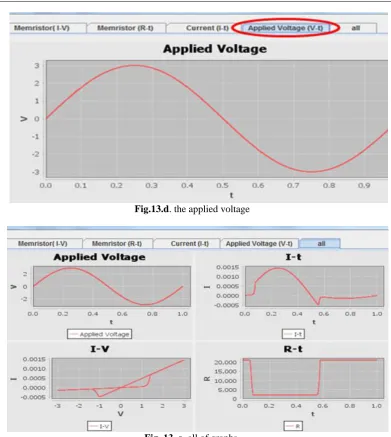
MemrSim has several differences compared to XbarSim; it enables the undergraduate students to study the memristor and its characteristics without studying its applications, XbarSim display window for memristor model configuration which has a variety of resistance parameters as shown in Fig.5. These parameters can be difficult to understand the level of the student has no knowledge of the behavior of memristor; on the other hand, MemrSim makes all these parameters fixed and enables students to change Vth and - Vth directly without changing the values of these parameters. In this work, we focus on the basic characteristics of input wave that happens by display the shape of chosen input wave with its characteristics on label, as shown in Fig.10. MemrSim shows the symbol of memristor, its equivalent circuit and its structure. MemrSim enables the user to study the memristor behavior by three parametric relationships (I vs t), (R vs t) and (V vs t), from which the I-V characteristics of the memristor is deduced. Fig.14 plots these four relationships.
( (1)
Design An Educational Simulation
Tool (Memrsim) Using JAVA For Introducing HP-Memristor…
The user has the ability to determine the left threshold voltage (Vth) and the right threshold voltage (-Vth). MemrSim differ from XbarSim; XbarSim contains the resistance parameter options, but MemrSim doesn’t have that option so the memristance values of doped & undoped regions don’t change because all parameters are fixed. The upper panel on the left of this window enables changing the left threshold voltage (-Vth) and the right threshold voltage (Vth) as shown in Fig.6.
Fig.6. Right Vth field & Left Vth field
The lower Panel on the left of this window enables:
1- Changing of the type of the applied voltage (sine wave, triangular wave, rectangular wave and fixed applied voltage) as shown in Fig.7.
Fig.7. the input wave types.
2- Changing of the applied voltage characteristics (amplitude, duration, frequency) as shown in Fig.8.
Fig.8. the parameters for changing the applied voltage characteristics
Fig.9: panel for displaying the chosen applied voltage shape.
4- Changing the simulation step dt as shown in Fig.10.
Fig.10: step simulation field
5- Running the simulation by pressing on the Start button as shown in Fig.11.
Fig.11: Start button.
Fig.13.a. the current-voltage characteristics (I-V)
Fig.13.b. the resistance-time (R-t)
Fig.13.d. the applied voltage
Fig. 13. e. all of graphs.
Fig.14.b. another question of the hundred questions
II.
QUESTIONNAIRE CONTENTS & RESULTS:
The questionnaireThe questionnaire is divided into two parts, the first part inquiries about the simulation tool (MemrSim), and the second part inquiries about the test, the questionnaire contained the following inquiries:
1. Simulation tool displays memristor structure clearly. 2. The information that appears in graphs is shown clearly.
3. Simulation tool describes the behavior of memristor when all kinds of input signal correctly. 4. There is no ambiguity in any of the parts that is displayed by the simulation tool window. 5. The Simulation tool is well and acceptable in terms of its elements and colors coordinate. 6. Test questions are worded well.
7. Test questions deal with all aspects of the simulation tool. 8. Test questions are suitable for students those are research sample.
REFERENCES
[1]. Chua, L., “Memristor-the Missing Circuit Element,” IEEE Transaction on Circuit Theory, pp. 507–519, 1971. [2]. Strukov, D. B., “The Missing Memristor Found,” In Nature, Vol. 453, pp. 80–83, 2008.
[3]. Niu, D., “Impact of Process Variations on Emerging Memristor,” In Design Automation Conference (DAC), pp. 877–882, 2010. [4]. Chua, L. and Kang, S. M., “Memristive Devices and Systems,” Proceedings of the IEEE, Vol. 64, No. 2, pp. 209 – 223, 1976. [5]. Vourkas, I. and Sirakoulis, G. Ch., “A Novel Design and Modeling Paradigm for Memristor-based Crossbar Circuits,” IEEE Trans.
Nanotechnol., Vol. 11, No. 6, pp. 1151-1159, 2012.
[6]. Pickett, M. D.; Strukov, D. B.; Borghetti, J. L.; Yang, J. J. ; Snider, G. S.; Stewart, D. R. and Williams, R. S. “Switching Dynamics in Titanium Dioxide Memristive Devices,” Journal of Applied Physics, Vol. 106, pp. 1-6, 2009.
[7]. Budhathoki, R.K.; Sah, M.P.; Adhikari, S.P.; Hyongsuk Kim and Chua, L. “Composite Behavior of Multiple Memristor Circuits,” IEEE Transactions on Circuits and Systems I: Regular paper, Vol. 60, No.10, 2013.
[8]. Ho, Y.; Huang, G. M. and Li., P. “Nonvolatile Memristor Memory: Device Characteristics and Design Implications,” In International Conference on Computer-Aided Design, pp. 485–490, 2009.
[9]. Elshamy, M.; Mostafa, H. and Said, M. S. “Design Considerations/Insights for Memristor-based Memory Arrays,” International Conference on Engineering and Technology (ICET), 1-6, 2014.
[10]. Elshamy, M.; Mostafa, H. & Said, M. S. “New Non-destructive Read/Write Circuit for Memristor-based Memories,” International Conference on Engineering and Technology (ICET), 1-5, 2014.
[11]. Williams, R. S., “How We Found the Missing Memristor,” Spectrum IEEE, Vol. 45, pp. 28-35, 2008.
[12]. Yang, J. J.; Picket, M. D.; Li, X. M.; Ohlberg, D. A. A.; Stewart, D. R. and Williams, R. S., “Memristive Switching Mechanism for Metal/Oxide/Metal Nanodevices,” Nature Nanotechnology, Vol. 3, pp. 429-433, 2008.
[13].Ventra, M. Di; Pershin, Y. and Chua, L. “Circuit Elements with Memory: Memristors, Memcapacitors, and Meminductors,” Proceedings of the IEEE, vol. 97, No. 10, pp. 1717 –1724, 2009.
[14].Vourkas, I.; Stathis, D. and Sirakoulis, G. C. “XbarSim: An Educational Simulation Tool for Memristive Crossbar-based Circuits,” IEEE International Symposium on Circuits and Systems (ISCAS), pp. 1798-1801, 2015.