VOLUME 10 | ISSUE 2 | 2015 | 583
The evolution of motor creativity during primary
education
AIDA DOMÍNGUEZ † 1 , M. PINO DÍAZ-PEREIRA, AURORA MARTÍNEZ-VIDAL
Department of Special Subject Teaching, Area of Physical Education and Sports, University of Vigo, Spain
ABSTRACT
Dominguez, D., Diaz Pereira, P.M., & Martinez-Vidal, A. (2015). The Evolution of Motor Creativity during Primary Education. A review. J. Hum. Sport Exerc., 10(2), pp.583-591. A number of researchers have verified the possibility of enhancing motor creativity through specific physical education programmes. Nevertheless,little is known about the developmental pattern or the most critical stages in the acquisition of motor creativity. The broad objective of this study was to determine whether significant changes in motor creativity occur during primary education, and if so, when. A total of 84 Spanish girls and boys were evaluated using tests taken or adapted from the Thinking Creatively in Action and Movement tasks and Bertsch' Tests of Motor Creativity. In general, the results show that motor creativity – especially fluency and flexibility - increase with progression through school, though different aspects of creativity show different trends. In particular, motor fluency increased especially rapidly between ages 6 and 9 years, and the symbolic transformation of objects and movements between ages 8 and 11 years. Key words: MOTOR CREATIVITY, PRIMARY EDUCATION, EVALUATION, DEVELOPMENT
1 Corresponding author. Universidad de Vigo. Facultad de Ciencias de la Educación. Campus Universitario As Lagoas s/n.
32004. Ourense. E-mail: [email protected]
Submitted for publication September 2015 Accepted for publication December 2015
JOURNAL OF HUMAN SPORT & EXERCISEISSN 1988-5202
© Faculty of Education. University of Alicante
584 | 2015 | ISSUE 2 | VOLUME 10 © 2015 University of Alicante
INTRODUCTION
Most studies of creativity have focused on cognitive, verbal or figural activity; references to the development of motor creativity have been few (Lubart & Georgsdottir, 2004; Maker, Jo, & Muammar, 2008; Runco & Charles, 1997). Although a number of studies have verified the possibility of enhancing motor creativity through specific physical education programmes (see, e.g., Bournelli, 1998; Bournelli & Mountakis, 2008; Chatoupis, 2012; Martínez & Díaz, 2006), very little is known about the development of an individual's ability to respond in a divergent, original or flexible manner to motor challenges such as those arising in sports and games. Knowledge of the developmental course of creative motor skills would allow inference of causes and determining factors, information that would be an invaluable aid for planning creative work (Runco & Charles, 1997).
With regard to creativity in general, researchers appear to agree that creative skills increase as psychosocial development progresses, although their findings present a complex panorama offering no hard-and-fast conclusions.
The first studies in the field were carried out in the 1960s by Torrance using his Test of Creative Thinking (Torrance, 1966), which concerns verbal and figural creativity. He found that creative development is not an uninterrupted uniform progression, but exhibits both periods of rapid progress (around age 12 years) and periods of reversal (around ages 5 and 9 years) (Torrance, 1963, 1966, 1968). The “fourth-grade slump” at age 9 years is in fact widely acknowledged as a developmental milestone by researchers working in numerous countries and cultures (Pérez, 2009; Torrance, 1966; Urban, 1991), and acceptance of there being peaks and slumps in the development of creativity has for many years influenced both research and educational practice in this field. Nevertheless, over the past decade or so several authors who reviewed the most representative studies observed serious inconsistencies due, inter alia, to differences in viewpoint (integrative creativity versus divergent thinking), differences in evaluation instruments, differences among study groups, and differences in the behavioural domains that were analysed (in most cases verbal or figural); see, e.g., Bournelli, Makri & Mylonas (2009), Lubart & Georgsdottir (2004), Maker, Jo, & Muammar (2008), Runco & Charles (1997) and Scibinetti, Tocci & Pesce (2011).
VOLUME 10 | ISSUE 2 | 2015 | 585 marked between ages 7 and 8 years, largely due to fluency and originality scores, while the salient feature of imagination scores was a tendency to remain unaltered between the ages of 4 and 5 years. However, as well as being limited to 3-8–year-olds, this study failed to evaluate motor flexibility (ability to switch from one category of movement to another), an aspect of motor creativity that is not taken into account by the TCAM.
Another important study on motor creativity was carried out by Cleland and Gallahue (1993) using their Divergent Movement Ability test (DMA), which measures the quantity and quality of motor creativity as the fluency and flexibility of so-called “divergent movement”. One of the main difficulties in the evaluation of motor flexibility, the establishment of an appropriate taxonomy of movement categories, was tackled by these authors by defining a category change as a change in one of the basic parameters defining the structure of a motor skill (location, rhythm, spatial relationships, force, etc.). In their study of 40 children aged 4- 8 years, they observed significant increments in both fluency and flexibility (Cleland & Gallahue, 1993). Zachopoulou, Makri and Pollatou (2009) recently reported the existence of close correlation between TCAM and DMA scores.
In Spain, Cenizo (2005) constructed and validated a test in which three movement- prompting questions (“What can you do with a hoop?”, “What can you do with a newspaper?”, and “What can you do with a gym bench?”) elicit information on five measures of motor creativity: fluency, flexibility, originality, redefinition, and quality. The results of a study of 200 primary school children aged 6-12 years confirmed that on all facets of motor creativity the scores of 11-12–year-olds are generally higher than those of 6-7–year-olds (Cenizo, 2005).
In spite of their points of agreement, the studies sketched above leave many questions unanswered. The scant available empirical data are insufficient to establish conclusively the developmental course of motor creativity, especially in older children of 9-12 years of age. Nor are they sufficient to determine for sure whether the various facets of creativity develop in parallel or exhibit separate developmental patterns.
The work described here was designed to determine whether there are significant changes in corporal and manipulative motor creativity during primary education (ages 6-12 years), with separate consideration of fluency, flexibility, originality and imagination.
METHODS
Participants
The participants were 84 children in a state-run primary school in Galicia (NW Spain), where, as in the rest of Spain, primary education (ages 6-12 years) is divided into Level 1 (grades 1 and 2, ages 6-8 years), Level 2 (grades 3 and 4, ages 8-10 years) and Level 3 (grades 5 and 6, ages 10-12 years). The sample comprised 13 boys and 10 girls from Level 1 (5 boys and 8 girls from grade 1, 8 boys and 2 girls from grade 2), 19 boys and 9 girls from Level 2 (8 boys and 2 girls from grade 3, 11 boys and 7 girls from grade 4) and 19 boys and 14 girls from Level 3 (8 boys and 4 girls from grade 5, 11 boys and 10 girls from grade 6). Overall mean age was 9.3 years.
Materials
586 | 2015 | ISSUE 2 | VOLUME 10 © 2015 University of Alicante
Locomotion task.—How many ways can you move? This is the first of the TCAM tasks, and evaluates ability to move from one point to another, 6 m away, in different ways (as many as possible in 2 minutes). Manipulation task.—What can you do with a hoop? This is one of Bertsch' Tests of Motor Creativity, and evaluates creativity in the manipulation of a hoop in different ways. Time allowed: 2 minutes.
Symbolism task.—What else can you do with a plastic gym rod? Plastic gym rods are familiar objects in physical education classes. This is an adapted version of the third TCAM task (“What else can you do with a plastic cup?”), and evaluates capacity for redefinition and for finding new uses or functions for an object. All responses are acceptable so long as they exploit some property of the rod. Time allowed: 2 minutes.
Imagination Task.—Can you move like [a fish | a tree in the wind | a rabbit | someone driving a car | someone pushing an elephant]? This is another of the TCAM tasks, and evaluates capacity to imagine, empathize with, fantasize about, express and adopt unusual roles.
Scoring
The child's performances on the locomotion, manipulation and symbolism tasks were each scored for fluency, flexibility and originality, as follows.
Fluency.—The number of distinct responses. Total fluency was calculated as the sum of the participant's fluency scores in the locomotion, manipulation and symbolism tasks.
Flexibility.—The number of categories of response produced. In the locomotiontask , eight categories were considered (walking, running, jumping, crawling on all fours, slithering, backward movements, whirling, and combinations of these seven); in the manipulation task, thirteen (making the hoop revolve on some part of one's body, spinning it like a coin, rolling it, throwing and catching it, throwing it without catching it, rocking it, balancing it, dragging it, stepping through it, giving it to someone else, stepping over it, bouncing it, and combinations of these twelve); and in the symbolism task, fourteen (actions relating the rod to animals, sports, transport, toys, music, fantasy, everyday actions, school, home, cleaning or fighting; using it as a walking stick; using it as a bar; and others). Total flexibility was calculated as the sum of the participant's flexibility scores in the locomotion, manipulation and symbolism tasks.
Originality.—Responses were awarded an originality score of 0 if they had been given by three or more of the 84 participants, 1 if given by just two, and 2 if given by a single participant. Total originality was calculated as the sum of the participant's originality scores in the locomotion, manipulation and symbolism tasks.
For each of the five objects of imitation proposed in the imagination task (fish, tree, rabbit, driver, elephant-pusher), the participant scored 1 if he or she failed to move or acted inappropriately, 2 if an unsuccessful attempt at imitation was made, 3 if the movement made vaguely resembled the movement required, 4 if the movement made was clearly appropriate, and 5 if the movement made was unmistakably accurate and/or was used to act out a storyline.
VOLUME 10 | ISSUE 2 | 2015 | 587 Procedure
The tasks were performed by each participant in a multiple-use hall in the absence of other children. All were administered and scored by the same specifically trained evaluator. The tasks were presented to the children in a way that motivated their performance and, as in the application of the TCAM, the children were repeatedly encouraged to perform the tasks as well as possible. All task performances were videotaped for subsequent analysis.
RESULTS
The scores of each level on each creativity measure having failed the corresponding Kolmogorov-Smirnov test for normality, cross-level comparisons were carried out using Kruskal-Wallis tests followed, when appropriate, by Mann-Whitney U tests to identify the pairs of levels that differed. All analyses were performed using SPSS 17.0.
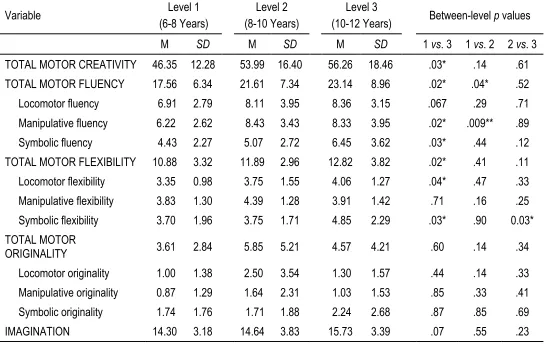
In general, (Table 1) task scores increased with level; in particular, the total motor creativity score was 46.35 for Level 1, 53.99 for Level 2, and 56.26 for Level 3 (Table 1).Level 1 had the lowest mean values of all measures except symbolic originality, for which Level 2 scored marginally lower. However, the difference between these two levels was only statistically significant for total motor fluency and manipulative fluency, and even the difference between Levels 1 and 3 was non-significant for imagination, all the originality measures, locomotor fluency and manipulative flexibility. Similarly, the difference between Levels 2 and 3 was only statistically significant for symbolic flexibility, and although Level 3 scored higher on imagination and on most fluency and flexibility measures, it scored lower than Level 2 on all originality measures except symbolic originality.
DISCUSSION
The observed increase in total motor creativity with educational level is in keeping with the findings of Torrance (1981) for 3 - 8-year-olds, Cleland & Gallahue (1993) for 4 - 8-year-olds, and Cenizo (2005) for 6 - 12-year-olds. This increase appears not to be limited to any particular age period within the 6-year span covered by the study, since Level 2 differed significantly from neither Level 1 nor Level 3 in regard to this variable.
588 | 2015 | ISSUE 2 | VOLUME 10 © 2015 University of Alicante Table 1. Motor creativity criterion scores at each level of schooling (means M and standard deviations SD), and
Mann-Whitney U test p values.
Variable Level 1
(6-8 Years)
Level 2 (8-10 Years)
Level 3
(10-12 Years) Between-level p values M SD M SD M SD 1 vs. 3 1 vs. 2 2 vs. 3 TOTAL MOTOR CREATIVITY 46.35 12.28 53.99 16.40 56.26 18.46 .03* .14 .61 TOTAL MOTOR FLUENCY 17.56 6.34 21.61 7.34 23.14 8.96 .02* .04* .52 Locomotor fluency 6.91 2.79 8.11 3.95 8.36 3.15 .067 .29 .71 Manipulative fluency 6.22 2.62 8.43 3.43 8.33 3.95 .02* .009** .89 Symbolic fluency 4.43 2.27 5.07 2.72 6.45 3.62 .03* .44 .12 TOTAL MOTOR FLEXIBILITY 10.88 3.32 11.89 2.96 12.82 3.82 .02* .41 .11 Locomotor flexibility 3.35 0.98 3.75 1.55 4.06 1.27 .04* .47 .33 Manipulative flexibility 3.83 1.30 4.39 1.28 3.91 1.42 .71 .16 .25 Symbolic flexibility 3.70 1.96 3.75 1.71 4.85 2.29 .03* .90 0.03* TOTAL MOTOR
VOLUME 10 | ISSUE 2 | 2015 | 589 The behaviour of total fluency, which increased very little between Levels 2 and 3, appears to corroborate the existence of what authors such as Torrance (1968) and Hargreaves (1982) have called "the fourth-grade slump". Similarly, the marked increase between Levels 1 and 2 is in keeping with the reports of significant advances between ages 7 and 8 years (Torrance, 1981; Cleland & Gallahue, 1993). However, while this pattern of between-level differences was evident for locomotor fluency and manipulative fluency (though the differences were only statistically significant for the latter, which was on average slightly lower in Level 3 than Level 2), symbolic fluency exhibited the contrary pattern, the significant difference between Levels 1 and 3 being due largely to an increase between Levels 2 and 3 that, while not in itself statistically significant, was twice as large as the increase between Levels 1 and 2.The absence of any increase in manipulative fluency between Levels 2 and 3 may possibly be linked to the progress of motor coordination. It is well documented that coordination improves markedly between ages 7 and 9 years (Winter, 1986; Weineck, 1998), a period frequently referred to as the "golden age" for the acquisition of basic or even more specific motor skills, but thereafter tends to remain constant or regresses, especially in the absence of training (Beraldo & Polleti, 1991).
Like total fluency, total flexibility increased significantly between Levels 1 and 3, but at a fairly steady rate that was insufficient to make the differences with respect to Level 2 statistically significant. This pattern may be interpreted as in keeping with the more qualitative nature of flexibility (Bertsch, 1983), changes in which involve changes in the perception and analysis of the spatial and temporal properties of movements, and hence in intellectual development, a relatively gradual process. This was the pattern exhibited by locomotor flexibility. However, manipulative and symbolic flexibility behaved somewhat similarly to manipulative and symbolic fluency, respectively: like manipulative fluency, manipulative flexibility peaked in Level 2, though in this case the subsequent fall was more marked and none of the between-level differences were statistically significant; while symbolic flexibility, like symbolic fluency, underwent a significant increase between Levels 1 and 3 that was largely - in this case almost exclusively - due to the period between Level 2 and Level 3. These coincidences suggest that while manipulative flexibility, like manipulative fluency, depends largely on the progress of coordination, the perception of new ways of using a gym rod requires cognitive tools such as analogy or transformation, which develop most rapidly following commencement of the formal operational stage.
None of the originality scores differed significantly between any pair of educational levels. However, all except symbolic originality exhibited a (non-significant) peak in Level 2, in keeping with the findings of Cenizo (2005). In the case of the manipulation task, this is the same behaviour as was shown by flexibility, and similar to that of fluency, suggesting, once more, dependence on the development of coordination. At the same time, it is perhaps relevant that Level 2 coincides with initiation in formal sports and the consequent emphasis on the perfection of specific motor skills, possibly at the expense of originality. Symbolic originality, like symbolic fluency and symbolic flexibility, rose markedly between Levels 2 and 3 (although in this case the difference was not statistically significant), whereas the average Level 1 and Level 2 scores were very similar. Once again, this suggests later development of motor creativity in tasks requiring the use of the cognitive tools that support fantasy and the conceptual transformation of one object into another.
590 | 2015 | ISSUE 2 | VOLUME 10 © 2015 University of Alicante fostered in Spanish schools, in which physical education has traditionally been oriented towards activities designed to improve health or towards formal sports.
CONCLUSIONS
On the whole, motor creativity appears to increase between the ages of 6 and 12 years. However, different aspects or measures of creativity exhibit different developmental patterns. Overall motor fluency (the number of different solutions found in a task) increases most markedly between Level 1 (6-8 years) and Level 2 (8-10 years), while overall flexibility (the number of different types of solution) increases more steadily, and originality and imagination show no statistically significant changes. In addition to these trends, creativity scores also depend on the kind of task performed. In a manipulation task ("What can you do with a hoop?"), fluency, flexibility and originality tend to peak in Level 2, while in a symbolism task ("What else can you do with a gym rod?") they all rise very little before Level 2 and markedly thereafter, as does imagination (capacity for representation: "Can you move like a ...?"). It may be relevant that this improvement in symbolic and imaginative performance coincides with the commencement of the formal operational stage.
DEDICATION
M.P.D. and A.M. dedicate their part in this paper to the memory of A.D., who died while it was in preparation.
REFERENCES
1. Beraldo, S., & Polleti, C. (1991). Preparación Física Total [Total physical preparation]. Barcelona: Editorial Hispano Europea.
2. Bertsch, J. (1983). La Créativité Motrice. Son évaluation et son optimisation dans la pédagogie des situations motrices à l’école [Motor creativity, its evaluation and optimization in the teaching of motor situations in schools]. Unpublished doctoral. Dissertation. Paris: INSEP.
3. Bournelli, P. (1998). The development of motor creativity in elementary school children through a specific physical education program. Journal of Biology of Exercise, 3, pp.68-82.
4. Bournelli, P., Makri, A., & Mylonas, K. (2009). Motor Creativity and Self-Concept. Creativity Research Journal, 21(1), pp.104-110.
5. Bournelli, P., & Mountakis,C. (2008). The development of motor creativity in elementary school children and its retention. Creativity Research Journal, 20(1), pp.72-80.
6. Cenizo, J.M. (2005). Implicaciones de los recursos materiales de Educación Física en el desarrollo de la Creatividad Motriz [Implications of the material resources of Physical Education for the development of Motor Creativity]. Unpublished doctoral dissertation, Univer. Seville, Spain.
7. Cleland, F.E., & Gallahue, D.L. (1993). Young children´s divergent movement ability. Perceptual and Motor Skills, 77, pp.535-544.
8. Chatoupis, C. (2012). Young children's divergent movement ability: a study revisited. Early Child Development and Care, 183(1), pp.92-108.
9. Hargreaves, D.J. (1982). The development of ideational fluency: some normative data. British Journal of Educational Psychology, 52, pp.109-12.
VOLUME 10 | ISSUE 2 | 2015 | 591 11. Maker, C.J., Jo, S., & Muammar O.M. (2008). Development of creativity: The influence of varying
levels of implementation of the DISCOVER curriculum model, a non traditional pedagogical approach. Learning and Individual Differences, 18(4), pp.402-417.
12. Martínez, A., & Díaz, M.P. (2006). Eficacia de un programa de intervención para la mejora de la creatividad motriz en un grupo de discapacitados psíquicos [Effectiveness of an intervention programme to improve motor creativity in a group of mentally disabled persons]. Apunts Educación Física y Deportes, 84, pp.11-19.
13. Pérez, P.M. (2009). Researching, measuring and teaching creativity and innovation: a strategy for the future. In E. Villalba (Ed.), Measuring Creativity. Proceedings of the conference “Can creativity be measured”. Luxembourg: Publications Office of the European Union.
14. Runco, M.A., & Charles, R.E. (1997). Developmental trends in creative potential and creative performance. In M. A. Runco (Ed.), The Creativity Research Handbook (Vol. 1) New York: Hampton Press. pp.115-152.
15. Scibinetti, P., Tocci, N., & Pesce, C. (2011). Motor Creativity and Creative Thinking in Children: The Diverging Role of Inhibition. Creativity Research Journal, 23(2), pp.262-272.
16. Torrance, E.P. (1963). Education and the creative potential. Minneapolis: University of Minnesota Press.
17. Torrance, E.P. (1966). The Torrance Test of Creative Thinking (1st ed.). Bensenville, Illinois: Scholastic Testing Service, Inc.
18. Torrance, E.P. (1968). A longitudinal examination of the fourth-grade slump in creativity. Gifted Child Quartely, 12, pp.195-199.
19. Torrance, E.P. (1981). Norms-technical manual:Thinking creatively in action and movement, Torrance test of creative thinking. Bensenville, Illinois: Scholastic Testing Service, Inc.
20. Urban, K.K. (1991). On the development of creativity in children. Creativity Research Journal, 4(2), pp.177-191.
21. Weineck, J. (1998). Entrenamiento Óptimo [Optimal training]. Barcelona: Editorial Hispano Europea.
22. Winter, R. (1986). Las fases sensibles. Orientaciones generales, nociones y datos prácticos sobre las fases sensibles [The critical phases. General orientation, notions and practical data concerning the critical phases]. Revista Stadium, 115, pp.13-20.