S Y S T E M A T I C R E V I E W
Open Access
Are multifaceted interventions more effective
than single-component interventions in changing
health-care professionals
’
behaviours? An overview
of systematic reviews
Janet E Squires
1,2*, Katrina Sullivan
2, Martin P Eccles
3, Julia Worswick
4and Jeremy M Grimshaw
2,5Abstract
Background:
One of the greatest challenges in healthcare is how to best translate research evidence into clinical
practice, which includes how to change health-care professionals
’
behaviours. A commonly held view is that
multifaceted interventions are more effective than single-component interventions. The purpose of this study
was to conduct an overview of systematic reviews to evaluate the effectiveness of multifaceted interventions in
comparison to single-component interventions in changing health-care professionals
’
behaviour in clinical settings.
Methods:
The
Rx for Change
database, which consists of quality-appraised systematic reviews of interventions to
change health-care professional behaviour, was used to identify systematic reviews for the overview. Dual,
independent screening and data extraction was conducted. Included reviews used three different approaches
(of varying methodological robustness) to evaluate the effectiveness of multifaceted interventions: (1) effect
size/dose-response statistical analyses, (2) direct (non-statistical) comparisons of multifaceted to single interventions
and (3) indirect comparisons of multifaceted to single interventions.
Results:
Twenty-five reviews were included in the overview. Three reviews provided effect size/dose-response statistical
analyses of the effectiveness of multifaceted interventions; no statistical evidence of a relationship between the number
of intervention components and the effect size was found. Eight reviews reported direct (non-statistical) comparisons
of multifaceted to single-component interventions; four of these reviews found multifaceted interventions to be
generally effective compared to single interventions, while the remaining four reviews found that multifaceted
interventions had either mixed effects or were generally ineffective compared to single interventions. Twenty-three
reviews indirectly compared the effectiveness of multifaceted to single interventions; nine of which also reported either
a statistical (dose-response) analysis (N
= 2) or a non-statistical direct comparison (N
= 7). The majority (N
= 15) of reviews
reporting indirect comparisons of multifaceted to single interventions showed similar effectiveness for multifaceted and
single interventions when compared to controls. Of the remaining eight reviews, six found single interventions to be
generally effective while multifaceted had mixed effectiveness.
Conclusion:
This overview of systematic reviews offers no compelling evidence that multifaceted interventions are
more effective than single-component interventions.
* Correspondence:[email protected]
1
School of Nursing, University of Ottawa, Ottawa, Canada
2Clinical Epidemiology Program, Ottawa Hospital Research Institute, Centre
for Practice-Changing Research (CPCR), 501 Smyth Road, Room 1282, Box 711, Ottawa, Ontario K1H 8L6, Canada
Full list of author information is available at the end of the article
Implementation Science
© 2014 Squires et al.; licensee BioMed Central Ltd. This is an Open Access article distributed under the terms of the Creative Commons Attribution License (http://creativecommons.org/licenses/by/4.0), which permits unrestricted use, distribution, and reproduction in any medium, provided the original work is properly credited. The Creative Commons Public Domain Dedication waiver (http://creativecommons.org/publicdomain/zero/1.0/) applies to the data made available in this article, unless otherwise stated.
Background
One of the greatest challenges for health-care systems
globally is how to best translate research evidence into
clinical practice, which includes how to change
health-care professionals
’
behaviours to reflect the best
evidence. A commonly held view is that multifaceted
interventions (i.e. an intervention with two or more
com-ponents) are more effective than single-component
inter-ventions [1]. On the surface, the rationale for this widely
held belief is compelling; it is well documented that
there are multiple barriers at different levels to
chan-ging health-care professionals
’
behaviours [2,3]. In
the-ory, multifaceted interventions that target several of
these barriers simultaneously should be more effective
than single-component interventions that address just
one of the many barriers to a behaviour. Yet, despite
this face validity, evidence as to whether multifaceted
interventions are truly more effective remains
uncer-tain. Multifaceted interventions, by their nature,
re-quire more resources (costs) and are inherently more
complex to deliver and sustain [4]. It is therefore
critical to determine whether the additional resources
and effort required for multifaceted interventions
lead to better behavioural outcomes for health-care
professionals.
Existing evidence on the effectiveness of multifaceted
interventions is limited and conflicting. Early
system-atic reviews by Davis et al. [5] (on the effectiveness of
continuing medical education) and Wensing and Grol
[6] (on the effectiveness of multifaceted and single
interventions in primary care) argue that multifaceted
interventions are more effective than single-component
interventions. However, the methods used in these studies
are unclear, and there are common methodological
is-sues in the primary studies included in the reviews
such as unit of analysis errors. Additionally, synthesis
in the reviews was through vote counting which
comprises a weak form of indirect evidence for the
effectiveness of multifaceted interventions [5,6]. More
recent systematic reviews [7,8] that used robust
statis-tical tests to investigate this topic are in opposition to
these early findings. Grimshaw et al. [7] was the first
review team to use robust statistical methods to
ex-plore the effectiveness of multifaceted interventions in
changing health-care professionals
’
behaviours; they
concluded that multifaceted are not necessarily more
effective than single-component interventions.
In summary, evidence of the effectiveness of multifaceted
interventions in changing health-care professionals
’
behav-iours to reflect best practice is uncertain. The purpose of
this study was to conduct an overview of systematic reviews
to evaluate the effectiveness of multifaceted interventions
in comparison to single-component interventions in
chan-ging health-care professionals
’
behaviour in clinical settings.
Methods
Design
The design of this study was an overview of systematic
reviews. Overviews have become increasingly popular in
recent years [9]. This may be because they have potential
advantages over systematic reviews. For example, one
limitation of systematic reviews that can be overcome by
doing an overview is that the overviews allow one to
compare data on different interventions or conditions,
providing a broader summary of the current information
available [10,11]. Second, overviews can compare the
findings of several reviews and determine reasons for
conflicting reviews, allowing users to base their decisions
on the most current, reliable and suitable data for their
context [10,12]. For these reasons, and because we were
interested in broadly evaluating the effectiveness of
multi-faceted interventions in comparison to single-component
interventions, an overview of systematic reviews was the
preferred design for this study.
Data source
The data source for this overview was the
Rx for Change
database (www.rxforchange.ca). This database contains
quality-appraised and summarized systematic reviews on
the effectiveness of (1) interventions for improving
pre-scribing by health-care professionals and medicines use
by consumers and (2) professional interventions that
im-pact the delivery of care. The
Rx for Change
database is
populated using systematic methods. It is regularly
up-dated using sensitive searches of MEDLINE, EMBASE,
DARE and
The Cochrane Library
[13-15]. All reviews
eligible for inclusion in the database are screened and
assessed for methodological quality by two individuals
on the Rx for Change team (a quality assessment is
per-formed by one reviewer, with a second reviewer verifying
the assessment). Methodological quality is assessed using
AMSTAR, an 11-item valid and reliable measurement
tool to assess methodological quality of systematic
re-views [16].
Inclusion criteria
Included reviews in this overview were required to
expli-citly report a comparison of the effectiveness of
multifa-ceted to single-component interventions to change the
behaviour of health-care professionals. A health-care
professional was defined as a person who by education,
training, certification or licensure is qualified to and is
engaged in providing health care. Multifaceted
interven-tions were defined using the Cochrane Effective Practice
and Organisation of Care Group definition of
‘
any
inter-vention including two or more components
’
[17].
Be-haviour change refers to a change that reflects research
evidence. Examples of such behaviour changes could be
prescribing behaviours (e.g. reducing the number of
Squireset al. Implementation Science2014,9:152 Page 2 of 22
prescriptions written for antibiotics), use of guidelines
and improving hand hygiene. The actual behaviours will
vary across individual systematic reviews. Included
re-views were restricted to those rated as moderate or high
methodological quality (i.e. AMSTAR rating of 4 or
higher and thus summarized in the
Rx for Change
database). This decision was based on our and others
experiences that it is difficult to draw meaningful
con-clusions based on data from low-quality reviews [13,14].
A minimum of three primary studies per review
com-paring multifaceted to single interventions (for direct
comparisons) or comparing multifaceted interventions
to a control and single interventions to a control (for
in-direct comparisons) was also required; this is consistent
with a recent review [18] that examined the extent to
which social cognitive theories explain health-care
pro-fessionals
’
intention to adopt a clinical behaviour. If a
review was updated, only the latest version of the review
was included. Systematic reviews that were published in
more than one source were treated as linked reviews
and only the most comprehensive paper was included.
No reviews were excluded based on the type of
health-care professional, the targeted behaviour (the outcome),
study designs of the primary studies or publication date.
Selection of studies and data extraction
Dual, independent screening and data extraction was
conducted. Screening involved assessing the full-text
articles of all moderate- and high-quality reviews that
targeted health-care professionals in the
Rx for Change
database published on or before May 1, 2013. This
in-cluded all reviews summarized in Rx for Change up to
and including the April 2013 update (which included
re-views published before April 2012) and rere-views
identi-fied in the
Rx for Change
database as published between
April 2013 and May 2013 but not yet summarized in the
database. For included reviews, data was extracted on
the following characteristics: year of publication, focus of
the review, setting, population, number of primary
stud-ies, primary study designs, interventions, comparisons,
outcomes and all findings related to the effectiveness of
multifaceted compared to single-component
interven-tions. Disagreements in both screening and data
extrac-tion were resolved by consensus and consultaextrac-tion with a
third overview author when necessary.
Data synthesis
Included reviews used three different approaches (of
vary-ing methodological robustness) to evaluate the
effective-ness of multifaceted interventions. Some reviews reported
more than one analytic approach; where multiple
ap-proaches were reported, all apap-proaches were extracted and
a sensitivity analysis conducted to see if overall
conclu-sions differed when these reviews were limited to just their
most robust analysis. The three analytic approaches
re-ported, starting with the most robust, are as follows: (1)
ef-fect size/dose-response statistical analyses, (2) direct
comparisons (non-statistical) of the effectiveness of
multi-faceted compared to single interventions and (3) indirect
comparisons of the effectiveness of multifaceted compared
to single interventions (by comparing multifaceted
inter-ventions to controls vs. single interinter-ventions to controls). A
dose-response analysis examines whether there is a
rela-tionship between the effectiveness (the response) and the
number of intervention components (the dose);
effect-iveness is reported statistically, frequently using the
Kruskal-Wallis statistical test which assesses for
differ-ences between groups (e.g. between effectiveness of
in-terventions with one component, two components,
three components, etc.). Effectiveness in the reviews
that reported non-statistical direct and indirect
com-parisons of multifaceted to single-component
interven-tions was determined by vote counting. In line with a
recent previous overview [14], and to increase the
robust-ness of this analysis, reviews were categorized before vote
counting as follows: (1) generally effective (if more than
two thirds of its primary studies demonstrated positive
ef-fects), (2) mixed effects (if one third to two thirds of its
primary studies demonstrated positive effects) and (3)
generally ineffective (if fewer than one third of its primary
studies demonstrated positive effects). This step was not
taken in the previous overviews [5,6] on the effectiveness
of multifaceted interventions that relied on vote counting.
Further discussion on the strengths and limitations of this
phase of our analysis can be found in the discussion of this
manuscript.
Sensitivity analyses
Two sensitivity analyses were conducted. First, for
re-views that reported greater than one analytic approach
to examine the effectiveness of multifaceted to
single-component interventions, we assessed whether including
both analyses changed our overall conclusions. To carry
out this analysis, we removed the review from the least
robust approach reported (e.g. removed from indirect
comparisons if a direct comparison was also reported)
and compared these findings to those with all reviews
included. The second sensitivity analysis we conducted
was to assess the impact of overlapping reviews.
Accord-ing to Pieper and colleagues [10], all overviews of
re-views should be assessed for overlaps of primary studies,
and this overlap should be reported even when it is
small and unlikely to impact the conclusion of the
overview. To assess overlap, we used the Wilson and
Limpsey [19] approach which is comprised of two steps.
First, we identified
‘
significant
’
overlap (defined as 25%
or more primary studies in common between two
re-views [19]) for all possible pairs of rere-views for each
Squireset al. Implementation Science2014,9:152 Page 3 of 22
analytic approach (i.e. for each of the effect
size/dose-response statistical analyses, direct (non-statistical)
com-parisons and indirect comcom-parisons). Second, where
significant overlap was found, we removed the smaller
review and compared conclusions for the analytic
ap-proach with and without the overlapping review [19].
According to Wilson and Limpsey [19], this should
re-sult in minimal overlap (less than 10% overall).
Results
Description of reviews
Of the 233 reviews included in the
Rx for Change
data-base that examined professional behaviour change
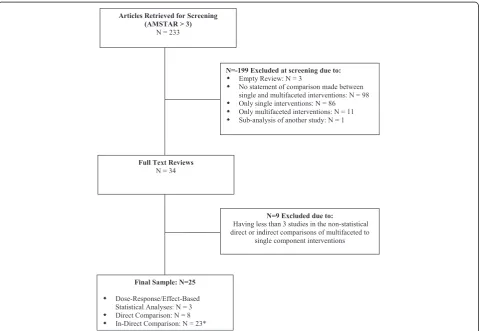
inter-ventions, 25 met our inclusion criteria (Figure 1). The
25 reviews were published between 1994 and 2012. The
number of primary studies per review ranged from 10 to
235, with a median of 28. Most reviews included
mul-tiple populations (physicians, nurses, pharmacists, etc.)
(N
= 24, 96%) and multiple settings (hospitals, clinics,
primary care, etc.) (N
= 23, 92%). The methodological
quality of the included reviews was variable; the median
AMSTAR score was 7 (range 4 to 9) (Figure 2). Several
AMSTAR items were rarely reported in the included
re-views: (1) providing an a priori design (working from a
protocol), (2) disclosing conflict of interest for individual
studies and (3) assessing publication bias.
Sensitivity analyses
For the first sensitivity analysis, we examined whether
allowing individual reviews to be considered in greater
than one analytic approach changed our overall
conclu-sions. Nine studies reported two analytic approaches; two
reviews reported effect size/dose-response statistical
ana-lyses and indirect comparisons [7,8], and seven reviews
[6,20-25] reported both direct and indirect comparisons.
Overall, our conclusions regarding the effectiveness of
multifaceted compared to single interventions did not
change when these reviews were removed from the less
robust (indirect comparisons) category. Therefore, the
nine were retained in both analytic categories. For the
sec-ond sensitivity analysis, we used the approach by Wilson
and Limpsey [19] to explore the effect of overlapping
re-views. However, this made no impact on our findings (see
Additional file 1 for the details of this analysis). Based on
Figure 1Article screening and selection.*Some reviews include more than one level of evidence. Therefore, the cumulative number of reviews is greater than the included number of reviews.N=7 of the reviews reporting indirect comparisons also reported direct comparisons, andN=2 of the reviews reporting indirect comparisons also reported dose-response/effect-based statistical analyses.
Squireset al. Implementation Science2014,9:152 Page 4 of 22
this analysis, all 25 reviews were retained and summarized
in this overview.
Effectiveness of multifaceted interventions
Effect size/dose-response statistical analyses (N = 3)
Three reviews provided effect size statistical analyses of
the effectiveness of multifaceted interventions [7,8,26]
(Table 1). In two of these reviews, a dose-response
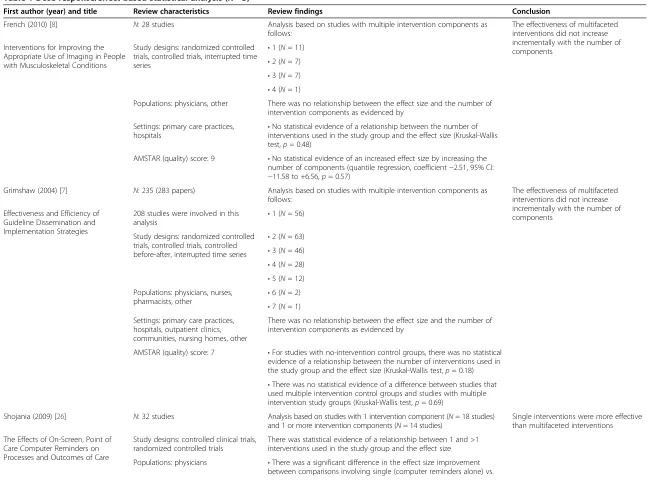
ana-lysis was conducted. Grimshaw et al. [7], in a review of
the effectiveness of guideline dissemination and
imple-mentation interventions, constructed box plots to
visu-ally inspect the spread of effect sizes for increasing the
number of intervention components. Visually, there
ap-peared to be no relationship between the effect size and
the number of components in the interventions. There
was also no statistical evidence of a relationship between
the number of intervention components used in the
study group and the effect size (Kruskal-Wallis test,
p
=0.18 for studies with no intervention control groups
and
p
=0.69 for studies with multiple intervention
con-trol groups) [7]. French et al. [8], in a review of the
ef-fectiveness of interventions to improve the appropriate
use of imaging in people with musculoskeletal
condi-tions, conducted a similar analysis. They also found that
the box plots displayed no visible relationship between
the effect size and the number of intervention
compo-nents. Further, there was also no statistical evidence of a
relationship between the number of intervention
com-ponents used in the study group and the effect size
(Kruskal-Wallis test,
p
value =0.48) or an increased
effect size by increasing the number of intervention
components (quantile regression coefficient =
−
2.51,
95% CI
−
11.58 to 6.56,
p
=0.57) [8]. Shojania et al. [26]
assessed the effectiveness of computer reminders on
processes and outcomes of care and compared effect
sizes for single-component interventions (N
= 18) to
multifaceted interventions (N
= 14). In their review,
Shojania et al. [26] found evidence of a statistical
relation-ship (Kruskal-Wallis test,
p
=0.04); the median
improve-ment for single vs. usual care (with no co-interventions)
was 5.7%, and for multifaceted vs. single interventions, it
was only 1.9% [26].
Direct comparisons (N = 8)
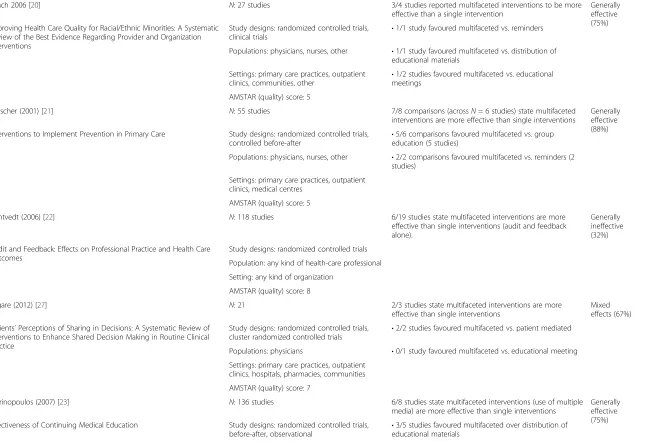
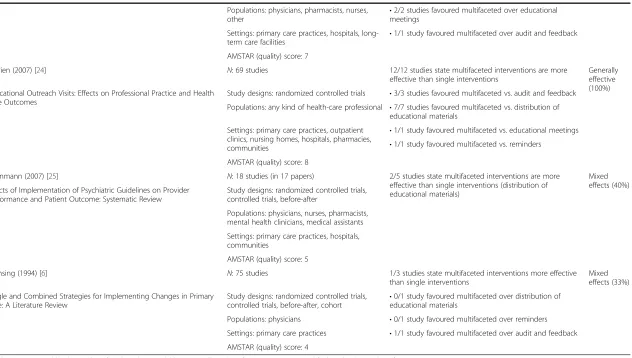
Eight reviews reported direct (but non-statistical)
compar-isons of multifaceted to single-component interventions
(Table 2). Half of these reviews found multifaceted
inter-ventions to be generally effective in comparison to
single-component interventions (N
= 4/8) [20,21,23,24], while the
remaining reviews found either mixed effectiveness for
multifaceted interventions (N
= 3/8) [6,25,27] or that
multi-faceted interventions were generally ineffective (N
= 1/8)
[22] compared to single-component interventions.
Indirect comparisons (N = 23)
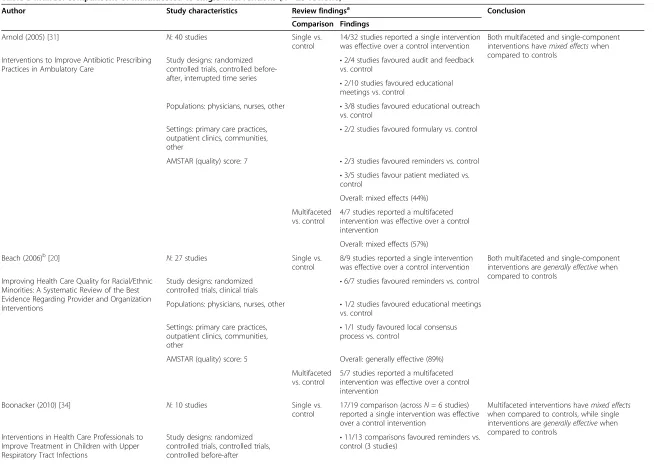
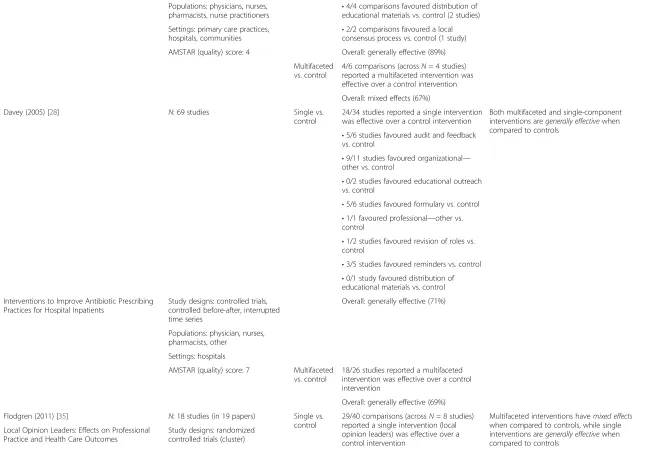
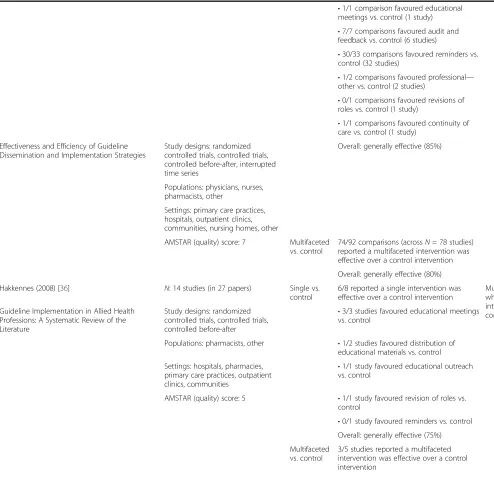
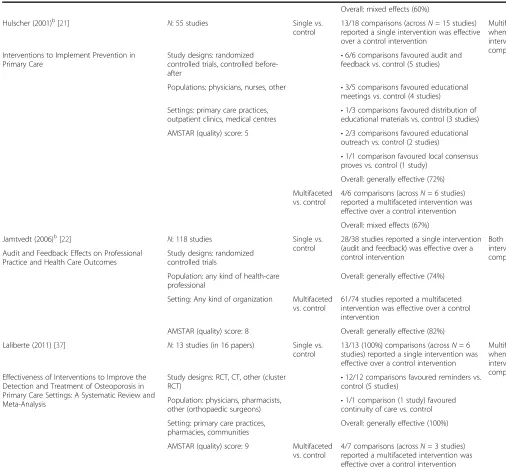
Twenty-three reviews reported indirect comparisons of
multifaceted to single-component interventions by
com-paring multifaceted interventions to controls and single
interventions to controls (Table 3). Nine of these reviews
also reported either a statistical (dose-response) analysis
of the effectiveness of multifaceted interventions (N
= 2)
[7,8] or a non-statistical direct comparison of multifaceted
to single-component interventions (N
= 7) [6,20-25]. A
majority (N
= 15/23) of the reviews that reported an
indir-ect comparison reported effindir-ectiveness data that could be
categorized at the same level (i.e. as generally effective,
mixed effects or generally ineffective) for both single
component vs. control and for multifaceted vs. control
comparisons:
9/23 reviews reported findings consistent with both
single-component and multifaceted interventions
being generally effective compared to controls
[
7
,
8
,
18
,
20
,
22
,
24
,
28
-
30
]
Figure 2AMSTAR scores of included reviews (N=25).
Squireset al. Implementation Science2014,9:152 Page 5 of 22
Table 1 Dose-response/effect-based statistical analysis (
N
=3)
First author (year) and title Review characteristics Review findings Conclusion
French (2010) [8] N: 28 studies Analysis based on studies with multiple intervention components as
follows:
The effectiveness of multifaceted interventions did not increase incrementally with the number of components
Interventions for Improving the Appropriate Use of Imaging in People with Musculoskeletal Conditions
Study designs: randomized controlled trials, controlled trials, interrupted time series
•1 (N= 11) •2 (N= 7) •3 (N= 7) •4 (N= 1)
Populations: physicians, other There was no relationship between the effect size and the number of
intervention components as evidenced by
Settings: primary care practices,
hospitals •
No statistical evidence of a relationship between the number of interventions used in the study group and the effect size (Kruskal-Wallis test,p= 0.48)
AMSTAR (quality) score: 9 •No statistical evidence of an increased effect size by increasing the
number of components (quantile regression, coefficient−2.51, 95% CI: −11.58 to +6.56,p= 0.57)
Grimshaw (2004) [7] N: 235 (283 papers) Analysis based on studies with multiple intervention components as
follows:
The effectiveness of multifaceted interventions did not increase incrementally with the number of components
Effectiveness and Efficiency of Guideline Dissemination and Implementation Strategies
208 studies were involved in this analysis
•1 (N= 56)
Study designs: randomized controlled trials, controlled trials, controlled before-after, interrupted time series
•2 (N= 63) •3 (N= 46) •4 (N= 28) •5 (N= 12) Populations: physicians, nurses,
pharmacists, other •
6 (N= 2) •7 (N= 1) Settings: primary care practices,
hospitals, outpatient clinics, communities, nursing homes, other
There was no relationship between the effect size and the number of intervention components as evidenced by
AMSTAR (quality) score: 7 •For studies with no-intervention control groups, there was no statistical
evidence of a relationship between the number of interventions used in the study group and the effect size (Kruskal-Wallis test,p= 0.18) •There was no statistical evidence of a difference between studies that used multiple intervention control groups and studies with multiple intervention study groups (Kruskal-Wallis test,p= 0.69)
Shojania (2009) [26] N: 32 studies Analysis based on studies with 1 intervention component (N= 18 studies)
and 1 or more intervention components (N= 14 studies)
Single interventions were more effective than multifaceted interventions
The Effects of On-Screen, Point of Care Computer Reminders on Processes and Outcomes of Care
Study designs: controlled clinical trials, randomized controlled trials
There was statistical evidence of a relationship between 1 and >1 interventions used in the study group and the effect size
Populations: physicians •There was a significant difference in the effect size improvement
between comparisons involving single (computer reminders alone) vs.
Squires
et
al.
Implementa
tion
Science
2014,
9
:152
Page
6
o
f
2
2
http://ww
w.implemen
tationscien
ce.com/cont
ent/9/1/15
Table 1 Dose-response/effect-based statistical analysis (
N
=3)
(Continued)
usual care (no co-interventions) and multifaceted (computer reminders plus one or more co-interventions) vs. the other interventions alone (Kruskal-Wallis test,p= 0.04)
Settings: ambulatory care settings, hospitals, nursing homes, outpatient clinics, primary care practices
•The median improvement for single vs. usual care was 5.7% (IQR: 2.0% to 24.0%)
AMSTAR (quality) score: 8 •The median improvement for multifaceted interventions (that is
computer reminders plus additional interventions versus those additional interventions alone) was 1.9% (IQR: 0.0% to 6.2%)
Squires
et
al.
Implementa
tion
Science
2014,
9
:152
Page
7
o
f
2
2
http://ww
w.implemen
tationscien
ce.com/cont
ent/9/1/15
Table 2 Direct comparisons (
N
=8 reviews)
First author (year) and title Review characteristics Review findingsa Conclusionb
Beach 2006 [20] N: 27 studies 3/4 studies reported multifaceted interventions to be more
effective than a single intervention
Generally effective (75%) Improving Health Care Quality for Racial/Ethnic Minorities: A Systematic
Review of the Best Evidence Regarding Provider and Organization Interventions
Study designs: randomized controlled trials,
clinical trials •
1/1 study favoured multifaceted vs. reminders
Populations: physicians, nurses, other •1/1 study favoured multifaceted vs. distribution of
educational materials
Settings: primary care practices, outpatient
clinics, communities, other •
1/2 studies favoured multifaceted vs. educational meetings
AMSTAR (quality) score: 5
Hulscher (2001) [21] N: 55 studies 7/8 comparisons (acrossN= 6 studies) state multifaceted
interventions are more effective than single interventions
Generally effective (88%)
Interventions to Implement Prevention in Primary Care Study designs: randomized controlled trials,
controlled before-after •
5/6 comparisons favoured multifaceted vs. group education (5 studies)
Populations: physicians, nurses, other •2/2 comparisons favoured multifaceted vs. reminders (2
studies)
Settings: primary care practices, outpatient clinics, medical centres
AMSTAR (quality) score: 5
Jamtvedt (2006) [22] N: 118 studies 6/19 studies state multifaceted interventions are more
effective than single interventions (audit and feedback alone).
Generally ineffective (32%)
Audit and Feedback: Effects on Professional Practice and Health Care Outcomes
Study designs: randomized controlled trials
Population: any kind of health-care professional
Setting: any kind of organization
AMSTAR (quality) score: 8
Legare (2012) [27] N: 21 2/3 studies state multifaceted interventions are more
effective than single interventions
Mixed effects (67%)
Patients’Perceptions of Sharing in Decisions: A Systematic Review of Interventions to Enhance Shared Decision Making in Routine Clinical Practice
Study designs: randomized controlled trials,
cluster randomized controlled trials •
2/2 studies favoured multifaceted vs. patient mediated
Populations: physicians •0/1 study favoured multifaceted vs. educational meeting
Settings: primary care practices, outpatient clinics, hospitals, pharmacies, communities
AMSTAR (quality) score: 7
Marinopoulos (2007) [23] N: 136 studies 6/8 studies state multifaceted interventions (use of multiple
media) are more effective than single interventions
Generally effective (75%)
Effectiveness of Continuing Medical Education Study designs: randomized controlled trials,
before-after, observational
•3/5 studies favoured multifaceted over distribution of educational materials
Squires
et
al.
Implementa
tion
Science
2014,
9
:152
Page
8
o
f
2
2
http://ww
w.implemen
tationscien
ce.com/cont
ent/9/1/15
Table 2 Direct comparisons (
N
=8 reviews)
(Continued)
Populations: physicians, pharmacists, nurses, other
•2/2 studies favoured multifaceted over educational meetings
Settings: primary care practices, hospitals,
long-term care facilities •
1/1 study favoured multifaceted over audit and feedback
AMSTAR (quality) score: 7
O’Brien (2007) [24] N: 69 studies 12/12 studies state multifaceted interventions are more
effective than single interventions
Generally effective (100%) Educational Outreach Visits: Effects on Professional Practice and Health
Care Outcomes
Study designs: randomized controlled trials •3/3 studies favoured multifaceted vs. audit and feedback
Populations: any kind of health-care professional •7/7 studies favoured multifaceted vs. distribution of educational materials
Settings: primary care practices, outpatient clinics, nursing homes, hospitals, pharmacies, communities
•1/1 study favoured multifaceted vs. educational meetings •1/1 study favoured multifaceted vs. reminders
AMSTAR (quality) score: 8
Weinmann (2007) [25] N: 18 studies (in 17 papers) 2/5 studies state multifaceted interventions are more
effective than single interventions (distribution of educational materials)
Mixed effects (40%) Effects of Implementation of Psychiatric Guidelines on Provider
Performance and Patient Outcome: Systematic Review
Study designs: randomized controlled trials, controlled trials, before-after
Populations: physicians, nurses, pharmacists, mental health clinicians, medical assistants
Settings: primary care practices, hospitals, communities
AMSTAR (quality) score: 5
Wensing (1994) [6] N: 75 studies 1/3 studies state multifaceted interventions more effective
than single interventions
Mixed effects (33%)
Single and Combined Strategies for Implementing Changes in Primary Care: A Literature Review
Study designs: randomized controlled trials, controlled trials, before-after, cohort
•0/1 study favoured multifaceted over distribution of educational materials
Populations: physicians •0/1 study favoured multifaceted over reminders
Settings: primary care practices •1/1 study favoured multifaceted over audit and feedback
AMSTAR (quality) score: 4
a
Findings are reported by the number of studies where available. In a small number of cases, reviews reported findings by the number of comparisons.
b
Effectiveness of multifaceted compared to single-component interventions.
Squires
et
al.
Implementa
tion
Science
2014,
9
:152
Page
9
o
f
2
2
http://ww
w.implemen
tationscien
ce.com/cont
ent/9/1/15
Table 3 Indirect comparisons of multifaceted to single interventions (
N
=23 reviews)
Author Study characteristics Review findingsa Conclusion
Comparison Findings
Arnold (2005) [31] N: 40 studies Single vs.
control
14/32 studies reported a single intervention was effective over a control intervention
Both multifaceted and single-component interventions havemixed effectswhen compared to controls
Interventions to Improve Antibiotic Prescribing Practices in Ambulatory Care
Study designs: randomized controlled trials, controlled before-after, interrupted time series
•2/4 studies favoured audit and feedback vs. control
•2/10 studies favoured educational meetings vs. control
Populations: physicians, nurses, other •3/8 studies favoured educational outreach
vs. control
Settings: primary care practices, outpatient clinics, communities, other
•2/2 studies favoured formulary vs. control
AMSTAR (quality) score: 7 •2/3 studies favoured reminders vs. control
•3/5 studies favour patient mediated vs. control
Overall: mixed effects (44%)
Multifaceted vs. control
4/7 studies reported a multifaceted intervention was effective over a control intervention
Overall: mixed effects (57%)
Beach (2006)b[20] N: 27 studies Single vs.
control
8/9 studies reported a single intervention was effective over a control intervention
Both multifaceted and single-component interventions aregenerally effectivewhen compared to controls
Improving Health Care Quality for Racial/Ethnic Minorities: A Systematic Review of the Best Evidence Regarding Provider and Organization Interventions
Study designs: randomized controlled trials, clinical trials
•6/7 studies favoured reminders vs. control
Populations: physicians, nurses, other •1/2 studies favoured educational meetings
vs. control
Settings: primary care practices, outpatient clinics, communities, other
•1/1 study favoured local consensus process vs. control
AMSTAR (quality) score: 5 Overall: generally effective (89%)
Multifaceted vs. control
5/7 studies reported a multifaceted intervention was effective over a control intervention
Boonacker (2010) [34] N: 10 studies Single vs.
control
17/19 comparison (acrossN= 6 studies) reported a single intervention was effective over a control intervention
Multifaceted interventions havemixed effects
when compared to controls, while single interventions aregenerally effectivewhen compared to controls
Interventions in Health Care Professionals to Improve Treatment in Children with Upper Respiratory Tract Infections
Study designs: randomized controlled trials, controlled trials, controlled before-after
•11/13 comparisons favoured reminders vs. control (3 studies)
Squires
et
al.
Implementa
tion
Science
2014,
9
:152
Page
10
of
22
http://ww
w.implemen
tationscien
ce.com/cont
ent/9/1/15
Table 3 Indirect comparisons of multifaceted to single interventions (
N
=23 reviews)
(Continued)
Populations: physicians, nurses, pharmacists, nurse practitioners
•4/4 comparisons favoured distribution of educational materials vs. control (2 studies)
Settings: primary care practices,
hospitals, communities •
2/2 comparisons favoured a local consensus process vs. control (1 study)
AMSTAR (quality) score: 4 Overall: generally effective (89%)
Multifaceted vs. control
4/6 comparisons (acrossN= 4 studies) reported a multifaceted intervention was effective over a control intervention
Overall: mixed effects (67%)
Davey (2005) [28] N: 69 studies Single vs.
control
24/34 studies reported a single intervention was effective over a control intervention
Both multifaceted and single-component interventions aregenerally effectivewhen compared to controls
•5/6 studies favoured audit and feedback vs. control
•9/11 studies favoured organizational— other vs. control
•0/2 studies favoured educational outreach vs. control
•5/6 studies favoured formulary vs. control •1/1 favoured professional—other vs. control
•1/2 studies favoured revision of roles vs. control
•3/5 studies favoured reminders vs. control •0/1 study favoured distribution of educational materials vs. control
Interventions to Improve Antibiotic Prescribing Practices for Hospital Inpatients
Study designs: controlled trials, controlled before-after, interrupted time series
Overall: generally effective (71%)
Populations: physician, nurses, pharmacists, other
Settings: hospitals
AMSTAR (quality) score: 7 Multifaceted
vs. control
18/26 studies reported a multifaceted intervention was effective over a control intervention
Overall: generally effective (69%)
Flodgren (2011) [35] N: 18 studies (in 19 papers) Single vs.
control
29/40 comparisons (acrossN= 8 studies) reported a single intervention (local opinion leaders) was effective over a control intervention
Multifaceted interventions havemixed effects
when compared to controls, while single interventions aregenerally effectivewhen compared to controls
Local Opinion Leaders: Effects on Professional Practice and Health Care Outcomes
Study designs: randomized controlled trials (cluster)
Squires
et
al.
Implementa
tion
Science
2014,
9
:152
Page
11
of
22
http://ww
w.implemen
tationscien
ce.com/cont
ent/9/1/15
Table 3 Indirect comparisons of multifaceted to single interventions (
N
=23 reviews)
(Continued)
Populations: physicians, nurses, other Overall: generally effective (73%)
Settings: primary care practices, hospitals, communities, other
AMSTAR (quality) score: 9 Multifaceted
vs. control
16/26 comparisons (acrossN= 6 studies) reported a multifaceted intervention was effective over a control intervention
Overall: mixed effects (62%)
Forsetlund (2009) [18] N: 81 studies Single vs.
control
12/16 studies reported a single intervention was effective over a control intervention
Both multifaceted and single-component interventions aregenerally effectivewhen compared to controls
Continuing Education Meetings and Workshops: Effects on Professional Practice and Health Care Outcomes
Study designs: randomized controlled trials
•12/15 studies favoured educational meetings vs. control
Populations: nurses, pharmacists,
physicians, psychiatrists, other •
0/1 study favoured changes in structure/ facilities/equipment vs. control
Settings: communities, hospitals, outpatient clinics, pharmacists, primary care practices
Overall: generally effective (75%)
AMSTAR (quality) score: 8 Multifaceted
vs. control
10/14 studies reported a multifaceted intervention was effective over a control intervention
Overall: generally effective (71%)
French (2010)c[8] N: 28 studies Single vs.
control
12/14 comparisons (acrossN= 11 studies) reported a single intervention was effective over a control intervention
Both multifaceted and single-component interventions aregenerally effectivewhen compared to controls
Interventions for Improving the Appropriate Use of Imaging in People with Musculoskeletal Conditions
Study designs: randomized controlled trials, controlled trials, interrupted time series
•5/6 comparisons favoured distribution of educational materials vs. control (5 studies) •5/5 comparisons favoured reminders vs. control (4 studies)
Populations: physicians, other •2/3 comparisons favoured audit and
feedback vs. control (2 studies)
Overall: generally effective (86%)
Settings: primary care practices, hospitals
Multifaceted vs. control
14/20 comparisons (acrossN= 16 studies) reported a multifaceted intervention was effective over a control intervention
AMSTAR (quality) score: 9 Overall: generally effective (70%)
Grimshaw (2004)c[7] N: 235 studies (in 283 papers) Single vs.
control
53/62 comparisons (acrossN= 60 studies) reported a single intervention was effective over a control intervention
Both multifaceted and single-component interventions aregenerally effectivewhen compared to controls
•7/11 comparisons favoured distribution of educational materials vs. control
(11 studies)
Squires
et
al.
Implementa
tion
Science
2014,
9
:152
Page
12
of
22
http://ww
w.implemen
tationscien
ce.com/cont
ent/9/1/15
Table 3 Indirect comparisons of multifaceted to single interventions (
N
=23 reviews)
(Continued)
•1/1 comparison favoured educational meetings vs. control (1 study) •7/7 comparisons favoured audit and feedback vs. control (6 studies)
•30/33 comparisons favoured reminders vs. control (32 studies)
•1/2 comparisons favoured professional— other vs. control (2 studies)
•0/1 comparisons favoured revisions of roles vs. control (1 study)
•1/1 comparisons favoured continuity of care vs. control (1 study)
Overall: generally effective (85%) Effectiveness and Efficiency of Guideline
Dissemination and Implementation Strategies
Study designs: randomized controlled trials, controlled trials, controlled before-after, interrupted time series
Populations: physicians, nurses, pharmacists, other
Settings: primary care practices, hospitals, outpatient clinics, communities, nursing homes, other
AMSTAR (quality) score: 7 Multifaceted
vs. control
74/92 comparisons (acrossN= 78 studies) reported a multifaceted intervention was effective over a control intervention
Overall: generally effective (80%)
Hakkennes (2008) [36] N: 14 studies (in 27 papers) Single vs.
control
6/8 reported a single intervention was effective over a control intervention
Multifaceted interventions havemixed effects
when compared to controls, while single interventions aregenerally effectivewhen compared to controls
Guideline Implementation in Allied Health Professions: A Systematic Review of the Literature
Study designs: randomized controlled trials, controlled trials, controlled before-after
•3/3 studies favoured educational meetings vs. control
Populations: pharmacists, other •1/2 studies favoured distribution of
educational materials vs. control
Settings: hospitals, pharmacies, primary care practices, outpatient clinics, communities
•1/1 study favoured educational outreach vs. control
AMSTAR (quality) score: 5 •1/1 study favoured revision of roles vs.
control
•0/1 study favoured reminders vs. control Overall: generally effective (75%)
Multifaceted vs. control
3/5 studies reported a multifaceted intervention was effective over a control intervention
Squires
et
al.
Implementa
tion
Science
2014,
9
:152
Page
13
of
22
http://ww
w.implemen
tationscien
ce.com/cont
ent/9/1/15
Table 3 Indirect comparisons of multifaceted to single interventions (
N
=23 reviews)
(Continued)
Overall: mixed effects (60%)
Hulscher (2001)b[21] N: 55 studies Single vs.
control
13/18 comparisons (acrossN= 15 studies) reported a single intervention was effective over a control intervention
Multifaceted interventions havemixed effects
when compared to controls, while single interventions aregenerally effectivewhen compared to controls
Interventions to Implement Prevention in Primary Care
Study designs: randomized controlled trials, controlled before-after
•6/6 comparisons favoured audit and feedback vs. control (5 studies)
Populations: physicians, nurses, other •3/5 comparisons favoured educational
meetings vs. control (4 studies)
Settings: primary care practices,
outpatient clinics, medical centres •
1/3 comparisons favoured distribution of educational materials vs. control (3 studies)
AMSTAR (quality) score: 5 •2/3 comparisons favoured educational
outreach vs. control (2 studies)
•1/1 comparison favoured local consensus proves vs. control (1 study)
Overall: generally effective (72%)
Multifaceted vs. control
4/6 comparisons (acrossN= 6 studies) reported a multifaceted intervention was effective over a control intervention
Overall: mixed effects (67%)
Jamtvedt (2006)b[22] N: 118 studies Single vs.
control
28/38 studies reported a single intervention (audit and feedback) was effective over a control intervention
Both multifaceted and single-component interventions aregenerally effectivewhen compared to controls
Audit and Feedback: Effects on Professional Practice and Health Care Outcomes
Study designs: randomized controlled trials
Population: any kind of health-care professional
Overall: generally effective (74%)
Setting: Any kind of organization Multifaceted
vs. control
61/74 studies reported a multifaceted intervention was effective over a control intervention
AMSTAR (quality) score: 8 Overall: generally effective (82%)
Laliberte (2011) [37] N: 13 studies (in 16 papers) Single vs.
control
13/13 (100%) comparisons (acrossN= 6 studies) reported a single intervention was effective over a control intervention
Multifaceted interventions havemixed effects
when compared to controls, while single interventions aregenerally effectivewhen compared to controls
Effectiveness of Interventions to Improve the Detection and Treatment of Osteoporosis in Primary Care Settings: A Systematic Review and Meta-Analysis
Study designs: RCT, CT, other (cluster RCT)
•12/12 comparisons favoured reminders vs. control (5 studies)
Population: physicians, pharmacists,
other (orthopaedic surgeons) •
1/1 comparison (1 study) favoured continuity of care vs. control
Setting: primary care practices, pharmacies, communities
Overall: generally effective (100%)
AMSTAR (quality) score: 9 Multifaceted
vs. control
4/7 comparisons (acrossN= 3 studies) reported a multifaceted intervention was effective over a control intervention
Squires
et
al.
Implementa
tion
Science
2014,
9
:152
Page
14
of
22
http://ww
w.implemen
tationscien
ce.com/cont
ent/9/1/15
Table 3 Indirect comparisons of multifaceted to single interventions (
N
=23 reviews)
(Continued)
Overall: mixed effects (57%)
Lemmens (2009) [38] N: 40 studies Single vs.
control
2/7 studies reported a single intervention was effective over a control intervention
Multifaceted interventions havemixed effectswhen compared to controls, while single interventions aregenerally ineffective
when compared to controls A Systematic Review of Integrated Use of
Disease-Management Interventions in Asthma and COPD
Study designs: randomized controlled trials, controlled before-after
•0/3 studies favoured revision roles— nursing vs. control
Populations: nurses, physicians and
pharmacists •
2/3 studies favoured revision roles— pharmacy vs. control
•0/1 study favoured continuity of care vs. control
Overall: generally ineffective (29%) Settings: communities, hospitals,
nursing homes, outpatient clinics, pharmacies, primary care practices
AMSTAR (quality) score: 8 Multifaceted
vs. control
3/7 studies reported a multifaceted intervention was effective over a control intervention
Overall: mixed effects (43%)
Lloyd-Evans (2011) [29] N: 11 studies Single vs.
control
3/4 comparisons (acrossN= 2 studies) reported a single intervention (educational meetings) was effective over a control intervention
Both multifaceted and single-component interventions aregenerally effectivewhen compared to controls
Initiatives to Shorten Duration of Untreated Psychosis: Systematic Review
Study designs: randomized controlled trials, controlled trials, observational
Overall: generally effective (75%)
Populations: physicians, youth workers, counsellors
Multifaceted vs. control
7/10 comparisons (acrossN= 8 studies) reported a multifaceted intervention was effective over a control intervention
Settings: primary care practices, schools
Overall: generally effective (70%)
AMSTAR (quality) score: 6
Lugtenberg (2009) [32] N: 20 studies (in 30 papers) Single vs.
control
2/4 studies reported a single intervention was effective over a control intervention
Both multifaceted and single-component interventions havemixed effectswhen compared to controls
Effects of Evidence-Based Clinical Practice Guide-lines on Quality of Care: A Systematic Review
Study designs: randomized controlled trials, controlled before-after, interrupted time series
•0/1 study favoured audit and feedback vs. control
•1/1 study favoured distribution of educational materials vs. control Populations: physicians, other
Settings: primary care practices, hospitals
AMSTAR (quality) score: 5 •1/1 study favoured educational meetings
vs. control
•0/1 study favoured educational outreach vs. control
Squires
et
al.
Implementa
tion
Science
2014,
9
:152
Page
15
of
22
http://ww
w.implemen
tationscien
ce.com/cont
ent/9/1/15
Table 3 Indirect comparisons of multifaceted to single interventions (
N
=23 reviews)
(Continued)
Overall: mixed effects (50%)
Multifaceted vs. control
10/18 comparisons(acrossN= 16 studies) reported a multifaceted intervention was effective over a control intervention
Overall: mixed effects (56%)
Marinopoulos (2007)b[23] N: 136 studies Single vs.
control
14/22 studies reported a single intervention was effective over a control intervention
Both multifaceted and single-component interventions havemixed effectswhen compared to controls
Effectiveness of Continuing Medical Education Study designs: randomized controlled trials, before-after, observational
•3/6 studies favoured distribution of educational materials vs. control
Populations: physicians, pharmacists, nurses, other
8/13 studies favoured educational meetings vs. control
Settings: primary care practices, hospitals, long-term care facilities
2/2 studies favoured educational outreach vs. control
AMSTAR (quality) score: 7 •1/1 study favoured audit and feedback vs.
control
Overall: mixed effects (64%)
Multifaceted vs. control
24/39 studies reported a multifaceted intervention was effective over a control intervention
Overall: mixed effects (62%)
Naikoba (2001) [39] N: 21 studies Single vs.
control
6/9 studies reported a single intervention was effective over a control intervention
Multifaceted interventions aregenerally effective
when compared to controls, while single interventions havemixed effectswhen compared to controls
The Effectiveness of Interventions Aimed at Increasing Handwashing in Healthcare Workers -A systematic Review
Study designs: randomized controlled trials, controlled trials, observational
•2/4 studies favoured audit and feedback vs. control
Populations: physicians, nurses, other •2/2 studies favoured reminders vs. control
•1/2 studies favoured educational meetings vs. control
Settings: hospitals, nursing homes •1/1 study favoured distribution of
educational materials vs. control
AMSTAR (quality) score: 4 Overall: mixed effects (67%)
Multifaceted vs. control
6/7 studies reported a multifaceted intervention was effective over a control intervention
Overall: generally effective (86%)
O’Brien (2007)b[24] N: 69 studies Single vs.
control
26/28 studies reported a single intervention (educational outreach) was effective over a control intervention
Both multifaceted and single-component interventions aregenerally effectivewhen compared to controls
Educational Outreach Visits: Effects on Professional Practice and Health Care Outcomes
Study designs: randomized controlled trials
Squires
et
al.
Implementa
tion
Science
2014,
9
:152
Page
16
of
22
http://ww
w.implemen
tationscien
ce.com/cont
ent/9/1/15
Table 3 Indirect comparisons of multifaceted to single interventions (
N
=23 reviews)
(Continued)
Populations: any kind of health-care professional
Overall: generally effective (93%)
Settings: primary care practices, outpatient clinics, nursing homes, hospitals, pharmacies, communities
Multifaceted vs. control
40/45 studies reported a multifaceted intervention was effective over a control intervention
AMSTAR (quality) score: 8 Overall: generally effective (89%)
Robertson (2010) [40] N: 21 studies Single vs.
control
10/11 comparisons (acrossN= 10 studies) reported a single intervention (reminders) was effective over a control intervention
Multifaceted interventions havemixed effects
when compared to controls, while single interventions aregenerally effectivewhen compared to controls
The Impact of Pharmacy Computerised Clinical Decision Support on Prescribing, Clinical and Patient Outcomes: A Systematic Review of the Literature
Study designs: randomized controlled trials, controlled trials, interrupted time series, controlled before-after, cohort
Populations: physicians, nurses, pharmacists, nurse practitioners
Overall: generally effective (91%)
Multifaceted vs. control
3/9 comparisons (acrossN= 8 studies) reported a multifaceted intervention was effective over a control intervention Settings: primary care practices,
outpatient clinics, hospitals, pharmacies, communities
AMSTAR (quality) score: 4 Overall: mixed effects (33%)
Solomon (1998) [33] N: 49 studies Single vs.
control
18/34 studies reported a single intervention was effective over a control intervention
Both multifaceted and single-component interventions havemixed effectswhen compared to controls
Techniques to Improve Physicians’Use of Diagnostic Tests: A New Conceptual Framework
Study designs: randomized controlled trials, controlled trials
•8/15 studies favoured audit and feedback vs. control
Populations: physicians, nurses,
medical and surgical residents •
5/7 studies favoured distribution of educational materials vs. control
Settings: hospitals, outpatient clinics, communities, other
•3/5 studies favoured reminders—general vs. control
AMSTAR (quality) score: 5 •0/1 study favoured reminders—CPOE vs.
control
•0/4 studies favoured educational meetings vs. control
•2/2 studies favoured local consensus process vs. control
Overall: mixed effects (53%)
Multifaceted vs. control
10/18 studies reported a multifaceted intervention was effective over a control intervention
Overall: mixed effects (56%)
Steinman (2006) [30] N: 26 studies Single vs.
control
10/10 studies reported a single intervention was effective over a control intervention
Both multifaceted and single-component interventions aregenerally effectivewhen compared to controls
Squires
et
al.
Implementa
tion
Science
2014,
9
:152
Page
17
of
22
http://ww
w.implemen
tationscien
ce.com/cont
ent/9/1/15
Table 3 Indirect comparisons of multifaceted to single interventions (
N
=23 reviews)
(Continued)
Improving Antibiotic Selection: A Systematic Review and Quantitative Analysis of Quality Improvement Strategies
Study designs: randomized controlled trials, controlled before-after, interrupted time series
•7/7 studies favoured educational outreach vs. control
Populations: not specified •1/1 study favoured educational meetings
vs. control
Settings: primary care practices,
outpatient clinics •
1/1 study favoured audit and feedback vs. control
AMSTAR (quality) score: 5 •1/1 study favoured distribution of
educational materials
Overall: generally effective (100%)
Multifaceted vs. control
21/23 studies reported a multifaceted intervention was effective over a control intervention
Overall: generally effective (91%)
Weinmann (2007)b[25] N: 18 studies (in 17 papers) Single vs.
control
1/4 studies reported a single intervention was effective over a control intervention
Both multifaceted and single-component interventions aregenerally ineffectivewhen compared to controls
Effects of Implementation of Psychiatric Guidelines on Provider Performance and Patient Outcome: Systematic Review
Study designs: randomized controlled trials, controlled trials, before-after
•1/3 favoured education vs. control
Populations: physicians, nurses, pharmacists, mental health clinicians, medical assistants
•0/1 favoured audit and feedback vs. control
Multifaceted vs. control
Overall: generally ineffective (25%)
Settings: primary care practices, hospitals, communities
2/8 studies reported a multifaceted intervention was effective over a control intervention
Overall: generally ineffective (25%) AMSTAR (quality) score: 5
Wensing (1994)b[6] N: 75 studies Single vs.
control
18/30 studies reported a single intervention was effective over a control intervention
Both multifaceted and single-component interventions havemixed effectswhen compared to controls
Single and Combined Strategies for Implementing Changes in Primary Care: A Literature Review
Study designs: randomized controlled trials, controlled trials, before-after, cohort
•1/4 favoured distribution of educational materials vs. control
Populations: physicians •2/3 favoured educational outreach vs.
control
Settings: primary care practices •7/10 favoured audit and feedback vs.
control
AMSTAR (quality) score: 4 •6/8 favoured reminders vs. control
•2/5 favoured educational meetings vs. control
Overall: mixed effects (60%)
Squires
et
al.
Implementa
tion
Science
2014,
9
:152
Page
18
of
22
http://ww
w.implemen
tationscien
ce.com/cont
ent/9/1/15
Table 3 Indirect comparisons of multifaceted to single interventions (
N
=23 reviews)
(Continued)
Multifaceted vs. control
7/16 studies reported a multifaceted intervention was effective over a control intervention
Overall: mixed effects (44%)
a
Findings are reported by the number of studies where available. In a small number of cases, reviews reported findings by the number of comparisons.
b
Also in Table2.
c
Also in Table1.
Squires
et
al.
Implementa
tion
Science
2014,
9
:152
Page
19
of
22
http://ww
w.implemen
tationscien
ce.com/cont
ent/9/1/15
5/23 reviews reported findings consistent with both
single-component and multifaceted interventions
having mixed effectiveness in comparison to controls
[
6
,
23
,
31
-
33
]
1/23 reviews reported findings consistent with both
single-component and multifaceted interventions
being generally ineffective compared to controls [
25
].
Of the remaining eight reviews that conducted an
in-direct comparison of the effectiveness of multifaceted to
single-component interventions, six found single
inter-ventions to be generally effective while multifaceted had
mixed effectiveness [21,34-37,40]. Another review
re-ported that single interventions were generally effective
and multifaceted were of mixed effectiveness [38], while
the final review found single interventions to be of
mixed effectiveness but multifaceted to be generally
ef-fective [39].
Discussion
There has been a gradual increase in the number of
studies examining the effectiveness of multifaceted
inter-ventions to change health-care professionals
’
behaviour
in different clinical settings. The first systematic review
examining this topic was published in 1994 by Wensing
and Grol [6] and included three studies that compared
multifaceted to single-component interventions. Since
that time, several primary studies and systematic reviews
using different methods and approaches to examine the
effectiveness of multifaceted interventions for different
health-care professionals and clinical behaviours in
di-verse clinical settings have been published.
This overview draws on 25 systematic reviews of
moder-ate or strong methodological quality to examine whether
multifaceted interventions are more or less effective than
single-component interventions at improving health-care
professionals
’
behaviours. Three approaches of varying
methodological robustness were used in the included
re-views to evaluate the effectiveness of multifaceted
inter-ventions: (1) effect size/dose-response statistical analyses,
(2) direct comparisons (non-statistical) of the effectiveness
of multifaceted compared to single interventions and (3)
indirect comparisons of the effectiveness of multifaceted
compared to single interventions (by comparing
multifa-ceted interventions to controls vs. single interventions to
controls). The findings of this overview do not support the
commonly held assumption that multifaceted
tions are more effective than single-component
interven-tions at changing health-care professionals
’
behaviours [1].
The statistical evidence from this overview, although from
a small number (N
= 3) of reviews, indicates that
increas-ing the number of intervention components
does not
sig-nificantly improve the effect size [7,8] and that single
interventions compared to usual care may have larger
effects than multifaceted compared to single interventions
[26]. The majority of reviews included in this overview
re-ported direct (but non-statistical) or indirect comparisons
of the effectiveness of multifaceted compared to
single-component interventions. The evidence provided in these
reviews, although less robust than the statistical
effect-based analyses, lends further support to the conclusion
that multifaceted interventions are not necessarily more
effective than single interventions. The direct comparisons
had mixed results with just 4/8 reviews providing evidence
that multifaceted interventions may be more effective than
single interventions. With respect to indirect comparisons,
most reviews found similar effectiveness for multifaceted
and single interventions, and when effectiveness differed,
it mostly favoured single interventions (N
= 6/8, 75%).
Thus, overall, this overview offers no compelling evidence
that multifaceted interventions are more effective than
single-component interventions for changing health-care
professionals
’
behaviours.
This overview attempted to summarize the literature
on the effectiveness of multifaceted interventions in
comparison to single-component interventions to
pro-vide useful information to guide researchers, knowledge
translation implementers and health-care professionals
to more critically consider the design and
implementa-tion of intervenimplementa-tions to change health-care professional
behaviours in different clinical settings so that
effective-ness and efficiency are more appropriately balanced. If
one begins with a barrier and enabler assessment to
changing a specific clinical behaviour, a multifaceted
intervention will often be the logical next step. However,
a single-component intervention or a multifaceted
inter-vention with fewer components might be as or even
more appropriate, either as
‘
the single best bet
’
or as
‘
the
most appropriate off the shelf intervention
’
. We are not
suggesting that multifaceted interventions are not useful,
but rather that a single or less complex multifaceted
intervention that is tailored to overcome the barriers
and enhance the enablers of the behaviour that needs to
be changed may be appropriate.
Strengths and limitations
There are several strengths to this overview. First, it
employed a comprehensive search strategy, as part of a
larger project (Rx for Change) to examine interventions
to change health-care professionals
’
behaviours. This
fa-cilitated the conduct of a broad overview in a shorter
period of time. Second, duplicate screening, data
extrac-tion and quality assessments were conducted. Third, a
validated instrument (AMSTAR) was used to assess the
methodological quality of the included reviews.
Despite the use of rigorous methods, there are also
some limitations to this overview. First, we limited
inclu-sion to reviews published in the
Rx for Change
database.
Squireset al. Implementation Science2014,9:152 Page 20 of 22
This database however is large, robust and populated
using systematic methods and regularly updated using
sensitive searches of MEDLINE, EMBASE, DARE and
The Cochrane Library
[13,14] which limits the likelihood
that we missed high-quality published systematic reviews
on this topic. We did not search for grey literature, and,
as such, this review may not be representative of all
rele-vant work in the field. Second, we did not retrieve data
from the primary studies that comprised the included
reviews; therefore, we were limited by the information
reported by the review authors. However, by focusing on
the results of the systematic reviews rather than each
in-dividual primary study, we were able to obtain a broad
sense of the field. Third, because of the small number of
reviews reporting effect size/dose-response statistical
analyses of effectiveness, we also included non-statistical
assessments of effectiveness to answer our research
question. This necessitated a vote counting approach to
data synthesis for the non-statistical analyses. There are
several weaknesses associated with using vote counting.
For example, this approach to synthesis fails to account
for effect sizes (vote counting gives equal weight to all
associations, regardless of magnitude) and precision of
the estimate from the primary studies (vote counting
gives equal weight to comparisons irrespective of the
sample size). Despite this limitation, our findings using
vote counting support the small number of more robust
statistical effect-based/dose-response statistical analyses
that there is no consistent or compelling evidence that
multifaceted interventions are more effective than
single-component interventions. Finally, and related to the field
overall, is that currently there is no generally accepted
method of categorizing elements of an intervention
—
so, it
is possible that one person
’
s single (composite)
interven-tion is another person
’
s multifaceted intervention.
Future research
This overview indicates several areas for future research.
First, there is a lack of robust systematic statistical
inves-tigation into the effectiveness of multifaceted compared
to single-component interventions. Only three (12%) of
the 25 reviews in this overview reported a statistical
ana-lysis of the topic. While none of these three reviews
sup-ported improved effectiveness with more intervention
components, this is a small number of cases and therefore
effect-based statistical analyses to assess the effectiveness
of multifaceted interventions should be replicated in
fu-ture systematic reviews of behaviour change interventions.
A second area for future inquiry is the assessment of cost
effectiveness of multifaceted compared to less multifaceted
and single interventions. Multifaceted interventions, by
their nature, are likely to be more costly than
single-component interventions. The added expense is frequently
accepted perhaps because of the commonly held belief
that multifaceted interventions are more effective than
single interventions or multifaceted interventions with
fewer components, which is now challenged based on the
findings of this overview. While there are primary studies
that examine intervention cost effectiveness generally,
none of the reviews included in this overview reported
cost effectiveness of multifaceted compared to single
inter-ventions; future systematic reviews of behaviour change
interventions should include a summary of intervention
cost effectiveness. Additionally, a focused systematic
re-view on the cost effectiveness of multifaceted
interven-tions broadly would also be a fruitful avenue for future
inquiry.
Conclusion
This overview of systematic reviews offers no
compel-ling evidence that multifaceted interventions are more
effective than single-component interventions as
com-monly believed.
Importantly, we provide syst