Eeg Signal Preprocessing Using Dwt And
Reco-nustruction By Phase Space Trejectory
Mr.V.Lakshmana Rao, Dr.K.V.Ramana, Dr.P. Krishna Subba Rao
Abstract: In the society most of the cases exclusively in children age group of 0-9 years are suffering from seizures. In many of these cases, there is some family history of seizures. The remaining causes include infections such as meningitis, developmental problems include cerebral palsy, head trau-ma .So the early detection of seizures leads to the speed recovery from the chronical disorders of hutrau-man body. A sudden change in the high frequencies in Electroencephalogram (EEG) indicates that the EEG signal characteristics have changed rapidly. This information can be used to detect seizure-like activity in childrens. Recently, seizures are identified through video-EEG analysis, EEGs are used to visualize and analyze brain activity. While reading EEG signals, redundancy is highly visible in a single channel between different time segments. The electroencephalogram (EEG) signals play promi-nent role in identifying the complexities of brain activities. It provides a monitoring method to record the electrical activity of the brain. One of the general-ly faced problems in EEG recordings is the presence of artifacts that come from sources other than brain and contaminate the acquired signals signifi-cantly. Therefore, Artifact removal involves canceling or correcting the arti- facts without distorting the signal of interest. This is primarily done in two ways: either by filtering and regres- sion or by separating/decomposing the EEG data into other domains. In order to extract the individual EEG sub-bands, a wavelet filter is employed. Wavelet transform has the advantages of time–frequency localization, multirate filtering, and scale-space analysis [2]. The decomposition of the original EEG into its five constituent subbands helps better identification of the dynamical system of EEG signal. Recon-structions of these five components using the inverse wavelet transform approximately correspond to the five physiological EEG subbands delta, theta, alpha, beta, and gamma.
Index Terms: Electroencephalogram (EEG) Signal, Artifacts, Epilepsy, Discrete Wavelet Transformation, Phase Space Reconstruction and preprocessing.
————————————————————
1 INTRODUCTION
Epilepsy
Epilepsy is a group of neurological disorders characterized by epileptic seizures, commonly referred to as fits[14]. Epileptic seizures are episodes that can vary from brief and nearly un-detectable to long periods of vigorous shaking. In epilepsy, seizures tend to recur, and have no immediate underlying cause while seizures that occur due to a specific cause are not deemed to represent epilepsy. The cause of most cases of epilepsy is unknown, although some people develop epilepsy as the result of brain injury, stroke, brain tumor, and drug and alcohol misuse. Genetic mutations are linked to a small pro-portion of the disease. Epileptic seizures are the result of ex-cessive and abnormal cortical nerve cell activity in the brain. The diagnosis typically involves ruling out other conditions that might cause similar symptoms such as syncope. Additionally, it involves determining if any other cause of seizures is present such as alcohol withdrawal or electrolyte problems. This may be done by doing imaging of the brain and blood tests.
Epilepsy can often be confirmed with an electroencephalo-gram (EEG) but a normal test does not rule out the disease. EEG signal is an electric activity of the brain measured by electrodes (channels), which placed on the scalp is a super-position of electric signals which are produced by a synchro-nous activity of numerous neurons.[1] The common procedure adopted by the various research groups on EEG-based bio-metric involves data collection, preprocessing feature extrac-tion, and patternrecognition.[7]. Therefore, Artifact removal which was studied in the recent years is considered as the pre-processing step for EEG based measurements. While do-ing experiments usdo-ing EEG signals, it is found that the signal is mainly contaminated by i) internal artifacts (like muscle movement, eye-blink etc.) and ii) system artifacts (like power supply interference, impedance fluctuations, spurious noise due to Bluetooth connectivity etc.). For most of the applica-tions related to cognitive load and BCI, the EEG signals are analysed using delta (< 4Hz), theta (4-7.5 Hz), alpha (7.5-12.5) and beta (12.5-30 Hz) frequency bands. Among all the internal artifacts, the muscle related movements affects a lot to the gamma frequency band (> 30 Hz) and is easily removed by a low pass filter with cut-off frequency at 30 Hz. However, the eye blink related artifacts (< 7 Hz) fall mostly in delta and partly in theta band [9]. In this paper, a novel approach called the EEG Signal Preprocessing using Wavelet Decomposition followed by the Reconustruction with Phase space Trejectory has been proposed. This paper is organized as follows. Sec-tion describes the IntroducSec-tion to EEG and Artifacts. SecSec-tion provides the Existing artifact removal methods.Section illus-trates the Artifacts removal by Wavelet Decomposition. Sec-tion elaborates the phase space reconstrucSec-tion technique fol-lowed by Conclusion.
2 INTRODUCTION
TO
EEG
AND
ARTIFACTS
2.1 EEG:EEG’s are the observations pertaining to electrical activities from the exteriors of brain which are illustrated as rhythms and transients. A rhythmic activity of EEG can be segregated into
Mr.V.Lakshmana Rao GVP College of Engineering for Women
Visakhapatnam-530048 Andhra Pradesh, India
E-mail:[email protected]
Dr.K.V.Ramana JNTUK College of Engineering JNTUK
Univer-sity Kakinada – 533003 Andhra Pradesh, India
E-mail:[email protected]
Dr.P. Krishna Subba Rao GVP College of Engineering
Visa-khapatnam-530048 Andhra Pradesh,India
INTERNATIONAL JOURNAL OF SCIENTIFIC & TECHNOLOGY RESEARCH VOLUME 9, ISSUE 03, MARCH 2020 ISSN 2277-8616
bands of frequency whereas usual EEG rhythms can be clas-sified as delta, alpha, theta, gamma, and beta waves, where predominantly gamma waves are extensively used in EEG analysis [4].
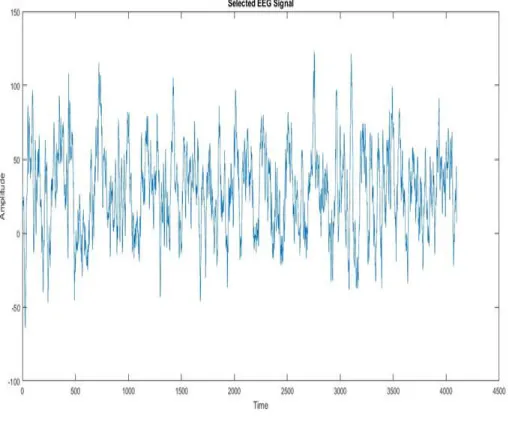
Figure. 2.1 Selected EEG Signal
2.2 Artifacts:
The EEG recordings are tainted by various forms of artifacts which occur from internal and external sources and taint the EEG in both temporal and spectral domains with varying fre-quency band.
2.3 Artifact detection
Inorder to handle artifacts the primary step is to identify them.Arifacts interfere with spectral and temporal domains such that it becomes complex to use simple filtering or straight forward signal processing technique.
2.4 Artifact removal
Before getting straight into artifacts removal it is always bene-ficial to be cautious by artifacts avoidance which could be achieved by following simple measures like instructing the subject to remain still and avoid unnecessary blinks or involun-tary physical movements. Even though this process of artifacts avoidance is not recommended but could help achieve mini-mal artifacts thus minimising data loss and minimising compu-tational complexity.
3
EXISTING
ARIFACTS
REMOVAL
METHODS
There are some of the earlier works that are related to artifacts removal. Some of these existing works have been underlined in the following discussion. EEG signals are very sensitive and susceptible to different types of artifacts. Prior arts suggest using different methods todeal with eye-blink artifacts [7]. Broadly there are two approaches: First one is to detect the eye-blink region and then apply corrections on that particular region only. The second approach is to apply Independent component analysis (ICA) based [8] or adaptive filter based [10] approaches, where the detection of blink region is not required.Some article presents an extensive review of the
ex-from scalp EEG for all potential EEG-based applications and analyses the pros and cons of each method [4]. A method for the analysis of EEG for seizure detection using wavelet-based features has been presented [9] in this draw back is to ad-dress the problem of non-stationary signals should reduce more and the seizure detection problem is basically having to improve for classifications. A number of authors have looked for the presence of nonlin-earity in human EEG signals with varying outcomes. Liley et al. proposed an EEG model to de-scribe the dynamics of neural activ-ity in cortex [11]. Stam ana-lyzed the nonlinear dynamics of EEGand MEG [12]. Many nonlinear features were used to analyzeepilepsy, mental fa-tigue [13]. The existing methods of EEG processing for arti-facts involves artiarti-facts removal techniques which are rudimen-tary, our paper emphasizes the use of wavelet transformation for artifacts removal followed by PFRC for EEG signal reco-nustruction that results in better signal. Further using this technique in classification of EEG signal can also yield better results.
4
ARTIFACTS
REMOVAL
BY
WAVELET
DECOMPOSITION
The EEG signal is preprocessed by Discrete Wavelet Trans-formation (DWT) into sub-bands and purposed spikes-based parameters are extracted from these sub-bands. Wavelet De-composition is a wavelet transform where the discrete-time (sampled) signal is passed through more filters than the dis-crete wavelet transform (DWT). The wavelet is a mathemati-cal oscillating function which lomathemati-calizes a signal in both time and frequency domain [7]. In the DWT, each level is calculated by passing only the previous wavelet approximation coeffi-cients (cAj) through discrete-time low and high pass
quadra-ture mirror filters. However, in the WPD, both the detail (cDj
(in the 1-D case), cHj, cVj, cDj (in the 2-D case)) and
approxi-mation coefficients are decomposed to create the full binary tree. For n levels of decomposition, the WPD produces 2n dif-ferent sets of coefficients (or nodes) as opposed to (3n + 1) sets for the DWT. However, due to the downsampling process the overall number of coefficients is still the same and there is no redundancy. Wavelet remodel uses a variable window size over the length of the signal, that permits the moving ridge to be stretched or compressed counting on the frequency of the signal. This ends up in wonderful feature extraction from non-stationary signals like electroencephalogram signals. during this analysis, the distinct moving ridge remodel (DWT), sup-ported scales and positions, is employed to form the formula computationally terribly economical while not compromising accuracy. The EEG signal is rotten into increasingly finer de-tails by means of multiresolution analysis victimisation com-plementary lowpass and high-pass filters. once a first-level decomposition, 2 sequences representing the high (details) and low (approximations) resolution parts of the signal area unit obtained. The low-resolution parts area unit any rotten into low and high-resolution parts once a second-level decomposi-tion and then on. From the point of view of compression, the standard wavelet transform may not produce the best result, since it is limited to wavelet bases that increase by a power of two towards the low frequencies.
Figure. 4.1 EEG Signal to be Processed
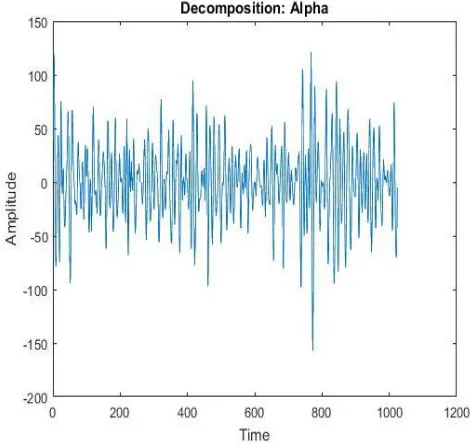
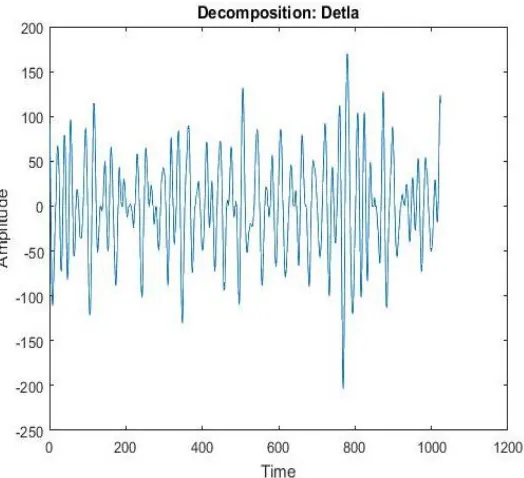
The EEG input vector to the Discrete Wavelet Transformation splits the vector into alpha,beta,gamma,theta and delta signals are shown in Figure. 4.1,4.2.4.3.4.4,4.5,4. respectively. Where Gamma range of values contributing to the eye movement.it is involved with attention, working and long term memo-ries,algemers and epilepsy .
Figure. 4.2 Decomposition: Gamma
Beta ranges of values denotes different part movement of body,these wave play a dominating factor in working state of consciousness.It’s value high durig fast ativities.
Figure. 4.3 Decomposition: Beta
Where the range of Alpha values denotes the calm state varia-tions,The Synchrony and desyncrony in alpha waves has ef-fect on cognitive process.
Figure. 4.4 Decomposition: Alpha
INTERNATIONAL JOURNAL OF SCIENTIFIC & TECHNOLOGY RESEARCH VOLUME 9, ISSUE 03, MARCH 2020 ISSN 2277-8616
Figure. 4.5 Decomposition: Theata
Delta denoting the depth of sleeping levels which are in direct propotion to concentration levels.low values of delta
obse-cured in parieto-occuptal region is an indication for slow activi-ty in children.
Figure. 4.6 Decomposition: Delta
5
PHASE
SPACE
RECONSTRUCTION
A phase space of a dynamical system is a space in which all possible states of a system are represented, with each possi-ble state of the system corresponding toone unique point in the phase space. For mechanical systems, the phase space usually consists of all possible values of position and momen-tum variables. In quanmomen-tum mechanics, the coordinates p and q of phase space normally become hermitian operators in a Hil-bert space. The phase space formulation of quantum mechan-ics, a complete and logically autonomous reformulation of
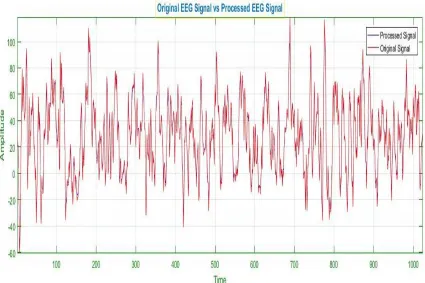
Figure. 5.1 Recounstructed EEG Signal
INTERNATIONAL JOURNAL OF SCIENTIFIC & TECHNOLOGY RESEARCH VOLUME 9, ISSUE 03, MARCH 2020 ISSN 2277-8616
7
CONCLUSION
This paper describes a brief novel technique for artifact re-moval using wavelet decomposition and EEG signal recon-struction via phase face reconrecon-struction techniques. The exten-sive simulation results outperform the existing technique. The extension of this work encompases feature extraction using RQA and followed by the classification with the help of ECOC classifier which provides the clear information about the pa-tient is normal,Ictal or interectal stage.
REFERENCES
[1]. A Data Driven Approach for Resting-state EEG sig-nal Classificition of Schizophrenia with Control Par-ticipants Using Random Matrix Theory
[2]. Classification of EEG Signals using various Dimen-sionality Reduction Techniques
[3]. Feature Extraction and Classification of EEG Signals using Wavelet Transform
[4]. Methods for artifact detection and removal from scalp EEG: A review
[5]. A New Method for Artifact Removing in EEG Signals [6]. A machine learning system for automated
whole-brain seizure detection
[7]. Detection of Epileptic Seizure using Wavelet Trans-formation and Spike based Features Artifact Remov-al from EEG SignRemov-als Recorded using Low Resolution Emotiv Device.
[8]. Hyvarinen, E. Oja, Independent component analysis: algorithms and applications Neural Networks, 13 (2000), pp. 411- 430.
[9]. ThasneemFathima, M. Bedeeuzzaman, Omar FarooqandYusuf U Khan, Wavelet Based Features for Epileptic Seizure Detection.
[10]. Wallstrom, G. L., Kass, R. E., Miller, A., Cohn, J. F., & Fox, N. A. "Automatic correction of ocular arti-facts in the EEG: a comparison of regression-based and component-based methods." International jour-nal of psychophysiology 53.2 (2004): 105-119. [11]. D.T. Liley, P.J. Cadusch, M.P. Dafilis, A spatially
con-tinuous mean field theory ofelectrocortical activity, Computation in Neural Systems 13 (1) (2002) 67– 113.
[12]. C.J. Stam, Nonlinear dynamical analysis of EEG and MEG: review of an emergingfield, Clinical Neuro-physiology 116 (10) (2005) 2266–2301.
[13]. M.C. Casdagli, L.D. Iasemidis, R.S. Savi, R.L. Gil-more, S.N. Roper, J. Chris Sackel-lares, Non-linearity in invasive EEG recordings from patients with temporallobe epilepsy, Electroencephalography and Clinical Neurophysiology 102 (2)(1997) 98–105. [14]. Lasefr, Z., Ayyalasomayajula, S. S. V. N. R., &
El-leithy, K. (2017). An efficient automated technique for epilepsy seizure detection using EEG signals. 2017 IEEE 8th Annual Ubiquitous Computing, Electronics and