O R I G I N A L R E S E A R C H
Selenium Nanoparticles-Embedded Chitosan
Microspheres and Their Effects Upon
Alcohol-Induced Gastric Mucosal Injury in Rats: Rapid
Preparation, Oral Delivery, and Gastroprotective
Potential of Selenium Nanoparticles
This article was published in the following Dove Press journal: International Journal of Nanomedicine
Kaikai Bai1,2,*
Bihong Hong1,2,*
Ran Tan1,2
Jianlin He 1,2
Zhuan Hong1,2
1Third Institute of Oceanography,
Ministry of Natural Resources, Xiamen
361005, Republic of China;2Technical
Innovation Center for Utilization of Marine Biological Resources, Ministry of Natural Resources, Xiamen 361005,
People’s Republic of China
*These authors contributed equally to this work
Background: Selenium (Se) is an indispensable trace element required for animals and human beings, whereas Se-deficiency can accelerate the development of acute gastric injury induced by over-consumption of alcohol. Selenium nanoparticles (SeNPs), as a special Se-supplement with favorable properties and unique bioactivities, are expected to play a passive role in gastroprotection. To the best of our knowledge, the gastroprotective potential of SeNPs is unknown and also, a rapid preparation of orally stable SeNPs available for prospective commercial application in the clinic is needed. Thus, SeNPs-embedded chitosan microspheres (SeNPs-CM) were developed to deliver SeNPs, and their gastroprotective potential was evaluated.
Results: Herein, a rapid, eco-friendly and economic preparation process, composed of synthesis of SeNPs decorated by chitosan (CS), purification of CS-SeNPs by ultra-filtration (UF) and spray-drying of the purified CS-SeNPs, was introduced to prepare SeNPs-CM. The uniformly distributed SeNPs with a nanosize range of 60 nm were loaded into CS-microspheres, and they could be released from the microspheres in gastric conditions. In addition, SeNPs-CM were safer than selenite in terms of Se dose, with a LD50of around
8-fold of that of selenite, and it could efficiently enhance the Se retention in Se-deficient Wistar rats. Furthermore, SeNPs-CM pre-treatment might significantly attenuate the ethanol-induced gastric mucosal damage, based on histological evaluation. It might be partly attributed to the systematic antioxidant activities of SeNPs-CM, reflected by the reduction in lipid peroxidation, the augmentation in antioxidant enzymatic activity as well as decreas-ing aggressive nitric oxides (NO).
Conclusion: SeNPs-CM could be taken into consideration as a prospective Se-supplement for the oral delivery of SeNPs, with prominent gastroprotective effect against ethanol-induced mucosal injury.
Keywords:selenium nanoparticles, gastric mucosal injury, gastroprotection, antioxidant
Introduction
Gastric mucosal ulcer is a common gastrointestinal disorder all over the world. Chronic gastric ulcer is closely associated with smoking, bacteria infection, irregular
eating habits, chronic bile reflux, autoimmune disorders and stress, whereas acute
gastric ulcer is usually caused by excessive consumption of alcohol or high dose of Correspondence: Kaikai Bai
Third Institute of Oceanography, Ministry of Natural Resources, No. 184, Daxue Road, Siming District, Xiamen, Fujian
361005, People’s Republic of China
Tel +86 592 2195309 Fax +86 592 2190818 Email [email protected]
International Journal of Nanomedicine
Dove
press
open access to scientific and medical research
Open Access Full Text Article
International Journal of Nanomedicine downloaded from https://www.dovepress.com/ by 118.70.13.36 on 24-Aug-2020
non-steroidal anti-inflammatory drugs (NSAIDs).1–6 High concentration of alcohol (>40%, v/v) and overconsumption of alcoholic beverages can lead to acute gastric ulcers characterized by powerful oxidative stress.1–4,6–8
Selenium (Se) is an indispensable trace element required for most of the living organisms including
ani-mals and human beings.9Se-deficiency might condone the
development of acute gastric mucosal injury induced by
alcohol, especially for those living in Se-deficient
area.7,10–12 Low-Se diet affects both inflammatory cyto-kine production and histological characteristics, especially
in the digestive system.11 As reported, selenium inhibits
the formation of ethanol-induced gastric mucosal lesions in rats through prevention of lipid peroxidation and
activa-tion of enzymatic radical scavenging.7As well, selenium
either alone or in combination with N-acetylcysteine and vitamin E has a protective effect against ethanol-caused gastric mucosal injury in rats, by increasing gastric glu-tathione (GSH) and lowering gastric lipid peroxide (LPO)
levels.12 Besides, Se-supplement can be gastroprotective
against the gastric mucosal damage induced by water-immersion restraint stress in rats.13 Apart from its gastro-protective effects, Se can accelerate the healing of gastric mucosal injury caused by chemicals. For instance, this element has a curative effect on gastric ulcer induced by
indomethacin.14 As well, it can accelerate the healing of
acetic acid-induced gastric ulcer by facilitating mucosal regeneration, reducing LPO, increasing antioxidant
activ-ity and altering mucus secretion response.15 Collectively,
the aforementioned studies indicate that Se-supplement has protective and curative effects upon acute gastric injury, involving the antioxidant activity of this element.
Selenium nanoparticles (SeNPs), a kind of elemental Se particles at a nano-size scale with bright red color, have attracted increasing attention in recent years.16,17 The nanoparticles, famous of their low toxicity,16,17have been considered as a prospective Se formulation for nutritional supplement use, chemoprevention and chemi-cal therapy against cancer, due to their unique properties and excellent biological activities such as free radicals scavenging, immunomodulation, growth promotion, anti-tumor, antimicrobial and anti-inflammatory effects.16–21 Thus, the passive role of SeNPs-supplement in dealing with the gastric injury caused by oxidative stress is
anticipated. However, the potential of SeNPs as
a gastroprotective agent has not been reported yet. Also, and bare SeNPs are unavailable for commercial applications in the clinic due to their awful stability.19–23
From this perspective, the development of feasible oral SeNPs-supplement with gastroprotective potential is needed.
In some previous reports,19–24SeNPs were synthesized in protein or polysaccharides, and then, dialysis was applied to purify these nanoparticles, followed by
a lyophilization to obtain the final SeNPs product.
However, these methods are impracticable in industrial
production due to their small production scale, low effi
-ciency and high cost. In this study, a simple way compris-ing of fast synthesis of SeNPs in the presence of chitosan (CS) and rapid purification of CS-SeNPs by ultra-filtration
(UF) was introduced. Thereafter, the purified CS-SeNPs
was spray-dried to obtain selenium
nanoparticles-embedded chitosan microspheres (SeNPs-CM) designed for the oral delivery of SeNPs. Furthermore, the biosafety, Se retention capacity and gastroprotective effects of SeNPs-CM against ethanol-induced gastric mucosal injury were investigated.
Materials and Methods
Reagents and Animals
CS (>90% deacetylated, average molecular weight of 37
kDa) of food grade was purchased from Aoxin
Pharmaceutical Co. Ltd (Taizhou, People’s Republic of
China). The assay kits for measuring glutamic-oxaloacetic transaminase (GOT), glutamic-pyruvic transaminase (GPT), nitric oxide (NO), prostaglandin E2 (PGE2), thiobarbituric
acid-reactive substances (TBARS), lipid peroxide (LPO), glutathione peroxidase (GSH-Px), superoxide dismutase (SOD), catalase (CAT) and protein content were provided
by Jiancheng Bio-engineering Institute (Nanjing, People’s
Republic of China). Sucralfate suspensoid was obtained from Kunming Jida Pharmaceutical Co. Ltd (Kunming, People’s Republic of China). Ethanol, chloral hydrate, 40% Formaldehyde, hematoxylin, eosin and other agents of AR grade, were supplied by commercial suppliers.
Male Wistar rats of specific-pathogen-free (SPF) grade, 5–6 weeks old, 180–220 g body weight (bw), were supplied by Laboratory Animal Center, Shenyang Pharmaceutical
University (Shenyang, People’s Republic of China) with
the license No. SCXK (Liaoning) 2015–0001. Kunming
(KM) mice of SPF grade, half male and half female, 6–8
weeks old, weighing 18–22 g, were provided by the same
supplier with the license No. SCXK (Liaoning) 2014–0004.
Animals were housed in a standardized sterile animal room
International Journal of Nanomedicine downloaded from https://www.dovepress.com/ by 118.70.13.36 on 24-Aug-2020
with controlled temperature (25 ± 2°C) and humidity (50 ± 10%) and a 12 hr light/dark cycle.
Synthesis of SeNPs and Preparation of
SeNPs-CM
The synthesis of SeNPs and preparation of SeNPs-CM
were carried out as shown in Scheme 1. SeNPs were
prepared by reducing selenite as described in our previous studies19,20 with some modification. Briefly, CS (200 g), Vc (0.8 molar), acetic acid (300 mL) and deionized water (5700 mL) were mixed well to attain CS/Vc solution. After that, selenium dioxide or sodium selenite (0.2 molar) was dissolved in 500 mL of deionized water, and the resultant mixture was dropwise added to the CS/Vc solution and stirred (150 rpm).
Consequently, the CS-SeNPs colloid was rapidly
pur-ified through ultrafiltration (UF) by using a membrane
separation device (FlowMem-0015, Xiamen Starmem
Scitechnology Co. Ltd, People’s Republic of China)
equipped with a piece of polyethersulfone (PES) UF
membrane (UE008, GE, USA) with its molecular weight cut-off (MWCO) of 8 kDa. In each round of UF, the component intercepted by the previous round of UF was mixed with aqueous acetic acid (0.5%, v/v) at the ratio of 1:3 (v/v), and the mixture was ultra-filtrated till the volume of the intercepted section decreased to 1/4 of that of the mixture. After few rounds of UF, the by-products with low molecular weight, such as selenite, Vc and its oxidation products, were almost removed, which was evidenced by
the fact the final permeatee did not fade 1 μmol/L of
potassium permanganate (KMnO4) solution (containing
18.4 mmol L−1of sulphuric acid) within 20 min.
Finally, this red colloid was spay-dried by using a centrifugal spray dryer (LPG-5; Shiyuan Biological
Equipment Engineering Co. Ltd., Shanghai, People’s
Republic of China) with a typical working condition: inlet temperature 155°C, inlet temperature 105°C, rotation rate of centrifugal atomization device 20,000 rpm,
pump-ing flow rate 4–5 L−1, and drying air flow discharge
860–1160 m3.h−1The ratio of SeNPs/CS could be adjusted
--
ReductionAscorbic acid
Nucleation Functionalization
Spray drying
-SeNPs-CM
Ultraflitration
CS
-
SeO
32-Byproducts
Atomic Se
Se nucleus
SeNPs
Gastric digestion
Scheme 1The preparation of SeNPs-CM and the oral delivery of SeNPs in the stomach. In brief, aqueous selenite used as the Se precursor was reduced by ascorbic acid (Vc) in the presence of chitosan (CS), generating atomic selenium (Se). Atomic Se nucleated to form Se nucleus, and these Se nuclei assembled into SeNPs. SeNPs was surface-decorated by CS, benefiting to its purification performed by using ultra-filtration (UF). The purified CS-SeNPs colloid was spay-dried to obtain spherical SeNPs-CM with acceptable storage stability, also allowing the expected release of SeNPs in the stomach.
International Journal of Nanomedicine downloaded from https://www.dovepress.com/ by 118.70.13.36 on 24-Aug-2020
before spay-drying. The blank chitosan microspheres (BCM) without any SeNP were prepared by replacing Se (IV) with deionized water.
Characterization of SeNPs and
SeNPs-CM
The morphology of nanoparticles or microspheres was observed by means of transmission electron microscopy (TEM) and scanning electron microscopy (SEM). A TEM device (JEM-2100; JEOL, Tokyo, Japan) and a SEM machine (S-4800; Hitachi, Tokyo, Japan) both equipping an energy-dispersive X-ray spectroscopy (EDS) apparatus were
used.19,20 The size distribution of SeNPs was measured
basing on their TEM image, and the zeta-potential of the nanoparticles was determined by using a Zetasizer Nano ZS particle analyzer (VEM3600; Malvern Instruments, Malvern, UK) with a 173° scattering angle.20The size of microspheres was also investigated by a particulate size analyzer (LS-POP (6); Zhuhai OMIC Instruments Co. Ltd., Zhuhai, P.R.
China).19,20 The Se content of SeNPs-CM was determined
by utilizing inductively coupled plasma mass spectrometry
(ICP-MS).25 A Nicolet Nexus 470 spectrometer (Thermo
Fisher Scientific, Waltham, MA, USA) was used to record
the infrared spectra acquired at 400–4000 cm−1
wavenum-bers with a 4 cm−1resolution.19,20 XPS measurement was conducted by a photoelectron spectrograph (Escalab 250Xi;
Thermo Fisher Scientific) equipped with a monochromatic
Al KαX-ray source with an energy resolution of 0.05 eV.19,20
A dual-beam charge neutralization system composed of
a low-energy electronflood gun (~1 eV) and an argon ion
gun (≤10 eV) was used.19,20
Release Study
The release of SeNPs from their vehicles was studied in a HCl solution (pH 1.2) stimulating the pH environment of
the stomach. Briefly, SeNPs-CM was mixed with the HCl
solution (pH 1.2) and stirred at 37°C for 1–2 hrs. The
mixture wasfiltrated with afilter membrane (pore size of
0.22 μm), and the filtrate was dropped onto copper grids
and dried in clean air, followed by the TEM observation and the EDS determination as previously described.19,20
Animal Experiment
Acute Lethal Test in vivo
The acute lethal properties of SeNPs-CM were determined as previously described19,20with little change. Briefly, 60 KM mice were randomly divided into 6 groups with 10
mice per group after adaption for 3 days. Each group was given saline or SeNPs-CM (5.00, 3.75, 2.81, 2.10, 1.58 mg
kg−1bw) by single intragastric administration, and
cumu-lative mortality within 14 days was recorded to calculate
median lethal dose (or LD50) by Bliss method.26
Ulcer Experiment
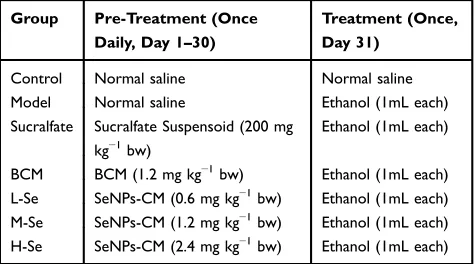
Seventy male Wistar rats, as presented in Table 1, were
randomly divided into 7 groups (each containing 10 ani-mals): Control (saline), Model (ethanol), Sucralfate (etha-nol + sucralfate), BCM (etha(etha-nol + BCM) and three Se groups (ethanol + SeNPs-CM) comprised of L-Se, M-Se and H-Se. Control and Model groups were given normal
saline by gavage (10 mL kg−1bw), while Sucralfate group
acting as a positive group was intragastrically
adminis-tered sucralfate suspensoid (200 mg kg−1 bw). L-Se,
M-Se and H-Se groups were orally administrated with
0.6, 1.2 and 2.4 mg kg−1bw of SeNPs-CM, respectively.
Meanwhile, BCM at a comparable dose (1.2 mg kg−1bw)
acting as a vehicle control was utilized to evaluate the contribution of chitosan vehicle to the bioactivity of SeNPs-CM. The daily administration and body weighting were performed for 30 days. All rats were allowed free access to a low-Se diet (<0.1 mg Se kg−1diet) and water during the experiments.
After the last administration, all the rats were deprived of food. Twenty-four hours later, the fasting animals were administrated with absolute ethanol (1 ml per rat) by gavage except for the Control group. At 60 min after the ethanol treatment, the anaesthesia of rats was carried out through intraperitoneal injection of aqueous chloral
hydrate (0.5 mg kg−1bw). The blood in aorta abdominalis
was collected into a heparin-free tube, and the animals were euthanized by cervical dislocation. Quickly, serum
Table 1 The Administration During the Gastroprotective Experiment (Wistar Rats, n=10)
Group Pre-Treatment (Once
Daily, Day 1–30)
Treatment (Once,
Day 31)
Control Normal saline Normal saline
Model Normal saline Ethanol (1mL each)
Sucralfate Sucralfate Suspensoid (200 mg
kg−1bw)
Ethanol (1mL each)
BCM BCM (1.2 mg kg−1bw) Ethanol (1mL each)
L-Se SeNPs-CM (0.6 mg kg−1bw) Ethanol (1mL each)
M-Se SeNPs-CM (1.2 mg kg−1bw) Ethanol (1mL each)
H-Se SeNPs-CM (2.4 mg kg−1bw) Ethanol (1mL each)
Abbreviation:bw, body weight.
International Journal of Nanomedicine downloaded from https://www.dovepress.com/ by 118.70.13.36 on 24-Aug-2020
was obtained after immediate centrifugation (1000×g, 4°C,
10 min) and stored at −80°C until analysis, while some
important organs such as stomach and liver were collected for further investigation. The viscera index, defined as the
ration of organ weight to body weight,27 was also
measured.
Macroscopic Evaluation
The freshly excised stomach was opened along the greater curvature and rinsed in ice-cold normal saline to remove the gastric contents and blood clots. The samples were photographed to explore the gross gastric mucosal lesions. The injury incidence was calculated following Equation (1). Gross mucosal lesions were recognized as hemorrhage spot or damage strip
(ero-sions) on the mucosal surface.6 The areas of stomach
tissue and gross lesions were approximately measured by using Image J (v1.48) software (developed by
National Institutes of Health, USA).28 The results were
expressed as the gross ulcer index-1 (GUI-1) calculated by using Equation (2). Macroscopic scoring of gastric mucosal lesions was also performed by an independent viewer blinded to the treatment as described by Kan et al6with limited modification. In brief, scoring gastric injury was carried out basing on the severity of hyper-emia and hemorrhagic erosions, and the gross ulcer
index-2 (GUI-2) was defined as the weighted sum of
individual scores according to Kan.6,30
Injury incidence %ð Þ ¼ ðThe number of rats with mucosal injury in a group=Total number
of rats in the same groupÞ 100%
Equation (1)
GUI1¼ðTotal ulcerated area=Total mucosa areaÞ100% Equation (2)
Histological Examination
Samples from the comparable region of the stomach or
liver were excised andfixed in a 10% of buffered formalin
solution, routinely followed by paraffin embedding.
Sections (5 μm thick) were stained with hematoxylin &
eosin (HE) dual-dye and examined under a light microscope.1,12,19The sections were observed and photos were captured to explore the histological change.
Based on the severity of histological disorder, the his-tological damage in gastric mucosa was graded by using
two methods. In the first method, each field was scored
histologically on a scale from 0 to 4 in accordance with previously described criteria29 with limited modification:
0 – normal; 1 – epithelial cell damage; 2 – glandular
disruption, vasocongestion or edema in the upper mucosa;
3– mucosal disruption, vasocongestion or edema in the
mild lower mucosa; 4 – extensive mucosal disruption
throughout the mucosa. The overall mean value of the
scores for each of thefields was taken as the histological
ulcer index-1 (HUI-1) for the section. In the second
method, grading the gastric injury was achieved on a 1–5
scale according to Kan et al6based on the percentage of
the damage area. The damage score called the histological
ulcer index-2 (HUI-2), was defined as the weighted sum of
individual scores.6All determinations were performed in
a randomized manner and histological sections were coded to eliminate an observer bias.
Se Retention Determination
Se concentration in blood or organ was determined by
ICP-MS assay as described in previous studies.19,20,25
Briefly, serum or organ sample was mixed with hydrogen
nitrate/hydrogen peroxide (HNO3/H2O2) solution. The
mixture was then digested by means of microwave heat-ing. The Se concentration of each digested sample was
determined by using an ICP-MS device (7700X,
Agilent, USA).
Biochemical Analysis
The fresh samples of the liver or stomach were rinsed with cold normal saline, and the homogenization in ice-cold saline was conducted. After immediate centrifugation (10,000×g, 4°C, 10 min), the supernatant was collected. After that, the serum and the supernatant were used to measure the levels of GOT, GPT, GSH, TBARS
(malon-dialdehyde equivalent), GSH-Px, CAT, SOD, PGE2, NO
and LPO, following the instructions of commercial kits listed previously.
Statistical Analysis
In all the experiments, data were presented as mean ± SD. The difference between the two groups was analyzed by Student’st-test, while the difference between three or more groups was analyzed by one-way analysis of variance (one-way ANOVA) test followed by multiple
compari-sons. SPSS software program (version 17.0 for
Windows) was utilized, and aPvalue of <0.05 was
con-sidered statistically significant.
International Journal of Nanomedicine downloaded from https://www.dovepress.com/ by 118.70.13.36 on 24-Aug-2020
Results and Discussion
Design of SeNPs-CM
CS is the only positively charged natural polysaccharide with excellent biodegradable and biocompatible character-istics, having been extensively examined in the pharmaceu-ticalfields for its potential in developing medicine delivery systems.30SeNPs (Se(0)) can be synthesized in the presence of CS.19–22However, it was a process of laboratory level, with its small scale far from practical production. Even worse, the purification of SeNPs by means of dialysis19,22 was impracticable in industrial production because of the
low efficiency and high cost. Besides, bare SeNPs and
CS-SeNPs were unavailable for commercial applications in oral administration systems due to their awful stability.19,20 Therefore, SeNPs-CM aiming at both the stability and oral delivery of SeNPs was developed, and a rapid preparation process designed for the industrial production of
SeNPs-CM was also introduced (Scheme 1). The physicochemical
characters and bioactivities of SeNPs might be retained if the design worked.
Physicochemical Properties of SeNPs and
SeNPs-CM
Morphology and Formation of SeNPs
The synthesis of SeNPs was performed on a much bigger scale (>1000-fold) and at a significantly lower stirring
speed (150 rpm) as compared with previous studies.19–22
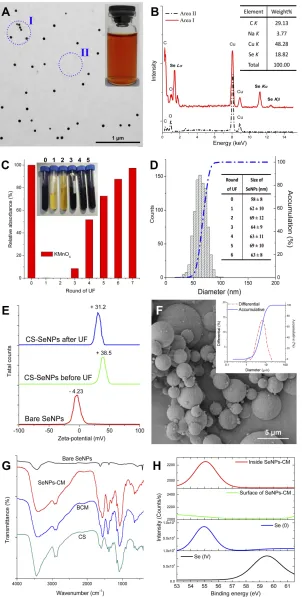
As a result, monodisperse spherical CS-SeNPs in high uniform was obtained, with red appearance and the mean
size of around 60 nm (Figure 1A). The typical Se peaks
(1.37, 11.22 and 12.49 keV), identified as SeLα, SeKαand
SeKβ, respectively, were found in the EDS spectra of
CS-SeNPs, strongly confirming the elemental nature of these
nanoparticles (Figure 1B). It indicated small CS-SeNPs
can be fabricated even in such a condition stimulating industrial production.
Influence of UF Upon CS-SeNPs
Ultrafiltration (UF) was used instead of dialysis to purify CS-SeNPs. The PES membrane (MWCO of 8 kDa) used could retain CS and SeNPs, but it allowed free access of soluble compounds with low molecular-weight (such as Vc and its oxidates), of which might fade aqueous acidic
KMnO4 solution.31 The content of the byproduct in the
retentate, in theory, could be reduced by geometric progres-sion in accordance with the frequency of the UF process.
After six or seven round of UF treatment, aqueous KMnO4
(1μmol L−1) was unable to fade within 20 min when mixed with the correspondingfiltration, indicating little byproduct could be transported to the filtrate (Figure 1C). It implied
UF can remove the unwanted inclusion efficiently. More
importantly, limited modification of the shape or size of
SeNPs was observed during rounds of the UF process
(shown in Figure 1D), also suggesting the feasibility of
UF used in the purification of SeNPs. Significantly, CS
might guarantee the stability of SeNPs during the UF pro-cess. It could be partly explained by the viscosity of CS.30 The surface decoration by CS on SeNPs, resulting in the elevation of zeta-potential of these nanoparticles,19,22 also contributed to the stability (Figure 1E). The limited change of zeta-potential during UF processing made UF suitable for the rapid purification of CS-SeNPs.
Characterization of SeNPs-M
The purified CS-SeNPs colloid was finally mixed with
another CS solution, and the mixture was spray-dried to remove moisture and acetic acid, generating solid
SeNPs-CM with their average size of around 6 μm (Figure 1F).
The SeNPs-CM seemed to be a simple collection of SeNPs and CS, without any new functional group found in the
FTIR spectra (Figure 1G). Furthermore, XPS patterns of
SeNPs-CM were recorded to explore the status of Se. As
presented inFigure 1H, the peaks at 55.3 eV and 59.5 eV
were identified as the typical Se 3dsignals of Se (0) and
Se (IV), respectively, confirming the Se within SeNPs-CM
was in elementary status.19,20 However, the Se 3dsignals
on the surface of SeNPs-CM were significantly weaker
than that inside SeNPs-CM, which was found by using argon ion etching to expose the elements inside. It implied most of the SeNPs are enclosed inside SeNPs-CM. Apparently, the physical stabilization of SeNPs was car-ried out, and the content of SeNPs within SeNPs-CM could be easily adjusted by modifying material ratio.
Release of SeNPs from SeNPs-CM
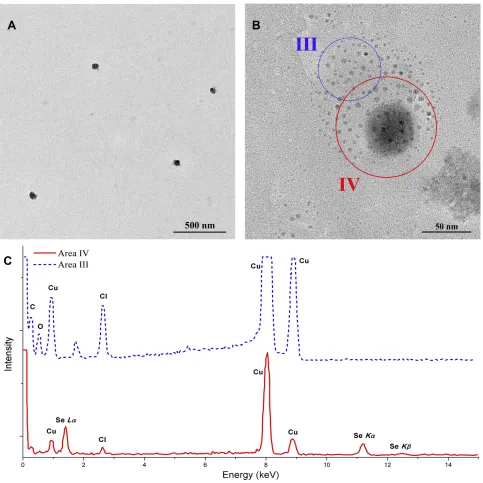
The release of nanoparticles from their vehicle was very important to their absorption and their bioactivities.17,20 In the study, SeNPs-CM was mixed with HCl solution (pH 1.2) and stirred at 37°C, simulating the gastric digestion of this Se-supplement. Intact SeNPs could be observed in the
mix-ture after the incubation (shown inFigure 2AandB),
sug-gesting SeNPs can be released from SeNPs-CM in the mammalian stomach. Interestingly, many small beads of few nanometres were found around much bigger single
ones in the TEM image (Figure 2B). EDS performed on
International Journal of Nanomedicine downloaded from https://www.dovepress.com/ by 118.70.13.36 on 24-Aug-2020
Figure 1The physicochemical properties of CS-SeNPs. (A) Transmission electron microscopy (TEM) image of CS-SeNPs and their appearance (inset). (B) Typical energy-dispersive X-ray spectroscopy (EDS) spectra of CS-SeNPs (found at Area I, Panel (A) and their elemental composition (inset). (C) The absorbance (525 nm) of potassium permanganate (KMnO4) solution when coming across with UFfiltrate and their appearance (inset). (D) The size distribution of CS-SeNPs measured basing on TEM results,
and the influence of UF on the size of these nanoparticles (inset). (E) Zeta-potentials of bare SeNPs and CS-SeNPs (before or after 6 rounds of UF). (F) SEM image of SeNPs-CM and their size distribution (inset). (G) FTIR spectra of bare SeNPs, BCM and SeNPs-M. (H) Se3dXPS patterns of Se (IV) (selenite or selenium dioxide), Se (0) (bare SeNPs or crystal Se) and SeNPs-CM, obtained with or without argon etching.
International Journal of Nanomedicine downloaded from https://www.dovepress.com/ by 118.70.13.36 on 24-Aug-2020
the area containing the small or big beads (shown in
Figure 2C) indicated the bigger ones were SeNPs while the smaller ones might be CS. Perhaps CS in SeNPs-CM might collapse into small colloid drop when mixing with HCl solution. It was also possible the aqueous CS might turn to solid CS beads when sampling for TEM investigation. Although how the SeNPs escaped from SeNPs-CM was unknown, it was certain SeNPs can be released from their vehicles in the digestive tract. In other words, the embedding
by CS did not change the size and morphology of SeNPs, two important properties of which could profoundly affect the bio-activities of the nanoparticles.32,33 It also proved SeNPs were stable in the vehicle during storage.
Safety of SeNPs-CM
Acute Toxicity of SeNPs-CM in KM Mice
The safety of SeNPs-CM was considered before its potential in the clinic. As reported in some previous work,19,20,34 Figure 2Release of SeNPs from SeNPs-CM in HCl solution. SeNPs-CM was mixed with HCl solution (pH 1.2). After 1–2 hrs, the mixture wasfiltrated by using afilter membrane (with the aperture size of 0.45μm), and thefiltrate was sampled for TEM observation and EDS investigation. (A) TEM image of SeNPs and (B) the details. (C) Typical EDS spectra obtained in Figure 2B (Area III versus Area IV).
International Journal of Nanomedicine downloaded from https://www.dovepress.com/ by 118.70.13.36 on 24-Aug-2020
SeNPs were safer than selenite or selenomethionine, mainly responsible for the whole toxicity of SeNPs/vehicle com-plexes. In this study, SeNPs-CM was much safer than
selenite19 in turns of Se dose, with a LD50 of around
8-fold of that of selenite in KM mice (Table 2). Thefinding was in accordance with some reports,19,20,34 though the model animals (KM mice or ICR mice) or the vehicle (chitosan, or chitosan/citrate, or BSA) might be different. Perhaps, SeNPs loaded by protein or polysaccharide might present comparable toxicity, when (1) they shared similar basic physicochemical properties35,36 such as shape, size, chemical composition and surface properties and (2) they could escape from their vehicles in the stomach.19
Influence of SeNPs-CM on the Growth, Viscera and
Aminotransferases of Wistar Rats
In the ulcer experiment, another SeNPs-CM sample
contain-ing 20 mg g−1of Se (measured by ICP-MS25) was
admini-strated at the doses of 0.6, 1.2, 2.4 mg/kg bw (shown in
Table 1) based on the daily recommendation dose of Se.37,38
During the experiment, BCM (1.2 mg kg−1bw), SeNPs-CM
and sucralfate (200 mg kg−1bw) did not exhibit any visible
negative effects on rats’ behavior and body weight (See
Table S1, Supplementary materials). Besides, the viscera indexes of heart, liver, spleen and kidney were normal in
each group (See Table S2, Supplementary materials).
Moreover, little visible modification could be found in the
structure of the liver (See Figure S1, Supplementary
materials).
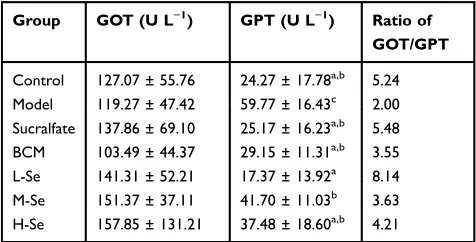
The levels of GOT and GPT in serum can help people diagnose body tissues are injured or not,
espe-cially the heart and the liver.39 Serum GPT is sensitive
to acute hepatic injury since it can be released from hepatic cells when acute destruction of cytomembrane
happens.40 The jump of serum GOT is closely
asso-ciated with the damage to endochylema and the
dysfunction of the mitochondrial membrane, implying
severe injury of an organelle.40 In this study, GOT in
each group was normal (Table 3), indicating 30-day
administrations of SeNPs, BCM and sucralfate at their setting doses were safe. Besides, the ethanol-caused elevation of the GPT level might be retarded by all the pretreatments, suggesting the liver protection conducted by the three compounds.
Selenium Retention in vivo
The Se level in the body was monitored to study the Se-supplying ability of SeNPs-CM in rats. As presented in
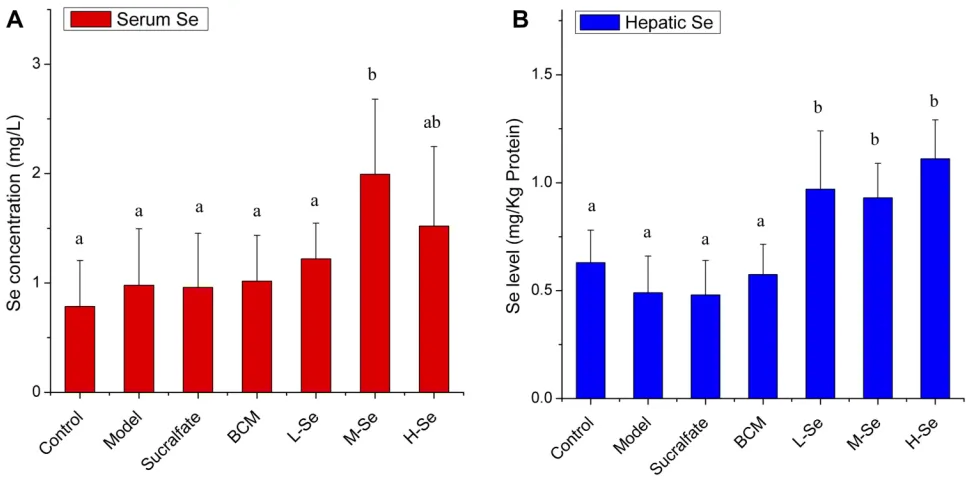
Figure 3, serum Se concentrations in M-Se group and hepatic Se levels in the Se-supplement groups were
sig-nificantly higher than that of no Se-supplement groups
(P< 0.05), indicating SeNPs-CM at the doses could
ben-efit to the Se stock in animals. Markedly, SeNPs-CM was
actually the main Se supplement, in consideration of the extremely low Se content of the feed (<0.1μg Se g−1diet) and the estimable daily intake of adult Wistar rats (about 20–30 g diet day−1each).41–43Additionally, visible differ-ence in Se levels was found between M-Se and BCM
(P < 0.05). It was the SeNPs within SeNPs-CM
contrib-uted to the improvement of Se retention.
The deposition preference of SeNPs was studied. Interestingly, hepatic Se seemed to be more sensitive to
the supplement of SeNPs-CM than serum Se (Figure 3).
The Se-boost in serum was latter than that in the liver, in line with a previous study20reporting a faster increase of hepatic Se than that of plasma Se in mice. It suggested the Se from SeNPs-CM is apt to be stored in the liver. Additionally, Se accumulation in the liver was found in
mice or fish when BSA-SeNPs34,44,45 or selenite34 or
selenate46were given. Possibly, inorganic Se was inclined
to be collected in hepatic tissue.
Table 2 Acute Lethal Results by Single Oral Administration in KM Mice (n=10)
Sample Se Content
(mg g−1
)
LD50 #
(mg kg−1
bw)
LD50(Se) *
(mg Se kg−1
bw) Sodium selenitea 456.7 19.2 (16.2–22.7)$ 8.8 (7.4–10.4)^ BCMa
– > 15 × 103
–
SeNPs-CM 30 2.44 × 10³
(1.81×10³
- 3.03×10³
)$
73.2 (54.3–90.9)^
Notes:#
LD50= median lethal dose; *LD50(Se) = LD50× Se content.$The LD50of
95% confidence interval. ^The LD50(Se) of 95% confidence interval. a
The results of sodium selenite and BCM were reported in previous work Reference.19 Abbreviation:bw, body weight.
Table 3The Serum Aminotransferases in Wistar Rats at the End of Ulcer Experiment (n=10)
Group GOT (U L−1) GPT (U L−1) Ratio of GOT/GPT
Control 127.07 ± 55.76 24.27 ± 17.78a,b 5.24
Model 119.27 ± 47.42 59.77 ± 16.43c 2.00
Sucralfate 137.86 ± 69.10 25.17 ± 16.23a,b 5.48
BCM 103.49 ± 44.37 29.15 ± 11.31a,b 3.55
L-Se 141.31 ± 52.21 17.37 ± 13.92a 8.14
M-Se 151.37 ± 37.11 41.70 ± 11.03b 3.63
H-Se 157.85 ± 131.21 37.48 ± 18.60a,b 4.21
Notes:a–cMeans within a column with different letters differ significantly (P< 0.05).
International Journal of Nanomedicine downloaded from https://www.dovepress.com/ by 118.70.13.36 on 24-Aug-2020
The dose of SeNPs needed more attention. Comparable hepatic Se levels were achieved in all the Se groups,
suggesting a possible “plateau” (Figure 3B). A similar
plateau was reported by Barnes47 and Raines,48 who
pointed out haptic Se level was very sensitive to Se con-tent in food. Se-supplementation resulted in a sigmoidal response in the liver Se concentration of rats: hepatic Se
quickly increased to a plateau at 0.08 μg Se g−1 diet,
remained at this level until 0.24 μg Se g−1diet, and then increased gradually to 1.80-fold of Se adequate levels (0.08–0.24 μg Se g−1 diet) in rats fed 0.8 μg Se g−1 diet;47 hepatic Se increased fast if the Se content in diet was too high (>0.8μg Se g−1diet).48Herein, the daily Se intakes in the Se groups reached the plateau, indicating the daily doses of SeNPs were able to meet the requirement of adequate or super-nutritional Se. That was, the doses of SeNPs-CM were acceptable, far from the toxic status
according to Barnes47 and Raines.48
Macroscopic Gastric Damage
Ethanol resulted in gastric edema, which was evidenced
by the significantly higher stomach index (P < 0.05,
Model versus Control) as shown in Figure 4A
and B. Apart from the edema, high injury incidence
(≥90%) was observed in the groups given ethanol
(Table 4), suggesting the ethanol-induced lesions are
very common in animals. The damage was highlighted in the congestion and hemorrhagic lesions in the gastric
mucosa (Figure 4C). Sucralfate, an efficient anti-ulcer
medicine widely used to treat gastric ulcer,49 strongly
resisted the gastric disorder induced by ethanol (Figure
4D). BCM also retarded the formation of lesions (Figure
4E), while strong gastroprotection was found in all the
groups pretreated by SeNPs-CM (Figure 4F–H).
The methods of grading gastric injury were various.6,28
Herein, grading was performed basing on scar area28 or
scar severity,6and the results were expressed as GUI-1 or
GUI-2 (Table 4). As expected, SeNPs-CM was able to
inhibit the forming of gastric mucosal injury in a dose-dependent manner. Amazingly, the inhibition of both GUIs
(about 70% - 85%) by SeNPs-CM (1.2 or 2.4 mg kg−1bw)
was comparable with that by sucralfate (200 mg kg−1bw),
suggesting the potent gastric protection by the Se-supplement. Furthermore, more inhibition of GUIs was found in M-Se group as compared with BCM group (P< 0.05), though BCM itself also had a passive influence on gastric protection.50It implied SeNPs contribute greatly to the gastroprotection of SeNPs-CM against ethanol.
Histological Findings
The histological property of gastric mucosa was investi-gated for more details. Normal structures were found in Figure 3The serum Se concentration (A) and hepatic Se level (B) in Wistar rats. The daily administration of each group was performed as shown inTable 1. After the last administration, rats were deprived of food, allowed free access to water. Twenty-four hours later, rats were given ethanol or saline, and they were sacrificed in 1 hr to obtain serum, liver and other organs. The samples were digested in hydrogen nitrate/hydrogen peroxide (HNO3/H2O2) solution, and then, the Se content in the digestion was
determined by using ICP-MS assay.a–bMeans within a panel with different letters differ significantly (P< 0.05).
International Journal of Nanomedicine downloaded from https://www.dovepress.com/ by 118.70.13.36 on 24-Aug-2020
Control (Figure 5A). However, extensive damage in the gastric mucosa was found in Model group, characterized by epithelial degeneration, cell desquamation,
hemor-rhage, and inflammatory cell infiltration (shown in
Figure 5B), in line with previous reports.6,29 Pretreatment with sucralfate or SeNPs-CM revealed the protective effects highlighted in the reduction in hyper-aemia, haemorrhage, disrupted surface epithelium and
leucocytes infiltration (Figure 5C,5E–5G), while BCM
also showed some weak protection (Figure 5D). Other
typical responses to ethanol, such as submucosal edema, deeply penetrated necrotic lesions into the mucosa and
weak mucous secretion, were also weakened in all the pretreatment groups. Particularly, nearly normal structure was found throughout the full thickness of gastric section
in M-Se group (presented in Figure 5H), implying
SeNPs-CM can protect the whole gastric tissue from ethanol-caused damage.
HUI-1 and HUI-2 were measured to grade the micro-scopic lesions in gastric mucosa, depending on scar area and scar severity.6,29As shown inTable 5, Model ranked the highest HUI-1 and HUI-2. However, the pretreatment groups exhibited lower HUIs when comparing with Model
(P < 0.05). Among the pretreatments, SeNPs-CM at the
Figure 4The viscera index of the stomach and the gross appearance of gastric mucosa in Wistar rats. Wistar rats were pre-treated as described inTable 1. After the pre-treatment, gastric mucosal injury was induced by the oral administration of ethanol. One hour after the ethanol challenge, the rats were sacrificed. The stomach was opened along the greater curvature and washed in ice-cold normal saline, followed by macroscopic observation. The stomach was weighted to measure (A) viscera index, while typical appearances of gastric mucosa in different groups: (B) Control, (C) Model, (D) Sucralfate, (E) BCM, (F) L-Se, (G) M-Se and (H) H-Se, were recorded. Severe hemorrhages (arrow) were found in Model group.#
P< 0.05, versus Control.
Table 4The Gross Ulcer Indexes (GUIs) of Gastric Mucosa in Wistar Rats (n=10)
Group Injury Incidence (%) GUI-1 * (% of Area)
Inhibition of GUI-1^(%) GUI-2$ (Point)
Inhibition of GUI-2^(%)
Control 0 0 ± 0a - 1.5 ± 0.8a
-Model 100% 14.36 ± 8.92d 0 67.4 ± 12.7d 0
Sucralfate 90% 1.54 ± 1.46a,b 89.3 14.7 ± 11.2a,b 78.3
BCM 90% 7.73 ± 4.10c 46.2 37.7 ± 25.7c 44.2
L-Se 100% 5.72 ± 2.04b,c 60.2 34.3 ± 18.9b,c 49.2
M-Se 100% 2.50 ± 1.75a,b 82.6 14.1 ± 8.4a,b 79.1
H-Se 100% 2.03 ± 1.72a,b 85.8 20.4 ± 14.0a,b,c 69.8
Notes:a–d
Means within a column with different letters differ significantly (P< 0.05). *The score was grading in accordance with Reference.28$
The score was grading based on the criteria listed in Reference.6^The percentage of ulcer inhibition was calculated as the formula: (GUIModel- GUIexperimental group)/GUIModel× 100%.
International Journal of Nanomedicine downloaded from https://www.dovepress.com/ by 118.70.13.36 on 24-Aug-2020
dose of 1.2 mg kg−1bw presented potent inhibition against the ethanol-caused lesions, while the inhibition by BCM
was weaker (P < 0.05, M-Se versus BCM). This was
consistent with the results shown inTable 4. It also
con-firmed the contribution of SeNPs to the gastroprotection of
SeNPs-CM.
Figure 5Histological details of the gastric mucosa in Wistar rats. The microscopic examination was performed on the gastric mucosa obtained from different groups: (A) Control, (B) Model, (C) Sucralfate, (D) BCM, (E) L-Se, (F, H) M-Se and (G) H-Se. Briefly, Wistar rats were treated as presented inTable 1, and they were sacrificed after the ethanol challenge. The stomach was immediately obtained, part of which was quicklyfixed in formaldehyde solution, routinely embedded by paraffin, sectioned (5μm thick) andfinally stained by hematoxylin and eosin (H&E) duel-dye. The Sections were examined under a light microscope. Typical gastric mucosal damage including epithelial exfoliation (arrow), mucosal hemorrhage (square) and inflammatory cell infiltration (star) was found in Model group. (A–G) magnification, × 200; (H) magnification, × 40.
Table 5The Histological Ulcer Indexes (HUIs) of Gastric Mucosa in Wistar Rats (n=10)
Group HUI-1*
(Point)
Inhibition of HUI-1^ (%)
HUI-2$ (Point)
Inhibition of HUI-2^ (%)
Control 0.00 ± 0.00a - 0.00 ± 0.00a
-Model 3.40 ± 0.70d 0 14.30 ± 3.47d 0
Sucralfate 1.70 ± 1.06b,c 50.0 8.50 ± 3.41b,c 40.6
BCM 1.80 ± 1.11c 47.1 10.30 ± 4.62c,d 28.0
L-Se 2.00 ± 0.82c 41.2 9.80 ± 2.44b,c,d 31.5
M-Se 0.65 ± 0.63a,b 80.9 4.80 ± 2.97a,b 66.4
H-Se 2.10 ± 1.52c 38.2 9.40 ± 6.15b,c,d 34.3
Notes:*The score was grading in accordance with Reference.32$
The score was grading based on the criteria reported in Reference.6^
The percentage of ulcer inhibition was calculated as the formula: (HUIModel- HUIexperimental group)/HUIModel× 100%.
a–d
Means within a column with different letters differ significantly (P< 0.05).
International Journal of Nanomedicine downloaded from https://www.dovepress.com/ by 118.70.13.36 on 24-Aug-2020
Relieving Effect of SeNPs-CM Against
Ethanol-Induced Biochemical in Stomach
Antioxidant Ability of SeNPs-CM in Stomach
Exogenous ethanol acting as a potent aggressive agent not only causes serious lesions in gastric mucosal by its direct toxic effect,51but also lead to excessive lipid peroxidation in gastric mucosa by intriguing radical oxygen species
(ROS) reaction.52As shown inTable 6, both LPO (typical
intermediate product in lipid peroxidation)53,54 and
TBARS (typical end-product in lipid peroxidation)53,54
were increased by ethanol, indicating oxidative damage in cytomembrane. However, the lipid peroxidation could be retarded by the pretreatment with BCM, SeNPs-CM and Sucralfate, as evidenced by the decrease of LPO or
TBARS (Table 6). Interestingly, SeNPs-CM might be
superior to sucralfate (200 mg kg−1 bw) in attenuating
lipid peroxidation, since the former could decrease both LPO and TBARS, whereas the latter might not reduce LPO. Probably, SeNPs-CM inhibited some oxidation steps throughout the lipid peroxidation.
GSH-Px is a family of enzymes reducing lipid hydroper-oxides to their corresponding alcohols and also reducing free hydrogen peroxide to water, whose catalytic site contains Selenocysteine (Se-Cys).16–20,34 Dramatic decrease of gas-tric GSH-Px was induced by ethanol, suggesting the
dys-function of the antioxidant enzyme system (Table 6).
Pretreatment with sucralfate or BCM could not stop the loss of GSH-Px. In contrast, oral administration of
SeNPs-CM (1.2 mg kg−1bw) was able to suppress the reduction of
GSH-Px caused by ethanol (P< 0.05, versus Model). The
boost of GSH-Px might benefit to the stability of some
bioactive gastric mucosal defensive factors such as endo-genous nitric oxides (NO) by lowering ROS (i.e., hydrogen peroxide),55and it could also retard the oxidative damage to cells,16–20,34resulting in the reduction of TBARS and LPO.
Furthermore, SeNPs might contribute mainly to the retention
of GSH-Px by SeNPs-CM (P< 0.05, M-Se versus BCM), in
consideration of the negative influence of BCM on GSH-Px
level. Perhaps SeNPs-CM could offer Se to the synthesis of GSH-Px, consistent with its contribution to Se retention
in vivo (Figure 3). Undoubtedly, the improvement of
GSH-Px by SeNPs took an important part in the gastroprotection mechanism of SeNPs-CM.
Influence of SeNPs-CM on Inflammatory Mediators
PGE2and NO are proved to be important mediators of the
inflammatory process in gastric ulcer or acute gastric
injury.56As an important member of prostaglandins (PGs),
PGE2 can protect the gastric mucosa by activating its
different EP receptors, which can enhance the secretion
of mucus and bicarbonate, increase blood flow, and
decrease acid secretion.56,57 Moreover, PGE2in ulcer
tis-sue specimens has been reported to play a passive role in ulcer repairing.56,57However, little change of PGE2could
be found among the groups except Sucralfate group in the
present study (shown inTable 6), implying the
gastropro-tection of SeNPs-CM might be independent of endogenous PGE2. It was quite different from that of sucralfate.
The physiological role of NO in gastric tissue is very complicated. Not only is NO a free radical acting as a precursor of different reactive nitrogen species (RNS),58 but it is a critical signaling molecule in the inflammatory process.56,58In mammals, synthesis of NO is catalyzed by a set of enzymes called nitric oxide synthases (NOS), and three distinct isoforms of NOS have been identified– neuro-nal, macrophage and endothelial types.56,58A high level of NO is released by the inducible isoform (iNOS, macrophage type) as compared to the amount generated by the constitu-tive isoforms (neuronal or endothelial types), when wound healing, burn injury, endotoxin exposure, arthritis and
Table 6The Levels of LPO, TBARS, GSH-Px, PGE2and NO in Stomach (Wistar Rats, n=10)
Group LPO
(μmol g−1Prot)
TBARS (μmol g−1Prot)
GSH-Px (U mg−1Prot)
PGE2
(ng mg−1Prot)
NO
(μmol g−1Prot)
Control 2.32 ± 1.43a,b 0.94 ± 0.52a 836 ± 206c 1.67 ± 0.84a 0.45 ± 0.26a
Model 4.31 ± 1.88b,c 1.93 ± 0.81b 427 ± 45a,b 1.59 ± 0.51a 1.32 ± 0.43b
Sucralfate 5.16 ± 1.52c 0.91 ± 0.37a 385 ± 120a,b 4.81 ± 0.62b 1.07 ± 0.35a,b
BCM 2.03 ± 1.39a,b 1.35 ± 0.81a,b 181 ± 86a 1.04 ± 0.54a 1.05 ± 0.54a,b
L-Se 3.52 ± 2.25a,b,c 1.08 ± 0.67a,b 616 ± 203b,c 1.26 ± 0.48a 0.76 ± 0.38a,b
M-Se 2.29 ± 1.71a,b 1.19 ± 0.60a,b 731 ± 302c 1.03 ± 0.49a 0.67 ± 0.48a
H-Se 1.11 ± 0.79a 1.17 ± 0.39a,b 444 ±182b 1.06 ± 0.54a 0.50 ± 0.16a
Notes:a–c
Means within a column with different letters differ significantly (P< 0.05). Abbreviation:prot, protein.
International Journal of Nanomedicine downloaded from https://www.dovepress.com/ by 118.70.13.36 on 24-Aug-2020
inflammatory bowel diseases happen.56,58 In acute gastric injury caused by ethanol, great up-regulation of iNOS takes place at both gene and protein levels,56,59,60 whereas the
levels of other NOS are strongly down-regulated.1,59 As
a result, a dramatic jump of NO can be found hand in hand with the up-regulation of iNOS in the gastric tissue damaged by ethanol, resulting in inflammation56,58,61 and immunostimulation.58,61,62 Herein, nitrate and nitrite (NO3
/NO2), a marker of NO production, was determined to
eval-uate the perturbation in NO level of the stomach. When an excessive amount of absolute ethanol was given, an acute rise of NO generation was observed in the gastric tissue (P <
0.05, Model versus Control, shown inTable 6), accompanied
by the inflammatory cell infiltration (Figure 5B). Sucralfate and BCM were unable to control the increase of NO
con-centration, but SeNPs-CM, as presented in Table 6, might
retard the generation of NO (P < 0.05, versus Model). It suggested the reduction of NO is probably involved in the gastroprotective action of SeNPs-CM.
Systematic Antioxidant Activity of
SeNPs-CM
Excessive consumption of high concentration of ethanol
might lead to oxidative damage in other tissues63 when
inducing gastric mucosal lesions. Ethanol triggered marked oxidative stress in the serum and liver of rats, as character-ized by the increase of TBARS and the decrease of GSH (Tables 7and8), resulting in the release of GPT (Table 3). It meant the ethanol-caused oxidative stress extend quickly throughout the body of rats. However, the oxidative effects
were significantly attenuated by SeNPs-CM, which might
be attributed to the capacity of SeNPs-CM in up-regulating
the levels of SOD, GSH-Px and CAT (Tables 7 and 8).
More precisely, SeNPs was the main reason for the improvement of these antioxidant enzymatic activities,
which might be deduced from the significant difference
between M-Se and BCM (Tables 7 and 8). Apparently,
SeNPs-pretreatment established a defense system against ethanol in other tissues in addition to the stomach.
The antioxidant ability of SeNPs, highlighted in the improvement of both Se retention and antioxidant enzy-matic activities, had been found in many organs of animals.16,19,20,33,34,44 The results shown in Tables 6–8
implied the antioxidant activity of SeNPs is systematic but not local, superior to that of Sucralfate. The antiox-idant effect in the stomach, contributing to gastric protec-tion, was merely a part of the total antioxidant activity of SeNPs. The gastroprotective function of SeNPs-CM might be supported by its systematic antioxidant activities. Besides, oxidative stress is one of the major contributors
to the development of stomach diseases,52 and it is very
common in acute gastric mucosal injury caused by ethanol,28,59 emotional stress,13,28 bacteria infection64 or NSAIDs.14,28Possibly, the antioxidant activities of SeNPs might be used to treat or prevent other gastric diseases or damages. It deserved more investigation.
Conclusion
In this study, a simple preparation process composed of
synthesis of CS-SeNPs, ultra-filtration of CS-SeNPs and
spray-drying of purified CS-SeNPs was introduced to
pre-pare SeNPs-CM. The SeNPs of around 60 nm were embedded in SeNPs-CM, allowing their stabilization in storage and their release in the gastric environment.
SeNPs-CM at their recommended daily intake doses (0.6–2.4 mg
kg−1bw) were safe to Wistar rats, and they might benefit the Se retention in rats. SeNPs-CM were able to protect rats from the ethanol-induced gastric mucosal injury, due to their potent capacities of improving antioxidant enzymatic
Table 7The Levels of TBARS, GSH and GSH-Px in the Serum of Wistar Rats (n=10)
Group TBARS
(μmol L−1)
GSH (μmol L−1)
GSH-Px (U mL−1)
Control 3.95 ± 0.53a 31.6 ± 18.1a,b 39.2 ± 4.4a
Model 5.06 ± 0.71b 11.2 ± 9.4a 38.4 ± 6.0a
Sucralfate 3.80 ± 0.44a 25.6 ± 12.4a,b 41.8 ± 5.3a
BCM 4.44 ± 0.74a,b 18.5 ± 10.7a,b 36.3 ± 5.0a
L-Se 3.92 ± 0.54a 20.8 ± 9.7a,b
-M-Se 4.32 ± 0.39a,b 26.7 ± 15.1a,b 81.1 ± 8.4b
H-Se 4.23 ± 0.56a 34.3 ± 17.4b 76.4 ± 6.9b
Notes:a–bMeans within a column with different letters differ significantly (P< 0.05).
Table 8 The Levels of TBARS, SOD, CAT and GSH-Px in the Liver of Wistar Rats (n=10)
Group TBARS (μmol g−1 Prot)
SOD (U mg−1 Prot)
CAT (U mg−1 Prot)
GSH-Px (U mg−1 Prot)
Control 1.28 ± 0.31a 141 ± 51a 74 ± 39a 180 ± 42a,b
Model 1.78 ± 0.46a 154 ± 31a 79 ± 29a 150 ± 29a
Sucralfate 1.18 ± 0.40a 202 ± 30a 63 ± 25a 232 ± 60a,b,c
BCM 1.72 ± 0.46a 211 ± 21a 78 ± 37a 150 ± 42a
L-Se 1.77 ± 0.91a 414 ± 138b 76 ± 45a 340 ± 145c,d
M-Se 1.58 ± 0.84a 410 ± 75b 123 ± 64a 289 ± 38b,c,d
H-Se 1.79 ± 0.48a 370 ± 70b 88 ± 27a 361 ± 60d
Notes:a–d
Means within a column with different letters differ significantly (P< 0.05). Abbreviation:prot, protein.
International Journal of Nanomedicine downloaded from https://www.dovepress.com/ by 118.70.13.36 on 24-Aug-2020
activity, inhibiting lipid peroxidation and attenuating infl am-matory NO generation. SeNPs made the main contribution to the gastric protection of SeNPs-CM. SeNPs-CM posses-sing the potential in nutrient supplement and gastroprotec-tion, deserved further development.
Abbreviations
BCM, blank chitosan microspheres; Blank-C/C, blank chit-osan/citrate complex; BSA, bovine serum albumin; bw, body weight; CAT, catalase; CS, chitosan; EDS, energy-dispersive X-ray spectroscopy; FTIR, Fourier transform infrared spectroscopy; GOT, glutamic-oxaloacetic transami-nase; GPT, glutamic-pyruvic transamitransami-nase; GSH, glu-tathione; GSH-Px, glutathione peroxidase; GUI, gross ulcer index; HE, hematoxylin and eosin; ICR, Institute of Cancer Research; HUI, histological ulcer index; ICP-MS, inductively coupled plasma mass spectrometry; KM,
Kunming; KMnO4, potassium permanganate; LD50, median
lethal dose; LPO, lipid peroxide; MWCO, molecular weight
cut-off; NO, nitric oxides; PGE2, prostaglandin E2; RH,
relative humidity; ROS, radical oxygen species; Se,
sele-nium; SEM, scanning electron microscopy; SeNPs,
selenium nanoparticles; SeNPs-CM, selenium nanoparti-cles-embedded chitosan microspheres; SOD, superoxide
dismutase; SPF, specific-pathogen-free; TBARS,
thiobarbi-turic acid-reactive substances; TEM, transmission electron
microscopy; UF, ultra-filtration; Vc, ascorbic acid; XPS,
X-ray photoelectron spectroscopy.
Ethics Approval and Consent to
Participate
The procedures used in animal experiments were
approved by the Animal Ethics Committee of Shenyang Pharmaceutical University, and they were also compliant with the Provisions and General Recommendation of Chinese Experimental Animals Administration Legislation.
Data Sharing Statement
The datasets supporting the conclusions of this article are included within the article and its supplementaryfiles.
Consent for Publication
All authors agreed to submit this manuscript.
Acknowledgments
We thank Yanhua Mu from Shenyang Pharmaceutical University offered great help in the animal experiments.
We also gratefully acknowledge assistance by Li Gu (Third Institute of Oceanography, MNR), Binbin Xu and Yuanfei Wu (both Xiamen University) when measuring TEM, SEM and EDS.
Funding
The project was sponsored by the Scientific Research
Foundation of Third Institute of Oceanography, Ministry
of Natural Resources, People’s Republic of China (No.
2019014), the Scientific and Technological Projects of
Fujian Province, People’s Republic of China (No.
2016N0018), and the Science &Technology Major
Projects of Fujian Province, People’s Republic of China
(No. 2014NZ0001).
Disclosure
The authors declare that they have no competing interests.
References
1. Zhao X, Sun P, Li G, Yi R, Qian Y, Park K. Polyphenols in Kuding tea help prevent HCl/ethanol-induced gastric injury in mice.Food Funct.2018;9:1713–1725. doi:10.1039/C7FO01754E
2. Li W, Wang X, Zhang H, et al. Anti-ulcerogenic effect of cavidine against ethanol-induced acute gastric ulcer in mice and possible underlying mechanism. Int Immunopharmacol. 2016;38:450–459. doi:10.1016/j.intimp.2016.06.016
3. Sánchez-Mendoza ME, López-Lorenzo Y, Cruz-Antonio L, Matus-Meza A, Sánchez-Mendoza Y, Arrieta J. Gastroprotection of Calein D against ethanol-induced gastric lesions in mice: role of prostaglan-dins. Nitric oxide and sulfhydryls. Molecules. 2019;24:622–629. doi:10.3390/molecules24030622
4. Chen H, Liao H, Liu Y, et al. Protective effects of pogostone from Pogostemonis Herba against ethanol-induced gastric ulcer in rats. Fitoterapia.2015;100:110–117. doi:10.1016/j.fitote.2014.11.017 5. Sabatino A, Lenti MV, Giuffrida P, Vanoli A, Corazza GR. New
insights into immune mechanisms underlying autoimmune diseases of the gastrointestinal tract.Autoimmun Rev.2015;14(12):1161–1169. doi:10.1016/j.autrev.2015.08.004
6. Kan J, Hood M, Burns C, et al. A novel combination of wheat peptides and fucoidan attenuates ethanol-induced gastric mucosal damage through anti-oxidant, anti-inflammatory, and pro-survival mechanisms.Nutrients.2017;9:978–989. doi:10.3390/9090978 7. Kim JH, Park SH, Nam SW, Choi YH. Gastroprotective Effect of
Selenium on Ethanol-Induced Gastric Damage in Rats.Int J Mol Sci.
2012;13:5740–5750. doi:10.3390/ijms13055740
8. Loguercio C, Tuccillo C, Federico A, Fogliano V, Del Vecchio Blanco C, Romano M. Alcoholic beverages and gastric epithelial cell viability: effect on oxidative stress-induced damage.J Physiol Pharmacol.2009;60(Suppl 7):87–92. doi:10.1007/BF03185938 9. Navarro-Alarcon M, Cabrera-Vique C. Selenium in food and the
human body: a review. Sci Total Environ. 2008;400:115–141. doi:10.1016/j.scitotenv.2008.06.024
10. Yu J, Yao H, Gao X, Zhang Z, Wang J-F, Xu S-W. The role of nitric oxide and oxidative stress in intestinal damage induced by selenium deficiency in chickens. Biol Trace Elem Res. 2015;163:144–153. doi:10.1007/s12011-014-0164-8
International Journal of Nanomedicine downloaded from https://www.dovepress.com/ by 118.70.13.36 on 24-Aug-2020
11. Wu C, Xu Z, Huan K. Effects of dietary selenium on inflammation and hydrogen sulfide in the gastrointestinal tract in chickens. Biol Trace Elem Res.2016;174:428–435. doi:10.1007/s12011-016-0735-y 12. Ozkol H, Bulut G, Balahoroglu R, Tuluce Y, Ozkol HU. Protective effects of selenium, N-acetylcysteine and Vitamin E against acute ethanol intoxication in rats.Biol Trace Elem Res.2017;175:177–185. doi:10.1007/s12011-016-0762-8
13. Sadau Y, Adelaiye AB, Magaji RA, Ayo JO, Mabrouk MA, Isa AI. Role of selenium and vitamin E on gastric mucosal damage induced by water-immersion restraint stress in wistar rats.IOSR J Pharm Biol Sci.2015;10(1):34–39. doi:10.9790/3008-10133439
14. Kim JH, Kim BW, Kwon HJ, Nam SW. Curative effect of selenium against indomethacin-induced gastric ulcers in rats. J Microbiol Biotechnol.2011;21(4):400–404. doi:10.4014/jmb.1012.12019 15. Stephen AO, James O, Ikoojo ER, Sunday AO. Effects of selenium
treatment on healing of acetic acid induced gastric ulcer in albino wistar rats.Am J Biomed Res.2016;4(1):18–22. doi:10.12691/ajbr-4-1-4
16. Hosnedlova B, Kepinska M, Skalickova S, et al. Nano-selenium and its nanomedicine applications: a critical review. Int J Nanomed.
2018;13:2107–2128. doi:10.2147/IJN
17. Skalickova S, Milosavljevic V, Cihalova K, Horky P, Richtera L, Adam V. Selenium nanoparticles as a nutritional supplement. Nutrition.2017;33:83–90. doi:10.1016/j.nut.2016.05.001
18. Wang J, Zhang Y, Yuan Y, Yue T. Immunomodulatory of selenium nano-particles decorated by sulfated Ganoderma lucidum polysaccharides. Food Chem Toxicol. 2014;68:183–189. doi:10.10 16/j.fct.2014.03.003
19. Bai K, Hong B, Hong Z, Sun J, Wang C. Selenium nanoparticles-loaded chitosan/citrate complex and its protection against oxidative stress in d-galactose-induced aging mice. J Nanobiotechnol.2017;15:92–105. doi:10.1186/s12951-017-0324-z 20. Bai K, Hong B, He J, Hong Z, Tan R. Preparation and antioxidant properties of selenium nanoparticles-loaded chitosan microspheres. Int J Nanomed.2017;12:4527–4539. doi:10.2147/IJN
21. Zhai X, Zhang C, Zhao G, Stoll S, Ren F, Leng X. Antioxidant capacities of the selenium nanoparticles stabilized by chitosan. J Nanobiotechnol.2017;15:4–15. doi:10.1186/s12951-016-0243-4 22. Zhang C, Zhai X, Zhao G, Ren F, Leng X. Synthesis,
characteriza-tion, and controlled release of selenium nanoparticles stabilized by chitosan of different molecular weights. Carbohydr Polym.
2015;134:158–166. doi:10.1016/j.carbpol.2015.07.065
23. Kong H, Yang J, Zhang Y, Fang Y, Nishinari K, Phillips GO. Synthesis and antioxidant properties of gum arabic-stabilized sele-nium nanoparticles. Int J Biol Macromol. 2014;65:155–162. doi:10.1016/j.ijbiomac.2014.01.011
24. Zhang JS, Gao XY, Zhang LD, Bao YP. Biological effects of a nano red elemental selenium. Biofactors. 2001;15:27–38. doi:10.1002/ biof.5520150103
25. Dufailly V, Noël L, Guérin T. Determination of chromium, iron and selenium in foodstuffs of animal origin by collision cell technology, inductively coupled plasma mass spectrometry (ICP-MS), after closed vessel microwave digestion. Anal Chim Acta. 2006;565 (2):214–221. doi:10.1016/j.aca.2006.02.046
26. Bliss CI. The calculation of the dosage-mortality curve.Ann Appl Biol.1935;22(1):134–167. doi:10.1111/aab.1935.22.issue-1 27. Zheng G, Xu X, Zheng J, Liu A. Protective effect of seleno-β
-lactoglobulin (Se-β-lg) against oxidative stress in d-galactose-induced aging mice.J Funct Foods.2016;27:310–318. doi:10.1016/ j.jff.2016.09.015
28. Zheng Y-F, Xie J-H, Xu Y-F, et al. Gastroprotective effect and mechanism of patchouli alcohol against ethanol, indomethacin and stress-induced ulcer in rats. Chem-Biol Interact. 2014;222:27–36. doi:10.1016/j.cbi.2014.08.008
29. Dokmeci D, Akpolat M, Aydogdu N, Doganay L, Turan FN. L-carnitine inhibits ethanol-induced gastric mucosal injury in rats. Pharmacol Rep.2005;57:481–488. doi:10.1016/j.ejca.2006.07.001 30. Rinaudo M. Chitin and chitosan: properties and applications.Prog Polym
Sci.2006;31(7):603–632. doi:10.1016/j.progpolymsci.2006.06.001 31. Wang L, Jiang J, Pang SY, et al. Further insights into the combination of
permanganate and peroxymonosulfate as an advanced oxidation process for destruction of aqueous organic contaminants.Chemosphere.2019;228 (33):602–610. doi:10.1016/j.chemosphere.2019.04.149
32. Huang B, Zhang J, Hou J, Chen C. Free radical scavenging efficiency of Nano-Se in vitro. Free Radic Biol Med. 2003;35(7):805–813. doi:10.1016/S0891-5849(03)00428-3
33. Peng D, Zhang J, Liu Q, Taylor EW. Size effect of elemental sele-nium nanoparticles (Nano-Se) at supranutritional levels on selesele-nium accumulation and glutathione S-transferase activity.J Inorg Biochem.
2007;101(10):1457–1463. doi:10.1016/j.jinorgbio.2007.06.021 34. Wang H, Zhang J, Yu H. Elemental selenium at nano size possesses lower
toxicity without compromising the fundamental effect on selenoenzymes: comparison with selenomethionine in mice. Free Radical Bio Med.
2007;42:1524–1533. doi:10.1016/j.freeradbiomed.2007.02.013 35. Rivera-Gil P, Jimenez de Aberasturi D, Wulf V, et al. The challenge
to relate the physicochemical properties of colloidal nanoparticles to their cytotoxicity.Acc Chem Res.2013;46(3):743–749. doi:10.1021/ ar300039j
36. Gil PR, Oberdörster G, Elder A, Puntes V, Parak WJ. Correlating physico-chemical with toxicological properties of nanoparticles: the present and the future.ACS Nano.2010;4(10):5527–5531. doi:10.10 21/nn1025687
37. Xia Y, Hill HE, Byrne DW, Xu J, Burk RF. Effectiveness of selenium supplements in a low-selenium area of China. Am J Clin Nutr.
2005;81(4):829–834. doi:10.1093/ajcn/81.4.829
38. Levander OA, Burk RF. Update of human dietary standards for selenium. In: Hatfield DL, Berry MJ, Gladyshev VN, editors. Selenium. Boston: Springer;2006:399–400.
39. Huang XJ, Choi YK, Im HS, Yarimaga O, Yoon E, Kim HS. Aspartate Aminotransferase (AST/GOT) and Alanine Aminotransferase (ALT/ GPT) detection techniques. Sensors. 2006;6:756–782. doi:10.3390/ s6070756
40. Vroon DH, Israili Z. Aminotransferases. In: Walker HK, Hall WD, Hurst JW, editors. Clinical Methods: The History, Physical, and Laboratory Examinations. 3rd ed. Boston: Butterworths;1990:492–493. 41. Della-Zuana O, Presse F, Ortola C, Duhault J, Nahon JL, Levens N.
Acute and chronic administration of melanin-concentrating hormone enhances food intake and body weight in Wistar and Sprague-Dawley rats.Int J Obesity.2002;26:1289–1295. doi:10.1038/sj.ijo.0802079 42. Yamanaka A, Sakurai T, Katsumoto T, Yanagisawa M, Goto K.
Chronic intracerebroventricular administration of orexin-A to rats increases food intake in daytime, but has no effect on body weight. Brain Res.1999;849:248–252. doi:10.1016/S0006-8993(99)01905-8 43. Owu DU, Osim EE, Ebong PE. Serum liver enzymes profile of Wistar rats
following chronic consumption of fresh or oxidized palm oil diets.Acta Trop.1998;69:65–73. doi:10.1016/S0001-706X(97)00115-0
44. Li H, Zhang J, Wang T, Luo W, Zhou Q, Jiang G. Elemental selenium particles at nano-size (Nano-Se) are more toxic to Medaka (Oryzias latipes) as a consequence of hyper-accumulation of selenium: a comparison with sodium selenite.Aquatic Toxicol.2008;89:251–256. doi:10.1016/j.aquatox.2008.07.008
45. Zhang J, Wang H, Bao Y, Zhang L. Nano red elemental selenium has no size effect in the induction of seleno-enzymes in both cultured cells and mice.Life Sci.2004;75:237–244. doi:10.1016/j.lfs.2004.02.004 46. Lennicke C, Rahn J, Kipp AP, et al. Individual effects of different
selenocompounds on the hepatic proteome and energy metabolism of mice. BBA-Gen Subjects. 2017;861:3323–3334. doi:10.1016/j. bbagen.2016.08.015
International Journal of Nanomedicine downloaded from https://www.dovepress.com/ by 118.70.13.36 on 24-Aug-2020
47. Barnes KM, Evenson JK, Raines AM, Sunde RA. Transcript analysis of the selenoproteome indicates that dietary selenium requirements of rats based on selenium-regulated selenoprotein mRNA levels are uniformly less than those based on glutathione peroxidase activity. J Nutr.2009;139:199–206. doi:10.3945/jn.108.098624
48. Raines AM, Sunde RA. Selenium toxicity but not deficient or super-nutritional selenium status vastly alters the transcriptome in rodents. BMC Genomics. 2011;12:26–40. doi:10.1186/1471-2164-12-26
49. Hollander D, Tarnawski A, Krause WJ, Gergely H. Protective effect of sucralfate against alcohol-induced gastric-mucosal injury in the rat - macroscopic, histologic, ultrastructural, and functional time sequence-analysis.Gastroenterology.1985;88(1):366–374. doi:10.10 16/S0016-5085(85)80191-8
50. Carvalho JE, Pintado ME, Ana Lúcia TG, Ruiz JMP, Tavaria FK. Anti-proliferative, anti-inflammatory, anti-ulcerogenic and wound healing properties of chitosan. Curr Bioact Comp. 2016;12 (2):114–122. doi:10.2174/1573407212666160330204522
51. Jafri MA, Farah JK, Singh S. Evaluation of the gastric antiulcerogenic effect of large cardamom (fruits of Amomum subulatum Roxb). J Ethnopharmacol.2001;75(2–3):89–94. doi:10.1016/S0378-8741(00) 00398-6
52. Suzuki H, Nishizawa T, Tsugawa H, Mogami S, Hibi T. Roles of oxidative stress in stomach disorders.J Clin Biochem Nutr.2011;50 (1):35–39. doi:10.3164/jcbn.11-115SR
53. Kolesnikova LI, Darenskaya MA, Grebenkina LA, et al. Activity of lipid peroxidation in infertile women from different populations. B Exp Biol Med. 2012;154(2):203–205. doi:10.1007/s10517-012-1912-4
54. Baltacıoğlu E, Yuva P, Aydın G, et al. Lipid peroxidation levels and total oxidant/antioxidant status in serum and saliva from patients with chronic and aggressive periodontitis. Oxidative stress index: a new biomarker for periodontal disease? J Periodontol. 2014;85(10):14 32–1441. doi:10.1902/jop.2014.130654
55. Förstermann U. Nitric oxide and oxidative stress in vascular disease. Pflügers Arch Eur J Phy. 2010;459:923–939. doi:10.1007/s00424-010-0808-2
56. Wang QS, Zhu XN, Jiang HL, Wang GF, Cui YL. Protective effects of alginate-chitosan microspheres loaded with alkaloids from Coptis chinensis Franch. andEvodia rutaecarpa(Juss.) Benth. (Zuojin Pill) against ethanol-induced acute gastric mucosal injury in rats.Drug Des Dev Ther.2015;9:6151–6165. doi:10.2147/DDDT.S96056 57. Konturek SJ, Konturek PC, Brzozowski T. Prostaglandins and ulcer
healing.J Physiol Pharmacol.2005;56(Suppl 5):5–31.
58. Kumar S, Singhc RK, Bhardwaj TR. Therapeutic role of nitric oxide as emerging molecule. Biomed Pharmacother. 2017;85:182–201. doi:10.1016/j.biopha.2016.11.125
59. Long X, Zhao X, Wang W, et al. Protective effect of silkworm pupa oil on hydrochloric acid/ethanol-induced gastric ulcers.J Sci Food Agr.2019;99:2974–2986. doi:10.1002/jsfa.2019.99.issue-6 60. El-Naga RN. Apocynin protects against ethanol-induced gastric ulcer
in rats by attenuating the upregulation of NADPH oxidases 1 and 4. Chem Biol Interact. 2015;242:317–326. doi:10.1016/j.cbi.2015.10. 018
61. Zheng H, Chen Y, Zhang J, et al. Evaluation of protective effects of costunolide and dehydrocostuslactone on ethanol-induced gastric ulcer in mice based on multi-pathway regulation. Chem Biol Interact.2016;250:68–77. doi:10.1016/j.cbi.2016.03.003
62. Li W, Huang H, Niu X, Fan T, Mu Q, Li H. Protective effect of tetrahydrocoptisine against ethanol-induced gastric ulcer in mice. Toxicol App Pharm.2013;272:21–29. doi:10.1016/j.taap.2013.05.035 63. Molina PE, Hoek JB, Nelson S, et al. Mechanisms of alcohol-induced tissue injury. Alcohol Clin Exp Res. 2003;27(3):563–575. doi:10.1097/01.ALC.0000057946.57330.F7
64. Handa O, Naito Y, Yoshikawa T. Helicobacter pylori: a ROS-inducing bacterial species in the stomach. Inflamm Res.
2010;59:997–1003. doi:10.1007/s00011-010-0245-x
International Journal of Nanomedicine
Dove
press
Publish your work in this journal
The International Journal of Nanomedicine is an international, peer-reviewed journal focusing on the application of nanotechnology in diagnostics, therapeutics, and drug delivery systems throughout the biomedical field. This journal is indexed on PubMed Central, MedLine, CAS, SciSearch®, Current Contents®/Clinical Medicine,
Journal Citation Reports/Science Edition, EMBase, Scopus and the Elsevier Bibliographic databases. The manuscript management system is completely online and includes a very quick and fair peer-review system, which is all easy to use. Visit http://www.dovepress.com/ testimonials.php to read real quotes from published authors.
Submit your manuscript here:https://www.dovepress.com/international-journal-of-nanomedicine-journal
International Journal of Nanomedicine downloaded from https://www.dovepress.com/ by 118.70.13.36 on 24-Aug-2020