Patient Preference and Adherence
Linking self-determined functional problems
of patients with neck pain to the International
Classification of Functioning, Disability,
and Health (ICF)
Nada Andelic1 Jan Borre Johansen1 Erik Bautz-Holter1,2 Anne Marit Mengshoel3 Eva Bakke3
Cecilie Roe1,2
1Department of Physical Medicine
and Rehabilitation, Oslo University Hospital, Oslo, Norway; 2Faculty of
Medicine, University of Oslo, Oslo, Norway; 3Department of Health
Sciences, Institute of Health and Society, University of Oslo, Oslo, Norway
Correspondence: Nada Andelic Department of Physical Medicine and Rehabilitation, Oslo University Hospital, PB 4950 Nydalen, 0424 Oslo, Norway Tel +47 9181 7910
Email [email protected]
Objective: To describe commonly reported self-determined functional problems in patients with neck pain and to evaluate their fit to the components of the International Classification of Functioning, Disability, and Health (ICF).
Methods: Overall, 249 patients were included in this cross-sectional study that comprised patients with neck pain referred to the outpatient clinic at Oslo University Hospital (2007–2009). Patients were asked to report their three most significant functional problems on the Patient-Specific Functional Scale, a self-determined measure of function. The ICF was used as a tool for analysis. Meaningful concepts within the functional problems were identified, coded, and linked to second-level categories within the components of “body functions,” and “activities and participation.” Two researchers performed coding and linking independently. The ICF categories were presented by percentage of the total number of functional problems linked to the ICF. Results: Of 628 reported functional problems, 13 meaningful ICF domains were identified: four domains belonging to the body functions component (b) and nine domains belonging to activities and participation components (d). Within the 88 second-level ICF classification categories of body functions, the most frequently reported items were sleep function (b134; 27%) and mobility of joint functions (b710; 26%). Within the 538 second-level categories of activities and partici-pation, remunerative employment was reported as the most frequent item (d850; 15%), closely followed by doing housework (d640; 14%), and recreation and leisure activities (d920; 13%). Only two meaningful concepts, described as “be active” and “to function after activities,” were not assigned to a specific ICF category.
Conclusion: The majority of the specific functional problems presented by patients in this study showed a good fit with the ICF model. The substantial number of links to the activities and participation categories, such as mobility, domestic life, employment, and social and civic life, suggests that a comprehensive approach, as well as the involvement of a multidisciplinary team, should be present in the rehabilitation of neck pain-related disability.
Keywords: neck pain disability, self-determined functional problems, PSFS, ICF
Introduction
Patients experiencing neck pain (ie, discomfort or more intense forms of pain that are
localized to the posterior or lateral cervical region)1 constitute a large and heterogeneous
group.2,3 Patients experiencing a chronic course of neck pain often have substantial
functional limitations.4,5 These patients are often referred to specialist units, and they
account for the majority of health care utilizations and costs.6
Dove
press
O R I g I N A L R E S E A R C H
open access to scientific and medical research
Open Access Full Text Article
Patient Preference and Adherence downloaded from https://www.dovepress.com/ by 118.70.13.36 on 26-Aug-2020
For personal use only.
Number of times this article has been viewed
This article was published in the following Dove Press journal: Patient Preference and Adherence
According to Barten et al,7 there has been an increase in
patient-based concepts in health policy, and individualized outcome measures are becoming increasingly important. The patient’s perspective in addressing neck pain-related functioning and disability may be an important part of the identification of and consensus about which aspects of functioning need to be addressed in the management of
patients with neck pain.8 The Patient-Specific Functional
Scale (PSFS),9 which is based on self-determined functional
problems, is often used in clinical practice to assess patient-focused functional outcomes in musculoskeletal patients,
including patients with neck disabilities.10 However, it is
questionable to what extent the patient-specific outcomes are comparable between patients because of the
individual-ized content.7
In rehabilitation medicine, it has become a common practice to classify the consequences of disease and to structure rehabilitation goals according to the International Classification of Functioning, Disability and Health (ICF),
which is founded on the bio-psycho-social model of health.11
Conceptually, the ICF is based on an integrative model that covers functioning within the components: body functions (b), body structures (s), activities and participation (d), and contextual factors: environmental factors (e) and personal factors not classified in the ICF.
In a patient-oriented approach, the ICF model can help care providers to identify patients functioning and disability by using a standard language for the description of the ICF
components.12 Fairbairn et al13 argued that outcome measures
in clinical practice should reflect the ICF model to ensure that the assessments cover all aspects of daily life.
In a recently published review,14 some of the frequently
used neck pain-specific questionnaires that measure func-tioning and disability and content-predetermined items were linked to the ICF. Within the body functions component, the sensation of pain, sleep disturbances, and respiratory dysfunc-tions were addressed as the most commonly measured ICF categories. Within the domain of activities and participation, the questionnaires were found to address participation in recreation, leisure, and work activities, and other activities of daily living including eating, dressing, self-washing, reading,
and housework.14 However in practice, the evaluated
question-naires are often difficult to interpret on an individual level, as they do not address what the patient considers to be the significant problems related to the neck pain.
To our knowledge, only one study from New Zealand has classified the extent to which the patients’ self-determined problems assessed by the PSFS reflects the ICF framework,
in patients with musculoskeletal pain.13 The study found
that the ICF component of activities and participation were more commonly represented in these patients than the body functions component.
There is increasing evidence that cultural factors seem
to be important in neck pain-related disability.15 Thus, it can
be argued that cross-cultural studies from different countries may provide a more accurate reflection of functional problems following neck pain, from both the global and patients’ perspectives. By using the ICF in this context, the results will be comparable across studies, populations, and context, and enable clinicians to target treatment strategies for specific functional problems and to develop rehabilitation services to improve patient outcomes.
Therefore, the aim of this study was to describe com-monly reported self-determined functional problems in Norwegian patients with neck pain and evaluate how they fit the ICF framework.
Methods
Study design and participants
This study was based on cross-sectional data collected from patients with neck pain referred to the neck and back out-patient clinic at Oslo University Hospital over a two-year period from December 2007 to December 2009. According to the quality register at the hospital, the referred patients had equal gender distribution and mean age of approximately 45 years.
The inclusion criteria were: age 16 years or older, presence of neck pain, and ability to communicate in Norwegian. According to the Bone and Joint Decade 2000–2010 Task Force on Neck Pain and Its Associated
Disorders,16 and a new classification system for patients
with neck pain seeking clinical care, we included patients who could be categorized into grade 2 (no structural pathology, but significant disability) or grade 3 (signifi-cant disability, and structural pathology). The exclusion criterion was a categorization as grade 4 (neck fractures, inflammatory rheumatic diseases, and systemic diseases causing neck pain). We chose broader classification criteria for neck pain due to the existing evidence that prognosis and treatment strategies are not strongly related to the
specific findings in the neck.17
Patients referred to the clinic received the questionnaires to complete before the consultation. Questionnaires were sent to 600 referred patients. Thirty per cent of patients could not complete the questionnaire due to language barriers and were excluded, and approximately 10% were excluded due
Dovepress
Andelic et al
Patient Preference and Adherence downloaded from https://www.dovepress.com/ by 118.70.13.36 on 26-Aug-2020
to other exclusion criteria. Of the 360 eligible patients, 30% did not consent, giving an inclusion rate of 70%.
The Patient-Specific Functional Scale9 is a self-determined
measure of function that can be used in patients with mus-culoskeletal pain and varying levels of independence. The PSFS has been found to have good reliability, validity, and
responsiveness for patients with neck disabilities.10 The
extent to which PSFS items reflect ICF domains in patients
with musculoskeletal pain has also been investigated.13
Patients in our study were asked to identify the three most important activities they were finding difficult to perform because of their neck pain. They were also asked to rate the strongest pain intensity experienced in the previous week using a numeric rating scale ranging from 1 (“no pain”) to 10 (“the worst pain imaginable”).
Written informed consent was obtained from the participating patients. The Regional Committee for Medical Research Ethics in the Health Region South-East approved the study.
Data analysis
The ICF was applied as a tool for analysis. Each ICF compo-nent consists of various domains, and each domain has
spe-cific categories, which are the units of the ICF classification.11
An example selected from the “activities and participation” component (d) could result in the domain “mobility” d4 (the first-level classification), with d415 “maintaining a body posi-tion” at the second level, and d4153 “maintaining sitting” at the third level. Established linking rules were used to guide
the linking of functional problems to the ICF.18 Meaningful
concepts within the functional problems nominated by each patient on the PSFS were identified, coded within the first and second levels of the classification, and linked to the compo-nents of body functions, and activities and participation. If the patients reported different problems in the same PSFS item, different meaningful concepts were identified in that item. For example, if patients noted, “I have headache when moving the neck”, two concepts “headache” and “neck movement” were identified and linked to the separate ICF categories. If the meaningful concept could not be linked, this concept was assigned a “nondefinable” code (nd).
To increase the validity of the results, two researchers (NA and CR) performed coding and linking procedures
independently. High correlations (r = 0.88–0.91) between
researchers in linking to the ICF and good reliability
(Cronbach’s alpha = 0.91–0.97) were found. However, in
cases of disagreement, we established agreement through a consensus meeting. ICF categories were presented by
percentage of the total number of functional problems linked to the ICF. The categories linking to 10% (or more) of prob-lems were regarded as more frequent, and those linking to fewer than 10% were regarded as less frequent, in line with
prior study.8
The characteristics of the participants were reported as per-centage of included patients, means and standard deviations (SD), median and interquartile ranges (IQR) or ranges.
Results
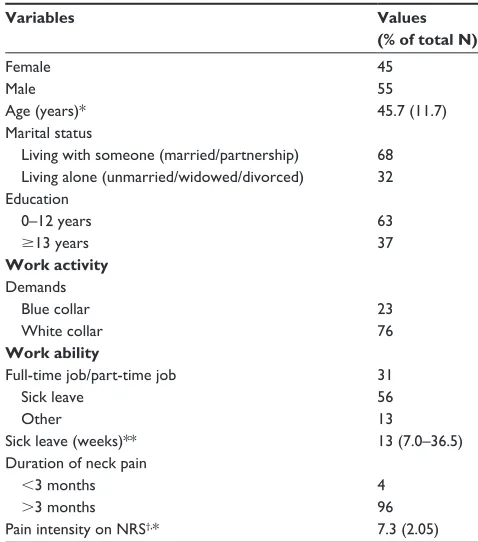
The mean age of the 249 participants was 45.7 years (SD 11.7). The characteristics of the participants are summa-rized in Table 1. The majority of the patients suffered from chronic neck pain (96%), with a mean pain intensity of 7.3 as indicated on the numeric rating scale. At the assessment time, 56% of the patients were on sick leave.
Of 628 reported functional problems by the PSFS, 13 meaningful ICF domains were identified: four domains loading on a body functions component (b) and nine domains loading on the activities and participation component (d).
Of the twelve categories referring to body functions, four were in the domain of mental functions (b1), followed by three categories in the neuromusculoskeletal and movement-related
Table 1 Characteristics of participants (N = 249)
Variables Values
(% of total N)
Female Male
45 55
Age (years)* 45.7 (11.7)
Marital status
Living with someone (married/partnership) Living alone (unmarried/widowed/divorced)
68 32 Education
0–12 years
$13 years
63 37
Work activity
Demands Blue collar White collar
Work ability
Full-time job/part-time job Sick leave
Other
23 76
31 56 13
Sick leave (weeks)** 13 (7.0–36.5)
Duration of neck pain
,3 months
.3 months
4 96 Pain intensity on NRS†,* 7.3 (2.05)
Notes: *Expressed as mean (SD); **expressed as median (IQR); †values ranging
from 1 (“no pain”) to 10 (“the worst pain imaginable”).
Abbreviations: SD, standard deviation; IQR, interquartile range; NRS, numeric rating scale.
Dovepress Linking self-determined functional problems to the ICF
Patient Preference and Adherence downloaded from https://www.dovepress.com/ by 118.70.13.36 on 26-Aug-2020
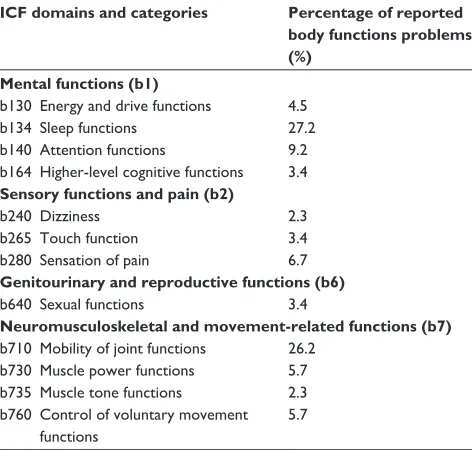
functions domain (b7). The fewest categories were in the geni-tourinary and reproductive functions domain (b6) (Table 2).
Of the 31 categories referring to activities and participa-tion, nine were in the mobility domain (d4), followed by four in the self-care domain (d5). The fewest links were in the communication domain (d3) (Table 3).
Within the 88 second-level ICF classification categories of body functions, the most frequently reported items were sleep function (b134; 27%) and mobility of joint functions (b710; 26%).
Within the 538 second-level categories of activities and participation, remunerative employment (d850; 15%) was reported as the most frequent item, closely followed by doing housework (d640; 14%), and recreation and leisure activities (d920; 13%). Lifting and carrying objects (d430) was also frequently reported (10%), while driving (d475) and maintaining a body position (d415) were reported in less than 10% of problems (see Table 3).
Only two meaningful concepts described as “be active” and “to function after activities” were not assigned to a spe-cific ICF category. These were reported by one patient each, and coded as nondefinable (nd).
Discussion
An assessment of the self-reported functional problems in patients with neck pain showed that the majority of specific
functional problems presented in this study fit with the ICF model.
By dividing the linked categories into more and less frequently reported, we were able to highlight the typical functional problems described by these patients. Problems with functions belonging to the activities and participation
Table 2 Percentage of self-determined functional problems on PSFS linked to the ICF component of body functions (N = 88)
ICF domains and categories Percentage of reported body functions problems (%)
Mental functions (b1)
b130 Energy and drive functions 4.5 b134 Sleep functions 27.2 b140 Attention functions 9.2 b164 Higher-level cognitive functions 3.4
Sensory functions and pain (b2)
b240 Dizziness 2.3
b265 Touch function 3.4
b280 Sensation of pain 6.7
Genitourinary and reproductive functions (b6)
b640 Sexual functions 3.4
Neuromusculoskeletal and movement-related functions (b7)
b710 Mobility of joint functions 26.2 b730 Muscle power functions 5.7 b735 Muscle tone functions 2.3 b760 Control of voluntary movement
functions
5.7
Abbreviations: PSFS, Patient-Specific Functional Scale; ICF, International Classification of Functioning, Disability, and Health.
Table 3 Percentage of self-determined functional problems on PSFS linked to the ICF component of activities and participation (N = 538)
ICF domains and categories Percentage of reported activities and participation problems (%)
Learning and applying knowledge (d1)
d155 Acquiring skills 0.2 d160 Focusing attention 0.4
d166 Reading 4.0
d170 Writing 0.6
General tasks and demands (d2)
d220 Undertaking multiple tasks 0.4 d230 Carrying out daily routine 0.6 d240 Handling stress and other
psychological demands
0.4
Communication (d3)
d360 Using communication devices and techniques
5.0
Mobility (d4)
d410 Changing body position 1.0 d415 Maintaining a body position 7.8 d420 Transferring oneself 0.4 d430 Lifting and carrying objects 10.4 d440 Fine hand use 0.6 d445 Hand and arm use 2.4
d450 Walking 3.1
d455 Moving around 3.0
d475 Driving 9.0
Self-care (d5)
d510 Self-washing 1.0 d520 Caring for body parts 1.0
d540 Dressing 1.5
d570 Looking after one’s health 0.6
Domestic life (d6)
d630 Preparing meals 0.4 d640 Doing housework 14.0 d660 Assisting others 0.8
Interpersonal interactions and relationship (d7)
d750 Informal social relationship 1.5 d760 Family relationship 1.0
Major life area (d8)
d839 Education 0.6
d850 Remunerative employment 14.7 d855 Non-remunerative
employment
0.2
Community, social and civic life (d9)
d920 Recreation and leisure 13.2 d930 Religion and leisure 0.2
Abbreviations: PSFS, Patient-Specific Functional Scale; ICF, International Classification of Functioning, Disability, and Health.
Dovepress
Andelic et al
Patient Preference and Adherence downloaded from https://www.dovepress.com/ by 118.70.13.36 on 26-Aug-2020
component were the most frequently reported and in
accor-dance with findings in a study from New Zealand.13 However,
the study found that patients with neck problems showed a higher proportion of body function impairments than those reported by patients with musculoskeletal pain in other body
regions.13
Sleep disturbance was a frequently reported body function
problem in our study. According to Sjors et al,19 it has been
suggested that neurobiological sensitization at the somatic, cognitive, and behavioral level may increase the prevalence
of sleeping problems.19 Another possible explanation is that
sleeping problems are secondary to the consequences of
living with chronic pain.20
Functional problems with mobility of joint functions were also frequently described. The cervical range of motion is often used in clinical practice as a functional outcome
measure.21 Previous studies have reported that patients with
subclinical neck pain showed important signs of impair-ment in neck muscle endurance, rotation, and extension
movement.22,23 These impairments in range of motion and
muscle endurance may be early physical markers of the
development of chronic neck pain.23 Other studies have
reported that rotation and extension in the cervical spine are
commonly reduced in chronic neck pain patients.22
The substantial number of links to the activities and participation categories supports the evidence that currently
exists.13 Patients reported problems with static activities such
as, computer work (ie, category of using communication devices and techniques), driving and maintaining a body position (ie, sedentary activities), and lifting and carry-ing objects. Neck pain is linked to movement repetitions, awkward postures and prolonged maintenance of static
postures.21,24 Sustained static muscle activation has also
been associated with chronic neck pain.25 For example, the
progressive deterioration in the posture of computer work-ers has been associated with an increase in trapezius muscle
activity while performing data entry tasks.26
Functional problems, including housework, recreation and leisure, and employment, were the main areas of limitation in the component of activities and participation. Housework activities, such as cleaning, and problems with an active life style, including regularly training, swimming, and bicycling, were also noted. It has been reported that non-specific neck pain impacted on the risk of limited physical
and social functioning in the long-term perspective.27 Our
findings of frequently reported problems regarding employ-ment may reflect the fact that almost 60% of patients were on long-term sick leave at the time of the assessment. The mean
age of patients showed that they were in their most
produc-tive years, in accordance with previous studies.28 According
to a recently published review article, neck disorders are a significant source of activity limitations in workers. The complex relationships between individual and workplace risk factors, such as occupation, poor job satisfaction, awkward work postures, poor physical work environment, emotional problems, and workers’ ethnicity, may be associated with
neck pain.29
A study by Ferreira et al,14 found that the most frequently
used measurement of neck pain-related disability with
predetermined items, the Neck Disability Index (NDI),30
demonstrated a well-balanced distribution of items across the ICF components. The NDI contains the following items: pain intensity, personal care, lifting, reading, headache, concentra-tion, work, driving, sleeping, and recreational activities.
The findings in our study were comparable with Ferreira’s findings regarding the distribution of self-determined
functional problems and NDI items.14 However, frequently
reported functions and activities in our study, such as mobility of joint functions, maintaining a body position, using com-munication devices and techniques, and doing housework, are not part of the NDI. Additionally, a number of functions reported with low frequency in our study, such as several categories of general tasks and demands (including psycho-logical demands) and interpersonal interactions and relation-ship, are not included in the NDI. Taken together, the most and least frequently reported functions in our study seem to provide significant knowledge about the self-determined functional consequences of chronic neck pain. The use of the PSFS as a supplement to NDI assessment may enable clini-cians to obtain a more complete picture of neck pain-related functional limitations and patient needs.
From the ICF perspective, the ICF-based “Core Sets” for
the classification of health conditions have been developed.31
These core sets select a subset of categories that can serve as minimal standards for the assessment of functioning and health in relation to specific disorders including arthritis, low
back pain, and other chronic musculoskeletal conditions.32
As there is currently no core set for neck pain, we chose to utilize the patient’s own experience to classify their func-tional problems and linked those to the ICF. The results of this study may contribute to the identification of the aspects of functioning that need to be addressed in the clinical assessment, evaluation, and rehabilitation of patients with neck pain.
Some study limitations should be mentioned. The patients were recruited from a university hospital and represent a
Dovepress Linking self-determined functional problems to the ICF
Patient Preference and Adherence downloaded from https://www.dovepress.com/ by 118.70.13.36 on 26-Aug-2020
sample with long-lasting disability related to neck pain. Half of the invited patients were not eligible for the study due to exclusion criteria, giving a low response rate. However, we included 70% of all eligible patients. Their gender distribu-tion and mean age was equal to that of other patients with neck pain referred to the clinic (source: quality register at the hospital), making the study results generalizable. The com-plete health experience of a person with neck pain was not widely described in this study as the PSFS failed to represent the context of personal and environmental factors, and the study was not designed to assess the influence of psychologi-cal distress on neck pain-related disability.
Conclusion
The majority of the specific functional problems presented by patients in this study showed a good fit with the ICF model. By dividing the linked categories into more and less frequently reported functions, we were able to highlight typical functional problems in these patients that need to be addressed in the clinical assessment. The frequent links to the body functions categories (ie, sleep function and mobility of joints) and to the activities and participation categories (ie, lifting and carrying objects, doing housework, employ-ment, recreation and leisure) indicate a multidimensionality of functional problems. Interventions designed to improve functional status of patients with neck pain-related disabil-ity should integrate these complexities as well as include a multidisciplinary rehabilitation team in order to secure best functional outcomes for patients.
Disclosure
The authors declare they have no conflicts of interest.
References
1. Kuorinka I, Jonsson B, Kilbom A, et al. Standardised Nordic
ques-tionnaires for the analysis of musculoskeletal symptoms. Appl Ergon.
1987;18(3):233–237.
2. Carroll LJ, Hurwitz EL, Côté P, et al. Research priorities and methodological implications: the Bone and Joint Decade 2000–2010
Task Force on Neck Pain and Its Associated Disorders. J Manipulative
Physiol Ther. 2009;32(Suppl 2):S244–S251.
3. Feleus A, Bierma-Zeinstra SM, Miedema HS, Bernsen RM, Verhaar JA, Koes BW. Incidence of non-traumatic complaints of arm, neck and
shoulder in general practice. Man Ther. 2008;13(5):426–433.
4. Hill J, Lewis M, Papageorgiou AC, Dziedzic K, Croft P. Predicting
persistent neck pain: a 1-year follow-up of a population cohort. Spine
(Phila Pa1976). 2004;29(15):1648–1654.
5. Borghouts JA, Koes BW, Bouter LM. The clinical course and prog-nostic factors of non-specific neck pain: a systematic review. Pain. 1998;77(1):1–13.
6. Hansson EK, Hansson TH. The costs for persons sick-listed more than one month because of low back or neck problems. A two-year
prospec-tive study of Swedish patients. Eur Spine J. 2005;14(4):337–345.
7. Barten JA, Pisters MF, Huisman PA, Takken T, Veenhof C. Measurement properties of patient-specific instruments measuring physical function.
J Clin Epidemiol. 2012;65(6):590–601.
8. Tschiesner U, Linseisen E, Baumann S, et al. Assessment of functioning in patients with head and neck cancer according to the International Classification of Functioning, Disability, and Health (ICF): a multicenter
study. Laryngoscope. 2009;119(5):915–923.
9. Stratford P, Gill C, Westaway M, Binkley J. Assessing disability and change on individual patients: a report of a patient specific measure.
Physiother Can. 1995;47(4):258–263.
10. Westaway MD, Stratford PW, Binkley JM. The patient-specific func-tional scale: validation of its use in persons with neck dysfunction.
J Orthop Sports Phys Ther. 1998;27(5):331–338.
11. WHO. The International Classification of Functioning, Disability and Health-ICF. Geneva: World Health Organization [2001]. Available from: http://www.who.int/classifications/icf/en/. Accessed September 6, 2012.
12. Wade DT, de Jong BA. Recent advances in rehabilitation. BMJ.
2000;320(7246):1385–1388.
13. Fairbairn K, May K, Yang Y, Balasundar S, Hefford C, Abbott JH. Mapping Patient-Specific Functional Scale (PSFS) items to the International Classification of Functioning, Disability and Health (ICF).
Phys Ther. 2012;92(2):310–317.
14. Ferreira ML, Borges BM, Rezende IL, et al. Are neck pain scales and questionnaires compatible with the international classification of
functioning, disability and health? A systematic review. Disabil Rehabil.
2010;32(19):1539–1546.
15. Lee KC, Chiu TT, Lam TH. The role of fear-avoidance beliefs in patients with neck pain: relationships with current and future disability and work
capacity. Clin Rehabil. 2007;21(9):812–821.
16. Haldeman S, Carroll L, Cassidy JD, Schubert J, Nygren A; for The Bone and Joint Decade 2000–2010 Task Force on Neck Pain and Its Associated Disorders. The Bone and Joint Decade 2000–2010 Task Force on Neck Pain and Its Associated Disorders: executive summary.
Spine (Phila Pa 1976). February 15, 2008;33(Suppl 4):S5–S7. 17. Carroll LJ, Hogg-Johnson S, van der Velde G, et al. Course and
prog-nostic factors for neck pain in the general population: results of the Bone and Joint Decade 2000–2010 Task Force on Neck Pain and Its Associated
Disorders. J Manipulative Physiol Ther. 2009;32(Suppl 2):S87–S96.
18. Cieza A, Geyh S, Chatterji S, Kostanjsek N, Ustün B, Stucki G. ICF
link-ing rules: an update based on lessons learned. J Rehabil Med. 2005;37(4):
212–218.
19. Sjörs A, Larsson B, Persson AL, Gerdle B. An increased response to experimental muscle pain is related to psychological status in women
with chronic non-traumatic neck-shoulder pain. BMC Musculoskelet
Disord. 2011;12:230.
20. Eriksen HR, Ursin H. Sensitization and subjective health complaints.
Scand J Psychol. 2002;43(2):189–196.
21. Howell ER. The association between neck pain, the Neck Disability
Index and cervical ranges of motion: a narrative review. J Can Chiropr
Assoc. 2011;55(3):211–221.
22. Jordan A, Mehlsen J, Ostergaard K. A comparison of physical character-istics between patients seeking treatment for neck pain and age-matched
healthy people. J Manipulative Physiol Ther. 1997;20(7):468–475.
23. Lee H, Nicholson LL, Adams RD. Cervical range of motion associations
with subclinical neck pain. Spine (Phila Pa 1976). 2004;29(1):33–40.
24. Madeleine P, Lundager B, Voigt M, Arendt-Nielsen L. Shoulder muscle co-ordination during chronic and acute experimental neck-shoulder
pain. An occupational pain study. Eur J Appl Physiol Occup Physiol.
1999;79(2):127–140.
25. McLean L. The effect of postural correction on muscle activation
amplitudes recorded from the cervicobrachial region. J Electromyogr
Kinesiol. 2005;15(6):527–535.
26. Kleine BU, Schumann NP, Bradl I, Grieshaber R, Scholle HC. Surface EMG of shoulder and back muscles and posture analysis in
secretar-ies typing at visual display units. Int Arch Occup Environ Health.
1999;72(6):387–394.
Dovepress
Andelic et al
Patient Preference and Adherence downloaded from https://www.dovepress.com/ by 118.70.13.36 on 26-Aug-2020
Patient Preference and Adherence
Publish your work in this journal
Submit your manuscript here: http://www.dovepress.com/patient-preference-and-adherence-journal
Patient Preference and Adherence is an international, peer-reviewed, open access journal focusing on the growing importance of patient preference and adherence throughout the therapeutic continuum. Patient satisfaction, acceptability, quality of life, compliance, persistence and their role in developing new therapeutic modalities and compounds to
optimize clinical outcomes for existing disease states are major areas of interest. This journal has been accepted for indexing on PubMed Central. The manuscript management system is completely online and includes a very quick and fair peer-review system. Visit http://www.dovepress.com/ testimonials.php to read real quotes from published authors.
27. Thelin A, Holmberg S, Thelin N. Functioning in neck and low back pain from a 12-year perspective: a prospective population-based study.
J Rehabil Med. 2008;40(7):555–561.
28. Lakke SE, Soer R, Takken T, Reneman MF. Risk and prognostic factors for non-specific musculoskeletal pain: a synthesis of
evi-dence from systematic reviews classified into ICF dimensions. Pain.
2009;147(1–3):153–164.
29. Côté P, van der Velde G, Cassidy JD, et al. The burden and determi-nants of neck pain in workers: results of the Bone and Joint Decade 2000–2010 Task Force on Neck Pain and Its Associated Disorders.
J Manipulative Physiol Ther. 2009;32(Suppl 2):S70–S86.
30. Vernon H, Mior S. The Neck Disability Index: a study of reliability
and validity. J Manipulative Physiol Ther. 1991;14(7):409–415.
31. Stucki G, Kostanjsek N, Ustün B, Cieza A. ICF-based classification
and measurement of functioning. Eur J Phys Rehabil Med. 2008;44(3):
315–328.
32. Schwarzkopf SR, Ewert T, Dreinhöfer KE, Cieza A, Stucki G. Towards an ICF Core Set for chronic musculoskeletal conditions: commonalities across ICF Core Sets for osteoarthritis, rheumatoid arthritis,
osteopo-rosis, low back pain and chronic widespread pain. Clin Rheumatol.
2008;27(11):1355–1361.
Dovepress
Dove
press
Linking self-determined functional problems to the ICF
Patient Preference and Adherence downloaded from https://www.dovepress.com/ by 118.70.13.36 on 26-Aug-2020