68
Determinats Of Commitment From Women’s
Cooperatives Through Relationship Values
M. Farid Afandi, Armanu Thoyib, Eka Afnan Troena, M. Misbahul Amri
Abstract: Relationship marketing is important for marketers and researchers. The objective of this study is to analyze the causal effects and relations of the four constructs, i.e., customer satisfaction, relational values, trust and commitment applied in the context of services marketing. The research sample consisted of 200 respondents i.e., the members of women’s cooperative in East Java Province, collected by applying the simple random sampling method. Data were analyzed by using Structural Equation Modelling (SEM) with AMOS program. The results showed that to create a strong bonding in the form of commitment with the customer, the initial strategy must be built to strengthen members’ trust by creating customer satisfaction. The process must be supported continuously by the creation of advantageous values for customers. Customers perceived with relational values will have a strong impact on the customer to maintain a long-term relationship.
Index Terms: Satisfaction, values, trust, commitment, relationship marketing.
————————————————————
1
I
NTRODUCTIONRELATIONAL marketing is an important issue for researchers and marketers, as the development of its concept and practice has significantly influenced current marketing activities. Several decades ago, when the term of relational marketing was not yet as prominent as it is now, had proposed the idea about the importance of maintaining long-term relationships with customers (Arndt, 1979). However, it was (Berry, 1983) who first introduced the term "relational marketing" at a conference about services marketing. At first, relational marketing was mostly applied on B-to-B research. The development of the relational marketing concept has made researchers and marketers realize the significance of building a long-term relationship with the end users of the product.. Some research results explain that trust and commitment are two important factors in establishing relational marketing (E. Anderson & Weitz, 1992; Morgan & Hunt, 1994). Several studies have defined the relationship of satisfaction, trust, and commitment (Morgan & Hunt, 1994; Rizan, Warokka, & Listyawati, 2014; Walter, Mueller, & Helfert, 2000b; Wright & Grace, 2011); and the interesting relationship between relational values and relational marketing (Ravald & Grönroos, 1996a). The concept of value has become a major concern for company management (Tzokas & Saren, 1999). Referring to the research background, this study aims to analyze the effect and relationship of the four constructs, namely customer satisfaction, relational values, trust, and commitment in the context of service business. A theoretical study of the concept leading to a hypothesis formulation will explain the relationship of the four constructs. The analysis includes the methods used and results of the study, along with the conclusion that describes the managerial implications, limitations, and suggestions for future research.
2
L
ITERATURER
EVIEW2.1 Services on Relational Marketing
The consumers of service products are different from the consumers of goods or physical products. The quality of service products relies on the process while the physical products prioritizes the final output of the products (Grönroos, 1998). Service providers have direct contact or involvement with their customers. Thus, it is easier for them to establish a relationship with the customers. In the service industry, the competitive advantage is not only created based on the product price setting, as what has mostly been applied in the market competition for the physical products, but mainly also about how to deliver excellent service to customers (Christopher, Payne, & Ballantyne, 1991). There are several things that should be considered regarding the relational marketing process in the service business context, i.e., the interaction process as the core of relational marketing, the communication planning process that supports the relation, and the value delivery process as the result of relational marketing (Grönroos, 2004). However, although the concept of relational marketing has rapidly developed, there is no fixed understanding of the real definition of relational marketing. According to (Agariya & Singh, 2011), there are 72 definitions of relational marketing. Some notions include the process of attracting, maintaining, and improving customer relationship (Berry, 1983); the process of forming, maintaining, and improving customer relationships (Gronroos, 1990); and the process attracting, developing, and maintaining customer relationships (Berry & Parasuraman, 1991); Meanwhile, (Morgan & Hunt, 1994) state that relational marketing is a marketing activity aimed to build, develop, and maintain a successful exchange of relationship between marketer and customer. Referring to these definitions, it can be concluded that relational marketing is a marketing activity performed by companies, ranging from building, developing, and maintaining exchange with customers for long-term periods. As previously explained, relational marketing on the service business context is mainly focused on the process, not only on the output or end products. There are several values that can be increased to the marketing of service products, including waiting time (just-in-time), fast response service delivery, customer orientation, and timely service (Grönroos, 2004). Consumers in service products vary greatly and might demand a variety of requests towards the offered services, such as friendliness, trustworthiness, and most importantly, on time ______________________________
M. Farid Afandi is doctoral student in faculty of economics
and business in University of Brawijaya, Indonesia. E-mail: [email protected]
Prof. Dr. Armanu Thoyib, faculty of economics and
business in University of Brawijaya, Indonesia.
Prof. Dr. Eka Afnan Troena, faculty of economics and business in University of Brawijaya, Indonesia.
Dr. M. Misbahul Amri, State University of Malang,
service. It can be concluded that in order to survive in the industry, and to have a competitive advantage, a company should not simply focus on creating an interesting product, but it should also offer added-value to its customers. The added value is the company's competitive advantage, one of which is by establishing a relational marketing strategy.
2.2 Customer Satisfaction
Satisfaction is a person's emotional reaction to the results of experience after consuming a product or service (Oliver, 1993). It is the feeling of happiness or disappointment towards a product or service, by comparing the product performance with expectations (Kotler, Philip & Keller, 2016). Satisfaction has become an important part of the marketing concept. There are several models and theories used to explain the concept of satisfaction. Two of the most widely used are the C/D paradigm (confirmation/disconfirmation) and perceived performance or quality (E. W. Anderson & Sullivan, 1993; Walter et al., 2000b). The C/D paradigm describes satisfaction as a comparison made by the customer between the post purchase of the product and the evaluation after consuming the product compared to the expectation before purchasing and consuming the product. Consumers will value satisfaction in every single detail of the transaction, not only cumulative satisfaction, but starting from the purchase up until the post-purchase evaluation. This C/D paradigm is widely used by consumers who buy service products, for both goods or physical products, the most used concept is product performance measurement or perceived quality.
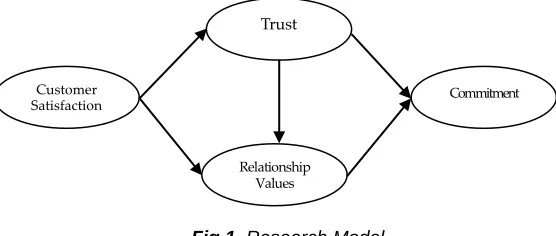
Fig 1. Research Model
Figure 1 shows the relationships between variables in the conceptual framework of this study. Satisfaction is an attitude based on past experience. A person's positive experience towards a product or a company will gradually form his/her trust towards the product/company (Walter, Mueller, & Helfert, 2000a). An effective way for companies to build customer trust is by providing a positive experience. If customers can feel the positive experience in meeting their needs and desires, then they will be more easily satisfied and will more easily give trust to the company (Ganesan, 1994). Therefore, we formulate the first hypothesis of the study as the following:
Hypothesis 1: Customer satisfaction has a significant effect on customer trust.
Satisfaction can strengthen the relationship between customers and companies/organizations (Holt, 1999). Relational value is a form of exchange or comparison between all benefits and sacrifices in building a business relationship. Satisfied customers have a tendency to claim less complaints because they tend to reduce the sacrifice or effort needed to
look for other similar products (Sharma, Niedrich, & Dobbins, 1999). Referring to the reasoning, the second hypothesis of the study is:
Hypothesis 2: Customer satisfaction has a significant effect on relationship value.
2.3 Trust
Trust and commitment are the most important parts of building a relationship (Morgan & Hunt, 1994). According to Moorman, Deshpande, & Zaltman (Morgan & Hunt, 1994) trust is the willingness or compliance to depend on exchange partners based on a belief. (Walter et al., 2000b) argue that trusting with a belief involves three components. First, trusting that a relational partner will show kindness or generosity in each of his actions, both directly and indirectly. Second, trust also includes honesty, which means that the party who give trust wishes to depend on the relational partner whom he considers credible. Third, trusting that relational partners have the competence to act for the purpose of maintaining relationships. Kindness (generosity), honesty, and competence are significant in building trust. These three concepts are important in building relationship value between customers and companies (Walter et al., 2000b). A relational value might be achieved when customers have faith towards the reliability and integrity of theirs partners in the exchange process (Morgan & Hunt, 1994). High relational values can be achieved when customer perceptions of sacrifice in establishing relationships can be reduced by increasing safety, credibility, and security (Ravald & Grönroos, 1996a). Thus, our third hypothesis is the following:
Hyphotesis 3: Trust has a significant effect on relationship value.
Many studies explain the relationship between trust and commitment (Morgan & Hunt, 1994; Wright & Grace, 2011). Long-term relationships are strongly influenced by the level of trust between customers and vendors towards the "channel partners" (Ganesan, 1994). Trust is the main determinant of the commitment (Morgan & Hunt, 1994), which arises when there is a trust towards the reliability and integrity of the exchange partners (Wright & Grace, 2011). In accordance with the theory of trust and commitment, described by Morgan & Hunt, the fourth hypothesis is formulated as below:
Hypothesis 4: Trust has a significant effect on customer commitment.
2.4 Relationship Values
Value is an important part of relational marketing. In order to create competitive advantage, the company should be able to create superior value. The purpose of adding value to the company's main products is to offer the best product that will increase customer satisfaction. Therefore, adding value is expected to strengthen customer bonds with the company and to achieve customer loyalty (Ravald & Grönroos, 1996a). (Woodruff, 1997) defines customer value as a preference, perceived by customers to evaluate product attributes, performance attributes, and the consequences as the results from the use of the facilities to achieve customers’ goals and objectives in a situation of utilization. However, this definition is still limited to the understanding of customer value at the Trust
Customer
Satisfaction Commitment
70 product level. Recently, the researchers have tried to explain
the value of the relational meaning (shifting from transactional orientation to relational orientation) (Ravald & Grönroos, 1996a). Research on relational value is still limited, especially related to its antecedents and outputs in a business relationship (Walter et al., 2000b). Customers are willing to continue to build relationships in the future with the company based on positive experiences and evaluations (Walter et al., 2000a). A business that is oriented towards its customers will provide assurance to customers that the company strongly strives to maintain relationships by increasing the values of relationships that will finally affect customer commitment (Morgan & Hunt, 1994; Walter et al., 2000b). These reasons lead to the fifth hypothesis of the study:
Hypothesis 5: Relationship value has a significant effect on customer commitment.
2.5 Commitment
Commitment is an important part in building long-term relationships (Morgan & Hunt, 1994). Commitment is defined as a belief that a sustained relationship with other parties is very important and needs maximum effort to maintain, so that both parties are committed and trust each other without any limitation of time (Morgan & Hunt, 1994). According to (Gundlach, Achrol, & Mentzer, 1995) there are three dimensions of commitment. First, affective commitment is a positive attitude towards the sustainability of relationships into the future. Second, instrumental commitment is to make a form of investment (time, other resources) of the relationship. Third, temporal commitment indicates a relationship that exists from time to time.
3
R
ESEARCHM
ETHODOLOGY3.1 Data Collection and Sample
This research is a causal study with the purpose to analyze the causal relationships among variables. Results from causal research can be used by decision makers based on the assumptions of the results of their causal relationships (Malhotra & Birks, 2007). The population of this study was all members of the women's cooperative, called Setia Bhakti Wanita Cooperative (SBWC) in Surabaya, as has been assigned by the Indonesian Ministry of Cooperatives and Small Medium Enterprises (SMEs). SBWC is also the representative of the pioneering women's cooperative. Currently, there are 13 thousand members of SBWC that are included in 400 active member groups. The sample of the study consisted of 200 respondents, collected by applying simple random sampling. This study used primary data that was obtained directly from the respondents, i.e., the members of SBWC, in line with the purpose of the study (Malhotra & Birks, 2007). Data were collected by distributing questionnaires to the SBWC members at the beginning of every month (May-August 2017). The time is set due to conditions that during the first and the thirteenth dates, there is one of the group leaders and/or the members visiting the SBWC office in Surabaya to arrange the fund lending transactions. Collected data used simple random sampling.
3.2 Data Collection and Sample
All research constructs were measured using a Likert scale with 5 answer points. A list of the questions used in this study
is presented in the appendix. The first measurements are the validity and reliability testing of the questionnaire. Second, the construct testing of the four variables. And finally, a SEM analysis with AMOS program is used to test the model fit.
Customer satisfaction will be measured by modifying the question from the (Walter et al., 2000b). The questions asked about respondent satisfaction with the performance of each attribute by using 5 answer points, ranging from "very dissatisfied" to "very satisfied". The questions are about the satisfaction towards the performance of the KSBW’s management; satisfaction towards the service performance of KSBW’s employees; satisfaction towards the speed of the lending transaction process at the SBW; and satisfaction towards the performance of Field Officers (PPL) of KSBW.
Trust is measured by adapting the research questionnaire of (Kumar, Stern, & Anderson, 1993), (Ganesan, 1994), and (Walter et al., 2000b). There are 3 questions about trust associated with honesty, benevolence, and competence. All question items use 5 answer points, ranging from "strongly disagree" to "strongly agree".
Relationship values are measured by adapting (Ravald & Grönroos, 1996b); and (Walter et al., 2000b). There are 4 items of questions about relational values, namely: perceived value related to the benefits and sacrifices as the members of KSBW, relational value of KSBW compared to its competitors, the value of the overall relationship with KSBW, and the value of benefits obtained from the overall KSBW performance. The item question used 5 answer points. The first to the third questions used "strongly disagree" to "strongly agree" answers, while the fourth question used the "very low" to "very high" answers.
Commitment is measured by referring to the research of (Ganesan, 1994), and (Walter et al., 2000b). It consists of 5 question items. This question relates to several aspects of commitment, namely relationships with long-term goals, willingness of members to provide time and other resources in building relationships, prioritizing long-term relationships over short-term relationships, helping to develop organizations in the future, and defending organizations when outsiders criticize. The item question uses 5 answer points. The answers are ranging from "strongly disagree" to "strongly agree".
4
R
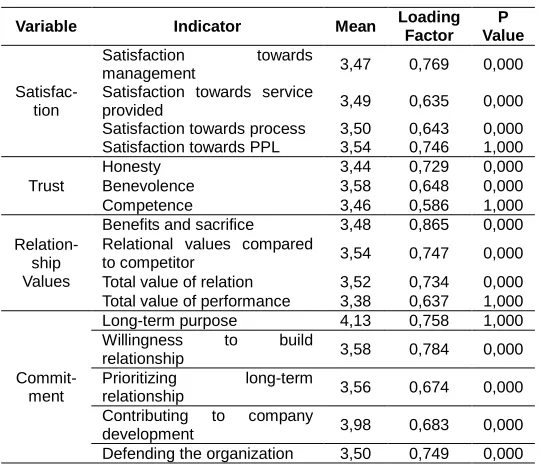
ESULTTable 1. Measurement Model
Variable Indicator Mean Loading
Factor P Value
Satisfac-tion
Satisfaction towards
management 3,47 0,769 0,000
Satisfaction towards service
provided 3,49 0,635 0,000
Satisfaction towards process 3,50 0,643 0,000 Satisfaction towards PPL 3,54 0,746 1,000
Trust
Honesty 3,44 0,729 0,000
Benevolence 3,58 0,648 0,000
Competence 3,46 0,586 1,000
Relation-ship Values
Benefits and sacrifice 3,48 0,865 0,000 Relational values compared
to competitor 3,54 0,747 0,000 Total value of relation 3,52 0,734 0,000 Total value of performance 3,38 0,637 1,000
Commit-ment
Long-term purpose 4,13 0,758 1,000 Willingness to build
relationship 3,58 0,784 0,000
Prioritizing long-term
relationship 3,56 0,674 0,000
Contributing to company
development 3,98 0,683 0,000
Defending the organization 3,50 0,749 0,000
Table 2 shows that, overall, the measurement model is acceptable, or in other words the model's fit is achieved as there is a match between the model and the data. The Chi-square value (ꭓ2) = 143,366; probability (P) value = 0.024; and AGFI value = 0.893 are all below the cutoff value but are still considered moderate. Other index values such as RMSEA = 0.038 or less than 0.08; GFI = 0.930 or more than the minimum value of 0.9; TLI = 0.960 and CFI = 0.971 or more than the minimum value of 0.95, meaning that it is considered acceptable (Bagozzi & Yi, 1988).
Table 2. Evaluation Results of the Goodness of Fit
Goodness of fit
index Cut-off value
Model
result Description Chi-square Preferably small 143,366 Moderate
Probability ≥ 0,05 0,024 Moderate
RMSEA ≤ 0,08 0,038 Good
GFI ≥ 0,90 0,930 Good
AGFI ≥ 0,90 0,893 Moderate
TLI ≥ 0,95 0,960 Good
CFI ≥ 0,95 0,971 Good
The tool used to explain the results of the structural relationships of each hypothesized variable is AMOS 20 (Table 3). The results of the analysis show that satisfaction has a significant effect on trust and relationship values (hypothesis 1 and hypothesis 2 are supported). Trust has a significant effect on relationship value and commitment (hypothesis 3 and hypothesis 4 are supported). Finally, relationship values have a significant effect on commitment (hypothesis 5 is supported).
Tabel 3. Results of Model Relation Testing
Proposed model path Estimated C.R Description Satisfaction → trust
Satisfaction → relationship values
Trust → relationship values Trust → commitment
Relationship values → commitment 0,611 1,184 0,202 0,185 0,583 3,348 3,607 3,562 2,871 3,887 Supported Supported Supported Supported Supported
5
M
ANAGERIALI
MPLICATIONSThe process of developing, managing and maintaining relationships with customers is an important part of the organization, and needs to be improved regarding the processes and mechanisms for building bonds (Walter et al., 2000a). The proposed model of this study has several implications for the women's cooperatives that seek to strengthen the commitment of their members. First, to build bonds with all members of the organization, the cooperative board should be able to build trust among those in the internal organization. Trust can be built and strengthened by conducting joint training, rewarding teamwork and all behaviors directed to achieve the common goals (Smith & Barclay, 1993). Second, the value of the relationship, based on the results of this study, is also a trade-off to maintain the relationships and commitments. Therefore, to establish an effective bonding, the KSBW management must be able to strengthen the value of the relationships as by their members. The basic concept of an organization is in establishing a good relationship with customers to deliver value (Walter et al., 2000a). Therefore, organizations must understand what values they have to offer to the customers in order to gain competitive advantage. The results of this study show how all benefits are perceived by customers compared to their sacrifices. This, can affect the value of relationships and their commitments.
6
C
ONCLUSIONSatisfaction has a positive effect and relationship towards trust and the value of relationships. Trust has a positive effect and relationship towards the value of the relationship, and trust and the value of the relationship have a positive effect and relationship to commitment. The results of this study are as what have been expected (cf. Garbarino & Johnson, 1999). The findings indicate that satisfaction towards commitment is related to the value of the relationship. There are not many studies explaining the relationship between satisfaction and customer value (Walter et al., 2000a), although, theoretically, there are several researchers who have explained the relationship between satisfaction and the value of relationships (Grönroos, 1997). In our study we have focused on service provider (co-operative)-customer relationships. If we would have looked at relationships between channel relationships and their customers, or in the retailers and manufactures there might have been different results. Therefore, the variables we have explained might not have reported for such a high part of the variance of commitment. It could be that our findings can only be generalized to relationships in other industries to a certain amount.
R
EFERENCES[1]. Agariya, A. K., & Singh, D. (2011). What Really Defines Relationship Marketing ? A Review of Definitions and General and Sector- Specific Defining Constructs. Journal of Relationship Marketing, 10, 203–237.
http://doi.org/10.1080/15332667.2011.624905
[2]. Anderson, E. W., & Sullivan, M. W. (1993). The Antecedents and Consequences of Customer Satisfaction for Firms. Marketing Science, 12(2), 125– 143.
72 to Build and Sustain Commitment in Distribution
Channels. Journal of Marketing Research, 29(1), 18– 34.
[4]. Arndt, J. (1979). Toward a Concept of Domesticated Markets. Journal of Marketing, 43, 69–75.
[5]. Bagozzi, R. P., & Yi, Y. (1988). On the Evaluation of Structural Equation Models. Journal of the Academy of Marketing Science, 16(1), 74–94. http://doi.org/10.1007/BF02723327
[6]. Berry, L. L. (1983). Relationship Marketing. In G. L. Shostack & G. D. Upah (Eds.), Emerging Perspectives on Services Marketing (pp. 25–28). Proceedings Series, American Marketing Association, Chicago, IL.
[7]. Berry, L. L., & Parasuraman, A. (1991). Marketing services. New York: NY: Free Press.
[8]. Christopher, M., Payne, A., & Ballantyne, D. (1991). Relationship Marketing. London: Butterworth, Heinemann.
[9]. Ganesan, S. (1994). Determinants of Long-Term Orientation in Buyer-Seller Relationships. Journal of Marketing, 58(2), 1–19.
[10]. Garbarino, E., & Johnson, M. S. (1999). The Different Roles of Satisfaction, Trust, and Commitment in Customer and Relationships. Journal of Marketing, 63(2), 70–87.
[11]. Gronroos, C. (1990). Relationship Approach to Marketing in Service Contexts: the Marketing and Organizational Interface. Journal of Business Research, 20(1), 3–11.
[12]. Grönroos, C. (1997). Value-Driven Relational Marketing: From Products to Resources and Competencies. Journal of Marketing Management,
13(5), 407–419.
http://doi.org/10.1080/0267257X.1997.9964482
[13]. Grönroos, C. (1998). Marketing Services: the Case of a Missing Product. Journal of Business & Industrial
Marketing, 13(4/5), 322–338.
http://doi.org/10.1108/08858629810226645
[14]. Grönroos, C. (2004). The Relationship Marketing Process: Communication, Interaction, Dialogue, Value. Journal of Business & Industrial Marketing, 19(2), 99–113.
[15]. Gundlach, G. T., Achrol, R. S., & Mentzer, J. T. (1995). The Structure of Commitment in Exchange. Journal of Marketing, 59(January), 78–92. http://doi.org/10.2307/1252016
[16]. Holt, S. (1999). Determination of Customer-Perceived Value of Business-to-Business Relationship Managers: A Conceptual Model. In Damien McLoughlin and Conor Horan (eds.) Proceedings of
The 15th Annual IMP Conference. University College, Dublin.
[17]. Kotler, Philip & Keller, K. L. (2016). Marketing Management (15th Ed). New York, NY: Pearson Education, Inc.
[18]. Kumar, N., Stern, L., & Anderson, J. (1993). Conducting Interorganizational Research Using Key Informants. Academy of Management Journal, 36(6), 1633–1651.
[19]. Malhotra, N. K., & Birks, D. F. (2007). Marketing Research: An Applied Approach (3rd ed). England: Prentice Hall, Inc., a Pearson Education company.
[20]. Morgan, R. M., & Hunt, S. D. (1994). The Commitment-Trust Theory of Relationship Marketing. Journal of Marketing, 58(3), 20–38.
[21]. Oliver, R. L. (1993). Cognitive, Affective, and Attribute Bases of the Satisfaction Response. Journal of Consumer Research, 20(December), 418–430.
[22]. Ravald, A., & Grönroos, C. (1996a). The Value Concept and Relationship Marketing. European Journal of Marketing, 30(2), 19–30. http://doi.org/10.1108/03090569610106626
[23]. Ravald, A., & Grönroos, C. (1996b). The Value Concept and Relationship Marketing. European Journal of Marketing, 30(2), 19–30. http://doi.org/http://dx.doi.org/10.1108/002517490101 39116
[24]. Rizan, M., Warokka, A., & Listyawati, D. (2014). Relationship Marketing and Customer Loyalty: Do Customer Satisfaction and Customer Trust Really Serve as Intervening Variables? Journal of Marketing Research and Case Studies, 2014, 1–12. http://doi.org/10.5171/2014.724178
[25]. Sharma, S., Niedrich, R. W., & Dobbins, G. (1999). A Framework for Monitoring Customer Satisfaction: An Empirical Illustration. Industrial Marketing Management, 28, 231–243.
[26]. Smith, J. B., & Barclay, D. W. (1993). Team Selling Effectiveness: A Small Group Perspective. Journal of Business-to-Business Marketing, 1(2), 3–32. http://doi.org/10.1300/J033v01n02
[27]. Tzokas, N., & Saren, M. (1999). Value Transformation in Relationship Marketing. Australasian Marketing Journal (AMJ), 7(1), 52–62.
[29]. Walter, A., Mueller, T. A., & Helfert, G. (2000b). The Impact of Satisfaction, Trust, and Relationship Value on Commitment: Theoretical Considerations and Empirical Results. In Unpublished working paper.
[30]. Woodruff, R. B. (1997). Customer Value: The Next Source for Competitive Advantage. Journal of the Academy of Marketing Science, 25(2), 139–153. http://doi.org/10.1007/BF02894350