5714 IJSTR©2020
www.ijstr.org
Risk Detection Solution on Road Based on
Image Processing and Deep Learning
Giao N. Pham, Thang V. Tran, Hai T. Nguyen, Phong H. Nguyen, and Binh N. Le
Abstract—Safety for pupils on the way to school is always the care of their parents. Because of on the way to school pupils can be meet many risks and dangerous issues as accident, violence, kidnapper, and stranger. Thus, their parents always desire to know the status of pupils on the way to school, and they also desire a solution to detect risks on the road and generate warning to pupils. In this paper, we would like to propose a risk detection solution on the road for pupils based on object detection, face detection and distance estimation. The proposed solution uses the techniques of image processing and deep learning to detect dangerous objects, human face and estimate the distance from the detected objects to pupil to give necessary warnings. Experimental results on the road verified that the proposed solution works well, and it have been responded to the purpose of risk detection on the road for pupils in the real.
Index Terms— Risk Detection on Road, Image Processing, Object Detection, Face Detection, Deep Learning, Fast R-CNN, and Yolo. —————————— ——————————
1 INTRODUCTION
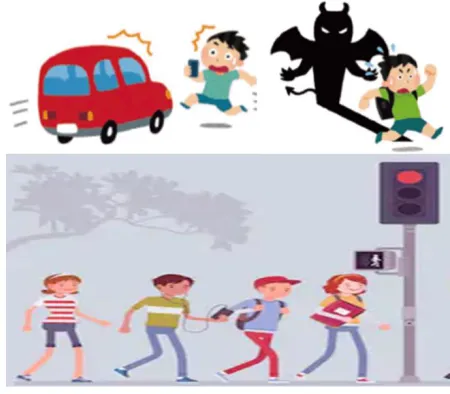
n the developed countries people always is so busy that they could not take time to take their children to school. Thus, children often go to school by themselves. But when children go to school by themselves, they can meet many risks on the way as accidents, violence, kidnapper or stranger [1]. Even they can meet robbers or fight with their friends. Besides that, the number of attacks to pupils who often go alone on the road is increasing [2]. This leads the concern of their parents. And risk issues on the road for pupils are the issues being noticed.Until now, there is no any research that can focus on risks detection for pupils on the way to school and vice versa while the concern of pupils’ parents is increasing. Because of their children can be faced many risks as moving car, motorbike, red light, traffic signs and stranger whom maybe robber or kidnapper on the road without any warning as shown in Fig. 1. Thus, they want a solution to detect risks on the road and generate warnings to children when they are moving on the road. Consequently, a risk detection solution on the road is necessary and suitable to respond the desires of pupils’ parent.
For meeting the desire of parent, in this paper we would like to propose a solution to detect risks on the road as moving cars, moving motorbikes, red traffic light, traffic signs or strangers and generate warnings to pupils when they are moving on the way. The proposed solution is based image processing techniques as object detection, face detection, distance estimation and deep learning. To understand the proposed solution, our paper is organized as follow. Image processing techniques and deep learning models will be explained in Sec. 2. The proposed solution will be presented in Sec. 3. Sec. 4 describes experimental results, and the
conclusion will be explained in Sec. 5.
Fig. 1. Risk on the road example.
2 RELATED WORK
As previous mention, although the number of attacks and accidents to children is increasing but the technical solutions to prevent this issue are not seriously considered. The reason of this delay is due to the lack of suitable equipment. However, up to present it is not difficult. Because we have many smart phones, smart devices. So, we think that we could use smart phones, smart devices to detect risk on the road with purpose to protect pupils when they are moving on the road from home to school, and from school to home.
With smart phone or smart device that contains good camera, we can use it to capture images in front of us if it is attached on our body. Thus, we can use image processing techniques as object detection, face detection and distance estimation [3]-[5] to identify and detect dangerous objects on the road. The object detection and face detection in image processing are basic issues. They are previously solved by many methods [6], [7], and now they are solved by deep learning techniques as CNNs, R-CNNs,
I
————————————————
Giao N. Pham, Dept. of Computing Fundamentals, FPT University, Hanoi, Vietnam. E-mail: [email protected]
Thang V. Tran, Institute of Engineering, Ho Chi Minh University of Technology, Ho Chi Minh city, Vietnam. E-mail: [email protected] Hai T. Nguyen, Institute of Engineering, Ho Chi Minh City University of
Technology, Ho Chi Minh city, Vietnam. E-mail: [email protected] Phong H. Nguyen, Center of Machine Vision and Signal Analysis, University
of Oulu, Finland. E-mail: [email protected]
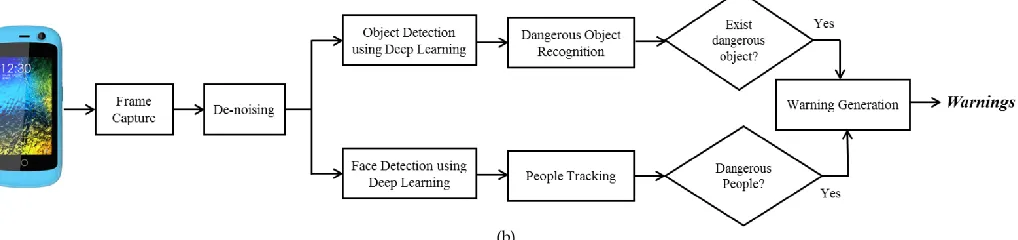
detection risks on the road from the captured frame is shown in Fig. 2b. The captured frame is removed noises before inputting to object detection and face detection steps. Both steps are performed by deep learning. After object detection, the list of the detected objects will be filtered to recognize dangerous objects. If existing dangerous objects, they will be added to the list of warnings. After face detection, the face of human will be tracking. If the existing time of the face of tracking human is greater than a threshold and the distance from that person to children is less than a threshold, that person will be considered as dangerous person and added to the list of warnings. Finally, the list of warnings will be generated and informed risks to children.
Given 𝑰 is the frame captured at time t by the camera of mini smart phone. It is removed noises by median filtering [9]
as shown in Eq. (1) with 𝑭 is the frame after the median filtering process.
𝑭 = 𝑀𝑒𝑑𝑖𝑎𝑛𝐹𝑖𝑙𝑡𝑒𝑟(𝑰) (1)
The frame 𝑭 is then used to detect object and face as described in Eq. (2) and Eq. (3) with 𝑳 is the list of the detected objects and 𝑳 is the list of the detected faces.
𝑳 = 𝑂𝑏𝑗𝑒𝑐𝑡𝐷𝑒𝑡𝑒𝑐𝑡𝑖𝑜𝑛(𝑭) (2)
threshold, that face will be add to the list of dangerous people. We consider 𝑳 = *𝑓|𝑛 ≥ 1+ is a list of the detected faces, and 𝑳
is the list of dangerous people. Each face 𝑓 is tracked and
counted the existing time. If the existing time 𝑇 of the face 𝑓 is
greater than the threshold 𝑇 and the distance 𝐷 between person n and children is less than the threshold 𝑇 , that person will be add to the list of dangerous people 𝑳 as shown in Eq. (5).
𝑇 = {𝑇 ≥ 𝑇 𝑎𝑛𝑑 𝐷 ≤ 𝑇 𝑡𝑒𝑛 𝑎𝑑𝑑 𝑓 𝑡𝑜 𝑳
𝑇 < 𝑇 𝑡𝑒𝑛 𝑑𝑒𝑙𝑒𝑡𝑒 𝑓 (5) 𝐷 = (𝑓 × 𝑤 )/𝑤 (6)
𝑳 = 𝑳 ∪ 𝑳 (7)
The distance 𝐷 between person n and children is estimated by Eq. (6) with 𝑓 is the focal length of camera of mini smart
phone, 𝑤 is the average with of person in real, and 𝑤 is the
width of the detected people on the image. Finally, the list of dangerous objects and the list of dangerous people are combined to generate a list of warnings to inform to children. The list of warning 𝑳 is the union of the list of dangerous objects 𝑳 and the list of dangerous people 𝑳 as presented by Eq. (7)
5716 IJSTR©2020
www.ijstr.org
(b)
Fig. 2. The proposed solution, (a) smart device, and (b) processing method.
4 EXPERIMENTAL RESULTS
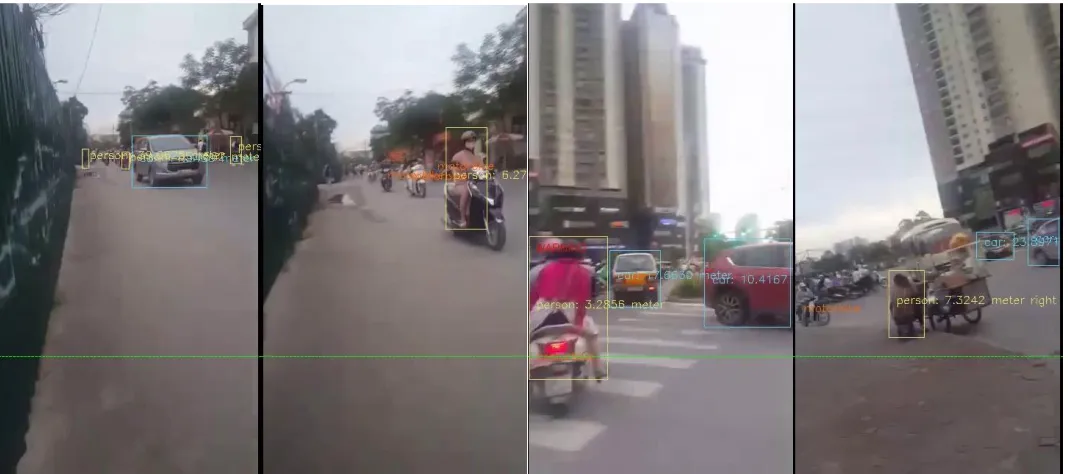
We attached mini smart phone in front of body’s chest to capture frames. We implemented the proposed solution with Open-CV and Python. We used the improved convolutional neural networks implemented in YOLO-V3 [10], [11] for object detection. YOLO-V3 is the best current deep learning model for real-time object detection. It provides 80 types of objects in the pre-trained model, and the accuracy of YOLO-V3 approximated 99 %. For face detection, we used the pre-trained Caffe model [12]. In our experiments, we defined a list of dangerous objects as “Car, Moto-bike, Bus, Stop Sign, and Red Light”. For dangerous people detection, we defined the threshold 𝑇 = 60, and the
threshold 𝑇 = 10𝑚. These thresholds could be changed by user for differential environments or for each specific
application.
5718 IJSTR©2020
www.ijstr.org
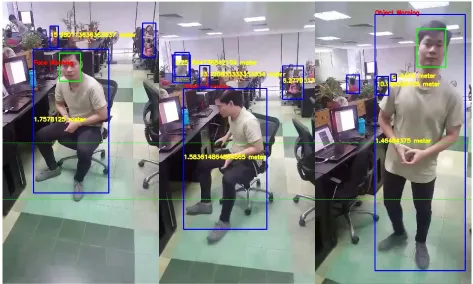
Fig. 4. Experimental results in offices.
5 CONCLUSION
In this paper, we presented a solution to detect risks on road from home to school and school to home for pupil. Based on experimental results, we concluded that the solution worked well for both public areas and office areas. The proposed solution adapted to the requirements of pupil protection and could be applied in real. Next time, we will experiment with many areas and many study cases to improve the proposed solution and to determine parameters better.
A
CKNOWLEDGMENTThis work is supported by the FPT University, Hanoi, Vietnam; Ho Chi Minh University of Technology, Ho Chi Minh city, Vietnam; and Aeronautical Electronics & Telecommunications Faculty, Viet Nam Aviation Academy.
R
EFERENCES[1] X. Y. J. Feng, S. A. Nah, Y. T. Lee, Y. C. Lin, and L. W. Chiang, ―Pedestrian injuries in children: who is most at risk?,‖Singapore Medical Journal, vol. 6, no. 11, pp. 618–621, Nov. 2015.
[2] Vietnamese outraged as girl's killer in Japan escapes death. https://asia.nikkei.com/Politics/International-relations/Vietnamese-outraged-as-girl-s-killer-in-Japan-escapes-death, (accessed on 01 Jan. 2020) [3] R. Hussin, M. R. Juhari, N. W. Kang, R. C. Ismail, and A. Kamarudin,
―Digital Image Processing Techniques for Object Detection From Complex Background Image,‖ Procedia Engineering, vol. 41, pp. 340 – 344, 2012. [4] R. Jindal., A. Gupta., V. Sonia, ―Face Detection using Digital Image
Processing,‖ International Journal of Advanced Research in Computer Science and Software Engineering, vol. 3, no. 11, pp. 1572-1574, 2013.
[5] Find distance from camera to object/marker using Python and OpenCV.
https://www.pyimagesearch.com/2015/01/19/find-distance-camera-objectmarker-using-python-opencv/ (accessed on 1 Jan. 2020)
[6] A. Kumar, A. Kuar., and M. Kumar., ―Face Detection Techniques: A Review,‖ Artificial Intelligence Review, July 2018.
[7] S. Jain., and S. Chadokar, ―A Object Detection in Image Processing: A Review,‖ International Journal of Electrical, Electronics and Computer Engineering, vol. 4, no. 2, pp. 26-29, 2015.
[8] A 2019 Guide to Object Detection.
https://www.kdnuggets.com/2019/08/2019-guide-object-detection.html, (accessed on 1 Jan. 2020)
[9] Median Filtering.
https://opencv-python-tutroals.readthedocs.io/en/latest/py_tutorials/py_imgproc/py_filtering/ py_filtering.html, (accessed on 01 Jan. 2020)
[10] R. Joseph., and F. Ali, ―YOLOv3: An Incremental Improvement,‖ online:
https://pjreddie.com/media/files/papers/YOLOv3.pdf
[11] YOLO: Real-Time Object Detection. https://pjreddie.com/darknet/yolo/, (accessed on 01 Jan. 2020)
[12] Face Detection – OpenCV, Dlib and Deep Learning.