Network Coding Design for Reliable Satellite
Communication Services
Do Duy Tan
Department of Computer and Communication Engineering, HCMC University of Technology and Education, Vietnam. Email:[email protected]
Abstract
In this paper, we present a possible way forward to the design of network coding (NC) as a virtual network functionality offered to the communication service designer. Specifically, we propose the integration of NC and Network Function Virtualization (NFV) architectural designs. The integration is realized as a toolbox of NC design domains that the service designer can use for flow engineering. Our proposed design framework combines network protocol-driven design and system modular-driven design approaches. In particular, the adaptive choice of the network codes and its use for a specific service can be optimized depending on the ultimate service intent and underlying network.
We work out a complete use case where we design geo-network coding, an application of NC for which coding rate is optimized using databases of geo-location information towards an efficient use of network resources. Our numerical results highlight the benefits of both the proposed NC design framework and the specific application.
Received on 01 August 2019; accepted on 13 August 2019; published on 30 August 2019
Keywords: Network coding, network function virtualization, satellite communications, reliability, connectivity.
Copyright ©2019 Do Duy Tan et al., licensed to EAI. This is an open access article distributed under the terms of the Creative Commons Attribution license (http://creativecommons.org/licenses/by/3.0/), which permits unlimited use, distribution and reproduction in any medium so long as the original work is properly cited.
doi:10.4108/eai.16-9-2019.160074
1. Introduction
Fundamental results show that NC technology enables network capacity achievability both for noiseless [3] and noisy networks [4]. Such fundamental ground has lead to an enormous body of research which further confirms the great potential of the technology as a multipurpose communication networking tool to control capacity and reliability across different types or networks and systems with applicability at different communication layers. However, full exploitation of NC potential clearly requires novel design paradigms as compared to traditional networking protocols. This is due to the fact that differently to traditional networking procedures, NC optimizes the information flow by considering such flow as a non-physical flow which is the subject of computational manipulation. NC should also operate in full coordination with other existing and upcoming networking protocols. It becomes self-evident that such new design paradigms should not rely
∗The paper has been presented in part at the 2016 IEEE 17th
International Workshop on Signal Processing Advances in Wireless Communications (SPAWC), Edinburgh, UK [1] and in part at the 2017 IEEE International Conference on Communications (ICC), Paris, France [2].
on dedicated and/or specialized physical hardware or network-dependent devices. Such requirements naturally match current trends of virtualization of standard technologies of computation networking and storage.
As an innovative technique towards the implementa-tion of network funcimplementa-tions, network funcimplementa-tion virtualiza-tion (NFV) [5,6] is clearly a NC design option as it would make NC available as a flow engineering functionality offered to the network. NFV has been proposed as a promising design paradigm by the telecommunications sector to facilitate the design, deployment, and man-agement of networking services (see [6–9] for details). Essentially, NFV separates software from physical hard-ware so that a network service can be implemented as a set of virtualized network functions through virtu-alization techniques and run on commodity standard hardware. Furthermore, NFV can be instantiated on demand at different network locations without requiring the installation of new equipment. The integration of NC and NFV will enable the applicability of NC in future networks (e.g. upcoming 5G networks [10, 11]) to both distributed (i.e. each network device) and centralized manners (i.e. servers or service providers). The Euro-pean Telecommunications Standards Institute (ETSI) has proposed some use cases for NFV in [12], including
the virtualization of cellular base station, mobile core network, home network, and fixed access network, etc. Furthermore, NFV is expected as an innovative tech-nology to promote cost-efficient and new added-value services for satellites [13]. There are already available proposals that combine NC virtualization and software-defined networking (SDN) technology. For example, in [14], the authors investigate the usability of random linear NC as a function in SDNs to be deployed with virtual (software) OpenFlow switches. The NC functions including encoder, re-encoder, and decoder are run on a virtual machine (ClickOS). This work provides a prototype with implementation of additional network functions via virtual machines (VMs) by sharing system resources or additional hardware (e.g. FPGA cards). In [15], NC is implemented in a VM which is then embedded into an Open vSwitch. The paper shows the relation between NC (as a software), VM and host OS of Open vSwich. These works indicate the feasibility of integrating NC as a functionality based on SDN and the concentration of network functions in centralized architectures such as data centers or centralized locations proposed by network operators, service integrators and providers. However, a unified design framework for NC design in view of NFV either centralized or distributed is currently missing. In this paper, we focus on the functional-level design regardless of how it is softwarised. The motivation of this paper is to show the generalization of NC design domains as a toolbox so that NC can be applied over different operational frameworks and services including satellite or hybrid networks thus enabling softwarization and rapid innovative deployment. Our contributions can be summarized as follows.
• We propose the integration of NC and NFV as a functional architecture given as a structured toolbox of NC design domains so that tailored designs can be implemented in software and deployed over virtualised infrastructures to allow flow engineering tailored to different service operational intent.
• We validate our proposed NC function (NCF) over a complete design for the use case of geo-network coding. VNCF is integrated as a VNF in ETSI NFV architecture. In particular, coding is optimized according to geo-tagged link statistics and geo-location information given the computational complexity constraint. Numerical results indicate that per-link achievable rate region obtained with NC at the source and re-encoding at the intermediate node is twice wider than that of transmission with NC at the source only. Furthermore, connectivity gains up to 32 times and 47 times are obtained if compared with the uncoded case for 80% and 85%
target reliability with computational complexity constraint of 125000 operations in terms of multiplications and additions, respectively.
The rest of this paper is organized as follows. In Section 2, we propose the framework of NC design. In Section 3, we validate our proposed architectural design in a specific virtualized Geo-NC function (VGNCF) design using the functionalities identified in previous sections. In Section 4, we conduct numerical results to validate the performance for the case of using our VGNCF design and the uncoded case. Finally, Section5 identifies conclusions and further work.
2. NC DESIGN FRAMEWORK
NFV and NC are two different techniques to address different challenges in the designs of upcoming network technologies. The combination of NFV and NC brings forth a potential solution for the management and operation of the future networks. NC design involves different domains [16]:
• NC coding domain - domain for the design of network codebooks, encoding/decoding algo-rithms, performance benchmarks, appropriate mathematical-to-logic maps, etc.
• NC functional domain- domain for the design of the functional properties of NC to match design requirements built upon abstractions of
– Network: by choosing a reference layer in the standardized protocol stacks and logical nodes for NC and re-encoding operations.
– System: by abstracting the underlying physical or functional system at the selected layer e.g. SDN and/or function virtualization.
• NC protocol domain- domain for the design of physical signaling/transporting of the information flow across the virtualized physical networks in one way or interactive protocols.
The domain clearly relevant for NC to be designed as a NFV is the NC functional domain and we develop this domain in the next sections.
When interpreting NC as a functionality to the network, NC function virtualization simply consists in integrating the NC architectural framework described above into existing architectural NFV frameworks. As any virtualized network function (VNF), we will also need first of all to identify physical networks/systems infrastructure with the physical computing, storage, and network resources that will provide NC function virtualization (NCFV) with processing, storage, and connectivity through virtualization, respectively.
functionalities are identified that will enable to tailor the use of NC to engineer the throughput and reliability of multiple information network flows depending on the ultimate service operational intent. The resulting VNF will likely operate together with additional virtualized functionalities, which will appropriately be taken care of by the NFV management and orchestration.
Based on the key features of NFV design, our proposed set of basic NC functionalities are distributed into three hierarchical levels based on their significance, universal-ity, and availability. In particular, the common elemen-tary functionalities include NC coding functionalities, NC information flow engineering functionalities, and NC physical/virtualization functions (see [1,16]).
3. Geo-Controlled network connectivity
3.1. Physical system/network abstraction
Our interest is to validate the performance of a specific design using the functionalities proposed in the previous sections. In particular, we propose a specific VGNCF design for reliable communication services over satellite, called geo-controlled network connectivity. In the illustrative design proposed here, the optimization functionality will use databases with geo-tagged link statistics and geo-location information of network nodes in the service coverage area for some service operational intents. The overall design target here is to achieve a given connectivity and/or target reliability throughout the service coverage area given constraints of computational complexity.
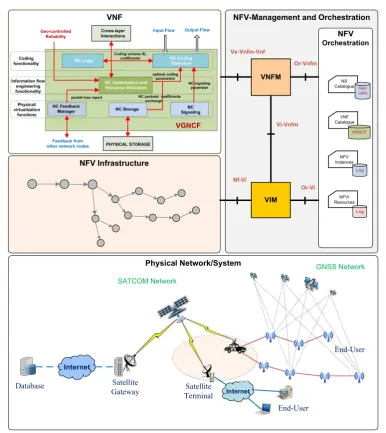
The interest of NFV is that the same virtualized network functionality can be applied over different operational frameworks and services as well as over different underlying physical networks, including satellite or hybrid networks thus enabling softwarization and rapid innovative deployment. In Fig. 1, we abstract the underlying physical network/system to identify functionalities of NC. All network nodes in the deployment area are geo-localized based on GNSS network. Our proposed use case applies to multiple scenarios consisting of terminals (randomly) distributed in the service area both within and beyond cell coverage of satellites. Connectivity to/from the source is realized via satellites and/or transport networks (e.g. internet, cellular networks), depending on availability but in all cases they are abstracted for our design as sender/sink (end-user) nodes, respectively, through a virtualization layer. Logical network then illustrates information flow functionality of network nodes including encoding, re-encoding, and decoding points.
3.2. Virtualized Geo-NC function architecture
Fig. 1 denotes our proposed VGNCF in which we show how NCF can be integrated with the ETSI NFV
architecture given the abstracted underlying physical system/network as part of the NFV Infrastructure (NFVI). The design also indicates exchanges between VGNCF and NFV-Management and Orchestration (NFV-MANO) over reference points Ve-Vnfm-Vnf, Nf-Vi, Vi-Vnfm, Or-Vnfm and Or-Vi [17]. Specifically, NFV-MANO is the grey block in Fig. 1 that includes three functional blocks: NFV Orchestrator (NFVO), VNF Manager (VNFM), and Virtualized Infrastructure Manager (VIM). Where NFVO block is considered as the brain of the NFV architecture which has two main responsibilities: (1) the orchestration of NFVI resources across multiple VIMs and (2) the life-cycle management of all network services. While VNFM manages the life-cycle of VNF instances, VIM is responsible for managing and controlling NFVI resources including physical, virtual, and software resources [17].
The detailed functional domain of VGNCF is shown in the VNF block of Fig. 1. At the NC core blocks, interactions with other nodes bring into agreement on coding schemes, coefficients selection, etc. NC coding block receives all inputs such as coding scheme, coefficients, coding parameters, packets from storage block, and signaling to perform elementary encoding/re-encoding/decoding operations, etc. At the NC interoperable blocks, geographical location-based information and level of reliability provided by
geo-controlled reliability block will be given to the NC
optimization and resource allocation block so that optimal coding parameters are generated to the NC coding operation block. In addition, packet loss feedback from other network nodes is also an important factor in the resource allocation process. At the last stage, NC console blocks connect the physical storage and the feedback from other network nodes to provide information packets and packet loss rate to the upper stage, respectively. The proposed NCF will interact with protocol domain, i.e. network, at a suitable position in the reference model of each standardized protocol stack e.g. transportation layer.
As denoted in Fig. 1, NFV-MANO needs the
repositories that hold different information regarding network services (NSs) and VNFs (VGNCF is part of VNFs). There are four types of repositories as follows
• VNF catalogue represents the repository of all usable VNF packages, supporting the creation and management of the VNF packages.
• NS catalogue represents the repository of all usable NSs.
Physical Network/System
NFV-Management and Orchestration
NFV Infrastructure
NFV
Orchestration
VNFM
VIM
VNF Catalogue
NS Catalogue
NFV Instances
NFVI Resources
Ve-Vnfm-Vnf
Or-Vnfm
Or-Vi Nf-Vi
VNF
Cross-layer Interactions Geo-controlled
Reliability
PHYSICAL STORAGE Feedback from
other network nodes
optimal coding
packet loss report
Input Flow Output Flow
Vi-Vnfm
VGNCF
NC packets/ coefficients h
VGNCF Geo -info
Log
Log
GNSS Network
Database
SATCOM Network
Internet
Satellite
Gateway TerminalSatellite Internet
End-User
er
Figure 1. VGNCF integrated as a VNF in ETSI NFV architecture.
• NFVI resources is the repository that holds information about NFVI resources utilized for the establishment of NS and VNF instances.
3.3. Design of Coding Functionality
Let i be the erasure rate of each link i and be the
vector of per-link erasure rates e.g.= (1, 2) for 2 hops.
If all links are equal, we use a unique value. A source generates n coded packets from a set of k information packets over linear map by a coefficient matrix generated using coefficients from the same Galois field of sizeg= 2q. Then, coding rate is given by r=k/n. Assume that
packet length isM bits, resulting in m=M/q symbols per packet.
Let ηi(r, i) denote the residual erasure rate after
decoding at each single hop i. The NC codebook will be systematic NC (SNC) as introduced in [18,19].
In view of multi-hop line networks, we define the reliability after decoding at hophas
ρN CR (r, , h) = Yh
i=1(1−ηi(r, i)). (1)
Accordingly, we define the reliability at hophfor the uncoded case as
ρnoN CR (, h) =Yh
i=1(1−i). (2)
3.4. Optimization Functionality
Computational complexity. Let β0 denote the
computational complexity required for NCF at the source, re-encoding points Rj(1≤j < h), and the
des-tination, respectively.
Proposition 1. The number of multiplications and additions required for encoding process is NM
enc= (n−
k)km and NA
enc= (n−k)(k−1)m, respectively.
There-fore, computational complexity for encoding in terms of multiplications and additions is βenc(r) =NM
enc+
NA
enc= (n−k)m(2k−1). Whereas computational
com-plexity of finite-length decoding comcom-plexity using Gaus-sian Elimination algorithm in terms of the number of multiplications and additions in GF(2q), denoted by
βdec(r) =NdecM +NdecA , can be found in [20].
Each re-encoding pointjwill decode and re-encode the linear combinations before forwarding the coded packets towards the next hops. Without decoding the re-encoder does not know which packets are innovative while with decoding the relay may do a more intelligent re-encoding operation. Therefore, the complexity required for the relay is total of computational complexity for decoding and re-encoding, βRj(r) =β
dec(r) +βenc(r).
Whereas βS(r) =βenc(r) and βD(r) =βdec(r). Assume
that coding rate r is the same for all the nodes. Then
βS(r) is less thanβRj(r) andβD(r).
Note that the computational complexity can be equivalently mapped into energy consumption in terms of power per computational unit e.g., logic gates. However, such specification depends on specific hardware that NC function is deployed. As a generalized approach, we thus briefly mention energy consumption via computational complexity in terms of multiplications and additions.
Utility Function. Identification of utilities allows the optimization of the network coded flows. We are interested in the design of when NC should be activated in terms of (1) computational complexity/energy consumption and (2) target reliability after decoding (ρ0). In order to do so, we define the following utility
function:
uact(r, , ρ0) =
fN C(r, , ρ
0)
fCOST(r) , (3)
where fN C(r, , ρ
0) accounts for the goodness of
the encoding/decoding scheme in achieving target performance ρ0. Whereas fCOST(r) accounts for the
cost in terms of computational complexity. The utility function denotes the energy efficiency in terms of the ratio between the goodness and the computational complexity. We define the goodness and the cost function, respectively, as follows
fN C(r, , ρ0) =ρRN C(r, )−ρ0, (4)
fCOST(r) =βS(r), (5)
with βS(r) is the computational complexity of the
source node as defined in Section3.4.
Optimized operative ranges of performance. The source identifies the upper bound for the energy efficiency of coding strategy and the optimized ρN C
R (.) that it
should provide to the destination according to a given (, ρ0) and the computational complexity constraint.
Underlying geo-tagged channel statistics are assumed to be stored in NS catalogue (see Fig.1). The upper bound for energy-efficient coding rate is given by the following proposition.
Proposition 2. The source identifies at which rate it maximizes its own utility under constraints of computational complexity by the following optimization strategy:
argmax
r
uact(r, , ρ0)
subject to βD(r)≤β0, βRj(r)≤β0.
(6)
Numerical results reveal that the utility function has the property of quasi-concavity. Moreover, βD(r) and
βRj(r) are increasing functions with redundant coded packets. Therefore, Problem (6) is equivalently quasi-convex optimization and can be efficiently solved by bisection methods [21].
Our proposed strategy identifies optimal points that bring the optimal benefit for the source’s viewpoint. It is thus necessary to identify optimized operative ranges of performance so that the destination is aware and admits some variations in the quality. At the source or a centralized controller, the cognitive algorithm to identify optimized operative ranges is briefly realized as follows:
(1) identify maximal utility uact
max(r, , ρ0) and
respective r,ρN C
R (r, ) given (, ρ0), (2) determinerand ρN CR (r, ) that satisfiesuactmin(.)≤uact(r, , ρ0)≤uactmax(.),
withuactmin(.) is the lower bound, (3) activate the NCF if the range of performance is acceptable by users.
4. PERFORMANCE EVALUATION
4.1. Per-link achievable rate region
ε2 ε1
0 0.1 0.2 0.3 0.4 0.5 0.6 0
0.1 0.2 0.3 0.4 0.5
0.1 0.2 0.3 0.4 0.5 0.6 0.7 0.8 0.9
(a)Re2e
ε2 ε1
0 0.1 0.2 0.3 0.4 0.5 0.6 0
0.1 0.2 0.3 0.4 0.5
0.1 0.2 0.3 0.4 0.5 0.6 0.7 0.8 0.9
(b)RN C
Figure 2. Per-link achievable rate region with respect to
link erasure rates forη0= 5%,r∈[0.5,1].
ε2 ε1
0 0.1 0.2 0.3 0.4 0.5 0.6 0
0.1 0.2 0.3 0.4 0.5
0.1 0.2 0.3 0.4 0.5 0.6 0.7 0.8 0.9
(a)Re2e
ε2 ε1
0 0.1 0.2 0.3 0.4 0.5 0.6 0
0.1 0.2 0.3 0.4 0.5
0.3 0.4 0.5 0.6 0.7 0.8 0.9
(b)RN C
Figure 3. Per-link achievable rate region with respect to
link erasure rates forη0= 5%,r∈[0.3,1].
It is noted that we use interchangeably the target reliability ρ0 and η0, the target residual packet erasure
rate after decoding at the receiver, with η0= 1−ρ0.
Let denoteRN C=r 1−ηN C
andRe2e=r 1−ηe2e
as the achievable rate for NC case and end-to-end coding, respectively, whereηN C is residual erasure rate
after decoding for 2-hop networks andηe2e corresponds
to residual erasure rate after decoding for single-hop networks but with erasure rate is total erasure of the 2-hop network. In the below figures, we show achievable rate region with respect to per-link erasure rates for different target η0. First, we consider and analyze the
behavior of Re2e and RN C with a limitation of coding rate. We then evaluate the impact of different limitations of coding rate on the behavior ofRe2e andRN C.
Figure2 depicts the achievable rate region of the two coding schemes w.r.t. various values of link erasure rates for differentη0withη0= 5%, where coding rate is limited
in range from 0.5 to 1. For each value of (1, 2), we
choose a coding rate as large as possible so thatηe2eand
ηN C satisfyη
0, respectively with end-to-end coding and
coding at the source and re-encoding at the intermediate node. We term achievable region as the region where η0
is satisfied. Otherwise, the region in blue represents the cases in which there is not any coding rate in the given range that meetsη0.
As denoted in Fig.2a, Re2e reaches 0.9 since channel
condition is good. However, since link erasure rates increase, respective regions such as red, orange, etc show the reduced Re2e. This is due to lower coding rate
required to meet η0 in worse channel conditions. It is
interesting to note that each region is shaped by curves. On the other hand, Fig. 2b denotes RN C w.r.t. link
erasure rates where achievable regions are shaped by squares. In general, coding at the source and re-encoding at the intermediate node can widen the achievable region to approximately 90% if compared to end-to-end coding. The detailed proof can be seen in Appendix.
In addition, in Fig. 3, regions of Re2e and RN C
have been extended by appearance of some new regions located at points with higher i (i= 1,2) if compared
with those of Figure2. Main reason is that with a wider range of coding rate, regions with very bad channel conditions whichη0cannot be satisfied by anyr∈[0.5,1]
are now covered due to a wider range of feasible coding rate.
In general, we can conclude that
• The shapes of Re2e and RN C are curves and
squares, respectively, regardless the constraints ofr
andη0. The difference is the extension of achievable
rate region when a wider range of coding rate is allowable.
• Achievable rate region obtained with NC case is almost twice wider than that of end-to-end coding for the same limitation of coding rate andη0.
• The shapes of RN C and Re2e are symmetric
over the diagonal. Therefore, RN C and Re2e are
independent of the order of the two links.
Our results indicate that NC at the source and re-encoding at the intermediate nodes can enhance significantly network performance in terms of achievable rate. Therefore, we will apply NC whenever an intermediate node is ready to implement NCF. For the latter, in the specific application of geo-controlled network connectivity, we evaluate the optimized utility, reliability, and connectivity gain beyond the service coverage area of satellite with assumption that NC is deployed both at the source and intermediate nodes along the path.
4.2. Geo-controlled network connectivity
2 4 6 8 10 12 14 16 18 20 0
10 20 30 40 50 60 70 80 90 100
Path length (hops)
%
ρRNC, β 0 high, ε=0.1
ρRNC, β 0 low, ε=0.1
ρRNC, β 0 high, ε=0.15
ρRNC , β0
low , ε=0.15
ρRnoNC , ε=0.1
ρRnoNC, ε=0.15
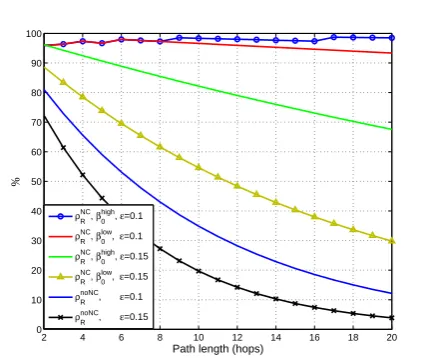
Figure 4. Reliability with NC, ρN C
R , and uncoded case,
ρnoN C
R , according to optimized utility respectively for
different path length and erasure rates, withρ0= 80%.
resources. The proposed solution can cope with technical problems such as providing transmission to devices at low power locations (e.g. long distance and/or obstacles) or to extend the transmission beyond the coverage of satellite. We evaluate the potential of our solution through simulation results using Matlab.
For illustrative purposes, we assume that a great number of network devices are uniformly distributed in the deployment area. All links undergo the same erasure rate for different cases of= 0.1 and 0.15, while k= 50 information packets, M = 100 bytes, q= 8, ρ0= 80%
for two different computational complexity constraints,
β0low = 125000 and β
high
0 = 150000 operations. Coding
rate is optimized according to Section3.4.
Network Reliability. We conduct various numerical results to evaluate how network performance will be improved with VGNCF according to system limitations and different network conditions such as erasure rate, path length, etc.
A glance at Fig. 4 reveals that network reliability with NCF outperforms the case of transmission without NC. Note that we only denote the path length up to 20 hops in which the performance of the no-NC case is extremely low and thus 20 hops are large enough for our comparison. In particular, βhigh0 can guarantee the target ρ0= 80% for a path length of more than
20 hops (even some hundred hops) in low erasure rate. For longer paths, the NCF just needs to increase the redundant level of combined packets in order to cope with the residual erasure rate. In comparison with NC case, network performance without NC (no-NC case) degrades dramatically with the number of hops. Especially, consider such high complexity constraints, the target is only satisfied up to approximately 12 hops in bad conditions e.g.= 0.15. The reason is that the longer
the transmission path, the lower the connectivity due to physical limits. The limitations of redundant combined packets then cannot provide the packet successfully-received after decoding as the design target.
As we have seen, the target reliability can be satisfied for different erasure rates depending on the redundancy of coded packets generated by the source, i.e. some computational cost is needed for activating NCF and thus equivalently requiring more energy consumption at network nodes.
Connectivity gain. Assuming some reliability design target ρ0, in the uncoded case, many nodes would
not achieve the target ρ0 while NC case could. Let hN C(ρ
0) and hnoN C(ρ0) denote the hop at which NC
and the uncoded case can provide connectivity with the reliability satisfying ρ0, respectively. For simplicity, the
connectivity gain for a target ρ0 is defined as γ(ρ0) = hN C(ρ
0)/hnoN C(ρ0).
Fig. 5 depicts connectivity gain when using NCF in times for different ρ0 with β0very−low= 100000, βlow
0 = 125000, and β
high
0 = 150000. The larger the
computational constraint, the higher the connectivity gain beyond the cell coverage of the satellite. Particularly, since = 0.1, NC can obtain up to 335 times and 495 times gain in connectivity if compared to the uncoded case with high constraint for 80% and 85% target reliability, respectively. Otherwise, in low constraint, the connectivity gain obtained with NC is 32 times and 47 times for 80% and 85% reliability, respectively. The reason is that the performance of the uncoded case is significantly impacted by per-link erasure rate and length of transmission path. NC case, meanwhile, can adapt its coding rate within the constraints to obtain the target reliability while optimizing the source’s utility. However, implementing NCF is then strongly affected by computational complexity which is equivalently mapped into the cost of energy consumption.
5. Conclusions
0.1
0.15 0
100 200 300 400
ε
β0high
β0low
β0very−low
(a)ρ0= 80%
0.1
0.15 0
100 200 300 400 500
ε
β0very−low
β0low β0 high
(b)ρ0= 85%
Figure 5. Connectivity gain according to the optimized NC (in times) for differentρ0 andβ0.
can provide connectivity gain up to 32 times and 47 times in comparison with the uncoded case for 80% and 85% reliability with complexity constraint of 125000 operations.
Our proposed framework can naturally be tailored for different designs and accommodate additional functionalities. Moreover, the proposed architectural design framework and interaction between VGNCF and NFV-MANO functional blocks can also be generalized as a design framework for several different VNFs.
ηe2e depends on end-to-end packet erasure rate
given as ηe2e= 1−(1−
1)(1−2). ηe2e and Re2e
thus directly depend on the product (1−1)(1−2).
Therefore, we will consider whether there exists a set of (1, 2) with the same value of the product (1−1)(1− 2) leading the sameRe2e.
We evaluate the function f(1, 2) = (1−1)(1−2)
to address the existence of such set of (1, 2) and how
they affect the shapes ofRe2eas depicted in Figures2a
-3a.
We assume that there is a set of (1, 2) so thatf(1, 2)
is a given constant, e.g. (1−1)(1−2) =A, for some
(1, 2) in a limited range e.g. i∈[0,0.6] (i= 1,2). For
example, for (1=a, 2= 0), we findf(1=a, 2= 0) = A. Then, our concern is that whether there is a set of (1, 2) so that value of the product f(1, 2) is still
equal to A. If (1−1)(1−2) =A and an arbitrary 1,
it necessarily exists2 written by
2=f(1) =
1+A−1 1−1
. (E.1)
Note that the point (1=a, 2= 0) satisfies Eq. E.1
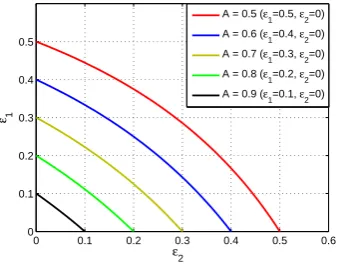
and there are infinitely such points. Analyzing Equation E.1, a form of reciprocal graphs, we obtain numerical results as denoted in Fig.E.1.
Assume that 1∈[0,0.6], 2∈[0,0.6], we find some
values of A respectively to some points of (1=
0 0.1 0.2 0.3 0.4 0.5 0.6
0 0.1 0.2 0.3 0.4 0.5
ε2
ε1
A = 0.5 (ε
1=0.5, ε2=0)
A = 0.6 (ε
1=0.4, ε2=0)
A = 0.7 (ε
1=0.3, ε2=0)
A = 0.8 (ε
1=0.2, ε2=0)
A = 0.9 (ε
1=0.1, ε2=0)
Figure E.1. Illustration of some values of (1, 2) that
brings the sameRe2e.
a, 2= 0), e.g. (1= 0.5, 2= 0), (1= 0.4, 2= 0), (1=
0.3, 2= 0), (1= 0.2, 2= 0), (1= 0.1, 2= 0). As
depicted in Fig.E.1, it is interesting to see that
(1) There exists a set of (1, 2) for a specific constant Arespectively to a point (1=a, 2= 0).
(2) The set of (1, 2) with respect to A draws
a symmetric curve. In other words, this proves the existence of a set of (1, 2) producing a same value of
(1, 2) and therefore, Re2eobtains a same value for the
set of (1, 2).
(3) The above results also indicate the symmetry of the curves and the independence of the order of the links. Especially, it is clear to observe the shapes of regions at the frontier and at the boundary of achievable rate region as shown in Figures 2a-3a. Furthermore, as for small values of (1, 2), the curves look as lines within
our limitation of (1, 2).
Edinburgh, UK [1] and in part at the 2017 IEEE International
Conference on Communications (ICC), Paris, France [2].
References
[1] D.-D. Tan and M. A. Vazquez-Castro, “Network
coding function virtualization,” in 2016 IEEE 17th
International Workshop on Signal Processing Advances in Wireless Communications (SPAWC), pp. 1–5, July 2016.
[2] D.-D. Tan and M. A. Vazquez-Castro, “Geo-network coding function virtualization for reliable
communica-tion over satellite,” in2017 IEEE International
Confer-ence on Communications (ICC), pp. 1–6, 2017.
[3] R. Ahlswede, N. Cai, S. Y. R. Li, and R. W. Yeung,
“Network information flow,” IEEE Transactions on
Information Theory, vol. 46, no. 4, pp. 1204–1216, 2000. [4] A. F. Dana, R. Gowaikar, R. Palanki, B. Hassibi, and
M. Effros, “Capacity of wireless erasure networks,”IEEE
Transactions on Information Theory, vol. 52, pp. 789– 804, Mar. 2006.
[5] A. U. Rehman, R. L. Aguiar, and J. P. Barraca,
“Network functions virtualization: The long road
to commercial deployments,” IEEE Access, vol. 7,
pp. 60439–60464, 2019.
[6] R. Mijumbi, J. Serrat, J. L. Gorricho, N. Bouten, F. D. Turck, and R. Boutaba, “Network function virtualization: State-of-the-art and research challenges,” IEEE Communications Surveys Tutorials, vol. 18, no. 1, pp. 236–262, 2016.
[7] B. Han, V. Gopalakrishnan, L. Ji, and S. Lee, “Network function virtualization: Challenges and opportunities for
innovations,”IEEE Communications Magazine, vol. 53,
no. 2, pp. 90–97, 2015.
[8] C. Liang and F. R. Yu, “Wireless network virtualization:
A survey, some research issues and challenges,” IEEE
Communications Surveys Tutorials, vol. 17, no. 1, pp. 358–380, 2015.
[9] I. Afolabi, T. Taleb, K. Samdanis, A. Ksentini, and H. Flinck, “Network slicing and softwarization: A survey on principles, enabling technologies, and solutions,” IEEE Communications Surveys Tutorials, vol. 20, no. 3, pp. 2429–2453, 2018.
[10] M. Fallgren and B. T. (Eds.), “Scenarios, requirements
and kpis for 5g mobile and wireless system,” in
ICT-317669-METIS/D1.1, 2013.
[11] A. Gupta and R. K. Jha, “A survey of 5g network:
Architecture and emerging technologies,”IEEE Access,
vol. 3, pp. 1206–1232, 2015.
[12] The European Telecommunications Standards Institute, “Network functions virtualisation (NFV); use cases,” in
GS NFV 001 (V1.1.1), Oct. 2013.
[13] G. Gardikis, S. Costicoglou, H. Koumaras, C. Sakkas, A. Kourtis, F. Arnal, L. M. Contreras, P. A. Gutierrez, and M. Guta, “Nfv applicability and use cases in satellite
networks,” in 2016 European Conference on Networks
and Communications (EuCNC), pp. 47–51, 2016. [14] D. Szabo, F. Nemeth, B. Sonkoly, A. Gulyas, and F. H.
Fitzek, “Towards the 5G revolution: A software defined network architecture exploiting network coding as a
service,” SIGCOMM Comput. Commun. Rev., vol. 45,
no. 4, pp. 105–106, 2015.
[15] J. Hansen, D. Lucani, J. Krigslund, M. Medard, and F. Fitzek, “Network coded software defined networking:
enabling 5G transmission and storage networks,”
Communications Magazine, IEEE, vol. 53, no. 9, pp. 100–107, 2015.
[16] M. A. Vazquez-Castro and P. Saxena, “Network coding over satellite: From theory to design and performance,” in Volume 154 of the series Lecture Notes of the Institute for Computer Sciences, Social Informatics and Telecommunications Engineering, pp. 315–327, Sept. 2015.
[17] The European Telecommunications Standards Institute, “Network functions virtualisation (nfv); management
and orchestration,” inETSI GS NFV-MAN 001 V1.1.1,
Dec. 2014.
[18] B. Shrader and N. Jones, “Systematic wireless network
coding,” inMilitary Communications Conference, 2009.
MILCOM 2009. IEEE, pp. 1–7, 2009.
[19] S. Wunderlich, F. Gabriel, S. Pandi, F. H. P. Fitzek, and M. Reisslein, “Caterpillar RLNC (CRLNC): A
practical finite sliding window rlnc approach,” IEEE
Access, vol. 5, no. 99, pp. 20183–20197, 2017.
[20] G. Garrammone, “On decoding complexity of
reed-solomon codes on the packet erasure channel,” IEEE
Communications Letters, vol. 17, no. 4, pp. 773–776, 2013.
[21] S. Boyd and L. Vandenberghe, Convex Optimization.
Cambridge University Press, 2004.
[22] D.-D. Tan and M. A. Vazquez-Castro, “Efficient commu-nication over cellular networks with network coding in
emergency scenarios,” in2015 2nd International
Confer-ence on Information and Communication Technologies for Disaster Management (ICT-DM), pp. 71–78, 2015. [23] M. A. Vazquez-Castro, P. Saxena, D.-D. Tan, T.
Vam-stad, and H. Skinnemoen, “SatNetCode: Functional design and experimental validation of network coding
over satellite,” in the International Symposium on
![Figure 2. Per-link achievable rate region with respect tolink erasure rates for η0 = 5%, r ∈ [0.5, 1].](https://thumb-us.123doks.com/thumbv2/123dok_us/8420318.1693921/6.595.46.292.108.211/figure-link-achievable-region-respect-tolink-erasure-rates.webp)