United Kingdom ISSN 2348 0386 Vol. VII, Issue 9, September 2019
Licensed under Creative Common Page 49
http://ijecm.co.uk/
THE EFFECT OF ETHICAL SALES BEHAVIOR ON
CUSTOMER TRUST, COMMITMENT, AND LOYALTY
Ida Ayu Komang Tiara Pratistha Sari
Master of Management Study Program, Faculty of Economics and Business, Udayana University, Indonesia
Made Wardana
Master of Management Study Program, Faculty of Economics and Business, Udayana University, Indonesia
Abstract
Ethical sales behavior is one of the key factors in company's success. It can be maximized if it is
balanced with customer trust, commitment and loyalty. This study aims to explain the influence
of ethical sales behavior on customer trust, commitment and loyalty. Data collected by
distributing questionnaires to 90 Mcdonald's fast food chain customers in Denpasar City,
Indonesia. This study used a non-probability sampling method and Structural Equation Modeling
(SEM) to analyzed the data. The results show that ethical sales behavior have a positive and
significant effect on both customer trust and commitment, customer trust have positive and
significant effect on customer commitment, and ethical sales behavior, customer trust, and
commitment do not have a significant effect on customer loyalty. Therefore, this study could be
implied theoretically as to enrich the empirical evidence mainly on ethical sales behavior,
customer trust, commitment and loyalty. The practical implication of this study is to be able to
provide an overview to the management of Mcdonald’s in identify and decide the ethical sales
behavior and its effect on customer trust, commitment and loyalty.
Licensed under Creative Common Page 50
INTRODUCTION
As advances in information technologya very positive progress, McDonald's customers are now becoming smarter, sophisticated, receiving more information, having many access and also the choices drive the company needs to provide the best service. McDonald's have to present attractively in order to catch the market share and maintain customer loyalty. Today's customers strongly dislike inappropriate and irresponsible social behavior, they will not hesitate to stop dealing with the business (Farah & Newman, 2010). Seeing this, McDonald's have to deal with good ethics because it will impact on business success. Crespo et al. (2011) said that financial institutions have to pay more attention to ethics and relationships towards their customers and stakeholders, this indicate that ethical aspects have a positive relationship with customer loyalty. Fast food consumption routinely causes obesity and increases body weight (Stender et al., 2007; Currie et al., 2010; Anderson et al., 2011, Barre et al., 2013). This is because fast food in most countries still contain high levels of fat that cannot be tolerated, so it not only unfriendly to our body but also unhealthy (Stender et al. 2007). Study found that student are the most often
group who came to McDonald'sup to three times a week (Lisnawaty 2008). This can be caused by the proximity of a location (such as a school or home) from the fast food restaurant (Currie et al., 2010). McDonald's, which was originally a place for eating out quickly; on its development influenced by east culture to become an alternative place for family recreation, meet up with friends, and become symbol of social status (Erdiawati 2008).
This study was aimed to explain the effect of ethical sales behavior on customer trust, commitment, and loyalty, the effect of customer trust and commitment on customer loyalty, and also the effect of customer trust on customer commitment of Mcdonald's fast food chain in Denpasar City.
LITERATURE REVIEW
Ethical Sales Behavior
Licensed under Creative Common Page 51
Customer Trust
Customer trust refers to all cognitions owned and conclusions made by customers regarding the object, attributes and benefits (Mowen and Minor, 2002). According to Siagian and Cahyono (2014) customer trust is a belief from one of the parties regarding the intent and behavior addressed to the other party, thus customer trust is defined as a customer expectation that the service provider can be trusted or relied upon in fulfilling their promise.
Customer Commitment
Customer commitment refers to a strong desire that grows within an individual to maintain a long relationship with their business partner. Commitment to maintaining the relationships will be built if each party gets the expected value from its business partners. If there is one party that feels aggrieved then there will be no commitment in the long term.
Customer Loyalty
Customer loyalty can be described as the willingness of customers to shop only at certain locations (Utami, 2010: 58). Loyalty is not formed in a short time but through a long learning process and the results of customer all time purchases experience. If what is obtained is in line with expectations, the buying process continues it also means that the loyalty has arise.
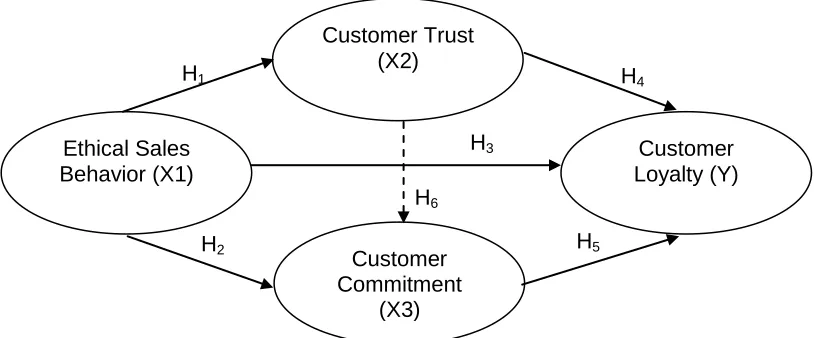
Figure 1. Conceptual Framework
Effect of Ethical Sales Behavior on Customer Trust
Silviani (2013) states that ethical sales behavior significantly influences customer trust. Sutojo (2003) found that there was a positive and significant effect between ethical sales behavior on customer trust. Maharani (2013) in her study show that ethical sales behavior has a positive
Customer Commitment
(X3)
Customer Loyalty (Y) Customer Trust
(X2)
Ethical Sales Behavior (X1) H1
H2
H4
H5
H6
Licensed under Creative Common Page 52 effect on customer trust. Holden (2014), Chen and Mau (2013), and Sanzo et al. (2003) show that ethical sales behavior plays a major role in influencing customer trust. In addition, Wray et al. (2012) have stated that ethical sales behavior practices, as perceived by financial service customers, increase customer trust in seller.
H1: Ethical sales behavior has a positive and significant effect on customer trust.
Effect of Ethical Sales Behavior on Customer Commitment
Maharani (2013) found that advertising conducted by Islamic banks have a positive influence on the commitment of sharia bank customers, it is show that ethical sales behavior has a positive effect on customer commitment. The research of Iwanon et al. (2015), and Hansen and Riggle (2009) shows that the relationship between ethical sales behavior and the commitment of buyers to sellers is mediated by the buyer's trust to the seller. Punwatkar and Verghese (2014), and Valentine (2009) shows that ethical behavior of salespeople is very important to encourage customers in building their commitment.
H2: Ethical sales behavior has a positive and significant effect on customer commitment.
Effect of Ethical Sales Behavior on Customer Loyalty
Consumer that satisfied with a product, is not necessarily going to be loyal, but the continuous satisfaction obtained by consumers will lead them into loyalty. Hansen and Riggle (2009)stated that ethical sales behavior positively influences customer loyalty. This means that if ethical sales practice appliedsimultaneously, customers will be more loyal to the company.
H3: Ethical sales behavior has a positive and significant effect on customer loyalty.
Effect of Customer Trust on Customer Loyalty
Morgan and Hunt (2010) states that trust and commitment are the key to success in building loyalty. Ramadania (2002) show that trust is the base to form commitment, and commitment tend to against preferences that are key to build loyalty. In line with Khotimah (2013) which states that trust has a positive and significant effect to loyalty. Long-term customer loyalty will be achieved if the customer has a high level of trust towards the product or company.
H4: Customer trust has a positive and significant effect on customer loyalty.
Effect of Customer Commitment on Customer Loyalty
Licensed under Creative Common Page 53 supermarket customers. This research was conducted on customers who shop at Pamella Supermarket Yogyakarta with a multiple regression analysis. Rini (2007), and Henning et al., (2012) revealed that customer commitment has a positive and significant effect on customer loyalty. The underlying logic is that customer loyalties are achieved if the customer really has a strong commitment towards maintaining a long-term relationship with the company.
H5: Customer commitment has a positive and significant effect on customer loyalty.
Effect of Customer Trust on Customer Commitment
Trust is also widely studied in the social exchange literature. For example, in the world of service marketing, the effectiveness of marketing services depends on trust management because consumers specifically have to buy the product first before they can really feel or enjoy the service (Berry and Parasuraman, 2015). This finding is in line with Fardila's (2012) who stated that trust has a positive and significant effect on commitment. Asakdiyah (2011) show that trust, commitment and its interaction affect customer loyalty at supermarkets.
H6: Customer trust has a positive and significant effect on customer commitment.
RESEARCH METHOD
This research uses quantitative data types and is in the form of associative causality study. The variables used in this study are ethical sales behavior, customer trust, commitment, and loyalty. The sampling method is non-probability sampling which is purposive sampling method. Data collected by distributing questionnaires to 90 students at the Faculty of Economics and Business, Udayana Universityas one of the most often group who visit McDonald’s which also have eaten in McDonalds fast food chain in Denpasar.
Licensed under Creative Common Page 54
ANALYSIS AND RESULTS
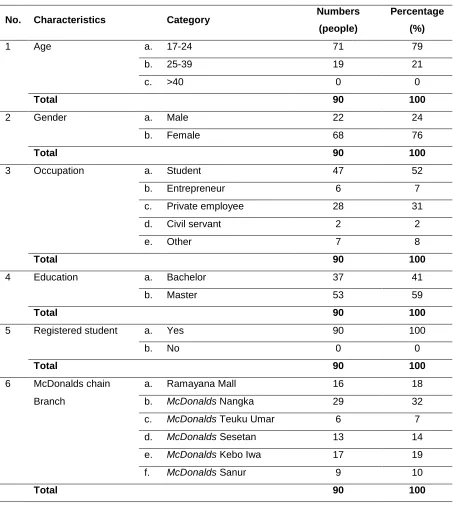
Table 1.Characteristics of Respondents
No. Characteristics Category Numbers
(people)
Percentage
(%)
1 Age a. 17-24 71 79
b. 25-39 19 21
c. >40 0 0
Total 90 100
2 Gender a. Male 22 24
b. Female 68 76
Total 90 100
3 Occupation a. Student 47 52
b. Entrepreneur 6 7
c. Private employee 28 31
d. Civil servant 2 2
e. Other 7 8
Total 90 100
4 Education a. Bachelor 37 41
b. Master 53 59
Total 90 100
5 Registered student a. Yes 90 100
b. No 0 0
Total 90 100
6 McDonalds chain a. Ramayana Mall 16 18
Branch b. McDonalds Nangka 29 32
c. McDonalds Teuku Umar 6 7
d. McDonalds Sesetan 13 14
e. McDonalds Kebo Iwa 17 19
f. McDonalds Sanur 9 10
Total 90 100
Licensed under Creative Common Page 55 percent. Those students must be registered for this semester and it as much as 100 percent. The frequently visited McDonalds branch is McDonalds Nangka by 32 percent, then McDonalds Kebo Iwa 19 percent, Ramayana Mall18 percent, McDonalds Sanur 10 percent, McDonalds Sesetan 14 percent, and McDonalds Teuku Umar 7 percent.
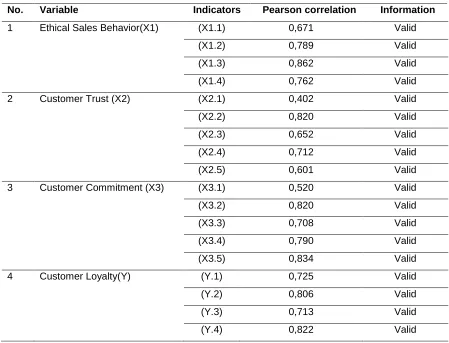
Table 2. Instrument Validity Test
All the indicators shown in Table 2 already meet the requirements of validity which the correlation coefficient is more than 0.3 therefore all the indicators are valid.
Table 3. Instrument Reliability Test
No Variabel Alpha Cronbach Information
1 Ethical Sales Behavior(X1) 0,771 Reliable 2 Customer Trust(X2) 0,647 Reliable 3 Customer Commitment(X3) 0,783 Reliable 4 Customer Loyalty(Y) 0,764 Reliable
No. Variable Indicators Pearson correlation Information
1 Ethical Sales Behavior(X1) (X1.1) 0,671 Valid
(X1.2) 0,789 Valid
(X1.3) 0,862 Valid
(X1.4) 0,762 Valid
2 Customer Trust (X2) (X2.1) 0,402 Valid
(X2.2) 0,820 Valid
(X2.3) 0,652 Valid
(X2.4) 0,712 Valid
(X2.5) 0,601 Valid
3 Customer Commitment (X3) (X3.1) 0,520 Valid
(X3.2) 0,820 Valid
(X3.3) 0,708 Valid
(X3.4) 0,790 Valid
(X3.5) 0,834 Valid
4 Customer Loyalty(Y) (Y.1) 0,725 Valid
(Y.2) 0,806 Valid
(Y.3) 0,713 Valid
Licensed under Creative Common Page 56 The entire items on the variables ethical sales behavior, customer trust, commitment and loyalty seen in Table 3 have been tested to meet the reliability requirements, the Alpha Cronbach correlation coefficient of all the items has exceeded 0.6, therefore it could be stated that all of them are reliable.
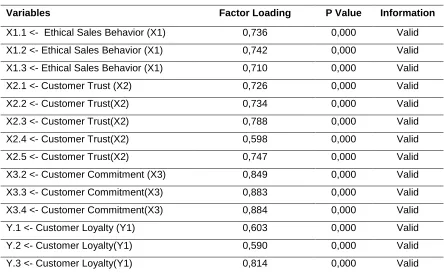
Table 4. Factor Loading
Variables Factor Loading P Value Information
X1.1 <- Ethical Sales Behavior (X1) 0,736 0,000 Valid X1.2 <- Ethical Sales Behavior (X1) 0,742 0,000 Valid X1.3 <- Ethical Sales Behavior (X1) 0,710 0,000 Valid X2.1 <- Customer Trust (X2) 0,726 0,000 Valid X2.2 <- Customer Trust(X2) 0,734 0,000 Valid X2.3 <- Customer Trust(X2) 0,788 0,000 Valid X2.4 <- Customer Trust(X2) 0,598 0,000 Valid X2.5 <- Customer Trust(X2) 0,747 0,000 Valid X3.2 <- Customer Commitment (X3) 0,849 0,000 Valid X3.3 <- Customer Commitment(X3) 0,883 0,000 Valid X3.4 <- Customer Commitment(X3) 0,884 0,000 Valid Y.1 <- Customer Loyalty (Y1) 0,603 0,000 Valid Y.2 <- Customer Loyalty(Y1) 0,590 0,000 Valid Y.3 <- Customer Loyalty(Y1) 0,814 0,000 Valid
Table 4 shows that the factor loading of ethical sales behavior, customer trust, commitment and loyalty variables is valid with p value of each indicator are less than 0.001.
Aside from the factor loading value, convergent validity also can be seen from Average Variance Extracted (AVE). The AVE value must above the 0,50. Table 5 shows one item with value below 0.5 that is Customer Loyalty (Y). Therefore, there is a convergent validity problem in the model tested so that the construct in this research model needs to be modified.
Table 5. Average Variance Extracted (AVE)
Variable AVE
Licensed under Creative Common Page 57 Table 6 shows that the square root value of AVE is greater than the correlation coefficients of each constructs. Thus, it can be conclude that the data has good discriminant validity.
Table 6. Discriminant Validity
Variable Ethical Sales
Behavior (X1)
Customer
Trust (X2)
Customer
Commitment (X3)
Customer
Loyalty (X4)
Ethical Sales Behavior (X1) 0,730
Customer Trust (X2) 0,614 0,721
Customer Commitment (X3) 0,625 0,642 0,872
Customer Loyalty (Y) 0,296 0,351 0,359 0,677
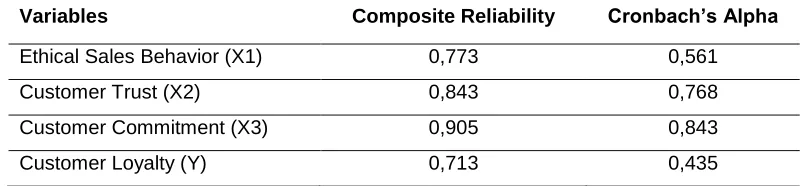
Ensuring that there are no problems with measurement, the final step in evaluating the outer model is to test the unidimensionality of the model. Both composite reliability and Alpha Cronhbach tests with the cut-off point value is 0.7 as shown in Table 7.
Table 7. Composite Reliability and Cronbach’s Alpha Coefficient
Variables Composite Reliability Cronbach’s Alpha
Ethical Sales Behavior (X1) 0,773 0,561
Customer Trust (X2) 0,843 0,768
Customer Commitment (X3) 0,905 0,843
Customer Loyalty (Y) 0,713 0,435
Table 7 shows that the composite reliability coefficient of all variables are above the criterion limit of 0.6 so that there are no composite reliability problems. While, there is one item (Loyalty, Y) below 0.5 in Cronbach's Alpha so there may be unidimensionality problem in the model formed.
Inner Model Evaluation aims to determine the goodness of fit model with the R-Square (R2) method. It is shows the strengths and weaknesses of the effect caused by variations in exogenous variables on endogenous variables.
Table 8. R2 ofEndogenous Variables
Variables R-Square Value Inference
Ethical Sales Behavior(X1) - -
Customer Trust (X2) 0,377 Moderate
Customer Commitment (X3) 0,497 Moderate
Licensed under Creative Common Page 58 Table 8 shows that the R-Square (R2) value of the entire variables is less than 0.50 which included in the moderate criterion, it can be said that the model formed is considered to be quite weak.
Q-Square (Predictive Relevance) measures how well the observed value generated by the estimation model and its parameters. Q-Square value>0 indicates the model has good predictive relevance. The Q-Square (Predictive Relevance) value can be calculated as follows:
Q2 = 1 – (1 – R2
1) (1 – R22)(1 – R33)
Q2 = 1 – (1 – 0,377) (1 – 0,497)(1 – 0,155)
Q2 = 1 – (0,623) (0,503)(0,845)
Q2 = 1 – (0,263)
Q2 = 0,73 or 73%
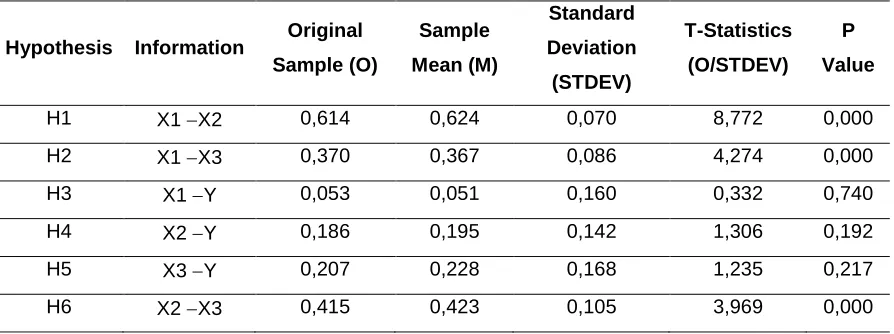
Calculation of Q-Square (Predictive Relevance) amounted 0,73 means that 73 percent customer loyalty variables are explained by customer trust, commitment and loyalty variables while the remaining 27 percent explained by variables that are not included in the model. The calculations of R2 and Q2 can be continued with the hypothesis testing.
Table 9. Path Coefficients
Hypothesis Information Original
Sample (O)
Sample
Mean (M)
Standard
Deviation
(STDEV)
T-Statistics
(O/STDEV) P
Value
H1 X1 X2 0,614 0,624 0,070 8,772 0,000 H2 X1 X3 0,370 0,367 0,086 4,274 0,000 H3 X1 Y 0,053 0,051 0,160 0,332 0,740 H4 X2 Y 0,186 0,195 0,142 1,306 0,192 H5 X3 Y 0,207 0,228 0,168 1,235 0,217 H6 X2 X3 0,415 0,423 0,105 3,969 0,000
Licensed under Creative Common Page 59 Table 10. Indirect Effects
Hypothesis Information Original
Sample (O)
Sample
Mean (M)
Standard
Deviation
(STDEV)
T-Statistics
(O/STDEV) P Value
H1 X1 - X2 - - - - -
H2 X1 - X3 0,255 0,265 0,075 3,378 0,001
H3 X1 – Y 0,243 0,264 0,100 2,431 0,015
H4 X2 – Y 0,086 0,102 0,083 1,038 0,300
H5 X3 – Y - - - - -
H6 X2 - X3 - - - - -
Table 10 shows the significance of the indirect relationship between the ethical variables of sales behavior on customer trust, commitment and loyalty. The effect of H1, H2, and H6are significant with P values (0,000 <0.05), whereas H3, H4, and H5 are not significant with P values (0,000 <0.05).
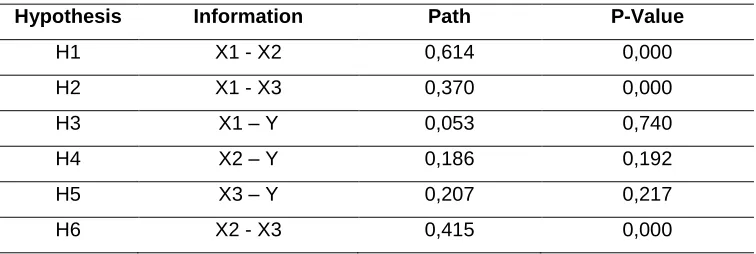
The hypothesis test shows the statistical analysis of the relationships between the studied variables. The hypothesis test as shown in Table 11.
Table 11. Path Coefficient and Hypothesis Test
Hypothesis Information Path P-Value
H1 X1 - X2 0,614 0,000
H2 X1 - X3 0,370 0,000
H3 X1 – Y 0,053 0,740
H4 X2 – Y 0,186 0,192
H5 X3 – Y 0,207 0,217
H6 X2 - X3 0,415 0,000
Licensed under Creative Common Page 60 Figure 2. Path Analysis SEM-PLS Diagram
CONCLUSION AND SUGGESTION S
Based on the empirical results, conclusions have been obtained as follows: First, ethical sales behavior has a positive and significant effect on customer trust, it applied by McDonald’s employees when they do their job and generate a positive impact on customer trust. Second, ethical sales behavior has a positive and significant effect on customer commitment, such as work ethics in McDonald’s gives a positive impact on customer commitment towards the
Licensed under Creative Common Page 61 Suggestions to McDonalds management in Denpasar are to encourage their employees to always keep the ethics of good sales behavior, maintain a close relationship with customers, emphasize the employees that unethical sales behavior such as lying, forcing sales, or exaggerating information about a product is not acceptable. Further researchers can improve the existing limitations in this study by increasing the number of samples to get a comprehensive result, it would be better if the interview method is added in collecting the and were expected to develop research by adding other variables that matter such as brand image, buying interest, marketing mix, or satisfaction.
REFERENCES
Anderson, B., Lyon-Callo, S., & Rafferty, A. P. (2011). Fast Food Consumption and Obesity among Michigan Adults. Prevention Chronic Disease, 8(4)
Barre, A., Aminuddin S., & Devintha V. (2013). Hubungan antara Pengetahuan dan Kebiasaan Konsumsi Fast Food dengan Kejadian Gizi Berlebih pada Siswa SDN Sudirman I. Retrieved from http://www.repository.unhas.ac.id. Bua, H. (2014). Pergeseran Pemikiran Paradigma Pemasaran Transaksional ke Pemasaran Hubungan. Tunggal Mandiri Cetakan I.
Crespo, A. H., Del Bosque, I. R., & De Los Salmones Sanchez, M.G. (2009). The Influence of Perceived Risk on Internet Shopping Behavior: A Multidimensional Perspective. Journal of Risk Research, 12(2), 259-277.
Currie, J., Vigna, S. D., Moretti, E., & Pathania, V. (2010). The Effect of Fast Food Restaurants on Obesity and Weight Gain’, American Economis Journal: Economic Policy, 2(8), 32-63.
Endang, S R. (2015). Pengaruh Economic Content, Resource Content dan Social Content Terhadap Kepercayaan, Kepuasan dan Komitnen Serta Relationship Intention Debitur Bank SUMUT Di Sumatera Utara, Universitas Airlangga.
Erdiawati, A. (2018). Studi Kualitatif Konsumsi Fastfood pada Remaja yang Berkunjung ke Restoran Fast Food MTOS. Fakultas Kesehatan Masyarakat, Universitas Hasanuddin, Makassar.
Farah, M.F., & Adrew J. N. (2010). Exploring Consumer Boycott Intelligence Using A Sociocognitive Approach. Journal of Business Research, 63(4), 347-355.
Fardila. (2012). Pengaruh Kepercayaan dan Komitmen Pelanggan TerhadapLoyalitas Pengguna Jasa Service AC Pada PT. Cahaya Gentalla Mandiri.Skripsi.
Fullerton, G. (2003). When Does Commitment Lead to Loyalty. Journal of Service Research. 5(4), 333-334
Griffin, Jill. (2015). Customer Loyalty: Menumbuhkan dan Mempertahankan Kesetiaan Pelanggan. Jakarta: Erlangga Hansen, J.D., & Riggle, R.J. (2009). Ethical Salesperson Behavior in Sales Relationships. Journal ofPersonal Selling and Sales Management. 29(2). 151-166.
Hennig T., Thorsen, K. P. G. & Dwayne D. G. (2012). Understanding Relationship Marketing Outcomes: an Integration of Relational Benefits and Relationship Quality. Journal of Service Research. 4(3), 230-247.
Iwanon H., McEachern, M.G., & Jeffrey, A. (2015). The Influence of Ethical Trading Policies in Customers Apparel Purchase Decision: A Focus on The Gap Inc. International Journal of Retail & Distribution Management. 33(5), 371. Jannah, M. (2016). Pengaruh Perilaku Tenaga Penjualan Terhadap Keputusan Pembelian Konsumen. Program Pascasarjana Fakultas Ekonomi Universitas Islam Indonesia. Yogyakarta
Khotimah, K. (2013). Pengaruh Kepercayaan Terhadap Loyalitas Nasabah Menabung Pada Kantor Cabang Utama PT. Bank Pembangunan Daerah Papua Di Jayapura. Jurnal.
Licensed under Creative Common Page 62 McKnight, D. H., Choudhury, V. & Kacmar, C. (2012). The Impact of Initial Consumer Trust On Intentions to Transact With a Website; A trust building model. Journal of Strategic Information System, 297-323
Mowen, J.C. & Minor, M. (2002). Perilaku Konsumen. Jakarta: Erlangga.
Pritchard, M.P., Havitz, M.E., Howard, D.R. (1999). Analyzing The Commitment–Loyalty Link in Service Contexts. Journal of The Academy of Marketing Science, 27(3), 333 – 348.
Punwatkar, S. & Manoj, V. (2014). The Impact of Salespersons Behavior on Consumers Purchase Decision: An Empirical Study. The IUP Journal of Marketing Management, 13(2), 72-83.
Ramadani. (2002). Kepercayaan dan Komitmen sebagai Perantara Kunci Relationship Marketing salam Membangun Loyalitas Survey pada Nasabah Bank Muamalat Indonesia Surabaya. Jurnal Riset Ekonomi dan Manajemen. 2(1). Rini, E. S. (2007). Pengaruh Economic Content, Resource Content dan Social Content terhadap Kepercayaan, Kepuasan dan Komitmen serta Relationship Intention Debitur Bank SUMUT Di Sumatera Utara, Universitas Airlangga.
Ronald, J. E. & Ricky W. Griffin. (2000). Bussiness Essentials. Seventh Edition. New Jersey Prentice Hall.
Sanzo, M.J., & Santos, L. V. (2003). The Role Market Orientation in Bussiness Dynamic Relationship : Testing an Integrator Model. Journal of Marketing Management, 19, 73-107.
Siagian, H & Cahyono H. (2014). Analisis Website Quality, Trust, dan Loyalty Pelanggan Online Shop. Jurnal Manajemen Pemasaran, 8(2)
Silviani, A. (2013). Pelanggaran Etika Dalam Iklan (Studi Deskriptif Iklan Pengobatan Alternatif Pada Skh Merapi dan SKH Meteor Periode Mei-Juni 2013). Fakultas Ilmu Sosial Dan Ilmu Politik Universitas Pembangunan Nasional Veteran Yogyakarta 2013.
Stender, S., Dyerberg, J., & Astrup, A. (2007). Fast Food: Unfriendly and Unhealthy. International Journal of Obesity, 31, 887-890.
Supriaddin, N. (2018). Pengaruh Kepuasan, Kepercayaan dan Komitmen Nasabah Terhadap Loyalitas Nasabah pada Bank BNI Cabang Kota Kendari