In/Visibility of the Abandoned School: Beyond
Repre-sentations of School Closure
Natalie LeBlanc
University of British Columbia1
ABSTRACT
In/Visibility of The Abandoned School is a practice-led form of visual inquiry that investigates school closure in two ways: first, through a photographic prac-tice that documents my experience in and with schools as they stand closed on the periphery of society, boarded up and locked off from the public; and sec-ond, through a site-specific installation performed with a closed school located in British Columbia, Canada, in which a temporal site of exchange took place. This research contributes to arts-based research by attending to the roles that photography and installation, as conceptual art practices, can play in a prac-tice-led research project and it responds to a call made by arts-based research-ers to investigate ways that art practice can be conceptualized as a mode of research (O Donoghue, 2009; 2011; Sullivan, 2004; 2006; 2010; 2011).
Key words: school closures, photography, practice-led research, visual inquiry
Description of the Project
In/Visibility of the Abandoned School is a practice-led form of visual
inquiry whereby knowledge is generated from a closed school because it is a de-institutionalized, de-commissioned, and empty place that has not yet been legally re-zoned, re-sold, or repurposed. The objective of this research is to emphasize the evocative and ambiguous character that a closed school embodies while in a
temporal state and to examine its pedagogical possibility. To complete this research I spent four years doing fieldwork photographing closed and abandoned schools in cities across Canada and interviewing principals, students, board directors, faculty, and community members about their experiences with school closure. For the final stage of my inquiry, I projected images of the inside of a decommissioned school onto the outside’s physical structure and I invited the community that had experienced the closure of their school to take part in an immersive experience with the intention
Left Behind (NCLB) in which high stakes testing and accountability are penalizing public schools with closure when they fail to meet uniform standards (Kirshner & Pozzoboni, 2011). Districts in New York, Chicago, Detroit, St. Louis, Philadelphia, and Washington, DC, have recently witnessed manifold closures where “failing schools” have had their funds revoked and their schools shut down (see Aggarwal, Mayorga, & Nevel, 2012; Ayala & Galetta, 2012; Hursh, 2007; Jack & Sludden, 2013; Kretchmar, 2011; Lipman & Person, 2007). School closings are also occurring in the United Kingdom, Europe, Asia, Australia, and New Zealand (see Blackmore, 2004; Cheng, 2009; Cheng & Walker, 2008; Egelund & Laustsen, 2006; Haiming, et al. 2013; Holloway & Pimlott-Wilson, 2012; Kearns, et al. 2009; & Walker, 2010).
Tightly woven into neoliberal educational reform are many social, economic, cultural, and political inequalities. Kirshner & Pozzoboni (2011) reveal that closures in the United States are “disproportionately falling on schools with high percentages of poor and working class students of color” (p. 1635). Case studies performed in Chicago (Lipman & Haines, 2007), New Orleans (Buras, 2014), and most recently, Philadelphia (Jack & Sludden, 2013) support this argument further, revealing that school closure is a broader effort to gentrify low income African American neighborhoods (Aggarwal, Mayorga, & Nevel, 2012). Public schools are closing only to re-open as private, for-profit, competitive, market-based schools such as charter schools and schools of choice (Buras, 2014). In British Columbia, rural schools have been particularly hard-hit by closures because they are located in areas with a lower density population that makes them more vulnerable to the government’s per-pupil funding allocation formula. Pupil-led funding is regulated by the number of pupils in attendance, forcing schools to compete for pupils with neighboring schools and putting pressure on parents to become astute consumers (Walker, 2010).
School closure raises many issues and questions intersecting with and relating to social justice, citizenship, and human rights. It is a that they could project their own stories and imaginations onto the
artwork. Participants were encouraged to share their responses of the work so that further examinations could be made. Data was acquired in two phases: first, in the production of the work, where I produced a photographic archive on closed schools in their liminal state and second, in the encounter with the artwork, in which a site-specific installation comprised of selections made from my photographic archive were projected onto a closed school located on Vancouver Island, a rural community in British Columbia.
Context
School Closure is not a new phenomenon. In the second half of the 20th century, many Canadian provinces witnessed school closure due to urbanization that forced small community schools to amalgamate into larger schools (Chambers, 2007). Today, Canadian schools are closing for a different reason, namely neoliberalism, a political ideology grounded in the belief that market principles led by private enterprise and consumer choice applied to the public sector contributes to greater efficiency and economic prosperity (Poole, 2007). Ross & Vinson (2013) argue that school closure in British Columbia is a visible example of the financial cuts being made to the public education system as a result of a neoliberal agenda based on educational reform. The government’s decisions and policies are designed to maximize profits rather than serve the community’s needs (Ross & Gibson, 2007; Ross & Vinson, 2013). Since 2002, the province has witnessed the closure of over two hundred schools that has displaced more than twenty-seven thousand students (BCTF, 2014). The de-commissioned school selected for this study closed in June 2013 just short of its one hundredth anniversary. The decision to close the school came along with five other schools in the district to save a $3.7 million deficit.
the closed school because it is a place that has been abandoned for its educational possibility. Although the closed school ceases to exist as it once did, and is no longer utilized as it once was, can it still be a place
for learning?
Methodology
The project involved a multi-method research design. In one sense, it is a technology-based, performative, and participatory form of research that combines the visual and the narrative to build an understanding of a community’s subjective experience of school closure through an artistic intervention performed with a closed school. In another more accurate sense, it is a visual arts-based form of inquiry in which the image plays a crucial, yet changing role during the research process. In the first phase, the photograph is a researcher-produced form of visual data that acts both as document and as art. In the second phase, the installation demonstrates how the visual can be used as a situational provocation allowing for new perceptions pertaining to school closure to come forth. During the second phase, the visual opens up multiple meanings determined not only by myself as the artist/researcher, but by the viewer, and by the context of the viewing experience.
Inspired by the recent work done by arts-based researcher Dónal O Donoghue (2011), I emphasize emerging theories and philosophies of contemporary art while drawing attention to how meaning is made in the production of the artwork and in the encounter with the artwork. Rather than trying to find ways to use artistic practices and processes in educational research, I engage in a practice-based approach that allows art practice to lead the inquiry. As such, I am less concerned with answering predetermined questions than I am with “generating new insights that are not easily available through verbal modes” (O Donoghue, 2011, p. 640). I am also contributing to ways in which art practice can be conceptualized as a form of research that makes use of “inventive forms whose uniqueness is best seen as connected to, but representation of a cultural struggle over race, ethnicity, and power
(Lipman, 2007). Schools are not closing silently nor are they closing without conflict. The community that is the focus of this study took action; they demonstrated civic participation and attempted to challenge the policy collectively. They organized protests, wrote letters, and attended public hearings to voice their opinions pertaining to reasons why they thought their school should stay open. The decision to close the school revealed that the school trustee, who held legal responsibility for the school, also held substantial power to close the five schools when the decision fulfilled the character of their own closure policies and ministry regulations. Undermining procedural fairness,2 a decision was reached to eliminate middle schools in favor of kindergarten to grade seven elementary schools and grade eight to twelve secondary schools.
Unlike an event or action that is immediate or instantaneous, school closure is “a slow violence” that occurs gradually and out of sight (Aggarwal, Mayorga, & Nevel, 2012, p. 162). The process is not easy for the community involved; it forces people to make difficult changes that affect their everyday lives and it causes them to experience a loss that can bring forth feelings of anger, sadness, fear, depression, and confusion (Oncescu & Giles, 2012). The term “abandonment” has been intentionally selected and applied to this study because it portrays a picture of loss, rejection, and emptiness (Dewar & Manning Thomas, 2013). The community that is forced to surrender the place that once played such a pivotal role in housing their social and educational encounters witnesses their school become stripped of its name and its identity and pushed to the margins of society. The fate of the building and the surrounding lot becomes unknown. Will it be sold? Will it remain vacant for a number of years? Will it be transformed into something else? Will it simply be left to the perils of nature, becoming an eyesore that the community has to live with? My interest resides in
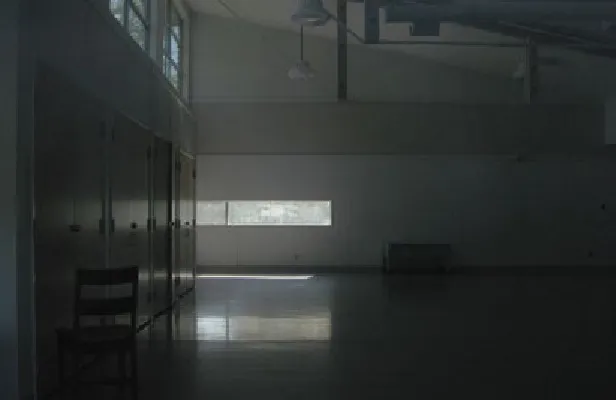
Figure 1. The Closed School as Void. Photo: Natalie LeBlanc
There was something extraordinary about being alone in the closed school. Having been boarded up for some time, the air was stale, and the atmosphere damp. Sections had become musty and moldy. There was a heaviness and deadness in the place as if it had been transformed into a museum (Newbegin, n.d.). It disarmed memories and electrified my imagination (Trigg, 2012), while my camera helped me take possession of it (Sontag, 1977). I photographed objects as I encountered them, as if they were evidence in a crime scene. I discovered how their configurations told a story and how that story would change depending on how it was framed and from what vantage point it was framed. I played with these narratives; I cropped objects; I used extreme close-ups; I flattened the depth of field; and I emphasized various formal elements that were easily found in the modernist characteristics of the building. I accentuated the mysterious relationships that these objects formed as if their spatial configurations testified to an independent agency while being confined within the closed school. Tim Edensor (2005) explains this phenomenon as “the happenstance montages of ruined space” (p. 77) for which the arbitrary relationships and the juxtapositions between distinct from, traditional systems of inquiry” (Sullivan, 2011, p. 100).3
Phase One: The Production of the Archive
Motivated by a recent surge of school closures in my neighborhood, I began to research their social, political, economic, and cultural significance. I read newspaper and journal articles, websites, news reports, and various provincial and state school board/district archives. I actively searched for and compiled information on school closure. This process led to a series of phone calls, emails, and correspondence with secretary treasurers, school board assistants, and former principals, seeking permission to enter the off-limit buildings. Once the bureaucratic red tape had been cut, I would travel to the closed school, camera in hand. During these visits, I found myself on a journey led by curiosity and discovery. I opened drawers, cupboards, and closets; I read paperwork and writing left on chalkboards, walls, and corners. I inspected objects left in classrooms, halls, and offices. I searched for traces and remnants of things that had been removed. I imagined how the school might have looked in its open state; I contemplated reasons for why things had been taken away and alternately, why things had been left behind. Similar to an urban explorer, the experience placed emphasis on my individual sense of freedom. It called for movement much different from the horizontal, vertical, linear, or rigid paths that I normally take in and through architecture. It called for crouching down low, stepping over things, and weaving around through darkness. It demanded for a slower, more careful, and more intimate engagement than is normally required in an everyday space. It asked that I utilize multiple
senses and pay attention to the unexpected that, in turn, guided my trajectory. As such, my movements operated on chance, coincidence, and speculation.
shares a similar form in which absence of the human body emits a powerful human presence. Ristelhueber reveals the residue of combat through abandoned clothing and piles of spent explosive shells. Doherty reveals the turbulence of Northern Ireland through framing corroded areas of derelict city streets. Bhimji produces images reminiscent of still lifes, acting as evocative narratives for cultural elimination and erasure. These photographers play with what is seen and what is not seen in the visual composition; what is presented before the viewer and what the viewer brings to the photograph becomes a method of visualizing the void of human loss and the complexity involved in conflict. The viewer is left imagining the economic, social, cultural, and political forces that have motivated such acts and is left to construct stories that are open-ended and unresolved (Cotton, 2009). A counter-photojournalistic approach advocates how the photograph is more than it represents. It offers a possible state of encounter between the image and the viewer that involves participation in order for an interpretation and/or an experience to occur. In this sense, the viewer is not a passive spectator, but rather, an active participant who has to piece together clues, both found and made in order to construct a bigger picture of the event depicted.
In a similar mode of representation to the artists previously described, the photographs of the closed school document the aftermath of closure through objects that have been left behind in the de-commissioned building. Contrasting to the seamlessness, to the smoothness, and to the regulated space that a school regularly embodies, the photographs included in this text present a tension between order and disorder, and between what is seen and not seen. Figure 2 depicts how the school’s materiality is no longer neatly organized, categorized, segregated, or “in place” (Edensor, 2005, p. 66). It produces a disruption to the order that is normally presented in a functioning school. Figures 1, 3, 4, and 5, on the other hand,
the Greek words “other” and “to speak in public,” allegory is commonly commu-nicated through symbolic figures or symbols that, when combined in the mind of the viewer, function beyond their literal representation (wiseGEEK, n.d.).
different forms, shapes, textures, and materialities create assemblages that defamiliarize a common place, thus celebrating the unfamiliar and producing alternate narratives. These stories often played with the utilitarian value of the object and how new formations made new meanings depending on how objects were placed in context with other objects. I documented these arrangements; I captured them on scene as if the school was a stage and the event of closure their fate.
Figure 2. Natalie LeBlanc, The Closed School in Ruins. Digital photograph.
The Disintegration of an Ordered World
Charlotte Cotton (2009), author of The Photograph as Contemporary
Art, refers to the form of documentary practice I used as a
“counter-photojournalistic approach” (p. 9). Rather than trying to capture an event in a more traditional photo-journalistic way, the wake of these events are depicted by that which has been left behind. Such an approach is evident in the photographic work of Sophie Ristelhueber, Willie Doherty, and Zarina Bhimji where the scars of tragedy, war, and economic, social, and political upheaval in Kuwait, Ireland, and Uganda are revealed through allegory.4 This genre of photography
even take on anthropomorphic qualities that mirror the human form. Susan Sontag (1977) once declared that the photograph itself is a “melancholic object” (p. 49) as did Roland Barthes (1981), who stated that the photograph’s appeal is its “melancholy” (p. 90).
Figure 4. Natalie LeBlanc, Principal’s Office. Digital photograph.
Both authors make reference to the photographic capability of
recording a moment in time, and turning that moment into something that can be kept and looked at over and over again. A careful reading of the manner in which these objects are represented, however, reveals that the negative space plays an equivalent, if not leading role over the objects in the frame. Absence, in this regard, reveals that the actual object of attention lies in what is not there, what is no longer there, or what has been taken away from there. In the presence of this absence, the photograph creates a void that produces a disturbance—a tension in the performance of reading the image. The image suggests a narrative, but it is incomplete, asking viewers to complete the story in the frame. The void takes on an important role, hinging on the viewers’ projections to think, fantasize, and assemble what cannot be seen, transforming what is not visible into a polyvocal way of seeing. Thus, absence does not necessarily represent
Figure 3. Natalie LeBlanc, Un lapin chanceu(x). Digital photograph.
spatial organization, and the arrangement is documented in a certain deadpan aesthetic.5 Like Bernd and Hilla Becher who documented disappearing German industrial architecture, I prefer to capture scenes so that the formal frontality amplifies the static temperament of the school, capturing characteristics that Paulo Friere (1971) once labeled as “lifeless” and “petrified” (p. 71), and that Maxine Geene (1977) infamously called “anaesthetic” (p. 284). The mode in which school characteristics are presented grants them a structured clarity, allowing the small (sometimes partial) detail to become the focal point. Framing a vestibule, the photograph displays a shelving unit with a row of coat hooks that, at one time, must have been a center of order within the school (protecting it from disorder).
Figure 5. Natalie LeBlanc, Contents Erased. Digital photograph.
Its contents are empty except for a semi-transparent container located near the upper right hand corner and a chalkboard eraser located
5 Charlotte Cotton (2009) refers to the deadpan aesthetic as “a cool, de-tached and keenly sharp type of photography” (p. 81) where there is a seemingly emotional detachment and a neutrality on the part of the photographer who re-mains concerned for depicting highly specific descriptions of the subject without allowing sentimentality to guide the image’s connotations.
loss, rejection, or emptiness as it could initially be perceived; absence creates a rupture that disrupts a narrative of melancholia by leaving it open to possibility, making possible alternate readings and responses based on creative or even emotive receptions, where the lost object can become “something new” and “something different” (Min, 2003, p. 231).
Contents Erased: A Case Study
In Camera Lucida, Roland Barthes (1981) establishes two different modes of appearance in a photograph that work heterogeneously. The first mode, the studium, presents an average affect; it allows the viewer to “get” the photographer’s intentions, to approve or disapprove, but always to understand. Barthes (1981) further describes the studium as an education, a production of knowledge, “a civility,” and a certain “politeness” (p. 28). Although the studium allows the viewer to participate in the figures, faces, gestures, settings, or actions depicted by the photograph, it does not cause delight or pain, whereas the second mode of appearance, the punctum, breaks the studium and rises from the scene to “pierce” the viewer (p. 26). Barthes (1981) describes the punctum as a sensitive point, a “sting,” a “speck,” a “cut,” or a “little hole” that is “cast out like a dice” (p. 27). It is an accident with the uncanny ability to “prick” (p. 47) the viewer and also to “bruise” (p. 27). After visiting 16 schools and acquiring 2,487 photographs, I spent hours reviewing, analyzing, and sorting through them. To a certain extent, I had an interest in all of them as they each revealed something unique about the school or about my experience inside of it. There were only a few photographs, however, that presented me with something unexpected; something that pulled me in and provoked me, like “a tiny shock” which in turn caused me to notice, to observe, and to think (p. 49).
Contents Erased (figure 5) was one such image. It depicts the particular
up like little toy soldiers or birds on a wire that produce a figurative contrast to the geometric shapes in the composition. Allowing my eyes to follow each hook in sequence, from left to right, and then from right to left, I witness them transform into a school teacher’s stern finger protruding from the wall that begins to move like a Muybridge stop motion photographic series telling me where to go and what to do. Tired, my eyes rest on the blue splatter caught inside a white brick on the left hand side of the photograph, located outside of the vestibule altogether. I can’t stop looking at this spot. It is the only thing that seems out of place. I want to erase it. I want to contain it. Its presence begins to haunt me. Why can’t I stop looking at it?
The Refusal (of Erasure)
In terms of digital technology, photographic software and even in-camera features afford me with various quick and easy ways to manipulate the image. I am aware that I can delete this mark so that it can appear as though it were never here. In contemplating this option, I refuse to erase the mark. I need to keep looking at it. This blue splatter, slightly lighter and brighter than the blue below it and in the vestibule draws my attention to other marks, splotches that are slightly lighter on the radiator and areas where the laminate has torn off the shelves. These marks force me to look back at the chalk eraser on the bottom shelf, causing each mark to be read with the connotation that it will soon be erased along with all the other objects in the composition. They simultaneously become a sign of resistance (defying a system that is endeavoring to control and contain them), and the markings of failure (a rhetoric for the school’s internal collapse). With the knowledge that this de-commissioned school has since been re-purposed into a nursing home, I am presented with what Barthes (1981) refers to as the “defeat of time” (p. 96). In other words, I am confounded with the school as it will disappear, while having the knowledge that it has already disappeared. The photograph does not simply become a privileged, honored, or powerful moment in the past that can be kept and looked at after the school is gone, it actually works to collapse time by falling into the liminal in-between of “this-below on the lower shelf. The formation of the image is a geometric
pattern that presents a frame within a frame, a box within a box, and a grid within a grid.6 The rectangular bricks echo the rectangular shelving unit, which echo the rectangular blocks of color, which echo the rectangular air vent, which echoes the rectangular room, which echoes the rectangular school. Like a Matryoshka doll that decreases in size to nest smaller versions of itself neatly inside, the image produces a mise-en-abyme7 that leads the eye to recognize how, like a topological map, or a bird’s eye view, or a Piet Mondrian painting— only called “red, blue and green”—the entire structure presents a container within a container. Embodying a hollow form, it suggests to us that its purpose is to hold a physical object or a substance. The vestibule’s empty contents play with the idea that it is empty of school as if school were a substance that once filled it. The vestibule becomes a microcosm, a fragment caught within a larger macrocosm that one can only imagine bleeds outside of the frame into the rest of the abandoned school.
The image is not as fixed as it appears at first glance but is composed of numerous associations represented by two opposing forces: the dynamic and the static. The thin white line of dust lying to the right of the chalk eraser takes on a presence. Suggesting that contents of the school have just been erased, it evokes thoughts pertaining to what or who has been erased through the closure of the school. Lying delicately on the surface of the laminate shelf, it is uncertain whether the line is headed towards the eraser or away from it. This suggests that the things that have been left here also risk erasure, along with the history of the place and the memories inside the building. Thinking, fantasizing, and imagining what has been made absent in the wake of the dust, my gaze moves on to the coat hooks, lined
6 The art critic and art theorist Rosalind E. Krauss (1979) argued, “by vir-tue of the grid, the given work of art is presented as a mere fragment, a tiny piece arbitrarily cropped from an infinitely larger fabric. Thus the grid operates from the work of art outward, compelling our acknowledgement of a world beyond the frame” (p. 60).
Phase Two: Encounters with the Archive
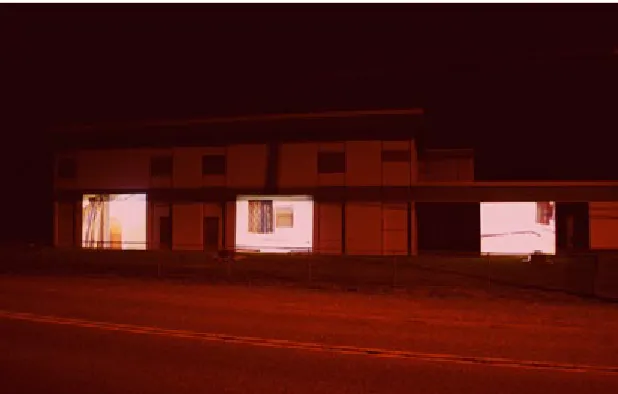
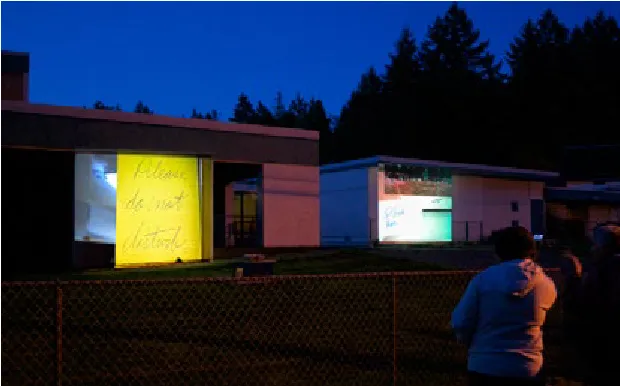
The second phase of the research was comprised of a site-specific installation in which photographs taken inside of a de-commissioned school9 were projected onto its outside physical structure (refer to figures 6 & 7). There were certain challenges in implementing this project. First, the design had to abide by certain conditions set forth by the school district that granted me permission to utilize the building. Second, the rural location, positioned in a remote and isolated area, made several visits not only time consuming, but difficult to maneuver (especially in the dark). Third, since the building was already cut off from the electrical grid, a generator was essential to power the projections, demanding a careful integration into the project’s design (tucked neatly behind the building). The installation was comprised of multiple layers, involving the site, the images, and the community participants. The physical place was the closed school and its environment (including the dark evening; the adjacent forest and surrounding field; the long rural road with no visible neighbors). The projected images, juxtaposed in series of four, were programmed to change every twenty seconds, which looped in its entirety every ten minutes. The building’s flat white walls were selected for the projections and worked very well for this purpose. The community who experienced the closure of the school ten months earlier were invited to come and see the projections and to take part in the event which lasted for two hours. People ages 10 to 80 were in attendance and various forms of dialogue took place. The types of responses ranged from observations and conversations, to response cards that asked a series of open-ended questions. Anecdotal responses sparked many impromptu dialogue sessions, including conversations between viewers and between the viewers and myself.
9 The name of the school is being withheld in order to protect the partici-pants’ identities.
has-been” and “this-will-be” (p. 96). These objects—the shelves, the container, the coat hooks, the peeling laminate, the ventilator, the blue and white bricks, the chalk eraser, and the arbitrary markings on the walls—appear as though they are suspended in time, as if the school will forever be closed, awaiting its fate and preparing for its death. This is the punctum that “pricks” me as if I’ve been pierced with a sharp point. It is no longer a form, but an “intensity” (p. 96). I begin to think critically about the processes for which I am coming to see my role as an artist/researcher concerned with and for the closed school. I realize that photographing the closed school has become a form of documentation; an historical task; an act of remembering, collecting, recalling, archiving, and even mourning. This blue mark, finding its way outside the structure trying to contain it, asks me to think how my work does the same. I begin to think, to reflect, and to wonder about the enormity and complexity of the issue at hand. Although the photograph acts to remember the past, it also asks that I consider the future. Returning to the idea that the vestibule is a topological map, or better yet and more fitting with the spatiotemporal architecture of the building, a modernist grid, the flattened, ordered, and geometricized formation appears as a world of its own, abstract and independent from the natural world. Rosalind Krauss (1979) once described the grid in modern art as being “autotelic” (p. 52), meaning it only has an end, or purpose, in and not apart from itself. I question whether this is true for the photograph: is this why it appears constrained by a trope of
loss and remembrance, creating a perpetual cycle of melancholia? The irony
here resides in the idea that, like an empty cabinet of curiosity, or a
Wunderkammer,8 the unfilled compartments and barren shelves await the answers where new thoughts, new questions, and new relations have plenty of space to form. This brings me to phase two of the research project, where, through a close reading of encounters with the photographs projected onto the closed school, the community helped put in context the archives created in phase one.
Windows Looking “In”
I feel like I can walk into the school,
but then I remember that it’s closed and I can’t. (Participant) One of the most defining features of a closed school in British Columbia is the manner in which the windows are boarded up (meticulously) in order to protect the unoccupied site from thieves and vandals. The photographic interiors projected onto the outside walls evoked large, oversized windows that disrupted the static building by creating openings into new spaces, new thoughts, and new worlds. The projected photographs intentionally addressed the binary of outside/inside, linking the two disparate physical spaces together by bringing the viewer “in” through a virtual space. The projected interior, with its larger-than-life objects and empty rooms, became more dreamlike than actual. It fired imagination and reflection by asking viewers to engage with the closed school by putting their own fantasies, memories, and experiences into play. Taking into consideration the dimensions of the actual site, the projections were situated between the intersecting lines of the architecture that echoed the formal structure of the building. The projected interiors appeared as though they were actually located inside the dark school, behind the flat walls that not only acted as a surface for the projections, but as gatekeepers that physically blocked the public from actually seeing in. The projections created an illusion that changed viewers’ perceptions of the materiality of the closed school by granting them access to enter “inside” the building through the virtual. As the quotation at the beginning of this theme reveals, juxtapositions between the real and the virtual, the tangible and the intangible, the light and the dark, the positive and negative, the open and the closed, the seen and the unseen created tension in the viewing experience. The closed school, inhabiting the participants more than the participants could inhabit the building, disrupted the habitual ways that the community had previously moved about the space. It provoked thoughts pertaining to how the closed school was situated Findings & Analyses
Art historian and critic Miwon Kwon (2000) describes site specific art as an object or event that is not only placed in an actual, or real, location (i.e. outside an institution such as a gallery or museum), but is directed and determined by the “site” that it is placed with/in. In other words, the location is not coincidental; it is not an afterthought, nor is it simply where the work of art is exhibited. Rather, the location is the primary element of the artwork’s composition that takes “the fabric of the time and place” as its starting point for a critical intervention into how it is historically located and/or culturally determined (p. 54). In/Visibility of the Abandoned School follows in the tradition of site specific art beginning in the 1960s and 1970s with Fluxus happenings, Situationism, Minimalism, and Dadaism in producing a “situation” (Doherty, 2009,p.13 ) that adopted a performative, relational, and process-based approach that remained concerned with the facilitation of dialogue and exchange (Bishop, 2006; Bourriaud, 2002, Kester, 2004). Findings and analyses are organized into four different themes: 1) window’s looking “in,” 2) disrupting narratives, 3) politics of the space between, and 4) the abandoned school as place for learning. Each of these will be explored below.
The event enabled unlikely creative and intellectual associations, and it elicited a diversity of expressions and performances from the viewers. The personal memories, cultural histories, and subjective experiences that viewers brought to the work became the content of the work. They took the form of action (movement or dialogue) and reflections (looking, reading, hearing oneself and/or other voices). The spatiotemporal organization not only asked viewers to engage in a physical interaction between the land, the building façade-turned screen, the projector(s), and each other, it invited them into relation with these components, and each other, as equally contributing components of the work that, in return, produced new relations and new connections. The event was not only a perceptual experience, it was an immersive one that demanded for participation and for a multi-sensorial engagement, forming a new social context altogether. Rather than a closed system, detached from nature and cut off from society as it had been made to appear within the process of school closure, the abandoned school created new formations that opened it up to possibility. It also created a space for adventure, cultivation, acquisition, and creativity by bringing something new into existence. One participant, curious as to why I chose not to have the oldest part of the school play a pivotal role in the site specific installation, observed,
It’s interesting that you chose not to include the oldest part of the school — the old school house that was built in 1914. I was told that the community is going to keep [the old building] as part of the historical society of [the area]. The other two sections, added sometime in the 1950s and 1970s, will most likely be turned into something else, removed, or torn down altogether. It’s ok—as long as they keep the old school. That’s where the history is. (Elaine)
This comment captivated my imagination. My thoughts were quickly carried to the places in which history is found, located, or in this case, overlooked. I thought of the materials that I encountered while inside the closed school, “materials of the 1950s and 1970s”—the wood, in the present as an inaccessible, impassable, and unattainable space.
The virtual school surged forward to penetrate the viewers’ thoughts and emotions while the actual building, comparatively, appeared firmly rooted to the ground. A public discourse centered on what could not be seen in the installation quickly emerged. One viewer commented “I don’t see any people in these photographs. There are no books. There are no signs of activity.” Another person commented on how the photographs were “missing children.” “I wish I could go inside and see how the interior has changed since I was a pupil in the 1950s,” stated one participant. And another wanted “to see the music room” because it was her “favorite place in the school.”
Disrupting Narrative(s)
Not only did the projections provoke memories, they brought forth questions and recollections of people and places that had been forgotten, while demonstrating how the same projection could have a different effect and/or affect on different viewers. One sequence of images, consisting of a long row of coat-hooks that were individually labeled with student names, caused an older participant to think back to her children’s youth. She recalled, “Both my children brought home lice! The lice jumped from coat to coat along those coat-hooks” (Colleen). A little girl, quite engaged with the names labeled under each hook, excitedly called out names of her (past) classmates,
Figure 7. Natalie LeBlanc, In/Visibility of the Abandoned School, 2014. Detail of site-specific installation.
Politics of the Space Between
I can’t get used to the silence. I miss the sounds of the children at play and running in the fields. It’s a loss in our community—a loss of history to the area. (Participant)
The temporal, shifting, and (re)negotiated meanings formed and re-formed in/on site revealed a complex and interwoven field of emergent issues relating to memory, history, place, identity, authority, and power. Similar to the work of Krzysztof Wodiczko, the Polish-American artist who enables public discourses on cultural oppression through the use of new technology, installation, and performance, In/
Visibility of the Abandoned School allowed participants to speak to, and
engage with, a place that had been cast into the shadows—forcibly taken from them ten months prior to the event. The site-specific installation commemorated one hundred years that the building had occupied the site and had actively been a part of the rural town, partially forming and informing its identity. Participants were given an opportunity to voice their memories, opinions, beliefs, fears, concerns, and hopes regarding the closed school, and the influence that it had in the past and continued to have in the present on concrete, steel, copper, aluminum, laminate, linoleum, marmoleum,
glass, plastic, plaster, paper, masking tape, cinder blocks, bricks, mortar, tar, carpet, lead-based paint, and all of the asbestos-filled components and equipment. I was reminded of the materials that people are quick to forget, or to erase—things that are not perceived as national heritage objects, things that are rarely preserved for their historical or cultural significance, things that are not/or cannot be maintained in order to benefit current or future generations, and things that are perceived as having little or no value. Although these materials may become justifications for why a school building should be torn down, do they not speak to the significance of the place just as much
as the old section that was built in 1914? Do they not also define the school? evoke a certain nostalgia, and situate it within a particular time in history?
Elaine’s response drew other participants’ curiosity to “where the history is” located in the closed school. Her reflection not only
disrupted other participants’ observations, it challenged them to think about where the contents, the substance, and the value of the closed school resided. Was it inside the closed school? in certain areas of the closed school? in the participants’ thoughts, memories, and personal lived experiences, that, similar to the installation, remained outside, projected onto the closed school?
that viewers recalled from their memory, the liminal state of the de-commissioned building created significant anxiety, apprehension, and sadness. Many participants felt as though school closure were a monumental authoritative scheme that eminently disregarded the psychological, social, and even economic impact it would have on the community’s past, present, and future. The projections succeeded in bringing the ideological framework of school closure to the fore and it also illuminated the closed school as a neglected social and political body that, like the community, had also become a victim of the rash of school closures. In the context of a neoliberal regime that is currently in the process of drastically eliminating social services and programs and leading to unstable situations such as school closure, events that allow inhabitants to project their own critical thoughts and reflections are becoming sparse. Reminding us of the importance of such events, Wodiczko (1999) argues, “not to speak through city monuments is to abandon them and to abandon ourselves, losing both a sense of history and the present” (p. 63).
Examining Wodiczko’s performative installations through Winnicott’s notion of transitional space, Elizabeth Ellsworth (2005) considers such events as forms of civic pedagogy, opportunities that can interrelate, yet separate participants at the same time in order to produce a third space, or a space between self and other (and self and world) that produces a place she recalls “is neither self nor other but the reality of relation” (Ellsworth, 2005, p. 31). In/Visibility of the Abandoned
School produced relations between the singular and the plural, the
individual and the collective, the past and the present, and the present and the future by opening the closed school up to public discourse and thought. The participants, taking up the event’s beginnings, helped to (re)configure the closed school as a network of relations that connected with a broader physical and social landscape. This revealed the multiple character of the place and the plurality of meanings that the school held due to the social and political processes that helped to shape and re-shape it. In a conscious attempt at saving it from being a representation of nostalgic historicism (Kwon, 2000) and a work of mourning (O’Sullivan, 2006), the site-specific installation was not their personal and collective identity. During the event, they were
presented with an opportunity to discuss some of the social, political, cultural, and economic constraints of school closure by publicly addressing some of the hidden discourses that were brought in its wake, including the difficulty of loss, the uncertainty of change, and the unsettling phenomenon of historical and cultural erasure.
For Wodiczko (1999), architecture establishes an absent-minded and passive relation. Daily, we move around and through it with unconscious, “ritualistic” (p. 46) movements based on a belief that it is meant to be stationary, static and “rooted permanently to the ground” (p. 46). A building (whether public or private) is not only one of the most valuable and expensive investments in our environments, for Wodiczko (1999), buildings are the most secretive and protected, the most disciplined and disciplining, and also the most controlled and controlling environments. In the discourse of power and authority, school, as an institution, is a systemic structure put in place (either by the government or by private corporations) to house education, which is, by law, a compulsory event. Intended first and foremost as a political educational facility, schools also provide opportunities for creating social and political linkages in the community, which can help foster a strong civil society (Basu, 2004). When a school is taken away—that is, when a school is closed, boarded up, demolished, or transformed into something else—it does not simply create a historical, cultural or social void, it creates a psychological one as well. Wodiczko (1999) explains,
We feel a desire to identify with or become part of the building. We recognize the familiarity of the building, like that of our own body. We feel a drive to “complete” the building as we desire to be “completed” by it. We sense that there is something about us which is incomplete, and which can only be completed by a full integration with the building. (p. 45)
practice. In the book Architecture from the Outside, Elizabeth Grosz (2001) brings together philosophy and architecture through the space of the outside. She argues that the outside provides an ability “to see what cannot be seen from the inside” (p. xv). Exploring school closure from the outside allows me to document the disappearing schools while imagining, considering, and wondering about the people who are excluded from the frame of the photograph and who, situated beyond its edges, are made absent from its operations.
Second, Disrupting Narratives makes reference to my role as a catalyst working within the context of the everyday (Loftus, 2009). The site specific installation required many organizational and administrative skills, but more importantly, it required that I trust the situation and relinquish control so that the event, and thus the artwork, could unfold at its own pace and on its own accord—in time and space— through the participants’ active involvement. In adopting the role of context provider as opposed to content provider (Kester, 2004), I assumed a performative commitment that provoked a plurality of responses.
Third, Politics of the Space Between calls attention to my ethical and political encounters as the photographer-turned-performer-turned-interventionist. Living in the intersection between artist and researcher required that I proceed in a critical yet socially responsive manner. Urban exploration, guerilla activism, interventionist, and other anti-authoritative practices that break the law present a challenge to researchers working within the academy. Seeking permission to utilize the closed schools required that I subject myself to rejection; I often had to change my course of action, beginning anew. These restrictions challenged my artistic conceptualizations and demanded on-going revisions. Seeking city permits, special event liability insurance, and ethical consent for engaging with human subjects, however, did not cause the project to lose its appeal, rather, it made the not-quite-private/not-quite-public site more alluring. The process, although at times difficult, presented me with opportunities to re-think issues regarding privilege and power, power relationships, only a form of remembrance revealing the repressed memories and
histories of a group of individuals, it put practices of remembering and forgetting into a context of power relations (Foucault, 2003) and it drew attention to the architecture of the closed school as a repository of memories (both individual and collective) that had been locked and boarded up from the community in which it existed. The installation provided participants with a means to reassert a certain control over the closed school’s image and history because it asked them to acknowledge that within the closed school resided a possibility to re-construct and re-present stories of the past with their own existing narratives.
The Abandoned School as a Place of Learning
The three previous themes demonstrate how the projections were seen in relation to the participants, which was the central requirement of phase two. This fourth and final theme brings the previous three together through a portrayal of my experience as the artist/researcher who was engaged in an experimental journey into unmapped
territory. Sullivan (2010) argues that, “one of the tasks involved in promoting art practice as research is to reconsider what it is that artists do” (p. 76). For Sullivan, the practices and processes of art require an examination of the production from the perspective(s) of the individual(s) making the art. Sullivan further attests that the artist, taking on various roles such as theorist, philosopher, researcher, curator, and art writer, should refrain from being “a silent participant” who leaves the relevance of their art for others to interpret (p. 76). During this project, I played many roles specified by Sullivan in addition to three more that will be explored here in order to demonstrate how the abandoned school became a place of learning. First, Windows Looking “In” makes reference to my role as
Concluding Reflections
Photographs taken inside of the closed schools in combination with the site specific installation performed with a closed school challenged me to address ideas and assumptions that I had about art, visual research, and myself. It produced, in the words of O’Sullivan (2006), “a new way of looking at the world and of positioning my own practices within that world” (p. 2).
In phase one, I demonstrated how photographic practice, guided by a counter-photo-journalistic approach, remains devoted to capturing the aftermath of an event through lost object(s) and the absence of the human figure. In a performative reading of the photograph Contents
Erased, I revealed how absence hinges on the viewers’ projections to
think, fantasize, and assemble what cannot be seen into a polyvocal way of seeing. Associations made in the viewing experience provoked me to see and think about the closed school differently. It asked that I not only pay attention to the past, but in directing my curiosity and imagination to the people who were excluded from the photographic frame, it asked that I think critically about the processes through which I was coming to see my role as an artist/researcher concerned with and for the closed school and that I consider its future.
In phase two, photographs of the interior of a closed school projected onto the building’s façade created a situational provocation in which the community that had experienced the closure of their school not only witnessed, but participated, in an event in which art took over the site and brought something new into existence. By “recontextualizing” the familiar (and even the mundane) so that aspects of the world could take on a new significance (Eisner, 1995, p. 2), it heightened awareness of previously unseen qualities of the closed school in order to help the community, including myself, to notice what we had learned not to see. Generating multiple perspectives, the installation disrupted the dominant, static, privileged, and authoritative narrative of school closure by creating a more open-ended and evocative way of dealing with and competing values. O Donoghue (2008) writes:
it is often in these in-between spaces that power is played out, contested, and takes form; where identities are formed, reformed, and transformed; where an othering takes place; where boundaries are imagined, articulated, and lived. Located in the in-between denotes living within and between boundaries. (p. 120)
This position asked that I adopt a stance of “epistemological
humility” (Barone & Eisner, 2012, p. 128); that I take into consideration the partial, multiple, and local narratives (and
counter-histories); that I become ethically responsive to the fragile, porous, fluid, and even conflicting perspectives that emerged; and that I resist representing them in an oversimplified and systematic manner. Living in this shifting and mutable role placed me in relation to my participants, allowing me to recognize how the event comprised what we brought to it from our own internal realities (Ellsworth, 2005). Transformed from a more conventional relationship between artist, artwork and audience, the project generated an exchange between artistic practice, social engagement, and knowledge production by revealing how art can create community, allow for an exploration of critical social issues through creative processes, and develop understanding through shared experiences.
Engaging in roles of photographer, catalyst, and arts-based researcher demanded that I work in ways that were not always familiar
British Columbia Teachers’ Federation (2014). Background on school closures. Retrieved from https://www.bctf.ca/SchoolClosures.aspx
Chambers, D. (2007). School closures in British Columbia: Past, present and future. Retrieved from https://dsweb.bcsta.org/docushare/dsweb/Get/ Document-29452/2006-12-07_Chambers.pdf
Cheng, Y.C. (2009). Hong Kong educational reforms in the last decade: Reform syndrome and new developments. International Journal of Educational
Management, 23(1), 65- 86.
Cheng, Y.C., & Walker, A. (2008). When reform hits reality: The bottleneck effect in Hong Kong primary schools. School Leadership and Management, 28(5), 505-521.
Cotton, C. (2009). The photograph as contemporary art (2nd ed.). London: Thames and Hudson.
Dewar, M., & Manning Thomas, J. (2013). The city after abandonment. Philadelphia: University of Pennsylvania Press.
Doherty, C. (2009). Situation: Documents of contemporary art. London: Whitechapel. Edensor, T. (2005). Industrial ruins: Space, aesthetics and materiality. Oxford: Berg. Egelund, N., & Laustsen, H. (2006). School closure: What are the consequences for
the local society? Scandinavian Journal of Educational Research, 50(4), 429-439. Eisner, E.W. (1995). What artistically crafted research can help us to understand
about schools. Educational Theory, 45(1), 1-6.
Ellsworth, E. (2005). Places of learning: Media, architecture, pedagogy. New York: Routledge.
Finnigan, K.S., & Lavner, M. (2012). A political analysis of community influence over school closure. Urban Review, 44, 133-151.
Foucault, M. (2003). Society must be defended. New York: Picador.
Freire, P. (1970; 1993; 2000). Pedagogy of the oppressed. New York & London: Continuum.
Freud, S. (1917). Mourning and melancholia. In The standard edition of the complete
psychological works of Sigmund Freud, volume XIV (1914-1916): On history of the psycho-analytic movement, papers on metapsychology and other works (pp. 240-
258). London: Hogarth.
Garoian, C. & Gaudelius, Y.M. (2008). Spectacle pedagogy: Art, politics, and visual
culture. Albany: State University of New York Press.
the representation of history and with the neoliberal regime that is directly affecting communities.
In/Visibility of the Abandoned School operates beyond representation
because it produces an encounter—a rupture that “obliges us to think otherwise” (O’Sullivan, 2006, p. 1). This rupture is the imaginative “substance” that gets created and re-created through the plurality of memories and stories that are projected onto the closed school in the advent of its closure. It becomes something that is neither inside the closed school nor outside the closed school, but something that exceeds, multiplies, and moves beyond the closed school through its very potential.
References
Ayala, J., & Galletta, A. (2012). Documenting disappearing spaces: Erasure and remembrance in two high school closures. Peace and Conflict: Journal of Peace
Psychology, 18(2), 149-155.
Aggarwal, U., Mayorga, E., & Nevel, D. (2012). Slow violence and neoliberal education reform: Reflections on a school closure. Peace and Conflict: Journal
of Peace Psychology, 18(2), 156-164.
Barthes, R. (1981). Camera lucida: Reflections on photography (R. Howard, Trans.). London: Jonathan Cape (Original work published 1980).
Basu, R. (2004). A Flyvbjergian perspective on public elementary school closures in Toronto: A question of “rationality” or “power”? Environment and Planning
C: Government and Policy, 22, 423-451.
Bishop, C. (Ed.) (2006). Participation: Documents of contemporary art. London: Whitechapel.
Blackmore, J. (2004). Restructuring educational leadership in changing contexts: A local/global account of restructuring in Australia. Journal of Educational
Change, 5, 267-288.
Barone, T., & Eisner, E.W. (2012). Arts Based Research. Los Angeles: Sage. Bourriaud, N. (2002). Relational aesthetics (S. Pleasance, F. Woods, & S. & M.
Copeland, Trans.). France: Les presses du réel (Original work published 1998).
Buras, K.L. (2014). Charter Schools, race, and urban space: Where the market meets
of renaissance 2010 school closings in the midsouth. Chicago: Kenwood Oakland
Community Organization. Retrieved from http://ceje.uic.edu/wp-content/ uploads/2013/11/collateral-damage-midsouth-report-1-31-07.pdf
Loftus, A. (2009). Intervening in the environment of the everyday. Geoforum, 40(3), 326-334.
Min, S. (2003). Remains to be seen: Reading the works of Dean Sameshima and Khanh Vo. In D. L. Eng & D. Kazanjian (Eds.) Loss: The politics of mourning (pp. 229-250). Berkley: University of California Press.
Newbegin, K. (n.d.). Katherine Newbegin. Retrieved from http://www. katherinenewbegin.com/?page=portfolio&statement=1
O Donoghue, D. (2008). “That stayed with me until I was an adult”: Making visible the experiences of men who teach. In S. Springgay, R. L. Irwin, C. Leggo, & P. Gouzouasis (Eds.), Being with a/r/tography (pp. 109-124). Rotterdam: Sense Publishers.
O Donoghue, D. (2009). Are we asking the wrong questions in arts-based research?
Studies in Art Education, 50(4), 352-368.
O Donoghue, D. (2011). Doing and disseminating visual research: Visual arts-based approaches. In E. Margolis & L. Pauwels (Eds.), Handbook of visual
research methods (pp. 638-650). Thousand Oaks, CA: Sage.
O’ Sullivan, S. (2006). Art encounters Deleuze and Guattari: Thought beyond
representation. New York: Palgrave Macmillan.
Oncescu, J., & Giles, A.R. (2012). Changing relationships: The impacts of a school’s closure on rural families. Leisure/Loisir, 36(2), 107-126.
Owens, C. (1978). Photography “en abyme.” October, 2, 73-88.
Poole, W. (2007). Neo-liberalism in British Columbia’s education and teachers’ union resistance. International Electronic Journal for Leadership in Learning. Retrieved from http://iejll.synergiesprairies.ca/iejll/index.php/ijll/article/ view/679/340
Richter, G. (2010). Copy, archive, signature: A conversation on photography (J. Fort, Trans.). Palo Alto, CA: Stanford University Press (Original work published 2000).
Ross, E.W., & Gibson, R. (Eds.). (2007). Neoliberalism and education reform. Cresskill, NJ: Hampton Press.
Ross, E.W., & Vinson, K. D. (2013). Resisting neoliberal education reform: Insurrectionist pedagogies and the pursuit of dangerous citizenship. Works
& Days, 61/62, 31(1&2), 27-58.
Greene. M. (1977). The artistic-aesthetic and curriculum. Curriculum Inquiry, 6(4), 283-296.
Grosz, E.A. (2001). Architecture from the outside: Essays on virtual and real space. Massachusetts: The MIT Press.
Haiming, L., Gaowa, N., & Shu, W. (2013). Closures and consolidation: The effective path to improving overall quality of basic education. Chinese
Education and Society, 46(5), 36-55.
Holloway, S.L., & Pimlott-Wilson, H. (2012). Neoliberalism, policy localisation and idealised subjects: A case study on educational restructuring in England.
Transactions of the Institute of British Geographers, 37(4), 639-654.
Hursh, D.W. (2007). Marketing education: The rise of standardized testing: Accountability, competition, and markets in public education. In E.W. Ross & R. Gibson (Eds.), Neoliberalism and education reform (pp. 15-34). Creskill, NJ: Hampton Press.
Jack, J., & Sludden, J. (2013). School Closings in Philadelphia. Perspectives on Urban
Education, 10(1). Retrieved from http://www.urbanedjournal.org/archive/
volume-10-issue-1-summer-2013/school-closings-philadelphia
Kearns, R.A., Lewis, N., McCreanor, T., & Witten, K. (2009). “The status quo is not an option”: Community impacts of school closure in South Taranaki, New Zealand. Journal of Rural Studies, 25, 131-140.
Kester, G. H. (2004). Conversation pieces: Community + communication in modern art. Berkeley & Los Angeles: University of California Press.
Kirshner, B., & Pozzoboni, K. (2011). Student interpretations of a school closure: Implications for student voice in equity-based school reform. Teachers College
Record, 113(8), 1633-1667.
Krauss, R.E. (1979). Grids. October, 9, 50-64.
Kwon, M. (2000). One place after another: Notes on site specificity. In E. Suderburg (Ed.) Space, site, intervention: Situating installation art (pp. 38-63). Minneapolis, MN: University of Minnesota Press.
Lipman, P. (2007). “No Child Left Behind”: Globalization, privatization, and the politics of inequality. In E.W. Ross & R. Gibson (Eds.) Neoliberalism and
education reform (pp. 35-58). Cresskill, NJ: Hampton Press.
Lipman, P., & Haines, N. (2007). From accountability to privatization and African American exclusion. Educational Policy, 21(3), 471-502.
Sontag, S. (1977). On photography. New York: Penguin.
Suderburg, E. (Ed.). (2000). Space, site, intervention: Situating installation art. Minneapolis: University of Minnesota Press.
Sullivan, G. (2004). Studio art as research practice. In E. Eisner & M. Day (Eds.),
Handbook of research and policy in art education (pp. 795-814). Mahwah, NJ:
Lawrence Erlbaum.
Sullivan, G. (2006). Research acts in art practice. Studies in Art Education, 48(1), 19-35.
Sullivan, G. (2010). Art practice as research: Inquiry in visual arts (2nd ed.). Los
Angeles: Sage.
Sullivan, G. (2011). The artist as researcher: New roles for new realities. In J. Wesseling (Ed.), See it again, say it again: The artist as researcher (pp. 79-101). Amsterdam: Valiz.
Trigg, D. (2012). The memory of place: The phenomenology of the uncanny. Athens: Ohio University Press.
Walker, M. (2010). Choice, cost and community: The hidden complexities of the rural primary school market. Educational Management Administration &
Leadership, 38(6), 712-727.
WiseGEEK. (n.d.). What is the function of allegory in art? Retrieved from http:// www.wisegeek.com/what-is-the-function-of-allegory-in-art.htm