EAI Endorsed Transactions
on Creative Technologies
Research Article
Effect of avatars and viewpoints on performance in
virtual world: efficiency vs. telepresence
Y. Rybarczyk
1,*, T. Coelho
1, T. Cardoso
1and R. de Oliveira
21Electrotechnical Engineering Department, New University of Lisbon, Portugal 2Department of Applied Sciences, London South Bank University, UK
Abstract
An increasing number of our interactions are mediated through e-technologies. In order to enhance the human’s feeling of presence into these virtual environments, also known as telepresence, the individual is usually embodied into an avatar. The natural adaptation capabilities, underlain by the plasticity of the body schema, of the human being make a body ownership of the avatar possible, in which the user feels more like his/her virtual alter ego than himself/herself. However, this phenomenon only occurs under specific conditions. Two experiments are designed to study the human’s feeling and performance according to a scale of natural relationship between the participant and the avatar. In both experiments, the human-avatar interaction is carried out by a Natural User Interface (NUI) and the individual’s performance is assessed through a behavioural index, based on the concept of affordances, and a questionnaire of presence The first experiment shows that the feeling of telepresence and ownership seem to be greater when the avatar’s kinematics and proportions are close to those of the user. However, the efficiency to complete the task is higher for a more mechanical and stereotypical avatar. The second experiment shows that the manipulation of the viewpoint induces a similar difference across the sessions. Results are discussed in terms of the neurobehavioral processes underlying performance in virtual worlds, which seem to be based on ownership when the virtual artefact ensures a preservation of sensorimotor contingencies, and simple geometrical mapping when the conditions become more artificial.
Keywords: telepresence, mapping, body ownership, avatar, viewpoint, affordances, virtual environments, NUI.
Received on 14 May 2014, accepted on 11 August 2014, published on 14 October 2014
Copyright © 2014 Y. Rybarczyk et al., licensed to ICST. This is an open access article distributed under the terms of the Creative Commons Attribution licence (http://creativecommons.org/licenses/by/3.0/), which permits unlimited use, distribution and reproduction in any medium so long as the original work is properly cited.
doi: 10.4108/ct.1.1.e4
1. Introduction
Telepresence is the feeling of being present in a place where the person is not [1]. This feeling can be achieved while an individual is using a simulator or performing a certain task in a virtual environment (VE), such as a game [2]. Another way this phenomenon can occur is in teleoperation, in which the user remote-controls a robot with a camera that provides the teleoperator with visual feedback from the working space [3]. Telepresence is a critical mental process as it increases the immersion of the individual within a certain task. Teleoperation and VE are the most common situations in which a feeling of telepresence may occur.
One of the most powerful demonstrations of telepresence is body ownership, in which the individual is so immersed in the teleoperation task he/she is performing that he/she considers the remote artefact as part of him/her [4]. In an experiment carried out by Sumioka et al. [5], subjects remote-controlled a human-like machine. They had a first
person view over the machine, which replicated every move of the individual. The participant’s reactions were gauged by measurement of the skin conductance. The results show that the participants seemed to feel the machine as it was their own body. In addition, the feeling of ownership can also happen in other cases of mediated situations such as in virtual reality (VR), in which the individual believes he/she is the avatar.
ownership questionnaire data confirmed that the participants were considering the rubber hand as their own hand.
It seems that the ownership feeling is not exclusive of the individual limbs and can occur on the entire body. In Petkova and Ehrsson’s [10] experiment, participants wore a head-mounted display and had a first person view over a body-sized mannequin. They received visual and tactile stimulations over the whole body. In that condition, the participants had the feeling that the mannequin’s body was their own. The ownership feeling was measured through skin conductance, which can detect psychological or physiological alterations. Authors stress the fact that a human-like representation of the mannequin and a synchronous visuo-tactile stimulation were crucial to trigger the ownership illusion.
A more surprising observation is the fact that body ownership may also occur in a simple situation of tool-use. Studies showed that when individuals manipulate an artefact, they consider it as an extension of their arm [11]. The initial study was performed with non-human primates and their brain activity was measured by electrodes. The results show that some specific bimodal neurons coding for the monkey’s hand fire in a similar manner when a stimulus is applied to the hand or close to the tool manipulated by the animal [12]. This is clear evidence showing that the artefact seems to be integrated into the primate body schema.
Overall, these experiments showed that ownership occurs in the brain, after integration of multimodal information (vision, touch and proprioception) in order to build a coherent representation of the body.
There are several ways to measure telepresence. One way the evaluation can be done is by questionnaire, in which the user answers a few questions in order to express what they felt during the experiment. This is probably the most popular kind of presence assessment. A significant number of studies on telepresence or ownership ask their participants to fill a questionnaire when the experiment is over [6, 9, 10, 13].
Questionnaires are mostly used because of the simplicity of their implementation and the large range of possible questions. They are also a very quick and practical way for people to express their feelings, on a numerical scale that allows quantification and comparisons. Nevertheless there are some disadvantages, such as misinterpretation of questions, subjectivity of answers, the scale level number (odd vs. even) or, since it happens after the experiment, participants might forget what they felt and remained unaware of the phenomenon on their responses [14]. Another disadvantage is the number of questions: if there are too many, the participants may lose interest and answer randomly.
In this project, affordances are used as a behavioural assessment to measure telepresence in a VE. Affordances are a concept first suggested in the literature by J.J. Gibson [15]. An affordance is an action possibility whereby people perceive their environment and the objects within it as possibilities of doing certain actions and not doing other actions. Affordances exist where the characteristics of the object and the characteristics of the person match in a particular way. For instance, most chairs will afford sitting to
most adults, but will not afford sitting to a 6-months baby, and might afford standing to someone making a speech. This concept is also applicable to other animal species, like for example a tree can afford nourishment to a giraffe but for a bird it can afford nesting. An affordance is a combination of the physical characteristics of the object and the animal, the knowledge about the object, and the needs to the animal at a particular time. In some cases, the action possibility may be harmful, in which case the animal may choose not to perform the action. For example a knife affords cutting into various surfaces because it has a blade. If someone grasps it by the handle it affords cutting into bread or cut through paper but it also affords injury if grasped by the blade. Another example is about apertures. An aperture will only afford passage if it is wider than the individual. If it is narrower it may afford passage if the individual rotates upon himself [16]. Affordances are based on experience, in the sense that people learn to perceive the relevant characteristics of the environment and objects within it. This means they will be common to many individuals (e.g., passing through apertures which are large enough) but different from one individual to another (e.g., a rugby player, a gymnast, or a child will fit through different apertures). The link between perception and action which guides people’s decision evolves over time through experience [17]. After the initial study by Warren and Whang [16] testing affordances, other studies have followed which explore and test the notion of affordances, such as [18, 19]. One crucial finding was that the possibilities for action available to an individual are scaled to the individual’s body. This scaling factor is important because it links object properties and individual’s dimensions through an invariant value; this means there is a lawful relation underpinning (at least some) affordances. Such lawful relations have been found in various animals. In human participants, this was found in stair climbing where participants deem a stair climbable (without the aid of hands) if the raiser is smaller than 0.88 their leg length [20]. This was also found to be the case in passing through apertures where participants rotate their shoulders over their longitudinal axis if the aperture is smaller than 1.4 the width of their shoulders [16].
Effect of avatars and viewpoints on performance in virtual world: efficiency vs. telepresence
2. Experiment 1: Effect of the avatar
The first experiment aims to evaluate the effect of an avatar on the human’s feeling of telepresence and task accuracy. Avatars are very common in VE. They are the alter-egos of users in the virtual world. Several aspects can be studied regarding the avatar, such as its dynamics, morphology or physical appearance. In addition, aspects such as the camera perspective or a visuo-motor feedback from hardware might change the ownership feeling about the avatar. The physical user interface is an important parameter to take into account because the control the user has on the avatar influences his/her behaviour [21]. All of these features may influence the way a person feels towards the avatar [22]. Here, the avatar’s morphology and dynamics are studied when a human user controls it through a NUI.
The morphology of the avatar is an important feature in achieving body ownership. For instance, Tsakiris and Haggard [23] carried out the rubber hand illusion experiment with a fake hand and with a wooden stick. Their results showed that, with the rubber hand, ownership was easier to achieve than with the wooden stick. Because feeling of ownership happened with the hand, a similar result is expected if applied on a larger scale to a scaled-to-user avatar. This was done by Petkova and Ehrsson [10] in a study using a camera on a mannequin in the real world.
The dynamics of the avatar may also help to induce the feeling of telepresence and ownership on its user. If there is real-time congruence between the movements of the user and the movements of the avatar, then the feeling of telepresence and ownership should be greater than with incongruent movements. This is supported by the experiment carried out by Kalckert and Ehrsson [24]. These authors showed that the rubber hand illusion can be induced through a simple visuo-motor correlation, without the need for a tactile stimulation as had been used in the original study of Botvinik and Cohen [6].
The experiment presented here is composed with two experimental conditions. In one of the conditions, the avatars are morphologically proportional (similar) to each participant. It is possible to have a dynamic avatar fully proportional to the user thanks to a full body motion capture. In the other condition, the avatar resembles the first one in how it looks, but it is the same (standard) for every participant. In addition, the movements of this standard avatar do not exactly match the participant’s movements, as it only moves sideways and rotates upon itself. Aside from the avatar conditions, there is also a speed condition: fast and slow.
2.1. Subjects
Participants are 24 university students (18 males and 6 females, aged between 20 and 28), with normal or corrected-to-normal vision and varied experience in playing video games. Half of the participants perform in two conditions (similar fast, similar slow) and the other half performed in two other conditions (standard fast, standard slow). This is
done to enable the study of eventual learning effects under each speed condition. The experiment is approved by the local ethics committee of the Nova University Lisbon.
2.2. Setup
The ATTAVE (Avatar Telepresence Testing: Affordances in VE) is the name of the prototype developed. The ATTAVE is a VE where the avatars exist and where experiments using affordances are performed. This VE is the same for both avatar conditions. Thus, the only parameters that change in the experiment are the avatar’s characteristics. The design of the prototype is based on a study performed by Warren and Whang [16]. The authors evaluated how people passed through apertures considering the shoulder width of the participant and the ratio between the aperture and their shoulder width. The participants passed through several apertures of various sizes and the degree of their shoulder rotation was recorded. There were two speed conditions: a slow and a fast walking speed. Results showed that the participants only walked frontally through the aperture when the ratio between the aperture and the shoulders was smaller than 1.4. The present study is similar to the one performed by Warren and Whang [16], but is performed in a VE. By replicating a study performed in the real world, telepresence can be verified if the same behaviours that happen in the real world also happen in the VE.
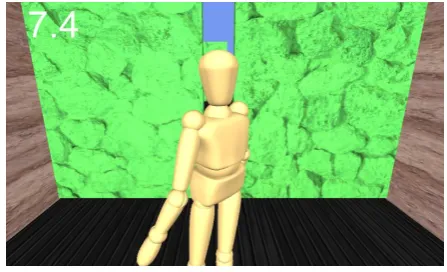
The display of ATTAVE consists of a virtual scenario showing a long treadmill moving towards a visible avatar (and also towards the participant). The avatar resembles a wooden mannequin and is visible from head to knees, as the viewpoint of the participant is 2 m behind the avatar. The treadmill is enclosed on the side by tall walls. On the treadmill itself there are frontal green walls with an aperture on the left, centre or right side of the wall. All surfaces have texture as can be seen in Figure 1. The participants can control the translation and rotation of the avatars by physically moving side to side and rotating their own shoulders. Shoulder rotation proportionally slows down the treadmill. The participants’ task is to avoid collisions and pass through all doors as fast as possible.
For the full body motion capture a Kinect NUI is used. This device uses an optic technology that allows detection of the human body thanks to an infrared depth camera. This choice is due to its ease to set up, as it can be ready to use in less than five minutes, and also due to its low cost compared to other equipments of the same category. Another advantage in using this system is the fact that the user does not have to wear a specific suit and, consequently, he/she has full range of movement. In order to provide the participant with audio-visual feedback, a noise and a flash next to the avatar’s shoulders are displayed whenever there is a collision with a wall.
When the participant rotate the shoulders, the speed of the treadmill decreases in proportion to the cosine of the angle (∂) between the shoulders’ axis and the avatar’s translation axis, as described by the formula below.
(1) In (1), the value of the angle is taken as 0 if the individual is in a frontal position towards the door and 90º if the individual is facing the side walls. The angles are in absolute values from 0º to 90º. The speed decreases with rotation is introduced because it simulates a normal behaviour observed in the real world. People usually reduce their locomotion velocity when they have to pass through a narrow aperture. The decreasing value of 0.4, used to calculate the current speed, was based on pilot trials. Moreover, the correlation between rotation and speed is an incentive for participants not to rotate their shoulders unless there is a danger of collision, as the rotation slows down the treadmill and adds to their total time on the task.
The experiment is conducted in a 3 × 3 m area. Participants stand 3 m away from a 75 cm height table. On the table is mounted an off-the-shelf Kinect sensor (Microsoft, for Xbox 360) and an 18" computer screen (1440 × 900 pixel resolution), both connected to a PC. Three small marks on the floor indicate the positions aligned with the three apertures on the display (see Figure 2).
Figure 2. Physical setup of the experiment
2.3. Procedure
The experiment starts with participants reading and signing the consent form. Then, the measure of participants’ height
and shoulder width is taken and the Kinect is calibrated to the participants’ movements. Subjects are instructed to avoid collisions and complete the task in the shortest possible time, and are informed that shoulder rotation proportionally decreases the speed of the treadmill. In each session, participants complete the increasing-decreasing series in the slow condition followed by the fast condition. At the end of each session, they are asked to fill in a questionnaire of presence, adapted from Witmer et al. [25]. The adaption consists in including an assessment of ownership to the genuine dimensions (realism, self-evaluation and possibility) of the original version. In total, each session lasts about 20 minutes.
Participants perform 32 trials for each of 2 speed conditions and for each of 4 sessions. Also, there are 2 avatar conditions; each uses in a group of participants. The 32 trials consist of apertures that showed in the central position with widths gradually increasing relative to the avatar’s shoulders from 0.7 to 2.2 and then gradually decreasing from 2.2 to 0.7 (in steps of 0.1). When the avatar passes through each of these apertures, the value corresponding to the angle between the shoulders is recorded. These trials are alternated with 32 dummy trials with apertures of constant size shown in the right and left side positions. These side apertures remain twice the shoulder width of the avatar and are not used for data collection. Every aperture is 10 meters away from the next aperture. The two speed conditions are slow and fast (respectively 5 and 10 Km/h). They are taken from the walking speeds reported by Warren and Whang [16] and adjusted during pilot testing. The avatar condition consists of manipulating the morphology and movements of the avatar. In the similar avatar condition the avatar is anatomically proportional to the dimensions of the participant and all segments are animated to mimic the natural movements of the participant. In the standard condition the dimensions of the avatar are standard for all participants and the avatar has only two degrees of freedom: translation sideways and rotation upon itself (see arrows on Figure 2). An animation of a sidestep is implemented on the avatar when the participant performs a sidestep. This animation is recorded with a natural user interface and results from a sidestep performed by a human being.
The ratio between each virtual door and the avatar’s shoulders width is the independent variable manipulated. The dependent variable is the angle between the shoulders during the passage through each aperture.
2.4. Results
Effect of avatars and viewpoints on performance in virtual world: efficiency vs. telepresence
calculated for each participant, condition, and session and these are used in the data analysis.
To examine learning effects from session to session, the critical ratios are submitted to a multivariate repeated measures analysis of variance (MANOVA F-test) with the factor session (4 levels), and using the 4 conditions as measures (slow-similar, similar, slow-standard, fast-standard). Based on the results of this analysis, the averages of the last 3 sessions are used in the remaining analysis.
To examine the effect of conditions on the critical ratios, the individual critical ratios from the last 3 sessions are averaged and submitted to a repeated measures analysis of variance (ANOVA F-test) with factors speed (2 levels: slow and fast) and avatar (2 levels: similar and standard).
To examine how participants feel regarding the experienced environment, the scores for each dimension of the questionnaires are averaged and submitted to a multivariate repeated measures analysis of variance (MANOVA) with factors avatar (2 levels: similar and standard) and session (4 levels) and using the 5 dimensions as measures (realism, possibility, quality, ownership, and self-evaluation).
Finally, Pearson’s r is used to test the correlation between critical A/S ratios and the dimension of ownership as measured by the questionnaire.
Critical A/S ratios
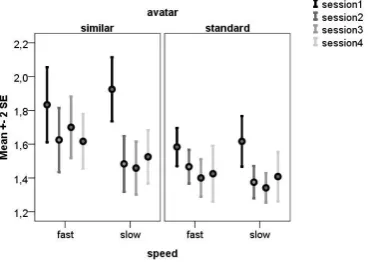
Overall, there is a significant learning effect on the critical ratios, F(12, 86) = 6.85, p < .001. This is reflected in the four conditions: slow-similar, F(3, 33) = 17.74, p < .001; fast-similar, F(3, 33) = 3.08, p < .05; slow-standard, F(3, 33) = 8.74, p < .001; and fast-standard, F(3, 33) = 3.07, p = .05. Pairwise comparisons show significant differences between the first and the last three sessions which do not differ between them (see Figure 3).
Figure 3. Average critical A/S ratios for the four conditions over the four sessions
There is a strong tendency for an effect of avatar on critical A/S ratio, F(1, 11) = 4.62, p = .055 (Figure 4), which is caused by participants rotating their shoulders at smaller critical ratios when the avatar is standard than when the avatar is similar (Table 1).
Figure 4. Mean absolute angle of shoulder rotation as a function of aperture width normalized for shoulder
width (A/S) for the two avatar conditions
Table 1. Means (M) and Standard Errors (SE) of critical A/S ratios for avatar and speed conditions
Critical A/S
M SE
Avatar conditions Standard 1.40 0.05 Similar 1.57 0.07
Speed conditions Slow 1.43 0.04 Fast 1.54 0.05
There is a significant main effect of speed on critical A/S ratio, F(1, 11) = 5.13, p < .05 (Figure 5). This is caused by participants rotating their shoulders at smaller critical ratios in the slow condition compared to the fast condition (Table 1).
Figure 5. Mean absolute angle of shoulder rotation as a function of aperture width normalized for shoulder
Questionnaire of presence
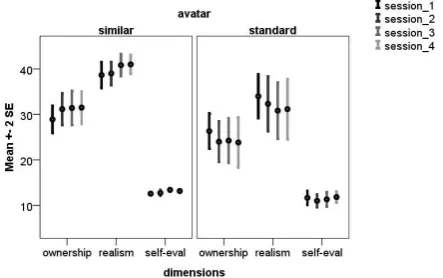
Overall, there is no significant main effect of avatar, F(2, 7) = 1.83, ns, or session, F(2, 7) = 0.93, ns. However, there is a significant Avatar × Session interaction, F(15, 80) = 1.87, p < .05. This significant interaction is reflected in three dimensions: realism, F(3, 33) = 4.00, p < .05; ownership, F(3, 33) = 3.93, p < .05, and self-evaluation, F(3, 33) = 3.17, p < .05. This interaction occurs because feelings of realism, ownership and self-evaluation increase in the similar condition and decrease in the standard condition (Figure 6). The evaluation of these three parameters is carried out through the questions listed in Table 2.
Figure 6. Feeling of telepresence for three dimensions of the questionnaire over sessions
Table 2. Questions related to feelings of ownership, realism and self-evaluation
Ownership
- How closely did you feel that the avatar’s proportions fit yours?
- How well were you able to estimate distances? - How well could you concentrate on the task rather than on the mechanisms used to perform it?
- During the experiment there were moments in which you felt as if the virtual avatar was your own body? - When the avatar hit the wall, how much did you feel that your own body hit the wall?
- During the experiment there were moments in which you had the sensation of having more than one body?
Realism
- How much did the visual/auditory aspects of the environment involve you?
- How natural did your interactions with the environment seem?
- How natural was the mechanism which controlled movement through the environment?
- How realistic was your sense of objects moving through space?
- How much did your experiences in the VE seem consistent with your real world experiences?
- How realistic was your sense of moving around inside the VE?
- How involved were you in the VE experience (gauge
your abstraction level regarding the surrounding RE)?
Self-evaluation
- How quickly did you adjust to the VE experience? - How proficient in moving and interacting with the VE did you feel at the end of the experience?
Overall, there is a small, positive correlation between feeling of ownership and critical A/S ratios, r = 0.36, n = 96, p < .05 indicating that increases in one variable are accompanied by increases in the other variable (Figure 7).
Figure 7. Scatter plot and Pearson’s r
2.5. Discussion
The main objective of this first experiment is to study whether the dynamics and the morphology of an avatar would reflect on the feeling of telepresence and ownership of the participant. Also, to know whether affordances are used in a VE the same way they are in a real environment (RE). In order to perform the experiment, a prototype named ATTAVE is developed. ATTAVE possess a VE where the participant’s avatar performs the experimental task. The user controls the avatar through a natural motion capture carried out by a Kinect NUI. There are two avatar conditions to test: one morphologically proportional to the user and that replicates his/her movements; and another with an avatar that is identical for every participant, and exhibits limited mobility, as it can only rotate upon himself and step sideways.
Effect of avatars and viewpoints on performance in virtual world: efficiency vs. telepresence
of the task. On the contrary to a simple tool held in hand, the remote or virtual interaction is not straightforward and involves a specific design of the artefact to be ergonomically adapted to the human user [27]. After learning, the critical A/S ratios obtained in the VE (1.4 and 1.57) are very similar to those in the RE (1.4 reported by Warren and Whang [16]), which demonstrates that people perceive similar body-scaled affordances in the VE as in RE.
The effect of the different avatars is significant. Participants with the standard avatar have a smaller critical ratio than the participants with the similar avatar (1.4 vs. 1.57). It means that participants who control a similar avatar tend to keep a greater safety margin between the body and wall, compared with a standard avatar. This result can suggest a higher feeling of agency for the similar avatar by the individual, who may care about his/her alter-ego and therefore makes sure it does not collide with the wall. In contrast, participant seems less concerned regarding the standard avatar. This interpretation is supported by the analysis of the correlation between the ownership questionnaire and the critical A/S ratios. There is a positive correlation between these two variables, albeit small, which suggests that the rise in the critical ratios is related with an increase in the feeling of ownership.
The higher critical ratios in the similar condition compared to the standard condition is coherent with the principle of distance estimation according to body representation [28, 29]. This theory says that scaling one’s body size up or down proportionally results in perceiving the world as smaller or larger respectively [30]. In our experimental setup the avatar appears relatively large in the centre of the screen comparing to the rest of the environment, because of the lack of perspective (2D view). Thus, the doors may appear smaller than they really are only in the condition in which the avatar is considered as an extension of the participant’s body (similar avatar) and not in the standard avatar, for which an ownership feeling does not seem to occur.
In the standard condition, the participant’s body controls the avatar as if it was a simple joystick. Consequently, this condition can be interpreted in terms of a classical remote control of a teleoperated machine. In a study carried out by Moore et al. [31], the user controlled a robot and supervised the environment by means of a camera on top of the robot. The operator’s task was to judge whether or not the robot could pass through apertures of various sizes. The results indicate that the participants judged the robot could pass even when it could not. Authors argue that the results might be influenced by structural and morphological aspects. The same effect could explain the results of the experiment presented here. The fact that the individual underestimates the aperture width could signify that he/she considers the standard avatar as a machine-like character and, consequently, he/she can hardly be engaged in an ownership process with it.
In addition, one aspect that can increase the immersiveness in a VE is the type of interaction between human and machine. If the interaction is done through a classic controller such as a mouse or joystick, the users need
to learn the mapping between their own movement and its consequence in the virtual world [32, 33]. On the contrary, the mapping is facilitated if the interaction is done through a full motion capture. Research has shown that natural user interfaces, in which users can recognize their own movements in the VE, are more immersive [34, 35]. It could explain why the similar avatar condition seems to bring a higher feeling of ownership compared with the standard condition.
Analyzing the effect of speed on the critical A/S ratios, it is observable that in both avatar conditions the critical ratio is larger when the speed is higher. This happens because at higher speeds people leave larger safety margins. In the real world, when an individual is confronted with an aperture, he/she will reduce his/her speed in order to fit through without colliding. In this project, the only way to decrease the speed was by rotating the shoulders, which results in a higher critical ratio. The relation between speed and accuracy is well-known in the area of motor control and was described for the first time in Fitts’ law [36]. The fact that the participants of this experiment reproduce this natural motor control adaptation suggests their immersion into the VE (ATTAVE).
The questionnaire shows that the similar avatar elicits an increasing feeling of ownership and realism over the four sessions. In contrast, the standard avatar causes a decreasing feeling of ownership and realism from session to session. This result means that an agency process in which the participants consider the similar avatar as a natural extension of themselves seems to happen and to increase through the interaction with the avatar. In contrast, with the standard avatar, participants may have become bored due to the avatar’s movement not being as diverse as their own. This lack of biological motion could lead the participants to act as if they were controlling a machine instead of a virtual representation of themselves. Overall, considering the questionnaire results and the affordances described through the critical A/S ratios, it seems that an avatar with natural movements and tailored the morphology of the user can significantly enhance the feeling of body ownership.
3. Experiment 2: Effect of the viewpoint
When an individual controls an avatar in a virtual environment, such as a video game, two visual perspectives are usually available to the user: first or third person perspective. In the first-person viewpoint (1PV) the camera is located at the level of the avatar’s eye, whereas the third-person viewpoint (3PV) provides a perspective from a fixed distance behind the avatar. Gamers generally prefer the 3PV because it gives a more global view of the environment [38]. On the other hand, the 1PV seems to bring an advantage for actions that need precision such as sniping or fine manipulations [39].
In terms of telepresence the advantage of a certain viewpoint over the other remains debated, as well. Authors like Salamin et al. [37] argue that the fact to be able to see the own body, through a 3PV, contributes to an increase in the feeling of presence. On the contrary, Maselli and Slater [13] stress the importance of the 1PV to make body ownership of a virtual avatar possible. According to these authors, the egocentric viewpoint is the only one that enables a right correlation between the visual feedback, from the avatar, and the proprioceptive feedback of the movement performed by the user [40]. Overall, it seems crucial to preserve the human’s natural sensorimotor contingences [41] for inducing illusory ownership of artefacts [42, 27]. For instance, different studies showed that the lack of synchronism between the individual and the avatar’s movements [43, 44], or between the visual and tactile stimulations of an anthropomorphic artefact [45, 46] reduces the feeling of telepresence and ownership.
In this second experiment, participants’ performance will be compared when they have to execute the task described in experiment 1, in the 1PV vs 3PV. Due to the fact that the 1PV provides an egocentric frame of reference, in which the subjects can use their body to act and to perceive in much the same way as normally [47], we hypothesize this condition will tend to induce a higher feeling of telepresence than the 3PV. In addition, if the human-similar avatar relationship is really based on an ownership phenomenon, and not simple geometrical mapping, the efficiency to complete the task, over the whole experiment, should not be different between both conditions of perspective.
3.1. Subjects
Subjects were 24 university students (18 males and 6 females, aged between 20 and 28), with normal or corrected-to-normal vision and varied experience in playing video games. Half of the participants performed in one condition (third-person viewpoint) and the other half performed in the other condition (first-person viewpoint). This was done to enable the study of eventual learning effects under each condition of viewpoint. The experiment is approved by the local ethics committee of the Nova University Lisbon.
3.2. Setup
(a) (b)
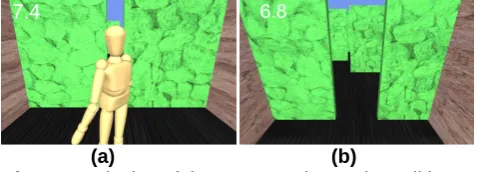
Figure 8. Display of the two experimental conditions, when the avatar is viewed from the third-person viewpoint (a) vs. from the first-person viewpoint (b)
The setup (ATTAVE) is identical to that in experiment 1, except that the avatar’s characteristics are the same in both experimental conditions. A similar avatar that is morphologically proportional to each participant and that matches the subject’s movement is used in both viewpoint conditions. Thus, the only parameter that changes in the experiment is the subject’s perspective in the VE. In the third-person viewpoint, the participant’s perspective is 2 m behind the avatar, as it is described in experiment 1 (Figure 8a). In the first-person viewpoint, the subject’s perspective is located at the level of the avatar’s eyes (Figure 8b). In this last condition, the individual is exactly in the same virtual position as the avatar. By consequence, and as in the real life, he/she can see a very limited part of the avatar’s body. The only body’s parts, which are visible from the participant, are the avatar’s arms, when they are stretched forward, and the avatar’s shoulders, when he/she performs a rotation of the trunk. A unique fast velocity is used in this second experiment. Fast speed is preferred to the slow one because participants’ performances were more stables with this velocity.
The participants can control the translation and rotation of the avatars, through the Kinect NUI, by physically moving side to side and rotating their own shoulders. Shoulder rotation proportionally slows down the treadmill, according to the equation (1). The participants’ task is to avoid collisions and pass through all doors as fast as possible. The shoulder degrees of rotation are recorded each time the subject passes through the central doors. The experiment is conducted in a 3 × 3 m area. Participants stand 3 m away from a 75 cm height table. On the table is mounted an off-the-shelf Kinect sensor (Microsoft, for Xbox 360) and an 18" computer screen (1440 × 900 pixel resolution), both connected to a PC. Three small marks on the floor indicate the positions aligned with the three apertures on the display (see Figure 2).
3.3. Procedure
Effect of avatars and viewpoints on performance in virtual world: efficiency vs. telepresence
movements. Participants are instructed to avoid collisions and complete the task in the shortest possible time, and are informed that shoulder rotation proportionally decreases the speed of the treadmill. In each session, participants complete the increasing-decreasing series of aperture width, at fast speed. At the end of each session, participants are asked to fill in a questionnaire of presence adapted from Witmer et al. [25]. In total, each session lasts about 20 minutes.
Participants perform 32 trials for each of 6 sessions. Also, there are 2 conditions of viewpoint; each used in a group of participants. The 32 trials consist of apertures that showed in the central position with widths gradually increasing relative to the avatar’s shoulders from 0.7 to 2.2 and then gradually decreasing from 2.2 to 0.7 (in steps of 0.1). The velocity of translation in the VE (ATTAVE) is 10 Km/h. The viewpoint conditions consist of manipulating the perspective view the participant has of the avatar. In the first-person condition the individual sees exactly the same thing that the avatar sees. This condition is hypothesized as the most realistic regarding the feeling of presence and agency. In the third-person condition the individual perspective view is translated backward from the avatar. Although, this is the situation the most commonly used in video games, we make the hypothesis that this viewpoint should not provide the best feeling of telepresence.
To test these two conditions, the ratio between each virtual door and the avatar’s shoulders width is the independent variable manipulated. The dependent variable is the angle between the shoulders during the passage through each aperture.
3.4. Results
The same dependent variables as in the previous experiment are analysed. The main dependent variable is the critical aperture-to-shoulder-width ratio (A/S) after which the participant passed without rotation. The critical ratio is that with an angle smaller than 16º and after which all angles are smaller than 16º. A critical ratio is calculated for each subject, condition, and session and these are used in the data analysis.
To examine learning effects from session to session, the critical ratios are submitted to a repeated measures analysis of variance (ANOVA) with the factor session (6 levels), and using the 2 conditions as measures (first-person viewpoint and third-person viewpoint).
To examine the effect of conditions on the critical ratios, the individual critical ratios from the last session are averaged and submitted to a repeated measures analysis of variance (ANOVA) with the factor viewpoint (2 levels: first-person and third-first-person).
To evaluate the participants immersiveness into the VE, the scores for each dimension of the questionnaire of telepresence are averaged and submitted to a repeated measures analysis of variance (ANOVA) with factors viewpoint (2 levels: first-person and third-person) and session (6 levels) and using 3 dimensions as measures (realism, possibility, and ownership).
Critical A/S ratios
Overall, there is a significant learning effect on the critical A/S ratios, F(5, 138) = 3.81, p < .003. However, this is reflected only in the condition of third-person viewpoint, F(5, 66) = 2.98, p < .02; and not in the condition of first-person viewpoint, F(5, 66) = 1.77, ns (Figure 9).
Figure 9. Average critical A/S ratios for the two conditions over the six sessions
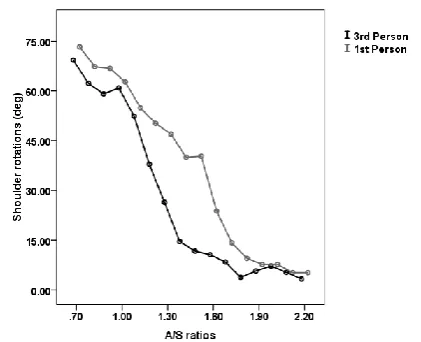
Overall, there is no significant effect of the viewpoint on the critical A/S ratio, F(1, 142) = 0.76, ns. However, a comparison on the last session (session 6), when we can consider that the subjects are completely trained, reveals a significant difference between the two conditions of viewpoint, F(1, 22) = 6.22, p < .03 (Figure 10). This is caused by participants rotating their shoulders at smaller critical ratios when the viewpoint is third-person than when the viewpoint is first-person (Table 3).
Figure 10. Mean absolute angle of shoulder rotation as a function of aperture width normalized for shoulder
Table 3. Effect of the point of view (POV) on the critical A/S ratios for the last session
Critical A/S
M SE
Conditions of POV 1st person 1.63 0.07 3rd person 1.38 0.07
Questionnaire of presence
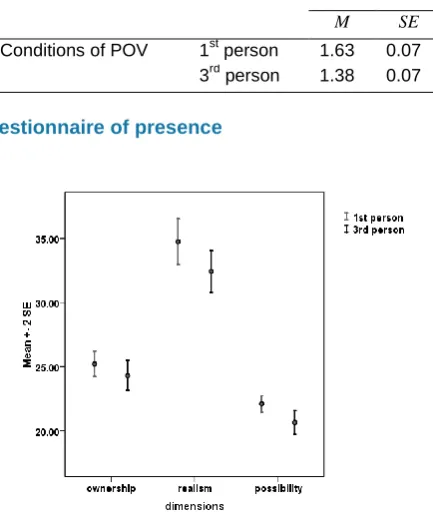
Figure 11. Feeling of telepresence for three dimensions of the questionnaire over the whole
experiment
Overall, there is a strong tendency for a main effect of view point, F(1, 142) = 3.71, p = .056. The higher feeling of telepresence in the first-person point of view than in the third-person point of view is supported by a significant feeling of possibility, F(1, 142) = 6.87, p < .01, and a strong tendency for the feeling of realism, F(1, 142) = 3.73, p = .056 (Figure 11). The evaluation of the first parameter (feeling of possibility) is carried out through the questions listed in Table 4. Questions to assess the two other feelings are available in Table 2.
Table 4. Questions related to the feeling of possibility
Possibility
- How much were you able to control your avatar? - How responsive was the environment to actions that you initiated (or performed)?
- Were you able to anticipate what would happen next in response to the actions that you performed? - How completely were you able to actively survey or search the environment using vision?
3.5. Discussion
This second experiment aims to evaluate the effect of the avatar’s viewpoint on the user’s performance in the virtual environment ATTAVE. As in the previous experiment, two main performance parameters are assessed, which are the feeling of telepresence and the efficiency to complete the sensorimotor task. In both conditions of viewpoint, 1PV and 3PV, a Kinect NUI enables the participants to control a morphologically and dynamically customized avatar for each subject. However, due to the fact that the 1PV impedes a vision of the avatar’s full body, whereas the 3PV allows it, it permits us to test the interpretation of the first experiment’s results in terms of ownership, only when the individual interacts with a similar avatar. Another objective of this experiment is to gauge whether or not an egocentric perspective increases the feeling of telepresence and if it makes a difference regarding the user’s efficiency.
The results show that the accuracy to pass through the doors improves across the sessions. However, this learning effect is only significant for the 3PV and it is particularly high between the penultimate (session 5) and ultimate session (session 6). In this condition, the last session exhibits critical A/S ratios that are very similar to those in the RE (1.4 reported by Warren and Whang [16]). The fact that the number of sessions in this experiment is higher than in the previous one may explain, by a natural phenomenon of compensation and adaptation to the environment [48], why such ratio is reached, and is coherent with Peters et al. [26], who show that 6 sessions are necessary to remote control accurately a telerobotic arm. On the contrary, in the 1PV the critical ratio remains relatively the same over the whole sessions, which means that the participants are involved in a neurobehavioral process of interaction with the VE that is stable from the beginning to the end of the virtual experience and do not need to be learned. This is characteristic of the feeling of ‘being there’ that is typically reported by the individuals instantaneously immersed – without trying or doing anything special – into the VE [47].
The main result related here is that no significant effect of the viewpoint on the critical ratio is observed. This similar performance between the 1PV and the 3PV, and the fact that no visual cue regarding the avatar’s full body are available in the egocentric perspective, suggest that no geometrical mapping of the avatar with the environment are used by the participants to perform the task. Consequently, it can be deducted that another process, possibly based on an ownership phenomenon, seems to occur when the user controls a digital character that is propositionally and cinematically close to him/her. In both conditions, the ratios are higher than in the real world, which can be explained by the fact that viewers always have a tendency to underevaluate the distances in VE [49, 50, 51]. Because the doors appear to be smaller than they really are, participants still rotate their shoulder for apertures in which the rotation is not necessary to pass through them.
Effect of avatars and viewpoints on performance in virtual world: efficiency vs. telepresence
high in this experiment. The 1PV has a tendency to produce a higher feeling of telepresence than the 3PV for some particular dimensions of the questionnaire, as it was expected because of the preservation of the sensorimotor contingences [42, 27]. The result of the questionnaire is also coherent with the fact that no learning effect is recorded in the 1PV. It has already been demonstrated that more natural is the sensor/effector configuration and coupling, higher is the possibility to induce an integration of an artefact into the body schema or an ownership [27, 52, 53].
4. Conclusions
The fundamental achievement of this study is to show that the situation that brings the higher feeling of telepresence is not necessarily the condition for which the individual acts with the maximum efficiency in the VE. This result opens up some interrogations about what is the best design to control a virtual character. Regarding the visual perspective we can imagine that the human-avatar interaction would benefit from a setup that combines first and third person viewpoints, as it has been explored by Salamin et al. [54]. In terms of avatar’s mechanisms, a semiautonomous control, in which some aspects are under the human’s decision whereas others are automatics, seems to be an interesting approach. This balanced control could be implemented according to a model where high level processes are controlled by the user and low levels are automatized [4, 55]. This implementation is inspired on biological mechanisms, such as in walking, for which the individual only decides to trigger, stop or regulate the gait, and the rest is automatically processed by subcortical structures.
This study also provides a new insight regarding the possible neurobehavioral processes involved when the user interacts with a human-like vs. a machine-like avatar. If the character exhibits some anthropomorphic aspects and/or behaviours the individual will have a tendency to develop an ownership relationship with his/her self-representation in the VE. On the contrary, if the avatar does not share certain human properties, it will be considered, even unconsciously, as a simple machine that has to be operated according to geometrical mappings of an object with its surrounding environment. As mentioned above, it does not mean that the overall performance will be lower in the second case because, it is usually easier to control a stereotypical system than a more versatile one. For instance, Rybarczyk et al. [4] observed a tendency for more accurate distance estimation when a teleoperator has to gauge the reaching space with a robotic arm than with the operator arm itself. The reason is the fact that a robot is better calibrated than a human being. In conclusion, this study shows that it is possible to generalize previous considerations on the conditions to induce ownership in teleoperation [53, 56] to any mediated systems involving a human-artefact interaction, which include VE.
Acknowledgements.
We would like to thank all of the participants for their time and for the data they generously gave us.
References
[1] MINSKY,M.(1980) Telepresence. Omni 2: 45-51.
[2] SLATER,M.,USOH,M.,STEED,A. (1994) Depth of presence in
virtual environments. Presence 3: 130-144.
[3] RYBARCZYK,Y.,COLLE,E.,HOPPENOT,P. (2002) Contribution
of neuroscience to the teleoperation of rehabilitation robot. In
Proc. IEEE Systems, Man and Cybernetic, Hammamet, Tunisia.
[4] RYBARCZYK,Y.,HOPPENOT,P.,COLLE,E.,MESTRE,D. (2012)
Sensori-motor appropriation of an artefact: a neuroscientific approach. In Inaki, M. [ed.], Human Machine Interaction - Getting Closer (InTech), ch. 10.
[5] SUMIOKA,H., NISHIO,S., ISHIGURO, H. (2012) Teleoperated
android for mediated communication: body ownership, personality distortion, and minimal human design. In Proc. IEEE Ro-Man, Social Robotic Telepresence, Paris, France.
[6] BOTVINICK,M.,COHEN,J. (1998) Rubber hands 'feel' touch
that eyes see. Nature 391: 756-756.
[7] YUAN, Y., STEED, A. (2010) Is the rubber hand illusion induced by immersive virtual reality? In Proc. IEEE Virtual Reality, Waltham, USA.
[8] TSAKIRIS, M., PRABHU, G., HAGGARD, P. (2006) Having a
body versus moving your body: how agency structures body-ownership. Consciousness and Cognition 15: 423-432.
[9] EHRSSON,H.H.,SPENCE,C.,PASSINGHAM,R.E.(2004) That's
my hand! Activity in premotor cortex reflects feeling of ownership of a limb. Science 305: 875-877.
[10] PETKOVA, V.I., EHRSSON, H.H. (2008) If I were you:
perceptual illusion of body swapping. Plos One 3: e3832.
[11] MARAVITA,A.,IRIKI,A.(2004) Tools for the body (schema).
Trends in Cognitive Sciences 8: 79-86.
[12] IRIKI, A., TANAKA, M., IWAMURA, Y. (1996) Coding of
modified body schema during tool use by macaque postcentral neurons. Neuroreport 7: 2325-2330.
[13] MASELLI,A.,SLATER,M.(2013) The building blocks of the
full body ownership illusion. Frontiers in Human Neuroscience 7(83): 1-15.
[14] PEÑA,J.,HANCOCK,J.T.,MEROLA,N.A. (2009) The priming
effects of avatars in virtual settings. Communication Research
36(6): 838-856.
[15] GIBSON, J.J. (1979) The Ecological Approach to Visual
Perception (Boston, MA: Houghton Mifflin).
[16] WARREN, W.H., WHANG, S. (1987) Visual guidance of
walking through apertures: body-scaled information for affordances. Journal of Experimental Psychology: Human Perception and Performance 13: 371-383.
[17] DE OLIVEIRA,R.F.,DAMISCH, L.,HOSSNER, E.J.,OUDEJANS,
R.D., RAAB, M.,VOLZ, K.G., WILLIAMS, A.M. (2009). The
bidirectional links between decision making, perception, and action. Progress in Brain Research 174: 85-93.
[18] MARK, L.S. (1987) Eyeheight-scaled information about affordances: a study of sitting and stair climbing. Journal of Experimental Psychology: Human Perception and Performance 13: 361-370.
[19] ESTEVES,P.T.,DE OLIVEIRA,R.F.,ARAÚJO,D. (2011)
Posture-related affordances guide attack in basketball. Psychology of Sport and Exercise 12: 639-644.
[20] WARREN, W.H. (1984) Perceiving affordances: visual
Psychology: Human Perception and Performance 10: 683-703.
[21] MEADOWS,M.S. (2008) I, Avatar (Berkley, CA: New Riders
Press).
[22] CASTRONOVA, E. (2003) Theory of the Avatar (Munich,
Germany: CESifo).
[23] TSAKIRIS,M.,HAGGARD,P.(2005) The rubber hand illusion
revisited: visuotactile integration and self-attribution. Journal of Experimental Psychology: Human Perception and Performance 31: 80-91.
[24] KALCKERT,A.,EHRSSON,H.H. (2012) Moving a rubber hand
that feels like your own: a dissociation of ownership and agency. Frontiers in Human Neuroscience 6(40): 1-14.
[25] WITMER,B.J., JEROME,C.J.,SINGER,M.J. (2005) The factor
structure of the presence questionnaire. Presence 14: 298-312.
[26] PETERS,R.A.,CAMPBELL, C.L.,BLUETHMANN, W.J.,HUBER,
E. (2003) Robonaut task learning through teleoperation. In
Proc. IEEE International Conference on Robotics and Automation, Taipei, Taiwan.
[27] RYBARCZYK,Y.,MESTRE, D. (2013) Effect of visuo-manual
configuration on a telerobot integration into the body schema.
Le Travail Humain 76(3): 181-204.
[28] NOË,A. (2004) Action in Perception (Cambridge, MA: MIT Press).
[29] PROFFITT,D.R. (2006) Embodied perception and the economy
of action. Perspect. Psychol. Sci. 1(2): 110-112.
[30] BANAKOU, D., GROTEN, R., SLATER, M. (2013) Illusory
ownership of a virtual child body causes overestimation of the object sizes and implicit attitude changes. PNSA 110(31): 12846-12851.
[31] MOORE, K.S., GOMER, J.A., PAGANO, C.C., MOORE, D.D. (2009) Perception of robot passability with direct line of sight and teleoperation. Human Factors: The Journal of the Human Factors and Ergonomics Society 51: 557-570.
[32] DE OLIVEIRA, R.F., WANN, J.P. (2011). Driving skills of
young adults with developmental coordination disorder: regulating speed and coping with distraction. Research in Developmental Disabilities 32: 1301-1308.
[33] WISE, S.P., MURRAY, E.A. (2000) Arbitrary associations between antecedents and actions. Trends in Neurosciences 23: 271-276.
[34] BRUDER, G., STEINICKE, F., HINRICHS, K.H. (2009)
Arch-explore: a natural user interface for immersive architectural walkthroughs. In Proc. IEEE Symposium on 3D User Interfaces, Lafayette, USA.
[35] FRANCESE,R.,PASSERO,I.,TORTORA,G.(2012) Wiimote and
Kinect: gestural user interfaces add a natural third dimension to HCI. In Proc. Working Conf. Advanced Visual Interfaces,
Naples, Italy.
[36] FITTS,P.M. (1954) The information capacity of the human motor system in controlling the amplitude of movement.
Journal of Experimental Psychology 47: 381-391.
[37] SALAMIN,P.,TADI,T.,BLANKE,O.,VEXO,F.,THALMANN,D.
(2010) Quantifying effects of the exposure to the third and first-person perspectives in virtual-reality-based training.
IEEE Transactions on Learning Technologies 3(3): 272-276. [38] ROUSE, I.R. (1999) What's your perspective? ACM
SIGGRAPH Computer Graphics 33(3): 9-12.
[39] SALAMIN,P.,THALMANN,D.,VEXO,F. (2006) The benefits of
third-person perspective in virtual and augmented reality? In
Proc. ACM Symp. Virtual Reality Software and Technology,
Limassol, Cyprus.
[40] SANCHEZ-VIVES,M.V.,SLATER,M.(2005) From presence to
consciousness through virtual reality. Nature 6: 332-339.
[41] O´REGAN, J.K., NOË, A. (2001) A sensorimotor account of vision and visual consciousness. Behav. Brain Sci. 24: 939-973.
[42] SLATER, M.,PEREZ-MARCOS, D., EHRSSON,H.H., SANCHEZ
-VIVES,M.V. (2009) Inducing illusory ownership of a virtual
body. Frontiers in Neurosciences 3(2): 214-220.
[43] GONZÁLEZ-FRANCO, M.,PEREZ-MARCOS, D., SPANLANG, B.,
SLATER,M. (2010) In Proc. IEEE Virtual Reality, Waltham,
USA.
[44] COELHO,T.,DE OLIVEIRA,R.,CARDOSO,T.,RYBARCZYK,Y.
(2014) Body ownership of virtual avatars: an affordance approach of telepresence. In RYBARCZYK, Y.,CARDOSO,T.,
ROSAS, J., CAMARINHA-MATOS, L. [ed.], Innovative and
Creative Developments in Multimodal Interaction Systems
(Springer), ch. 1.
[45] SLATER, M., SPANLANG, B., FRISOLI, A., SANCHEZ-VIVES,
M.V. (2008) Towards a digital body: the virtual arm illusion.
Frontiers in Human Neurosciences 2: 1-8.
[46] LENGGENHAGER, B., MOUTHON, M., BLANKE, O. (2009)
Spatial aspects of bodily self-consciousness. Conscious. Cogn. 18: 110-117.
[47] SLATER,M. (2009) Place illusion and plausibility can lead to
realistic behaviour in immersive virtual environment. Philos. Trans. R. Soc. Lond. 364: 3549-3557.
[48] WILLEMSEN, P., COLTON, M.B., CREEM-REGEHR, S.H.,
THOMPSON, W.B. (2004) The effects of the head-mounted
display mechanisms on distance judgments in virtual environments. In Proc. Symposium on Applied Perception in Graphics and Visualization, New York, USA.
[49] LAMPTON, D.R., MCDONALD, D.P.,SINGER, M., BLISS, J.P.
(1995) Distance estimation in virtual environments. Proc. Human Factors and Ergonomics Soc. 39(20): 1268-1272.
[50] LOOMIS, J.M., KNAPP, J.M. (2003) Visual perception of
egocentric distance in real and virtual environments. In
HETTINGER, L.J., HAAS, M.W. [ed.], Virtual and Adaptive
Environments (Erlbaum), ch. 2.
[51] MESSING,R.,DURGIN,F.H.(2005)Distance perception and the
visual horizon in head-mounted displays. ACM Trans. Applied Perception 2(3): 234-250.
[52] SLATER,M.,SPANLANG,B.,SANCHEZ-VIVES,M.V.,BLANKE,
O.(2010)First person experience of body transfer in virtual reality. Plos One 5: e10564.
[53] RYBARCZYK, Y., MESTRE, D. (2012) Effect of temporal
organization of the visuo-locomotor coupling on the predictive steering. Frontiers in Psychology 3(239): 1-9
[54] SALAMIN,P.,THALMANN,D.,VEXO,F. (2008) Improved
third-person perspective: a solution reducing occlusion of the 3PP? In Proc. Working Conf. Advanced Visual Interfaces, Naples, Italy.
[55] RYBARCZYK,Y.,MESTRE,D.,HOPPENOT,P.,COLLE,E. (2004)
Implémentation de mécanismes d’anticipation visuo-motrice en téléopération. Le Travail Humain 67(3): 209-233.
[56] HOPPENOT,P., RYBARCZYK,Y., MESTRE,D. (2007)