1
Effects of using learners’ produced screencast as worked
examples in learning
I.Yang
1,*, B.T. Lau
11Faculty of Engineering, Computing and Science, Swinburne University of Technology Sarawak Campus, Malaysia
Abstract
In this study, we compared the effect of learning by worked example and the cognitive load imposed by learner creating or using screencast in three conditions; studying worked examples (USER), example-problem pairs (PRUS) and problem solving (PRODUCE) in learning calculus problems. Our results showed a significant difference in transferring test performance and effectiveness between PRUS and USER conditions for the difficult questions while there was no significant difference for moderate and easy questions, in the three learning conditions. Moreover, our findings also showed no significant difference in cognitive load imposed between the three learning conditions with different levels of difficulty either during learning phase or testing phase. In conclusion, combination of studying worked examples with problem solving is more superior than studying worked examples alone when learning difficult concepts through screencast.
Keywords: Cognitive load, worked examples, screencast, problem solving
Received on 25 August 2017, accepted on 18 October 2017, published on 29 November 2017
Copyright © Y2017I.Yang and B.T. Lau, licensed to EAI. This is an open access article distributed under the terms of the Creative Commons Attribution licence (http://creativecommons.org/licenses/by/3.0/), which permits unlimited use, distribution and reproduction in any medium so long as the original work is properly cited.
doi: 10.4108/eai.29-11-2017.153390
1. Introduction
The existing education model emphasizes on using appropriate teaching and learning strategies to achieve the learning outcome. Nowadays, it is inevitable that higher education also follows the trend to transform education by integrating it with technology. On the other hand, mathematics is commonly identified as one of the difficult subjects due to learners’ inability to recognize and retaining the mathematics concepts. Some learners may lack of mental strategies to perform algorithmic procedures and making connections between conceptual and procedural knowledge due to limited working memory capacity. Hence, it is crucial to assist learners to gain concepts and skills by applying appropriate learning instructions within learners’ limited memory capacity. For instance, worked example learning has been recognized as an effective way in learning by reducing
*Corresponding author. Email: [email protected]
learners’ cognitive load. Hence, instructional design that applies worked examples learning theory with appropriate technology integration has the potential to optimize learning. In this way, differentiated instruction may give learners opportunities to acquire knowledge by considering individual differences such as learning strategies and memory capacity.
1.1. Cognitive load
Cognitive load theory [1] is a theory to understand how learners process new information with the limited capacity of working memory to transfer information in long term memory. In order not to exceed the limitation of working memory, schema or mental representation for knowledge need to be stored in long term memory. Schemas could permit multiple elements to be treated as a single or chunk element in working memory. Once learners have constructed and automated schemas, schemas could be activated from
long-EAI Endorsed Transactions on e-Learning
2 term memory and free up space in working memory for learning.
Cognitive load theory distinguishes between three types of cognitive load: intrinsic load relates to the complexity of the task to-be-learned, extraneous load relates to the design of the instructional method and germane load relates to the mental load for schema acquisition and automation in long term memory. These three types of cognitive load are additive, hence the main objective of cognitive load theory is to reduce intrinsic and extraneous load while optimizing germane load. Intrinsic load or difficulty of the task could be manipulated by constructing information from sub-schemas before learners organize the individual pieces of information into a completely meaningful schema, or called as “chunking technique” [2]. This might be an effective way to scaffold learners with different background knowledge to reach some basic baseline knowledge and skills. In addition, constructing new chunks based on learners’ prior knowledge could help them recognizing if the new knowledge conflicts with existing conceptual knowledge. In this way, learners could make sense of their own learning and relate concepts to the entire learning context. Another way to reduce intrinsic load was is to provide pre-training to learners [3] regarding the concepts need to-be-learnt prior to instruction. In this way, learners could devote more working memory to find the relationship between the concepts rather than processing the elements and relationship simultaneously.
It is crucial to design appropriate instructional methods to reduce extraneous load that interferes with learning. According to cognitive load theory, there are several ways to reduce extraneous load such as split-attention effect, modality effect, redundancy effect and worked examples effect. For example, searching information from few resources or split-attention effect that is not in an integrated format may generate extraneous load and lead to impaired learning [4, 5]. On the other hand, modality effect such as presentation of materials in both visual and audio is more effective than presentation in a single mode such as visual or audio form alone [6]. In addition, redundancy effect [7] may interfere with learning by presenting unnecessary multiple identical information simultaneously to learners such as learning video with same information displayed on-screen text and narration. Moreover, worked example effect could reduce extraneous cognitive load by focusing learners’ attention to problem statement and solution steps whereas problem-solving technique such as means-end analysis might induce high extraneous cognitive load to learners.
Germane load refers to the instructional events that facilitate learning by schemas acquisition and automation [8]. Reducing intrinsic and extraneous load will maximize the germane load within the limits of memory capacity. Germane load could be increased by using self-explanations prompts [9] in worked examples. Learners would be challenged to connect existing schemas with new concepts, correct their misconceptions and fill in the gaps in knowledge [10] when they generate self-explanation. As a result, this constructive learning activity could facilitate deeper learning as learners cognitively engage in learning and thus fostering germane load.
1.2. Worked example learning
Worked example based learning is a learning approach to demonstrate the worked-out solution steps to solve a problem. Worked example typically consists of a problem statement, solution steps and final solution [11]. In a standard worked example based learning environment, learners study the procedure of the worked-out solution by understanding the relationship or strategies applied to the step by step solution and hence accommodate or construct appropriate schemas to solve similar new or transfer problems [12]. Learning from worked examples is typically more effective when compared to conventional problem solving method in learning [8, 13] with less invested mental effort [14]. This benefit is called “worked examples effect” [8] and especially effective for novice learners with insufficient prior knowledge.
However, worked example might not optimize transfer learning if it is not accompanied with explanation or justification of the underlying concepts and solution steps. Hence, it is important to scaffold and engage learners with concepts and procedures of problem solving so that learners could gain deeper understanding instead of following a series of algorithmic operations. One of the ways to improve worked examples approach is providing explanations to the solution steps.
There are two types of explanation suggested in previous research, which are instructional explanations [15] and self-explanations [16]. The two different types of self-explanations have their own benefits and limitations. For example, instructional explanation in worked examples could provide and justify the rationales of the procedural working steps but novice learners may not actively engage in constructing schema as they might gain surface understanding through the process [9, 17].
On the other hand, prompting learners to generate self-explanation about the worked-out solution could stimulate them for active learning but this approach might not be suitable for novice learners. This is due to novice learners might not able to generate high quality or correct explanations. As a result, self-explanation might not facilitate the learning [18]. One way to overcome the limitation of both types of explanation is to combine instructional and self-explanation [19]. For instance, learners are prompted to generate self-explanation first, followed by feedback through instructional explanation to correct their misconceptions.
Previous research compared the effectiveness of learning by using different pairs or sequence of worked examples such as worked examples only, example-problem pair, problem-example pair, problem solving only. Some of these comparisons are with or without self-explanation or instructional strategies. Previous research [20, 21] revealed that learning from example-problem pair condition is more effective than learning in problem solving condition only.
However, research [22] has revealed that there are no differences with the learning performance between studying worked examples alone and example-problem pair condition or between problem–example pair and problem solving condition. In addition, the same finding [22] revealed that the
EAI Endorsed Transactions on e-Learning
3
sequence of example-problem pair should be used rather than the sequence of problem-example pair. Problem-example pair is less superior compared to example-problem pair or worked examples only might due to most of the learners unable to identify their own performance deficiencies accurately. However, problem-example pair might be effective for learning as the method motivate learners to analyse the example in a deeper way after encounter with initial problems in solving. As the matter of fact, another study [23] revealed that learners’ prior knowledge is the significant factor to determine which sequence to be used; novice learners gain more learning from example-problem pair whereas expert learners gain more learning from problem-example pair.
In addition, research also revealed that the strategy of using fading worked examples could foster learning [24]. Based on this approach, full worked example was presented to learners in early phase of skill acquisition and as learners’ expertise increase, appropriate stages of worked-out solution will be removed one after another and eventually replaced by problem to-be-solved. Thus, fading worked examples promote transition from complete example to incomplete example by scaffolding problem solving and gradually leads to problem solving. This fading technique was also found more effective than traditional method of alternating example and problem [25].
Fading procedure in backward approach is more commendable compared with forward approach [26]. In backward fading, learners studied a worked out example and later in the next example, the last solution step will be omitted whereas forward approach leave out the first step of worked solution in the initial fading procedure. Fading worked examples could improve learners’ perceived self-efficacy, increase motivation in learning and build confidence in their capabilities to master the learning materials as they fill in the gap of the solution steps. Moreover, combination of backward fading examples with cognitive strategy such as self-explanation significantly foster performance in near and far transfer learning [27].
1.3. Screencast and the design to optimize its
effectiveness
Screencast is defined as recordings that capture computer screen output along with audio narration. With the emerging technology, screencast is rapidly becoming a favourable instruction within different platform of education such as complementary to normal face-to-face lecture, e-learning and long distance learning due to the numerous advantages of screencast. In addition, screencast videos have been developed to improve learning gains in various domain knowledge such as mathematics [28], statistics [29], accounting [30], engineering [31, 32] and also computer programming [33].
Instructors could produce screencast videos easily with appropriate screen casting software and tools such as tablet PC or pen-based device then uploading the videos into the learning management system. This enables learners to access the learning materials at their own convenient time, location
and platform (computer, laptop or mobile gadgets) which encourage self-directed learning.
In addition, learners could personalise their learning progress at their own pace due to the features of screencast (watch, rewind, pause) and subsequently address learners’ needs with diverse background knowledge, interest and learning styles [28]. On the other hand, learners’ perceptions regarding screencast videos have been documented in numerous research. Survey results indicate that majority of the learners perceived screencasts as beneficial to facilitate learning [28, 29, 31, 33] as demonstrated in their final exam performance [30, 32, 33].
Current research on screencast tend to shift from instructor-produced screencast to learners or peers-produced screencast. For instance, the findings [34] revealed that learners who created screencast either independently or with instruction guidelines performed better in assessments scores compare with their counterpart peers who did not create screencast. In the same way, learners who generated screencast by their own, scored higher in test when compared with learners who utilized instructor-produced screencast in learning [35]. As the matter of fact, creating screencast could improve learner engagement and performance in assessment [30].
Despite the promising feature of screencast as learning strategy, there is a limited understanding on how to design screencast based on the instructional principles and cognitive load while effectively employ screencast as worked example. Based on the cognitive theory of multimedia learning [36], there are three instructional goals in multimedia learning which include minimizing extraneous processing, managing essential processing and fostering generative processing. Cognitive capacity must be distributed among the three types of processing to promote learning and this concept is similar to cognitive load theory by Sweller [8].
The screencast used in the current study was customized based on the relevant principles of multimedia. The screencast consists of digital annotations of mathematical algorithm solution steps by pen tablet accompanied with voice narration of instructional explanation. The explanation was about the rationale and procedural working of the solution steps instead of reading the mathematical equation in spoken words. In addition, some of the steps were highlighted with different colours when they are mentioned verbally. In sum, the screencast consisted of on-screen mathematical equations and verbal explanation without any diagram or graphic.
The design of the screencast followed some of the techniques under the first goal (minimize extraneous processing) which include signalling principle (highlight important points), redundancy principle (similar visual text is not presented simultaneously with verbal narration) and temporal contiguity principle (present corresponding narration and on-screen mathematical steps simultaneously rather than successively).
Signalling principle allowed learners to devote their cognitive load in focusing on understanding the concept rather than searching for information from screencast. There is no on-screen text in screencast, hence redundancy principle
EAI Endorsed Transactions on e-Learning
4 avoids learners to engage unnecessary cognitive load for checking similarities between narration and on-screen text. In addition, temporal contiguity principle in screencast devote learners to link both verbal and visual elements in the working memory at the same time, and thus engage them in deep cognitive processing by organizing mental representations. The three principles above were supported by better performance in learning as evidenced in the research respectively [37, 7, 38].
For managing essential processing, modality principle was applied in the screencast where mixed mode (verbal-visual) was presented in screencast rather than single mode (verbal or visual only). Learners process information in dual-channel which is visual and auditory channels [39] and there is a limited channel capacity of information that could be processed each time [40]. Hence, the design of screencast in verbal channel via narration and on-screen mathematic equation in visual form could reduce the cognitive load for each processing channel and thus enhance learning [41].
In order to foster generative processing, the technique of personalization and voice principle were applied in screencast. The feature of screencast enables instructor to personalize freely the narration in a human conversation style, this facilitates learning better when compared to formal explanation in machine voice. The personalization principle was supported by better performance in far transfer test with conversational rather than formal style words as evidenced in the study [42]. Likewise, the voice principle also leads to better performance on learners’ near and far transfer test [43].
1.4. The problem and significance of the study
This study proposed a new learning approach to improve learners’ performance in calculus. Despite several research revealed that worked example learning is an effective instruction to facilitate learning, there are limited study focus on learner generated screencast and the effect of using peers’ produced screencast as worked examples. In addition, most research examined the effects of watching screencast videos produced by instructor rather than learner produced screencast. Prior studies also compared different types of examples and problem solving approaches. However, the medium of the worked examples is different.
In this study, we particularly interested in understanding whether worked example using screencast videos produce similar results as using other platforms, the best approach to use screencast videos as worked examples and the cognitive load imposed by creating and using screencast videos as learning platform in a well-defined calculus problem. The research questions were:
(i) Is there any significant difference in the mean test performance between three learning groups for question with different level of difficulty (difficult, moderate, and easy)?
(ii) Is there any significant difference in the mean mental effort invested during the learning phase between three
learning groups for question with different level of difficulty (difficult, moderate, and easy)?
(iii) Is there any significant difference in the mean mental effort invested during the testing phase between three learning groups for question with different level of difficulty (difficult, moderate, and easy)?
(iv) Is there any significant difference in the mean instructional efficiency index between three learning groups for question with different level of difficulty (difficult, moderate, and easy)?
2. Methodology
2.1. Design of the study and participants
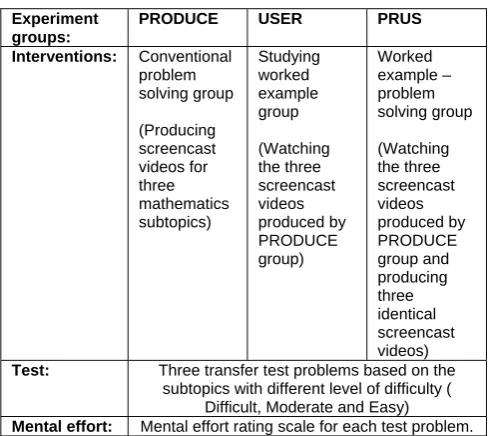
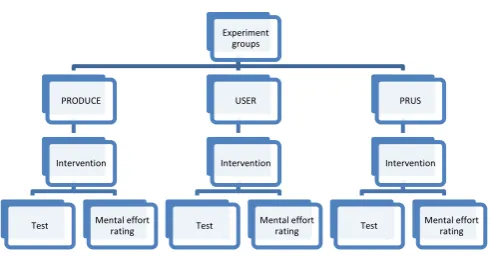
This research examined a few combinations of worked examples by using peer constructed screencast videos in learning such as conventional problem solving, worked-examples-problem solving pairs and studying worked examples as shown in Figure 1 and Figure 2. In the conventional problem solving condition (PRODUCE), learners were required to perform procedural-focused explanation (encourage students to explain the procedures of solutions) while solving the problem by producing screencast videos. In studying the worked example condition (USER), learners were provided with the peers’ constructed screencast videos which means they were provided with the step by step solution with the verbal instructional guidance. In the worked example-problem solving condition (PRUS), the learners were provided with the worked examples of peer constructed screencast videos and followed by constructing screencast videos to solve similar problem.
Experiment groups:
PRODUCE USER PRUS
Interventions: Conventional problem solving group
(Producing screencast videos for three mathematics subtopics)
Studying worked example group
(Watching the three screencast videos produced by PRODUCE group)
Worked example – problem solving group
(Watching the three screencast videos produced by PRODUCE group and producing three identical screencast videos) Test: Three transfer test problems based on the
subtopics with different level of difficulty ( Difficult, Moderate and Easy) Mental effort: Mental effort rating scale for each test problem.
Figure 1. Experimental Groups, Interventions and Evaluation
EAI Endorsed Transactions on e-Learning
5 Figure 2. Experimental Framework
There were 218 participants, who were students enrolled in Engineering Mathematics unit in a private university in Malaysia. The participants consented to take part in this study. Students participated in the study learnt basic calculus in pre-University course before they enrolled into the unit. However, they had never learnt the subtopics included in this study. The experiments were conducted from eighth to twelfth weeks in a semester, for three consecutive semesters. The samples selected for the study were assigned randomly to one of the three learning groups: conventional problem solving group (PRODUCE), studying worked examples group (USER) or worked example-problem solving group (PRUS) according to the semester they enrolled in the unit.
2.2. Materials and procedure
The learning materials were derived from three subtopics included in the learning outcome of the unit, Engineering Mathematics. The experiment consisted of two phases including the learning phase and testing phase. During learning phase, participants in the conventional problem solving condition (PRODUCE) were required to solve questions from the three subtopics by producing screencast videos as the output of their assignment. The problem solving given as a collaborative group project for three members, where they could discuss the solutions prior to recording the video. However, every member in a group was tasked to produce a screencast video for an assigned subtopic. Each group was provided with screencast software and a WACOM pen tablet to record their working and explanation for the problems they solved. The screencast videos produced by this group would then be presented to the other two learning groups as their worked examples.
On the other hand, the studying worked examples group (USER) were presented with three screencast videos developed by peers. Finally, the worked example-problem solving group (PRUS) were presented with screencast videos developed by peers and followed by constructing screencast videos to solve an identical problem. At the end of the learning phase, students in the three learning conditions were
asked to rate their mental score effort [45] based on the 9-point scales (1= extremely low mental effort to 9 = extremely high mental effort). The ratings measured the cognitive load that learners invested while learning the three subtopics during learning phase.
A test phase was administered at the end of the semester for three group conditions on an individual basis. The test consisted of three transfer problems with different level of difficulty (Difficult, Moderate and Easy). The maximum score for both difficult and moderate type of question is six marks whereas seven marks are allocated for easy question with a possible total score of 19 marks for each participant. The problems in learning phase were not similar with the test items. Therefore, learners were expected to transfer their skills and knowledge during learning phase into solving the test questions. At the end of test phase, learners were also asked to rate their cognitive load based on the mental score they invested in solving each question.
3. Findings
3.1. Test performance
Means and standard deviations for test performance are presented in Table 1. The results of the ANOVA analysis for test performance showed a statistically significant difference in mean scores between the three groups for difficult type of question [F(2,215)=9.18, p<0.05]. The mean score of PRUS group is far higher than the mean scores of the other two groups. The effect size, calculated using eta squared, was .08, indicating a medium effect size [44].
The post hoc comparisons test results show that the mean test score for PRUS group (M = 2.8563) was significantly higher than USER group (M = 1.4803), with a mean difference of 1.3760 and p<0.0001. This finding indicated that students learnt through watching and also producing screencast videos (PRUS) performed better on solving difficult question during test as compared to learning through watching screencast videos (USER).
The results of the ANOVA analysis also showed a statistically significant difference in mean scores between the three groups for moderate type of question [F(2,215)=3.723,
p<0.05]. The mean score of PRUS group is far higher than the mean scores of the other two groups. However, the Tukey post-hoc test revealed a marginally significant differences of
p = 0.054 and p=0.053, between the “PRODUCE and PRUS conditions”, and “between the USER and PRUS conditions”, respectively. In addition, the one way ANOVA test results showed no significant difference in mean scores between the three groups for easy type of question (F(2, 215) = 1.49, p = 0.23). This result suggested that all three groups performed quite similarly for easy question.
Experiment groups
PRODUCE
Intervention
Test Mental effort rating
USER
Intervention
Test Mental effort rating
PRUS
Intervention
Test Mental effort rating
EAI Endorsed Transactions on e-Learning
6
Table 1. Mean (and SD) test performance, mental effort and instructional efficiency scores per condition with different level of difficulty.
Variables Level of difficulty PRODUCE (n=62) PRUS (n=80) USER (n = 76)
M SD M SD M SD
Test performance Difficult (max 6) 2.1290 2.0263 2.8563 2.3723 1.4803 1.5087 Moderate (max 6) 2.7823 2.5473 3.7938 2.3756 2.8355 2.7609 Easy (max 7) 4.6694 2.1897 4.9625 1.8654 4.4145 1.9346 Mental effort learning
phase (max 9)
Difficult 4.5417 2.0959 4.5841 1.9861 4.3256 2.1224 Moderate 4.6944 2.1139 4.6073 2.0578 4.5233 2.1948 Easy 4.8472 2.1861 4.9828 2.2140 5.1279 2.1682 Mental effort testing
phase (max 9)
Difficult 7.3065 1.9383 6.8375 2.2972 7.0132 1.7851 Moderate 6.3065 2.5900 6.4125 2.4889 6.2895 2.1028 Easy 6.1613 2.1439 6.0625 2.5820 5.6053 2.0790 2-D instructional
efficiency index
Difficult -0.4430 0.9779 -0.1124 1.0090 -0.4888 0.7353 Moderate -0.0965 1.3637 0.1481 1.0935 -0.0769 1.0917 Easy -0.0780 1.2303 0.0569 1.1928 0.0029 1.1293
In response to the first research question, there was a significant difference in the mean test scores of the three learning groups for difficult type of question but no significant difference for moderate and easy question. The finding suggested that PRUS group perform better compared to USER group for difficult question. One potential explanation for this is that learners in PRUS group achieved most transfer knowledge since they were exposed to worked examples and have a chance to practise solving similar problems by themselves.
3.2. Mental effort
Table 1 shows the reported mean and standard deviations of the mental effort invested for the three learning groups during learning phase and testing phase.
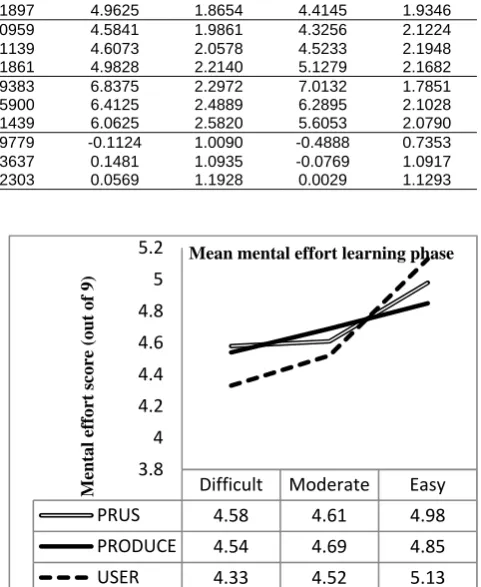
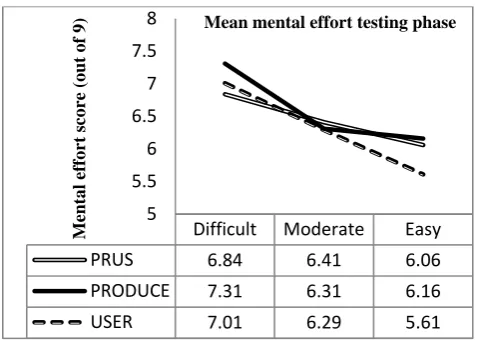
The findings showed a negative relationship between level of difficulty and mean mental effort scores during learning phase as shown in Figure 1. This means that as level of concept difficulty decreases, the perceived mental effort scores increases. In contrast, level of difficulty items was positively associated with mean mental effort scores during testing phase as shown in Figure 2. In other words, the higher level of difficulty, the higher mental effort scores learners perceived.
Figure 3. Group comparison of mean mental effort during learning phase.
In general, the mean mental effort scores were higher during testing phase compared with learning phase as indicated in Figure 3 and Figure 4. However, the one-way ANOVA test results showed no significant difference in mean mental effort scores between the three groups for each level of difficulty questions either during learning phase or testing phase. In response to the second and third research questions, the results did not indicate a significant difference in the cognitive load among the three groups either during learning or testing phase.
Difficult Moderate Easy
PRUS 4.58 4.61 4.98
PRODUCE 4.54 4.69 4.85
USER 4.33 4.52 5.13
3.8 4 4.2 4.4 4.6 4.8 5 5.2
Men
tal effort
sc
ore (ou
t of
9)
Mean mental effort learning phase
EAI Endorsed Transactions on e-Learning
7 Figure 4. Group comparison of mean mental effort
during testing phase.
3.3. The 2-D instructional efficiency index
(E)
Instructional efficiency index is a measure of learners’ mental workload while performing certain cognitive tasks which provide information for the effects of instruction. In the current study, the measure of instructional efficiency bases on learners’ mental effort and performance on test. A high instructional efficiency was indicated by high performance in test with low mental effort whereas low instructional efficiency was indicated by low performance in test with high mental effort. The formula developed by Pass and Van [45] was used to calculate the efficiency of instructional conditions,
√2 .
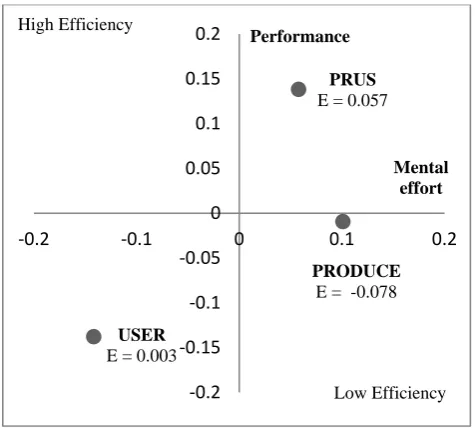
According to the formula, we standardized the student’s test performance and mental effort during testing phase before substituting the mean of the standardized two variables into the formula. Representation of relative condition efficiency for the three groups for questions with different level of difficulty were represented in Figure 5, Figure 6 and Figure 7. In addition, Table 1 shows the comparison of 2-D instructional efficiency index for three groups according to different type of questions.
Difficult question
From Figure 5, none of the three environment groups showed high or positive performance in solving difficult question. PRODUCE group (E = -0.443) invested high mental effort but achieved only intermediate performance when compared with performance of the other two groups. In addition, USER group (E = -0.489) invested intermediate level of mental effort but they achieved the lowest performance. However, the PRUS group was slightly more efficient than the other two groups because this group showed a higher performance despite lower
invested mental effort with the relative condition efficiency of -0.112.
The results of the ANOVA analysis showed a statistically significant difference in the mean of relative condition efficiency (E) between the three groups [F(2,215)=3.886, p<0.05]. The Tukey HSD post hoc comparison test results showed a significant difference occurred between PRUS group and the other two groups. The mean of relative condition efficiency (E) of PRUS group is far higher than the mean of the other two groups. Despite reaching statistical significance, the actual difference in mean scores between groups was quite small. The effect size, calculated using eta squared was .03. The post hoc comparison test results showed that the PRUS group (M = -0.11242) was significantly higher than the USER group (M = -0.48879) with a mean difference of 0.37637 and p=0.029. Hence, learning through watching and producing screencast videos at the same time (PRUS) is more effective when compared to learning through watching screencast videos (USER) for difficult type of question.
Figure 5. Representation of relative condition efficiency (E) for producing screencast (PRODUCE),
produce and user of screencast (PRUS) and user of screencast (USER) for difficult question.
Moderate question
From Figure 6, PRUS group invested the highest mental effort to achieve the highest performance compare with other two groups. In addition, USER group (E = -0.077) invested the lowest mental effort but achieved only an intermediate lower performance. Besides, PRODUCE group invested intermediate level of mental effort but achieved the lowest performance. However, the one-way ANOVA test results showed that there was no significant difference in mean of relative condition efficiency (E) between the three groups for moderate type of question.
Difficult Moderate Easy
PRUS 6.84 6.41 6.06
PRODUCE 7.31 6.31 6.16
USER 7.01 6.29 5.61
5 5.5 6 6.5 7 7.5 8
Men
tal effort
sc
ore (ou
t of
9) Mean mental effort testing phase
PRODUCE
E = -0.443
PRUS
E = -0.112
USER
E = -0.489
‐0.9
‐0.7
‐0.5
‐0.3
‐0.1 0.1 0.3 0.5 0.7
‐0.15 ‐0.1 ‐0.05 0 0.05 0.1 0.15
Mental effort Performance
High Efficiency
Low Efficiency
EAI Endorsed Transactions on e-Learning
8
Figure 6. Representation of relative condition efficiency (E) for producing screencast (PRODUCE),
produce and user of screencast (PRUS) and user of screencast (USER) for moderate question.
Easy question
From Figure 7, PRUS group invested an intermediate mental effort but achieve the highest performance. In addition, USER group (E = 0.003) invested the lowest mental effort and achieved the lowest performance. PRODUCE group invested more mental efforts when compared to the other two groups but achieved an intermediate lower performance with E = -0.078. However, the one-way ANOVA test results showed that no significant difference in the mean of relative condition efficiency (E) between the three groups.
Figure 7. Representation of relative condition efficiency (E) for producing screencast (PRODUCE),
produce and user of screencast (PRUS) and user of screencast (USER) for easy question.
In response to the fourth research question, there was a significant difference in the effectiveness of the three learning methods for difficult question [F(2,215)=3.886,
p<0.05]. PRUS group was more effective when compared to USER group for difficult question. However, there was no difference for moderate and easy questions.
4. Discussion and conclusion
This study aimed to examine the effects of using learner’s produced screencast as the worked examples by comparing three types of instructions; conventional problem solving, worked examples-problem solving pairs and studying worked examples on learners’ cognitive load, learning performance and effectiveness with questions from different level of difficulty. Results revealed that worked examples-problem solving pairs are significantly more effective and outperformed studying worked example condition based on test performance and the 2-D instructional efficiency index in learning difficult item. However, there is no significant difference in test performance or effectiveness of learning techniques in learning moderate or easy items among the three learning instructions.
The results supported the prior research [20] that combination of problem solving (producing screencast videos) and worked examples (watching screencast videos) leads to better performance for learners especially when they are in the early phase of acquisition or unfamiliar to the concept to-be-learnt. The findings also revealed that watching screencast videos only without practising the problem could give learners false security that they have mastered the learning [17, 46] especially if the level of content is difficult.
Conversely, when learner expertise increase or has prior knowledge, problem solving would promote learning when compared with studying worked examples [21]. In other words, instructional approach that is highly effective for novice learners might impede the learning for expert learners. This expertise reversal effect [47] is due to expert learners already acquired appropriate prerequisite schemas, thus studying worked examples might not be beneficial when compared to problem solving only.
On the other hand, the mean of mental effort observed during learning phase or testing phase between the three groups revealed a non-significant difference within each level of difficulty. Although we expect learners to rate their mental effort significantly different between the three types of instructions within each level of items difficulty in learning phase, but each group invested quite similar amount of mental effort in learning phase. In other words, the learners did not find any of the instructions requiring them to invest extra cognitive load during the learning phase.
There are a few possible explanations: (1) learners may not study the worked examples in depth, thus they may have overestimated their learning of the worked examples without understanding the underlying significant concept;
PRODUCE
E = -0.097
PRUS
E = 0.148
USER
E = -0.077
‐0.2
‐0.15
‐0.1
‐0.05 0 0.05 0.1 0.15 0.2 0.25 0.3
‐0.03 ‐0.02 ‐0.01 0 0.01 0.02 0.03 0.04
Mental effort Performance
Low Efficiency
PRODUCE
E = -0.078
PRUS
E = 0.057
USER
E = 0.003
‐0.2
‐0.15
‐0.1
‐0.05 0 0.05 0.1 0.15 0.2
‐0.2 ‐0.1 0 0.1 0.2
Mental effort Performance
High Efficiency
High Efficiency
Low Efficiency
EAI Endorsed Transactions on e-Learning
9
(2) the screencast worked example has been designed to reduce the cognitive load such as chunking screencast video length within five minutes, thus learners could devote less cognitive load to process information, (3) learners benefited from problem solving during group collaboration prior to producing screencast videos individually, thus their cognitive load has been distributed among the peers even though the task imposed high cognitive load. Likewise, each learning group invested quite similar amount of mental effort in testing phase within each level of items difficulty although group performance for each test item might be different. This could be explained that learners may not be able to accurately self-evaluate and monitor their performance.
The findings also revealed a negative relationship between level of difficulty items and mental effort scores during learning phase. In contrast, level of difficulty items was positively associated with mental effort scores during testing phase. These results suggested that the timing to ask learners for their mental effort rating might be the key variable to explain the difference. Mental effort rating scales for learning phase were applied at the end of the entire learning that is few weeks after the learning instruction. Consequently, learners encountered problem when recalling the perceived cognitive load imposed by each task during instruction.
During testing phase, learners were asked to provide mental effort rating immediately after solving each question. As anticipated, learners rated higher mental effort in testing phase when compared with learning phase even though it did not reach a statistically significant difference. This was due to test items assess learners’ far transfer knowledge and not similar with the problems they learnt in learning phase.
A potential limitation of the present study is the use of convenience sampling in data collection. The findings may not generalize the results beyond the population who study other domain knowledge. Second, the present study did not assess participants’ prior knowledge or conduct pre-test before they were assigned to different learning conditions. Hence, the study might not be able to determine to what extent different learning conditions contributed to test performance and cognitive load based on learners’ expertise. Finally, although measuring indirect subjective mental effort is common in cognitive load research, the timing to rate the scale likely influence the results. Despite these limitations, the present study provides initial insights regarding the use screencast videos as worked examples and the cognitive load imposed by using screencast videos as learning platform which have not been widely discussed in previous studies.
In light of the findings of this study, there are some recommendations for further studies. Mental effort rating should be conducted immediately after each task for different learning instructions in learning phase, not in a later date and setting. In addition, providing multiple and varying types of worked example during learning phase might be more beneficial for learners to facilitate their learning [48]. Further research could also be conducted to
investigate on other ways to improve worked examples such as applying fading worked examples strategy [24] in screencast.
In addition, it is better to conduct a pre-test to assess the learners’ prior knowledge. With this, researcher can distinguish how novice and expert learners improve their learning gains through different instructional strategies. The current research findings emphasize that examples-problem solving pairs are significantly more effective than studying worked examples alone, especially in learning difficult concept. Thus, it is important to tailor instructional scaffolding for students through transitional learning from worked examples to problem solving based on learner’s expertise. In the initial stage of learning, learners are suggested to study worked examples and alternate with practising problem solving. Once schema has been constructed and automated, learners could proceed with the problem solving method in the later stage.
In closing, it is important to assess and evaluate the effectiveness of using worked examples or screencast videos as there are substantial number of higher education institutions adopting these approaches in their teaching and learning. However, connecting learning theory and practical applications is significant to achieve learning outcomes. Ultimately, it is essential for researcher and education practitioners to reflect on the impact of using instructional strategies with respect to learning performance, cognitive load and effectiveness of the instruction. Finally, the implementation of technology tools such as screencast in this study may be used as a guide for instructors to identify the most efficient way to use worked examples in learning.
Acknowledgements.
This work is part of a research project funded by the Swinburne Sarawak Research Grant (SSRG 2-5522).
References
[1] Sweller, J. (1988). Cognitive load during problem solving: Effects on learning. Cognitive Science, 12, 257–285. [2] Pollock, E., Chandler, P. A. & Sweller, J. (2002).
Assimilating complex information. Learning and Instruction, 12 (1), 61-86.
[3] Mayer, R. E., & Moreno, R. (2003). Nine ways to reduce cognitive load in multimedia learning. Educational psychologist, 38(1), 43-52.
[4] Mwangi, W., & Sweller, J. (1998). Learning to Solve compare word problems: The effect of example format and generating self-explanations. Cognition and Instruction, 16, 173–199.
[5] Tarmizi, R., & Sweller, J. (1988). Guidance during mathematical problem solving. Journal of Educational Psychology, 80, 424–436.
[6] Mousavi, S., Low, R.,&Sweller, J. (1995). Reducing cognitive load by mixing auditory and visual presentation modes. Journal of Educational Psychology, 87, 319–334. [7] Chandler, P., & Sweller, J. (1991). Cognitive load theory
and the format of instruction. Cognition and Instruction,
8(4), 293–332.
EAI Endorsed Transactions on e-Learning
10
[8] Sweller, J.; Van Merrienboer, J. J. G., & Paas, F. G. W. C. (1998). Cognitive architecture and instructional design. Educational Psychology Review, 10(3), 251-96.
[9] Chi, M. T., Bassok, M., Lewis, M. W., Reimann, P., & Glaser, R. (1989). Self‐explanations: How students study and use examples in learning to solve problems. Cognitive science, 13(2), 145-182.
[10] VanLehn, K., Jones, R. M., & Chi, M. T. (1992). A model of the self-explanation effect. The journal of the learning sciences, 2(1), 1-59.
[11] Renkl, A., & Atkinson, R. K. (2003). Structuring the transition from example study to problem solving in cognitive skill acquisition: A cognitive load perspective.
Educational Psychologist, 38(1), 15-22.
[12] Cooper, G., & Sweller, J. (1987). Effects of schema acquisition and rule automation on mathematical problem-solving transfer. Journal of Educational Psychology. 79(4), 347–362.
[13] Renkl, A. (2005). The worked-out examples principle in multimedia learning. In Mayer, R.E. (Ed.), The Cambridge Handbook of Multimedia Learning. Cambridge: Cambridge University Press.
[14] Van Gerven, P. W. M. , Pass, F. G. W. C., Van Merriënboer, J. J. G., & Schmidt, H. G. (2002). Cognitive load theory and aging: effects of worked examples on training efficiency.
Learning and Instruction, 12, 87-105.
[15] Renkl, A. (2002). Worked-out examples: Instructional explanations support learning by selfexplanations. Learning and Instruction, 12, 529–556.
[16] Chi, M. T., & Bassok, M. (1989). Learning from examples via self-explanations. Knowing, learning, and instruction: Essays in honor of Robert Glaser, 251-282.
[17] Renkl, A. (1997). Learning from worked‐out examples: A study on individual differences. Cognitive science, 21(1), 1-29.
[18] Renkl, A., Stark, R., Gruber, H., & Mandl, H. (1998). Learning from worked-out examples: The effects of example variability and elicited self-explanations.
Contemporary Educational Psychology, 23, 90–108. [19] Aleven, V. A., & Koedinger, K. R. (2002). An effective
metacognitive strategy: Learning by doing and explaining with a computer-based Cognitive Tutor. Cognitive science,
26(2), 147-179.
[20] Sweller, J., & Cooper, G. A. (1985). The use of worked examples as a substitute for problem solving in learning algebra. Cognition and instruction, 2(1), 59-89.
[21] Kalyuga, S., Chandler, P., Tuovinen, J., & Sweller, J. (2001). When problem solving is superior to studying worked examples. Journal of Educational Psychology,
93(3), 579-588.
[22] Van Gog, T., Kester, L., & Paas, F. (2011). Effects of worked examples, example-problem, and problem-example pairs on novices’ learning. Contemporary Educational Psychology, 36(3), 212-218.
[23] Reisslein, J., Atkinson, R. K., Seeling, P., & Reisslein, M. (2006). Encountering the expertise reversal effect with a computer-based environment on electrical circuit analysis.
Learning and instruction, 16(2), 92-103.
[24] Salden, R. J., Aleven, V., Schwonke, R., & Renkl, A. (2010). The expertise reversal effect and worked examples in tutored problem solving. Instructional Science, 38(3), 289-307.
[25] Renkl, A., Atkinson, R. K., & Maier, U. H. (2000, January). From Studying Examples to Solving Problem: Fading
Worked-Out Solution Steps Helps Learning. In Proceedings of the Cognitive Science Society (Vol. 1, No. 1).
[26] Renkl, A., Atkinson, R. K., Maier, U. H., & Staley, R. (2002). From example study to problem solving: Smooth transitions help learning. The Journal of Experimental Education, 70(4), 293-315.
[27] Atkinson, R. K., Renkl, A., & Merrill, M. M. (2003). Transitioning from studying examples to solving problems: Effects of self-explanation prompts and fading worked-out steps. Journal of Educational Psychology, 95(4), 774. [28] Mullamphy, D. F., Higgins, P. J., Belward, S. R., & Ward,
L. M. (2010). To screencast or not to screencast. Anziam Journal, 51, C446-C460.Dsdsa
[29] Lloyd, S. A., & Robertson, C. L. (2012). Screencast tutorials enhance student learning of statistics. Teaching of Psychology, 39(1), 67-71.
[30] Wakefield, J. A., Frawley, J. K., Dyson, L. E., Tyler, J. V., & Litchfield, A. J. (2011). Increasing student engagement and performance in introductory accounting through student-generated screencasts. In AFAANZ Conference. AFAANZ.
[31] De Grazia, J. L., Falconer, J. L., Nicodemus, G., & Medlin, W. (2012, June). Incorporating screencasts into chemical engineering courses. In 2012 ASEE Annual Conference & Exposition (pp. 25-762).
[32] Green, K. R., Pinder‐grover, T., & Millunchick, J. M. (2012). Impact of screencast technology: Connecting the perception of usefulness and the reality of performance.
Journal of Engineering Education, 101(4), 717-737. [33] Pinder-Grover, T., Green, K. R., & Millunchick, J. M.
(2011). The efficacy of screencasts to address the diverse academic needs of students in a large lecture course.
Advances in Engineering Education, 2(3), n3.
[34] Powell, L. M. (2015). Evaluating the effectiveness of self-created student screencasts as a tool to increase student learning outcomes in a hands-on computer programming course. Information Systems Education Journal, 13(5), 106. [35] Esgi, N. (2014). Comparisons of effects of student and
teacher prepared screencasts on student achievement.
European Scientific Journal, ESJ, 10(22).
[36] Mayer, R. E. (2nd Ed.). (2014). The Cambridge handbook of multimedia learning. Cambridge University Press. [37] Jeung, H. J., Chandler, P., & Sweller, J. (1997). The role of
visual indicators in dual sensory mode instruction.
Educational Psychology, 17(3), 329-345.
[38] Mayer, R. E., & Anderson, R. B. (1991). Animations need narrations: An experimental test of a dual-coding hypothesis. Journal of educational psychology, 83(4), 484. [39] Paivio, A (1986). Mental representations: a dual coding
approach. Oxford. England: Oxford University Press. [40] Baddeley, A. D. (1986). Working memory. Oxford: Oxford
University Press.
[41] Mayer, R. E., Moreno, R., Boire, M., & Vagge, S. (1999). Maximizing constructivist learning from multimedia communications by minimizing cognitive load. Journal of educational psychology, 91(4), 638.
[42] Mayer, R. E., Fennell, S., Farmer, L., & Campbell, J. (2004). A personalization effect in multimedia learning: Students learn better when words are in conversational style rather than formal style. Journal of Educational Psychology,
96(2), 389.
[43] Atkinson, R. K., Mayer, R. E., & Merrill, M. M. (2005). Fostering social agency in multimedia learning: Examining the impact of an animated agent’s voice. Contemporary Educational Psychology, 30(1), 117-139.
EAI Endorsed Transactions on e-Learning
11 [44] Cohen J. (1988). Statistical Power Analysis for the
Behavioral Sciences. New York, NY: Routledge Academic [45] Paas, F., & Van Merri¨enboer, J. J. G. (1993). The efficiency of instructional conditions: An approach to combine mental effort and performance measures. Human Factors, 35, 737– 743.
[46] Trafton, J. G., & Reiser, B. J. (1993). Studying examples and solving problems: Contributions to skill acquisition. In
Proceedings of the15th conference of the Cognitive Science Society (pp. 1017-1022).
[47] Kalyuga, S., Ayres, P., Chandler, P., & Sweller, J. (2003). The expertise reversal effect. Educational psychologist,
38(1), 23-31.
[48] Atkinson, R. K., Derry, S. J., Renkl, A., & Wortham, D. (2000). Learning from examples: Instructional principles from the worked examples research. Review of educational research, 70(2), 181-214
EAI Endorsed Transactions on e-Learning