The influence of the physical environment
on learning behaviour:
a case study of intermediate schools in Kuwait
Mohammad A A H M Ali
PhD
2017
BIRMINGHAM CITY UNIVERSITY
The influence of the physical environment
on learning behaviour:
a case study of Intermediate schools in Kuwait
By
Mohammad A A H M Ali
Doctor of Philosophy, PhD
March 2017
A thesis submitted in partial fulfilment of the degree of Doctor of
Philosophy
BIRMINGHAM CITY UNIVERSITY
Faculty of the Arts, Design and Media (ADM)
The Parkside Building, Birmingham, B4 7BD
© Birmingham City University 2016. All rights reserved. No part of this
publication may be reproduced without the written permission of the copyright
Abstract
A school’s physical environment plays a vital role in enhancing learning and teaching
experiences. Currently, there is a growing body of literature indicating the critical impacts a school’s physical environment can effect on students and teachers. However, far too little attention has been paid to this issue, not excluding public schools in Kuwait.
This research investigates the impact of the physical environment on learning and teaching
behaviour, performance and outcomes in Kuwaiti intermediate public schools. It evaluates
the quality of architectural characteristics of school buildings, and the classroom interior
features in term of spatial, visual, acoustic, thermal and personal environmental aspects.
A mixed methods approach was adopted to efficiently assess the quality of learning
environments. The documented case studies consist of comprehensive figures consolidated
from five public schools by three methods. A physical survey was designed to assess the
condition of school buildings and classroom environments. The observation helped to measure the influence interior classroom environments exerted on students’ and teachers’ performance and behaviour. Concomitantly, a school inventory survey (questionnaires) were also designed to represent the students’, teachers’ and school administrators’ concerns and feedback regarding their school environment. In addition, a qualitative semi-structured
interview was conducted with a Ministry of Education official, who generously provided further insight into the case studies’ results.
Comparative analysis findings from this study indicate several contributions to the current
literature. Firstly, results revealed that the effective quality of the learning environment
identified a positive impact on learning and teaching performance and behaviour. Secondly,
the results identified many inadequacies and weaknesses within the architectural system
adopted in Kuwaiti schools. Thirdly, this study revealed that the lack of a proper protocol
within the Ministry of Education in Kuwait imposed a negative influence on school design
quality. The study concludes with a description of more specific outcomes pertinent to the
quality of physical features, as well as recommendations for further studies towards
Acknowledgments
First of all, I am evermore grateful to Allah (God) for giving me the ability to accomplish this
thesis as part of my PhD study.
Secondly, this piece of work could not have been completed had it not been for the
motivation, moral support, and encouragement of many people in this organisation over the
long years of my research journey. Special thanks go to my director of studies, Professor
Mohsen Abutorabi, for his constant supervision, expertise, enthusiasm, advice, support,
encouragement and assistance in reaching this stage; without his support, I would have never
been able to complete this project. I would also like to acknowledge my second supervisor,
Dr Sue Dawes, she offered valuable assistance and encouragement in editing and enhancing
this research. Further, I thank Dr Rokhshid Ghaziani for her feedback and comments on this
thesis.
Thirdly, I would like to thank my country Kuwait, and the Public Authority for Applied
Education and Training. In particular, I would like to thank the Interior Design department
who offered me all necessary means of completing this research. Additionally, I am grateful
for the extensive cooperation of the Ministry of Education in Kuwait, the students, teachers,
school administrators and official staff from the Department of Design and Establishment. I
especially thank Eng. Abdul-Mohsen Sadeq. Their collaboration was unforgettable and
extraordinary, as I have found their contribution to be one of the most moving experiences I
have ever been through.
Fourthly, I offer my particular thanks to my parents, who provided the support,
encouragement and prayers over the years. Also, I would like to thank my wife, Roukia, and
my sons Mahdi and Maitham, for their patience and willingness to accept the temporary
disruption of our lives.
Last but not least, I wish to thank all my friends, family, colleagues, and all those who
Table of Contents
Abstract ... I
Acknowledgments... II
Table of Contents ... III
List of Figures ... VIII
List of Tables ... XV
1 Introduction to the study
1.1 Concept ... 1
1.2 Statement of the Problem: ... 2
1.3 Aims and objectives ... 4
1.4 Research methodology ... 4
1.5 Scope of the study ... 5
1.6 Research key questions ... 6
1.7 The structure of the research ... 7
2 The philosophy of education 2.1 Introduction ... 10
2.2 Educational philosophy ... 11
2.3 Definition of education ... 12
2.4 The History of education ... 13
2.5 The growth of education ... 15
2.6 Educational ideologies ... 16
2.7 Development of educational theories ... 20
Behaviourism ... 20
Cognitivism ... 22
Constructivism ... 26
2.8 Learning approaches ... 32
2.9 Education system ... 33
Educational theory ... 34
Educator needs ... 35
Pedagogy ... 35
Curriculum ... 37
Policy ... 38
Summary of Chapter two ... 41
3 Theory of learning Environment 3.1 Introduction ... 43
3.2 Theoretical background of the educational learning environment ... 44
3.3 Impact of learning environment on users ... 46
Social environment ... 47
Psychological Environment ... 52
Cultural environment ... 56
Teaching environment ... 58
Physical Environment ... 63
Summary ... 66
3.4 Development and assessment of the physical learning environment ... 66
Educationalist perspectives... 67
Designers’ and architects’ perspective ... 68
Environmental psychologists’ perspective ... 70
Summary ... 73
3.5 Evidence-based research of the physical learning environment ... 74
Spatial environment ... 75
Visual Environment ... 80
Acoustic Environment ... 84
Thermal environment ... 87
Personal elements ... 89
Summary of Chapter Three ... 90
4 Research Methodology 4.1 Parts 1 – Review of the methodology ... 93
The philosophy of research in social studies ... 94
Summary ... 97
4.2 Part 2 - The research design ... 97
Introduction ... 97
The research process ... 99
The required data ... 101
Research sample/ pilot study ... 102
Research methods ... 104
Data collection and analysis ... 111
Summary of chapter four... 116
5 The development of the learning system and the learning environment in Kuwait 5.1 Brief background history of Kuwait ... 119
Location and environmental conditions: ... 119
Demographics (population, genders, ethnic groups and religion) ... 120
5.2 The development of the socio-cultural, economical and the educational systems in Kuwait ... 122
First period: The Historical development of Kuwait up to the 19th century. ... 123
Second period: The state of Kuwait and its educational movement within the 20th century. ... 132
Third period: The independence of Kuwait and the contemporary educational system... 141
5.3 Existing school building design and architecture in Kuwaiti public schools ... 153
Summary of chapter five ... 171
6 Case studies and interview 6.1 Introduction ... 173
6.2 Pilot study: ... 173
Outcome of the pilot study ... 175
6.3 Main case study ... 177
Observation ... 199
School inventory survey (Questionnaires) ... 224
Summary of the case studies ... 253
6.4 Interview with the official ... 254
7 Analysis of the case study outcomes 7.1 Group 1: the built school environment quality ... 257
School building age ... 259
School location ... 260
Spatial properties (spatial socio-cultural aspects) ... 261
School population and size ... 264
Summary of Group 1 ... 265
7.2 Group 2: classrooms’ physical environment quality ... 266
Classroom size and density ... 266
Colour ... 267
Lighting ... 270
Seating arrangement ... 272
Lockers ... 274
Displays ... 275
Noise ... 276
Temperature ... 278
Summary of Group 2 ... 279
7.3 Group 3: communications and interactions quality ... 280
Analysis of students’ interaction ... 280
Analysis of Teachers’ movement ... 281
Analysis of Classroom facilities ... 284
Summary of Group 3 ... 286
8 Analysis and interpreting of the outcomes with the governmental official 1- An analysis of the physical school built environment factors with the government official ... 288
2- Analysis of the guidelines and considerations for the school facilities design with the official ... 296
9 Conclusion
9.1 The summary of the chapters ... 301
9.2 The research outcomes ... 304
Contribution to knowledge ... 304
Specific outcomes ... 306
9.3 Recommendations and further studies ... 310
References ... 312
Appendices Appendix A. The Pilot study questionnaire ... 329
Appendix B. The physical survey checklists ... 330
Appendix C. The school facility appraisal ... 331
Appendix D. Observation checklists ... 347
Appendix E. Students questionnaire ... 349
Appendix F. Teachers’ questionnaire ... 350
Appendix G. School administrator questionnaire ... 352
Appendix H. Interview transcript ... 356
Appendix I. Space and facility requirements for intermediate school building ... 368
Appendix J. Letter from Birmingham City University and approval permissions from the Ministry of Education in Kuwait ... 374
Appendix K. Ethics consideration for this research ... 378
List of Figures
Figure 1. The research structure ... 7
Figure 2. Dichotomous approaches, adapted from (Meighan et al., 2007, p. 191- 198) ... 17
Figure 3. The behaviourism theory sees learning as a behavioural change. ... 22
Figure 4. Cognitivism theory sees learning is structured mental change. ... 26
Figure 5. Constructivism learning theory ... 32
Figure 6: The learning theories requirement on learning environment. ... 41
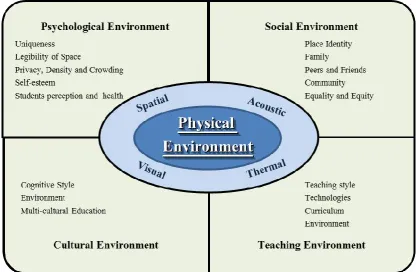
Figure 7. Five factors influencing the learning environment ... 47
Figure 8. Social Cognitive Theory (Bandura, 1986, Jordan et al., 2008) ... 49
Figure 9. Social environment aspects ... 50
Figure 10 . Maslow’s hierarchy of needs (Long et al., 2011, p.128). ... 53
Figure 11. Psychological environment aspects. ... 53
Figure 12. The cultural environment aspects ... 57
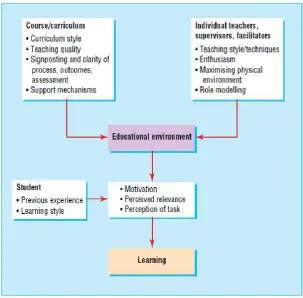
Figure 13. Educational factors that influence learning (Hutchinson, 2003) ... 60
Figure 14 The teaching environment aspects... 61
Figure 15 The physical environment factors ... 64
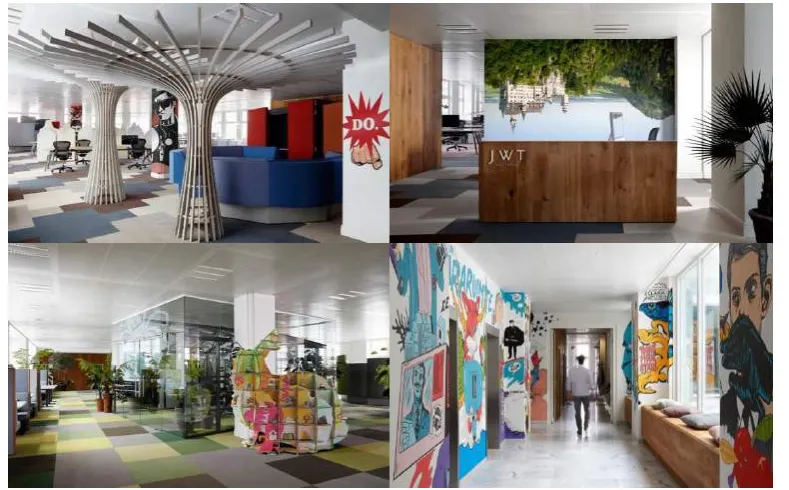
Figure 16: JWT Amsterdam office (Williams, 2013). ... 69
Figure 17. The methods by which we learn by percentages: the effective ways that students use to learn (Biggs and Tang, 2011, P.63) ... 72
Figure 18. Spatial environment factors ... 75
Figure 19. Visual environment factors... 81
Figure 20. Acoustic environment factors ... 85
Figure 21. Thermal environment factors ... 88
Figure 22. The research philosophy ‘onion’ (Saunders et al., 2011, p.108) ... 94
Figure 23. The research framework, interconnection of paradigms, strategies and research methods (Creswell, 2009, p.5) ... 95
Figure 25. The data required and the research instruments. ... 101
Figure 26. Analysis strategy and data required for this research. ... 112
Figure 27: Kuwait Geography (Factbook, 2016). ... 119
Figure 28: Population gender and nationality in Kuwait (Central Statistical Bureau, 2013).120 Figure 29: Kuwaiti population pyramid (Statistical Information Bureau, 2013). ... 121
Figure 30. Kuwait’s harbour in 1760, which clearly shows in the middle of the image the small fortress (Alkot). (Source: Asad Abunashi, 2007) ... 123
Figure 31. Location of the state of Kuwait within Middle East (Factbook, 2016). ... 124
Figure 32. Kuwait map that show the Failaka Island and Kazma town. (Google maps. 2016) ... 125
Figure 33. Greek Settlement at Failaka Islands in Kuwait (Al-Haji, 2004) ... 125
Figure 34. Atraditional path between houses (Watan-Alnahar, 2012) ... 127
Figure 35. The overview plan of the old Kuwait city which shows the paths between each house (Watan-Alnahar, 2012) ... 128
Figure 36. The layout plan of the historical building in Kuwait (Al-bader house) that shows the multiple courtyards in same building area (Lewcock, 1978) ... 128
Figure 37. A traditional building in Kuwait (Kuwaitpast.com) ... 129
Figure 38. Kuwaiti children playing outside of their houses with some traditional toys, children were required to cover their heads when they started attending traditional schools (Al-Haji, 2004.) ... 130
Figure 39. Al-Katatib classes (DiPiazza, 2006) ... 130
Figure 40. The organisation of the spaces in Al-Katatib classes (Kuwait TV) ... 131
Figure 41. Al-Jahra gates that have been refurbished, but still exist in Kuwait ... 132
Figure 42. Cloak maker using a handmade machines to produce traditional clothes (Al-Haji, 2004) ... 133
Figure 43. The first plan of the Kuwait that created by a British firm in 1950 (Mahmeed, 2007) ... 134
Figure 44 Modern house design 1950 -1970 (Cecil, 2014). ... 135
Figure 46. The entrance of the Al-Mubarakiya school; it has two entrances, the right door is
the main one (adopted from Ayyub Hussain Drawing) ... 139
Figure 47. Al-Mubarakiya school yard which shows the classrooms and corridors (Al-Mubalish, 2016) ... 139
Figure 48. A classroom at Al-Mubarakiya school which shows the basic setting and organisation of the space (Watan-Alnahar, 2012) ... 140
Figure 49. This landmark in Kuwait was been damaged after the Iraqi invasion (almrsal.com, 2014) ... 142
Figure 50.One of the damaged school after the Iraqi invasion that had been used as military centre (Alyosofi, 2011) ... 143
Figure 51. The difference between the traditional style (vernacular) and the modern style (Mahmeed, 2007) ... 144
Figure 52. The house styles based on modern design (Mahmeed, 2007) ... 145
Figure 53. House styles created by Kuwaiti architects which mix modern and traditional designs (Mahmeed, 2007). ... 145
Figure 54. Metal Cladding material been used in the new shopping mall in Kuwait for decorative and cover the walls and ceiling (MERO-TSK, 2007) ... 146
Figure 55. The scientific centre of Kuwait built in 1999 that shows the tensile structures in beach side (Birdair, n.a) ... 147
Figure 56. Ebn Al-Tofail intermediate school plan ... 154
Figure 57. Main Courtyards of the Ebn Al-Tofail School ... 155
Figure 58. The social spaces which shown the Bedouin tent in the second courtyard ... 156
Figure 59. The sheltered spaces and the cafeteria... 156
Figure 60. The classrooms in the Ebn Altofail School ... 157
Figure 61. Abdulatef Al-Shamlan school plan ... 157
Figure 62. The main Courtyard of the Abdulatef Al-Shamlan School ... 158
Figure 63. The two small linking courtyards in the Al-Shamlan School ... 158
Figure 64. The classrooms in the Al-Shamlan School ... 159
Figure 65. Al-Wohaib school plan. ... 160
Figure 67. The second courtyard in this school was totally enclosed. ... 161
Figure 68. The classrooms in the Al-Wohaib School ... 162
Figure 69. Mohalhal Al-Modaf school plan ... 162
Figure 70. One of the courtyards was not completely covered;and the three floors and corridor are visible ... 163
Figure 71. The centre space of the school leads to both courtyards as well as to the second section ... 163
Figure 72. The second section in Al-Modaf school ... 164
Figure 73. A-Modaf school classroom... 164
Figure 74. Qaiss bin Abi Al-Aass school plan ... 165
Figure 75. Qaiss bin Abi Al-Aass school main courtyard ... 166
Figure 76. The inside corridors of the octagonal section ... 166
Figure 77. Hexagon shape classroom layout ... 167
Figure 78. Qaiss bin Abi Al-Aass school classroom ... 167
Figure 79. Ahmad Al-Saqaf school plan... 168
Figure 80. The backyard of the school: a social space for students ... 169
Figure 81. The main courtyard where sport is played in free time ... 169
Figure 82. The octagonal classroom wing that shows how it is integrated with the main courtyard ... 170
Figure 83. The classroom in the Ahmad Al-Saqaf School ... 170
Figure 84. First Intermediate School site and entrance ... 174
Figure 85. The second Intermediate School site and entrance... 174
Figure 86. The third Intermediate School site and entrance ... 175
Figure 87. The student’s response to questions 1 and 2 ... 176
Figure 88. An example of the collected physical survey checklist. ... 178
Figure 89. School A plan ... 179
Figure 90. The classrooms in School A ... 180
Figure 92. Centre of science (left), and centre of maths (right) ... 181
Figure 93. : Students gathering in the Bedouin tent and other students praying in free time ... 182
Figure 94. School B plan ... 183
Figure 95. School B classroom layout ... 183
Figure 96. Damage in the School B classrooms ... 184
Figure 97. School C plan ... 186
Figure 98. The classrooms in School C ... 187
Figure 99. Damage elements in the School C classrooms ... 188
Figure 100. School D school layout ... 190
Figure 101. The English language classroom in School D ... 190
Figure 102. Science classroom while the right-hand picture shows the seats in rear of the English classroom. ... 191
Figure 103. Lack of building quality in School D classrooms ... 192
Figure 104. School E plan layout ... 194
Figure 105. Classroom layout at School E... 195
Figure 106. School E classrooms ... 196
Figure 107. The facilities in the classroom of the School E ... 197
Figure 108. An example of the observation notes that collected for this research. ... 200
Figure 109. The classroom layouts in the selected schools ... 201
Figure 110. Classrooms in School 1 painted with pink and green colour ... 202
Figure 111. Classroom in School 2 was painted beige colour. ... 202
Figure 112. Classroom in School 3 has blue colour ... 203
Figure 113. Year 6 classroom in School 3 has beige colour ... 203
Figure 114. Classroom colour in School 4 has beige colour, while the science lab combined of many colours... 204
Figure 116. School 1 classrooms show the natural lighting was causing glare in front of the
space. ... 205
Figure 117. Classroom lighting in School 2 shows poor natural lighting in the internal space. ... 206
Figure 118. Classroom lighting condition in School 3, the natural lighting was poor in the majority of the classroom, while year 6 classroom has better daylight. ... 206
Figure 119. A classroom in School 4 shown the daylight was not controlled properly. ... 207
Figure 120. Lighting level in School 5, shows the left classroom has poor light quality, while the right classroom has better daylight and artificial light ... 208
Figure 121. Row and cooperative seating arrangements were used in School 1 ... 208
Figure 122. Row seating arrangement in School 2 ... 209
Figure 123. The seating arrangement in School 3 was in rows, the distance between each student was not balanced ... 210
Figure 124. The seating arrangement in School 4 were usually rows, just the science lab was organised as group arrangement ... 210
Figure 125. Rows seating arrangements of the hexagon/trapezoidal shape classroom in School 5 ... 211
Figure 126. The ways that student store their belongings inside the classroom ... 212
Figure 127. Students wear jackets in School 1 during the teaching time. ... 214
Figure 128. Classroom layouts in general... 215
Figure 129. Students and teachers movement in School 1 ... 217
Figure 130. Teachers movement in School 2... 218
Figure 131. Students and teachers movement in School 3 ... 219
Figure 132. Students and teachers movement in School 4 ... 220
Figure 133. Students and teachers movement in School 5 ... 221
Figure 134. The School 1 entrance and the large car parking facility ... 260
Figure 135. Left image - School 3 entrance that shows the lack of parking for parents and visitors. ... 261
Figure 136. Bedouin tent in School 1 ... 262
Figure 138. Sports activities available for students in School 5 ... 263
Figure 139: The classroom shape and size in each school. ... 266
Figure 140. Classroom in School 1 and 3 that shows the use of intense and sharp colours .. 268
Figure 141. Two classrooms in School 5 ... 268
Figure 142. Students engaged with the teachers during class time in School 2 ... 269
Figure 143. Bright colours are shown in Arabic subject classroom at School 4 ... 269
Figure 144. Classroom in School 3 shows the lighting condition ... 271
Figure 145. Classrooms in School 4 shows the lighting condition ... 271
Figure 146. Classrooms in School 5 ... 271
Figure 147. Seating arrangement in some classrooms ... 273
Figure 148. Damaged storage in School 2 and 3 ... 275
Figure 149. Over-decorated room designed for each subject area in School 1 ... 276
Figure 150. The noise level in this study ... 277
Figure 151. Limited teacher movements in some observed classrooms ... 282
Figure 152 . Poor teacher’s movement in large and balanced arrangement classrooms. ... 283
List of Tables
Table 1. Comparison between transmission and interpretation teaching (Barnes and Shemilt,
1974, p. 223) ... 18
Table 2. The structure of learning environment theory ... 43
Table 3. Learning modes (Kopec, 2006, P.190) ... 74
Table 4. The standard lighting values required for Educational Building (Zumtobel, 2013) .. 82
Table 5: The research sample. ... 103
Table 6: Distribution of schools, classes, students and teaching staff in intermediate schools in Kuwait. (Ministry of Education, 2011) ... 103
Table 7: The scoring point for each category of School facility appraisal (Hawkins and Lilley, 1998, p.61). ... 114
Table 8. Population growth in Kuwait between 1965-2011. Source (Bureau, 2013) ... 120
Table 9. Historical development of Kuwait ... 122
Table 10. The public school stages (ladder) in Kuwait ... 148
Table 11. The Ministry of Education structure (Department of Public Relations and Educational Media 2011) ... 149
Table 12. The subjects in the intermediate school of Kuwait and the location of the lesson undertaken ... 151
Table 13. School A appraisal summary ... 182
Table 14. School B Appraisal summary ... 185
Table 15 . School C Appraisal summary ... 189
Table 16. School D Appraisal summary ... 193
Table 17. Al-Saqaf school Appraisal summary ... 198
Table 18. Questionaries’ sample ... 224
Table 19. Students’ responses to the quality of their classroom environment. ... 225
Table 20. The quality of the interaction and communication of students. ... 228
Table 21. The student’s views of their school and classrooms environment ... 229
Table 23. Teachers’ response to Q1 ... 232
Table 24 Teachers’ response to Q2 ... 233
Table 25. Teachers’ response to Q3 ... 233
Table 26. Teachers’ response to Q4 ... 234
Table 27. Teachers’ response to Q5 ... 234
Table 28. Teachers’ response to Q6 ... 235
Table 29. Teachers’ response to Q7 ... 235
Table 30. Teachers’ response to Q8 ... 236
Table 31. Teachers’ response to Q9 ... 236
Table 32 . Teacher’s response to Q10 ... 237
Table 33. Teachers’ response to Q11 ... 237
Table 34. Teachers’ response to Q12 ... 238
Table 35. Teachers’ response to Q13 ... 238
Table 36. Teachers’ response to Q14 ... 239
Table 37. Teacher’s response to Q15 ... 239
Table 38. Teacher’s response to Q16 ... 240
Table 39. Teacher’s response to Q17 ... 240
Table 40. Teacher’s response to Q18 ... 241
Table 41. Teachers’ response to Q19 ... 241
Table 42. Teachers’ response to Q20 ... 242
Table 43. School administrators’ responses to Q1 and Q2 ... 244
Table 44. School administrator’s responses to Q3... 244
Table 45. School administrators’ responses to Q4... 245
Table 46. School administrators’ responses to Q5 and Q6 ... 245
Table 47. School administrators’ responses to Q7... 246
Table 48. School administrators’ responses to Q8... 246
Table 50. School administrators’ responses to Q10... 247
Table 51. School administrators’ responses to Q11... 248
Table 52. School administrators’ responses to Q12... 248
Table 53. School administrators’ responses to Q13 and Q14 ... 249
Table 54. School administrators’ responses to Q15... 249
Table 55. School administrators’ responses to Q16... 249
Table 56. School administrators’ responses to Q17 and Q18 ... 250
Table 57. School administrators’ responses to Q19... 251
Table 58. School administrators’ responses to Q20... 251
Table 59. The general background of the Schools built environment ... 258
Table 60. The results of the school facility appraisal applied for each school in this research, the model borrowed by (Hawkins and Lilley, 1998). (See Appendix C for more details) .... 258
Table 61. The students’ responses regarding environmental quality of the school ... 259
Chapter One
1
Introduction to the study
1.1
Concept
This research explores the environment in which children spend a
large part of their formative years, where they gain knowledge,
play and engage with others - an environment where they
experience success and failure, and yet is somewhere where they
can experience wonderful moments that will stay with them
throughout their lives.
The verb ‘educate’ (Middle English, from Latin educatus) gives us the nominalised word ‘education’, the process of receiving or giving instruction and the means to give someone intellectual information on a particular subject. Education is both the process of teaching and
learning (Compact Oxford English Dictionary).
‘Teaching’ is defined in Merriam-Webster Online Dictionary as a process or activity aimed at enlightenment and an experience that educates learners (Webster, 2006): to encourage and prepare learners for their lives and understand the world. In contrast, ‘learning’ is a process in
which behaviour changes in the student as a result of experience or ‘teaching’, and could occur through the ongoing acquisition of knowledge, or through a formal, directed, educative
process (Smith, 2003b). Thus, the quality of a learning system depends on the quality of
teaching (Barber and Mourshed, 2007a). Enhancing the quality of learning and teaching is
The term ‘environment’ refers to the surroundings and conditions in which we live; each aspect of it has a different effect on human behaviour, productivity and perception. The main purpose of a ‘learning environment’ is to support and enhance the physical aspects of human
understanding, such as visual, auditory and kinetic elements (Kopec, 2006). The learning
environment influences human behaviour through both the physical and social factors
(Higgins et al. , 2005). Consequently, the circumstances of the learning environment and its associated physical features can have a significant influence on students’ behaviour and
attitudes.
The function of the learning environment is important on a student’s development during schooling (Rutter, 1979). An increasing body of literature indicates that there is a strong
positive relationships between the environment and learning outcomes (Cotterill, 2013).
However, literature on the subject reveals few studies that are focused on the physical
environment; little attention has been paid by the educators, interior designers and architects
as to what constitutes an effective learning environment. Allen and Hessick (2011) stated that “the research found in our literature review spans several decades, but still applies to the
classroom today”(Allen and Hessick, 2011 ,p.4)
These studies confirm that the quality of the physical leaning environment affect the students’ and teachers’ perceptions, behaviour, and outcomes. The physical aspects of the learning
environment have both direct and indirect influences on learning and teaching performance.
They impact on the potential to inspire desirable behaviour or alternatively can also contribute to students’ misbehaviour (Kopec, 2006;Wannarka and Ruhl, 2008). Improving the quality of the physical environment within the school design is one of the key issues that harnesses
the influence of the learning environment in developing and enhancing the education system
(Frith, 2011).
1.2
Statement of the Problem:
The Kuwaiti Ministry of Education developed an educational strategy for the period
2005-2025 targeted to improve the educational system. The main focus of the strategy is
“Enhancing the basic requirements for school curricula in general education system to
strategy is mostly concerned with modifying and developing the pedagogy system and
curriculum, paying less attention to the teaching techniques and the learning environment as important factors contributing to students’ learning and staff productivity (Ali, 2010).
The education system in Kuwait currently faces many problems. Improving educational
quality was ranked the third priority for Kuwait citizens following a survey conducted by the
Kuwait national assembly (Studies and Research Sector, 2013). A global competitiveness
report (2016-2017) by Schwab (2016) ; assessed groups of organisations, policies, and factors
to evaluate the level of productivity and prosperity, included the quality of education in 138
countries. This report shows although Kuwait was high ranking economically, it had the
lowest ranking for the quality of primary public education1, particularly in mathematics and science. Other studies revealed that the Ministry of Education in Kuwait lacks sufficient
educational facilities, strategies, and a future vision (Al-Rashidi et al. , 2012).
Recent studies that influence the circumstances of the physical learning environment in
Kuwait were influenced by the education systems used in western society. These studies also
suggest the need for further research into specific elements within the learning environment
(Rutter, 1979; Allen and Hessick, 2011). In Kuwait, there is a lack of awareness and
information about this subject. Architectural and interior-design-based research in Kuwaiti
education is limited. Little attention has been paid in recent years about the effects of the teaching quality on student’s academic achievements (Al-Enezi, 2002; Alghannam, 2003), and no clear attention been paid to the impact and effectiveness of the learning environment on
educational success.
There is a connection between teaching and learning which is not described in most of the
recent studies. An effective learning environment significantly improves and enhances the
learning outcomes (Lee and Cho, 2013) and creates more conducive circumstances for
students to learn (Lippman, 2010b). The present research aims enhance the literature about
education, learning and the environment in Kuwait, by examining the influence of the
physical environment on learning and performance, as well as evaluating the quality of the
building environment of the Kuwaiti schools.
1.3
Aims and objectives
The proposed research aims to address the aforementioned gap in Kuwaiti public schools; by
investigating the relationship between the qualities of the physical school environment in
relation to creating learning and teaching. This study considers how the learning experience,
attitudes, interaction and behaviour can be enhanced through the development of an appropriate learning environment. The broad definition of a ‘learning environment’ includes
architectural characteristics and organisational planning as well as teaching practice and the
study focusses on the quality of interior classroom spaces in terms of size, colour, lighting,
seating arrangements, noise and temperature.
The aims, therefore, are as follows:
To explore the correlation between the physical learning environment and the learning
and teaching outcomes.
To identify educational factors and theories that influence the behaviour and
productivity within the learning environment.
To review the education system in public schools in Kuwait, focusing on the influence of the teaching system and physical environment on learning experience.
To undertake a series of discussions with the educational authorities, educators and
teachers to explore their views and experiences in the physical environment on
learning outcomes.
To classify the main issues and obstacles within the education system and particularly
the contemporary physical learning environment in Kuwait.
1.4
Research methodology
The research methodology adapted for this research is based on the exploratory nature of a ‘mixed methodological approach’ (see Section 4.2) that pursues a better understanding of the research objectives. The theoretical background of the educational philosophy and the
to the theoretical context of the research. The research provides important insights and
includes evidence from a Kuwaiti Ministry of Education official to strengthen the findings.
This study provides an evidence that can help advance knowledge and understand the reasons
for the difficulties in Kuwaiti educational schemes.
1.5
Scope of the study
This research is based on a previous study undertaken at Masters level by the author entitled
"How can classroom design support and lead students to want to learn and study in Kuwait’s
public intermediate schools?” (Ali, 2010). Three years’ teaching experience gained in
intermediate public schools in Kuwait made the author aware of the influence that the
learning environment has on students’ performance and outcomes. Further reading on the relationships between students’ productivity, performance, behaviour and the learning environment were critically important (Earthman and Lemasters, 1996). There is a growing
body of literature that recognises the link between the physical environment and students’ learning outcomes (Veltri et al. , 2006; Tinto, 1997; Berris and Miller, 2011). There is little
published data that correlates the learning environment with learning outcomes in Kuwait (Ali,
2014).
The research helps to fill the gap by exploring the relationship between the physical
environment and its impact on learning and teaching outcomes. This will facilitate better
understanding between educators and those responsible for designing the physical learning
space in schools, highlighting the linkages between the nature of the learning environment
and pedagogy systems (Frith, 2011).
Being sympathetic to the cultural limitations for male access to girls' schools, the study was undertaken at boys’ intermediate public schools in Kuwait. The public education have many
conflicts in terms of the quality in a variety of disciplines including the learning environment.
Addressing the theory of the learning environment in Kuwaiti public education is, in itself, in
its infancy. The first steps will clarify the benefits of a conducive learning environment on
improve the communications between the officials, educators, and designers to produce a
strategy for further research projects. The research recommendations could improve the
overall educational standards in Kuwait.
1.6
Research key questions
Bearing in mind that there has been little attention paid in Kuwait to the relationship between
the physical learning environment, experience and outcomes, so the current study is the first
attempt in this respect centring on the following questions:
1. What is the overall quality of the physical learning environment in Kuwait’s intermediate public (state) schools?
2. Who is responsible for the current quality of the learning environment in Kuwaiti
public schools?
3. Do the influences of the physical learning environment change based on the school’s
location and socio-cultural variations?
4. To what extent does the quality of the classroom environment affect learning
experience in Kuwaiti public schools?
5. How does the classroom environment affect the student and teacher’s interaction and movement within the classroom?
These research questions are drawn from the researcher's own experience and further defined
1.7
The structure of the research
Figure 1. The research structure
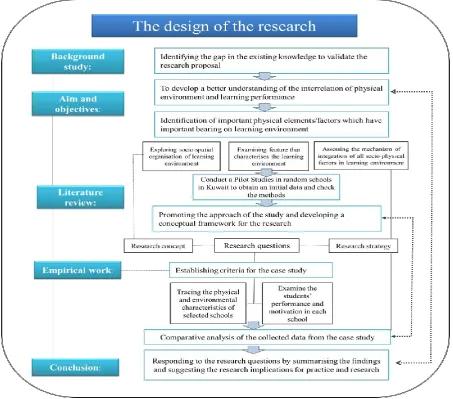
The research framework is shown in Figure 1 to illustrate the research context. The
foundation of the research aims and objectives being investigated are described in Chapter
one. The literature review introduces the conceptual and theoretical background of the
research and is divided into two chapters: Chapter two discusses the philosophy of education
and outlines the relationships between educational theory and the learning environment.
Chapter three is divided in to four sections: 1) the theory of the learning environment; 2) the
impacts of the learning environment; 3) the evaluation of the learning environment; and 4)
Chapter four illustrates the research methodology used in this research, outlining the social
philosophy and paradigms. It also acknowledges the research design process, the data
required, and samples. The last section of that chapter demonstrates the methods used to
obtain the data required, and the data collection procedures and the analysis approach that was
undertaken. Chapter five reviews the history of educational development in Kuwait to
introduce the context of the research, covering the historical development of education with
specific reference to architectural perspectives, and the design of the learning environment
from 18th century to the present day.
Chapter six contains the results and discussion of the research methods used in this research:
the pilot study, the main case studies (i.e. survey) and an interview.
Chapters seven and eight summarise the findings of the research. The case studies are
analysed to understand the broad perspectives and the influence of the learning environment
on learning and teaching outcomes. An in-depth analysis of the classroom circumstances, and users’ views and concerns, are addressed. The analysis of the interview from the perspective
of officials regarding the learning environment is discussed.
Chapter nine is the conclusion of the research, outlining the principal and specific outcomes
responding to the research questions. This is followed by the recommendations for future
Chapter Two
2
The philosophy of education
2.1
Introduction
Clarifying both the philosophy of education and the understanding of the learning
environment is crucial for the present research. Educational philosophy is discussed in this
chapter; the theory of the learning environment is described in Chapter three.
This chapter outlines the key ideas about the philosophy of education and the historical
development of education that includes the ideologies and theories, particularly with regard to
their influences on the learning environment. The literature review demonstrates the variety of
styles that education is based on today, and the systems which illustrate the needs of the
stakeholders who are responsible for learning quality, and how the physical learning
environment has to be arranged to suit those needs.
To introduce the concept of ‘education philosophy’, the Cambridge Advanced Learners’ Dictionary (Walter, 2008), defines ‘philosophy’ by stating:
“The use of reason in understanding such things as the nature of the real world and existence, the use and limits of knowledge, and the principles of moral judgment.”
“Group of theories and ideas related to the understanding of a particular subject.” “A particular system of beliefs, values, and principles.”
“The way that someone thinks about life and deals with it.”
The fundamental meaning of the philosophy of education has been described by Bailey et al.
(2010) as involving the use of logical reasoning, depending on the understanding of three
main elements: knowledge, moral judgments, and the nature of reality. They then refine this
into areas to develop a method that will facilitate understanding of awareness, truth, and
beliefs. This process means that theories can be understood more deeply and logically.
teaching and learning could not occur within the philosophy of education ideology in itself,
but can be created, applied or made by practice, experience and perception. This process involves many skills, including reading, writing and talking; these skills enhance the learners’
ability to understand and recognise the meanings of things.
The philosophy of education is seen as a mode of thinking, being or acting; these modes
might change depending on the circumstances of the educational system (Arthur and
Peterson, 2013). John Dewey (1859-1952), the American philosopher, proposed a definition
of the philosophy of education as follows:
"Philosophy of education" is not an external application of ready-made ideas to a system of practice having a radically different origin and purpose: it is only an explicit formulation of the problems of the formation of right mental and moral habitudes in respect to the difficulties of contemporary social life. The most penetrating definition of philosophy which can be given is, then, that
it is the theory of education in its most general phases.“(Dewey, 1916, p.386)
2.2
Educational philosophy
There are a wide range of issues and contexts inherent in the philosophy of education.
Identifying the philosophical issues for the present research is important to give a sense of the
richness of the field of study and enhances the understanding of the topic. These issues
mentioned by Arthur and Peterson (2013) are as follows:
1- The nature, aims and value (the ‘philosophy’) of education,
2- The development of learners and their intelligence, ethical and moral education: the
objectives,
3- Knowledge of, and aspects affecting, the curriculum,
4- The social and political aspects of education which include the learning environment,
education practices and education reform; this is crucial for this research,
5- Communication, inter-subjectivity and the role of language,
6- The philosophical underpinnings of the research methodology.
Gingell and Winch (2002) identify three main criteria framing the philosophy of education
compared to Arthur and Peterson (2013), with no direct reference to the learning
underlying value; second, education involves many sub-cognitive perspectives connected to a
core of knowledge and understanding which surpasses mere skill, and finally, the process of
education itself refers to the understanding of what is being learnt. All of which refers to
points two (objectives) and six (methods) above.
Knight (2008) and Fraser (2001) claimed that the philosopher’s approach is to emphasise the
three fundamental strands of education, and that each student has to become proficient in
reading, writing and arithmetic, whether they are taught at home or at state or fee-paying-
schools. Education also involves character and moral development, which enables the
students to function well socially, emotionally, spiritually and mentally. Therefore, the
philosophy of education is concerned with all that is said about education, and cannot exclude
the main conceptual objectives for education: teaching, learning, knowledge and experience
(Moore, 2010).
Collectively, these studies outline a critical role within the philosophy of education regarding
the learning environment. The impact of the learning environment and what the educational
philosophy is trying to achieve could be equal. This review aims to highlight the
philosophical vision of education to provide important insights to the learning environment
theory.
2.3
Definition of education
The Oxford English Dictionary indicates that the term ‘education’ is the nominalised form of the verb ‘educate’, the process of receiving or giving systematic instruction, such as intellectual information on a particular subject. Thus, education is the process of teaching and
learning, which includes the theory and practice of teaching itself (Soanes, 2002).
Furthermore, ‘education’ has broad applications as a term and can be used in conjunction with various sectors of knowledge, referring to personal education, school education, home
education and skills education (Caro, 2008).
The sociological perspective of education involves the actions that promote an individual’s ability to adopt the customs of a society, or altering the nature of their interaction with culture
and community. Also it encompasses the process that people follow to improve themselves or
and Grosvenor, 1999). However, as Carr (2005) and Arthur and Peterson (2013) argue, the
concept of education is sometimes contested, since different socio-cultural groups build their
own distinctive perception of it, thus creating opposing standpoints between philosophers and
educationalists, as some educational endeavours are less rationally defensible than others.
Peters (2003) describes education as involving the linking of ideas in such a way that learners
gain a wider understanding of the surrounding world through the use of different approaches that support their capabilities, without ‘brainwashing’ or coercing them.
In contrast, the educational perspective as described in the literature sees education as gaining
knowledge: identifying how to do the things, understanding the reality of things, and attaining
new ideas and skills, which are the chief purpose of education. Therefore, these classifications
of education lead to learning that can cause a behavioural changes as a result of experience,
and can occur through the continuous acquisition of knowledge, or as formalised learning
(Smith, 2003b).
Thus, the purpose of education is to inspire learning processes through providing educational
curricula to students via educational authorities, which depends on a variety of factors,
including the philosophical foundation of education (Peters, 2003;Bailey et al. , 2010), as
well as the history of education, and the way that educational ideologies and approaches have
been developed. The characteristics of environment is not excluded in this review, due to the
educational system is required a suitable environment to be applied effectively.
2.4
The History of education
A review of the history of education needs to embrace a combination of elements, especially
the pedagogy and teaching systems; although these were not always classified and addressed
clearly as major foundations of education. Classical education was dominated by ideologies,
which could now be classified as educational principles. The ancient educational systems of
Greek, Japanese and Chinese civilisations were grounded on a verbal structure and
observation to deliver information and impart knowledge, and communication was generally
limited to what was shared between learners and their instructor. These education systems
were facilitated by families and communities who had the necessary knowledge and abilities
civilization or community that the pupil belonged to, and was also affected by the quality of
knowledge and contemporary science, which varied widely depending on the region
(Hailmann, 1874; More and Hughes, 1997).
After the revolution in science, knowledge, and especially writing, the literature in the Middle
Ages (5th to 15th century), and the renaissance that followed, education became more
commonplace. This ‘revolution’ became apparent through different strategies, philosophies and systems, depending on the awareness, consideration, capabilities and priorities of each
culture. Each generation attempted to draw on their own religious, cultural and literary
traditions, and their own understanding of science. Consequently, the development of
education was dependent on the cognitive excellence and ability within the particular culture,
as well as the techniques used to offer their prioritised knowledge and beliefs to new
generations (Compayré and Payne, 2003).
The relationships between people’s thinking and their culture and traditions affected their learning style and educational reform (More and Hughes, 1997). For instance, Islamic
education encompasses the subjects with which Muslims are most concerned, such as Arabic
language, the Quran, metaphysics, literature, maths and religious studies; these studies were delivered informally in Masjids or in teachers’ houses (Ahmed and Donnan, 1994). During
the Middle Ages in Europe, education was also provided and funded mainly by the Church,
which focused on the teaching of language, politics, and medicine (Robinson, 2011). The
learning environment was organised to suit that vision which had no proper attention at that
time.
However, educational opportunities were not open to the whole community; only a selected
number of people were educated, due to limited family finances in a society were education
was not freely provided by the state, the lack of teachers and the need to work to earn a living
from a relatively young age. Children were often required to work to support their family’s finances. The educational subjects were also limited; language, science, maths, and medicine
2.5
The growth of education
Education systems followed different approaches across the world from ancient civilization to
the Middle Ages (5th to 15th century). Several teaching/learning strategies and methods were developed and evolved to contemporary formal education. Although educational theories and
visions were not always clear in that period, educational theories did exist before the
nineteenth century (Carr, 2006). Each society expressed its own vision and strategy in
forming and improving its education system. This has been recognised as an important factor
in the literature.
The development of education followed two main paths: the theoretical vision and the
practical vision (Robinson, 2011). The theoretical education vision (the knowledge base)
encompasses imparting information on a variety of subjects. While the practical education
vision (skills based training) focuses on teaching the skills and techniques needed for work.
However, Gingell and Winch (2002) claim that the distinction between education and
training theory has been misunderstood. It is important to note that both the theoretical and
practical education visions needs appropriate learning settings and arrangements.
In reviewing the literature about the history and philosophy of education, it is clear that
philosophers face a crucial obstacle in identifying the connections between doctrines and
philosophical systems, since each hypothesis or theory could be criticised and examined as an
individual principle (Ward, 2011). Educational principles are more complex because they
have a variety of interconnections that need to be evaluated (Grene, 1966). Consequently, the
growth of education follows the efforts of philosophers who have investigated, created and
reformed previous knowledge and hypotheses relevant to their society within different
disciplines. Moreover, Moore (2010) stated in the introduction of his book entitled ‘Philosophy of Education’ that:
“These overall types of educational theory are often met with in the writings of
those who for other reasons are known as philosophers. Plato, for instance, gives a general theory of education in the dialogue known as The Republic, in which his aim is to recommend a certain type of man as worthy to be the ruler of a distinctive type of society. Rousseau gives a general theory of education in
of education, and in most cases, if not in all, the theory is meant to serve an external end, to prescribe a political, social or religious way of life. General
theories of education are very often influential essays in propaganda.” (Moore, 2010, p.4-5)
Peters (1966), emphasises in his book ‘Ethics and Education’ that ‘education’ as a word has
normative implications that something meaningful will be achieved, creating a contrast
between the terms ‘knowledgeable’ and ‘educated’. In addition, Peters (1966) also sees educated people as following through a systematic strategy introduced by cognitive action. It
is necessary to link cognition to other capabilities of the mind (Gingell and Winch, 2002).
These require transformation of the educational beliefs into ideologies that the learning environment could supports the philosopher’s principles in education achievements.
2.6
Educational ideologies
The ideologies of education are the collections of ideas, beliefs, and reflections held by people
regarding educational theory and schooling. These ideologies are influenced and affected by
culture, learning traditions and customs (Meighan et al. , 2007). Although there have been
notable attempts to integrate two or more alternative educational ideologies to benefit from
each of them, many obstacles exist. Educational ideologies have been classified as either
theoretical or empirical; these classifications vary in approach, including the type of learning
environment (Meighan et al. , 2007). The main dichotomies as shown in Figure 2 are:
Teacher-centred v Child-centred Open-teaching v Closed-teaching Meaning-receiving v Meaning-making Authoritarian v Democratic
Traditional v Progressive Transmission v Interpretation Open schools v Closed schools
Figure 2. Dichotomous approaches, adapted from (Meighan et al., 2007, p. 191- 198)
Figure 2 demonstrates the two common ideologies of education: transmission and
interpretation (Barnes and Shemilt, 1974). The transmission approach emphasises giving
instructions and teaching quality, which treats learners as receivers of knowledge only, and
performance depends on the criteria applied by teachers. This approach is mirrored in the
Kuwaiti teaching system. In contrast, the interpretation approach is dependent on the learners’ efforts and capabilities in building their knowledge. The support that is given to the learners is on developing their personal skills, communicating and discussing with peers,
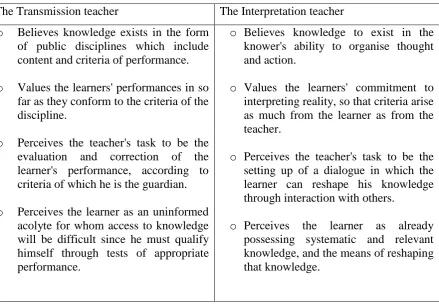
which enhances their learning motivation and performance. Table 1 illustrates the differences
Table 1. Comparison between transmission and interpretation teaching (Barnes and Shemilt, 1974, p. 223)
The Transmission teacher The Interpretation teacher
o Believes knowledge exists in the form of public disciplines which include content and criteria of performance.
o Values the learners' performances in so far as they conform to the criteria of the discipline.
o Perceives the teacher's task to be the evaluation and correction of the learner's performance, according to criteria of which he is the guardian.
o Perceives the learner as an uninformed acolyte for whom access to knowledge will be difficult since he must qualify himself through tests of appropriate performance.
o Believes knowledge to exist in the knower's ability to organise thought and action.
o Values the learners' commitment to interpreting reality, so that criteria arise as much from the learner as from the teacher.
o Perceives the teacher's task to be the setting up of a dialogue in which the learner can reshape his knowledge through interaction with others.
o Perceives the learner as already possessing systematic and relevant knowledge, and the means of reshaping that knowledge.
Raynor (1972) categorised the most common ideologies on education into four basic areas:
aristocratic, bourgeois, democratic and proletarian. These ideologies are defined as
follows:
The aristocratic ideology focuses on education as preparing a young person for their
social life, so the education must confirm with the social status of the learners.
The bourgeois ideology sees education as a sort of test that successful people must
pass to gain a prestigious position in work or public life.
The democratic view of education focuses on the best way to share and distribute
knowledge and skills to everyone, as a fundamental right within society regardless of background, religion, ethnicity, etc. Children’s development is at the core of the
educational process.
The proletarian view was originally held by the aristocratic section of society, and sees the purpose of education as providing young people with a suitable kind of work so
that the lifestyle of a particular group of the society - the leaders - could be
On the other hand, Davies (1969) distinguished in his point of view the educational ideologies
into a different set of four categories than Raynor(1972) as: conservative, revisionist,
romantic and democratic. These categories are outlined as follows:
Conservative ideology focuses on maintaining and establishing the standards of the
culture and community by respecting traditional values and educational sciences. Revisionist ideology emphasises economic language and aims to improve the system’s
competence in terms of job requirements and the current market’s needs.
The romantic attitude relates to the people’s development by focusing on the students’ progress, creative thinking, capabilities, etc.
The democratic stance originates from social and liberal thinkers in the 19th century.
This aims to provide equal opportunity for all in the community through teaching and
gaining knowledge. Recently, a democratic socialist approach was developed by
combining different disciplines and linking them with other ideologies. It has become
common now in the form of public education.
However, Cosin (1972) classified the ideologies as four pairs of groups in quite a similar way
as Davies (1969). These four ideologies are as follows: 1- Elitist/Conservative; 2-
Rationalising/Technocratic; 3- Romantic/Individualist; and 4- Egalitarian/Democratic.
The fundamental difference between these four ideologies and Davies’s categories is that
Cosin was clearer in describing their meanings, especially how the educational approaches
enhance cultural quality, professional skill, equality and rights of proper education that each
student has to gain (Matheson, 2014). The first criterion, Elitist/Conservative, focuses on
improving the established issue of cultural quality by traditional approaches. The
Rationalising/Technocratic approach is concerned with the importance of professional
education with an emphasis on an area of knowledge as well as on a community’s needs. Romanticism has a central interest in enhancing all of an individual’s inherent abilities. Egalitarianism maintains the belief that the equality of education is a right for everyone in the
community.
The above arguments and classifications enable the building of an analytical model based on
the multiple ideologies which influence an education system. These can examined in greater
depth, perhaps breaking down the sub-divisions which have been suggested to be
dichotomous (Barton and Walker, 2011). Each ideology could be combined with others in
aims. These issues can be used as an analytical tool to compare the patterns of different
educational doctrines (Meighan et al. , 2007).
2.7
Development of educational theories
Educational theories are developed from hypotheses aiming to make sense of learning
concepts. The ways in which educational authorities enact learning strategies and policies
have significant implications in terms of the quality of educational facilities, pedagogy and
curricula. The processes are based on elements including research and experiment that are
intended to suit the educational objectives. Learning theories also facilitate the design of
instruction methods, with approved strategies and techniques set out for providing optimal
learning outcomes. Many educational developers use a theoretical background, which can be
classified under three educational theories: behavioural, cognitive and constructional (Ertmer
and Newby, 2013). The following sections address these theories in turn, and consider other
approaches to the development of educational pedagogy, as well as the variation of physical
settings that suit each situation.
Behaviourism
‘Behaviourism’ as a theory was proposed at the end of the nineteenth century when psychologists examined and observed the automatic and involuntary responses of animals.
Different stimulants and responses to them were taken into account in the development of the
theory. Pavlov (1849-1936), Thorndike (1874-1949), Clark Hull (1884-1952) and Skinner
(1904-1990) were prominent behaviourism psychologists who developed the understanding of
behavioural changes in education (Boghossian, 2006). Educational behaviourism is the
systematic study and evaluation of students’ performance in learning that relates to the frequencies of change in behaviour. It involves presenting a definite environmental stimulus
to prompt suitable responses that generate learning2. It is the most influential theory of learning that emphasises behavioural changes that define learning as a permanent change in
behaviour prompted by the learner’s experiences. Behaviourists believe that human learning
2For example, Pavlov’s dog experiment, whereby dogs were fed after a bell w
takes place in response to the environment that surrounds them, while inaccessible mental
processes are avoided (Ertmer and Newby, 2013;Jordan et al. , 2008).
Classic behaviourism theory was inspired by Pavlov (1849-1936), who believed that learners
respond to external stimulation in a specific manner. People gain knowledge and learn from a
diversity of responses and the development of fears and phobias shape the learner’s future behaviour, having learned the consequences of actions and situations. For example, a student
who falls down stairs at an early age and breaks bones will be more cautious about stairs in
the future (Anrep and Pavlov, 1927). This theory is the origin of the ‘multi-sensory’ educational approach, which claims that students’ performance increases if all their senses are
influenced (Biggs, 2011), which indicates that diverse and interactive environments are more
effective.
Edward Thorndike (1874-1949), an American psychologist, presented a theory of learning
that was based on strengthening or weakening a response to stimuli, a theory which became known as ‘reinforcement behaviour’ (Berridge, 2000). The key principle of this theory is that
rewards are an important factor that promotes learning conditions, which had previously been
given scant regard to mental processing in behaviourist theory. This theory could be cited as the teaching strategy that improves the teacher’s performance practice in instruction and education.
Clark Hull (1884-1952) developed the ‘drive theory’, which concerns the scientific laws of the learning and motivation processes. It was inspired by Darwinian evolutionary theory,
which stresses the behavioural functions as being a mechanism, in which organisms follow
two main forces, drive and habit. Drive is a force that promotes human behaviour, whereas
habit is the consequence of stimuli and responses (Weiner, 1985;Jordan et al. , 2008).
However, classic behaviourist theories suggest that a stimulus guides responses directly,
while in other ways behaviour is a mix of stimuli and response. However, the drive theory
adds to the consideration of the strengths of an organism, since the characteristics of the
learner depend on habits also, not just the stimuli to which they are exposed (Hull et al. ,
Figure 3. The behaviourism theory sees learning as a behavioural change.
Although behaviourists take the surrounding environment and learners’ circumstances into
account, emphasis is placed on environmental quality (see Figure 3). Therefore, behaviourism
theory identifies the actual elements that instruct the learners, as well as restricting the key criteria that affect the efficiency of students’ learning (Ertmer and Newby, 2013).
Cognitivism
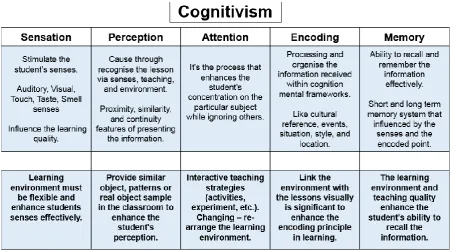
Significant theories and evidence refer to the proofs of cognitivism that affect learning and
teaching: sensation, perception, attention, encoding, and memory. Behaviourist theorists did not consider these ‘proofs’, but cognitivist's developed them as a response to behaviourism
who had neglected them to demonstrate cognition theory in