Quantifying the Evolutionary Conservation of Genes Encoding
Multidrug Efflux Pumps in the ESKAPE Pathogens To Identify
Antimicrobial Drug Targets
Lauren E. Brooks,aSabah Ul-Hasan,aBenjamin K. Chan,bMark J. Sistroma
aSchool of Natural Sciences, University of California Merced, Merced, California, USA
bDepartment of Ecology and Evolutionary Biology, Yale University, New Haven, Connecticut, USA
ABSTRACT Increasing rates of antibiotic-resistant bacterial infection are one of the most pressing contemporary global health concerns. The ESKAPE pathogens
(Entero-coccus faecium,Staphylococcus aureus,Klebsiella pneumoniae,Acinetobacter
bauman-nii,Pseudomonas aeruginosa, and Enterobacter species) have been identified as the
leading global cause of multidrug-resistant bacterial infections, and overexpression of multidrug efflux (MEX) transport systems has been identified as one of the most critical mechanisms facilitating the evolution of multidrug resistance in ESKAPE pathogens. Despite efforts to develop efflux pump inhibitors to combat antibiotic re-sistance, the need persists to identify additional targets for future investigations. We evaluated evolutionary pressures on 110 MEX-encoding genes from all annotated ESKAPE organism genomes. We identify several MEX genes under stabilizing selec-tion—representing targets which can facilitate broad-spectrum treatments with evo-lutionary constraints limiting the potential emergence of escape mutants. We also examine MEX systems being evaluated as drug targets, demonstrating that diver-gent selection may underlie some of the problems encountered in the development
of effective treatments—specifically in relation to the NorA system inS. aureus. This
study provides a comprehensive evolutionary context to efflux in the ESKAPE patho-gens, which will provide critical context to the evaluation of efflux systems as antibi-otic targets.
IMPORTANCE Increasing rates of antibiotic-resistant bacterial infection are one of the most pressing contemporary global health concerns. The ESKAPE pathogen group represents the leading cause of these infections, and upregulation of efflux pump expression is a significant mechanism of resistance in these pathogens. This has resulted in substantial interest in the development of efflux pump inhibitors to combat antibiotic-resistant infections; however, no widespread treatments have been developed to date. Our study evaluates an often-underappreciated aspect of resistance—the impact of evolutionary selection. We evaluate selection on all anno-tated efflux genes in all sequenced ESKAPE pathogens, providing critical context for and insight into current and future development of efflux-targeting treatments for resistant bacterial infections.
KEYWORDS antibiotic resistance, drug resistance evolution, efflux pumps, pathogens
T
he widespread and inappropriate use of antibiotics as therapeutic agents forhumans and domestic animals and as growth promoters in agriculture has led to an increased prevalence of multidrug-resistant (MDR) bacteria in the environment. Short-comings in the pipeline for the discovery, development, and approval of new antibi-otics to treat the array of pathogens resistant to existing antibiantibi-otics exacerbate the looming health crisis (1). The threat to public health is immediate (2), with MDR
Received20 February 2018Accepted20 March 2018 Published17 April 2018
CitationBrooks LE, Ul-Hasan S, Chan BK, Sistrom MJ. 2018. Quantifying the evolutionary conservation of genes encoding multidrug efflux pumps in the ESKAPE pathogens to identify antimicrobial drug targets. mSystems 3:e00024-18.https://doi.org/10.1128/ mSystems.00024-18.
EditorRachel Mackelprang, California State University, Northridge
Copyright© 2018 Brooks et al. This is an open-access article distributed under the terms of theCreative Commons Attribution 4.0 International license.
Address correspondence to Lauren E. Brooks, [email protected].
Selection impacts efflux systems in ESKAPE pathogens differently, which needs to be considered in combatting
#antibioticresistance
Ecological and Evolutionary Science
crossm
on September 8, 2020 by guest
http://msystems.asm.org/
infections leading to 700,000 deaths globally in 2016 (3). If the trajectory continues, MDR cases are expected to rise to 10 million by 2050 —more fatalities than both cancer and HIV/AIDS combined cause today (3).
The ESKAPE pathogens (Enterococcus faecium, Staphylococcus aureus, Klebsiella
pneumoniae, Acinetobacter baumannii, Pseudomonas aeruginosa, and Enterobacter
spp.), noted for their propensity to “escape” the inhibitory action of traditional antibi-otic drugs, cause a significant proportion of nosocomial and biofilm-mediated infec-tions (4–6). Upregulated expression of multidrug efflux (MEX) pumps is one mechanism by which the ESKAPE pathogens become resistant. These MEX pumps act by expelling compounds, including antibiotics, from the intracellular compartment/intermembrane space at a high rate, preventing drug concentrations from reaching inhibitory concen-trations (7–12). Six superfamilies of MEX pumps have been identified: the ATP-binding cassette (ABC) family, the small multidrug resistance (SMR) family, the major facilitator superfamily (MFS), the resistance-nodulation-division (RND) family, the multidrug and toxic compound extrusion (MATE) family, and the recently recognized sixth superfam-ily, the proteobacterial antimicrobial compound efflux (PACE) famsuperfam-ily, although this group of MEX pumps is known only to efflux cationic biocides (13, 14).
As MEX pump upregulation is critical to the evolution of MDR phenotypes across a broad array of pathogens, MEX pumps are attractive targets for drug development and discovery (15). Efflux pump inhibitors (EPIs) can be combined with antimicrobial agents in order to treat otherwise MDR infections (16), rendering previously resistant bacteria susceptible to multiple classes of antibiotic agents (17). While many potential EPIs have been described in the literature (16–19), challenges associated with EPIs as therapeutic compounds, including toxicity to patients, have prevented their widespread use.
Despite these challenges, there has been a renewed interest in these compounds to treat MDR infections (15). Studies have taken steps to address substrate specificity (20, 21), but few studies have considered the conservation of genes encoding efflux pumps at the strain level (18, 22, 23). Examining how these genes are conserved prior to EPI development can ensure that potential EPIs will target the widest range of pathogenic strains and minimize the likelihood of promoting escape mutants.
In this study, we take an evolutionary approach to evaluate selection across MEX systems in the ESKAPE pathogens to identify genes described by models of purifying selection (i.e., evolution that eliminates deleterious alleles from a population), stabiliz-ing selection (i.e., selection favorstabiliz-ing intermediate rather than extreme variants), neutral selection (i.e., stochastic evolution), and diversifying selection (i.e., selection favoring the tails of a trait distribution resulting in adaptive divergence). In doing so, we examine the breadth of likely applications for potential EPIs targeting each of these specific MEX systems. This identification of conservation provides a comprehensive evolutionary context to all MEX pumps in the ESKAPE pathogens, along with insights into the evolutionary origins of these important structures.
RESULTS
We took anin silicoapproach to identify genes encoding ESKAPE pathogen efflux
pumps undergoing evolutionary pressure. Using only those MEX genes with previously demonstrated involvement in antibiotic resistance, chromosomal genes encoding com-plete or partial efflux pumps were screened for evidence of selection by calculating the ratio of nonsynonymous to synonymous mutations (dN/dS) and evaluating coevolution with other efflux pump genes from the same organism, using comparisons of phylo-genetic topology evaluated by pairwise calculation of Robinson-Foulds (RF) distances. Preliminary analysis of the selected genes for DNA polymorphisms revealed overall low diversity as determined by the proportion of variable sites (see Table S2 in the supplemental material). An assessment of evolutionary pressure acting upon the selected genes revealed that across genes from all ESKAPE pathogens, there was evidence for selection at a high number of sites (proportion of sites at which there is
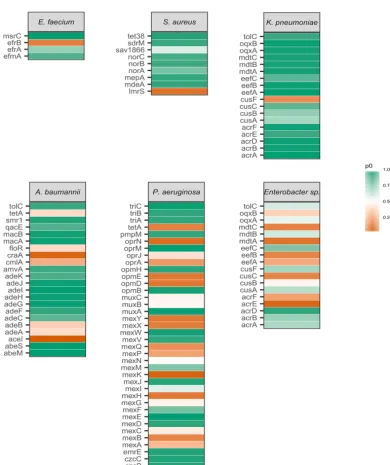
evidence for purifying selection [p0 ⬎90%]; see Fig. 3 and Table S4) for nearly half
(51/110) of efflux pump-associated genes, although the distribution and ranges ofp0
Brooks et al.
on September 8, 2020 by guest
http://msystems.asm.org/
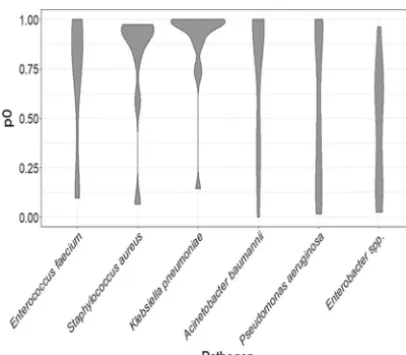
values were highly variable across each pathogen (Fig. 1; see also Fig 3 and Table S3).
Ten genes were classified as being under moderate selection (75%⬍p0⬍90%), with
the remaining 49 genes analyzed having a low (p0⬍75%) proportion of sites detected
as being under selection.
Of the genes indicating low proportions of sites under purifying selection, 38 exhibited statistically significant evidence for purifying selection based on the likelihood-ratio test of a nearly neutral model (M1a), assuming only neutral and purifying selection, and a positive pressure model (M2a) (Table S4). Statistically signif-icant purifying selection was also observed for two genes classified as under moderate selection as well as seven classified as under high selection.
To identify potential targets for EPIs, the selection models for genes of each pathogen were examined more closely. Of the selected efflux pump genes from
E. faecium,msrChad the highest evidence for selection, with all sites classified as under
selection. Moderate selection was observed for efrA and efmA, while evidence for
positive selection was observed forefrB.
Evidence for purifying selection was found inS. aureusMDR efflux pump genes, with
six of the nine genes havingp0values greater than 90% (Table S4). Not among these
is the gene encoding the well-characterized MFS efflux pump NorA (24, 25), which was
under moderate selection, along with two less-studied genes,lmrSandsav1866. Genes
fitted better by the more complex model M2a includednorA,lmrS, andmepA.
All identified efflux pump genes forK. pneumoniaewere of the RND superfamily of
efflux pumps. Purifying selection was identified for the majority (13/18) of K.
pneu-moniae genes, consisting of all complete RND systems except for the copper efflux
system,cusABCF. The geneeefC, encoding the outer membrane protein for theeefABC
system, was classified as having moderate selection but was close to the determined
classification cutoff for high levels of purifying selection (p0⫽0.88).
A. baumanniialso had a high number of genes identified as highly conserved (14/21)
but not theadeABCefflux pump system known to not be well expressed in wild-type
strains. Of the genes defined in this paper as experiencing moderate or low levels of selection, half were of the MFS superfamily of efflux pumps, while the remaining four
consisted ofaceI, a member of the PACE superfamily, and all three components of the
adeABC RND pump. No genes demonstrated a statistically significant difference in
model fit between the two models.
With 39 identified efflux pump genes, including 36 of the RND superfamily,P.
aerugi-nosahad the highest count of genes analyzed, resulting in a wide range ofp0values
FIG 1 Distribution of proportion of variable sites which fit a model of stabilizing selection (p0scores)
calculated for all MEX pump-encoding genes from each pathogen. The width of each object represents the density of the data for each pathogen. This illustrates a general pattern of high conservation of MEX genes inS. aureusandK. pneumoniae, with broader variation in other groups.
on September 8, 2020 by guest
http://msystems.asm.org/
(Fig. 1). These values exhibited three main clusters, corresponding to a group of high,
moderate, and low selection. Included among the highly conserved genes wasoprM,
the outer membrane protein affiliated with at least four identified RND efflux pump
systems in P. aeruginosa. Additionally, high p0 values were calculated for several
complete efflux pump systems, such asmexVW-oprMandtriABC-oprM/triABC-opmH, as
well as genes encoding the single-protein efflux pumps PmpM and EmrE. Despite these exceptions, the majority of efflux pump genes are not strongly under selection, with 23/39 genes being classified as low or moderate. Of the genes classified as being under low selection, all but three exhibited significant evidence for positive selection (Ta-ble S4).
Unlike other ESKAPE pathogens, Enterobacterspp. are a grouping based on the
entire genus, resulting in genomes from multiple operational taxonomic units com-pared in this analysis. Genes identified for this grouping had only one representative identified as under high selection (acrD), one under moderate selection (eefC), and all 16 other genes classified as under low selection, the majority of which (11/16) showed evidence for statistically significant positive selection.
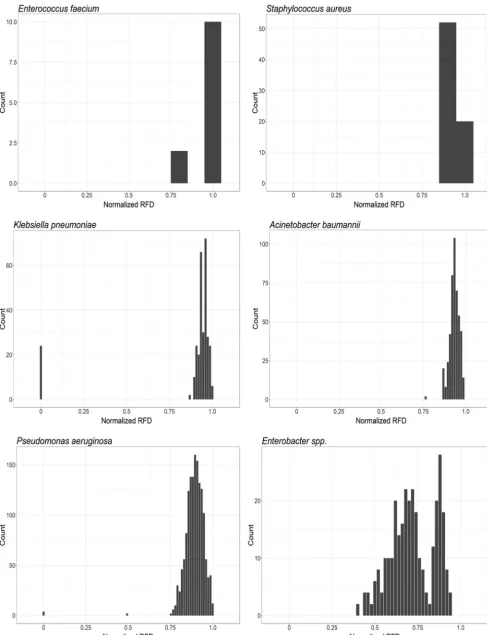
We used RF topological distances to compare gene trees for each pathogen and examine the presence of a possible shared evolutionary history. With a few notable exceptions, normalized RF scores indicate that most of the distances calculated be-tween gene trees were high (approaching 1), indicative of independent evolutionary histories (Fig. 2). However, low levels of polymorphism were detected in many genes (Table S2), suggesting that the observed RF distances are likely impacted by a lack of phylogenetic resolution in many comparisons, potentially resulting in a limited power of the analysis in these cases (26). Thus, the observed high RF scores should be interpreted with caution.
Within the genes identified for K. pneumoniae, 24 out of 306 gene pairs had a
calculated RF distance of 0, meaning phylogenetic topologies identical and suggesting possible coevolution (Fig. 2). These genes having RF distances of zero included sets of
the same RND components: periplasmic adaptorsacrA,eefA, andacrE; inner membrane
transportersacrB,acrD,acrF, andeefB; and outer membrane protein genescusCand
eefC. Additionally, phylogenetic topologies were identical for the components of the
mdtABC andoqxA. Identical topologies were also identified between two gene tree
comparisons,mexX-mexGandmexY-mexH, fromP. aeruginosa. All other pathogens had
ranges of RF distances that did not include zero (Fig. 2).
DISCUSSION
Despite being a fundamentally evolutionary process, the role of evolution is often underappreciated in the development of strategies to combat antibiotic resistance. Examining potential drug targets from an evolutionary perspective provides insight into the likely effectiveness of treatments impacting a selected target. Given the pressing need and high costs for establishing new ways to treat antibiotic-resistant infections, additional screening of potential treatments can prevent investing of re-sources in drugs that are unlikely to be broadly effective at treating resistant infections. Consideration of the results from this analysis provides a basis for the development of evolutionary robust and broadly effective methods to treat MDR infections in the face of a looming health crisis.
EPIs targeting the efflux pumps encoded by genes that we have identified as being under purifying selection have already been developed for several MEX systems. For
example,msrC, the only gene identified fromE. faeciumas a potential good target, has
previously been proposed as a potential drug target, as reductions in the MICs of macrolide antibiotics were demonstrated (27). However, questions regarding the
dis-tribution of this gene raised questions regarding the potential ofmsrCas a drug target
(28). This analysis suggests that not only is some form of this gene present in all
sequenced genomes ofE. faeciumbut also that the gene is under stabilizing selection
in these genomes and could make a good target for treating MDRE. faecium.
AlthoughEnterobacterspp. andK. pneumoniaeshare the same list of efflux pumps
Brooks et al.
on September 8, 2020 by guest
http://msystems.asm.org/
FIG 2 Distribution of Robinson-Foulds distances (RFD) calculated from phylogenetic trees generated for each gene in each pathogen. This demonstrates a general lack of support for coevolution of MEX genes in most cases, with the exception of some analogous genes inP. aeruginosaandK. pneumoniae, suggesting that these pumps may result from recent gene duplication events.
on September 8, 2020 by guest
http://msystems.asm.org/
(Fig. 3), no genes were identified as being under selection forEnterobacterspp. while
most genes fromK. pneumoniaewere classified as highly conserved. It is likely that the
genus-level analysis ofEnterobacterspp. resulted in higher genetic variation (average
nucleotide diversity ⫽0.16) than that for K. pneumoniae (average nucleotide
diver-sity⫽0.02). This discrepancy limits the ability to directly compare these groups, further
raising questions regarding the grouping of this genus as one class of ESKAPE patho-gens, as individual species may have different mechanisms and evolutionary pressures acting upon them.
TheacrAB-tolCsystem inEscherichia colihas received a lot of attention as a potential
drug target to treat resistant infections (17, 29), including the use of the FDA-approved
antipsychotic medication pimozide (30). This system is also found in bothEnterobacter
spp. andK. pneumoniae, is comparable with theadeABCandadeIJKsystems inA.
bau-mannii (31), and was found in this analysis to likely to be a good candidate for
FIG 3 A selection map showing the ESKAPE species, genes tested, and proportion of sites under stabilizing selection. Color indicates the relative strength of stabilizing selection on each gene in each species.
Brooks et al.
on September 8, 2020 by guest
http://msystems.asm.org/
treatment with EPIs. While a number of additional genes were identified here as good
candidates fromK. pneumoniaeandA. baumannii, little research has gone into
devel-oping EPIs for additional systems.
EPIs have been developed for treating MDRS. aureus, but none have proven to be
a reliable treatment. One common target for EPI development is norA, shown in
this analysis to be highly variable and under positive selection (see Table S4 in the supplemental material). Large amounts of variation in this gene have been observed previously (32, 33), possibly contributing to the failures of tested EPIs. Consideration of evolutionary selection has the potential to greatly increase the success of future EPI
trials. Thus, whilenorAis highly effective at the removal of antibiotics, it may be difficult
to target with EPIs due to genetic inconsistency.
MEX systems inP. aeruginosahave been heavily studied, as they are prevalent in
MDR strains. However, our findings suggest a lack of evolutionary pressure observed for a majority of these systems. One possible explanation for the discrepancy between what is known to be an important set of systems and the lack of evolutionary pressure is the possibility of redundancy within the efflux pumps. The sheer volume of efflux pump systems, many of which have components that are interchangeable with other systems, might alleviate the evolutionary pressure observed for many of the other
systems, making MEX systems fromP. aeruginosamore variable across strains.
In addition to screening for selective pressure, we used RF distances to measure the similarity/dissimilarity of phylogenies for each gene, providing for evidence of shared or independent evolutionary history. As MEX pumps are multiprotein/gene structures, coevolution indicates a tight link between pump components, and thus, mutations in individual components of MEX pumps affect the function of the structure as a whole. Conversely, independent evolutionary histories may indicate that pumps had been recently coopted from other functions and are able to respond rapidly to novel evolutionary selection.
Despite limitations due to low overall genetic diversity in the genes analyzed (see
Table S2), a number of RF comparisons inK. pneumoniaeandP. aeruginosa
demon-strated identical phylogenetic topologies. These genes are largely analogous genes in distinct MEX pump systems, which is indicative of these distinct pump systems arising from relatively recent gene duplication events. The possibility of spontaneous emer-gence of novel MEX systems may pose challenges for treating and monitoring MDR organisms, but the shared evolutionary history of distinct MEX systems may also mean that similar strategies may be used to target multiple MEX pumps in these pathogens.
MATERIALS AND METHODS
Data collection. Publicly available genome coding sequences for each ESKAPE pathogen were downloaded from NCBI (accessed on 14 July 2017). We selected complete genomes only, resulting in 545 genomes fromE. faecium(n⫽26),S. aureus(n⫽168),K. pneumoniae(n⫽137),A. baumannii(n⫽79),
P. aeruginosa (n ⫽ 80), and Enterobacter spp. (n ⫽ 55), including representatives from available operational taxonomic units within the genus (see Table S1 in the supplemental material). Downloaded coding sequences were converted to Basic Local Alignment Search Tool databases using BLAST⫹(34). Chromosomally located genes (n⫽110) encoding efflux pumps and their components from all of the ESKAPE pathogens, as listed in the work of Li et al. (35), were included in the analysis. The amino acid sequence for each of the identified genes was downloaded from the UniProt knowledge base (36) using the reference genome for each pathogen. These sequences were then used to identify analogous genes from the downloaded coding sequences for each pathogen using BLAST⫹(34). Duplicate gene se-quences within a genome were screened for similarity and in all cases were identical, allowing only one identified gene sequence to be used for analysis.
Data analysis.Sequences within the genomes with the top hit identified from BLAST⫹output from each genome were aligned for each gene using MUSCLE v3.8.31 (37). The resulting alignments were used to analyze individual genes for DNA polymorphisms with DnaSP v5 (38) and to construct unrooted maximum likelihood trees using RAxML (39) with a bootstrap value of 1,000.
Genes were screened for evidence of evolutionary pressures using the Phylogenetic Analysis by Maximum Likelihood (40) software package. Positive selection was tested for each gene based on the ratio of nonsynonymous to synonymous mutations per site (⫽dN/dS) using the codeml program. Variable sites in each gene alignment were fitted to both a nearly neutral model (M1a), assuming only neutral and purifying selection, and a positive-pressure model (M2a), allowing sites to be classified as either purifying, neutral, or under positive selection. All models were fitted using a singlevalue for all lineages and average nucleotide frequencies at the third codon position.
on September 8, 2020 by guest
http://msystems.asm.org/
Genes were assessed for evidence of evolutionary pressure by determining the proportion of sites at which there is evidence for purifying selection (p0) under M2a. Sites with highp0values (p0⬎90%) are
classified here as highly conserved and thus are more likely to be stable drug targets across multiple pathogen strains. The2 analysis of likelihood ratios of the two models was used to calculate the
statistical significance of fitting the more complex model (M2a) compared to the simpler model (M1a) to suggest an observed positive, or diversifying, for the genes.
To assess if any combination of genes exhibited coevolution, Robinson-Foulds (RF) distances (41) were calculated pairwise for all phylogenies within ESKAPE groups using the phytools package (42) in R statistical software (43).
SUPPLEMENTAL MATERIAL
Supplemental material for this article may be found at https://doi.org/10.1128/
mSystems.00024-18.
TABLE S1, XLSX file, 0.1 MB.
TABLE S2, PDF file, 0.1 MB.
TABLE S3, PDF file, 0.5 MB.
TABLE S4, PDF file, 0.3 MB.
REFERENCES
1. Cooper MA, Shlaes D. 2011. Fix the antibiotics pipeline. Nature 472:32.
https://doi.org/10.1038/472032a.
2. WHO. 2014. Antimicrobial resistance: global report on surveillance. WHO, Geneva, Switzerland.
3. O’Neill J. 2016. Tackling drug-resistant infections globally: final report and recommendations. The review on antimicrobial resistance. HM Gov-ernment and the Wellcome Trust, London, United Kingdom.
4. Boucher HW, Talbot GH, Bradley JS, Edwards JE, Gilbert D, Rice LB, Scheld M, Spellberg B, Bartlett J. 2009. Bad bugs, no drugs: no ESKAPE! An update from the Infectious Diseases Society of America. Clin Infect Dis 48:1–12.https://doi.org/10.1086/595011.
5. Høiby N, Bjarnsholt T, Givskov M, Molin S, Ciofu O. 2010. Antibiotic resistance of bacterial biofilms. Int J Antimicrob Agents 35:322–332.
https://doi.org/10.1016/j.ijantimicag.2009.12.011.
6. Rice LB. 2010. Progress and challenges in implementing the research on ESKAPE pathogens. Infect Control Hosp Epidemiol 31(Suppl 1):S7–10.
https://doi.org/10.1086/655995.
7. Klare I, Konstabel C, Badstübner D, Werner G, Witte W. 2003. Occurrence and spread of antibiotic resistances in Enterococcus faecium. Int J Food Microbiol 88:269 –290.https://doi.org/10.1016/S0168-1605(03)00190-9. 8. Livermore DM. 2002. Multiple mechanisms of antimicrobial resistance in
Pseudomonas aeruginosa: our worst nightmare? Clin Infect Dis 34: 634 – 640.https://doi.org/10.1086/338782.
9. Pakzad I, Zayyen Karin M, Taherikalani M, Boustanshenas M, Lari AR. 2013. Contribution of AcrAB efflux pump to ciprofloxacin resistance in Klebsiella pneumoniae isolated from burn patients. GMS Hyg Infect Control 8:Doc15.https://doi.org/10.3205/dgkh000215.
10. Piddock LJV. 2006. Clinically relevant chromosomally encoded multidrug resistance efflux pumps in bacteria. Clin Microbiol Rev 19:382– 402.
https://doi.org/10.1128/CMR.19.2.382-402.2006.
11. Pradel E, Pagès JM. 2002. The AcrAB-TolC efflux pump contributes to multidrug resistance in the nosocomial pathogen Enterobacter aero-genes. Antimicrob Agents Chemother 46:2640 –2643.https://doi.org/10 .1128/AAC.46.8.2640-2643.2002.
12. Vila J, Martí S, Sánchez-Céspedes J. 2007. Porins, efflux pumps and multidrug resistance in Acinetobacter baumannii. J Antimicrob Che-mother 59:1210 –1215.https://doi.org/10.1093/jac/dkl509.
13. Hassan KA, Elbourne LDH, Li L, Gamage HKAH, Liu Q, Jackson SM, Sharples D, Kolstø A-B, Henderson PJF, Paulsen IT. 2015. An ace up their sleeve: a transcriptomic approach exposes the AceI efflux protein of Acinetobacter baumannii and reveals the drug efflux potential hidden in many microbial pathogens. Front Microbiol 6:333. https://doi.org/10 .3389/fmicb.2015.00333.
14. Sun J, Deng Z, Yan A. 2014. Bacterial multidrug efflux pumps: mecha-nisms, physiology and pharmacological exploitations. Biochem Biophys Res Commun 453:254 –267.https://doi.org/10.1016/j.bbrc.2014.05.090. 15. Spengler G, Kincses A, Gajdács M, Amaral L. 2017. New roads leading to
old destinations: efflux pumps as targets to reverse multidrug resistance in bacteria. Molecules 22:468. https://doi.org/10.3390/molecules 22030468.
16. Lomovskaya O, Bostian KA. 2006. Practical applications and feasibility of efflux pump inhibitors in the clinic—a vision for applied use. Biochem Pharmacol 71:910 –918.https://doi.org/10.1016/j.bcp.2005.12.008. 17. Bohnert JA, Schuster S, Kern WV, Karcz T, Olejarz A, Kaczor A, Handzlik J,
Kiec´-Kononowicz K. 2016. Novel piperazine arylideneimidazolones in-hibit the AcrAB-TolC pump in Escherichia coli and simultaneously act as fluorescent membrane probes in a combined real-time influx and efflux assay. Antimicrob Agents Chemother 60:1974 –1983.https://doi.org/10 .1128/AAC.01995-15.
18. Chan BK, Sistrom M, Wertz JE, Kortright KE, Narayan D, Turner PE. 2016. Phage selection restores antibiotic sensitivity in MDR Pseudomonas aeruginosa. Sci Rep 6:26717.https://doi.org/10.1038/srep26717. 19. Pendleton JN, Gorman SP, Gilmore BF. 2013. Clinical relevance of the
ESKAPE pathogens. Expert Rev Anti Infect Ther 11:297–308.https://doi .org/10.1586/eri.13.12.
20. Blair JMA, Bavro VN, Ricci V, Modi N, Cacciotto P, Kleinekatho¨fer U, Ruggerone P, Vargiu AV, Baylay AJ, Smith HE, Brandon Y, Galloway D, Piddock LJV. 2015. AcrB drug-binding pocket substitution confers clini-cally relevant resistance and altered substrate specificity. Proc Natl Acad Sci U S A 112:3511–3516.https://doi.org/10.1073/pnas.1419939112. 21. Godoy P, Molina-Henares AJ, de la Torre J, Duque E, Ramos JL. 2010.
Characterization of the RND family of multidrug efflux pumps: in silico to in vivo confirmation of four functionally distinct subgroups. Microb Biotechnol 3:691–700.https://doi.org/10.1111/j.1751-7915.2010.00189.x. 22. Elkins CA, Mullis LB, Lacher DW, Jung CM. 2010. Single nucleotide polymorphism analysis of the major tripartite multidrug efflux pump of Escherichia coli: functional conservation in disparate animal reservoirs despite exposure to antimicrobial chemotherapy. Antimicrob Agents Chemother 54:1007–1015.https://doi.org/10.1128/AAC.01126-09. 23. Pao SS, Paulsen IT, Saier MH. 1998. Major facilitator superfamily.
Micro-biol Mol Biol Rev 62:1–34.
24. Costa SS, Viveiros M, Amaral L, Couto I. 2013. Multidrug efflux pumps in Staphylococcus aureus: an update. Open Microbiol J 7:59 –71.https:// doi.org/10.2174/1874285801307010059.
25. Ubukata K, Itoh-Yamashita N, Konno M. 1989. Cloning and expression of the norA gene for fluoroquinolone resistance in Staphylococcus aureus. Antimicrob Agents Chemother 33:1535–1539.https://doi.org/10.1128/ AAC.33.9.1535.
26. Hoelzer GA, Meinick DJ. 1994. Patterns of speciation and limits to phylogenetic resolution. Trends Ecol Evol 9:104 –107.https://doi.org/10 .1016/0169-5347(94)90207-0.
27. Singh KV, Malathum K, Murray BE. 2001. Disruption of an Enterococcus faecium species-specific gene, a homologue of acquired macrolide re-sistance genes of staphylococci, is associated with an increase in mac-rolide susceptibility. Antimicrob Agents Chemother 45:263–266.https:// doi.org/10.1128/AAC.45.1.263-266.2001.
28. Werner G, Hildebrandt B, Witte W. 2001. The newly described msrC gene is not equally distributed among all isolates of Enterococcus faecium. Antimicrob Agents Chemother 45:3672–3673.https://doi.org/10.1128/ AAC.45.12.3672-3673.2001.
Brooks et al.
on September 8, 2020 by guest
http://msystems.asm.org/
29. Haynes KM, Abdali N, Jhawar V, Zgurskaya HI, Parks JM, Green AT, Baudry J, Rybenkov VV, Smith JC, Walker JK. 2017. Identification and structure-activity relationships of novel compounds that potentiate the activities of antibiotics in Escherichia coli. J Med Chem 60:6205– 6219.
https://doi.org/10.1021/acs.jmedchem.7b00453.
30. Bohnert JA, Schuster S, Kern WV. 2013. Pimozide inhibits the AcrAB-TolC efflux pump in Escherichia coli. Open Microbiol J 7:83– 86.https://doi .org/10.2174/1874285801307010083.
31. Sugawara E, Nikaido H. 2014. Properties of AdeABC and AdeIJK efflux systems of Acinetobacter baumannii compared with those of the AcrAB-TolC system of Escherichia coli. Antimicrob Agents Chemother 58: 7250 –7257.https://doi.org/10.1128/AAC.03728-14.
32. Noguchi N, Okada H, Narui K, Sasatsu M. 2004. Comparison of the nucleotide sequence and expression ofnorAgenes and microbial sus-ceptibility in 21 strains of Staphylococcus aureus. Microb Drug Resist 10:197–203.https://doi.org/10.1089/mdr.2004.10.197.
33. Sierra JM, Ruiz J, Jimenez De Anta MT, Vila J. 2000. Prevalence of two different genes encoding NorA in 23 clinical strains of Staphylococcus aureus. J Antimicrob Chemother 46:145–146.https://doi.org/10.1093/ jac/46.1.145.
34. Camacho C, Coulouris G, Avagyan V, Ma N, Papadopoulos J, Bealer K, Madden TL. 2009. Blast⫹: architecture and applications. BMC Bioinfor-matics 10:421.https://doi.org/10.1186/1471-2105-10-421.
35. Li X, Elkins C, Zgurskaya H. 2016. Efflux-mediated antimicrobial
resis-tance in bacteria: mechanisms, regulation, and clinical implications. Springer International, Cham, Switzerland.
36. The UniProt Consortium. 2017. UniProt: the universal protein knowledge base. Nucleic Acids Res 45:D158 –D169. https://doi.org/10.1093/nar/ gkw1099.
37. Edgar RC. 2004. MUSCLE: multiple sequence alignment with high accu-racy and high throughput. Nucleic Acids Res 32:1792–1797.https://doi .org/10.1093/nar/gkh340.
38. Librado P, Rozas J. 2009. DnaSP v5: a software for comprehensive analysis of DNA polymorphism data. Bioinformatics 25:1451–1452.https://doi.org/ 10.1093/bioinformatics/btp187.
39. Stamatakis A. 2014. RAxML version 8: a tool for phylogenetic analysis and post-analysis of large phylogenies. Bioinformatics 30:1312–1313.
https://doi.org/10.1093/bioinformatics/btu033.
40. Yang Z. 2007. PAML 4: phylogenetic analysis by maximum likelihood. Mol Biol Evol 24:1586 –1591.https://doi.org/10.1093/molbev/msm088. 41. Robinson DF, Foulds LR. 1981. Comparison of phylogenetic trees. Math
Biosci 53:131–147.https://doi.org/10.1016/0025-5564(81)90043-2. 42. Revell LJ. 2012. Phytools: an R package for phylogenetic comparative
biology (and other things). Methods Ecol Evol 3:217–223.https://doi .org/10.1111/j.2041-210X.2011.00169.x.
43. R Core Team. 2015. R: a language and environment for statistical com-puting. R Foundation for Statistical Computing, Vienna, Austria.