GLOBAL JOURNAL OF ADVANCED ENGINEERING TECHNOLOGIES AND
SCIENCES
PERFORMANCE ANALYSIS OF DISTRIBUTED ROUTING PROTOCOLS IN
MANET WITH NODE ENERGY CONSTRAINTS
Deepankan Singh Rajput*
* M.Tech Scholar Galgotia University, Greater Noida
ABSTRACT
A major issue with ad-hoc networks is energy consumption since nodes are usually mobile and battery-operated. In this project we compared the performance of ad-hoc routing protocols in a network where each participating mobile node has a given battery life and will shut-down when a threshold is reached. We studied two routing protocols, Dynamic Source Routing (DSR), and Destination-Sequenced Distance-Vector Routing (DSDV), the Ad-Hoc On demand Distance Vector (AODV) by comparing the node termination rate as well as the over-all good put of the network.
KEYWORDS: DSDV, AODV, DSR, MANET, Glomosim.
INTRODUCTION
Since their appearance in the '70’s, the wireless networks have increasingly become more and more popular. This became quite noticeable in the course of the previous decade when the wireless networks managed to support the mobility of nodes. There are two categories of mobile wireless networks. The first category is known as infrastructure network and it maintains constant connections with the gates via cables. The access of terminals in these networks is made possible via concrete points of access, which are known as base stations. Wireless local area networks (WLANs) belong to this category.
The second category of mobile wireless networks is the infrastructure-less (not structured) wireless network, also known as wireless mobile ad hoc network – MANET[1,2]. The infrastructure-eless networks have no fixed router, so all nodes are capable of moving and are dynamically connected in an arbitrary way. Nodes of these networks function as routers themselves discovering and maintaining the paths to other nodes in the network. Such networks are particularly useful in cases where there is not fixed network structure.
The nodes of a wireless mobile ad hoc network are equipped with wireless devices for sending and receiving signals and use aerials for broadcasting, multicasting, or a combination of the above.
There are many simulation study has been done so far for the routing protocols. This paper has been organized as follows: In the following section we
Described the performance metrics on the basis of which we compared the protocols. Next to this a simulation model has been explained on which basis results are obtained and graphs are generated to compare and analyze the results with the help of
Performance metrics.
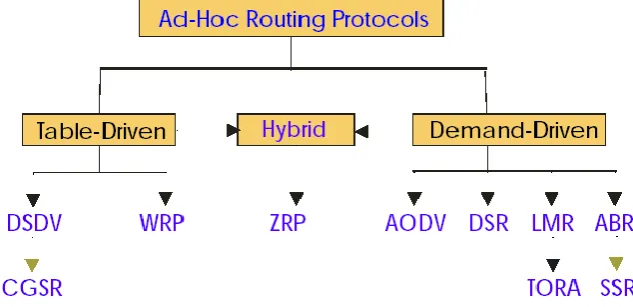
CLASSIFICATION OF AD-HOC ROUTING PROTOCOLS
Destination Sequence Distance Vector –DSDV
DSDV is one of the most well-known table-driven routing algorithms for MANETs. The DSDV routing algorithm is based on the classical Bellman-Ford Routing Algorithm (BFRA) with certain improvement [3]. Every mobile station maintains a routing table with all available destinations along with information like next hop, the number of hops to reach to the destination, sequence number of the destination originated by the destination node, etc. DSDV uses both periodic and triggered routing updates to maintain table consistency. Triggered routing updates are used when network topology changes are detected, so that routing information is propagated as quickly as possible. Routing table updates can be of two types – full dump and incremental. Full dump packets carry all available routing information and may require multiple Network Protocol Data Units (NPDU); „incremental‟ packets carry only information changed since the last full dump and should fit in one NPDU in order to decrease the amount of traffic generated. Mobile nodes cause broken links when they move from place to place. When a link to the next hop is broken, any route through that next hop is immediately assigned infinity metric and an updated sequence number. This is the only situation when any mobile node other than the destination node assigns the sequence number. Sequence numbers assigned by the origination nodes are even numbers, and sequence numbers assigned to indicate infinity metrics are odd numbers. When a node receives infinity metric, and it has an equal or later sequence number with a finite metric, it triggers a route update broadcast, and the route with infinity metric will be quickly replaced by the new route. When a mobile node receives a new route update packet; it compares it to the information already available in the table and the table is updated based on the following criteria:
If the received sequence number is greater, then the information in the table is replaced with the information in the update packet
Otherwise, the table is updated if the sequence numbers are the same and the metric in the update packet is better.
Actions that generate rewards and punishments and eventually learns to perform the actions that are the most rewarding in order to meet a certain goal relating to the state of the environment. Figure 1.represents the several components of a reinforcement-learning agent.
Ad-hoc On-demand distance vector
Reactive protocols discover routes only as needed. When a node wishes to communicate with another node, it checks with its existing information for a valid route to the destination. If one exists, the node uses that route for communication with the destination node. If not, the source node initiates a route request procedure, to which either the destination node or one of the intermediate nodes sends a reply back to the source node with a valid route [5]. A soft state is maintained for each of these routes, if the routes are not used for some period of time, the routes are considered to be no longer needed and are removed from the routing table. Example of this type algorithm is DSR and AODV. AODV is a reactive protocol, even though it still uses characteristics of a proactive protocol [4]. AODV takes the interesting parts of DSR and DSDV in the sense that it uses the concept of route discovery and route maintenance of DSR and the concept of sequence numbers and sending of periodic hello messages from DSDV.
Route Replies( RREPs)
Dynamic Source Routing (DSR)
Dynamic source Routing (DSR) is a reactive routing protocol that uses source routing to send packets. It is reactive like AODV which means that it only requests a route when it needs one and does not require that the nodes maintain routes to destinations that are not communicating. It uses source routing which means that the source must know the complete hop sequence to destination [1]. Each node maintains a route cache, where all routes it knows are stored. The route discovery process is initiated only if the desired route cannot be found in the route cache. To limit the number of route requests propagated, a node processes the route request message only if it has not already received the message and its address is not present in the route record of the message [3].
As mentioned before, DSR uses source routing, i.e. the source determines the complete sequence of hops that each packet should traverse. This requires that the sequence of hops is included in each packet’s header. A negative consequence of this is the routing overhead every packet has to carry. However, one big advantage is that intermediate nodes can learn routes from the source routes in the packets they receive. Since finding a route is generally a costly operation in terms of time, bandwidth and energy, this is a strong argument for using source routing. Another advantage of source routing is that it avoids the need for up-to-date routing information in the intermediate is included in the packets. Finally, it avoids routing loops easily because the complete route is determined by a single node instead of making the decision hop-by-hop.
SIMULATION MODEL
Glo-Mo-Sim
Global Mobile Information System Simulator (GloMoSim) is a scalable simulation environment for large wireless and wireline communication networks. GloMoSim uses a parallel discrete-event simulation capability provided by Parsec. GloMoSim simulates networks with up to thousand nodes linked by a heterogeneous communications capability that includes multicast, asymmetric communications using direct satellite broadcasts, multi-hop wireless communications using ad-hoc networking, and traditional Internet protocols. The following table lists the GloMoSim models currently available at each of the major layers
Layer Models
Physical (Radio Propagation) Free space, Two-Ray Data Link (MAC) CSMA, MACA, TSMA,
802.11
Network (Routing) Bellman-Ford, FSR, OSPF, DSR, WRP, LAR, AODV
Transport TCP, UDP
Application Telnet, FTP
requirements increase dramatically for a model with large number of nodes. With node aggregation, a single entity can simulate several network nodes in the system. Node aggregation technique implies that the number of nodes in the system can be increased while maintaining the same number of entities in the simulation. In GloMoSim, each entity represents a geographical area of the simulation. Hence the network nodes which a particular entity represents are determined by the physical position of the nodes
Use of GloMoSim Simulator
After successfully installing GloMoSim, a simulation can be started by executing the following command in the BINsubdirectory
glomosim < input-file >.
The <input-file> contains the configuration parameters for the simulation (an example of such file is CONFIG.IN). A file called GLOMO.STAT is produced at the end of the simulation and contains all the statistics generated
The Visualization Tool
GloMoSim has a Visualization Tool that is platform independent because it is coded in Java. To initialize the Visualization Tool, we must execute from the java GUIdirectory the following: java GlomoMain. This tool allows to debug and verify models and scenarios; stop, resume and step execution; show packet transmissions, show mobility groups in different colors and show statistics.
The radio layer is displayed in the Visualization Tool as follows: When a node transmits a packet, a yellow link is drawn from this node to all nodes within its power range. As each node receives the packet, the link is erased and a green line is drawn for successful reception and a red line is drawn for unsuccessful reception. No distinction is made between different packet types (ie: control packets vs. regular packets,
Basic Configuration File (Config.in)
The main configuration parameters for setting up an scenario are defined in the CONFIG.IN file. These parameters are the following
PARAMETER DESCRIPTION
SIMULATION-TIME Maximum simulation time. The number portion can be followed by optional letters to modify the simulation time. For example,
100NS (100 nano-seconds), 100MS (100 milli-seconds), 100S or
100 (100 seconds), 100M (100 minutes), 100H (100 hours) and
100D (100 days).
SEED Is a random number used to initialize part of the seed of various randomly generated numbers in the simulation. TERRAIN-DIMENSIONS Terrain Area simulated in
meters.
NUMBER-OF-NODES Number of nodes being simulated
The default values of these parameters in the CONFIG.IN file are: 1. SIMULATION-TIME 15M
2. SEED 1
Parameter Description
NODE-PLACEMENT Represents the node
placement strategy. MOBILITY.
MOBILITY Represents the mobility
model
The NODE-PLACEMENT parameter can be assigned the following values: RANDOM (nodes are placed randomly within the physical terrain), UNIFORM (based on the number of nodes in the simulation, the physical terrain is divided into a number of cells. Within each cell, a node is placed randomly), GRID (Node placement starts at 0,0 and are placed in grid format with each node GRID-UNIT away from its neighbors, the number of nodes has to be square of an integer) and FILE (Position of nodes is read from NODE PLACEMENT-FILE). The default values of these parameters in the CONFIG.IN file and an example of the NODES.INPUT file are:
1. NODE-PLACEMENT FILE
2. NODE-PLACEMENT-FILE ./nodes.input 3. NODE-PLACEMENT GRID
4. GRID-UNIT 30
5. NODE-PLACEMENT RANDOM 6. NODE-PLACEMENT UNIFORM
Figure 3: Glomo.stat in Glomosim configuration file
PERFORMANCE AND RESULTS
Simulation Methodology
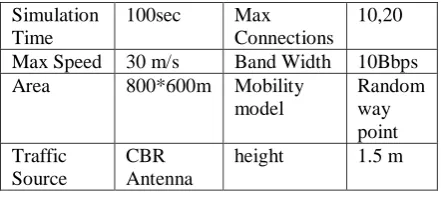
In our simulation we generate test traffic of constant bit rate (CBR) over UDP and FTP packets over TCP. We Create 30 mobile nodes with 12 FTP connections and 4 CBR connections with 1000 bytes/sec of traffic load. Our protocol evaluations are based on the simulation of 30 wireless mobile nodes forming an ad hoc network, moving about over a rectangle (800m x 600m) flat space for 100 seconds of simulation time.
The physical radio characteristics of each mobile node’s network interface, such as the antenna gain, transmit power, and receiver sensitivity, were chosen to approximate the Lucent Wave LAN direct sequence spread Spectrum radio. We used the following table1 shows simulation parameter to simulate our project.
Parameter value Parameter value Number of
nodes
Simulation Time
100sec Max Connections
10,20
Max Speed 30 m/s Band Width 10Bbps Area 800*600m Mobility
model
Random way point Traffic
Source
CBR Antenna
height 1.5 m
Table 1 Simulation parameter
Performance Matrices
In order to evaluate the performances of three MANET protocols, several metrics need to consider.
These metrics reflect how efficiently the data is delivered. In epidemic routing, multiple copies may be delivered to the destination. According to the literatures, some of these metrics are suggested by the MANET working group for routing protocol evaluation [1, 6,7].
I. Packet Delivery Ratio: The ratio between the number of packets originated by the application layer CBR sources and the number of packets received by the CBR sink at the final destination.
II. Average End-to-end Delay: This includes all the possible delays caused by buffering during route discovery latency, queuing at the interface queue, retransmission delays at the MAC, and propagation and transfer times.
III. Packet Dropped: The routers might fail to deliver or drop some packets or data if they arrive when their buffer are already full. Some none, or all the packets or data might be dropped, depending on the state of the network, and it is impossible to determine what will happen in advance.
IV. Routing Load: The total number of routing packets transmitted during the simulation. For packets sent over multiple hops, each transmission of the packet or each hop counts as one transmission.
V. Throughput: The total successfully received packet to the destination. In the other words, the aggregate throughput is the sum of the data rates that are delivered to all nodes in a network
Graphical Analysis
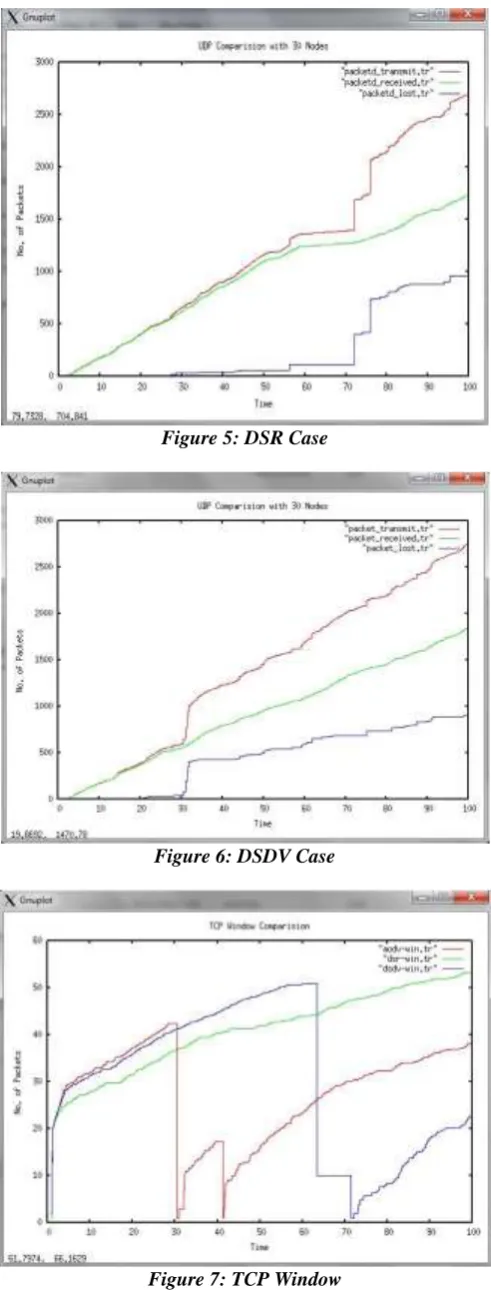
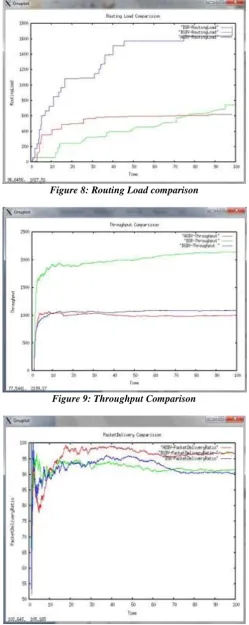
Simulation result are shown in the form of various graph shown below.fig 4 show the total packet received , transmit , loss for AODV protocol in CBR mode. Figure 5 show UDP packet transmission, received, loss for DSR. Figure 6 shows the same result for DSDV protocol. Figure 7 show comparative performance of DSDV, DSR, AODV protocol for TCP packet. Figure 8 show the routing load comparison for three protocol.
Throughput comparison is shown in Figure 9 and last Figure 10 shows the packet delivery ratio for respective protocols.
Figure 5: DSR Case
Figure 6: DSDV Case
Figure 8: Routing Load comparison
Figure 9: Throughput Comparison
ADVANTAGE OF PROPOSED METHOD
In our simulation, we test DSDV, AODV, DSR protocol using Glomosim simulator , we used DSSS as shard media access techniques for transmission and we get result that on the basis of packet delivery ratio, end to end delay , no of packet drop , AODV give significantly good performance over other protocol ,but on the basis of routing overhead, throughput.
FUTURE WORK
We can extent this work doing with more parameter that may give more in depth knowledge and analysis of protocols. This protocol can be tested in existing protocol for heavy traffic like MPED-4 video streaming. It is very useful to test this protocol in heavy traffic. In future work we can modified this work for 3-d space.
CONCLUSION
Results from this paper showed that network lifetime is a significant issue for the performance of a multi-hop ad-hoc network. For light node density, DSDV, AODV, DSR are compared and various graph are obtained to analyze Routing load, Throughput, and Packet delivery Ratio. This paper would help to give a brief idea of MANET and its protocols.
REFERENCES
1. Pirzada, A.A., Portmann, M., Indulska, J., “Performance Comparison of Multi-Path AODV and DSR
protocols in Hybrid Mesh Networks”, 14th IEEE International Conference on Networks, vol. 02, Pages:
1-6, 2006.
2. Geetha Jayakumar and Gopinath Ganapathy : Performance Comparison of Mobile Ad-hoc Network Routing Protocol, IJCSNSInternational Journal of Computer Science and Network Security, VOL.7 No.11(2007).
3. Mbarushimana, C., Shahrabi, A.,” Comparative Study of Reactive and Proactive Routing Protocols Performance in Mobile Ad Hoc Networks”, 21st International Conference on Advanced Information Networking and Applications Workshops, Vol. 2, Pages: 679-684, 2007.
4. Charles E. Perkins, Elizabeth M. Belding-Royer, and Samir R. Das, “Ad hoc On-Demand Distance
Vector Routing,” IEFT MANET Draft, Charles E. Perkins, Ad Hoc Networking, ISBN 0-201-30976-9
February 2003.
5. S H Manjula, C N Abhilash, Shaila K, K R Venugopal, and L M Patnaik, “Performance of AODV Routing
Protocol using Group and entity Mobility Models in Wireless Sensor Networks,” In proceedings of the
International Multi Conference of Engineers and Computer Scientists (IMECS 2008), Hong Kong, vol. 2, pp. 1212-1217, 19-21 March 2008.
6. Hetal Jasani, Kang Yen" Performance Improvement using Directional Antennas in Ad Hoc"in proceeding of IJCSNSInternational Journal of Computer Science and Network Security, VOL.6 No.6, June 2006.
7. Perkins, Ad hoc on demand Distance Vector (AODV) routing, IETF Internet draft (1997), http://www.ietf.org/internetdrafts/draftietf-manet-aodv-00.txt.
8. Performance Metric Comparison of AODV and DSDV routing protocols in manet Sachin KumarGupta* & R. K. SaketDepartment of Electrical Engineering.
9. S.S. Tyagi and R.K. Chauhan , “Performance Analysis of Proactive and Reactive Routing Protocols for
Ad hoc Networks” ©2010 International Journal of Computer Applications (0975 – 8887)Volume 1 – No.
14.
10. Procopius C. Karavetsios and Anastasiosa A.Economidies , “ Performance Comparison of Distributed
Routing Algorithms in Ad Hoc Mobile Networks” WSEAS transactions on communication ,Vol.3,Issue
1 (2004).
11. Anne Aaron and Jie Weng, “Performance Comparison of Ad-hoc Routing Protocols for Networks with
Node Energy Constraints ” Spring 2000-2001.
12. Performance Comparison of DSR and AODV Routing Protocols with Efficient Mobility Model in Mobile
Ad-Hoc Network Satveer Kaur CSE Department, SLIET (Deemed-to-be University), Longowal,
Sangrur, Punjab, India.
13. Comparative Study of Adhoc Routing Protocol AODV, DSR and DSDV in Mobile Adhoc NETwork
Kapang Lego et. al. / Indian Journal of Computer Science and Engineering Vol. 1 No. 4 364-371. 14. Protocol Comparison Using Omni Directional Antenna with Shared Media Access in MANET 2011
International Conference on Information and Network Technology IPCSIT vol.4 (2011) © (2011) IACSIT Press, Singapore.
15. Performance Comparison of AODV, DSDV and I-DSDV Routing Protocols in Mobile Ad Hoc Networks
European Journal of Scientific Research