45 |
P a g e
REGRESSION MODELLING AND GA
OPTIMIZATION OF WEDM PROCESS FOR METAL
MATRIX COMPOSITE
Narendra Kumar Jaiswar
Mechanical Engineering Department, Vindhya Institute of Technology and Science,
Satna, Madhya Pradesh, India
ABSTRACT
Advancement of technology has motivated the researchers to develop new materials so satisfy the critical requirements. Metal matrix composites (MMCs) meet the requirements up to great extent. These materials are used in many engineering applications to make various components. However, machining these materials with conventional techniques is still a challenge for manufacturing fraternity. Unconventional machining processes are viable option to machine these materials.
In the present research, the machining of copper based MMC has been done by using CNC wire cut electric discharge machine. The peak current, pulse-on time, pulse-off time and wire feed rate has been selected as input control factors. Cutting rate has been selected as responses. Modeling and optimization has been done by using artificial intelligence techniques.
Keywords
:
Artificial Neural Network, Cutting Rate, Genetic Algorithm, Modeling, Optimization
1.
INTRODUCTION
In present manufacturing paradigm, due to increased use of technology, requirement of materials having
high stiffness, hardiness and impact resistance is increasing. Machining of such materials is difficult by
conventional machining methods. Hence, non-traditional methods e.g. electrochemical machining, ultrasonic
machining, electrical discharge machining etc. are applied to machine such materials. One of the non traditional
methods is Wire Electrical Discharge Machining process. WEDM has become an important non-traditional
machining process, as it provides an efficient solution for producing components made of difficult-to-machine
materials like titanium, zirconium, etc., and difficult shape, which are not possible by conventional machining
methods.
Wire EDM machining is an electro thermal production process in which a thin single-strand metal wire
in conjunction with de-ionized water (water is a good conductor of electric) allows the wire to cut through metal
by the use of heat from electrical sparks.
Due to the inherent properties of the process, WEDM can easily machine intricate parts and accuracy
components out of hard conductive materials. It is a thermo electrical process in which material is eroded by a
continuously sparks between the work piece and the electrode in wire. The part and wire are immerse in a
dielectric fluid which also acts as a coolant and flushes away waste chip formation during machining (like a
debris). The movement of wire is controlled numerically to achieve the desired three dimensional shapes and
46 |
P a g e
Researchers have done extensive research in WEDM process. Vazini et al. [1] did parametric analysisof dry wire EDM process of cemented tungsten carbide, using air as dielectric medium. They investigated the
effects of pulse on time, pulse off time; gap set voltage, discharge current and wire tension on cutting velocity,
average surface roughness (ASR), and oversize. Central composite rotatable method was employed for design of
experiments. Response surface models were developed to create relationships between process factors and
responses by using to analysis of variances (ANOVA). To increase the predictability of the process, intelligent
models have been developed based on back-propagation neural network and accuracy of these models was
compared with mathematical models based on root mean square error and prediction error percent. Also they did
single and multi-objective optimization of the process.
Sarkar et al. [2] performed WEDM on Titanium Aluminide to develop second-order mathematical
model for surface finish, cutting speed and dimensional shift. The residual analysis and experimental results
indicate that the proposed models could adequately describe the performance. Finally, the process has been
optimized for a given machining condition by desirability function approach and Pareto optimization algorithm.
It was observed that performance of the developed Pareto optimization algorithm is better than the desirability
function. Sarkar et al. [3] on another work performed WEDM on Titanium Aluminide to find optimum control
factors with an appropriate wire offset to get best surface finish and dimensional accuracy. Ho et al. [4] did
review of WEDM process and identified it as one of the most important thermal energy based advanced
machining process. They discussed how EDM was developed and then evolution of WEDM was must. They
also discussed different modeling and optimization techniques used in WEDM process. Kalyanasary et al. [5]
used box behenken design of experiment methodology to to study the effect of cutting speed, peak current and
offset distance on the ASR and dimensional accuracy during WEDM of steel. Their finding revealed that the
peak current and cutting speed significantly affect the dimensional accuracy while ASR is mainly affected by
peak current. Further they did multiobjective optimization using desirability function.
WEDM is a complex machining process where input and output demonstrate highly complex and
non-linear behavior. Sajan et al. [6] used data mining approach to develop predictive models during WEDM process
and found that the models are able to predict the process responses with reasonably good accuracy. Puri et al. [7]
investigated the effect of wire lag with different machining condition on the geometrical accuracy. L27
orthogonal designs of experiments were used to perform the experiments. Apart from geometric accuracy, the
cutting rate (CR) and surface quality have also been considered as responses. Miller et al. [8] studied the effect
of pulse-on time and pulse-off time ratio on the material removal rate (MRR) and surface integrity of four types
of advanced material; porous metal foams, metal bond diamond grinding wheels, sintered Nd-Fe-B magnets and
carbon-carbon bipolar plates. Regression models were developed for MRR. Scanning Electron Microscopy
(SEM) analysis was used to investigate the effect of important EDM process parameters on surface finish.
Dhiman et al. [9] did the microstructure analysis for martensitic stainless steel quenched and then tempered at
60000 C. WEDM with reverse polarity was applied in first four cutting passes, while the straight polarity were
used during last passes. From the results of Scanning electron microscopy (SEM) examination, craters and
martensitic grains were registered in the micrograph of the finished surface machined after the 4-th cutting pass.
Manna and Bhattacharya [10] developed mathematical models for machining performances like MMR, ASR,
spark gap and gap current using the Gauss elimination method for effective machining of Al/SiC-MMC.
47 |
P a g e
relationship between control factors and responses like MRR by means of non linear regression analysis.Genetic algorithm was employed to optimize the wire electrical discharge machining process with multiple
objectives.
In the present research, copper-iron-graphite MMC has been selected to perform the experimentation.
CR has been selected as output parameter. Regression model has been developed for CR and then single
objective optimization has been done by using hybrid approach.
2.
METHODOLOGY
Due to complex nature of the WEDM process, the artificial intelligence techniques are the best methods to
solve the problems. Response surface methodology and genetic algorithm has been used for the modeling and
optimization.
2.1.
Regression Model
Response surface methodology or RSM is a collection of mathematical and statistical techniques that
are useful for the modeling and analysis of problems in which a response of interest is influenced by several
variables and the objective is to optimize this response. Mathematically it can be expressed as:
(1)
Where represents the noise or error observed in the response y. If we denote the expected response by E(y) =
= η, then the surface represented by
η = (2)
is called a response surface.
2.2.
Genetic Algorithm
For optimization, the combined approach of ANN-GA has been used. The genetic algorithm (GA) is based
on the process of natural selection. The GA is quite suitable to solve the complex and non linear optimization
problems. Since GA works with a set of populations, so they give global solutions for any optimization problem.
The working of GA has been explained with the help of the block diagram below [12]:
Fig. 1 Genetic Algorithm
Generation of randomPopulation
Evaluating the fitness of individual
Performing selection, cross-over and mutation operation
Evaluating the fitness new offspring Repeat till optimum
48 |
P a g e
3. EXPERIMENTATION
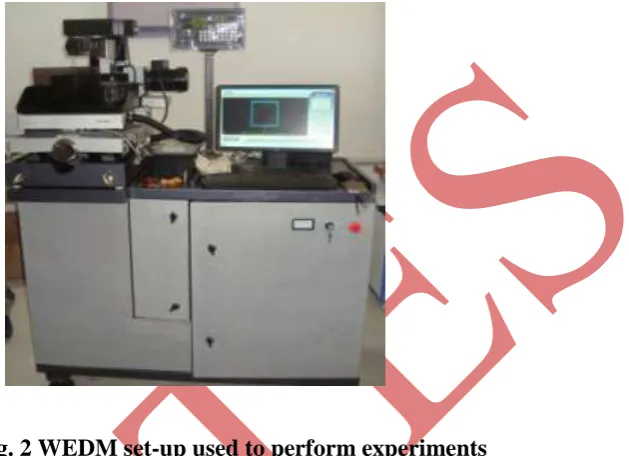
The experiments were carried out on a CNC wire cut EDM machine installed at laboratory of Mechanical
Engineering Department, Vindhya Institute of Technology and Science, Satna (M.P.). The WEDM machine,
used to perform the experiments, has been shown in the Fig. 2.
Fig. 2 WEDM set-up used to perform experiments
The copper-Iron-Graphite hybrid metal matrix composite (MMC) has been selected to perform the
experiments. The samples of the workpiece have been shown in Fig.3.
Fig. 3 Samples of metal matrix composite
The chemical composition of this workpiece is shown in the Table 1
Table 1 Chemical composition of workpiece material
Copper Iron Graphite
49 |
P a g e
For WEDM, CR is a desirable characteristic and it should be as high as possible to give least machine cycle timeleading to increased productivity. In the present study, CR is a measure of job cutting which is digitally
displayed on the screen of the machine and is given quantitatively in mm/min.
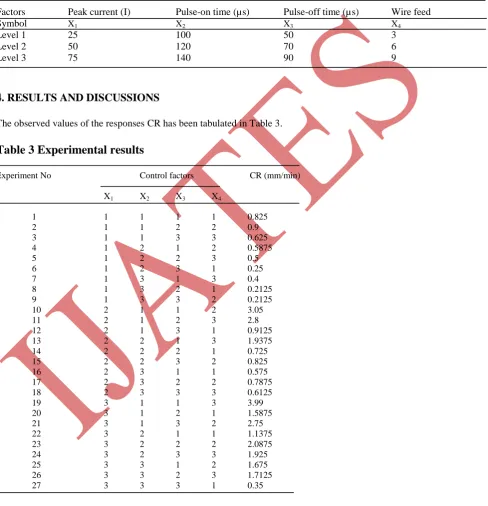
The values of the input control factors and their levels have been shown in the Table 2.
Table 2 Input control factors and their levels
Factors Peak current (I) Pulse-on time (µs) Pulse-off time (µs) Wire feed
Symbol X1 X2 X3 X4
Level 1 25 100 50 3
Level 2 50 120 70 6
Level 3 75 140 90 9
4. RESULTS AND DISCUSSIONS
The observed values of the responses CR has been tabulated in Table 3.
Table 3 Experimental results
Experiment No Control factors CR (mm/min)
X1 X2 X3 X4
1 1 1 1 1 0.825
2 1 1 2 2 0.9
3 1 1 3 3 0.625
4 1 2 1 2 0.5875
5 1 2 2 3 0.5
6 1 2 3 1 0.25
7 1 3 1 3 0.4
8 1 3 2 1 0.2125
9 1 3 3 2 0.2125
10 2 1 1 2 3.05
11 2 1 2 3 2.8
12 2 1 3 1 0.9125
13 2 2 1 3 1.9375
14 2 2 2 1 0.725
15 2 2 3 2 0.825
16 2 3 1 1 0.575
17 2 3 2 2 0.7875
18 2 3 3 3 0.6125
19 3 1 1 3 3.99
20 3 1 2 1 1.5875
21 3 1 3 2 2.75
22 3 2 1 1 1.1375
23 3 2 2 2 2.0875
24 3 2 3 3 1.925
25 3 3 1 2 1.675
26 3 3 2 3 1.7125
27 3 3 3 1 0.35
The analysis of variance (ANOVA) [13] has been performed to find out the significant control factors
for both the responses. Analysis of variance (ANOVA) is a collection of statistical models used to analyze the
50 |
P a g e
groups), developed by R.A. Fisher. In the ANOVA setting, the observed variance in a particular variable ispartitioned into components attributable to different sources of variation. In its simplest form, ANOVA provides
a statistical test of whether or not the means of several groups are equal, and therefore generalizes the F-test to more than two groups.
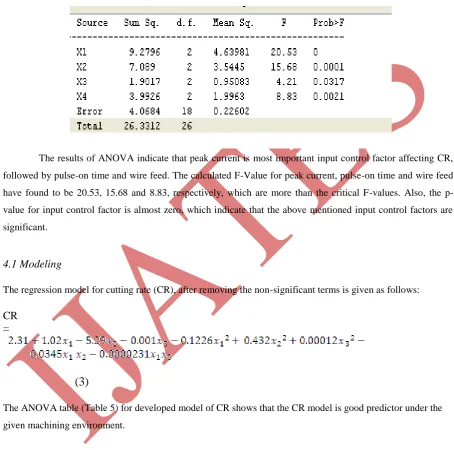
The ANOVA for CR has been shown in the Table 4.
Table 4 ANOVA for Cutting Rate
The results of ANOVA indicate that peak current is most important input control factor affecting CR,
followed by pulse-on time and wire feed. The calculated F-Value for peak current, pulse-on time and wire feed
have found to be 20.53, 15.68 and 8.83, respectively, which are more than the critical F-values. Also, the
p-value for input control factor is almost zero, which indicate that the above mentioned input control factors are
significant.
4.1 Modeling
The regression model for cutting rate (CR), after removing the non-significant terms is given as follows:
CR
=
(3)
The ANOVA table (Table 5) for developed model of CR shows that the CR model is good predictor under the
given machining environment.
Table 5 Analysis of variance for developed model of CR
Source Degree of freedom Seq SS Adj SS Adj MS F P
Regression 8 4.35 2.13 3.32 21.80
0.0005
Residual Error 18 1.22 0.456
Total 26 5.57
51 |
P a g e
4.2 Optimization
The objective function of optimization for CR can be written as:
Maximize CR
=
(4)
With the boundary conditions:
25≤ x1 ≤ 75
100≤x2≤140
50≤x3≤90
3≤x4≤9
The MATLAB 7.1 has been used to solve the optimization problem. Fig. 5 shows the generation fitness
graphics for CR. It is evident the mean curve converges to best curve at 50 generation. The optimum values of
control factors are; peak current: 74.99 A, pulse-on time:101µs, pulse-off time:51.42 µs and wire feed: 9.12
m/min. The value of CR obtained at these control factors is 4.135 mm/min.
0 10 20 30 40 50 60 70 80 90 100 0.2
0.4 0.6 0.8 1 1.2 1.4 1.6
Generation
F
itn
es
s
va
lu
e
Best: 0.24275 Mean: 0.24763
Best f itness Mean f itness
Fig. 5 Fitness curve for cutting Rate
5. CONCLUSIONS
Following conclusions can be drawn from present research:
1. Efficiency of WEDM has been proven during machining of metal matrix composite.
52 |
P a g e
3. The optimum values of control factors for cutting rate have found to be; peak current: 74.99 A,pulse-on time: 101µs, pulse-off time: 51.42 µs and wire feed: 9.12 m/min.
4.
The there is considerable improvement in cutting rate after single objective optimization.REFERENCES
[1] A. Vazini, R.Afzac, R. Teimourib, Parametric study along with selection of optimal solutions in dry wire cut
machining of cemented tungsten carbide (WC-Co), Journal of Manufacturing Processes 15 (2013) 644–658.
[2] S. Sarkar, S. Mitra, B. Bhattacharya, Parametric analysis and optimization of wire electrical discharge
machining of titanium aluminide alloy, Journal of Materials Processing Technology 159 (2005) 286–294.
[3] S. Sarkar, S. Mitra, B. Bhattacharya, Modeling and optimization of wire electrical discharge machining of
Ti-Al in trim cutting operation, Journal of materials processing technology 205 (2008) 376–387.
[4] K.H. Ho, S.T. Newman, S. Rahimifard, R.D. Allen, State of the art in wire electrical discharge machining
(WEDM), Journal of Materials Processing Technology 169 (2008) 1286–1294.
[5] K. Kanlayasiri, P. Jattakul, Simultaneous optimization of dimensional accuracy and surface roughness for
finishing cut of wire-EDMed K460 tool steel, Precision Engineering 37 (2013) 556- 561.
[6] K. Shajan, K. Mohan, M.S. Shunmugam, Data mining applied to wire-EDM process, Journal of Materials
Processing Technology 142 (2003) 182–189.
[7] A.B. Puri, B. Bhattacharya, An analysis and optimization of the geometrical inaccuracy due to wire lag
phenomenon in WEDM, International Journal of Machine Tools & Manufacture 43 (2003) 151–159.
[8] S. Miller, A. J. Shih, J. Qu, investigation of the spark cycle on material removal rate of wire electrical
discharge machining of advanced materials, International Journal of Machine Tools & Manufacture 44
(2004) 391-400.
[9] S. Dhiman, R. Chaudhary, V.K. Pandey, Analyis and study the effects of various control factors on
CNC-wire cut EDM for steel, Mechanical Engineering: An International Journal, 1(1) (2014), 57-65.
[10] A. Manna, B. Bhattacharya, Taguchi and Gauss elimination method: A dual response approach for
parametric optimization of CNC wire cut EDM of Al/SiC MMC, International Journal of Advanced
Manufacturing Technology, 28 (1) (2006), 67-75.
[11] S. Sivakiran, C. Reddy, Effect of process parameters on MRR in wire electrical discharge machining of
En31 steel, International Journal of Engineering Research and Application, 2(6) (2012), 1221-1226.
[12] Lamba V.K. Neuro fuzzy systems; University science press, New Delhi. 2008.