University of Pennsylvania University of Pennsylvania
ScholarlyCommons
ScholarlyCommons
Publicly Accessible Penn Dissertations
2019
Exploring The Use Of Transition Metals In The Synthesis Of Novel
Exploring The Use Of Transition Metals In The Synthesis Of Novel
Metal-Ligand Multiple Bonds, Azide Complexes, And
Metal-Ligand Multiple Bonds, Azide Complexes, And
Unprecedented Reactivity With The Phosphaethynolato Reagent
Unprecedented Reactivity With The Phosphaethynolato Reagent
Lauren Nicole Grant
University of Pennsylvania, [email protected]
Follow this and additional works at: https://repository.upenn.edu/edissertations
Part of the Inorganic Chemistry Commons
Recommended Citation Recommended Citation
Grant, Lauren Nicole, "Exploring The Use Of Transition Metals In The Synthesis Of Novel Metal-Ligand Multiple Bonds, Azide Complexes, And Unprecedented Reactivity With The Phosphaethynolato Reagent" (2019). Publicly Accessible Penn Dissertations. 3506.
https://repository.upenn.edu/edissertations/3506
This paper is posted at ScholarlyCommons. https://repository.upenn.edu/edissertations/3506
Exploring The Use Of Transition Metals In The Synthesis Of Novel Metal-Ligand Exploring The Use Of Transition Metals In The Synthesis Of Novel Metal-Ligand Multiple Bonds, Azide Complexes, And Unprecedented Reactivity With The Multiple Bonds, Azide Complexes, And Unprecedented Reactivity With The Phosphaethynolato Reagent
Phosphaethynolato Reagent
Abstract Abstract
Chapter 1: Titanium Nitrides: Synthesis and Reactivity as Powerful Nucleophiles. In this chapter we explore the synthesis and reactivity of a titanium nitride anion complex [?2-K(OEt2)]2[(PN)2Ti≡N]2, supported by two phosphino anilido ligands (PN− =
(N-(2-(diisopropylphosphino)-4-methylphenyl)-2,4,6-trimethylanilide). Reactivity studies discussed include the synthesis of a series of imide moieties including rare examples such as methylimido, borylimido,
phosphonylimido, and a parent imido. For the parent imide, using various weak acids allowed us to narrow the pKa range of the NH group to be between 26–36. The synthesis of the nitride was
accomplished by reductively promoted elimination of N2 from the azide precursor (PN)2TiN3, whereas reductive splitting of N2 could not be achieved using the dinitrogen complex (PN)2Ti=N=N=Ti(PN)2 and a strong reductant. Complete N-atom transfer reactions could also be observed when the nitride complex was treated with ClC(O)tBu and OCCPh2 to form NCtBu and KNCCPh2, respectively, along with the terminal oxo complex, (PN)2Ti≡O, which was also characterized. A combination of solid state 15N NMR (MAS) in collaboration with Prof. Gang Wu and theoretical studies in collaboration with Prof. Balazs Pinter describe the shielding effect of the counter cation in the nitride anion as well as the discrete salt
[K(18-crown-6)][(PN)2Ti≡N] and the putative anion [(PN)2Ti≡N]−, and also to probe the origin of the highly downfield 15N NMR resonance when shifting from dimer to monomer or to a terminal nitride (discrete salt). The upfield shift of the 15N nitride resonance in the 15N NMR spectrum was found to be linked to the K+ induced electronic structural change of the titanium-nitride functionality by using a combination of MO analysis and quantum chemical analysis of the corresponding shielding tensors. Chapter 2: Titanium Nitrides: Reactivity Spanning from the Generation of Nitridyl Radicals to Electrophilic Behavior. The titanium nitride complex discussed in Chapter 1 is instead showcased as a potent source of a nitridyl radical upon oxidation of the nitride with trityl chloride or iodine. This chapter presents a thorough mechanistic study that shows this nitridyl radical is capable of abstracting H-atoms from the PN ligand scaffold to make the rare parent imido discussed in Chapter 1. Alternatively, the nitridyl moiety is competent at oxidation of the phosphorous arm of the PN− ligand to form an asymmetric NPN’ scaffold. A thorough reactivity study to detail all aspects of this mechanism is presented. Eventually, all
intermediates result in the formation of halide complexes, (NPN’)(PN)TiX (X = I, Cl), based on two mechanistic pathways. In addition to the oxidation of the nitride, we show that this nitridyl radical can also be formed from photolysis of the azido complex (PN)2TiN3, originally presented in Chapter 1. In addition to reactivity, we also explore matrix EPR studies of (PN)2TiN3 in collaboration with the de Bruin group. From a different reactivity viewpoint, we showcase that the titanium nitride can behave
electrophilically in reactivity with isocyanides to form Ti(II) complexes [(PN)2Ti(NCNR)][K(solv)], where the R = Ad or tBu and the interaction of the countercation varies depending on the use of DME (not charge separated) or kryptofix (completely charge separated species). A discussion of the characterization of these complexes, complete with a discussion of other known Ti(II) chemistry is presented.
distances known to date (Zr≡NH, 1.830(3) Å; Zr≡N‒, 1.822(2) Å). It was found that the nitride in
{(PN)2Zr≡N[μ2-Li(THF)]}2 is super basic and in the range of −36 to −43 pKb units. Computational studies in collaboration with Prof. Balazs Pinter have been applied to probe the bonding and structure for this new class of zirconium-nitrogen multiple bonds. In addition to this study, the synthesis of U(III) and U(IV) complexes supported by the PN ligand is also discussed, which was conducted in collaboration with the Schelter and Baik labs. New complexes include the halide starting materials, (PN)2UI and (PN)2UCl2, which both yield (PN)2U(N3)2 when treated with NaN3. When reduced with potassium graphite, the azido complex produces a putative, transient uranium−nitrido moiety that undergoes an intramolecular C−H activation to form a rare example of a parent imido complex,
[K(THF)3][(PN)UI(?NH)[iPr2P(C6H3Me)N(C6H2Me2CH2)]]. Select calculations performed in collaboration with the Baik group are also presented.
Chapter 4: The (First) Structural Characterization of a Terminal Titanium Methylidene. The first example of a structurally characterized mononuclear, terminal titanium methylidene, (PN)2Ti=CH2, is presented in this chapter via one-electron oxidation of (PN)2Ti(CH3), followed by deprotonation using an ylide reagent or by H-atom abstraction using an aryloxyl radical. The use of the PN− ligand to stabilize this rare scaffold supports the molecular orbital discussion in Chapter 1, which shows this ligand scaffold to enforce an ideal orbital overlap for the formation of metal-ligand multiple bonds. The Ti=C distance was found to be 1.939(3) Å by a single crystal X-ray diffraction study. Multinuclear and multidimensional NMR
spectroscopic experiments revealed the methylidene to engage in long-range interactions with protons on the ligand framework. Decomposition of the methylidene moiety in solution is also discussed.
Computational studies in collaboration with the Baik lab are also presented, which showed that the Ti=C bond displays all the hallmarks of a prototypical Schrock-carbene.
Chapter 5: Stabilizing Unusual Oxidation States with the PN Ligand. This section details the final story of reactivity of our early transition metal complexes with the PN− ligand, in which we use this scaffold to stabilize highly reactive oxidation states. Reduction of the group 4 transition metal precursors (PN)2MCl2 (M = Zr or Hf), both readily prepared by transmetallation of 2 equiv. of LiPN with MCl4(THF)2 with a slight excess of KC8, resulted in the isolation of the trivalent complexes (PN)2MCl (M = Zr or Hf). Structural characterization of Zr and Hf (III) complexes is extremely rare, especially in non-metallocene scaffolds. All complexes were identified by solid-state X-ray diffraction analysis. For the trivalent complexes, access to these rare oxidation states called for use of EPR to determine the location of the radical electron. Low temperature X-band EPR spectroscopy conducted in collaboration with the Meyer group allowed for the identification of these metal-centered d1 radicals. A comparison with the isostructural and isoelectronic but more stable (PN)2TiCl is also presented.
Chapter 6: Phosphaethynolate Chemistry of Scandium to Stabilize Diisophosphaethynolate. This chapter takes a marked turn towards the experiments conducted with the phosphaethynolate reagent,
Na(OCP)(dioxane)2.5. At the outset, a brief summary of the reactivity of this reagent with electropositive metals is described. Next, the reactivity with a do Sc precursor supported by nacnac ligands (nacnac− = [ArNC(CH3)]2CH) is described. The unprecedented OCPPCO ligand, diisophosphaethynolate, is formed via reductive coupling of a Sc−OCP precursor. Upon reduction with KC8, isolation of the dinuclear complex, namely [K(OEt2)]2[(nacnac)Sc(OAr)]2(OCPPCO), is observed, leading to a unique motif [OCPPCO]4−, stabilized by two scandium centers. Detailed NMR spectra of all complexes as well as IR and single-crystal X-ray studies were obtained to fully elucidate the nature of these complexes in solution as well as in the solid state. Theoretical calculations in collaboration with Prof. Balazs Pinter were used to probe the electronic structure and orbitals responsible for the bonding interactions in the Sc−OCPPCO−Sc skeleton, with comparison to to the linear mode observed in the precursor.
when treated with –OCP forms the complex [(nacnac)Ti(OAr)]2(?2:?2,?2-P2). The exact mechanism of this reductive decarbonylation of the phosphaethynolate ion, which serves as a P atom source, is discussed. This complex is the first structurally characterized Group 4 transition metal P2 complex. Additionally, its structure reveals the rhombic Ti2P2 core is essentially planar (as opposed to an expected butterfly shaped core), which when paired with alternating short and long Ti−P bonds, implies some degree of multiple bonding character between the Ti–P and P–P sites. In order to study the planar nature of the core, as well as the origin of the highly downfield 31P NMR spectroscopic signal, computational studies in collaboration with Prof. Balazs Pinter are reported.
Chapter 8: Phosphaethynolato Chemistry of Vanadium: Challenging the Binding Mode of –OCP in Early Transition Metals. The last chapter to discuss the reactivity of –OCP, this chapter will focus on the use of the d2 precursor (nacnac)VCl(OAr). From many studies with –OCP, transmetallation has largely resulted in coordination according to classical Lewis acid–base theory. That is, for harder early transition metal ions, O-bound coordination has been observed, whereas in the case of softer late transition metal ions, P-bound coordination predominates. Using our V(III) complex, (nacnac)V(OAr)(PCO), the first example is provided of a 3d early transition metal that binds –OCP via the P-atom. Full characterization studies of this molecule including HFEPR spectroscopy and SQUID measurements in collaboration with Prof. Josh Telser and Dr. Jurek Kryzstek, and theoretical studies are presented in collaboration with Prof. Balazs Pinter.
Chapter 9: A Cobalt Azido Complex in a Cis-Divacent Octahedral Geometry. A family of Co(II) complexes supported by the bulky, dianionic bis(pyrrolyl)pyridine pincer ligand pyrr2py (pyrr2py2− =
3,5-tBu2-bis(pyrrolyl)-pyridine) are discussed in this chapter. These compounds include adducts of ether, toluene, and adamantyl azide, where the core of this complex = (pyrr2py)Co. The cobalt azido complex is notable in that the organic azide binds to the metal through the γ-N in a κ1 fashion. Photolysis of the azido complex results in N2 extrusion and formation of C−H insertion product (pyrrpypyrrNHAd)Co, which we propose to form via insertion of the nitrene (NAd) into one tBu C−H bond, thus resulting in a pincer ligand having a pendant secondary amine. The structural characterization of all complexes is discussed as well as electrochemical data of the ether complex.
Degree Type Degree Type Dissertation
Degree Name Degree Name
Doctor of Philosophy (PhD)
Graduate Group Graduate Group Chemistry
First Advisor First Advisor Daniel J. Mindiola
Keywords Keywords
azide, methylidene, nitride, phosphaethynolate, titanium, zirconium
Subject Categories Subject Categories
Chemistry | Inorganic Chemistry
EXPLORING THE USE OF TRANSITION METALS IN THE SYNTHESIS OF NOVEL METAL-LIGAND MULTIPLE BONDS, AZIDE COMPLEXES, AND UNPRECEDENTED REACTIVITY WITH THE
PHOSPHAETHYNOLATO REAGENT Lauren N. Grant A DISSERTATION
in Chemistry
Presented to the Faculties of the University of Pennsylvania in
Partial Fulfillment of the Requirements for the Degree of Doctor of Philosophy
2019
Supervisor of Dissertation ________________________
Dr. Daniel J. Mindiola
Brush Family Professor of Chemistry Graduate Group Chairperson
________________________ Dr. David W. Christianson
Roy and Diana Vagelos Professor in Chemistry and Chemical Biology
Dissertation Committee
Dr. Neil C. Tomson, Assistant Professor of Chemistry, Chair Dr. Patrick J. Walsh, Professor of Chemistry
ii
ABSTRACT
EXPLORING THE USE OF TRANSITION METALS IN THE SYNTHESIS OF NOVEL METAL-LIGAND MULTIPLE BONDS, AZIDE COMPLEXES, AND UNPRECEDENTED REACTIVITY WITH THE
PHOSPHAETHYNOLATO REAGENT
Lauren N. Grant
Professor Daniel J. Mindiola
Investigation of transition metal nitrides by synthetic and physical chemists alike
over the past several decades has revealed the relevance of this ubiquitous functional
group to industrial and biological processes, as well as their applications in materials
and surface chemistry. The research detailed herein involves the synthesis and
reactivity of an anionic titanium nitride supported by two PN− ligands (PN− =
(N-(2-(diisopropylphosphino)-4-methylphenyl)-2,4,6-trimethylanilide). Topics will
include the nucleophilic, electrophilic, and radical transformations observed in the
reactivity of this rare functional group. Also using the PN− ligand, the synthesis of a
molecular zirconium nitride complex is presented, including the description of the
first structurally characterized terminal zirconium nitride, as well as studies that
determined this nitride is within the category of a superbase (−36 to −43 pKb units).
The first structurally characterized mononuclear, terminal titanium methylidene
iii
characterization. The stabilization of unique oxidation states of zirconium and
hafnium are also presented, supported by the PN− ligand. Uranium chemistry of the
PN− ligand involving transient nitrides, conducted in collaboration with the Schelter
group, is also described. Nearly all of these complexes were scrutinized using
computational methods.
A thorough investigation of the reactivity of the phosphaethynolate reagent
Na(OCP)(1,4-dioxane)2.5 with early transition metals will also be a focus of this thesis.
This reagent has gained popularity in recent years due to its diverse reactivity and
valuable products within the organic and inorganic communities alike. In reactivity
with transition metal scaffolds, we are interested in the use of this reagent both as a
P-atom source via salt metathesis and decarbonylation reactions, as well as for the
design of novel transition metal scaffolds incorporating this motif. The reactivity of
this reagent with scandium, titanium, and vanadium is presented, as well as the
characterization of the products isolated in these reactions by spectroscopic and
computational methods. The reactivity of the arsenic analogue,
Na(OCAs)(dioxane)2.5 (arsaethynolate), is also considered.
With access to such unstable and previously unisolable complexes, the work
contained herein in one of few comprehensive reports on the reactivity, spectral
characterization, and computational elucidation of such rare metal-ligand multiple
iv
Acknowledgements
I would like to start off by thanking Prof. Dan Mindiola for giving me the opportunity to work in his lab these past four years at Penn. I have appreciated Dan’s style of mentorship that has allowed me to work independently on whatever projects strike my research interest, while still providing support and feedback when needed. This style has worked well for me to ensure my development into an independent researcher capable of designing and executing my own projects for my postdoctoral work and beyond. For this, I am very thankful I chose to work in Dan’s lab. Beyond that, I’ve really enjoyed getting to know Dan as a person and will miss his group meeting commentary and conversations in the office about chemistry, life, and soccer. He has always been supportive in my endeavors to go to conferences and expand my research horizons. Dan really hopes his students succeed and reach their full potential, and I think I have become the best researcher that a graduate education could provide me by working in Dan’s lab. I hope that in the future we will collaborate again. I have also appreciated the support and guidance of the members of my committee including my chair Prof. Neil Tomson, Prof. Pat Walsh, and Prof. Ivan Dmochowski. Inorganic seminars and other special speakers at Penn have also been a highlight of graduate school. With the weekly introduction to new material, these have made me think more critically about my own work and given me the opportunity to meet professors from all over the country and occasionally international invited speakers.
v
vi
Safety Specialist Kimi Bush for the biannual safety inspection and always appreciated her enthusiasm for safety and prompt responses to queries.
vii
their daughter, and to have had such wonderful, hard-working and loving parents raise me. They are both heroes to me for different aspects of their lives, and I hope I continue to make them proud for my choices in life both personally and professionally. My brother Justin has also made a tremendous impact on my life, being my mini-dad since birth and always taking care of me. He was the first friend I ever had, and because we were inseparable for the first (more than a) decade of my life, I still hear him in my head trying to influence my decisions in a way that only a big brother can. I consider myself very lucky to be his little sister. I am so thrilled that during graduate school I got to go back home to California to be at his wedding with my lovely sister-in-law, Farrah, who has truly become a sister to me. More recently, they completely filled my life with joy and changed my outlook on life and the world with the birth of my niece Abigail (Abby). I hope that I can be a good role model for her in her life and be an example of a strong woman pursuing a life in a scientific career. I loved her since the moment I saw her over Facetime in the hospital, and I can’t wait to move closer to home so I can get to know her and watch her grow. I hope when she grows up she finds something that excites and inspires her to learn as much as chemistry has in my life. I am lucky to also be close with my Aunts Ellen and Colette, who I have gotten to know even more since moving to the northeast and visiting with them in North Carolina. These visits have made lasting memories that I will carry with me no matter where I ultimately settle down. I know my Uncle Hank is excited to have me moving closer to LA again, where we can continue to make memories. Finally, I would like to thank my grandpa, George, who was an engineer at Hughes Aircraft and loves to talk with me about my science. I know my work makes him proud, and I will always remember how talking about my science with him made him light up like I had never seen in my life before. I am thankful that he is still with us to see me accomplish my goal of getting my Ph.D. and that he knows I made it to this point in my life. My family is small, but we are extremely close, and I am thankful to have all of them in my life.
viii
work independently as a graduate researcher, and how to develop my experiments. John was a formative mentor for me and set me down the career path that I have decided to follow. I will never forget how kind John was with all his students including undergraduates. This made an impression on me of how to be both a figure of authority, but still very approachable. In fact, John always insisted he was not a boss, he was a mentor. I know that this is something I want to incorporate into my future of mentorship as I believe it creates a positive and welcoming environment. Everyday I worked with either my former graduate student mentor Dr. Ben Kriegel, or Prof. Clement Camp, who was at the time a postdoc. Not only did these two teach me the ins and outs of air free organometallic synthesis, but also have become lifelong friends. Ben and I became closer over the couple years that we worked together, and since graduating, I consider Ben one of my closest friends even though we live far apart. Everything Ben taught me was always in the back of my mind as I started working independently in graduate school, especially in the beginning when there weren’t many others in the lab and I was getting adjusted to working alone as a graduate student. In John’s lab, I also met Alex Brown, who is also one of my best friends from undergrad and currently a graduate student at MIT. Finally, Dr. Maria Padilla was a very kind friend to me at Berkeley. Even though she was a busy postdoc, she always made time to talk with me, whether it was about chemistry or life, and I will never forget how kind and welcoming she was with me.
ix
met. Along the way, new group members Pavel, Orion, and Ethan have been strong additions to the Mindiola family. Perhaps most critical of all, however, was welcoming Dr. Dieter Sorsche as a postdoc to the lab. Dieter and I immediately clicked as though we had known each other forever. Morever, it was through Dieter that I met his roommate, Dr. Shaun O’Brien. Little did I know that this chance meeting would evolve into a relationship with Shaun, who ironically is also a Cal alum who came to Philly for graduate school. I am grateful that Dieter came to Penn, because it is really only from this chance decision that I was able to find the love of my life in Shaun, who I have been with for over half of my graduate school years. Shaun has been incredibly supportive of my work, even on nights where I have to work late, he understands and wants me to do well in my labwork. I also share some of my happiest memories on the east coast with Shaun, going to Broadway shows, and traveling on adventures together like Niagara Falls. I look many more adventures and continuing to write our story together.
x
xi
Table of Contents
Abstract ii
Acknowledgements iv
Chapter 1. Titanium Nitrides: Synthesis and Reactivity as
Powerful Nucleophiles 1
Introduction 2
Design of a Robust Ligand Scaffold 4
Results and Discussion 7
Synthesis of a Titanium Dinitrogen Complex and a Titanium Nitride 7 Reactivity Studies of the Titanium Nitride with Electrophiles 9 Complete N-Atom Transfer of the Titanium Nitride 18 Solid State 15N NMR Spectroscopic Studies of Titanium Nitrides 21 Computational Studies Scrutinizing the Titanium Nitride Functionality 23
Conclusion 32
Experimental Details 33
Notes and References 46
Chapter 2. Titanium Nitrides: Reactivity Spanning from the Generation of Nitridyl
Radicals to Electrophilic Behavior 52
Introduction 53
Results and Discussion 56
A Titanium Nitridyl Generated from Nitride One-Electron Oxidation 56 A Titanium Nitridyl Produced by Incomplete Azide Reduction 61 Reactivity Studies to Understand Formation of 2.1 and 2.2 From Nitride 1.3 and
oxidants I2 and ClCPh3 62
Attempts to Spectroscopically Observe Intermediate 2A and Formation of the
Parent Imido 1.9 65
A Transition to Ti(II) Molecular Chemistry: Introduction 69 Electrophilic Reactivity of Titanium Nitride Complex with Isocyanides 72
Conclusion 76
Experimental Details 77
Notes and References 88
Chapter 3. Extending Reactivity: Synthesis of A Molecular Zirconium Nitrido
Superbase and A Transient Uranium Nitrido 93
xii
Results and Discussion 96
Synthesis of a Zirconium Nitride 96
Studies to Quantify Basicity of the Zirconium Nitrido Moiety 100 Computational Studies Scrutinizing the Zirconium Nitride Functionality 101
Extending Studies to Uranium 105
Synthesis of a Uranium Parent Imido Complex 106
Conclusion 110
Experimental Details 113
Notes and References 123
Chapter 4. The (First) Structural Characterization of a Titanium Methylidene 126
Introduction 127
Results and Discussion 128
Synthesis and Structural Characterization of the Titanium Methylidene 128 Computational Studies Scrutinizing the Titanium Methylidene Functionality 133
Conclusion 135
Experimental Details 136
Notes and References 143
Chapter 5. Stabilizing Unusual Oxidation States with the PN Ligand 145
Introduction 146
Results and Discussion 147
Synthesis and Structural Characterization of Hf (III) and Zr (III) Complexes 147
X-band EPR Spectroscopic Studies 153
Conclusion 156
Experimental Details 156
Notes and References 166
Chapter 6. Phosphaethynolate Chemistry of Scandium to Stabilize
Diisophosphaethynolate 168
Phosphaethynolate Chemistry, Background and Reactivity
in Electropositive Metals. 169
Introduction 169
Exploring the Reactivity of Phosphaethynolate with Scandium 177
Results and Discussion 177
Reactivity of Scandium Complexes with Phosphaethynolate 177 Computational Studies Scrutinizing the Orbitals Involved in 6.3 and 6.4 181
Conclusion 188
Experimental Details 190
xiii
Chapter 7. Phosphaethynolate Chemistry of Titanium to Form a Ti2P2
Complex 202
Introduction 203
Results and Discussion 203
Synthesis of a P2 Complex of Titanium 204
Theoretical Analysis of the Ti2P2 Core 209
Conclusion 214
Experimental Details 216
Notes and References 227
Chapter 8. Phosphaethynolato Chemistry of Vanadium: Challenging the
Binding Mode of –OCP in Early Transition Metals 231
Introduction 232
Results and Discussion 232
Synthesis of a P-Bound Phosphaethynolate Complex of Vanadium 232 Magnetic and HFEPR Studies of the V–PCO Complex 239 Computational Studies of the Vanadium Phosphaethynolato Moeity 243 Exploring Chemistry of the Arsenic Analogue, OCAs– 247
Conclusion 250
Experimental Details 251
Notes and References 256
Chapter 9. A Cobalt Azido Complex in a Cis-Divacent Octahedral Geometry 259
Introduction 260
Results and Discussion 262
Synthesis and Reactivity of a Cobalt Azido Complex 262
Conclusion 272
Experimental Details 273
Notes and References 280
1
Chapter 1:
Titanium Nitrides: Synthesis and
2
Introduction. Investigation of transition metal nitrides by synthetic and physical chemists alike over the past several decades has revealed the relevance of this ubiquitous functional group to industrial and biological processes, as well as their applications in materials and surface chemistry.1-7 Nitride reactivity can be tuned with the appropriate transition metal ion to render this site either nucleophilic or electrophilic. High oxidation states, generally, can be stabilized with this type of motif and are known to participate in reactivity spanning various transformations8 such as N-atom transfer reactions and nitrile-alkyne cross-metathesis,9,10 and also to act as surface supports that engage in important industrial processes such as Haber-Bosch11-14 and hydrodenitrogenation and hydrodesulfurization of crude oil.15-19 The nitride ligand can also provide a realistic snapshot of the active site of nitrogenases through molecular platforms modeling N2 reductive splitting reactions.6,20 Additionally, nitride-based materials are investigated for use in thin films, often derived via chemical vapor deposition and by direct current electron sputtering methods.21-25 Consequentially, the nitride group is extremely important in small molecule activation, in modeling and performing N2 to ammonia synthesis, and in producing new materials with important electronic properties or applications.
acid-3
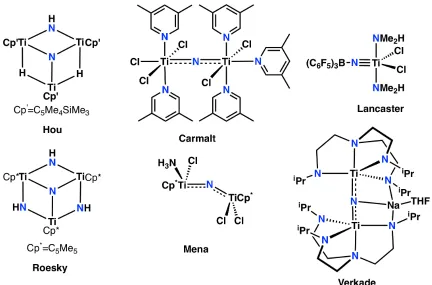
base adduct, this ultimately renders the nitrido moiety closer to an imido moiety in character. Thus, we focused our attention on group 4, especially on Ti, since studies of mononuclear nitride reactivity in this group have largely evaded the reach of the synthetic chemist until recently.52,53 The fact that mononuclear titanium nitrides are exceedingly rare is rather surprising since group 4 nitrides have been proposed in N2 activation and reductive splitting reactions, and the nitride group is often generated in route to the deposition of thin metal nitride films. The elusive nature of terminal titanium nitrides, adjunct with the wealth of useful reactivity established in mid-transition metal nitrides, calls for the attention to probe the nature of this highly polarized bond and to determine the degree of nucleophilicity in this rather uncharacterized motif.
4
Design of a Robust Ligand Scaffold.
Previously, we reported the synthesis of a dinuclear titanium-nitride complex supported by a sterically encumbering β-diketiminate (BDI) ligand (Figure 1.2, left).52 This nitride complex, [K][(tBunacnac)Ti(N)(Ntolyl2)] where tBunacnac =
(ArNCtBu)2CH; Ar = 2,6-iPr2C6H3, was synthesized by a rather circuitous route
involving the treatement of the chlorido precursor (tBunacnac)TiCl(Ntolyl2) with
NaN3, which then lost N2 to form a transient nitridyl radical complex which than abstracted an H-atom from the ligand scaffold to form (tBunacnac)Ti≡NH(Ntolyl2) (in
45% yield, accounting for the destruction of ~50% of the ligand scaffold). Finally, this parent imido ligand was deprotonated with benzylpotassium to form the nitrido complex.
Figure 1.2. Synthesis of molecular titanium nitrides salts using β-diketiminato or phosphino-anilido ligands.
5
by Parkin and Woo’s five coordinate LnTi=X complexes56,57 (Ln2− = meso-substituted porphyrin, octamethyldibenzotetraaza[14]annulene; X = chalcogen or imide group), we hypothesized that two PN− ligands could enforce a pseudo tetragonal ligand field
environment suitable for the construction of a terminally bound nitride or other isoelectronic atoms or groups. Figure 1.3 depicts a simplified d-orbital splitting diagram for a square planar Ti4+ fragment supported by four s donor nitrogen ligands, two of which could also serve as p-donors in a transoid orientation, akin to the ubiquitous porphyrin scaffold. For a d0 fragment, the empty and hybridized dz2 as well as p-like dxz and dyz orbitals are available to form a triple bond with an incoming axial ligand. Further evidence that a chelating ligand such as PN− could
6
Figure 1.3. Simplified d-orbital splitting diagram for a tetragonal ML4 fragment (d0) and its compatibility with a nitride ligand N3−. Note that dz2 hybrization is shown and the role of the p-orbitals in bonding is omitted for clarity in addition to these being too high in energy.
7
we also report a detailed study of the Ti−Nnitride multiple bond and the role of the counter cation in the Ti−Nnitride bonding.
Results and Discussion
Synthesis of a Titanium Dinitrogen Complex and a Titanium Nitride.
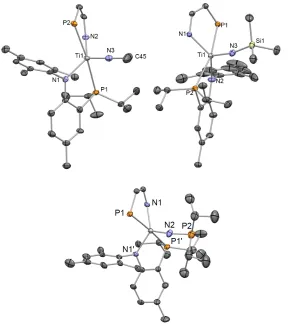
Recently, we reported that the azide complex (PN)2Ti(N3) (1.2), readily prepared from (PN)2TiCl (1.1) and NaN3, could undergo reductive extrusion of N2 with KC8 in Et2O to form the nitride salt [µ2-K(OEt2)]2[(PN)2Ti≡N]2 (1.3) along with graphite (Scheme 1.1).53 This route circumvents a radical mechanism commonly observed in the formation of the parent imido (tBuBDI)Ti≡NH(Ntolyl)2,52 which results in much lower yield due to the sacrificial H-atom source deriving from the ligand scaffold. In addition, the introduction of the nitride group directly from reduction of the azide skips an additional deprotonation step involving the parent imido. To our surprise however, we found that the dinitrogen complex (PN)2Ti=N=N=Ti(PN)2 (1.4) (note that this was originally synthesized by Dr. Maria Carroll, a species prepared in 49% yield from KC8 reduction of (PN)2TiCl under N2, cannot be fragmented with excess reductant (such as KC8) to form two equivalents of complex 1.3. This route would undoubtedly provide a more atom economical route to 1.3 using a vast resource such as atmospheric N2. Complex 1.4 is a diamagnetic species, displaying one single PN chemical environment by both 1H and 31P NMR spectra, and as shown in Figure 1.4, its solid-state structural diagram reveals a topologically linear TiN2Ti moiety where the N−N bond has been partially reduced by 2e− (1.252(8) Å versus 1.0976 Å in free N2). Although a formal N24− ligand would intuitively account for its diamagnetic nature, the observed N−N and Ti−N distances and computed bond orders argue for
8
transient titanium nitrides which then undergo insertion into the Ti−P linkages of the ligand.61 For us, we attribute the lack of reactivity in 1.4 to being reduced is likely to be kinetic as well as thermodynamic in nature. Akin to vanadium(II) dinitrogen complexes prepared in our group, we propose the rigid PN ligands in a putative species such as 1.42− (1.42− represents 1.4 being reduced by two electrons) to
disfavor the mixing of triplet and singlet subspaces that is critical for the dinitrogen cleavage process.62 In addition, the reactive nature of 1.3 suggests the formation of a nitride from N2 to be thermodynamically less stable than 1.42−, a common trait also
9
Scheme 1.1. Synthesis of complex 1.3 from reductive splitting of an azido complex
1.2 (synthesized from chloride complex 1.1) with KC8. Also shown is the attempted synthesis of 1.3 from reductive splitting of N2 in 1.4 with excess KC8.
Figure 1.4. Solid state structure of complex 1.4 showing thermal ellipsoids at the 50% probability level. Selected metrical parameters (distances Å in and angles in o) are shown in Table 1.1. Two molecules of residual benzene were removed for clarity.
Reactivity Studies of the Titanium Nitride with Electrophiles.
Although bridging derivatives of group 4 methyl imides have been reported,63,64 terminally bound examples are unknown. Accordingly, we treated compound 1.3
10
in ~95% yield (Scheme 1.2). The 31P NMR spectrum of 1.5 features a singlet at 12.45 ppm, shifted slightly upfield from 1.3 (7.23 ppm), while the methyl imide resonance is observed at 2.63 ppm in the 1H NMR spectrum and correlated to a resonance at 57.4 ppm in the 13C NMR spectrum. A solid-state structural analysis confirmed the monomeric nature of 1.5 (Figure 1.6), and revealed a short Ti−N distance of 1.709(3)
Å with a linear Ti−N−Me angle of 178.5(4)o (Table 1.1). While the geometry of 1.3 (t5 = 0.529) is between idealized trigonal bipyramidal (t5 = 1) and square pyramidal (t5 = 0), conversion to the imide species 1.5 (t5 = 0.721) alters the geometry more towards a trigonal bipyramidal environment.
Treatment of 1.3 with certain azide reagents can also result in salt elimination. For example, combining 1.3 with N3SiMe3 yields KN3 along with the trimethylsilylimide (PN)2Ti=N{SiMe3} (1.6) in ~90% yield as a deep red colored material (Scheme 1.2). Complex 1.6 shows similar spectroscopic features to 1.5 with the trimethyl resonance being observed at 0.217 ppm in the 1H NMR spectrum. An IR spectrum of the reaction mixture confirms the formation of KN3 (nN3 = 2030 cm−1). The synthesis of complex 1.6 was also confirmed by monitoring reactivity of 1.3 with Me3SiCl by 1H NMR spectroscopy. To probe the reaction mechanism with Me3SiN3 (Scheme 1.3), a 15N enriched sample of 1.3, [µ2-K(OEt2)]2[(PN)2Ti≡15N]2 (1.3)-15N was prepared and treated with Me3SiCl to independently prepare (PN)2Ti=15N{SiMe3} (1.6)-15N. As expected, a resonance at 534 ppm in 15N NMR was attributable to the imide isotopomer species 1.6-15N. A further experiment of 1.3-15N with Me3SiN3 reproduced the signal for 1.6-15N in the 15N NMR spectrum, showing that this reaction is proceeding by salt elimination rather than by cycloaddition and silyltropic shifts (Scheme 1.3). This mechanism follows the predicted behavior in reactivity with regard to the nucleophilic nitride attacking at the electrophilic silyl group of the azide. Consistent with our hypothesis, there was no reactivity between 1.3 and adamantyl azide or trisylazide. The solid-state structure of 1.6 shows an overall similar geometry to 1.5 but where the Ti−N distance has now been elongated to 1.730(2) Å,
11
reported Ti−N distances in Ti=NSiMe3 functionalities,65-69 although some shorter derivatives have been reported with distances as low as ~1.6 Å.70 The Ti−N−Si is slightly bent at nitrogen at 168.06(1)o (Figure 1.6, Table 1.1). In stark contrast to 1.5, the geometry of 1.6 remains quite similar to 1.3, confined between trigonal bipyramidal and square pyramidal (t5 = 0.557).
In the pursuit of rare functional imide groups we treated complex 1.3 with ClPiPr2.
Upon addition of the electrophile, the reaction mixture changed color from orange to dark green. Workup of the reaction mixture allowed for isolation of a green colored solid in 94.1% yield and 1H, 31P and 13C NMR spectral data were consistent with formation of the phosphonylimide (PN)2Ti=N{PiPr2} (1.7) (Scheme 1.2).
Phosphonylimides of early transition metals are rare functionalities, with only a few reported examples.71,72 The 31P NMR spectrum features a broadened resonance (Δν1/2= 16 Hz) attributable to the phosphonylimide at 152 ppm. Interestingly, the resonance for the P of the PN ligand appears as two broadened features centered at 13.73 ppm Δν1/2= 30 Hz. Although quite broad, it is clear that these two signals account for two separate PN ligand resonances, indicating a solution-state behavior that renders these two resonances inequivalent. Additionally, when cooled, the broadened resonances slightly sharpen although P-P coupling with phosphonylimide was unresolved, as shown in Figure 1.5, with a sample measured at 219 K in toluene-d8. We propose that, unlike other imides reported in these studies, the phosphonylimide results in inequivalency in the PN ligands due to steric clash of iPr
groups of the phosphonylimide with the iPr groups of the PN ligand. The molecular
12
Figure 1.5.31P{1H} NMR spectrum of 1.7, taken at 219 K in C7D8, 162 MHz.
This latter metrical parameter is similar to hydrazido complexes reported by Mountford and Odom, with Ti=N distances varying from 1.703-1.76 Å. Shorter Ti−N distances have been reported in some instances, attributable to NR3+ groups on the imido moiety.73-77Complex 1.7 crystallizes in a monoclinic crystal system in the space group I2/a, and the molecule lies along a two-fold axis. Consequently, this two-fold axis causes disorder in the iPr groups of the phosphonyl group. Hence, we restrain
ourselves from discussing metrical parameters. However, the gross solid-state structure of 1.7 reveals a bent TiNiPr2 moiety thus rendering both phosphorus groups
13
Scheme 1.2. Synthesis of compounds 1.5-1.9 from 1.3 and various electrophiles. All reactions were performed in toluene at 25 oC due to the insolubility of 1.3 in aliphatic solvents.
Early-transition borylimidos are rare functional groups in inorganic chemistry. Only two examples of titanium have been reported, both being derived from non-conventional routes involving B−B, B−H, and B−C bond activation reactions.52,78 Our ability to prepare nitride 1.3 allows us to explore simple salt-metathesis reactions to construct these types of functionalities. Hence, treating 1.3 with ClBcat (cat = catechol) resulted in clean conversion to the borylimido (PN)2Ti=N{Bcat} (1.8) in ~89% yield after subsequent workup of the reaction mixture (Scheme 1.2). Unlike the phosphonylimide, the borylimido does not display any unusual NMR spectroscopic features, with a 31P NMR spectrum featuring one singlet resonance at 17.19 ppm.A solid-state structural study of 1.8 shows a topologically linear Ti=N=B (175.00(1)o) due to the Lewis acidic nature of the boryl group. Consequently, the former titanium nitride distance Ti−N has elongated to 1.7312(2) Å, akin to 1.6
14
should also be noted that one crystal of the Ti(III) complex [(PN)2Ti=N{Bcat}][K(dme)4] was also isolated, although it is likely attributable to residual 1.3 remaining in the solution during crystallization. Although the formulation of this complex is unknown, it presents another unique example of a titanium imido complex. Further crystallographic information on this complex can be found in the Appendix of Molecules.79
Figure 1.6. Solid state X-ray structure of complexes 1.5-1.7 (Left to Right) depicting thermal ellipsoids at the 50% probability level. H atoms and the substituents of one depicted PN ligand have been omitted for clarity. A molecule of pentane has been omitted from 1.5 and 1.7 for clarity.
15
examples for group 4 at the time this work was done being (BDI)Ti≡NH(Ntolyl2)52,80,81 (BDI− = [ArNCMe]2CH or [ArNCtBu]2CH; Ar = 2,6-iPr2C6H3), and
16
attempts to protonate the nitride with diisopropylamine, HNiPr2 (pKa = 36, THF),83 resulted in no reaction. This observation allowed us to narrow the pKa range of the parent imide to within 26-36 based on these set of control experiments. Given these pKa ranges for the nitride, we are able to estimate the pKb of 1.3 on the order of −20, in accord with such a moiety being a strong base and nucleophile as demonstrated through our reactivity.
17
Figure 1.7. Solid state X-ray structure of complexes 1.8 and 1.9 depicting thermal ellipsoids at the 50% probability level. H atoms and the substituents of one depicted PN ligand have been omitted for clarity.
Table 1.1. Selected metrical parameters for complexes 1.3-1.9 showing bond distances in Å and angles in degrees. X represents the substituent on the nitride or formal nitride ligand.
For 1.3, X = K; 1.4, X = N; 1.5, X = C; 1.6, X = Si; 1.7, X = P; 1.8, X = B; 1.9, X = H. t5 Represents (b-a)/60 where β > α are the two greatest valence angles of the coordination center.84
Complex 1.3 1.4 1.5 1.6 1.7 1.8 1.9 Ti−N 1.674(2) 1.832(3) 1.709(3) 1.730(2) 1.753(3) 1.7312(2) 1.747(2) Ti−NPN 2.173(2) 2.107(3) 2.093(3) 2.095(2) 2.0695(2) 2.0521(1) 2.0605(1)
Ti−NPN 2.170(2) 2.091(2) 2.096(3) 2.0736(2) 2.0695(2) 2.0685(1) 2.0987(2)
Ti−P 2.6779(8) 2.6763(8) 2.6777(1) 2.6917(7) 2.7041(6) 2.6718(5) 2.6810(5) Ti−P 2.6853(8) 2.7306(8) 2.6824(1) 2.7094(7) 2.7041(6) 2.6532(6) 2.6656(1) N−X 2.729(2) 1.250(4) 1.431(5) 1.737(2) 1.732(3) 1.395(2) 0.860(0) P−Ti−P 167.42(3) 166.03(4) 173.14(3) 167.14(3) 171.16(3) 175.289(2) 177.16(3) Ti−N−X 135.40(1) 1.250(4) 178.5(4) 168.06(1) 162.21(6) 175.00(1) 180.0(0) NPN−Ti−NPN 135.67(8) 128.79(1) 129.87(1) 134.35(8) 130.02(1) 131.33(6) 130.99(6)
P−Ti−NPN 74.88(6) 76.30(7) 75.24(8) 73.77(6) 75.88(5) 75.27(4) 74.94(4)
18
P−Ti−N 95.83(8) 96.99(2) 93.46(1) 99.59(7) 94.419(2) 92.67(5) 92.52(6) P−Ti−N 96.75(8) 98.31(2) 93.37(1) 96.25(7) 94.419(2) 91.96(5) 90.22(7)
t5 0.529 0.621 0.721 0.557 0.686 0.733 0.769
Complete N-Atom Transfer of the Titanium Nitride.
A salt elimination reaction concurrent with complete N-atom transfer could be accomplished when complex 1.3 was treated with ClC(O)tBu in toluene. Immediate
formation of a purple solution is evidenced upon addition of the acid chloride, and workup of the reaction mixture followed by NMR spectroscopic characterization confirmed this purple species to be the oxo complex (PN)2Ti≡O (1.10) (Scheme 1.4) in near quantitative yield, 96%. Examination of the reaction mixture also revealed the formation of another product, which was identified as the organic nitrile NCtBu based
on NMR spectroscopic comparison to an authentic sample. The formation of the nitrile was monitored by NMR spectroscopy to be formed in the same ratio as the oxo as identified by integration. A similar transformation involving N for O/Cl exchange was originally reported by Cummins using nitride complexes such as N≡W(N[iPr]Ar)3
(Ar = 3,5-Me2C6H3) or the salt [Na][N≡Nb(N[Np]Ar)3] (Np = CH2tBu).31,85 Likewise, Veige more recently reported N-atom transfer to various acid chlorides using {[tBuOCO]Mo≡N]Na(DMF)}2 [tBuOCO3− = 2,6-C6H3(6-tBuC6H3O)2]. In these studies,
the authors were able to isolate the acylimido intermediate [tBuOCO]Mo≡NC(O)tBu,
19
Scheme 1.4. Salt metathesis, and N for O-atom transfer to form the oxo complex 1.10.
Complex 1.10 was characterized by 1H and 31P NMR spectroscopy and the latter displayed a sharp singlet at 13.3 ppm. Although there are no diagnostic signatures in the 1H NMR spectrum, monitoring the reaction mixture by 1H NMR spectroscopy revealed clean formation of a resonance at 0.77 ppm consistent with the pivaloyl nitrile (NCtBu). Single crystal X-ray diffraction studies of 1.10 are in accord with a
five-coordinate, mononuclear complex having a terminal oxo group, with a Ti≡O length of 1.644(2) Å, well within the range of many reported terminal titanium oxo moieties.58,87 Rather unsurprisingly, the oxo complex closely parallels the molecular geometry of the parent imide, complex 1.9, with a t5 value of 0.769 and very similar P−Ti−P angle of 179.08(3). Furthermore, we explored the unusual purple color of this Ti(IV) complex via UV-vis analysis. The extremely low intensity absorption observed at 550 nm (ε = 174.8 M−1 cm−1) possibly corresponds to a similar phenomenon like that observed in MnO4−, where the complex absorbs yellow light to promote a LMCT band.
Complex 1.3 can also transfer the nitride atom to other carbonyl containing groups such as the ketene O=C=CPh2 (Scheme 1.3). Accordingly, addition of the ketene to 1.3 rapidly produces the signature purple color indicative in formation of
20
with Me3SiCl, immediately forming a salt (presumably KCl) and a neutral species which was unequivocally identified to be the azaallene Me3SiN=C=CPh2 based on 1H NMR spectroscopic comparison to a literature report.88
21
Scheme 1.5. Proposed mechanistic route of formation of 1.10. Acylimido 1B then converts to azametallacylobutene 1C. Finally, retrocycloaddition to form NCtBu and
1.10.
Solid State 15N NMR Spectroscopic Studies of Titanium Nitrides.
Isolation of dinuclear and mononuclear nitrides of titanium presented us with a rare opportunity to investigate their axial symmetry. Hence, we prepared the 50% 15N enriched complex 1.3-15N and converted it to the terminal nitride
22
in Figure 1.9, the simulated 15N NMR solid state spectrum agrees well with experimentally collected values in both solid and solution state phases (δ = 958 ppm).53 Tensor components span a large chemical shift anisotropy (CSA) of nearly 1500 ppm, with δ11 ≈δ22 = 1392 ± 50 and δ33 = −78 ± 50 ppm. Such anisotropy has been similarly observed in other mononuclear metal nitride species, namely 15N≡Mo(N[tBu]Ar’)3 (Ar’ = 3,5-Me2C6H3) and [K(OEt2)]2[(tBuBDI)Ti≡15N(Ntolyl2)]2
(tBuBDI−= [ArNCtBu]2CH; Ar = 2,6-iPr2C6H3), which also have a range of several hundred
ppm for CSA in their tensor components.52,89-91 The observed 15N NMR chemical shift tensors were then used to compute the axial symmetry component, κ = 3(δ22 − δiso)/(δ11 − δ33) = 1 ± 0.2. Gratifyingly, the κ value close to unity supports the triply bound nature of the Ti-nitride moiety in [K(2,2,2-Kryptofix)][(PN)2Ti≡15N], and which is the favorable bonding due to a pseudo-tetragonal environment shown in Figure 1.3 (vide supra). The κ value observed here deviates notably from axial symmetry values reported previously for less-symmetrical Ti-nitride functionalities supported by the BDI ligand,52 which system has a κ = 0.64.
23
Computational Studies Scrutinizing the Titanium Nitride Functionality.
24
geometries established by single crystal X-ray diffraction studies. Also, in excellent agreement with our experiments, calculations predict the 15N NMR spectroscopic chemical shifts to be 913 ppm, 970 ppm and 878 ppm using the slightly truncated models of [(PN)2Ti≡N]−, [K(18-crown-6)][(PN)2Ti≡N], and 1.3, respectively. These two benchmarks convincingly imply that our computer models capture the most salient features of the electronic structure of these molecular systems reasonably well and that the introduced structural simplification is acceptable. In particular, the agreement between the computed and experimentally observed effect of alkali-metal coordination on 15N NMR spectroscopic resonances supports the notion that the corresponding electronic structure changes are captured computationally in at least a plausible fashion. Thus, a detailed analysis of the bonding is justified and it promises to reveal relevant aspects about how nearby alkali-metal ions influence the bonding and spectroscopic properties of the Ti≡N functionality.
25
of titanium, q(Ti), and the nitride center, q(N) together with the Mayer bond order (BO) index of the Ti≡N interaction.
As noted in our earlier communication,53 various computed electronic structure descriptors imply that the main difference in the Ti−Nnitride bonding is the different covalent/ionic character of the bond in the monomeric species [K(18-crown-6)][(PN)2Ti≡N] and [(PN)2Ti≡N]−. Namely, the Ti≡N bond in [(PN)2Ti≡N]− exhibits a greater degree of covalent character than in [K(18-crown-6)][(PN)2Ti≡N]. In the case of the latter, the proximity of the K+ ion encapsulated in crown ether electrostatically stabilizes the highly charged nitride center and, concomitantly, induces a density shift from the Ti center towards the Nnitride. This electron density shift induced by the proximity of K+ renders the titanium-nitride bond more ionic in [K(18-crown-6)][(PN)2Ti≡N] than in [(PN)2Ti≡N]−. As a matter of fact, the different ionic ionic character can be clearly witnessed in the computed atomic charges of Ti (0.53 e in [(PN)2Ti≡N]− and 0.87 e in [K(18-crown-6)][(PN)2Ti≡N]) and N (−0.63 e in [(PN)2Ti≡N]− vs. −0.88 e in [K(18-crown-6)][(PN)2Ti≡N]) (Figure 1.10). The reduced bond order in [K(18-crown-6)][(PN)2Ti≡N] (2.36 vs. 2.54 in [(PN)2Ti≡N]−) also conforms to a lower degree of covalent character of the Ti≡N bond in this structure. These pronounced differences in Ti−Nnitride bonding are further enhanced with the presence of two potassium ions in 1.3. In particular, atomic charges (q(Ti) = 1.02 e and q(N) = −0.975 e) as well as the reduced bond order of 2.27 indicate the higher ionic and lower covalent character of the Ti≡N bond in 1.3 to either [K(18-crown-6)][(PN)2Ti≡N] or hypothetical [(PN)2Ti≡N]−.
26
because the s-bond as well as one of the Ti−N p-bonds can be defined by two MOs. In detail, the Ti−Nnitride s-interaction of each Ti≡N functionality in Figure 1.11 is represented by two MOs, sb and sa, which evolve due to the formation of a bonding (b) and an anti-bonding (a) combination with a p-type orbital of the PN− ligand(s). Similarly, orbitals p1b and p1a, which appear again as a bonding/anti-bonding pair with a PN− ligand orbital, together characterize one of the Ti−Nnitride p-interactions. In addition, p2 represents the other p-type interaction which lies about in the P−Ti−P plane whereas, as hypothesized in Figure 1.3, the lone pair at Nnitride has a strong component of s atomic orbital character and it is of low energy.
Although the crown ether-encapsulated K+ breaks the symmetry in [K(18-crown-6][(PN)2Ti≡N] as well as it alters the ordering of the orbitals, the computed MOs characterize the same Ti−Nnitride interactions as for [(PN)2Ti≡N]−. Moreover, the analogous MOs can also be intuitively recognized for the dimer species 1.3 (Figure 1.11), for which only the symmetric combinations are illustrated for clarity. The side-by-side comparison of the corresponding MOs reveal that the s-interaction, mostly
sa, as well as p1a experiences a significant change in character when being affected by counter alkali metal ion(s); the atomic contribution of Ti decreases whereas that of Nnitride increases in these MOs as going from [(PN)2Ti≡N]− to [K(18-crown-6)][(PN)2Ti≡N] or 1.3. This difference in corresponding MOs conforms to the additional polarization of the Ti−Nnitride bond that was discussed above which was supported with charge distribution measures and bond descriptors. Finally, the stabilization effect of the nearby cation on the electron rich Nnitride can be clearly witnessed in the computed orbital energies, which are much more negative in 1.3 and in [K(18-crown-6)][(PN)2Ti≡N] than in [(PN)2Ti≡N]−.
[K(18-crown-27
6)][(PN)2Ti≡N] and 1.3 suggests a subtle change in the electronic structure due to the nearby cation(s). In order to put this trend of 15Nnitride chemical shift into context with the underlying electronic structures it is critical to realize that magnetic shielding of heavy nuclei does not directly correlate to the electron density at the nucleus. Rather, heavy nuclei, such as 15N, have access to low-energy molecular orbitals of p and d-type atomic contributions that make the electron density around these nuclei very dynamic in the sense that local fluctuations of the electron cloud become more prevalent in an external magnetic field. The magnetic shielding that results from these electron density fluctuations is conventionally referred to as paramagnetic shielding, sp, and is typically more sensitive to the changes in chemical bonding than the diamagnetic shielding, sd, which originates from tightly-bound electron density at the nucleus. In a recent study from our lab, the basic relationships of such density fluctuations with MOs, shielding tensors and chemical shifts was discussed and, by scrutinizing vanadium- and molybdenum-cyclo-P3 complexes, it was shown how a thorough analysis of shielding tensors of heavy nuclei can lead to a conceptual understanding of the bonding characteristics of unusual transition metal-ligand interactions.97
K(2,2,2-28
Kryptofix)+ counter ion and other condensed phase effects in the simulations, however, a difference of about 280 ppm between δ11 and δ22 appears in silico, which manifests in an underestimated axial symmetry component (k = 0.63 vs. app. 1) for the computationally considered model system, [(PN)2Ti≡N]−. As expected, the diamagnetic term displays a narrow range of shielding contributions with computed
sd values of 339.7, 341.3 and 347.7 ppm for 15Nnitride in [(PN)2Ti≡N]−, [K(18-crown-6)][(PN)2Ti≡N] and 1.3, respectively. The paramagnetic contribution, on the other hand, differs significantly with computed shielding parameters of −1050.3, −996.3 and −967.3 ppm, respectively. These values illustrate the general concept mentioned above that sp dominates the overall shielding of heavy nuclei and, thus, determines the chemical shift davg against a reference.
29
systems the s(M≡P) and p*(M≡P) MO mixing makes the primary contribution to the 31P paramagnetic shielding due to the components of the applied magnetic field which
are oriented perpendicular to the M≡P bond. Figure 1.11 also illustrates how the paramagnetic shielding contribution of sa↔p1* mixing varies for each nitride species. Most importantly, the coupling of these orbitals in an external magnetic field induces a density flow that has a deshielding effect in [(PN)2Ti≡N]−, whereas it generates a shielding effect in [K(18-crown-6)][(PN)2Ti≡N] and 1.3, where the K+ affects the bonding characteristics. The energy gap (DE) between interacting orbitals is also given in Figure 1.11, as the coupling efficiency is inversely proportional to the energy difference between the interacting orbitals.98 For example, the 31P NMR chemical shift of triple bonded phosphorous has been found to correlate very well with the s - p* energy gap, also the significance of energy gap of coupling orbitals was shown in determining the chemical shielding of phosphorous nuclei in metal-cyclo-P3 complexes.97 The very small differences in energy gaps (DE in Figure 1.11), however, cannot account for the qualitatively different paramagnetic shielding effects of s - p* coupling in the studied systems. Rather, the qualitative difference of paramagnetic contributions, i.e. deshielding in [(PN)2Ti≡N]− and shielding in K+-ligated systems, implies that the spatial distribution of these molecular orbitals alters upon K+ coordination. Accordingly, the localization of sa on the nitride center as well as the localization of p1* on Ti in K+-ligated systems results in a constructive orbital overlap when these orbitals couple through the angular momentum operator, in contrast to the destructive overlap (deshielding effect) in naked [(PN)2Ti≡N]−. Hence, the upfield shift of 15Nnitride resonance is linked to the K+ induced electronic structure change of the titanium-nitride functionality as demonstrated through a quantum chemical analysis of the corresponding shielding tensors.
30
source of thermodynamic stabilization and driving force for forming well-structured complex molecular ensembles such as [K(18-crown-6)][(PN)2Ti≡N] and the dimer
32
Figure 1.11. Most relevant occupied MOs for [(PN)2Ti≡N]−, [K(18-crown-6)][(PN)2Ti≡N] and 1.3 describing the electronic structure of the Ti≡N functionality. One of the unoccupied orbitals, p1*, which is critical for the paramagnetic shielding of Nnitride is also depicted.
Conclusion.
In these initial studies, it was demonstrated that the titanium nitride is a powerful nucleophile, able to do substitution chemistry for various R groups in order to synthesize unique imide scaffolds. Particularly of interest to us is the parent imide complex, given that this could provide a model for reduction of nitrogen to ammonia. Moreover, in the absence of light this imide could be isolated and kept in a bottle, unusual for an unsubstituted parent imide species.
With a thorough study of the reactivity of the titanium nitride with electrophiles, including complete N-atom transfer, this called into question whether the nitride was restricted to this behavior, or if this paradigm could be reversed. That is, is this titanium nitride only a classical nucleophile or could nitride reactivity be tuned to instead react as a nitridyl, or perhaps even electrophilic? In the next chapter, the divergent reactivity of this nitride species under differing reaction conditions will be discussed. Further, in Chapter 3 it will be shown how nitride synthesis can be extended down group 4 metal complexes.
33
Experimental Details
General Procedures
Unless otherwise stated, all operations were performed in a M. Braun Lab Master double-dry box under an atmosphere of purified dinitrogen or using high vacuum standard Schlenk techniques under an argon atmosphere. NMR spectra were recorded on a Bruker AV-II 500 MHz spectrometer for 13C spectra, and a Bruker AVIII 400 MHz spectrometer for 1H and 31P{1H} spectra. 1H NMR spectra are reported with reference to residual proteo solvent resonances of benzene-d6 at 7.16 ppm. 13C{1H} NMR spectra were referenced to solvent resonances of benzene-d6 at 128.06 ppm. 31P{1H} NMR spectra were referenced to external H3PO4 (0 ppm). Pentane, hexanes,
benzene, and toluene were purchased from Fisher Scientific and stabilizer-free diethylether (Et2O) and tetrahydrofuran (THF) were purchased from Sigma Aldrich. Solvents were sparged with argon for 20 minutes and dried using a two-column solvent purification system where columns designated for pentane, hexanes, benzene, and toluene were packed with Q5 and alumina respectively, and columns designated for Et2O and THF were packed with alumina. Deuterated benzene and deuterated toluene were purchased from Cambridge Isotope Laboratories (CIL) and were dried over 4 Å sieves, and degassed by freeze-pump-thaw cycles. All solvents were transferred into a dry box and were stored over 4 Å sieves. All sieves were heated to 200 °C under vacuum overnight prior to use. Celite used for filtrations was also heated to 200 °C under vacuum overnight prior to use. Compounds 1.1, 1.2,1.3, 1.3-15N, and [K(2,2,2-Kryptofix)][(PN)2Ti≡15N] were prepared following published procedures.53 The UV-Vis absorption spectra were obtained in a J-young valve 1 cm quartz cell on a Cary 5000 UV-Vis-NIR. Elemental analyses were performed on a FLASH EA 1112 Series CHN analyzer (Thermo Finnigan).
[(PN)2Ti=N]2 (1.4): In a 20 mL scintillation vial, (PN)2TiCl (1.1) (700 mg, 0.916
34
solution was added a 5 mL slurry of KC8 (123.8 mg, 0.916 mmol, 1 equiv.) while stirring with a glass coated metal stirbar. The mixture was stirred overnight at room temperature, during which time it became a deep red color. This solution was filtered over a thick pad of celite. The product is highly insoluble, so the celite pad was washed with 80 mL of toluene in order to extract the product free of alkali. The filtrate solution was concentrated to 50 mL, and then layered with 20 mL of hexane. Storage at −35 °C overnight resulted in the formation of a magenta powder, which was isolated over a frit, followed by washing with 10 mL cold toluene. (673 mg, 0.458 mmol, 49%). Single crystals suitable for X-ray diffraction could be grown from a concentrated benzene solution after one week at room temperature. 1H NMR (400
MHz, 298 K, benzene-d6):d7.04 (br, Δν1/2 = 8 Hz, 2H, meta-ArHMesityl), 6.85 (dd, 3
JH-H = 4.12 JH-Hz, 1JH-H, meta-ArJH-HTolyl), 6.73 (s, 1JH-H, meta-ArJH-HTolyl), 5.85 (dd, 3JH-H = 4.10 Hz, 1H, ortho-ArHTolyl), 2.87 (s, 3H, CH3Tolyl), 2.73 (br, 1H, P-CH-CH3), 2.23 (s, 3H, ortho-CH3Mesityl), 1.87 (s, 3H, para-ortho-CH3Mesityl), 1.40 (d, 3JH-H = 4.16 Hz, 3H, P-CH-CH3), 0.54 (br, 3H, P-CH-CH3), 0.29 (sept, 3JH-H = 4.13 Hz, 1H, P-CH-CH3). 31P{1H} NMR (162 MHz,
298 K, benzene-d6): d 18.98 (s, 2P, PN). Unfortunately, the poor solubility of this
complex prevented us from obtaining reliable 13C NMR spectra. Anal. calcd for C94H130N6P4Ti2 (including 1 benzene per dinuclear complex): C: 72.20 H: 8.38 N: 5.37 Found: C: 73.18 H: 9.19 N: 3.96 The N2 of the bridging dinitrogen complex was not detected based on the analysis found.
(PN)2Ti≡NMe (1.5): In a 20 mL scintillation vial, compound 1.3 (200 mg, 0.105
35
the isolation of red crystals (149.9 mg, 0.198 mmol, 94.6%), which were suitable for X-ray diffraction studies. 1H NMR (400 MHz, 298 K, benzene-d6): d 6.91 (br, 2H,
meta-ArHMesityl), 6.78(s, 1H, meta-ArHTolyl), 6.89 (br, Δν1/2 = 4 Hz, 1H, meta-ArHTolyl), 5.84 (dd, 3JH-H = 4.10 Hz, 1H, ortho-ArHTolyl), 2.63 (s, 3H, N-CH3), 2.69 (br, Δν1/2 = 20 Hz, 3H, P-CH-CH3), 2.23 (s, 3H CH3Tolyl), 2.17 (s, 3H, para-CH3Mesityl), 2.47, (br, 3H, P-CH-CH3), 0.81, (br, 3H, P-P-CH-CH3), 0.34 (br, 1H, P-CH-CH3) 31P{1H} NMR (162 MHz, 25 °C, benzene-d6): d 12.48 (s, 2P, PN). 13C{1H} NMR (125.8 MHz, 298 K, benzene-d6): d 161.8(Ar-C), 147.3, (Ar-C), 133.4 (Ar-C), 131.9 (Ar-C), 123.8 (Ar-C), 112.9 (Ar-C), 112.8(Ar-C), 57.44 (NCH3), 20.9 (PCH(CH3)2), 20.7 (PCH(CH3)2), 18.4 (Ar-CH3), 16.0 (Ar-CH3).
(PN)2Ti=NTMS (1.6): In a 20 mL scintillation vial, compound 1.3 (166 mg, 0.088
mmol, 1 equiv.) was dissolved in 3 mL toluene as a light orange solution. To this solution was added trimethylsilylazide dropwise via a microsyringe (23 μL, 0.175 mmol, 2 equiv.) while stirring. The solution rapidly turned to a deep red, along with precipitation of a solid that deposited on the walls of the vial. The volatiles were taken to dryness after 5 minutes of stirring, and the resulting red residue was triturated with 5 mL pentane resulting in a dark red powder. This powder was dissolved in 5 mL pentane, filtered through celite, and concentrated to 3 mL pentane. Cooling to −35 °C overnight resulted in the isolation of dark red crystals suitable for X-ray diffraction (128.1 mg, 0.157 mmol, 90.2%).1H NMR (400 MHz, 298 K, benzene-d6):d 7.00 (s,
1H, meta-ArHTolyl), 6.89 (br, Δν1/2 = 8 Hz, 2H, meta-ArHMesityl), 6.80 (dd, 3JH-H = 4.12 Hz, 2H, meta-ArHMesityl), 5.81 (dd, 3JH-H = 4.56 Hz, 1H, ortho-ArHTolyl), 2.53 (br, 3H, P-CH-CH3), 2.23 (s, 3H, CH3Tolyl), 2.14 (s, 3H, para-CH3Mesityl), 1.02 (s, 6H, ortho-CH3mesityl),
0.217 (s, 9H, NSiMe3). 31P{1H} NMR (162 MHz, 298 K, benzene-d6): d 13.33 (s, 2P,
PN). 13C{1H} NMR (125.8 MHz, 298 K, benzene-d6): d 161.7 C), 147.6