IndianJ.Plant Physiol., Vol. 5, No.1, (N.S.) pp. 38-46 (Jan.-Mar., 2000)
GROWTH AND YIELD PESPONSE OF TRANDITIONAL TALL AND IMPROVED
SEMI-TALL RICE CULTIVARS TO MODERATE ANnmGH
NITROGEN,
PHOSPHORUS AND POTASSIUM LEVELS
S. SINGH AND M.e. JAIN
Division of Environmental Sciences, fudian Agricultural Research Institute, New Delhi 11002 Received on 25 Jan., 1999, Revised on 22 Nov., 1999.
SUMMARY
Morpho-physiological' anal~is of growth and yield in traditional tall and improved semi-tall rice cultivars grown at moderate and highNPKlevels revealed that in all rice cultivars tested, high level ofNPKfertilization manifested significantly higher plant stature, tiller production, bioproductivity, leaf area index, leaf area ratio, crop growth rate, economic and biological productivity fha/day, panicles/m2, grain yield, straw yield and bioligical yield; whereas specific leaf weight, grains/panicle, foliage efficiency and harvest index were reduced drastically under high level of nutrients fertilization. Some physiological characters i.e.lOoo grain weight, pre and post anthesis dry matter production percentage, relative growth rate and net assimilation rate, however, were not affected much by high and moderate levels of nutrients application. Among diverse rice cultivars, the traditional tall were found superior to improved semi-tall in total biomass production, leaf area index, pre-anthesis dry matter production, biological productivity fha/day, straw and biological yield regardless of NPK levels. The improved sem-itall cultivars, however proved to be better than traditional tall in grains/panicle, foliage efficiency, harvest indix, grain yield and post anthesis dry matter prodiction. Greater number of panicles/m1 accompanied with low grains per panicle under high nutrients level. The traditional tall basmati cultivars proved to be promising in total biomass production m2 both under moderate and high soil fertility levels, but manifested lower grain yield than semi-tall improved ones mainly because of poor conversion effeciency of biomass into grain under severe lodging, as the grain yield of basmati 370 was at par to semi-tall cultivars when protected from lodging.
Key words : Leaf area, leaf area ratio, net assimilation rate, relative growth rate.
INTRODUCTION
The improved semi -dwarf rice cultivars have occupied maximum area of rice cultivation in India and other rice growing countries as well, mainly because of their higher productivity under high soil fertility and greater ecoligical
adaptability (photo-thermo insensitivity). However,
substantial area of rice especially in north India and
Pakistan is still under the cultivation of several local tradtional tall basmati rices, as these varieties despite their low grain yield potential possess certain desirable
characters ego better elongation and aroma following
38
cooking, which meet the specific reqUirement under
specific environment. The high yielding potential of
improved semi-tall rice cultivars is mainly attributed to their greater harvest index, and there has been no marked genetic gain in their biological productivity. Thetraditional tall cultivars on the other hand dominate the improvcd s@mi-tall cutivars in bioligical yield but mainfcst low grain yield mainly becausc of servere lodging and poor harvest index especially under high soil fertility status
(Jenning, 1964 ; Yoshida, 1981; Vcnkatcswarlu, 1980;
Singh and Gangwar, 1989). However, the traditional tall cultivars when compared with improved semi-tall ones at
r
FER.TILIZER mn;ctON RICE
individual plant level and even under crop level without lodging (lodging prevented by physical support) proved to be promising and superior to semi..:tall cultivars in respect ofbioligical yield and almost atpar in grain yield (Singh et ai, 1992, 1993). Though several traditional tall rice cultivars have been compare4 with differentimproved semi-tall cultivars for their growth, yield and various physiological traits (Janardan and Murty, 1980; Tripathi
and Rao, 1991; Singh et al., 1992, 1993), but the
informations on the grwoth and yield. characteristics of traditionsl tall basmati rice especially under high nutrients application are indequate. Keeping in view the significance of traditional tall basmati cultivars,a field experiment was conducted to compare these varieties with some
improved semi-tall ones for their growth and yield
parameters associated with crop productivity.
MATERIALS AND METHODS
A field experiment was conducted with diverse rice cultivars viz., IR 72, Pusa 169, Pusa basmati 1, Pusa 933 and Pusa 1019 as improved semi-tall and Basmati 370 and Karnallocal as traditional tall during the wet season, 1997 at the research farm of Indian Agricultural Research Institute, New Delhi. Thirty days old seedlings of all the
rice cultivars were transplanted separately in a paddy
field under moderate .(100:50:40 kg/ha) and high
(200: 100:80 kg/ha) levels ofNPK at 20x20 em apart with four replications in the split plot design. Fifty per cent of N along with full dose ofP and K were applied at planting and rest 50% N was applied in two splits at tillering (10 days after planting) and panicle initiation stages. Plants were sampled at active tillering (AT), panicle initiation (PI), 50% flowering (F) and maturity (M) stages to record
the growth and yield parameters such as plant height,
number of tillers/m2, number of grains /panicle, 1000
grain weight, economic yield, bioligical productivity/ha/ day and foliage efficiency both for grain and biomass. The grain, straw and bioligical yields were recorded from whole plot (15m2) of each treatment to compute the yield
per hectare. In order to examine the magnitude of loss in grain and bioligical yields by lodging and to know the actual production potenital of traditional tall basmati cultivars, plants in 3m2 area were prevented from lodging by supporting them with pegs before lodging. The grwoth and yield parameters were measured· following Yoshida et al (1976) and Yoshida (1981).
IndianJ. Plant Physiol., Vol. 5, No.1, (N.S.) pp.38-46 (Jan.-Mar., 2000)
RESUL TS AND DISCUSSION
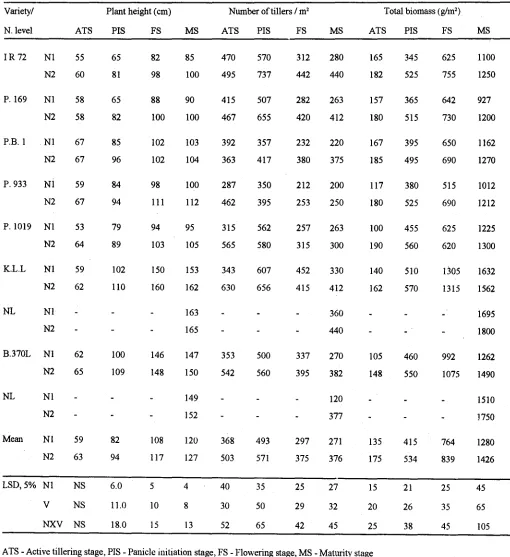
The results of growth and growth parmeters revealed that the tfaditional tall and improved semi-tall cultivars did not show significant difference in their stature at active tellering stage both under low and high levels of NPK fertilization, while at panicle initiation and flowering stages, there was significant difference in the stature of traditional tall basmati and improved semitall cultivars under both nutrients levels (Table I, II and III). High and moderate levels ofNPK though did not register significant difference in the height of plants at tillering, but at later
growth stages the stature of plants was significantly
higher under high nutrients level. The plant height
increased gradually from tillering to flowering and
remained almost constant thereafter till maturity. Diverse rice cultivars varied significanly in their stature, mainfested marked variation in the number oftillers/m2 at all growth stages under both NPK levels. Irrespective of rice cultivars it was invariably higher under high level of'soil fertility. Tiller production increased sharply from active tellering to panicle initiation stage and declined gradually towards flowering and remained almost constant during ripening
phase in all rice' cultivars (Table I). Among various
cultivars, tall statured variety Kamal local recorded highest
number of tillers/m2 followed by semi tall cv. IR 72,
Basmai 370 and lowest was in Pusa 933, Pusa 1019 and
Pusa basmati 1. Higher NPK level manifested greater
biomass production at all growth stages in all rice cultivars
as compared to low nutrients level. Among diverse
varieties, traditional tall basmati rices, Kamal local and Basmati 370 manifested about 80 and 40 per cent greater biomass than those of semi-tall improved cultivars at flowering and maturity stages, respectively, through the
magnitude of variation at active tillering and panicle
initiation grwoth stages was marginal (Table I). Lodging caused about 15-20% reduction in total biomass production of traditional tall xltivars. Though the leaf area index was higher under high soil fertility level at all growth stages in all rice cultivars, but the extent of increase was found maximum at panicle initiation stage followed by flowering stage of plant growth (Table II). Regardless ofNPK levels and varieties, highest leaf area index (LA!) was recorded at flowering stage. Among rice cultivars, the traditional tall varieties registered significantly higher leaf area
index than those of improved semi-tall ones both at
panicle initiation and flowering stages, though the
S. SINGH AND M. C. JAIN
Table I.Growth parameters of different riee cultivars at subquent growth stages under moderate and high NPK levels.
Plantheight(cm) Number oftillers/m2 Totalbiomass (g/m2) Variety/
N.level ATS PIS FS MS ATS PIS FS MS ATS PIS FS MS
IR 72 Nl
N2 P.169 Nl N2 55 60 58 58 65 81 65 82 82 98 88 100 85 100 90 100 470 495 415 467 570 737 507 655 312 442 282 420 280 440 263 412 165 182 157 180 345 525 365 515 625 755 642 730 1100 1250 927 1200 P.B.l Nl N2 67 67 85 96 102 102 103 104 392 363 357 417 232 380 220 375 167 185 395 495 650 690 1162 1270 1305 1632 P.933 Nl N2 P.I019 Nl N2 K.L.L Nl N2 59 67 53 64 59 62 84 94 79 89 102 110 98 111 94 103 150 160 100 112 95 105 153 162 287 462 315 565 343 630 350 395 562 580 607 656 212 253 257 315 452 415 200 250 263 300 330 412 117 180 100 190 140 162 380 525 455 560 510 570 515 690 625 620 1315 1012 1212 1225 1300 1562 NL Nl N2 163 165 360 440 1695 1800 1075 1490 B.370L Nl N2 62 65 100 109 146 148 147 150 353 542 500 560 337 395 270 382 105 148 460 550 992 1262 NL Mean Nl N2 Nl N2 59 63 82 94 108 117 149 152 120 127 368 503 493 571 297 375 120 377 271 376 135 175 415 534 764 839 1510 1750 1280 1426 NXV NS LSD,5% Nl
v
NS NS 6.0 11.0 18.0 5 10 15 4 8 13 40 30 52 35 50 65 25 29 42 27 32 45 15 20 25 21 26 38 25 35 45 45 65 105ATS -Activetilleringstage,PIS -Panicleinitiationstage,FS -Flowering stage,MS -Maturitystage Nl -Moderate NPK level(100:50:40kg.nUl),N2 -High NPK level(200:100:80kg.nla).
Kl.-Kamallocal, B.370- Basmati 370,P.B.-Pusa Basmati,P-Pusa L-Lodged,NL-Non-lodged
FERTILIZER EFFECT ON RICE
Table II. Growth parameters of rice cultivars at subsquent growth stages under moderate and high NPK levels.
VarietylN.level Leaf area indix Specific leaf weight mg/m2
ATS PIS FS ATS PIS FS
IR72 N1 2.4 3.4 2.8 3.9 6.0 6.5
N2 2.8 4.7 4.0 4.3 5.8 6.5
Pusa 169 N1 1.8 2.6 2.5 4.5 5.5 6.4
N2 2.1 5.2 4.5 4.1 5.2 5.1
Pusa Basmati. 1 N1 1.8 2.7 2.5 4.6 6.3 6.3
N2 2.1 4.0 3.4 4.7 6.4 6.3
Pusa 1019 Nl 1.6 4.2 2.8 3.3 4.8 5.1
N2 3.3 6.1 3.4 3.5 4.5 4.8
Kamal Local N1 2.5 5.3 6.3 3.3 4.4 5.3
N2 2.8 5.7 7.1 3.6 4.3 5.2
Basmati370 N1 2.0 4.6 5.5 4.1 4.7 4.7
N2 2.2 6.5 6.8 3.6 4.3 4.8
Mean N1 2.0 3.7 3.5 3.8 5.3 5.7
N2 2.6 5.4 4.7 3.9 5.0 '5.4
LSD at 5% N 0.2 1.2 0.5 NS NS NS
V 0.3 1.5 0.8 0.5 0.8 0.7
NXV 0.5 2.0 1.5 0.7 1.0 0.9
ATS - Active tillering stage, PIS - panicle initiation stage, FS - Flowering Stage magni~de of varietal variation in LA! was marginal at
tillering stage. There was no significant difference in specific leaf weight (SL W) under moderate and high NPK levels, but significant varietal variation was noticed at all growth stages, therebeing higher in improved semitall cultivars. Highest value ofSL W was recorded at flowering regardless to nutrients levels and cultivars. Irrespective of cultivars, non significant difference was recorded in relative grwoth rate (RGR) under different NPK lvels at
either growth stage, however, significant varietal
difference was noticed in the same at all growth stages. The relative growth rate was found maximum during
IndianJ. Plant Physiol ..Vol. 5. No.1, (N.S.) pp. 38·46 (Jan.-Mar., 2000)
active tillering to panicle initiation stage and declined
gradually with subsquent growth stages. Among the
cultivars, traditional tall cultivars mainfested higher RGR
than those of improved semi-tall ones during active
tillering to panicle initiation stage, but registered lower values of the same during later growth stages. Both net assimilation rate (NAR) and leaf area ratio (LAR) showed-non-significant difference under moderate and high NPK levels during ATS to PIS, while the same recorded significant variation under different nutrietns levels during PIS to FS. Net assimilation and leaf area ratio too were found higher during ATS to PIS than during PIS to FS.
FERTILIZER EFFECT ON RICE
Though the varieties showed significant difference in lodged condition. However, these traditional tall cultivars
NAR and LAR during various growth stages, but failed to when protected from lodging manifested CGR at par to
show any specific tr~nd between traditional tall and semi-tall improved ones.
improved sem-ital cultivars. NAR and LAR showed The data on yield and yield attributes revealed that
inverse relation with each other in all the cultivars during high level ofNPK manifested significantly higher number
various growth stages, Crop growth rate in general was , of panicles/m2 as compared to low NPK level (fable ill
highest during active tillering to panicle initiation stage and IV). Rice cultivars also showed significant variation
and reduced susquently. High NPK levels registered in the same, therebeing highest in tratitional tall cv.
higher crop grotwh than that of low nutrients level at all Karnallocal followed by P 933. Grain number per panicle,
grwoth stages.~ong cultivars, traditional tall registered however, redu~ significantly (20%) under high level of
higher CGR than. semi-tall ones until flowering, while NPK fertilization. The cultivars which registered lower
impaired the same during post flowering stage under number of panicles/m2 manifested higher grains/panicle.
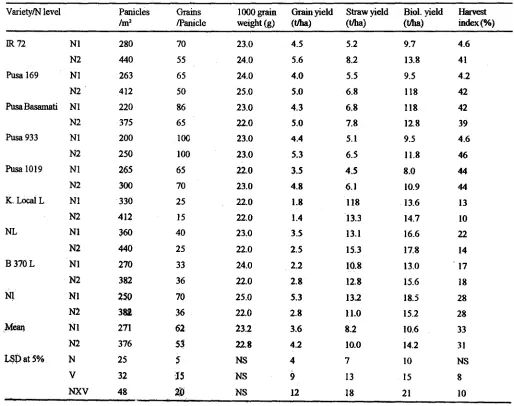
Table IV. Yield and yield components of different rice cultivars under moderate and high NPK levels.
VarietylN level Panicles Grains 1000 grain Grain yield Straw yield BioI. yield Harvest
1m2 /Panicle weight (g) (t/ha) (t/ha) (t/ha) index(%)
lR72 NI 280 70 23.0 4.5 5.2 9.7 4.6
N2 440 55 24.0 5.6 8.2 13.8 41
?usa 169 Nl 263 65 24.0 4.0 5.5 9.5 4.2
N2 412 50 25.0 5.0 6.8 118 42
Pusa Basamati NI 220 86 23.0 4.3 6.8 118 42
N2 375 65 22.0 5.0 7.8 12.8 39
Pusa 933 NI 200 100 23.0 4.4 5.1 9.5 4.6
N2 250 100 23.0 5.3 6.5 11.8 46
Pusa 1019 NI 265 65 22.0 3.5 4.5 8.0 44
N2 300 70 23.0 4.8 6.1 10.9 44
K. Local L Nl 330 25 22.0 1.8 118 13.6 I3
N2 412 15 22.0 1.4 13.3 14.7 10
NL NI 360 40 23.0 35 13.1 16.6 22
N2 440 25 22.0 2.5 15.3 17.8 14
B370L Nl 270 33 24.0 2.2 10.8 13.0 17
N2 382 36 22.0 2.8 12.8 15.6 18
Nt NI
~SO
70 25.0 5.3 13.2 18.5 28N2 3&t 36 22.0 2.8 11.0 15.2 28
Me&) Nl 271 62. 23.2 3.6 8.2 10.6 33
N2 376 53 22.8 4.2 10.0 14.2 31
L$pat5% N 25 5 NS 4 7 10 NS
V 32
15
NS 9 13 15 8NXV 48 21> NS 12 18 21 10
I
S. S1NGH. AND M. C. lAlN
NeIther SOllfertihty levels nor cUltivars showed marked marked reduction in an important yield oomponent i.e. -.um-.••..:.ar. in 1,\}% !;HUIl wcig\n.. IUl;;spl;;(.;tiveof rice grainsJpanicle115'%i). Among the two diverse group of cultivars, grain yield was significantly higher (17%) rice cultivars, the magnitude of response whether positive under high level ofNPK. Amon§ the cultivars semi-tall or negative to high of NPK fertilization in re~nf;ctnL
th - f -~-~--- ~40"~U~"'U Y UJ!9-1~~
gram
yielQthan vanous growth and yield parameters was generallyose0 traditional tall, while ~e traditional tall basmati higher in improved semitall cultivars than in traditional
3?0 when p~otec~edfrom lodgmg recorded parallel grain tall cultivars. Semi-tal varieties produced 45% greater ~eld to senu-tall unproved on.esboth under moderate and number of tillers1m2 as against 33% of traditional tall
h~ghNPK I~~els. The magm~d~ of reduction in grain under high nutrients fertilization, while the same fertiilty Ylel~of ~tl~nal ~I basmat~ nce was about 50% by level reduced the grains per panicle by 13 and 17percent lodgmg..BIOlogICalyield was SIgnificantlyhigher (34%) in semi tall and traditional cultiivars, respectively. Semi und~~high NPK I~vel regardless of rice cultivars. The tall cultivars enhanced their grain yield by 24% and t~aditIo~ tal.1cult~vars, however recorded 43 per cent bioligical yield by 27% under high NPK level while the ~lgher b~ologlca1yield than those of. ~emi~tallcultivars trad!tional tall improved their biological and ~ain yield
l"t~Ct1veG!
NPK levels.
J1te tradItional tall basmati by 14 and 3 per cent, respectively under same fertility c~ltlVarsmamfested 52 and 36 per cent higher bioligical level. Traditional tall basmati 370 registered highergrain .YIeldthan imprgym~mU-ta11
cultivafs under law and yield in contrast toKamalloeal which manifested lower high levels of NPK respectively. Lodging caused about grain yield under high NPK level. Despite severelodging,1~..1§
psrsent rooustion
ill
m616gical yield
offfacftiionaft13diti&al tall
CUJtivMSshowed
about 30 per cent higher tall cultivars. The harvest index was non-significantly bioproductivity than those of semi-tal culivars, whilehigher
(6%) tinder
low
nutrients level than under .high ~nder~~eventedlodgin~the s~e was about 56% greaterlevel of nutrient f~rtilization. The semi-tall improved m tradItional tall than m senu-tall ones.
cultivM§
r~ggnled
significantly greater
harvest index
It is evident from the results (Table IVand V) that than traditional tall cultivars. Lodging caused about 3.0- despite severe lodging, traditional tall basmati cultivars 40 per cent reduction in the harvest index of traditional recorded higher bioproductivity than those of smi-tall tall cultivars. Irrespective of rice cultivars, pre-anthesis cultivars and the magnitude of superiority over semitall dry matter production (75%) as against semi-tall (55%), increased markedly when prevented from lodging. It is while the semi-tall improved ones manifested greated also interesting to note that not only in bioproductivity, post-anthesis dry matter production (45%) as contrastto the traditional tall Basmati 370 protected from lodging tradition tall varieties (25%). Except traditional tall cv. recorded grain yield almost at par to improved semi-tall Karnallocal, which recorded lower economicproductivity cultivars. The greater bioproductivityin traditional tall fha/day under high NPK level than under low level, rest may perhaps be due to higher leaf area index (LAI) and cultivars manifestedgreater economicas wellasbiologica1 longer duration (15 days more) in the same (Table III) productivityfha/day under high level of NPK. Per day which are mainly responsible for photosynthesis and economicand biological productivity were reduced by 48 biomass production (Yoshida, 1981; Singhet ai, 1992, and 16 percent respectively by lodging in tradtional tall 1993; Tripathi and Rao, 1994). However, low grain yield cultivars. Foliage efficiency both for grain and biomass recorded in traditional tall cultivars was mainlyattributed reduced drastically- under high level of nutrients to poor transformation or conversioneffeciencyofbiomass feritilization. Among rice cultivars semi-tall proved to be into economicproduct (grains), as these varieties because better than traditional tall in respect of foliage effeicency of their· greater stature suffered severely from lodging, for grain as well as biomass. The results clearly indicate which prevents the translocation of photosynthates from that high level of NPK fertilization caused significant vegetative shoots (stem and leaves) to the reproductive improvementin grain yield (17%), bioligical yield (34%), sink (panicle) and finally causes spikelet sterility and and yield parametet~ such as panicles/m2 (40%) and decline the sink potential realization in the same (Jennin, economic and bioligical productivity/ha/day (20%); 1964;Yoshida, 1981; Singhet aI, 1992).It is evidentfrom wheareas the same high level ofNPK fertilizaion caused the results that lodging in traditional tall varieties causedFERTILIZER EFFECT ON RICE
Table V. Grain and biomass production efficiency of different rice cultivars under moderate and high NPK level
Variety/N. level Pre anthesis Post anthesis Economic Biological Foliage efficiency
DMP DMP productivity producitivity grain biomass
(%) (%) (kg/hald) (kglhald) (uLAI) (tILAI)
IR.72 Nl 57 43 47 102 2.5 5.4
N2 60 40 59 145 1.4 3.5
Pusa 169 Nl 69 31 42 100 1.6 3.8
N2 61 39 53 124 1.1 2.6
Pusa Basmati 1 Nl 56 44 ,. 45 117 1.7 4.4
N2 54 46 53 135 1.5 3.8
Pusa 933 Nl 51 49 46 100 1.9 2.8
N2 57 43 56 124 1.3 2.8
Pusa 1019 Nl 51 49 37 84 1.3 2.9
N2 48 52 51 115 1.4 3.2
K. Local L Nl 80 20 16 ll~' 0.3 2.2
N2 84 16 12 128 0.2 2.1
NL Nl 77 23 30 144 0.6 2.6
N2 73 27 22 154 0.4 2.5
B.370L Nl 79 21 19 113 0.4 2.4
N2 72 28 24 136 0.4 2.4
NL Nl 66 34 37 132 0.8 2.8
N2 61 39 46 161 0;8 2.8
Mean Nl 65 35 35 112 1.2 . 3.4
N2 63 37 42 136 0.9 2.8
LSTat5% N NS NS 3 8 0.2 0.4
V 10 8 7 15 0.5 0.6
NXV 13 ]J 10 21 0.7 0.9
DMP -Drymatter production, K. Local- Kamal Local, B.370 Basmati 370, L- Lodging, NL- No, lodging.
S. SINGH AND M. C. JAIN
30-40 per cent reduction in the harvest index which
caused reduction in grain yield by abOut 50% (Table IV). Semi-tal cultivars proved to be superior to traditional tall rice varieties in post-anthesis dry matter productiona and
foliage efficiency for grain and biomass as well.
Traditional tall cultivars, however showed greater
percentage of. pre-anthesis dry matter production as
compared to semi-tall cultivars. Lower post-anthesis dry matter production percentage in aforesaid cultivars may perhaps be due to severe lodging during post anthesis growth phase, which in tum declines and disturbs the
photosynthetic production and its partition to the sink
(grains). This finding is in confirmity with the result of Yoshida (1981), Janardhan and Murty (1980), Murty and
Venkateswrlu (1978) and Singh et al (1992). It is also
evident from the results that higher NPK level caused greater number of panicles/m2 in both type of cultivars, but on the on the other hand, reduced the number of grainslpanicles and finally impaired the extent of grain yield increase in proportion to increase in panicles/m2•
This inverse relation between panicles/m2 and grains!
panicle might be due to operation of compensatory
mechanism betWeen yield cimponents in the plants. Higher level of relative growth rate, net assimilation rate and leaf area ratio and crop growth rate especially during vegetative growth phase in traditional tall cultivars might be attributed
to the greater bioproductivity, as all these growth
parameters are responsible for growth and productivity (Yoshida, 1981; Janardha and Murty, 1980).
46
REFERENCES
Jenning, P.R. (1964). Plant types as a rice breeding objective. Crop Sci.,4: 13-15
Janardhan, KV. and Murty, KS. (1990). Effect oflow light during vegetative stage on photosynthesis and growth attributes in rice. IndiaJ.Plant Physiol., 23: 156-162.
Murty, KS and Venkateswarlu, B. (1978). Physioligical constraints on grwoth and productivity in rice during kharif season. Natl. Symp. on increasing rice in kharif season. Natl. Symp. on increasing rice yield in kharif season. ICAR/CRR!. P. 46-65. Singh, S. and Gangwar, B. (1989). Comparative studies on production efficiency in traditional tall and improved rice cultivars. J. Andaman Sc. Assoc.,5: 8}-82.
Singh, S; Gangwar, B. And Sharma, T.V.R.S. (1992). PhysioligicaJ analysis of growth and producti vity in rice varieties, Part I Crop level. J. andamanSci. Assoc., 8 :30-37.
Singh, S; Gangwar, B. and Sharma, T.V.R.S. (1992). Physiological analysis of growth and productivity in rice vareties, Part II Plant level. J.Andaman Sci. Assoc., 8 :38-42.
Singh, S: Gangwar, B. and Sharma, T. v.R.S. (1993). Physiological efficiency in rice varieties under diverse conditions. J. Andaman Sci.Assoc., 9: 1-5.
Tripathi, J.N. and Rao, C.N. (1991). Influence of matmity duration on photosynthesis and productivity in traditional rice varieties.
Oryza,28: 255-259.
Venk:ateswarlu,B. (1980). Canopyanalysis-Areviewofyieldattributes in rice. Int.Rice Commission News letter,29 : 24-26. Yoshida, S; Forno, D. A; Cock, J.H. and Gomez K.A. (1976).
Laboratory manual for physioligical studies of rice. Int. Rice Inst. Las banus,Laguna, Philippines.
Yoshida, S. (1981). Fundamentals of rice crop sciences. Int. Rice Res. Inst. Laguna, Philippines.