ARTICLE
Randomized, Controlled Trial of an
Internet-Facilitated Intervention for Reducing Binge Eating
and Overweight in Adolescents
Megan Jones, MSa, Kristine H. Luce, PhDb, Megan I. Osborne, PhDb, Katherine Taylor, BSc, Darby Cunning, MAb, Angela Celio Doyle, PhDd, Denise E. Wilfley, PhDe, C. Barr Taylor, MDb
aPacific Graduate School of Psychology-Stanford Doctor of Psychology Consortium, Palo Alto, California;bDepartment of Psychiatry and Behavioral Sciences, Stanford University, Stanford, California;cDepartment of Community Health Sciences, School of Public Health, University of California, Los Angeles, California; dDepartment of Psychiatry, The University of Chicago, Chicago, Illinois;eDepartment of Psychiatry, Washington University School of Medicine, St Louis, Missouri
The authors have indicated they have no financial relationships relevant to this article to disclose.
ABSTRACT
OBJECTIVE.This study examined the efficacy of an Internet-facilitated intervention for weight maintenance and binge eating in adolescents.
METHODS.A total of 105 adolescent male and female high school students at risk for overweight (mean age: 15.1 ⫾ 1.0 years) were randomly assigned to a 16-week online intervention, StudentBodies2-BED (n ⫽52), or the wait-list control group (n⫽53).
RESULTS.Participants in the StudentBodies2-BED group had significantly lower BMIz
scores and BMI from baseline assessment to follow-up assessment, compared with the wait-list control group. In addition, significant reductions in objective binge episodes and subjective binge episodes from baseline assessment to posttreatment assessment and from baseline assessment to follow-up assessment were observed among StudentBodies2-BED participants. The StudentBodies2-BED group also re-ported significantly reduced weight and shape concerns from posttreatment assess-ment to follow-up assessassess-ment and from baseline assessassess-ment to follow-up assessassess-ment. Participants in the StudentBodies2-BED group who engaged in objective overeating or binge eating episodes at baseline assessment experienced a significantly greater reduction in BMI at follow-up assessment, compared with the wait-list control group.
CONCLUSIONS.Results suggest that an Internet-facilitated intervention is moderately effective in short-term weight loss and weight maintenance and yields a large reduction in binge eating. This study also demonstrates that weight management and reduction of eating disorder psychopathological features can be achieved simulta-neously by using an easily disseminated, Internet-facilitated program.
What’s Known on This Subject
Weight management is notoriously difficult to promote and to maintain among children and adolescents. Research indicates that re-ducing binge eating may be effective in pre-venting additional weight gain and may lead to weight loss.
What This Study Adds
This study investigates the use of an Inter-net-facilitated intervention for weight maintenance and binge eating in adoles-cents. Results suggest that an Internet-facil-itated intervention is moderately effective in short-term weight loss and weight mainte-nance and yields a large reduction in binge eating. This study also demonstrates that weight management and reduction of eat-ing disorder psychopathological features can be achieved simultaneously by using an easily disseminated, Internet-facilitated program.
www.pediatrics.org/cgi/doi/10.1542/ peds.2007-1173
doi:10.1542/peds.2007-1173
This trial has been registered at www.clinicaltrials.gov (identifier NCT00125112).
Key Words
adolescents, overweight, disordered eating, eating disorders, weight management
Abbreviations
SB2-BED—StudentBodies2-BED WLC—wait-list control OBE— objective binge episode SBE—subjective binge episode OOE— objective overeating episode EBI—Eating Behaviors Inventory BED— binge eating disorder
Accepted for publication Aug 2, 2007 Address correspondence to Megan Jones, MS, Department of Psychiatry and Behavioral Sciences, Stanford Medical Center, 401 Quarry Rd, Stanford, CA 94305-5722. E-mail: [email protected]
N
ATIONAL CENTER FORHealth Statistics data indicate a steady increase in the proportions of overweight children and adolescents.1This trend has beenparticu-larly marked in recent years, with 34.3% of adolescents (12–19 years of age) meeting criteria for either at risk of overweight (ie, age-adjusted BMI of ⱖ85th percentile) or overweight (ie, ⱖ95th percentile).2 In light of the
compromised psychological and physical health associ-ated with overweight3 and the epidemic scale of the
problem, adolescent overweight remains a vitally impor-tant area of treatment and prevention research.
There is consistent evidence that increased energy consumption is associated with weight gain; therefore, interventions typically target eating behavior modifica-tion. Binge eating, which is associated with greater en-ergy intake, is also linked to increased degree of over-weight4–7 and prospectively predicts weight gain and
earlier onset of overweight among children and adoles-cents.8–11Therefore, individuals who binge eat seem to
be a relevant target for intervention programs, particu-larly because cessation of binge eating is often effective in stabilizing weight, thereby preventing future weight gain and perhaps promoting weight loss.12,13
The onset of binge eating typically occurs in late child-hood or adolescence14and is characterized by the sense
of loss of control over eating, accompanied by an eating episode involving the consumption of an objectively large amount of food (objective binge episode [OBE]) or smaller amount of food (subjective binge episode [SBE]). Rates of eating disorder pathological conditions, partic-ularly binge eating, are elevated and clinically significant in overweight youths,15which supports the need to
de-velop interventions that simultaneously address over-weight and binge eating. Children and adolescents who report loss of control over eating not only are heavier and have more body fat than peers without loss of control but also report greater eating-related psycho-pathological features, including greater weight and shape concerns and depressive symptoms.16–19 Weight
management programs target objective overeating epi-sodes (OOEs) (ie, consumption of an objectively large amount of food without loss of control) to reduce weight but traditionally rely on weight status as the criterion for enrollment and ignore the type and function of overeat-ing episodes, such as the role of overeatovereat-ing and bovereat-inge eating as a means of regulating negative affect.20
Tradi-tional weight loss programs may not attend adequately to loss of control, which is the central feature of binge eating,21 particularly in children and adolescents.22 In
addition, these programs typically do not consider idio-syncratic differences in the maintenance of overeating and binge eating, potentially limiting the long-term ef-fectiveness of the interventions.
Given the high prevalence of weight and shape con-cerns among overweight adolescents,23,24 some
profes-sionals express concern that weight loss programs may increase the risk of eating disorders through iatrogenic effects of increased focus on body weight, stimulus con-trol, and dietary restriction.25 However, comprehensive
weight management interventions may mitigate eating disorder risk by integrating components designed to
ad-dress shared risk factors for overweight and eating dis-orders, such as dieting, media use, weight-related teas-ing, and weight and shape concerns.26,27 Evidence
indicates that participation in an integrated weight loss program may not exacerbate risk28 and may even
de-crease binge eating symptoms29,30and compensatory
be-haviors,31 which suggests that professionally
adminis-tered weight management programs may not have adverse effects on eating disorder psychopathological conditions. Additional empirical evidence is needed to examine more thoroughly the efficacy of integrated in-terventions for the reduction of overweight and eating disorder symptoms.
Because of the high and increasing prevalence rates of overweight and obesity, the development and dissemi-nation of effective interventions are imperative. Tradi-tional comprehensive behavioral weight management interventions require a large investment of resources and may be prohibitively expensive for many individu-als, which limits their accessibility. One possible solution to the problem of limited access to adequate treatment resources involves Internet-facilitated interventions. Online interventions can minimize many barriers, such as cost, time constraints, and transportation difficulties, that may prevent adolescents from seeking treatment.32
Adolescent participants of focus groups identify minimi-zation of stigmatiminimi-zation as one of the most important features of obesity prevention programs,32and the
Inter-net provides unique advantages in the ability to preserve anonymity. Several studies showed that the Internet can be used to provide weight maintenance interventions in adults33–35and may be of benefit for overweight
adoles-cents.36
This study expands the empirical literature on inte-grated interventions for weight-related disorders and eating disorders by focusing on adolescents who are at risk for overweight and who report high rates of binge eating, a group that is at high risk of being overweight or obese in adulthood and experiencing adverse health con-sequences. To date, no studies have examined a program that combines cognitive-behavioral therapy for binge eat-ing and behavioral weight loss treatment in adolescents, although such programs demonstrate moderate efficacy in reducing binge eating and promoting weight loss among adults.12,13 Whereas behavioral weight loss programs for
adults typically seek to reduce weight, weight stabiliza-tion may be a more-appropriate goal for children and adolescents at risk for overweight because weight main-tenance can be achieved with less energy restriction, thus potentiating habits that are more likely to be main-tained.37 Furthermore, for adolescents who are still
growing, weight maintenance reduces overall BMI as height increases, while weight remains the same.38
METHODS
Participants
A total of 60 participants was deemed necessary for randomization at baseline assessment, to detect a mod-erate effect size (treatment compared with control) for the primary outcome variables (BMI and BMIzscore) of
⬃0.4039with 80% power and␣of 5%, assuming a 10%
attrition rate. Participants were 105 high school students from 2 public high schools, in Boise, Idaho (n⫽78), and Hayward, California (n ⫽ 27), who met the following inclusion criteria: (1)ⱖ85th percentile for age-adjusted BMI, (2) binge eating or overeating behaviors at a fre-quency ofⱖ1 times per week in the previous 3 months, (3) access to a computer and the Internet, (4) not cur-rently enrolled in a formal binge eating or weight loss program (eg, Weight Watchers), (5) absence of any med-ical condition in which the actual condition or treatment affects weight and/or appetite (ie, cancer, endocrine dis-eases, or certain medications), and (6) absence of anorexia nervosa and bulimia nervosa.
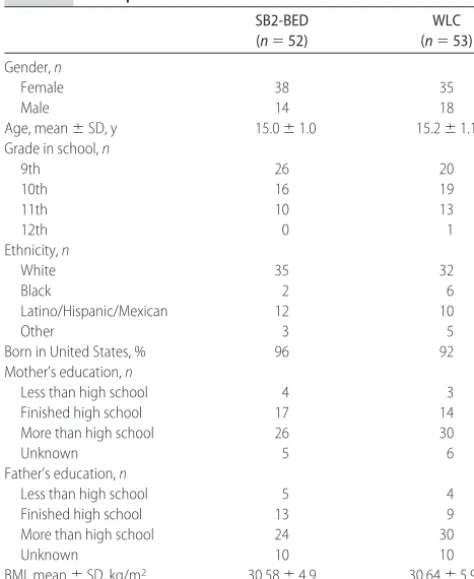
Students were recruited to participate in the Internet-based, healthy weight maintenance program through flyers and presentations in health education and physical education classes at cooperating high schools. Additional recruitment presentations were conducted at student rallies, freshmen orientation, and parent back-to-school night. Participant baseline characteristics are provided in Table 1. There were no significant differences between the intervention (StudentBodies2-BED [SB2-BED]) group and the wait-list control (WLC) group with re-spect to any demographic variables.
Study Design
Participant random assignment was stratified according to school, and random number sequences were gener-ated by the study coordinator with SPSS 12.0 for Win-dows (SPSS, Chicago, IL). There were 2 cohorts, each of which included participants from each site. Cohort 1 began the program in the spring of 2005 and completed it over the summer of 2005, and cohort 2 started the program in the autumn of 2005 and ended it in the winter of 2006. The study was approved by the partici-pating school districts and by the institutional review boards of Stanford University and Boise State University.
Study Procedures
After expressing interest in the study, potential partici-pants received an initial screening questionnaire, parent consent form, and student assent form to be signed and returned. The baseline questionnaire asked students to report their gender, date of birth, height, weight, grade in school, and contact information. Students were con-tacted by telephone to complete a more-comprehensive telephone screening questionnaire. Eligible participants were scheduled for an appointment at their respective schools, during which they completed several self-report questionnaires and a semi-structured diagnostic inter-view (Eating Behaviors Inventory [EBI]) and had their heights and weights measured. Participants completed the same assessment by telephone at the posttreatment assessment and provided self-reported height and weight. Participants were contacted 9 months after the baseline assessment for in-person measurements of height and weight and completion of the telephone self-report questionnaire and semi-structured interview. As-sessments were performed by the study coordinator and trained research assistants, who were supervised by a licensed psychologist and psychiatrist. Assessors were blinded with respect to participant assignment at the follow-up assessment but were not blinded with respect to assignment at the postintervention evaluation, be-cause of the inclusion of program satisfaction question-naires for SB2-BED participants.
Internet Privacy and Confidentiality Procedures
Participants were informed of the security risks associ-ated with online programs because of the inability to restrict all access to an Internet server; however, partic-ipants’ privacy was maintained to the greatest extent possible. The online program used a password-protected server, possible intrusions were monitored, and data were removed from the server after program comple-tion. The Web site was also equipped with a privacy feature that automatically logged users out of the pro-gram after 15 minutes of inactivity. No intrusions were detected. Both the intervention and the server were compliant with Health Insurance Portability and Ac-countability Act guidelines. Participants were assigned identification numbers to protect confidentiality and were asked not to reveal identifying information online.
TABLE 1 Participant Baseline Characteristics SB2-BED (n⫽52)
WLC (n⫽53)
Gender,n
Female 38 35
Male 14 18
Age, mean⫾SD, y 15.0⫾1.0 15.2⫾1.1
Grade in school,n
9th 26 20
10th 16 19
11th 10 13
12th 0 1
Ethnicity,n
White 35 32
Black 2 6
Latino/Hispanic/Mexican 12 10
Other 3 5
Born in United States, % 96 92
Mother’s education,n
Less than high school 4 3
Finished high school 17 14
More than high school 26 30
Unknown 5 6
Father’s education,n
Less than high school 5 4
Finished high school 13 9
More than high school 24 30
Unknown 10 10
WLC Group
WLC participants were informed at the start of the study that they would be offered the program at the 9-month follow-up assessment, in either online or printed format. A total of 11 participants elected to use the online sion and 6 participants reported using the printed ver-sion, although all control participants were offered the intervention.
Assessment Measures
BMI
Standing height was measured to the nearest 0.5 inch. Weight was determined to the nearest 0.1 lb by using a digital scale, with participants wearing light indoor clothing without shoes or coats. Participants were not instructed to fast before weight measurement, and mea-surements were taken during school hours. Height and weight were converted to BMI.
Binge Eating Behavior
Frequencies of OBEs, SBEs, and OOEs were measured with a semi-structured diagnostic interview, which is the recommended approach for evaluating binge eating among children and adolescents.40The EBI was adapted
from the Eating Disorder Examination41for use with an
adolescent population.42The EBI has been used in
sev-eral large epidemiologic studies of eating disorder risk factors in adolescents and hascoefficients ofⱖ.74 for key questions related to OBEs.42For the present study,
the EBI was modified to focus specifically on binge eat-ing disorder symptoms and objective overeateat-ing, includ-ing OBEs, SBEs, OOEs, compensatory behaviors, and weight and shape concerns. Existing questions on the EBI about OBEs (eg, “Since [3 months ago], have there been any times when you have eaten what you think is a really large amount of food in 2 hours or less?”) were supplemented by questions that attempted to simplify the concept (eg, “We consider a large amount of food to be something like 6 pieces of a large pizza or 5 donuts; do you think that you have eaten this amount of food or its equivalent in 2 hours or less, during the past 3 months?”). Participants were included if they were at risk for overweight or overweight (BMI of 85th percen-tile) and reported binge eating on the baseline screen, even if they did not meet criteria for having OBEs, SBEs, or OOEs during the structured interview. Because indi-viduals with binge eating disorder often experience OBEs and SBEs and loss of control is associated with inappropriate weight gain2 and greater eating-related
psychopathological features and depression,16,19
frequen-cies of OBEs and SBEs were combined in the analyses, to represent eating episodes involving loss of control.
Dietary Fat and Sugar Intake
Dietary fat and sugar intake was measured with the PACE⫹ dietary fat screening measure.43 This 21-item
self-report inventory assesses dietary intake of high-fat and high-sugar foods over a 1-week time period and has adequate internal consistency (␣⬎.70) and test-retest reliability (intraclass correlation ⬎ 0.60), as well as a
significant positive correlation with percentage of energy from fat (r⫽0.36;P⬍.01).
Depressive Mood
Depressed mood was examined by using the Center for Epidemiologic Studies Depression Scale.44The Center for
Epidemiologic Studies Depression Scale is a 20-item self-report scale designed to measure depressive symptoms, and it has adequate internal consistency (␣⬎.86) in a population of high school students.45
Program Adherence
Adherence was calculated as the mean number of con-tent screens accessed per week over the 16 weeks. Ex-amples of data collected include the mean number of food journal entries and number of messages posted to the discussion group.
Intervention
The SB2-BED intervention is a 16-week, Internet-facil-itated, semi-structured program that incorporates cogni-tive-behavioral principles from the self-help manual for binge eating disorder by Fairburn,46 the adolescent
weight loss intervention, Healthy Habits, described by Saelens et al,47and hunger and satiety awareness skills.48
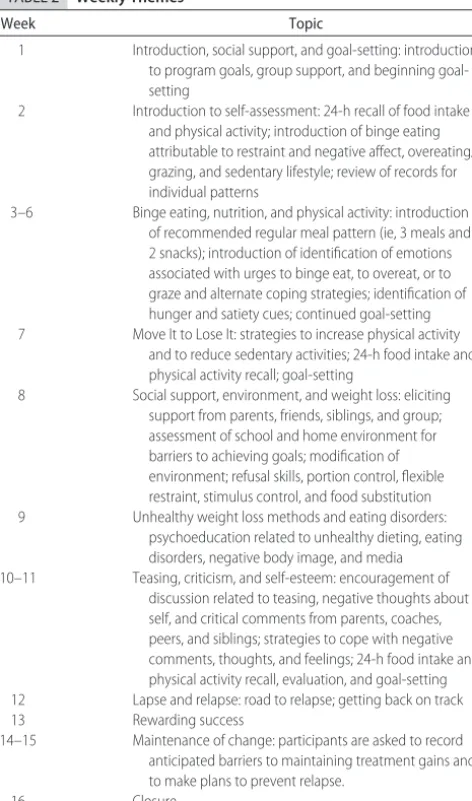
The intervention combines psychoeducation and behav-ioral interventions such as self-monitoring, goal-setting, stimulus control, and appetite awareness and introduces emotion regulation skills. The primary goals of the in-tervention were (1) to reduce binge eating, (2) to matain weight, (3) to increase healthy eating, (4) to in-crease physical activity, and (5) to reduce sedentary activities. The program introduced a new topic related to healthy eating, physical activity, binge eating, and weight loss/maintenance each week (Table 2), with con-tent from previous weeks being accessible at any time. In addition to psychoeducational material, the online pro-gram included interactive components such as self-monitoring journals for dietary intake, physical activity, weight, personal thoughts, and goals, as well as an asyn-chronous discussion group moderated by a research as-sistant. Students were given a packet of the monitoring forms to complete off-line, followed by entering the data into their online journal. As an additional program aid, a handbook was developed for parents.
Weekly letters were sent to participants to reinforce program participation and to encourage participants who did not comply with study expectations for partic-ipation. In addition, intermittent motivational messages were mailed to participants in an attempt to increase program adherence. Because of the relatively low adher-ence to the intervention observed for the first cohort, students in cohort 2 were given the option of face-to-face meetings with a mentor.
Statistical Analyses
by using completer analyses and intention-to-treat anal-yses, with baseline scores being carried forward. Only results from the completer analysis are included, because there were no differences between the completer and intention-to-treat analyses. Linear regression analyses were conducted on change scores for continuous depen-dent variables by using the following equation: change score⫽cgroup⫹csite⫹ccohort⫹(cgroup⫻csite)⫹(cgroup⫻ ccohort) ⫹ (csite ⫻ ccohort) ⫹ (cgroup ⫻ csite ⫻ ccohort), in
which c denotes centering. Effect sizes were calculated by dividing the difference between the mean change in the treatment group and the mean change in the WLC group by the pooled SD.
RESULTS
Attrition and Adherence
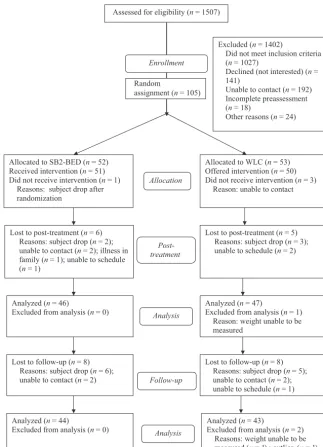
Participant flow can be seen in Fig 1. Overall, 105 par-ticipants were eligible and assigned randomly to either the SB2-BED group (n⫽52) or the WLC group (n⫽53). Eighteen participants (17%) had no follow-up data and were not available for the completer analysis. Pearson’s
2 tests and independent-sample t tests were used to
compare dropouts and completers with respect to all baseline variables. Dropouts were more likely to be white (2⫽7.25;P⬍.01) and to report depressed mood
(t96⫽ ⫺3.17;P⬍.01) and had greater weight and shape
concerns (t101⫽ ⫺2.36;P⬍.05), compared with
com-pleters. In the WLC group, 1 participant at posttreatment assessment and 1 participant at follow-up assessment reported participation in an outside weight loss program. There were no site or cohort differences in any primary outcome variable at baseline assessment, however, there was a greater incidence of binge eating in the treatment group at baseline assessment, which was addressed through the use of nonparametric analyses.
Approximately 27% of all SB2-BED participants (n⫽
14) used some component of the online program forⱖ8 weeks, 42% (n⫽22) used the program for 1 to 7 weeks, and 31% (n⫽16) never logged on. Participants used the online food journal function more frequently than the other online journals (Table 3). For cohort 2, on average, students attended only 1 mentor session. Spearman’s correlation coefficients were used to examine the rela-tionship between adherence and primary outcome vari-ables and yielded no significance. There were also no significant differences between cohorts in any primary outcome variables.
Weight Change
In the completer analyses, there were significant differ-ences in the change in BMIzscore (t87⫽ ⫺3.1;P⬍.01;
effect size: 0.8) (Fig 2) and the change in BMI (t87 ⫽ ⫺2.7;P⬍.01; effect size: 0.6) from baseline assessment to follow-up assessment, with SB2-BED participants ex-periencing greater reductions in BMI zscore and BMI. Intention-to-treat analyses also revealed significant dif-ferences in the changes in BMI zscore (t103⫽ ⫺3.15; P⬍.01) and BMI (t103⫽ ⫺2.58;P⬍.01) from baseline
assessment to follow-up assessment for the SB2-BED group, compared with the WLC group. Data from the posttreatment assessment at 4 months are included in Fig 2 for descriptive purposes but were not included in the analyses because they were self-reported rather than measured directly.
Among completers, 7% of the SB2-BED participants (3 of 44 participants) and 5% of the WLC participants (2 of 43 participants) were not at risk for overweight (ie, BMI of ⬍85th percentile) at baseline assessment. At follow-up assessment, 27% of SB2-BED participants were not at risk for overweight, compared with 12% in the WLC group (2⫽3.4;P⫽.067).
Changes in Binge Eating and Eating Disorder Psychopathological Features
Mann-Whitney tests indicated significant reductions in OBEs and SBEs from baseline assessment to posttreat-ment assessposttreat-ment (U81⫽565;P⬍.01) and from baseline
assessment to follow-up assessment (U84 ⫽652.5;P⬍
.05) for SB2-BED participants. The baseline assessment to posttreatment assessment (U103⫽939.5;P⬍.01) and
baseline assessment to follow-up assessment (U103 ⫽
TABLE 2 Weekly Themes
Week Topic
1 Introduction, social support, and goal-setting: introduction to program goals, group support, and beginning goal-setting
2 Introduction to self-assessment: 24-h recall of food intake and physical activity; introduction of binge eating attributable to restraint and negative affect, overeating/ grazing, and sedentary lifestyle; review of records for individual patterns
3–6 Binge eating, nutrition, and physical activity: introduction of recommended regular meal pattern (ie, 3 meals and 2 snacks); introduction of identification of emotions associated with urges to binge eat, to overeat, or to graze and alternate coping strategies; identification of hunger and satiety cues; continued goal-setting 7 Move It to Lose It: strategies to increase physical activity
and to reduce sedentary activities; 24-h food intake and physical activity recall; goal-setting
8 Social support, environment, and weight loss: eliciting support from parents, friends, siblings, and group; assessment of school and home environment for barriers to achieving goals; modification of environment; refusal skills, portion control, flexible restraint, stimulus control, and food substitution 9 Unhealthy weight loss methods and eating disorders:
psychoeducation related to unhealthy dieting, eating disorders, negative body image, and media 10–11 Teasing, criticism, and self-esteem: encouragement of
discussion related to teasing, negative thoughts about self, and critical comments from parents, coaches, peers, and siblings; strategies to cope with negative comments, thoughts, and feelings; 24-h food intake and physical activity recall, evaluation, and goal-setting 12 Lapse and relapse: road to relapse; getting back on track
13 Rewarding success
14–15 Maintenance of change: participants are asked to record anticipated barriers to maintaining treatment gains and to make plans to prevent relapse.
1040.5;P ⬍.05) changes in OBEs and SBEs remained the same when baseline scores were carried forward. Weight and shape concerns in the SB2-BED group de-creased significantly from baseline assessment to fol-low-up assessment (t78 ⫽ ⫺2.4;P ⬍.05) among
com-pleters, but not in the intention-to-treat analysis. No
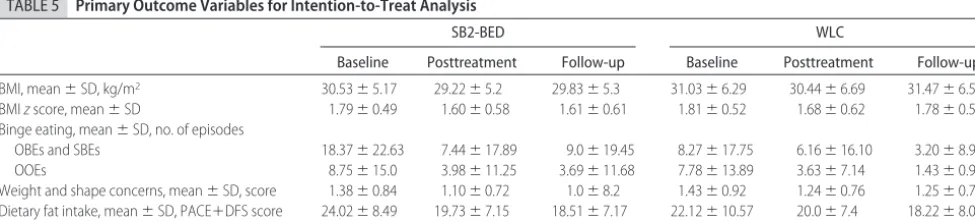
significant effects were observed for changes in OOEs, dietary fat and sugar intake, or depression. Although a self-report physical activity measure was used, the mea-sure proved unreliable in this sample because of large variations among participants and inaccurate scores (eg, sum of time spent engaged in sedentary activity, walk-ing, and moderate or vigorous physical activity exceeded 24 hours). The means for follow-up completers for all outcome variables are provided in Table 4. Although there were negligible differences between the completer analysis and the intention-to-treat analysis, the inten-tion-to-treat results are presented in Table 5.
Relationship of Binge Eating to Weight Change
To determine the relationship of binge eating to weight change, we evaluated the changes in BMI z scores for participants with baseline OBEs, SBEs, or OOEs (Fig 3). For SB2-BED participants with no baseline
disordered-TABLE 3 Participant Adherence
Adherence Variable Mean⫾SD
(Range)
No. of main topic screens viewed (of 104) 20.2⫾28.2 (0–94) Weeks of content screens accessed 4.5⫾5.2 (0–16) No. of food journal entries 21.4⫾30.7 (0–107) No. of physical activity journal entries 8.4⫾23.4 (0–157) No. of weight journal entries 2.8⫾4.3 (0–16) No. of discussion group postings 5.2⫾8.6 (0–34) No. of personal journal entries 3.0⫾5.4 (0–23)
Assessed for eligibility (n = 1507)
Excluded (n = 1402)
Did not meet inclusion criteria (n = 1027)
Declined (not interested) (n = 141)
Unable to contact (n = 192) Incomplete preassessment (n = 18)
Other reasons (n = 24)
Analyzed (n = 44)
Excluded from analysis (n = 0) Lost to follow-up (n = 8) Reasons: subject drop (n = 6); unable to contact (n = 2) Allocated to SB2-BED (n = 52) Received intervention (n = 51) Did not receive intervention (n = 1) Reasons: subject drop after randomization
Lost to follow-up (n = 8) Reasons: subject drop (n = 5); unable to contact (n = 2);
unable to schedule (n = 1) Allocated to WLC (n = 53) Offered intervention (n = 50) Did not receive intervention (n = 3) Reason: unable to contact
Analyzed (n = 43)
Excluded from analysis (n = 2) Reasons: weight unable to be
measured (n = 1) ; outlier (n = 1) Allocation
Analysis Follow-up Enrollment
Random
assignment (n = 105)
Analyzed (n = 46)
Excluded from analysis (n = 0) Lost to post-treatment (n = 6)
Reasons: subject drop (n = 2); unable to contact (n = 2); illness in family (n = 1); unable to schedule (n = 1)
Lost to post-treatment (n = 5) Reasons: subject drop (n = 3); unable to schedule (n = 2)
Analyzed (n = 47)
Excluded from analysis (n = 1) Reason: weight unable to be
measured Analysis
Post-treatment FIGURE 1
eating episodes (n ⫽ 19), the mean change in BMI z
score from baseline assessment to follow-up assessment was⫺0.12⫾0.24, compared with 0.08⫾0.23 for WLC participants (n ⫽ 27). For SB2-BED participants with baseline disordered-eating episodes (n⫽25), the mean change in BMIzscore from baseline assessment to fol-low-up assessment was ⫺0.28 ⫾ 0.34, compared with 0.05⫾ 0.22 for the WLC group (n ⫽16;t40⫽ ⫺3.78; P⬍.01).
DISCUSSION
This is the first study to demonstrate the efficacy of an Internet-facilitated intervention for adolescent weight maintenance and binge eating reduction. The results indicate that weight management and eating disorder psychopathological feature reduction can be achieved simultaneously by using an easily disseminated, Inter-net-facilitated program. The strengths of this study in-clude the randomized, controlled design and the inclu-sion of a heterogeneous group of adolescents who were at risk for overweight and overweight, some but not all of whom reported engaging in binge eating and overeating. This study has several limitations, includ-ing the use of a WLC group instead of a comparison group, self-reported height and weight data at postin-tervention assessment, nonblinding of assessors to
randomization at postintervention assessment, and low adherence rates.
Although the intervention had a significant effect on weight maintenance, the findings are somewhat surpris-ing, given the fact that the majority of participants used the online program for ⬍8 weeks and there was no relationship between adherence and outcomes. The low adherence is a limitation of this study and may be a result of the competing time demands faced by adoles-cents or a failure of the intervention to engage partici-pants sufficiently. The self-directed nature of the SB2-BED intervention has the advantage of allowing participants to access the program at their convenience, removing barriers to access; however, this may be less advantageous for adolescents, who may benefit from greater structure. The data suggest that a 16-week pro-gram may not be necessary to achieve behavior change and that adolescents who are at risk for overweight may experience benefits from a shorter intervention, possibly with booster sessions and a longer follow-up period. Furthermore, given the decline in program use over the 16 weeks, future programs should “front-load” the core program content, to maximize the effectiveness of early sessions.
The reductions in OBEs, SBEs, and OOEs in the WLC group were surprising, given that few of those
partici-TABLE 4 Primary Outcome Data for Follow-up Completers
SB2-BED WLC
Baseline Posttreatment Follow-up Baseline Posttreatment Follow-up
BMI, mean⫾SD, kg/m2 30.58⫾4.9 28.76⫾4.72 29.76⫾5.34 30.64⫾5.97 29.99⫾5.92 31.17⫾6.33a BMIzscore, mean⫾SD 1.81⫾0.47 1.56⫾0.59 1.60⫾0.62 1.79⫾0.51 1.68⫾0.54 1.76⫾0.57a Binge eating, mean⫾SD, no. of episodes
OBEs and SBEs 15.16⫾20.78 0.95⫾3.88 2.29⫾7.67 8.42⫾18.74 6.98⫾17.55 2.74⫾8.60b
OOEs 7.89⫾14.28 2.05⫾6.98 2.16⫾9.33 7.53⫾14.28 2.34⫾5.25 1.07⫾2.80
Weight and shape concerns, mean⫾SD, score 1.3⫾0.80 1.05⫾0.64 0.81⫾0.67 1.35⫾0.92 1.27⫾0.78 1.14⫾0.72b Dietary fat intake, mean⫾SD, PACE⫹DFS score 24.54⫾8.63 18.88⫾6.56 18.25⫾6.95 22.06⫾10.73 20.05⫾7.49 17.33⫾7.57 Depressed mood, mean⫾SD, CES-D score 14.26⫾9.43 9.63⫾8.30 12.42⫾11.59 15.63⫾10.33 12.57⫾10.10 10.49⫾11.21
CES-D indicates Center for Epidemiologic Studies Depression Scale; DFS, Dietary Fat Screening.
aP⬍.001, compared with the WLC group. bP⬍.05, compared with the WLC group.
FIGURE 2
pants reported engaging in outside weight loss program or binge eating treatment. However, this might reflect the variable course and transitory nature of binge eating symptoms49or might be a result of measurement error,
given the difficulty of assessing binge eating accurately in adolescents.40 This finding also might be attributable
to the fact that many participants engaged in subclinical levels of binge eating, representing a temporary occur-rence of disordered eating rather than a stable behav-ioral pattern. A social desirability effect might have re-sulted in fewer participants reporting overeating episodes at follow-up assessment in both groups. The reductions in OBEs, SBEs, and OOEs observed in the SB2-BED group seem to be consistent with previous research suggesting that weight management interven-tions may lead to decreases in disordered eating.29,30,50
The study raises questions about weight maintenance versus weight loss as a strategy among students at risk for overweight. On average, participant BMIs in this sample were⬃0.75 lower 9 months after baseline mea-surements, despite the program’s focus on weight main-tenance. This study produced a similar but slightly greater effect on BMI, compared with that found by Williamson et al,36 who described a BMI reduction of
⬃0.55 among overweight, black, adolescent girls after a 6-month, Internet-delivered intervention. Given the
finding of weight regain at the 2-year follow-up assess-ment reported by Williamson et al36 and the upward
trend in BMI observed in this study at the 6-month follow-up assessment, prolonged maintenance interven-tions, possibly also involving parents, may provide the support required for lasting weight maintenance.
Although in-person cognitive-behavioral treatment for overweight adolescents seems to yield the strongest effect on weight loss,51Internet-facilitated programs may
offer an effective means of preventing weight gain among adolescents at risk for overweight. Perhaps a focus on general meal size, eating control, and satiation is a more practical strategy than a program focused on weight loss for nonobese adolescents at risk of over-weight. Emphasizing weight maintenance versus weight loss in the intervention’s philosophy, language, and goal-setting might have allowed participants to set real-istic expectations for behavior change, possibly minimiz-ing disappointment and discouragement for participants who experienced gradual BMI changes, rather than marked decreases in BMI. Of note, this is one of the few programs to include a focus on training students to mon-itor satiation, with the goal of stopping eating when full. The food journal function asked participants to rate their hunger and satiety and to identify triggers for overeat-ing. Overall, participants used the food journal slightly more than 1 time per week (mean: 21.4 entries; SD: 30.7 entries), which suggests that adolescents are reasonably interested in monitoring intake. In addition, a focus on lifestyle changes, positive body image, improving self-esteem and mood, and responding to teasing and nega-tive sociocultural norms might have strengthened the overall effect of the intervention. The intervention was designed also to change other weight-related health in-dicators, including physical activity and fat and sugar intake. Reductions in self-reported dietary fat and sugar intake were reported in both groups. Unfortunately, the data reported for physical activity were unreliable and are not reported.
The inclusion of participants with a wide range of overeating behaviors, some with binge eating and some without, allowed the comparison of these 2 subgroups with respect to primary outcome variables. For the over-all sample, there was no relationship between change in
1.4 1.5 1.6 1.7 1.8 1.9 2.0 2.1
p u -w o ll o F e
n il e s a B
BMI
z
score
WLC Treatment
FIGURE 3
Mean BMIzscores at baseline and follow-up assessments for participants with baseline OBE, SBE, and OOE values.
TABLE 5 Primary Outcome Variables for Intention-to-Treat Analysis
SB2-BED WLC
Baseline Posttreatment Follow-up Baseline Posttreatment Follow-up
BMI, mean⫾SD, kg/m2 30.53⫾5.17 29.22⫾5.2 29.83⫾5.3 31.03⫾6.29 30.44⫾6.69 31.47⫾6.55a BMIzscore, mean⫾SD 1.79⫾0.49 1.60⫾0.58 1.61⫾0.61 1.81⫾0.52 1.68⫾0.62 1.78⫾0.57b Binge eating, mean⫾SD, no. of episodes
OBEs and SBEs 18.37⫾22.63 7.44⫾17.89 9.0⫾19.45 8.27⫾17.75 6.16⫾16.10 3.20⫾8.92a
OOEs 8.75⫾15.0 3.98⫾11.25 3.69⫾11.68 7.78⫾13.89 3.63⫾7.14 1.43⫾0.92
Weight and shape concerns, mean⫾SD, score 1.38⫾0.84 1.10⫾0.72 1.0⫾8.2 1.43⫾0.92 1.24⫾0.76 1.25⫾0.77 Dietary fat intake, mean⫾SD, PACE⫹DFS score 24.02⫾8.49 19.73⫾7.15 18.51⫾7.17 22.12⫾10.57 20.0⫾7.4 18.22⫾8.07 Depressed mood, mean⫾SD, CES-D score 16.62⫾10.26 11.29⫾9.76 12.35⫾11.57 15.94⫾10.49 13.22⫾10.79 11.16⫾11.05
CES-D indicates Center for Epidemiologic Studies Depression Scale; DFS, Dietary Fat Screening.
binge eating and change in BMI zscore, which is con-sistent with other studies that demonstrated that similar amounts of weight loss could be achieved by individuals with and without binge eating.50 However, SB2-BED
participants who reported binge eating or overeating at baseline assessment experienced significantly greater re-ductions in BMI z score than did WLC subjects. This suggests that, whereas a combined intervention for binge eating and weight maintenance effectively stabi-lizes weight among adolescents with and without disor-dered-eating episodes, the combined intervention is par-ticularly effective in preventing weight gain among participants with a history of binge eating and overeat-ing. In fact, the effect of the intervention overall may be related to changes in binge eating. As mentioned, binge eating predicts weight gain in adolescents, the interven-tion was designed to reduce binge eating, and there was a significant change in binge eating. However, these findings need to be considered in light of the much higher binge eating rates at baseline assessment in the SB2-BED group, compared with the WLC group, and the fact that the reported reductions for both groups were large.
Some professionals suggest that weight loss programs increase attention to weight, thereby increasing the risk for eating disorders. The reduction in weight and shape concerns observed from baseline assessment to fol-low-up assessment suggests that the intervention was associated with reduction in risk factors for eating disor-ders (eg, weight and shape concerns and dietary restric-tion). These improvements may be a result of the inclu-sion of intervention components designed specifically to address eating disorder psychopathological conditions. This finding supports the conclusion that weight man-agement programs that integrate key components of eating disorder prevention programs pose minimal risk for precipitating eating disorders in adolescents at risk for overweight28and may even reduce the risk of
develop-ing eatdevelop-ing disorders.
Although this study found a strong effect for stabili-zation of weight gain and reduction in binge eating and overeating at 9-month follow-up assessment, an ex-tended follow-up period would enhance the importance of the findings. In addition, comparison of the Internet-facilitated intervention and face-to-face intervention would provide a more-rigorous and clinically meaning-ful comparison. Given the significant differences be-tween dropouts and completers in terms of ethnicity, depression, and weight and shape concerns, future stud-ies are needed to examine the effects of matching par-ticipants to more-intensive, possible face-to-face inter-ventions, based on demographic data and severity of psychopathological features or risk factors.
This study suggests that a short-term Internet-facili-tated program can promote weight maintenance and reduce binge eating in motivated adolescents. It has the potential to be delivered in a variety of settings, includ-ing pediatric offices and schools, and to be incorporated into community-based programs.
ACKNOWLEDGMENTS
This study was supported by a grant from the National Institute of Diabetes and Digestive and Kidney Diseases (grant DK065757).
Appreciation is expressed to Brian Saelens, PhD, for contributing program content from Healthy Habits to the intervention and to Linda Craighead, PhD, for her assis-tance in adapting concepts of appetite awareness for the study population. We also thank Theresa McEwan, Chris Boynton, Dan Morrison, Don Nesbitt, and the participat-ing schools.
REFERENCES
1. Centers for Disease Control and Prevention. Health objectives for the nation prevalence of overweight among adolescents: United States 1988 –1991. Available at: www.cdc.gov/mmwr/ preview/mmwrhtml/00033492.htm. Accessed March 28, 2007 2. Ogden C, Carroll MD, Curtin LR, McDowell MA, Tabak CJ, Flegal KM. Prevalence of overweight and obesity in the United States, 1999 –2004.JAMA.2006;295(13):1549 –1555
3. Goldschmidt AB, Passi VA, Sinton MM, Tanofsky-Kraff M, Wilfley DE. Abnormal eating patterns in overweight children and adolescents. In:Recent Progress in Obesity Research: Proceed-ings of the International Congress on Obesity Conference. 2007 4. Kinzl JF, Traweger C, Trefalt E, Mangweth B, Biebl W. Binge
eating in females: a population-based investigation. Int J Eat Disord.1999;25(3):287–292
5. Fairburn CG, Cooper Z, Doll HA, Norman P, O’Conner M. The natural course of bulimia nervosa and binge eating disorder in young women.Arch Gen Psychiatry.2000;57(7):659 – 665 6. Neumark-Sztainer D, Croll J, Story M, Hannan PJ, French SM,
Perry C. Ethnic/racial differences in weight-related concerns and behaviors among adolescent girls and boys: findings from project EAT.J Psychosom Res.2002;53(5):963–974
7. Stice E, Cameron RP, Killen JD, Hayward C, Taylor CB. Natu-ralistic weight-reduction efforts prospectively predict growth in relative weight and onset of obesity among female adolescents.
J Consult Clin Psychol.1999;67(6):967–974
8. Marcus MD, Mouton MM, Greeno CG. Binge eating onset in obese patients with binge eating disorder.Addict Behav.1992; 20(6):747–755
9. Tanofsky-Kraff M, Cohen ML, Yanovski SZ, et al. A prospective study of psychological predictors of body fat gain among chil-dren at high risk for adult obesity. Pediatrics. 2006;117(4): 1203–1209
10. Field AE, Austin SB, Taylor CB, et al. Relation between dieting and weight change among preadolescents and adolescents.
Pediatrics.2003;112(4):900 –906
11. Stice E, Presnell K, Shaw H, Rohde P. Psychological and be-havioral risk factors for obesity onset in adolescent girls: a prospective study.J Consult Clin Psychol.2005;73(2):195–202 12. Agras WS, Telch CF, Arnow B, et al. Weight loss,
cognitive-behavioral, and desipramine treatments in binge eating disorder: an additive design.Behav Ther.1994;25(2):225–238 13. Telch CF, Pratt EM, Niego SH. Obese women with binge eating
disorder define the term binge.Int J Eat Disord. 1998;24(3): 313–317
14. Striegel-Moore RH, Dohn F, Kraemer HC, Taylor CB, Daniels S, Crawford P. Eating disorders in black and white women.Am J Psychiatry.2003;160(7):1326 –1331
16. Goossens L, Braet C, Decaluwe V. Loss of control over eating in obese youngsters.Behav Res Ther.2007;45(1):1–9
17. Morgan CM, Yanovski SZ, Nguyen TT, et al. Loss of control over eating, adiposity, and psychopathology in overweight children.Int J Eat Disord.2002;31(4):430 – 441
18. Decaluwe´ V, Braet C, Fairburn CG. Binge eating in obese children and adolescents.Int J Eat Disord.2003;33(1):78 – 84 19. Tanofsky-Kraff M, Faden D, Yanovski SZ, Wilfley DE, Yanovski
JA. The perceived onset of dieting and loss of control eating behaviors in overweight children.Int J Eat Disord.2005;38(2): 112–122
20. Agras WS, Telch CF. The effects of caloric deprivation and negative affect on binge eating in obese binge-eating disor-dered women.Behav Ther.1998;29(3):491–503
21. Pratt EM, Niego SH, Agras WS. Does the size of a binge matter?
Int J Eat Disord.1998;24(3):307–312
22. Marcus MD, Kalarchian MA. Binge eating in children and adolescents.Int J Eat Disord.2003;34(suppl):S47–S57 23. Neumark-Sztainer D, Story M, French SA, Resnick MD.
Psy-chosocial correlates of health compromising behaviors among adolescents.Health Educ Res.1997;12(1):37–52
24. McCabe MP, Ricciardelli LA, Holt K. A longitudinal study to explain strategies to change weight and muscles among normal weight and overweight children.Appetite.2005;45(3):225–234 25. Cooper Z, Fairburn CG. A new cognitive behavioral approach to the treatment of obesity. Behav Res Ther. 2001;39(5): 499 –511
26. Irving LM, Neumark-Sztainer D. Integrating the prevention of eating disorders and obesity: feasible or futile?Prev Med.2002; 34(3):299 –309
27. Haines J, Neumark-Sztainer D. Prevention of obesity and eat-ing disorders: a consideration of shared risk factors.Health Educ Res.2006;21(6):770 –782
28. Butryn ML, Wadden TA. Treatment of overweight in children and adolescents: does dieting increase the risk of eating disor-ders?Int J Eat Disord.2005;37(4):285–293
29. Presnell K, Stice E. An experimental test of the effect of weight-loss dieting on bulimic pathology: tipping the scales in a different direction.J Abnorm Psychol.2003;112(1):166 –170
30. Stice E, Martinez EE, Presnell K, Groesz LM. Relation of suc-cessful dietary restriction to change in bulimic symptoms: a prospective study of adolescent girls. Health Psychol. 2006; 25(3):274 –281
31. Austin SB, Field AE, Wiecha J, Peterson KE, Gortmaker SL. The impact of a school-based obesity prevention trial on dis-ordered weight-control behaviors in early adolescent girls.Arch Pediatr Adolesc Med.2005;159(3):225–230
32. Neumark-Sztainer D, Martin SL, Story M. School-based pro-grams for obesity prevention: what do adolescents recom-mend?Am J Health Promot.2000;14(4):232–235
33. Harvey-Berino J, Pintauro S, Buzzell P, Gold EC. Effect of Internet support on the long-term maintenance of weight loss.
Obes Res.2004;12(2):320 –329
34. Winett RA, Tate DF, Anderson ES, Wojcik JR, Winett SG.
Long-term weight gain prevention: a theoretically based Inter-net approach.Prev Med.2005;41(2):629 – 641
35. Tate DF, Jackvony EH, Wing RR. A randomized trial comparing human e-mail counseling, computer-automated tailored coun-seling, and no counseling in an Internet weight loss program.
Arch Intern Med.2006;166(15):1620 –1625
36. Williamson DA, Walden HM, White MA, et al. Two-year In-ternet-based randomized controlled trial for weight loss in African-American girls.Obesity.2006;14(7):1231–1243 37. Viner R, Bryant-Waugh R, Nicholls D, Christie D. Childhood
obesity: aim should be weight maintenance, not loss. BMJ.
2000;320(7246):1401
38. Carlisle LK, Gordon ST, Sothern MS. Can obesity prevention work for our children?J La State Med Soc.2005;157(Spec No 1):S34 –S41
39. Cohen J.Statistical Power Analysis for the Behavioral Sciences. 2nd ed. Hillsdale, NJ: Erlbaum; 1988
40. Decaluwe´ V, Braet C. Assessment of eating disorder psychopa-thology in obese children and adolescents: interview versus self-report questionnaire.Behav Res Ther.2004;42(7):799 – 811 41. Fairburn CG, Cooper Z. The Eating Disorder Examination. In: Fairburn CG, Wilson GT, eds.Binge Eating: Nature, Assessment and Treatment. 12th ed. New York, NY: Guilford Press; 1993: 317–360
42. McKnight Investigators. Risk factors for the onset of eating disorders in adolescent girls: results of the McKnight Longitu-dinal Risk Factor Study.Am J Psychiatry.2003;160(2):248 –254 43. Prochaska JJ, Sallis JF, Rupp J. Screening measure for assessing dietary fat intake among adolescents. Prev Med.2001;33(6): 699 –706
44. Radloff LS. The CES-D scale: a self-report depression scale for research in the general population.Appl Psychol Measure.1977; 1(3):385– 401
45. Radloff LS. The use of the Center for Epidemiologic Studies Depression Scale in adolescents and young adults. J Youth Adolesc.1991;20(2):149 –166
46. Fairburn CG.Overcoming Binge Eating. New York, NY: Guilford Press; 1995
47. Saelens BE, Sallis JF, Wilfley DE, Patrick K, Cella JA, Buchta R. Behavioral weight control for overweight adolescents initiated in primary care.Obes Res.2002;10(1):22–32
48. Craighead LW.The Appetite Awareness Workbook: How to Listen to Your Body and Overcome Bingeing, Overeating, & Obsession With Food. Oakland, CA: New Harbinger Publications; 2006 49. Stunkard AJ, Allison KC. Binge eating disorder: disorder or
marker?Int J Eat Disord.2003;34(suppl):S107–S116
50. Delinsky SS, Latner JD, Wilson GT. Binge eating and weight loss in a self-help behavior modification program. Obesity.
2006;14(7):1244 –1249
DOI: 10.1542/peds.2007-1173
2008;121;453
Pediatrics
Angela Celio Doyle, Denise E. Wilfley and C. Barr Taylor
Megan Jones, Kristine H. Luce, Megan I. Osborne, Katherine Taylor, Darby Cunning,
Reducing Binge Eating and Overweight in Adolescents
Randomized, Controlled Trial of an Internet-Facilitated Intervention for
Services
Updated Information &
http://pediatrics.aappublications.org/content/121/3/453 including high resolution figures, can be found at:
References
http://pediatrics.aappublications.org/content/121/3/453#BIBL This article cites 45 articles, 3 of which you can access for free at:
Subspecialty Collections
http://www.aappublications.org/cgi/collection/obesity_new_sub Obesity
http://www.aappublications.org/cgi/collection/eating_disorders_sub Eating Disorders
http://www.aappublications.org/cgi/collection/nutrition_sub Nutrition
http://www.aappublications.org/cgi/collection/endocrinology_sub Endocrinology
following collection(s):
This article, along with others on similar topics, appears in the
Permissions & Licensing
http://www.aappublications.org/site/misc/Permissions.xhtml in its entirety can be found online at:
Information about reproducing this article in parts (figures, tables) or
Reprints
DOI: 10.1542/peds.2007-1173
2008;121;453
Pediatrics
Angela Celio Doyle, Denise E. Wilfley and C. Barr Taylor
Megan Jones, Kristine H. Luce, Megan I. Osborne, Katherine Taylor, Darby Cunning,
Reducing Binge Eating and Overweight in Adolescents
Randomized, Controlled Trial of an Internet-Facilitated Intervention for
http://pediatrics.aappublications.org/content/121/3/453
located on the World Wide Web at:
The online version of this article, along with updated information and services, is
by the American Academy of Pediatrics. All rights reserved. Print ISSN: 1073-0397.