CHALLENGING CASE: DEVELOPMENTAL DELAYS AND
REGRESSIONS
Selective Mutism*
CASE
Peter’s parents made an appointment with his pe-diatrician because of their increasing concern about his refusal to speak. After approximately 2 weeks following the start of a new preschool, Peter, 4 years 10 months old, refused to speak to other children or the teacher. During the first week of school, he found it difficult to separate from his mother or father. He would cry and cling to them while asking to go home. This difficult separation experience gradually subsided by the beginning of the third week and corresponded with the onset of mute behavior. At home, he spoke only to his mother, with a clear speech pattern and full sentences. He limited his responses to his father or two older siblings with body gestures. He appeared to hear well and under-stand verbal directions.
Peter’s parents described him as a shy child who eventually makes friends and plays interactively. His play, both by himself and with others, is filled with imaginary activities. There have not been any disrup-tive behaviors at home or with friends. Peter’s ges-tation and birth were uneventful. Motor milestones were on time. At 18 months, he spoke only five words; at 24 months, he spoke 10 words. Two months after his second birthday, he was speaking with clear and elaborate sentences.
Physical examination revealed a normal office screening audiogram (25-dB threshold from 500 –3000 Hz) and the absence of dysmorphic facial features, cleft palate, middle ear fluid, or a neck mass. Compliance of the tympanic membrane on pneumo-otoscopy was normal; this was confirmed by normal peaks on tympanometry. Peter’s orophar-ynx, epiglottis, and uvula were easily visualized and found to be normal. His facial features, body move-ments, and responses to his mother’s commands were consistent with intact auditory receptive func-tion. In the office, he was calm and remained close to his mother. His family drawing revealed age-appro-priate fine motor and visual-perceptual skills. All members of his family were drawn with distinctive differences in size. Peter was at one end of the family group, standing next to his mother. During a 20-minute office assessment, the pediatrician was un-able to engage Peter in spoken speech.
Index terms:selective mutism, mutism, acquired aphasia.
Dr. Martin T. Stein
Selective mutism is an acquired disorder of inter-personal communication in which a child does not speak in one or more environments where commu-nication typically occurs. These children most often refuse to speak in school and to adults outside the home. Some children with selective mutism will not speak to any child; others will use speech with only a few other children. Parents report normal speech within the home with at least one parent and some-times with siblings. The onset of selective mutism is usually in the preschool or early school age period of development; often, it is associated with the start of school.
Although this disorder is uncommon (1% among children seen in mental health centers; 0.1% in the general population), parents of these children are understandably alarmed when the behavior persists. Normal language production at home and persistent mutism outside the home may be baffling.
The etiology and management of selective mutism have undergone a significant change during the past three decades. Clinicians from a variety of disciplines have discovered that most children with selective mutism have not experienced a major personal, fam-ily, or environmental trauma as a trigger for this peculiar behavior. Most recent evidence points to a child’s temperament and behavior consistent with anxiety as the clue to more effective management strategies.
I have asked two experienced clinicians to com-ment on Peter’s presentation to his pediatrician.Dr. Isabelle Rapinis Professor of Pediatrics and Neurol-ogy at the Albert Einstein College of Medicine, where she has taught pediatric neurology for over three decades. I can attest that her reputation as a scholar, teacher, and clinician is unmatched. No pe-diatric resident has left her clinic without equal re-spect for the details of the interview process and the nuances of pediatric neurological examination. Dr. Rapin has written extensively on neurobehavioral aspects of speech and language disorders in children.
Diane Yapko, M.A., is a speech and language pa-thologist with a remarkable ability to unravel lan-guage disorders in children with complex neurolog-ical and behavioral disorders. I asked her to comment on management strategies for children with selective mutism.
Martin T. Stein, MD
Professor of Pediatrics
University of California, San Diego San Diego, California
* Originally published inJ Dev Behav Pediatr.1999;20(1)
Dr. Isabelle Rapin
Selective mutism is virtually the only diagnostic consideration in this preschooler who was silent in school, although he understood what was said to him and was reported to speak normally at home. However, relying on the parents’ report of normal verbal expression at home is inadequate; pediatri-cians must insist that the parents bring in an audio or videotape, so that they can substantiate the report. If it is verified, and if the child is otherwise entirely normal, the child can safely be spared neuroimaging, EEG, and other neurological tests.
If the child is mute or near mute in any environ-ment, other diagnoses come under consideration (Ta-ble 1). A transient (the key word is transient, i.e., lasting at most a few hours or a day) aphasia may be a postepileptic deficit (Todd’s aphasia) or the mani-festation of a migraine, sometimes without head-ache.1Besides sudden onset deafness— exceedingly
rare unless preceded by bacterial meningitis—the first consideration is an acquired aphasia, since vir-tually all acquired aphasias in early childhood are expressive, with or without receptive impairment. Without a history of trauma or signs of an infection, an acute brain lesion producing an isolated aphasia is most likely a stroke, perhaps caused by an embo-lus or sickle cell anemia, although a stroke without associated sensorimotor or other deficit is unlikely. Acquired epileptic aphasia (Landau-Kleffner syn-drome), without overt clinical seizure but with an epileptiform EEG, requires consideration, since it may be sudden. A persistent aphasia with an insid-ious onset brings up the possibility of a mass lesion or a degenerative disease of the brain.
Two large series of children with selective mutism, one describing 100 European children,2the other 50
New York children,3provide concordant data on this
rare frustrating condition of preschoolers and school age children. Girls outnumbered boys 2 to 1. Mean age of reported onset was 4 years in one series and 21⁄2 years in the other, with a range of 1 to 7 years
(i.e., virtually from first words) in a small proportion of children. The possibility of an autistic spectrum (pervasive developmental) disorder needs to be con-sidered in such early cases. The duration was usually 5 or more years after exclusion of children who were mute for less than a month, for example, at the start of school. Although strict criteria for selective mut-ism would exclude children with developmental lan-guage disorders, almost a third of the European
chil-dren and some 20% of the New York sample had delayed or impaired language skills, and some came from immigrant homes where another language was spoken. What characterized both samples was exces-sive social anxiety and shyness, not acting out be-haviors, or depression. There was little or no evi-dence for social or emotional trauma as precipitant. Counseling and psychotherapy were largely inef-fective. A short open trial of fluoxetine in a dose of some 20 mg/day seemed modestly helpful.4 Few
long-term outcome data are available, although fam-ily histories suggest that possibly genetic personality traits like anxiety, social phobia, and avoidance may predispose children to selective mutism. The best ploy for management would seem to be acceptance, sympathetic encouragement, and patience, possibly with a trial of medication.
Isabelle Rapin, MD
Professor of Pediatrics and Neurology Albert Einstein College of Medicine Bronx, New York
REFERENCES
1. Marchioni E, Galimberti CA, Soragna D, et al: Familial hemiplegic migraine versus migraine with prolonged aura: An uncertain diagnosis. Neurology 45:33–37, 1995
2. Steinhausen H-C, Juzi C: Elective mutism: An analysis of 100 cases. J Am Acad Child Adolesc Psychiatry 35:606 – 614, 1996
3. Dummit ES III, Klein RG, Tancer NK, et al: Systematic assessment of 50 children with selective mutism. J Am Acad Child Adolesc Psychiatry 36:653– 660, 1997
4. Dummit ES III, Klein RG, Tancer NK, et al: Fluoxetine treatment of children with selective mutism: An open trial. J Am Acad Child Adolesc Psychiatry 35:615– 621, 1996
Diane Yapko, M.A.
Primary care pediatricians are increasingly chal-lenged to treat a variety of problems that may not be found in traditional medical training. The case of Peter is a typical example. Peter’s symptoms and history are consistent with a diagnosis of selective mutism, as defined in Diagnostic and Statistical Manual of Mental Disorders, 4th edition (DSM-IV).1
Historically, children with selective mutism have been treated by mental health professionals or speech-language therapists. My professional experi-ence leads me to recommend that physicians con-tinue to refer such patients to therapists with exten-sive pediatric experience and a background in cognitive, behavioral, and play therapy. Beyond making well-considered referrals, however, primary care physicians can skillfully manage these children with a variety of techniques, some of which can be illustrated in Peter’s case.
Selective mutism correlates more with anxiety dis-orders and social phobias in contrast to the historical association with oppositional disorders and speech-language problems.2This is reflected in the
modifi-cation of the diagnostic category from “elective” to “selective” mutism. Some children with selective mutism may have associated speech-language or be-havioral problems, either at the time of presentation or in the past.3Characteristically, the primary issues
are related to anxiety associated with the social con-text of speaking.
TABLE 1. Mutism in Childhood: Differential Diagnosis Transient aphasias
Postepileptic (Todd’s aphasia) Migraine Deafness Acquired aphasias Trauma Infection Stroke
Acquired epileptic aphasia (Landau-Kleffner syndrome) CNS mass lesion
CNS degenerative disease
CNS, central nervous system.
SUPPLEMENT 927
at Viet Nam:AAP Sponsored on August 30, 2020
www.aappublications.org/news
Physicians should avoid searching for a single cause of the mutism and especially avoid the sim-plistic assumption that it is necessarily rooted in trauma or abuse. There is little empirical evidence to support this claim, and it may alienate the individ-uals with whom one needs to establish a therapeutic alliance, in this case, Peter and his parents.2Current
research suggests that selective mutism is part of a personality profile consistent with shy and with-drawn behaviors expressed as mutism when a child enters school.3
A focused educational approach should be di-rected toward Peter’s parents. Specific suggestions that follow principles of behavior modification are presented in Table 2.
Fluoxetine has been used effectively with some patients who exhibit selective mutism.4I have found
that most parents of these children choose medica-tion as a last alternative rather than a first-line ap-proach. Fluoxetine may be more appropriate for those individuals who manifest a chronic form of mutism and for whom previous attempts at behav-ioral therapeutic interventions have been ineffective. Finally, the clinician’s use of language can be both suggestive and influential, and, therefore, must be deliberate.5Saying, “I wonder which day it will be
when Peter chooses to talk at school?” or, “I wonder which friend Peter will choose to talk with first?” are important indirect ways of letting Peter know he has choices and that you expect he will speak again. Do not speak about your impressions of Peter’s mutism in front of him. Instead, suggest he play in the wait-ing room. If he is not willwait-ing to separate from his mother in the office, a phone call to discuss Peter
should be arranged with his parents for later that day.
Diane Yapko, MA
Speech-Language Pathologist Solana Beach, California
REFERENCES
1. American Psychiatric Association: Diagnostic and Statistical Manual of Mental Disorders, 4th ed (DSM-IV). Washington, DC, American Psy-chiatric Association, 1994
2. Dummit ES III, Klein RG, Trancer NK, et al: Systematic assessment of 50 children with selective mutism. J Am Acad Child Adolesc Psychiatry 36:653– 660, 1997
3. Steinhausen H-C, Juzi C: Elective mutism: An analysis of 100 cases. J Am Acad Child Adolesc Psychiatry 35:606 – 614, 1996
4. Dummit ES, Klein RG, Trancer NK, et al: Fluoxetine treatment of children with selective mutism: An open trial. J Am Acad Child Adolesc Psychiatry 35:615– 621, 1996
5. Yapko M: Trance Work: An Introduction to the Practice of Clinical Hypnosis, 2nd ed . . . New York, NY, Brunner/Mazel, 1990
Dr. Martin T. Stein
Selective mutism was described over a century ago by the German physician Kussmaul, who wrote about patients with “aphasia voluntaria.” The early psychoanalytic literature contains similar case ports. Moritz Tramer, a Swiss child psychiatrist, re-ported children with “elective mutism,” a term that was used to describe this condition in the Diagnostic and Statistical Manual of Mental Disorders, 3rd edi-tion (DSM-IIIR). Black and Uhde hypothesized that elective mutism was a variant of social phobia in 19921and published a systematic study of selective
mutism and anxiety disorders in children in 1995.2
The most recent diagnostic classification (DSM-IV) uses the term “selective mutism” to emphasize that the disorder is selectively dependent on social con-text.
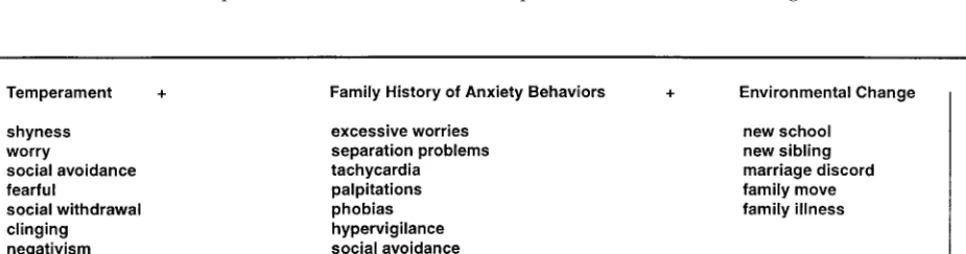
Studies that link selective mutism to a form of anxiety disorder emphasize antecedent behavior (shyness, social phobia, avoidance), a family history of anxiety symptoms s(or disorder), and the absence of major psychological stress as a presenting factor. The recent report of a favorable response among children with selective mutism to a selective seroto-nin receptor inhibitor may add support to reframing the symptom as an anxiety disorder associated with biological and environmental risk factors. The path-way to selective mutism might be conceptualized as presented in the model in Figure 1.
TABLE 2. Selective Mutism in Children: Guidelines for Parent Education
Encourage
The expectation that your child will begin talking again All forms of communication (e.g., facial expressions, gestures,
etc.)
All attempts at speech (e.g., whispers)
Incorporation of teacher in the therapeutic process Discourage
Punishment for lack of speech; prevent negative reinforcement
Insistence on speech, which may cause a no-win “power struggle” (e.g., “If you want “x” then you have to talk.”) Putting him or her “on the spot” to speak in social contexts
This model surely is an oversimplification to ex-plain such an unusual and uncommon symptom. With a high frequency of this temperament profile among children (15–20% of infants; 30 – 40% of school age children label themselves as shy)3, anxiety
disorders in families (5–10%), and the universal oc-currence of life event changes, why is selective mut-ism limited to a small proportion of children with this biological-environmental profile? Perhaps func-tional neuroimaging studies (with and without neu-rotransmitter drugs) will provide answers in the fu-ture. Long-term follow-up studies of these children and their families may also bring about further un-derstanding. Finally, selective mutism may be a final common pathway that is a result of different disor-ders. Dr. Rapin noted that 20% to 30% of children with selective mutism in the two recent studies have some form of developmental language delay. Ex-pressive language disorders and articulation disor-ders were most common. Are these children with selective mutism different from those with normal language development? Perhaps some children with early onset of speech and language disorders are predisposed to a speech avoidance pattern of behav-ior.
Management of children with selective mutism begins with consideration of the context, severity, and duration of the behavior. Some shy children with a history of intense separation reactions will experience a brief period of mutism with the start of preschool or kindergarten. These episodes are typi-cally transient, similar to the behaviors seen at this time during a separation reaction. A resolution fol-lows familiarity with a new teacher and new chil-dren. Other children with persistent mutism will respond to behavior therapy that offers rewards for increased speech or attempts at speech (e.g., mouth-ing words or whispers at school, restaurant, or a friend’s home). Ms. Yapko provides several practical
approaches that can be used by pediatric clinicians. Labbe and Williamson4use formal behavioral
mod-ification terminology that suggests the mechanism of behavioral management strategies:
Contingency management:Positive reinforcement of verbalization and nonreinforcement for nonverbal responses.
Stimulus fading:Gradually providing opportunities (people and places) where verbalization is rewarded. Shaping: Rewarding approximations to speech (e.g., mouthing words and whispering).
Response cost procedures: Losing tokens or money for not speaking.
A trial of behavioral management is a reasonable beginning. The studies using fluoxetine in children with selective mutism are promising, but either un-controlled (n ⫽ 21)5 or controlled, but with a few
patients (n ⫽ 15).6In these pilot studies, fluoxetine
was initiated at 10 mg daily, with graduated doses guided by a response to verbalization. With a mean dose of 21 mg per day (range, 10 – 60 mg), 76% of the children demonstrated increased speech and less anxiety in public settings, including school. Improve-ment was greater in younger children.5
REFERENCES
1. Black B, Uhde TW: Elective mutism as a variant of social phobia. J Am Acad Child Adolesc Psychiatry 31:1091–1094, 1992
2. Black B, Uhde TW: Psychiatric characteristics of children with selective mutism: A pilot study. J Am Acad Child Adolesc Psychiatry 34:847– 856, 1995
3. Cheek JM: Shyness, in Parker S, Zuckerman B (eds): Behavioral-Developmental Pediatrics: A Handbook for Primary Care. Boston, MA, Little, Brown, 1995, p 285
4. Labbe EL, Williamson D: Behavioral treatment of elective mutism: A review of the literature. Clin Psychol Rev 4:273–292, 1984
5. Dummit ES III, Klein RG, Tancer NK, et al: Fluoxetine treatment of children with selective mutism: An open trial. J Am Acad Child Adolesc Psychiatry 35:615– 621, 1995
6. Black B, Uhde TW: Treatment of elective mutism with fluoxetine: A double blind, placebo-controlled study. J Am Acad Child Adolesc Psy-chiatry 33:1000 –1006, 1994
SUPPLEMENT 929
at Viet Nam:AAP Sponsored on August 30, 2020
www.aappublications.org/news
2001;107;926
Pediatrics
Martin T. Stein, Isabelle Rapin and Diane Yapko
Selective Mutism
Services
Updated Information &
itation
http://pediatrics.aappublications.org/content/107/Supplement_1/926.c including high resolution figures, can be found at:
Subspecialty Collections
http://www.aappublications.org/cgi/collection/puberty_sub
Puberty
http://www.aappublications.org/cgi/collection/endocrinology_sub
Endocrinology
following collection(s):
This article, along with others on similar topics, appears in the
Permissions & Licensing
http://www.aappublications.org/site/misc/Permissions.xhtml in its entirety can be found online at:
Information about reproducing this article in parts (figures, tables) or
Reprints
2001;107;926
Pediatrics
Martin T. Stein, Isabelle Rapin and Diane Yapko
Selective Mutism
http://pediatrics.aappublications.org/content/107/Supplement_1/926.citation
located on the World Wide Web at:
The online version of this article, along with updated information and services, is
by the American Academy of Pediatrics. All rights reserved. Print ISSN: 1073-0397.
the American Academy of Pediatrics, 345 Park Avenue, Itasca, Illinois, 60143. Copyright © 2001 has been published continuously since 1948. Pediatrics is owned, published, and trademarked by Pediatrics is the official journal of the American Academy of Pediatrics. A monthly publication, it
at Viet Nam:AAP Sponsored on August 30, 2020
www.aappublications.org/news