POLICY STATEMENT
Identifying Infants and Young
Children With Developmental
Disorders in the Medical Home:
An Algorithm for Developmental
Surveillance and Screening
Council on Children With Disabilities
Section on Developmental Behavioral Pediatrics Bright Futures Steering Committee
Medical Home Initiatives for Children With Special Needs Project Advisory Committee
ABSTRACT
Early identification of developmental disorders is critical to the well-being of children and their families. It is an integral function of the primary care medical home and an appropriate responsibility of all pediatric health care professionals. This statement provides an algorithm as a strategy to support health care profes-sionals in developing a pattern and practice for addressing developmental concerns in children from birth through 3 years of age. The authors recommend that developmental surveillance be incorporated at every well-child preventive care visit. Any concerns raised during surveillance should be promptly addressed with standardized developmental screening tests. In addition, screening tests should be administered regularly at the 9-, 18-, and 30-month visits. (Because the 30-month visit is not yet a part of the preventive care system and is often not reimbursable by third-party payers at this time, developmental screening can be performed at 24 months of age. In addition, because the frequency of regular pediatric visits decreases after 24 months of age, a pediatrician who expects that his or her patients will have difficulty attending a 30-month visit should conduct screening during the 24-month visit.) The early identification of developmental problems should lead to further developmental and medical evaluation, diagnosis, and treatment, including early developmental intervention. Children diagnosed with developmental disorders should be identified as children with special health care needs, and chronic-condition management should be initiated. Identification of a developmental disorder and its underlying etiology may also drive a range of treatment planning, from medical treatment of the child to family planning for his or her parents.
INTRODUCTION
Early identification of developmental disorders is critical to the well-being of children and their families. It is an integral function of the primary care medical
home1and an appropriate responsibility of all pediatric health care professionals.
Delayed or disordered development can be caused by specific medical conditions
www.pediatrics.org/cgi/doi/10.1542/ peds.2006-1231
doi:10.1542/peds.2006-1231 All policy statements from the American Academy of Pediatrics automatically expire 5 years after publication unless reaffirmed, revised, or retired at or before that time.
Key Words
development, developmental disorders, developmental screening, disabilities, children with special health care needs, early intervention, medical home Abbreviations
AAP—American Academy of Pediatrics CPT—Current Procedural Terminology
PEDIATRICS (ISSN Numbers: Print, 0031-4005; Online, 1098-4275). Copyright © 2006 by the American Academy of Pediatrics
and may indicate an increased risk of other medical complications. Delayed or disordered development may also indicate an increased risk of behavior disorders or associated developmental disorders. Early identification should lead to further evaluation, diagnosis, and treat-ment. Early intervention is available for a wide range of developmental disorders; their prompt identification can spur specific and appropriate therapeutic interventions. Identification of a developmental disorder and its under-lying etiology may also affect a range of treatment ning, from medical treatment of the child to family plan-ning for his or her parents.
Current detection rates of developmental disorders are lower than their actual prevalence, which suggests that the challenges to early identification of children with developmental disorders have not been
over-come.2–4 A recent survey of American Academy of
Pediatrics (AAP) members revealed that despite publica-tion of the 2001 policy statement “Developmental Surveillance and Screening of Infants and Young
Chil-dren”5 and national efforts to improve developmental
screening in the primary care setting, few pediatricians use effective means to screen their patients for
de-velopmental problems.2 This 2006 statement replaces
the 2001 policy statement and provides an algorithm as a strategy to support health care professionals in de-veloping a pattern and practice of attention to develop-ment that can and should continue well beyond 3 years of age.
We recommend that developmental surveillance, as described later, be incorporated at every well-child visit. Any concerns raised during surveillance should be promptly addressed. In addition, standardized de-velopmental screening tests should be administered regularly at the 9-, 18-, and 30-month* visits. Pediatric health care professionals may also find it useful to conduct school-readiness screening before the child’s attendance at preschool or kindergarten. These recom-mendations represent our consensus; further research to evaluate the effectiveness of the proposed approach and available screening tools is encouraged. Separate recommendations aimed at the screening of children for behavioral and emotional disorders are also under con-sideration by the AAP and are not included in this doc-ument.
The detection of developmental disorders is an in-tegral component of well-child care. Title V of the Social Security Act (42 USC Chapter 7, Subchapter V §§701-710 [1989]) and the Individuals With Disabilities Education Improvement Act (IDEA) of 2004 (Pub L No. 108-446) reaffirm the mandate for child health
pro-fessionals to provide early identification of, and inter-vention for, children with developmental disabilities through community-based collaborative systems. The medical home is the ideal setting for developmental surveillance and screening of children and adolescents. Parents expect their medical home, as the site of their child’s continuous and comprehensive care, to be inter-ested in children’s development throughout childhood and adolescence, to competently identify developmental strengths and weaknesses, and to be knowledgeable of available community resources to facilitate referrals when needed.
Developmental screening is included in the AAP “Recommendations for Preventive Pediatric Health
Care”6 or “periodicity schedule” and is further
recom-mended by the 2 current AAP compilations of well-child
care guidelines:Bright Futures7andGuidelines for Health
Supervision III.8 In collaboration with other experts in
child health care, the AAP is currently revising Bright
Futures: Guidelines for Health Supervision of Infants, Chil-dren, and Adolescents. It is hoped that the third edition of
Bright Futures being developed by the AAP and the re-vised periodicity schedule will be consistent with the recommendations of this document.
Note Regarding Language
Within the context of this document, clear distinctions have been drawn among (1) surveillance, the process of recognizing children who may be at risk of developmen-tal delays, (2) screening, the use of standardized tools to identify and refine that recognized risk, and (3) evalua-tion, a complex process aimed at identifying specific developmental disorders that are affecting a child. These
definitions build on existing definitions.9 In a further
effort to ensure clarity throughout the document, we have purposefully avoided the term “assessment.” Al-though the Individuals With Disabilities Education Im-provement Act of 2004 —and others— use “assessment” as a synonym for “evaluation,” this usage is not univer-sally shared.
“Developmental delay” is used in this statement for the condition in which a child is not developing and/or achieving skills according to the expected time frame. The terms “delayed development,” “disordered develop-ment,” and “developmental abnormality” are used syn-onymously. “Developmental disorder” and “develop-mental disability” refer to a childhood “develop-mental or physical impairment or combination of mental and physical im-pairments that result in substantial functional limitations in major life activities.10
THE ALGORITHM†
1.Pediatric Patient at Preventive Care Visit
Developmental concerns should be included as one of several health topics addressed at each pediatric
pre-*Because the 30-month visit is not yet a part of the preventive care system and is often not reimbursable by third-party payers at this time, developmental screening can be performed at 24 months of age. In addition, because the frequency of regular pediatric visits decreases after 24 months of age, a pediatrician who expects that his or her patients will have difficulty
ventive care visit throughout the first 5 years of life
(see Fig 1).6 Many children are born with risk factors
that predispose them to delayed development and de-velopmental disorders; other children will show delayed or disordered development in early childhood, which if undetected and untreated, can contribute to early school failure and attendant social and emotional problems. Some children will have delayed development attribut-able to a specific medical condition for which medical treatments may be indicated. Early therapeutic interven-tion may be available for a wide range of developmental disorders.
2.Perform Surveillance
Developmental surveillance is a flexible, longitudinal, continuous, and cumulative process whereby
knowl-edgeable health care professionals identify children who may have developmental problems. Surveillance can be useful for determining appropriate referrals, providing patient education and family-centered care in support of healthy development, and monitoring the effects of de-velopmental health promotion through early interven-tion and therapy.
A great breadth and depth of information is consid-ered in comprehensive developmental surveillance; it is important to note, however, that much of this informa-tion (eg, static risk factors such as low birth weight, results of previous screenings) will accumulate within the child’s health record, where it can be reviewed and flagged as necessary before the visit.
There are 5 components of developmental
surveil-FIGURE 1
Developmental surveillance and screening algorithm within a pediatric preventive care visit.aBecause the 30-month visit is not yet a part of the preventive care system and is often not
lance: eliciting and attending to the parents’ concerns about their child’s development; documenting and maintaining a developmental history; making accurate observations of the child; identifying risk and protective factors; and maintaining an accurate record of docu-menting the process and findings.
Eliciting and Attending to the Parents’ Concerns
Parents and child health professionals have valuable observation skills, and they share the goal of ensuring optimal health and developmental outcome for the child. In the optimal situation, the child health profes-sional elicits parental observations, experiences, and concerns and recognizes that parental concerns mandate
serious attention. The literature suggests that posing simple questions to parents related to concerns about the child’s development, learning, or behavior can elicit
quality information.11–13Health care professionals might
ask, for example, “Do you have any concerns about your child’s development? Behavior? Learning?” Asking par-ents specifically about their child’s behavior can yield valuable information regarding development, because parents do not necessarily differentiate between behav-ior and development, and developmental delays often manifest through behavior. The absence of parental con-cern does not preclude the possibility of serious
devel-opmental delays.14 The health care professional must
Maintaining a Developmental History
“What changes have you seen in your child’s develop-ment since our last visit?” A developdevelop-mental history, updated through this or similar questions, should be a component of any history taken during a well-child visit and can assist a child health professional in identifying developmental abnormalities that warrant further inves-tigation. Age-specific queries, such as asking whether the child is walking or pointing, are also valuable.
In addition to attending to delayed development— whereby children acquire skills more slowly than their peers— child health professionals should give equal
con-sideration to other developmental abnormalities.15
Devi-ations in development, whereby children develop skills out of the usual sequence, are recognized in disorders such as cerebral palsy and autism. Dissociation— differ-ing rates of development in different developmental spheres— commonly occurs with developmental disor-ders. Children with mental retardation or autistic spec-trum disorders, for example, commonly display normal motor skills and delayed language development. Con-versely, children with cerebral palsy of the spastic diple-gic type often display delayed motor skills with normal language function. Regression, the loss of developmental skills, is a very serious developmental problem sugges-tive of an acsugges-tive, ongoing neurologic problem.
Making Accurate and Informed Observations of the Child As trained and experienced professionals, pediatricians and other child health professionals have the expertise and comparative knowledge to identify developmental concerns. A careful physical and developmental exami-nation within the context of the preventive care visit is
integral to developmental surveillance.16 Limited
evi-dence suggests that observation of the parent-child in-teraction may aid in identifying children with delayed
development.17
Identifying the Presence of Risk and Protective Factors A risk assessment is an important part of developmental
surveillance. Environmental, genetic, biological,16,18
so-cial, and demographic factors19can increase a child’s risk
for delays in development. Multiple risk factors can
am-plify each other.20,21Children with established risk
fac-tors may be referred directly for developmental evalua-tion or may require developmental surveillance at more frequent intervals than children without risk factors.
Child health professionals should identify protective factors as well as risk factors in children’s lives. Strong connections within a loving, supportive family, along with opportunities to interact with other children and grow in independence in an environment with appro-priate structure, are important assets in a child’s life. These factors, associated with resiliency in older
chil-dren, are important components in each family’s story.22
Documenting the Process and Findings
Medical charts, in paper or electronic form, should document all surveillance and screening activities during preventive care visits. In addition, specific actions taken or planned, such as scheduling an earlier follow-up visit, scheduling a visit to discuss developmental con-cerns more fully, or referrals to medical specialists or early childhood programs and specialists, should also be noted. A paper medical chart might contain a “mental growth chart” on which the results of develop-mental surveillance and formal screens are recorded in relationship to the child’s age and the dates at the time the findings were obtained. An electronic chart, on the other hand, may allow for the development of a form on which developmental findings and plans are recorded and from which prompts for further action may occur automatically. Recent technologies that automate devel-opmental risk assessments within the waiting room through computer-interpreted paper forms or informa-tion kiosks are also increasingly commonplace. We en-courage continued development and scientific evalua-tion of these technologies given their potential to facilitate the process of developmental surveillance and screening.
3.Does Surveillance Demonstrate Risk?
The concerns of both parents and child health profes-sionals should be included in determining whether sur-veillance suggests that the child may be at risk of de-velopmental problems. If parents or the child health professional express concern about the child’s develop-ment, a developmental screening to address the concern specifically should be conducted. This screening may require a separate visit; if so, the visit should be held as soon as possible.
Reassurance has a role in the clinical encounter but varies depending on the progress and outcome of devel-opmental surveillance. Reassurance should be rooted in and reference the findings of developmental surveil-lance. If, for example, developmental surveillance indi-cates that the child is at low risk of a developmental disorder, reassurance can be offered with caution and a planned outcome. Specific, simple, age-specific develop-mental goals can be identified, and parents can be en-couraged to schedule recheck appointments if the child is not attaining those goals. In reassuring the parents, the pediatrician should emphasize the importance of contin-ual surveillance and screening.
4.Is This a 9-, 18-, or 30-Month* Visit?
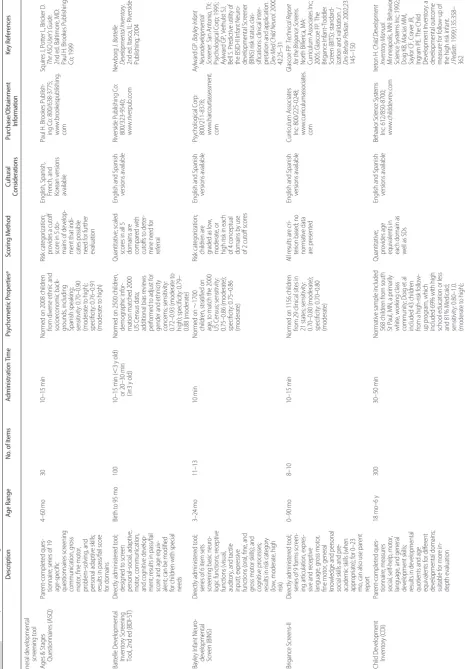
TABLE 1 Developmental Screening Tools Description Age Range No. of Items Administration Time Psychometric Properties a Scoring Method Cultural Considerations Purchase/Obtainment Information Key References General developmental screening tool Ages & Stages Questionnaires (ASQ) Parent-completed ques-tionnaire; series of 19 age-specific questionnaires screening communication, gross motor, fine motor, problem-solving, and personal adaptive skills; results in pass/fail score for domains 4–60 mo 30 10–15 min Normed on 2008 children from diverse ethnic and socioeconomic back-grounds, including Spanish speaking; sensitivity: 0.70–0.90 (moderate to high); specificity: 0.76–0.91 (moderate to high) Risk categorization; provides a cutoff score in 5 do-mains of develop-ment that indi-cates possible need for further evaluation English, Spanish, French, and Korean versions available Paul H. Brookes Publish-ing Co: 800/638-3775; www.brookespublishing. com Squires J, Potter L, Bricker D. The ASQ User’s Guide . 2nd ed. Baltimore, MD: Paul H. Brookes Publishing Co; 1999 Battelle Developmental Inventory Screening Tool, 2nd ed (BDI-ST) Directly administered tool; designed to screen personal-social, adaptive, motor, communication, and cognitive develop-ment; results in pass/fail score and age equiv-alent; can be modified for children with special needs Birth to 95 mo 100 10–15 min ( ⬍ 3 y old) or 20–30 min ( ⱖ 3 y old) Normed on 2500 children, demographic infor-mation matched 2000 US Census data; additional bias reviews performed to adjust for gender and ethnicity concerns; sensitivity: 0.72–0.93 (moderate to high); specificity: 0.79– 0.88 (moderate) Quantitative; scaled scores in all 5 domains are compared with cutoffs to deter-mine need for referral English and Spanish versions available Riverside Publishing Co: 800/323-9540; www.riverpub.com Newborg J. Battelle Developmental Inventory . 2nd ed. Itasca, IL: Riverside Publishing; 2004 Bayley Infant Neuro-developmental Screen (BINS) Directly administered tool; series of 6 item sets screening basic neuro-logic functions; receptive functions (visual, auditory, and tactile input); expressive functions (oral, fine, and gross motor skills); and cognitive processes; results in risk category (low, moderate, high risk) 3–24 mo 11–13 10 min Normed on ⬃ 1700 children, stratified on age, to match the 2000 US Census; sensitivity: 0.75–0.86 (moderate); specificity: 0.75–0.86 (moderate) Risk categorization; children are graded as low, moderate, or high risk in each of 4 conceptual domains by use of 2 cutoff scores English and Spanish versions available Psychological Corp:
800/211-8378; www.harcourtassessment. com
TABLE 1 Continued Description Age Range No. of Items Administration Time Psychometric Properties a Scoring Method Cultural Considerations Purchase/Obtainment Information Key References Child Development
Review-Parent Questionnaire (CDR-PQ)
Parent-completed ques-tionnaire; professional-completed child development chart measures social, self-help, motor, and language skills 18 mo to 5 y 6 open-ended questions and a 26-item possible-problems checklist to be completed by the parent, followed by 99 items crossing the 5 domains, which may be used by the profes-sional as an observation guide or parent-interview guide 10–20 min Standardized with 220 children aged 3–4 y from primarily white, working class families in south St Paul, MN; sensitivity: 0.68 (low); specificity: 0.88 (moderate) Risk categorization; parents’ responses to the 6 questions and problems checklist are clas-sified as indicat-ing (1) no prob-lem; (2) a possible problem; or (3) a possible major problem English and Spanish versions available Behavior Science Systems Inc Ireton H. Child Development Review Manual . Minneapolis, MN: Behavior Science Systems; 2004 Denver-II Develop-mental Screening Test Directly administered tool; designed to screen expressive and receptive language, gross motor, fine motor, and personal-social skills; results in risk category (normal, questionable, abnormal) 0–6 y 125 10–20 min Normed on 2096 term children in Colorado; diversified in terms of age, place of residence, ethnicity/cultural background, and maternal education; sensitivity: 0.56– 0.83 (low to moderate); specificity: 0.43–0.80 (low to moderate) Risk categorization; pass or fail for each question, and these re-sponses are com-pared with age-based norms to classify children as in the normal range, suspect, or delayed English and Spanish versions available Denver Developmental
Materials: 800/419-4729; www.denverii.com
Frankenburg WK, Camp BW, Van Natta PA. Validity of the Denver Develop-mental Screening Test. Child Dev .1971;42:475– 485; Glascoe FP, Byrne KE, Ashford LG, Johnson KL, Chang B, Strickland B. Accuracy of the Denver-II in developmental screening. Pediatrics .1992; 89:1221–1225 Infant Development Inventory Parent-completed ques-tionnaire; measures social, self-help, motor, and language skills 0–18 mo 4 open-ended questions followed by 87 items crossing the 5 domains 5–10 min Studied in 86 high-risk 8-mo-olds seen in a perinatal follow-up program and compared with the Bayley scales; sensitivity: 0.85 (moderate); specificity: 0.77 (moderate) Risk categorization; delayed or not delayed English and Spanish versions available Behavior Science Systems Inc Creighton DE, Sauve RS. The Minnesota Infant Develop-ment Inventory in the developmental screening of high-risk infants at 8 mo. Can JBehav Sci .1988;20 (special issue):424–433 Parents’ Evaluation of Developmental Status (PEDS) Parent-interview form; designed to screen for developmental and behavioral problems needing further evaluation; single response form used for all ages; may be useful as a surveillance tool 0–8 y 10 2–10 min Standardized with 771 children from diverse ethnic and socioeconomic backgrounds, including Spanish speaking; sensitivity: 0.74–0.79 (moderate); specificity: 0.70–0.80 (moderate) Risk categorization; provides algo-rithm to guide need for referral, additional screen-ing, or continued surveillance English, Spanish, Vietnamese, Arabic, Swahili,
Indonesian, Chinese, Taiwanese, French,
Communication
and
Symbolic
Behavior
Scales- Developmental Profile
(CSBS-DP): Infant Toddler Checklist Standardized tool for screening of com-munication and symbolic abilities up to the 24-mo level; the Infant Toddler Checklist is a 1-page parent-completed screening tool 6–24 mo 24 5–10 min Standardized on 2188 North American children aged 6-24 mo; correlations: 0.39–0.75 with Mullen Scales at2yo fage; sensitivity: 0.76–0.88 in low-and at-risk children at 2 y of age (moderate); specificity: 0.82–0.87 in low-and at-risk children at 2 y of age (moderate) Risk categorization (concern/no concern) English version available Paul H. Brookes Publishing Co Wetherby AM, Prizant BM. Communication and Symbolic Behavior Scales: Developmental Profile . Baltimore, MD: Paul H. Brookes Publishing Co; 2002 Early Language Mile-stone Scale (ELM Scale-2) Assesses speech and lan-guage development from birth to 36 mo 0–36 mo 43 1–10 min Small cross-sectional stan-dardization sample of 191 children; 235 children for speech intelligibility item; sensitivity: 0.83–1.00 in low-and high-risk populations (moderate to high); specificity: 0.68–1.00 in low-and high-risk populations (low to high) Quantitative (age equivalent, per-centile, standard score) English version avail-able Pro-Ed Inc: 800/897-3202; www.proedinc.com Coplan J. Early Language Milestone Scale .Austin, TX: Pro-Ed Inc; 1993; Coplan J, Gleason JR. Test-retest and interobserver reliability of the Early Language Mile-stone Scale, second edition. JPediatr Health Care .1993;7:212–219 Motor screening tools Early Motor Pattern Profile (EMPP) Physician-administered standard examination of movement, tone, and reflex development; simple 3-point scoring system 6–12 mo 15 5–10 min Single published report of 1247 high-risk infants; sensitivity: 0.87–0.92 (moderate to high); specificity: 0.98 (high) Risk
categorization (normal/suspect/ abnormal)
18-, and 30-month* visits. Consideration of a number of factors, including the time available to focus on devel-opmental concerns during a routine pediatric visit, led to these recommended ages.
● Nine months of age: At 9 months of age, many issues
involving motor skills development can be reliably identified. A 9-month screening provides an addi-tional opportunity to attend to the child’s visual and hearing abilities. Early communication skills may be emerging— evidence suggests symptoms of autism, such as lack of eye contact, orienting to name being called, or pointing, may be recognizable in the first
year of life.23,24 Early intervention to address specific
developmental disorders is available to infants from birth and should be accessed to address any delays
detected at 9 months.25 At-risk 9-month-old infants
should also be referred to early intervention programs if not previously referred. The 9-month preventive care visit also provides a good opportunity for the child health professional to educate parents about de-velopmental screening and to encourage parents to pay special attention to communication and language skills. Social and nonverbal communication, including vocalizations and gestures, are important aspects of emerging communication that can be assessed at 9 months. Because of the rapid development of motor, language, and cognitive skills, parents should be en-couraged to express any concerns they have about their child’s progress rather than waiting until the
18-month visit. The AAP brochure Is Your One-Year
Old Communicating With You?26might be distributed at the 9-month visit to educate parents about communi-cation and target any concerns they have. (If practices have eliminated the 9-month visit, this screening should be performed at the 12-month visit.)
● Eighteen months of age: Delays in communication
and language development are often evident by 18 months of age. Mild motor delays that were undetec-ted at the 9-month screening may be more apparent at 18 months of age. Medical interventions for motor disorders have been shown to be effective in children at 18 months of age, and effective early intervention
for delayed language development is also available.27
In addition to a general developmental screening tool, an autism-specific tool should be administered to all
children at the 18-month visit.28Symptoms of autism
are often present at this age, and effective early
inter-vention strategies are available.29
● Thirty months* of age: By 30 months of age, most
motor, language, and cognitive delays may be identi-fied with screening instruments, leading to evaluation of and intervention for those children with delayed development. A 30-month visit focusing on child de-velopment and dede-velopmental screening would allow
the health care provider to devote special attention to this area. Therefore, addition of this preventive care visit to the periodicity schedule is being considered by Bright Futures.
When child health professionals use only clinical impres-sions rather than formal screening, estimates of
chil-dren’s developmental status are much less accurate.30
Including developmental screening tools at targeted de-velopmental ages is intended to enhance the precision of the developmental surveillance process. These recom-mended ages for developmental screening are suggested only as a starting point for children who appear to be developing normally; surveillance should continue throughout childhood, and screenings should be con-ducted anytime that concerns are raised by parents, child health professionals, or others involved in the care of the child. At the 4-year visit, a screening for school readiness is appropriate.
5aand 5b: Administer Screening Tool
Developmental screening is the administration of a brief standardized tool that aids the identification of children at risk of a developmental disorder. Many screening tools can be completed by parents and scored by non-physician personnel; the non-physician interprets the screen-ing results.
Developmental screening does not result in either a diagnosis or treatment plan but rather identifies areas in which a child’s development differs from same-age norms. Developmental screening that targets the area of con-cern is indicated whenever a problem is identified during developmental surveillance. Because development is dynamic in nature and surveillance and screening have limits, periodic screening with a validated instrument should occur so that a problem not detected by surveil-lance or a single screening can be detected by subse-quent screening. Repeated and regular screening is more likely than a single screening to identify problems, espe-cially in later-developing skills such as language. Waiting until a young child misses a major milestone such as walking or talking may result in late rather than early recognition, increasing parental dissatisfaction and anx-iety and depriving the child and family of the benefits of early identification and intervention.
Table 1 provides a list of developmental screening tools; a discussion of how to choose an appropriate screening tool is included in “Implementing the Algorithm.”
6aand 6b: Are the Screening-Tool Results Positive/Concerning?
con-cerns about development, an early return visit to provide additional developmental surveillance should be sched-uled even if the screening-tool results do not indicate a risk of delay.
7.Make Referrals for Developmental and Medical Evaluations and Early Developmental Intervention/Early Childhood Services
If screening results are concerning, the child should be scheduled for developmental and medical evaluations. These evaluations may occur at a different visit or series of visits or often in a different setting by other profes-sionals. The separate box in which these steps are placed in the algorithm (Fig 1) is intended to represent the possibility that these actions will occur at a different time and location. However, they should be scheduled as quickly as possible, and professionals should coordinate activities and share findings.
8.Developmental and Medical Evaluations
Developmental Evaluation
When developmental surveillance or screening identifies a child as being at high risk of a developmental disorder, diagnostic developmental evaluation should be pursued. This evaluation is aimed at identifying the specific de-velopmental disorder or disorders affecting the child, thus providing further prognostic information and al-lowing prompt initiation of specific and appropriate early childhood therapeutic interventions.
Children with neurodevelopmental disorders also of-ten have other associated developmental or behavior disorders.31–33Identification of these disorders can lead to further evaluation and treatment. Pediatric subspecial-ists such as neurodevelopmental pediatricians, develop-mental and behavioral pediatricians, child neurologists, pediatric physiatrists, or child psychiatrists can perform the developmental diagnostic evaluation, as can other early childhood professionals in conjunction with the child’s primary care provider. Such early childhood pro-fessionals include early childhood educators, child psy-chologists, speech-language pathologists, audiologists, social workers, physical therapists, and occupational therapists, ideally working with families as part of an interdisciplinary team and with the medical home.
Medical Evaluation
In addition to the developmental evaluation, a medical diagnostic evaluation to identify an underlying etiology should be undertaken. This evaluation should consider biological, environmental, and established risk factors
for delayed development.34–37 Vision screening and
ob-jective hearing evaluation; review of newborn metabolic screening and growth charts; and an update of environ-mental, medical, family, and social history for additional risk factors are integral to this evaluation.
A comprehensive medical evaluation is essential
whenever a delay is confirmed. This evaluation varies somewhat with the risk factors and findings and may include brain imaging, electroencephalogram (EEG),
ge-netic testing, and/or metabolic testing.37
Identification of an etiology may provide parents with a greater depth of understanding of their child’s disabil-ity. Identifying an etiology also can affect various aspects of treatment planning, including specific prognostic in-formation, genetic counseling around recurrence risk and family planning, specific medical treatments for im-proved health and function of the child, and therapeutic
intervention programming.38 An underlying etiology
will be identified in approximately one quarter of cases
of delayed development, with higher rates (⬎50%) in
children with global developmental delays and motor
delays and lower rates (⬍5%) in children with isolated
language disorders.39
This evaluation can be performed by a trained and skilled pediatrician; a pediatric subspecialist such as a neurodevelopmental pediatrician, child neurologist, or developmental/behavioral pediatrician; or through affil-iated medical professionals such as pediatric geneticists or physiatrists. The primary care provider within the medical home should develop an explicit comanage-ment plan with the specialist(s).
Early Developmental Intervention/Early Childhood Services Early intervention programs can be particularly valuable when a child is first identified to be at high risk of delayed development, because these programs often provide evaluation services and can offer other services to the child and family even before an evaluation is
complete.25 These services can include developmental
therapies, service coordination, social work services, as-sistance with transportation and related costs, family training, counseling, and home visits. The diagnosis of a specific developmental disorder is not necessary for an early intervention referral to be made. Child health pro-fessionals should realize that a community-based early intervention evaluation may not address children with specific medical risks, and further developmental and medical evaluation will often be necessary for children with established delays.
Establishing an effective and efficient partnership with early childhood professionals is an important ingre-dient of successful care coordination for children within the medical home. The partnership is built on shared interest in the developmental outcomes of children and recognition of the different skill sets of child health professionals and educators. For additional information regarding care coordination, see the AAP policy state-ment “Care Coordination in the Medical Home: Integrat-ing Health and Related Systems of Care for Children
With Special Health Care Needs.”40
early childhood professionals who work in specialized health care centers, university centers, early interven-tion programs, early childhood educainterven-tional programs, or private practices. Whenever possible, communities should coordinate resources; this is especially true in preventing delays in care or unnecessary duplication of service.
The child’s medical charts, whether electronic or pa-per, should be organized to create a system that guaran-tees continuity of care, especially when the child is re-ferred to specialists and/or community agencies. In addition, a means of incorporating information about a child’s developmental status from sources outside the medical home should be available. The child health care chart should be designed to alert the clinician if further attention is needed between regular periodic visits.
9.Is a Developmental Disorder Identified?
If a developmental disorder is identified, the child should be identified as a child with special health care needs, and chronic-condition management should be initiated (see No. 10 below). If a developmental disorder is not identified through medical and developmental evalua-tion, the child should be scheduled for an early return visit for further surveillance, as mentioned previously. More frequent visits, with particular attention paid to areas of concern, will allow the child to be promptly referred for further evaluation if any additional evidence of delayed development or a specific disorder emerges.
10.Identify as a Child With Special Health Care Needs and Initiate Chronic-Condition Management
When a child is discovered to have a significant devel-opmental disorder, that child becomes a child with spe-cial health care needs even if that child does not have a specific disease etiology identified. Such a child should be identified by the medical home for appropriate chron-ic-condition management and regular monitoring and entered into the practice’s children and youth with
spe-cial health care needs registry.41Every primary care
tice should create a registry for the children in the prac-tice who have special health care needs.
The medical home provides a triad of key primary care services including preventive care, acute illness management, and chronic-condition management. A program of chronic-condition management provides proactive care for children and youth with special health care needs, including condition-related office visits, writ-ten care plans, explicit comanagement with specialists, appropriate patient education, and effective information systems for monitoring and tracking.
Management plans should be based on a comprehen-sive needs assessment conducted with the family. Man-agement plans should include relevant, measurable, and valid outcomes. These plans must be reviewed on a regular basis and updated as necessary. The child health
professional should actively participate in all care-coor-dination activities for children who have complex health conditions in addition to developmental problems. De-cisions regarding appropriate therapies and their scope and intensity should be determined in consultation with the child’s family, therapists, and educators (including early intervention or school-based programs) and should be based on knowledge of the scientific evidence for their use.
Children with established developmental disorders often benefit from referral to community-based family support services such as respite care, parent-to-parent programs, and advocacy organizations. Some children may qualify for additional benefits such as supplemental security income, public insurance, waiver programs, and state programs for children and youth with special health care needs (Title V). Parent organizations, such as Family Voices, and condition-specific associations can provide parents with information and support and can also provide an opportunity for advocacy.
IMPLEMENTING THE ALGORITHM
Choosing Developmental Screening Tools
Although all developmental screening tools are designed to identify children with potentially delayed develop-ment, each one approaches the task in a different way. There is no universally accepted screening tool appro-priate for all populations and all ages. Currently avail-able screening tools vary from broad general develop-mental screening tools to others that focus on specific areas of development, such as motor or communication skills. Their psychometric properties vary widely in char-acteristics such as their standardization, the comparison group used for determining sensitivity and specificity, and population risk status.
Broad screening tools should address developmental domains including fine and gross motor skills, language and communication, problem solving/adaptive behav-ior, and personal-social skills. Screening tools also must be culturally and linguistically sensitive. Many screening tools are available, and the choice of which tool to use depends on the population being screened, the types of problems being screened for in that population, admin-istration and scoring time, any adminadmin-istration training time, the cost of the tool, and the possibilities for ade-quate payment.
Screening tests should be both reliable and valid, with good sensitivity and specificity.
● Reliability is the ability of a measure to produce
con-sistent results.
● The validity of a developmental screening test relates
● Sensitivity is the accuracy of the test in identifying delayed development.
● Specificity is the accuracy of the test in identifying
individuals who are not delayed.
If a test incorrectly identifies a child as delayed, it will result in overreferrals. If a test incorrectly identifies a child as normal, it results in underreferrals. For devel-opmental screening tests, scoring systems must be de-veloped that minimize underreferrals and overreferrals. Trade-offs between sensitivity and specificity occur when devising these scoring systems. Sensitivity and specificity levels of 70% to 80% have been deemed
acceptable for developmental screening tests.42 These
values are lower than generally accepted for medical screening tests because of the challenges inherent in measuring child development and the absence of specific curative and clearly effective treatments. However, com-bining developmental surveillance and periodic screen-ing increases the opportunity for identification of unde-tected delays in early development. Overidentification of children using standardized screening tools may indicate that this group of children includes some with below-average development and/or significant psychosocial
risk factors.43 These children may benefit from other
community programs as well as closer monitoring of their development by their families, pediatric health pro-fessionals, and teachers or caregivers.
Table 1 provides a list of developmental screening tools and their psychometric testing properties. These screening tools vary widely in their psychometric prop-erties. This list is not exhaustive; other standardized, published tools are available. We look forward to further evaluation/validation of available screening instruments as well as the continued development of new tools with stronger properties. Child health professionals are en-couraged to familiarize themselves with a variety of screening tools and choose those that best fit their pop-ulations, practice needs, and skill level.
Incorporating Surveillance and Screening in the Medical Home A quality-improvement approach may be the most ef-fective means of building surveillance and screening
el-ements into the process of care in a pediatric office.44
Improving developmental screening and surveillance should be regarded as a “whole-office” endeavor and not simply a matter of clinician continuing education or the addition of tasks to well-child visits. Front-desk proce-dures, such as appropriate scheduling for screening visits and procedures for flagging children with established risk factors, need to be explicitly designed by the office staff. Nonphysician staff may need training in the ad-ministration of developmental screening tools. The input of consumers is crucial to developing an effective system and can be accomplished by adding a parent to an office
planning team, by using parent focus groups, or by ad-ministering parent questionnaires. Specific to develop-mental screening could be consumer opinion about pref-erences for completing questionnaires in the office or before the visit, how they would like to be informed about the results of screening, how parents of children with identified conditions associated with developmen-tal delay would like to have their children’s develop-ment monitored, or feedback on parental satisfaction with their child’s developmental screening or feedback on the referral process.
Screening Payment
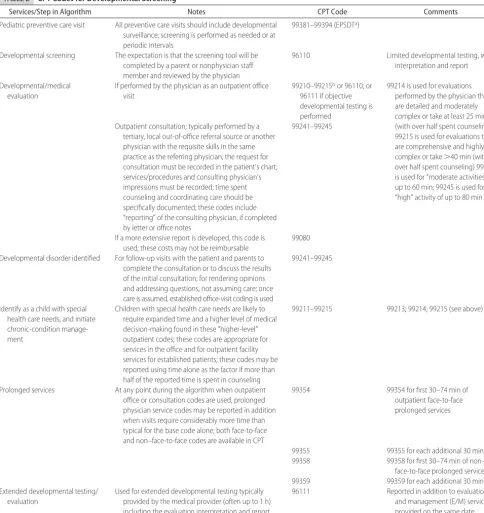
Separate Current Procedural Terminology (CPT)45 codes
(see Table 2) exist for developmental screening (96110: developmental testing; limited) and testing (96111: de-velopmental testing; extended). The relative values for these codes are published in the Medicare Resource-Based Relative Value Scale and reflect physician work, practice expenses, and professional liability expenses. Table 2 outlines the appropriate codes to use when bill-ing for the processes described in the algorithm. Health plans are encouraged to adhere to CPT guidelines and provide coverage and payment for developmental screening and testing.
Billing processes related to developmental screening and surveillance should be carefully reviewed to ensure that appropriate CPT codes are used to document screen-ing procedures and ensure proper payment. CPT code 96110 for limited developmental testing does not in-clude any payment for medical provider services. The expectation is that a nonphysician will administer the screening tool to the parent and then score their re-sponses. The physician reviews and interprets the screening results; the physician’s work is included in the evaluation and management code used for the child’s visit. Medicaid may not pay separately for developmen-tal screening when provided as part of early and periodic screening, diagnostic, and treatment services. If non-Medicaid carriers are involved, the preventive care code is used with the modifier 25 appended and 96110 listed for each screening tool administered. The CPT code 96111, extended developmental testing, includes medical provider work. This code would more appropriately be used when the medical provider observes the child performing a task and demonstrating a specific developmental skill.
The codes in Table 2 may be applicable to the phases of developmental surveillance, screening, and evalua-tion described in the proposed algorithm (Fig 1).
SUMMARY
identifies concerns about a child’s development and for children who appear to be at low risk of a developmental disorder at the 9-, 18-, and 30-month* visits.
When a child has a positive screening result for a developmental problem, developmental and medical evaluations to identify the specific developmental disor-ders and related medical problems are warranted. In addition, children who have positive screening results
for developmental problems should be referred to early developmental intervention and early childhood ser-vices and scheduled for earlier return visits to increase developmental surveillance.
Children diagnosed with developmental disorders should be identified as children with special health care needs; chronic-condition management for these chil-dren should be initiated.
TABLE 2 CPT Codes for Developmental Screening
Services/Step in Algorithm Notes CPT Code Comments
Pediatric preventive care visit All preventive care visits should include developmental surveillance; screening is performed as needed or at periodic intervals
99381–99394 (EPSDTa)
Developmental screening The expectation is that the screening tool will be completed by a parent or nonphysician staff member and reviewed by the physician
96110 Limited developmental testing, with
interpretation and report
Developmental/medical evaluation
If performed by the physician as an outpatient office visit
99210–99215bor 96110; or
96111 if objective developmental testing is performed
99214 is used for evaluations performed by the physician that are detailed and moderately complex or take at least 25 min (with over half spent counseling); 99215 is used for evaluations that are comprehensive and highly complex or take⬎40 min (with over half spent counseling) 99244 is used for “moderate activities” of up to 60 min; 99245 is used for “high” activity of up to 80 min Outpatient consultation; typically performed by a
tertiary, local out-of-office referral source or another physician with the requisite skills in the same practice as the referring physician; the request for consultation must be recorded in the patient’s chart; services/procedures and consulting physician’s impressions must be recorded; time spent counseling and coordinating care should be specifically documented; these codes include “reporting” of the consulting physician, if completed by letter or office notes
99241–99245
If a more extensive report is developed, this code is used; these costs may not be reimbursable
99080
Developmental disorder identified For follow-up visits with the patient and parents to complete the consultation or to discuss the results of the initial consultation; for rendering opinions and addressing questions, not assuming care; once care is assumed, established office-visit coding is used
99241–99245
Identify as a child with special health care needs, and initiate chronic-condition manage-ment
Children with special health care needs are likely to require expanded time and a higher level of medical decision-making found in these “higher-level” outpatient codes; these codes are appropriate for services in the office and for outpatient facility services for established patients; these codes may be reported using time alone as the factor if more than half of the reported time is spent in counseling
99211–99215 99213; 99214; 99215 (see above)
Prolonged services At any point during the algorithm when outpatient office or consultation codes are used, prolonged physician service codes may be reported in addition when visits require considerably more time than typical for the base code alone; both face-to-face and non–face-to-face codes are available in CPT
99354 99354 for first 30–74 min of
outpatient face-to-face prolonged services
99355 99355 for each additional 30 min
99358 99358 for first 30–74 min of non–
face-to-face prolonged services
99359 99359 for each additional 30 min
Extended developmental testing/ evaluation
Used for extended developmental testing typically provided by the medical provider (often up to 1 h) including the evaluation interpretation and report
96111 Reported in addition to evaluation
and management (E/M) services provided on the same date
aEPSDT (Early and Periodic Screening, Diagnosis, and Treatment) is the federal Medicaid program for preventive services. States may require physicians to use different codes to report these services. In general,
for non-Medicaid commercial insurers, the evaluation and management CPT codes for preventive medicine services (99381-99394) are used for the basic service (history, physical examination, and counseling/anticipatory guidance), with separate CPT codes reported additionally for the additional screening of hearing, vision, development, laboratory services, and immunization administration.
RECOMMENDATIONS
For the Medical Home
1. Perform developmental surveillance at every pre-ventive visit throughout childhood, and ensure that such surveillance includes eliciting and attending to parents’ concerns, obtaining a developmental history, making accurate and informed observations of the child, identifying the presence of risk and protective factors, and documenting the process and findings.
2. Administer a standardized developmental screening tool for children who appear to be at low risk of a developmental disorder at the 9-, 18-, and or 30-month* visits and for those whose surveillance yields concerns about delayed or disordered develop-ment.
3. Schedule early return visits for children whose sur-veillance raises concerns that are not confirmed by a developmental screening tool.
4. Refer children about whom developmental concerns are raised to early intervention and early-childhood programs.
5. Coordinate developmental and medical evaluations for children who have positive screening results for developmental disorders.
6. Initiate a program of chronic-condition management for any child identified with a developmental disorder.
7. Document all surveillance, screening, evaluation, and referral activities in the child’s health chart.
8. Establish working relationships with state and local programs, services, and resources.
9. Use a quality-improvement model to integrate sur-veillance and screening into office procedures and to monitor their effectiveness and outcomes.
For Policy and Advocacy
10. Provide appropriate payment for developmental surveillance, screening, and evaluation.
11. Teach child health professionals, through training and continuing education programs, to conduct de-velopmental surveillance and screening as an inte-gral responsibility of the medical home.
For Research and Development
12. Develop information systems and data-gathering tools to automate the algorithm recommended by this policy statement for ease and consistency of use.
13. Expand the evidence base for the effectiveness of developmental surveillance activities.
14. Improve the effectiveness of developmental screen-ing tools in the identification of children with de-velopmental disorders in the medical home.
15. Expand the evidence base for the use and effective-ness of the proposed algorithm, including the opti-mal timing of the recommended developmental screening.
POLICY REVISION COMMITTEE (PRC)
COUNCIL ON CHILDREN WITH DISABILITIES
John C. Duby, MD
Paul H. Lipkin, MD, PRC Chairperson
SECTION ON DEVELOPMENTAL AND BEHAVIORAL PEDIATRICS
Michelle M. Macias, MD Lynn M. Wegner, MD
BRIGHT FUTURES STEERING COMMITTEE
Paula Duncan, MD Joseph F. Hagan, Jr, MD
MEDICAL HOME INITIATIVES FOR CHILDREN WITH SPECIAL NEEDS PROJECT ADVISORY COMMITTEE
W. Carl Cooley, MD
Nancy Swigonski, MD, MPH
LIAISONS
Paul G. Biondich, MD, MS
Partnership for Policy Implementation (PPI) Donald Lollar, EdD
Centers for Disease Control and Prevention
STAFF
Jill Ackermann Amy Brin, MA
Mary Crane, PhD, LSW Amy Gibson, MS, RN
Stephanie Mucha Skipper, MPH, Principal Staff Darcy Steinberg-Hastings, MPH
CONSULTANT
Melissa Capers, MA, MFA
REFERENCES
1. American Academy of Pediatrics, Medical Home Initiatives for Children With Special Needs Project Advisory Committee. The medical home.Pediatrics.2002;110:184 –186
2. Sand N, Silverstein M, Glascoe FP, Gupta VB, Tonniges TP, O’Connor KG. Pediatricians’ reported practices regarding de-velopmental screening: do guidelines work? Do they help?
Pediatrics.2005;116:174 –179
3. Pinto-Martin JA, Dunkle M, Earls M, Fliedner D, Landes C. Developmental stages of developmental screening: steps to im-plementation of a successful program.Am J Public Health.2005; 95:1928 –1932
4. Smith RD. The use of developmental screening tests by prima-ry-care pediatricians.J Pediatr.1978;93:524 –527
Disabilities. Developmental surveillance and screening of in-fants and young children.Pediatrics.2001;108:192–195 6. American Academy of Pediatrics, Committee on Practice and
Ambulatory Medicine. Recommendations for preventive pedi-atric health care.Pediatrics.2000;105:645– 646
7. Georgetown University, National Center for Education in Ma-ternal and Child Health. Bright Futures: Guidelines for Health
Supervision of Infants, Children, and Adolescents. 2nd ed.
Wash-ington, DC: Georgetown University; 2002
8. American Academy of Pediatrics.Guidelines for Health
Supervi-sion III.Elk Grove Village, IL: American Academy of Pediatrics;
1997 (updated 2002)
9. Dworkin PH. British and American recommendations for de-velopmental monitoring: the role of surveillance. Pediatrics. 1989;84:1000 –1010
10. Accardo PJ, Whitman BY, Behr SK, Farrell A, Magenis E, Morrow-Gorton J.Dictionary of Developmental Disabilities
Termi-nology. 2nd ed. Baltimore, MD: Paul H. Brookes Publishing Co;
2003
11. Pulsifer MB, Hoon AH, Palmer FB, Gopalan R, Capute AJ. Maternal estimates of developmental age in preschool chil-dren.J Pediatr.1994;125:S18 –S24
12. Glascoe FP, Dworkin PH. The role of parents in the detection of developmental and behavioral problems. Pediatrics. 1995;95: 829 – 836
13. Glascoe FP. The value of parents’ concerns to detect and ad-dress developmental and behavioural problems.J Paediatr Child
Health.1999;35:1– 8
14. King TM, Rosenberg LA, Fuddy L, McFarlane E, Sia C, Duggan AK. Prevalence and early identification of language delays among at-risk three year olds.J Dev Behav Pediatr. 2005;26: 293–303
15. Capute AJ, Accardo PJ. A neurodevelopmental perspective on the continuum of developmental disabilities. In: Capute AJ, Accardo PJ, eds.Developmental Disabilities in Infancy and Child-hood. 2nd ed. Vol 1. Baltimore, MD: Paul H. Brookes; 1996: 1–22
16. Bear LM. Early identification of infants at risk for developmen-tal disabilities.Pediatr Clin North Am.2004;51:685–701 17. Dinkevich E, Ozuah PO. Well-child care: effectiveness of
cur-rent recommendations.Clin Pediatr (Phila).2002;41:211–217 18. Boyle RJ. Effects of certain prenatal drugs on the fetus and
newborn.Pediatr Rev.2002;23:17–24
19. Decoufle P, Boyle CA. The relationship between maternal ed-ucation and mental retardation in 10-year-old children.Ann
Epidemiol.1995;5:347–353
20. Parker S, Greer S, Zuckerman B. Double jeopardy: the impact of poverty on early child development.Pediatr Clin North Am. 1998;35:1227–1240
21. Escalona SK. Babies at double hazard: early development of infants at biologic and social risk.Pediatrics.1982;70:670 – 676 22. National Research Council and Institute of Medicine, Commit-tee on Integrating the Science of Early Childhood Develop-ment.From Neurons to Neighborhoods: The Science of Early
Child-hood Development.Shonkoff JP, Phillips DA, eds. Washington,
DC: National Academies Press; 2000
23. Maestro S, Muratori F, Cesari A, et al. Course of autism signs in the first year of life.Psychopathology.2005;38:26 –31
24. Zwaigenbaum L, Bryson S, Rogers T, Roberts W, Brian J, Szatmari P. Behavioral manifestations of autism in the first year of life.Int J Dev Neurosci.2005;23:143–152
25. American Academy of Pediatrics, Committee on Children With Disabilities. Role of the pediatrician in family-centered early intervention services.Pediatrics.2001;107:1155–1157 26. American Academy of Pediatrics.Is Your One-Year Old
Commu-nicating With You?[brochure]. Elk Grove Village, IL: American
Academy of Pediatrics; 2005
27. Lipkin PH, Schertz M. An assessment of the efficacy of early intervention programs. In: Capute AJ, Accardo PJ, eds.
Neuro-developmental Disabilities in Infancy and Childhood. Baltimore,
MD: Paul H. Brookes; 2006: In press
28. American Academy of Pediatrics, Committee on Children With Disabilities. Technical report: the pediatrician’s role in the di-agnosis and management of autistic spectrum disorder in chil-dren.Pediatrics.2001;107(5). Available at: www.pediatrics.org/ cgi/content/full/107/5/e85
29. National Research Council, Committee on Educational Inter-ventions for Children With Autism. Educating Children With
Autism. Lord C, McGee JP, eds. Washington, DC: National
Academies Press; 2001
30. Werner EE, Honzik MP, Smith RS. Prediction of intelligence and achievement at ten years from twenty months pediatric and psychologic examinations.Child Dev.1968;39:1063–1075 31. Lipkin PH. Epidemiology of the developmental disabilities. In:
Capute AJ, Accardo PJ, eds.Developmental Disabilities in Infancy
and Childhood. 2nd ed. Vol 1. Baltimore, MD: Paul H. Brookes;
1996:137–156
32. Rubin IL, Crocker AC.Medical Care for Children and Adults With
Developmental Disabilities. 2nd ed. Baltimore, MD: Paul H.
Brookes; 2005
33. Nickel RE, Desch LW.The Physician’s Guide to Caring for Children
With Disabilities and Chronic Conditions. Baltimore, MD: Paul H.
Brookes; 2000
34. Tjossem TD.Intervention Strategies for High Risk Infants and Young
Children. Baltimore, MD: University Park Press; 1976
35. Ashwal S, Russman BS, Blasco PA, et al. Practice parameter: diagnostic assessment of the child with cerebral palsy. Report of the American Academy of Neurology Quality Standards Subcommittee and the Child Neurology Society Practice Com-mittee.Neurology.2004;62:851– 863
36. Filipek PA, Accardo PJ, Ashwal S. Practice parameter: screen-ing and diagnosis of autism. Report of the Quality Standards Subcommittee of the American Academy of Neurology and the Child Neurology Society.Neurology.2000;55:468 – 479 37. Shevell M, Ashwal S, Donley D, et al. Practice parameter:
evaluation of the child with global developmental delay. Re-port of the Quality Standards Subcommittee of the American Academy of Neurology and the Practice Committee of the Child Neurology Society.Neurology.2003;60:367–380 38. Bailey DB Jr, Skinner D, Sparkman KL. Discovering fragile X
syndrome: family experiences and perceptions.Pediatrics.2003; 111:407– 416
39. Shevell MI, Majnemer A, Rosenbaum P, Abrahamowicz M. Etiologic determination of childhood developmental delay.
Brain Dev.2001;23:228 –235
40. American Academy of Pediatrics, Council on Children With Disabilities. Care coordination in the medical home: integrat-ing health and related systems of care for children with special health care needs.Pediatrics.2005;116:1238 –1244
41. McPherson M, Arango P, Fox H, et al. A new definition of children with special health care needs.Pediatrics.1998;102: 137–140
42. Barnes KE.Preschool Screening: The Measurement and Prediction of
Children At-Risk. Springfield, IL: Charles C. Thomas; 1982
43. Glascoe FP. Are overreferrals on developmental screening tests really a problem?Arch Pediatr Adolesc Med.2001;155:54 –59 44. Cooley WC, McAlister JW. Building a medical home:
improve-ment strategies in primary care for children with special health care needs.Pediatrics.2004;113:1499 –1506
45. American Medical Association.Current Procedural Terminology
DOI: 10.1542/peds.2006-1231
2006;118;405
Pediatrics
Children With Special Needs Project Advisory Committee
Pediatrics, Bright Futures Steering Committee and Medical Home Initiatives for
Council on Children With Disabilities, Section on Developmental Behavioral
Medical Home: An Algorithm for Developmental Surveillance and Screening
Identifying Infants and Young Children With Developmental Disorders in the
Services
Updated Information &
http://pediatrics.aappublications.org/content/118/1/405
including high resolution figures, can be found at:
References
http://pediatrics.aappublications.org/content/118/1/405#BIBL
This article cites 30 articles, 15 of which you can access for free at:
Subspecialty Collections
al_issues_sub
http://www.aappublications.org/cgi/collection/development:behavior
Developmental/Behavioral Pediatrics
ntal_behavioral_pediatrics
http://www.aappublications.org/cgi/collection/section_on_developme
Section on Developmental Behavioral Pediatrics
ves_for_children_with_special_needs_project_advisory_committee http://www.aappublications.org/cgi/collection/medical_home_initiati
Project Advisory Committee
Medical Home Initiatives for Children With Special Needs
with_disabilities
http://www.aappublications.org/cgi/collection/council_on_children_
Council on Children with Disabilities
g_committee
http://www.aappublications.org/cgi/collection/bright_futures_steerin
Bright Futures Steering Committee
http://www.aappublications.org/cgi/collection/current_policy
Current Policy
http://www.aappublications.org/cgi/collection/medical_home_sub
Medical Home
_sub
http://www.aappublications.org/cgi/collection/community_pediatrics
Community Pediatrics following collection(s):
This article, along with others on similar topics, appears in the
Permissions & Licensing
http://www.aappublications.org/site/misc/Permissions.xhtml
in its entirety can be found online at:
Information about reproducing this article in parts (figures, tables) or
Reprints
http://www.aappublications.org/site/misc/reprints.xhtml
DOI: 10.1542/peds.2006-1231
2006;118;405
Pediatrics
Children With Special Needs Project Advisory Committee
Pediatrics, Bright Futures Steering Committee and Medical Home Initiatives for
Council on Children With Disabilities, Section on Developmental Behavioral
Medical Home: An Algorithm for Developmental Surveillance and Screening
Identifying Infants and Young Children With Developmental Disorders in the
http://pediatrics.aappublications.org/content/118/1/405
located on the World Wide Web at:
The online version of this article, along with updated information and services, is
by the American Academy of Pediatrics. All rights reserved. Print ISSN: 1073-0397.