© Universiti Tun Hussein Onn Malaysia Publisher’s Office
IJIE
Journal homepage:http://penerbit.uthm.edu.my/ojs/index.php/ijie ISSN : 2229-838X e-ISSN : 2600-7916
The International
Journal of
Integrated
Engineering
Comparison Study of AN Removal in Different Geometrical
Shape of a Pilot-scale Aerated EAFS Filter Systems
Wan Afnizan Wan Mohamed
1,*, Rafidah Hamdan
1, Nur Shaylinda Mohd Zin
1,
Syarul Nizam Maarup
1Faculty of Civil and Environmental Engineering,
Universiti Tun Hussein Onn Malaysia, 86400 Parit Raja, Johor, MALAYSIA
*Corresponding Author
DOI: https://doi.org/10.30880/ijie.2019.11.09.009
Received 07 February 2019; Accepted 27 September 2019; Available online 30 December 2019
Abstract:Two types of aerated electric arc furnace slag filter systems in dissimilar geometry shape; the vertical upward-flow and horizontal-flow were studied in treating domestic wastewater in a tropical climate country. These filters were operated at the same hydraulic loading rate (HLR) set-up of 2.72 m3/m3.day and the removal efficiency
of the contaminant was studied and analyzed. Air was supplied to both systems at 10 L/min and the observation of dissolved oxygen concentration on ammonium nitrogen (AN) removal were finally compared. The results revealed that both systems were efficiently able to produce ammonium nitrogen (AN) removal of more than 85%; however with regard to individual’s system performance, the vertical upward-flow electric arc furnace slag filter (VFEAFS) system was found excellent than the horizontal-flow electric arc furnace slag filter (HFEAFS) system. The mean value of AN effluent concentration equally by the systems were discovered easily to follow regulated standard A of Malaysian sewage discharge limit (10 mg NH4-N/L). The results obtained in this pilot-scale study indicated that the
geometry shape of filter system has the effect on the removal of ammonium nitrogen, particularly in the aerated VFEAFS system due to their capability to produce higher and uniform oxygen distribution in the whole filter system, and eventually resulted in a lower AN effluent concentration rather the one operated in the horizontal-flow direction. Based on these findings, it is also recommended that further study on the aerated rock filter should be evaluated for the other parameters (total kjedahl nitrogen (TKN), nitrate-nitrogen (NO3-N), pH, and alkalinity) which on the other
hand are believed possess the potential to accommodate nitrification process in the system and eventually eliminate nitrogen pollutant from domestic wastewater.
Keywords:Electric arc furnace slag, ammonium nitrogen, vertical upward-flow, horizontal flow
1. Introduction
Nowadays, the engineered system that is invented to imitate the subsurface CW operation is the RF system. The system is grouped into two general types; horizontal flow and vertical flow systems; and can be operated whether in downward or upward direction. The application of rock filter system was started and widely used in the United States for nearly 40 years ago; principally for algal suspended solids and organic matter (BOD) removals using the unaerated rock filter (URF) system [4]. Nevertheless, this URF system which implement identical idea as in the CW has encountered the same drawback since the system was rapidly become anoxic, as there is no (or very little) ammonium nitrogen (AN) removal was observed [5]-[7].
Therefore, in 2005 several researchers from United Kingdom had initiated a study which implements the use of aerated rock filter (ARF) to improve wastewater quality parameter (BOD, TSS, faecal coliforms) as well as ammonium nitrogen removal [8], [9]. A good removal of AN was observed by the researchers in the vertical-flow type of ARF system [10]. Thus, considering the needs to increase oxygen availability in the RF system, a continuous aeration was introduced in the present study as it has proven in the previous research to provide sufficient oxygen, and eventually facilitate effective nitrification in the system [5]. Hence, the present study was initiated to examine the performance of pilot-scale of ARF systems of different geometrical shape (the vertical upward-flow and horizontal flow) systems in treating AN from wastewater. The aim was to observe removal trend of ammonium nitrogen in the ARF systems that treated domestic wastewater in tropical climate country using electric arc furnace slag (EAFS) as the filter medium and as has been suggested by the previous researchers [5]. In the current study, a combination of existing wastewater treatment system; the wastewater treatment plant (WWTP) grit tank, together with the proposed system; the proposed primary tank (PPT) and ARF systems either operated in vertical upward-flow or horizontal flow was monitored specifically in removing ammonium nitrogen. The systems previously have shown to be a good low-cost technology, have low energy requirements and do not require highly skilled personnel [11] in treating municipal wastewater.
In spite of complying with the strict regulations as has been legislated in the Malaysian Environmental Quality (Sewage) Regulations 2009 (PU(A) 432) Second Schedule (Regulation 7) [12] on the elimination of nitrogen particularly ammonium nitrogen (AN) from wastewater, the effluent discharge limit of AN to water body is limited not exceeding 10 mg/L for standard A; 20 mg/L for standard B. It is therefore, necessary for conventional wastewater treatment systems to be updated or the treatment scheme should be extended with a polishing treatment [13]. Thus, the combination of conventional and ARF application systems are believe to possibly generate a high quality of final effluent with the utilization of a low-cost media technology. Ultimately this technology is understood to be the best alternative for removal of AN in the case of small communities looking for high quality of final effluent. The research described here concerns the removal of AN from wastewater treatment plant influent using an efficient and low maintenance of both aerated EAFS (the VFEAFS and HFEAFS) filter systems.
2. Materials and Methods
2.1 The Pilot-scale of Aerated Vertical Upward-Flow and Horizontal-Flow of EAFS Filter
System Set-Up
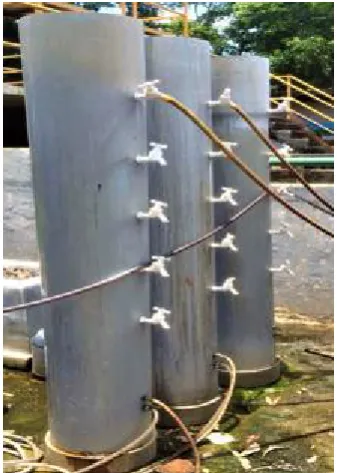
Fig. 2 - The pilot scale of vertical upward-flow EAFS system at site location
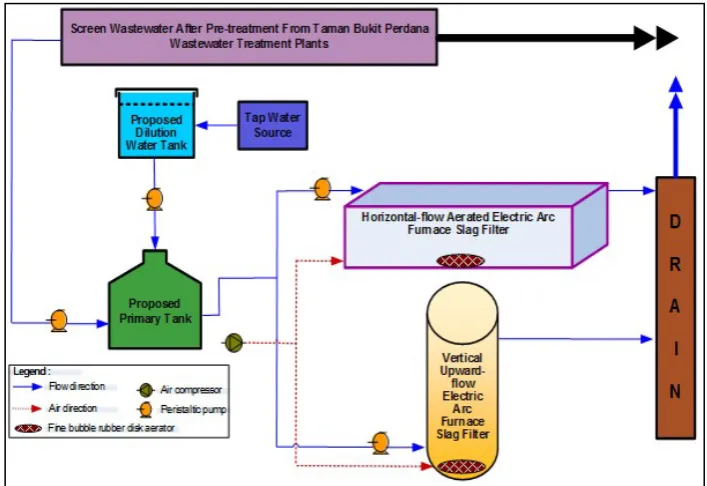
In general, this experimental study utilized a primary sedimentation treatment system (proposed primary tank) and a secondary treatment systems (the vertical upward-flow and horizontal-flow). Earlier, the after pre-treatment of screened wastewater from the existing grit and grease tank of WWTP was pumped to the proposed primary tank (PPT) using Masterflex peristaltic pump, model Cole Parmer 7524-20, USA equipped with Masterflex easy load pump head, model Cole Parmer 77200-62, USA. The influent wastewater was flowed to the PPT using 25.4-mm reinforced plastic pipework and connected with polyvinyl chloride (PVC) inlet strainer.
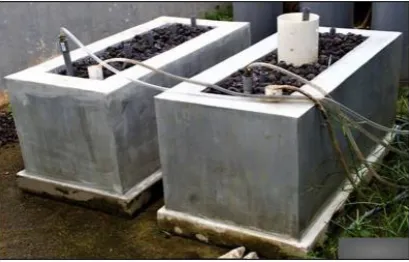
The wastewater effluent after PPT was then permitted to flow into the pilot scale of secondary treatment systems (the vertical upward-flow and horizontal-flow systems) using similar Masterflex peristaltic pump and Masterflex easy load pump head models, located at the base of the aerated VFEAFS filter systems, and were connected with 9.7-mm Masterflex platimum-cured silicone tubing L/S 36, model Cole Parmer EW-96410-36, USA. Both filters; the VFEAFS and HFEAFS of similar HLR (2.72 m3/m3.day) were aerated using an oil-free compressor, model Jun-air International
OF 302-25B, Denmark supplying a 250-mm fine bubble rubber disk aerator, model Biwater Treatment, England with air flow maintained at 10 L/min. The feeding of air flow rate to the fine bubble rubber disk aerator was regularly maintained using a float-and-tube air flow meter. The set-up of experimental study layout of the above-mentioned case is presented in Fig. 3.
The influent sample after passing pre-treatment process from the existing grit and grease tank of WWTP, as well as the effluent samples from PPT, and aerated VFEAFS and HFEAFS of similar HLR were collected bi-weekly and analyzed for ammonium nitrogen (AN) concentrations; according to the Standard Methods for the Examination of Water and Wastewater [14] procedures. In addition, the in-situ parameters (dissolved oxygen, pH and temperature) of weekly grab samples of WWTP grit tank influent, PPT and both aerated VFEAFSs filter effluents were measured using a portable DO meter, model Hanna HI 9146, Italy and portable pH meter, model Hanna HI 991301, Italy.
Measurement of oxygen distribution taken from sampling taps at the outer surface of column filter was also conducted at different depths (0.50 m, 0.75 m, 1.00 m, 1.25 m, and 1.50 m) of the aerated VFEAFS filter systems. Meanwhile, five perforated 25.4 mm PVC sampling pipes were arranged lengthwise in the filter at 0.2 m, 0.4 m, 0.6 m, 0.8 m, and 1.0 m from filter inlet to permit sampling of dissolved oxygen concentrations in wastewater at the base, middle and top of HFEAFS system. The purpose was to examine oxygen distribution concentration that had accommodated AN removal in both of the treatment systems. Finally, the performance of both aerated VFEAFS and HFEAFS filter systems on the monitored AN parameter was expressed as their percentage of removal efficiencies and computed using the following equation.
Removal efficiency (%) = ሾCin-Cout
Cin ሿ×100 (1)
Fig. 3 - The ARFs (HFEAFS and VFEAFS) pilot-scale treatment systems layout experiment
3. Results and Discussion
3.1 Dissolved Oxygen and Temperature of Aerated VFEAFS and HFEAFS Filter Effluents
The aerated vertical upward-flow filter was demonstrably fabulous in comparison with the aerated horizontal-flow filter concerning dissolved oxygen concentration in the system. The VFEAFS system with 1.5 m depth was observed to be more oxygenated rather than the HFEAFS system with 0.4 m depth. Initially, effluents from PPT system containing DO concentration at range of 0.39 – 1.44 mg O2/L were aerated as soon as it entered the aerated EAFS filter systems.
The VFEAFS filter system had shown an impressive capability in generating a high DO concentration at range of 3.60 – 5.43 mg O2/L; whilst the HFEAFS filter system had moderately produced DO concentration at range of 2.56 – 4.32 mg
O2/L. These trends are well described in Fig. 4. Furthermore, DO effluent concentrations found in the aerated VFEAFS
filter system were observed greater than 3 mg O2/L in most occasions; accordingly had improved nitrification rate as has
been pointed out by Gerardi [15]. Hence, in a well oxygenated system; for instance in the 1.5 m depth of aerated EAFS filter (the VFEAFS), greater of ammonium ions were oxidized to nitrate-nitrogen (NO3-N); in comparison with 0.4 m
depth of EAFS filter (the HFEAFS); indicating that high level of nitrification rate had occurred in the aerated VFEAFS filter system.
Fig. 4 - DO effluent concentrations of different geometry shape of aerated EAFS filter (vertical upward-flow and horizontal-flow) systems
nitrosomonasat almost 10%. During 73 days of monitoring period, influent wastewater temperature from WWTP grit
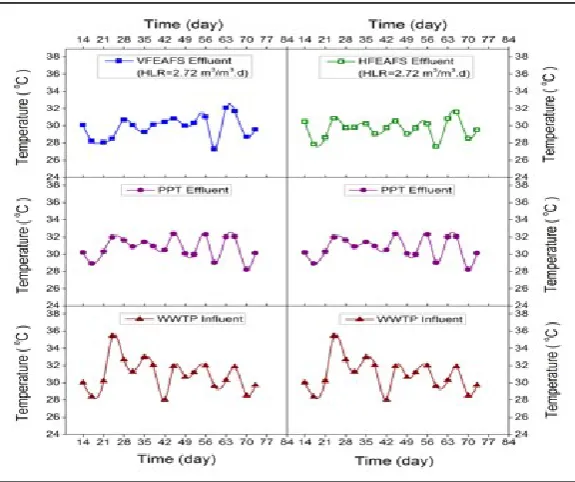
tank was measured at range of 28.00-35.43C. As influent wastewater entered PPT system, the range of temperature was observed at 28.23 – 32.40 C; which on the other hand was not obviously changed or affected. Later, the effluent wastewater from PPT system flowed into aerated EAFS filter system of different geometry shape (the VFEAFS and HFEAFS); yet at same HLR operation (2.72 m3/m3.day). Their effluent temperature data were more or less consistent at
range of 27.30 – 32.10C for vertical upward-flow system; while 27.60 – 31.60C for horizontal-flow system. Thus, it is entirely fanciful to suggest that the effluent temperature data obtained from both systems had indirectly accommodate biological processes for organic matter, and total nutrients removal to appear in the treatment system including nitrification and denitrification activities [16]-[19]. Fig. 5 compiles the variations of temperature data from WWTP grit tank influent, PPT and EAFS filters effluents systems.
Fig. 5 - Effluent temperature of different geometry shape of aerated EAFS filter (vertical upward-flow and horizontal-flow) systems
Table 1 - Summary of statistical data for aerated vertical upward-flow and horizontal-flow EAFS filter systems performance at different geometry shapea
Statistical data Sampling point T ParameterDO AN
Influen
t WWTP 30.98 1. 1.1
0.
5 28.6
5. 7 Concentrations
(mg/L)
( Effluen
VFEAFS (HLR = 2 72)
29.81.
3 4.4
0.
4 1.8
0. 4 HFEAFS 29.71. 3.60. 3.40. (HLR =
2 72)
Removal efficiency (%) (means.d)
WWTP + PPT n.a n.a 26.18.3 WWTP + PPT + VFEAFS
(HLR = 2.72) n.a n.a 93.71.2 WWTP + PPT + HFEAFS
(HLR = 2.72) n.a n.a 87.92.2
aNote : All units are in mg/L except for T = Temperature (C); DO = Dissolved oxygen; AN
In brief, the average values and standard deviation of removal efficiency of combined aerated EAFS filter systems (WWTP + PPT + VFEAFS; WWTP + PPT + HFEAFS) which were operated at same hydraulic loading rate of 2.72 m3/m3.day are summarized in Table 1. As a rule, the combination of proposed primary tank (PPT) and aerated EAFS
filter systems in treating contaminant was obviously very efficient in attaining ammonium nitrogen (AN) removal at higher percentage value. The concentration of AN of both aerated VFEAFS and HFEAFS filter systems were far below the permissible limit of Standard A of sewage discharge legislated by Malaysian Environmental Authority (10 mg NH4
-N/L). AN impurity from domestic wastewater were removed effectively in the vertical upward-flow system after secondary treatment. On the whole, in terms of individual system performance, the VFEAFS filter system performed better than the HFEAFS filter system in producing a high ammonium nitrogen removal (more than 90%).
3.2 Distribution of Dissolved Oxygen Inside the Aerated VFEAFS and HFEAFS Filter Systems
at Different Lengths and Stages
It is entirely admitted by previous researchers [20], [21] that the anoxic-oxic (AO) condition promotes a significant effect on biological nutrients removal processes in wastewater treatment system. During oxic condition which is only occurred in a well aerated system; nitrifying bacteria namely,nitrosomonasandnitrobacterwould consume an amount
of inorganic carbon sources to transform ammonia to nitrite and subsequently to nitrate, and this process is called nitrification. However, the nitrification process itself is incapable to provide nitrogen removal in overall; it should be followed by denitrification process which only exists in anaerobic zone.
Apparently, such condition is likely to occur in a well aerated of horizontal-flow system (middle air diffuser case). The air diffuser that was placed in the middle of HFEAFS filter system had allowed oxygen to uniformly transfer to the wastewater; as a result increase the DO level. Additionally, there was an even more interesting information discovered in this case; both oxic and anoxic zone had appeared simultaneously inside the HFEAFS filter system. As illustrated in Fig. 6, the oxic zone where the dissolved oxygen was measured more than 2 mg O2/L was observed to appear in the
middle and upper of sewage level. On the other hand, the anoxic zone (DO < 2 mg O2/L) was witnessed to occur at the
bottom of sewage level concurrently. This occasion had given an advantage to the aerated horizontal-flow system to achieve better nutrient removal efficiency in comparison with the vertical upward-flow system at similar HLR condition.
On the other perspective, the nitrification process was discovered solely to appear inside the aerated vertical upward-flow system. The concentration of dissolved oxygen was absolutely remarkable higher (3.27 – 5.44 mg O2/L) unlike in
the aerated horizontal-flow type system; creating the aerobic condition to occur uniformly in a well aerated of vertical upward-flow system. Nonetheless, this system was capable to provide only nitrification instead of denitrification which was truly to admit; had limited the complete nitrogen removal to present as a whole.
3.3 AN Removal Efficiency in the Aerated Vertical Upward-Flow and Horizontal-Flow of
EAFS Filter Systems
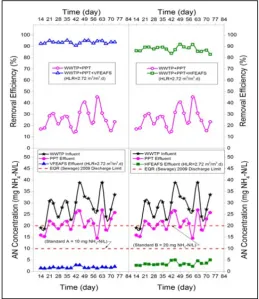
In the beginning of wastewater flow path treatment, influent concentration of AN were analyzed at range of 18.67 – 38.92 mg NH4-N/L. These concentrations were lessened slightly at range of 14.56 – 26.88 mg NH4-N/L after underwent PPT
system which creates average removal efficiency of 26%. Moreover, the capability of both vertical upward-flow and horizontal-flow of aerated EAFS filter systems were amazingly impressive where each system was able to produce average removal efficiency of AN at 88% (HFEAFS) and 94% (VFEAFS). Nevertheless, in respect of filter’s performance the VFEAFS was exhibited better than the HFEAFS system. Final effluent concentrations of VFEAFS and HFEAFS filter systems were at range of 1.37 – 2.80 mg NH4-N/L and 2.24 – 5.04 mg NH4-N/L; respectively. The trend
of AN effluent concentration of both aerated EAFS systems were relatively constant and obviously fulfil the Standard A requirement where their values were determined very far from the discharge consent limit (10 mg NH4-N/L). Fig. 7
describes the trend of AN influent and effluent concentrations during the monitoring period programme as well as their removal efficiencies.
4. Conclusion
In conclusion, the aerated VFEAFS filter system was determined efficient than HFEAFS filter system in minimizing ammonium-nitrogen concentration which accordingly, obey with Malaysian regulations of sewage discharge limit. Noticeably, the monitored of AN effluent parameter were constantly below the permissible limit of Standard A. Furthermore, it was discovered that the aerated horizontal-flow EAFS filter system perform nearly similar to the earlier system; however, their final effluent quality was slightly higher than that ran in the vertical upward-flow filter setup. In the first case, a higher concentration of DO effluents indicated that additional free AN ions were converted to nitrate, which eventually had resulted in a high removal of ammonium nitrogen. Therefore, the aerated vertical upward-flow EAFS filter system which owns taller filter depth (1.5 m) than the aerated horizontal-flow EAFS filter system (0.4 m) had maintained greatly effective system for nitrification process at HLR of 2.72 m3/m3.day, especially in tropical climate
Fig. 6 - DO distribution of different geometry shape of aerated EAFS filter (vertical upward-flow and horizontal-flow systems) at various height intervals and along longitudinal direction under similar HLR
operation
Acknowledgement
The authors are extremely indebted and acknowledged to all our funders especially; to Malaysian Ministry of Higher Education under Fundamental Research Grant Scheme (Vot. 1613) and Exploratory Research Grant Scheme (Vot. E031), as well as Universiti Tun Hussein Onn Malaysia. Appreciation is also given to the Antara Steel Mills Sdn. Bhd. for providing us Electric Arc Furnace Slag (EAFS) samples for this research.
References
[1] Richardson, C.J. (1985). Mechanisms controlling phosphorus retention capacity in freshwater wetlands. Science, 228 (4706), 1424–1427.
[2] Drizo, A., Frost, C.A., Grace, J., and Smith, K.A. (1999). Physico-chemical screening of phosphate-removing substrates for use in constructed wetland systems. Water Research, 33 (17), 3595–3602.
[3] Fan, J., Zhang, B., Zhang, J., Hao, H., Guo, W., Liu, F., Guo, Y., and Haiming, W. (2013). Intermittent aeration strategy to enhance organics and nitrogen removal in subsurface flow constructed wetlands. Bioresource Technology, 141, 117–122.
[4] Johnson, M.L. and Mara, D.D. (2007). Ammonia removal from facultative pond effluents in a constructed wetland and an aerated rock filter: performance comparison in winter and summer. Water Environment Research, 79 (5), 567–70.
[5] Hamdan, R. and Mara, D. (2013). Aerated blast-furnace-slag filters for the simultaneous removal of nitrogen and phosphorus from primary facultative pond effluents. International Journal of Integrated Engineering, 5 (1), 17–22. [6] Foladori, P., Ruaben, J. and Ortigara, A.R. (2013). Recirculation or artificial aeration in vertical flow constructed
wetlands: a comparative study for treating high load wastewater. Bioresource Technology, 149, 398–405.
[7] Li, F., Lu, L., Zheng, X., Ngo, H.H., Liang, S. Guo, W. and Zhang, X. (2014). Enhanced nitrogen removal in constructed wetlands: effects of dissolved oxygen and step-feeding. Bioresource Technology, 169, 395–402. [8] Johnson, M. and Mara, D.D. (2005). Aerated rock filters for enhanced nitrogen and faecal coliform removal from
facultative waste stabilization pond effluent. Water Science and Technology, 51 (12), 99–102.
[9] Mara, D.D., and Johnson, M.L. (2005). Aerated rock filters for enhanced ammonia and fecal coliform removal from facultative pond effluents. Water and Environment Journal, 19 (2), 143–146.
[10] Hamdan, R. and Mara, D.D. (2014). Removal of nitrogen and phosphorus from waste stabilization pond effluents using aerated blast-furnace-slag filters. WIT Transactions on Engineering Sciences, 88, 719–726.
[11] USEPA. (2000). Enhanced Nutrient Removal-Phosphorus (Washington, DC : Onsite Wastewater Treatment Systems Technology Fact Sheet 8).
[12] Environmental Requirement : A Guide for Investors. (2010). (Putrajaya, Malaysia : Ministry of Natural Resources and Environment), 1–71. from : http://www.doe.gov.my/eia/wp-content/uploads/2012/03/A-Guide-For-Investors1.pdf.
[13] Wan-Afnizan,W.-M., Hamdan, R., Norzila, O., Mohd-Adib, M.-R., Nur-Shaylinda, M.-Z., and Nur-Ain-Nazirah, M.-A. (2018). The effect of dissolved oxygen distribution on ammonium nitrogen removal in a pilot-scale of vertical upward-flow of aerated electric arc furnace slag filter systems at various hydraulic loading rates. International Journal of Engineering & Technology, 7 (4.30), 363–366.
[14] APHA. (2017). Standard Methods for the Examination of Water and Wastewater 23rdEdition (Washington, DC :
American Public Health Association).
[15] Gerardi, M.H. (2006). Wastewater Bacteria (New York : John Wiley and Sons, Inc.).
[16] Gerardi, M.H. (2002). Nitrification and Denitrification in the Activated Sludge Process (New York : John Wiley and Sons, Inc.).
[17] Halling-Sørensen, B., and Jorgensen, S.E. (1993). The Removal of Nitrogen Compounds from Wastewater (Amsterdam : Elsevier, 54).
[18] Cooper, P.F., Job, G.D., and Green, M.B. (1996). Reed Beds and Constructed Wetlands for Wastewater Treatment. (UK, Marlow : Water Research Centre, Marlow).
[19] Yamada, H., Kayama, M., Saito, K., and Hara, M. (1986). A fundamental research on phosphate removal by using slag. Water Research, 20 (5), 547–557.
[20] Bowker, R.P., and Stensel, H.D. (1990). Phosphorus Removal from Wastewater (Park Ridge, New Jersey : Noyes Data Corp.).