© Universiti Tun Hussein Onn Malaysia Publisher’s Office
JTET
http://penerbit.uthm.edu.my/ojs/index.php/jtet
ISSN 2229-8932 e-ISSN 2600-7932
Journal of Technical Education and
Training
Influence of Cognitive, Affective, and Conative Elements in
Promoting Engineering Problem Solving Skills
Norasyikin Omar
1, Mimi Mohaffyza Mohamad
1*, Marina Ibrahim Mukhtar
1,
Aini Nazura Paimin
11 Faculty of Technical and Vocational Education, Universiti Tun Hussein Onn Malaysia, Batu Pahat, 86400, MALAYSIA
DOI: https://doi.org/10.30880/jtet.2019.11.02.003
Received 06th September 2018; Accepted 18th March 2019; Available online 30th June 2019
1.
Introduction
The cognitive aspect of learning is the ability of student to connect with thinking and mental process in intellectual activity. Cognitive knowledge and skills involve the ability to acquire factual information that can be tested. The affective learning is acquisition of behaviours that reflect feelings, attitude, appreciations and values (Lashari, 2015). Conative is a mental process that encourage voluntary or striving action through the determination of desires and can be observed through persistence, initiative and resourcefulness behaviours of an individual’s (Paimin & Alias, 2017). In engineering education there is importance task for students and educators to ensure the connection of three aspects; cognitive, affective and conative to produce the graduates in appropriate level of engineering knowledge, skills and attitude. The connection of these three domains as proposed by Hilgard (1980) in Trilogy of Mind concept for achieving academic achievement. Engineering students are expected to develop their competency profile that covers all these domains (Paimin, Alias, Prpic, & Hadgraft, 2017). Previous studies involved 100 engineering students in polytechnic showed the
Abstract: Problem solving is one of the main challenges that needs to be mastered in engineering learning. This study aimed at looking whether cognitive, affective and conative elements play role in the process of mastering problem solving skills in engineering learning. Cognitive, affective and conative refer to the ‘Trilogy of Mind’ concept. Educational innovation from 1980-2016 shows that elements proposed in the ‘Trilogy of Mind’ capable in improving academic achievement. Previous studies conducted among engineering students in polytechnics Malaysia show the importance of cognitive, affective and conative elements in mastering problem solving in learning. This study continued in the process of looking whether cognitive, affective and conative can enhance the engineering learning. Strategy (cognitive), attitude (affective) and initiative (conative) are elements that are found to be able to improve academic achievement through the mastery of problem solving. An in-depth study is referring to the process of looking the relationship between strategy and attitude, initiative and attitude as well as the strategy and initiative. This study uses a survey design with a quantitative approach. The sampling method used is a simple random technique. A total of 100 engineering students from polytechnics were involved in this study. The data is analysed based on inferential statistic. The results showed that planned strategy in problems solving can be influenced by students' attitudes. Besides that, student attitude contributes to student initiative level. Strategy is also associated with initiative in mastering problem solving.
elements of cognitive, affective and conative required in problem solving process and the result also indicates strategy, attitude, initiative and intention are the elements that required for engineering students’ learning (Omar, Mohamad, Paimin, & Ibrahim Mukhtar (2018). Therefore, this study continued in process of looking whether cognitive, affective and conative can enhance the engineering learning. Strategy (cognitive), attitude (affective) and initiative (conative) are elements that are found to be able to improve academic achievement through the mastery of problem solving. Since engineering education learning is different compared to other programs, it is very important to identify the three aspects and their ability to face problem solving skills as readiness in their real world of work. Besides to prepare themselves with high level of competencies based on knowledge and skills, they also need to prepare their attitude towards their job need and also the conative element actually now a new domain, it is an approach of the intention, commitment and initiative for students’ characteristic of learning. In Technical and Vocational Education and Training (TVET) courses the learning task also include the cognitive skills and affective domain to support students’ psychomotor skills to achieve a particular learning goal. To cope the rapid changes in the real world of work and to prepare the workforce for 21st century the shift of TVET the psychology framework for TVET proposed by Safro (2016) involved the cognitive process and instructional methods to promote the development of TVET learning. In this framework cognitive learning processes such as attention, rehearsal, encoding, combinatory, comparative, accretion (elaboration), tuning, and restructuring to promote schema construction and the development of declarative and procedural knowledge, metacognitive skills, and cognitive strategies. Hence, the importance of cognitive, affective and conative in engineering education and TVET is in line with the focus of this study and the following objectives embarks in this study are:
i. To identify the relationship between strategy with students' attitudes in problem solving among engineering students.
ii. To identify the relationship between students' attitudes with students’ initiative in problem solving among engineering students.
iii. To identify the relationship between strategy with students' initiative in problem solving among engineering students
1.1
The elements of cognitive, affective and conative in engineering learning
The Trilogy of Mind applied as underlying theory in this research. This trilogy is a classification of mental activity into cognition, affection, and conation that originated in the eighteenth-century German faculty psychology, but was adopted by Scotland, England, and America's nineteenth-century association psychologists. It is suggested that the classification scheme will continue to be useful in assessing contemporary psychological emphases, such as the present prominence of cognitive psychology to the relative neglect of affection and conation (Hilgard, 1980). Preliminary study conducted by researchers in identifying the dominant of cognitive elements, affective element and conative elements in the problem-solving process among engineering students in polytechnic (Omar et.al, 2018). This study applied survey design with quantitative approach. The data was analysed based on descriptive and frequencies to represent the respondents’
Table 1: Elements of Cognitive, Affective and Conative Engineering Student’s
1.3 Trilogy of Mind
The traditional trilogy of mind represents domains of cognition, emotion, and motivation (or conation) as distinct, though interacting, with mental systems (Dai & Sternberg, 2004). Now, the idea of mind is known as Trilogy of mind which categorised into cognitive, affective and conative (Hilgard, 1980; Tallon, 1997). Hilgard said the element of Trilogy of mind that cannot be monitored are knowledge, feeling, and desire (Hilgard, 1980). LeDoux (2002) state the same thing in different contexts but still refer to trilogy consisting of cognition, affect (emotion), and conation (motivation). Not only that, the theory of knowledge (psychology-based) is emphasised in Descartes's philosophy where emphasis refers to acquiring knowledge through experience. However, psychology just not exclusive for cognition: psychology is also related to emotion and motivation. These three areas are what Hilgard said where it is a trilogy of mind (Hilgard, 1980). In depth study, according to Hilgard (1980) the elements of mind namely emotion, spirit, affection, and sentiment refer to affective, willingness and action refer to conative and, intellect refers to cognitive.
Moreover, trilogy of mind is proven to help students in learning because human behavior is influenced by cognitive, affective and conative (Kwahk, Ahn, & Ryu, 2018). Trilogy of mind also can help student in problem solving because human minds operate on the levels of cognition, affect, and motivation (Wood & Holt, 2018). Koshkaki and Solhi (2016) also stated that trilogy of mind provides a relatively complete view of the mind. Trilogy of Mind will help student’s learning in problem solving skill the three-stage process is at the heart of the learner's understanding of the learning and achievement engagement path (McGrew, 2007). Learners first address the "can I do this task?" questions. "And" I want to do this task, and why I have to do? These questions reflect the learner who contemplates or deliberates on their beliefs about what they can do, what they want to do or are asked to do, and what (positive or negative) intentions they form about how to proceed.
1.4
The Cognitive Domain (Strategy)
In resolving the problem of learning, students need to set strategy before completing the existing problems. Woods, Felder, Rugarcia, and Stice (2000) argued that it is important to set up the strategy in the process of problem solving for engineering education even though it is involving various phases. Yassin et al. (2012) argue in the same context i.e. strategy. The researchers stated that the implementation of strategies to solve problems in learning has improved student’s achievement and increased student’s knowledge (from the point of knowledge in problem solving). It has been proved by Yassin et al. (2012) via the study by (Hmelo-Silver, 2004). Effective strategy arrangements based on the ability of human minds to move thinking strategies are based on rational considerations in solving problems. Strategies help the problem-solving process but sometimes the probability of failure in the strategy can occur for a variety of reasons. As well, according to Jonassen (1997), problem solver with experience solved the problem easier than problem solver with non-experience. This is because why the strategies and schemes of problem are important. The study found a problem which has been arisen much easier to be solved if the problem has similarities with previous one that ever faced by the problem solver. This statement is reinforced by the study of Hmelo-Silver (2004) which focuses to thinking strategy (ability of thinking and rational judgment) for new people was ineffective because an individual need to have a broad basic knowledge to claim.
In another context, cognitive domain is very important because cognitive can help in many different ways through the development of knowledge and facts, analysis, synthesis, and more advanced assessment of knowledge (Bloom, 1965). This cognitive level is capable of generating strategies. Proof that cognitive can help in problem solving process based on research by Wang and Chiew (2010). These researchers stated that cognitive processes are fundamental to problem solving. Problem solving interacts with many other cognitive processes such as abstraction, searching, learning, decision making, inference, analysis, and synthesis.
Domain Attribute Results
Cognitive Belief 31
Strategy 36
Creative thinking 33
Affective Positive emotion 49
Attitude 51
Conative Desire 31
Intention 34.5
1.5
The Affective Domain (Attitude)
Attitudes are composed of behavior-related beliefs, opinions and thoughts that affect the degree of consistency (Felder, Felder, & Dietz, 2002). Leon Festinger gave the benchmark concept of attitude in the attitude formation cognitive-dissonance theory (Woolfolk, 2010). Among the studies that have been viewed literally, the importance of attitude in the problem-solving process was from Rahman's study. Rahman (2006) states that attitude is the importance element for problem solving because it is relating to the thinking process. The problem faced is easier to solve when a student has an existing knowledge as students are able to think well in addition to hard work. Based on their experience and how they relate to the problem-solving process, the existing knowledge can be based. The learner needs to organise something that is difficult to produce a solution for engineering learning problem (Felder Silverman, 1988). In other words, students need systematic information process as proposed by Felder Silverman (1988) based on student’s learning preferences. Hence, the preferences of student’s learning relate with their attitude and its show how important the element of affective (attitude) to master the problem-solving skills. Kirn and Benson (2018) and Toma and Greca (2018) state student’s attitude affects the problem-solving stage. The same finding stated by Tandogan and Orhan (2007), where a student's positive attitude can help solve learning problems. Blumenfeld et al. (1991) said the student's positive attitude would increase the motivation of the student. This situation helps students to more effectively solve their learning problems.
1.6
The Conative Domain (Initiative)
Mastery in problem solving in learning is incomplete without the presence of conative elements that are part of the trilogy of mind. The habits of students with good level of thinking will achieve a good academic but policy alone does not promise success if the student not have a tendency to do something (Driscoll, 2000). Felder & Silverman (1988) states that global-minded engineering students will be more likely to solve something difficult if they always have the initiative and always try. Such students are sometimes more successful than expected. The study by Herrmann (1995) shows that engineering students have a close personal profile to analytical thinking. Students with analytical thinking are predicted to be a better problem solver because these individuals always have the initiative to solve the problem (Jonassen, 2000). The habits of students with analytical thinking are complex thinking. Learning and career in engineering are challenging but if students have their initiative, they will be able to achieve outstanding success in this field (Becker, 2010). Initiative likes effort. Finding by McLeod (1992) showed effort can help students to solve problem in learning.
2.
Methodology
Research design applied survey design with quantitative approach. 138 number of populations from polytechnics engineering students and random sampling technique was applied to determine the number of samples. Based on Kerjcie and Morgan determining sample size table the minimum number of samples required is 97 and researcher selected 100 responses to analyse the data. The research instrument used is questionnaire and developed by researcher. The validation process of instruments through three expert’s evaluation in term of content validation and language used. Reliability tested towards 35 students with similar characteristic with respondents and the value of each construct with Cronbach’s alpha value is greater than .7 (α >.7) and it can be accepted value according to Mohamad et.al (2015) and Ghazali (2008) the value .06 is acceptable in social science research. The Pearson correlation used to answer the research questions and the data is normal distribution. Pearson correlation used is to measure of the linear relationship between two continuous variables.
3.
Results and Discussions
Data is analysed with a normalised test to ensure the data is normal or not. Inferential analysis is also made to answer the research questions of the study. Discussions were made based on research questions and confirmed with previous studies.
3.1 Normality test
Table 2: Normalised test statistics table
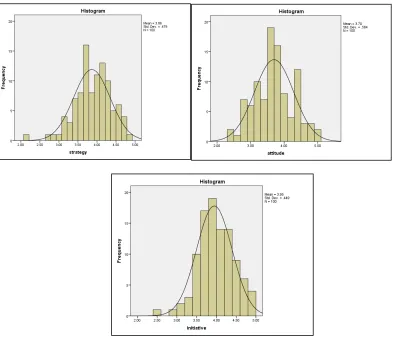
The normality data also reported in distribution graph form as stated in Fig.1. The histogram of the strategy element shows mean reading of 3.86 and standard deviation of 0.479. The histogram of the attitude element shows mean reading of 3.70 and standard deviation of 0.584. The distribution of the attitude element shows positively skewed. The histogram of the initiative element shows mean reading of 3.95 and standard deviation of 0.449.
Fig. 1 - Normality test distribution graph
3.2
Relationship between Strategy with Students’ Attitudes in Problem Solving among
Engineering Students
Table 3 shows the correlation between strategies and student's attitudes. The findings show that there is a significant relationship between the strategy and the student's attitudes. Analysis findings show that the value of strategy and attitude is within the range p < 0.01. The implication of this result as stated in Sazhin (1998) stated that when students are hardworking, the strategies that are made to solve the problem will be successful as students are always trying to make new strategy. Researcher refers to preliminary in initial study and found that when engineering students work hard, solution in engineering mathematical calculation can be made. Hardworking attitudes influencing problems solving in learning how their attitude impacts the way how to solve problem with their own strategy and self-desire.
In addition, Oakley et al. (2004)'s study has shown that individual attitudes are influenced by good strategy implementation. When a student is always looking for ways to complete a tutorial with various methods so the problem can be solved in learning. This situation means students not give up. When students not give up, strategy can be implementing many times to make sure the problem can be solved. Findings of other studies that support the result above
Strategy Attitude Initiative
Skewness -0.500 0.066 -0.173
are from (Kirn & Benson, 2018; Toma & Greca, 2018). Some researchers ' studies yield different results. Schibeci (1984), based on his study, said something else. This researcher said the student-managed strategy is not influenced by the attitudes of the student in learning. In addition, Dillashaw and Okey's study (1983) shows positive attitudes when there is direction from the group's head, but the success of the planned strategy does not depend entirely on members ' attitudes in learning.
Table 3: Strategy-attitude relationship analysis
Pearson correlation relationship
Element Strategy-Attitude
r 0.284
p 0.004
N 100
3.3
Relationship between Students' Attitudes with Students’ Initiative in Problem Solving
among Engineering Students
Table 4 shows the correlation between attitude and student's initiative. The findings show that there is a significant relationship between the attitude and the student's initiative. Analysis findings show that the value of (Attitude-Initiative) is within the range p < 0.01. From the result, Table 3 in the below shows that there is a significant relationship between the attitude and the student's initiative. This finding coincides with what Ferri (2018) stated, when students are an independent, hardworking, and confident, many of the efforts that students can trigger as they dare to risk things, free to plan what to do and repeatedly look for solutions (Ferri, 2018). Laguador (2013) also stated that, attitudes that incite positive behavior can help a student take initiative to perform additional tasks. In addition, previous research by Jin & Lin (2018) proved that have correlation between attitude and student’s initiative based on the statement that the students who have high initiative will be more diligent than the low initiative students. Study by Osborne & Dillon (2008) also show that have the relationship between students’ attitudes with students’ initiative. This study states have relationship between student achievement and student attitudes.
Table 4: Attitude-initiative relationship analysis
3.4
Relationship between Strategy with Students' Initiative in Problem Solving among
Engineering Students
Table 5 shows the correlation between strategy and student's initiative. The findings show that there is a significant relationship between the strategy and the student's initiative. Analysis findings show that the value of (Strategy-Initiative) is within the range p < 0.01. The findings from Table 4 show that there is a significant relationship between the strategy and the student's initiative. Research study by Jonassen (2017) shows that in the field of engineering education, many things require problem solving. Students need to organize various strategies to solve problems. To organise strategy, students should have a variety of idea and alternatives. Besides, study by Widodo (2019) shows that student initiatives can influence strategies that are planned because of whether students have high or low motivation. Having a high level of effort can lead to more effective strategy creation. The findings of this study are abreast with the result from Table 5.
Table 5: Strategy-initiative relationship Pearson correlation
relationship
Element Attitude-Initiative
r 0.417
p 0.000
N 100
Pearson correlation relationship
Element Strategy-Initiative
r 0.409
p 0.000
4.
Conclusion
As conclusion, this study shows that there is a relationship in mastering problem solving in engineering learning between cognitive-affective, affective-conative and cognitive-conative. In fact, the three domains are able to improve academic achievement on the basis of Yusri et al. (2010)'s study findings that cognitive needs to think, affective as an aspect that brings positive emotions when learning. In addition to enhancing learning and achievement, cognitive processes can also have this effect. Instructors should therefore provide both learning materials and an appropriate environment to enhance all cognitive, affective and conative processes. This research provided important information that may be useful to further define and understand factors that contribute to engineering education students’ ability in problem solving based on the combination of cognitive-affective -conative. In addition, problem solving skills is demand in students’ critical thinking as mentioned in Mohamad et.al (2017) that the relationship between critical thinking and problem solving are needed to cope engineering students with higher level ability to apply in workplace.
As suggestion this research should expand the number of populations because the population's scope may limit the generalizability of the findings. A larger group of respondents across disciplines and years of study will be considered in future research. Throughout larger size of samples and programs, a longitudinal study can be designed to enable researchers to establish a stronger basis for interpreting the causal relationship of factors and comparing students detail problem solving ability based on years of study. This research also can be applied in TVET program with similar pedagogical and didactic approach in engineering education in terms of development of teaching and learning process in determination competencies of students.
Acknowledgement
This research funded by Fundamental Research Grant Scheme (FRGS) Vote 1501 & Research Management Center (RMC) Research Fund, Universiti Tun Hussein Onn Malaysia.
References
Becker, F. S. (2010). Why don't young people want to become engineers? Rational reasons for disappointing decisions. European journal of engineering education, 35,4. 349-366.
Bloom’S, T. M. E. (1965). Bloom’s taxonomy of educational objectives. Longman.
Blumenfeld, P. C., Soloway, E., Marx, R. W., Krajcik, J. S., Guzdial, M., & Palincsar, A. (1991). Motivating project-based learning: Sustaining the doing, supporting the learning. Educational psychologist, 26,3-4. 369-398.
Dai, D. Y., & Sternberg, R. J. (Eds.). (2004). Motivation, emotion, and cognition: Integrative perspectives on intellectual functioning and development. Routledge.
Dillashaw, F. G., & Okey, J. R. (1983). Effects of a modified mastery learning strategy on achievement, attitudes, and on- task behavior of high school chemistry students. Journal of Research in Science Teaching, 20,3. 203-211.
Driscoll, M. P. (2000). Psychology of learning. Boston, Allyn and Bacon.
Felder, R. M., & Silverman, L. K. (1988). Learning and teaching styles in engineering education. Engineering education, 78,7.674-681.
Felder, R. M., Felder, G. N., & Dietz, E. J. (2002). The Effects of Personality Type on Engineering Student Performan ce and Attitudes. Journal of Engineering Education, 91 (1), 3-17.
Ferri, R. B. (2018). Task Competency: For Your Instructional Flexibility. In Learning How to Teach Mathematical Modeling in School and Teacher Education (1st ed). Springer: Cham.
Ghazali Darusalam (2008). Kesahan dan Kebolehpercayaan Dalam Kajian Kuantitatif dan Kualitatif. Jurnal Institut Perguruan Islam. April
Hermann,N.(1995).Creative Problem solving. IEEE XPLORE, 4-9 http//www.comp.dit.ie/dgordon/Courses/PSIC/ Problem Solving Hermann.
Hilgard, E. (1980). The trilogy of mind: Cognition, affection, and conation. Journal of the History of the Behavioral Sciences, 16, 107-117.
Jin, W., & Lin, Y. (2018). An Investigation into Senior High School Students' Psychological Quality and Its Relationship with Their English Performance. English Language Teaching, 11(6), 23-32.
Jonassen, D. H. (1997). Instructional design models for well-structured and III-structured problem-solving learning outcomes. Educational technology research and development, 45,1. 65-94.
Jonassen, D. H. (2000). Toward a design theory of problem solving. Educational technology research and development, 48,4. 63-85.
Jonassen, D. H. (Ed.). (2017). Learning to solve complex scientific problems. Routledge.
Kirn, A., & Benson, L. (2018). Engineering Students' Perceptions of Problem Solving and their Future. Journal of Engineering Education, 107,1. 87-112.
Kwahk, K. Y., Ahn, H., &Ryu, Y. U. (2018). Understanding mandatory IS use behavior: How outcome expectations affect conative IS use. International Journal of Information Management, 38,1. 64-76.
Laguador, J. M. (2013). Developing students’ attitude leading towards a life-changing career. Educational Research International, 1,3.28-33.
LeDoux, J. (2002). Synaptic self: How our brains become who we are (1st ed)NY: Penguin Books.
McLeod, D. B. (1992). Research on affect in mathematics education: A reconceptualization. Handbook of research on mathematics teaching and learning, 575-596.
McGrew, K. S. (2007). Beyond IQ: A Model of Academic Competence and Motivation (Institute for Applied Psychometrics). Retrieved May 9, 2019, from http://www.iapsych.com/acmcewok/map.htm
Mohamood, M.R., Megat Mohd Nor, M.N.M., Suppiah, S.V., Mohd Ariffin, S.M., Hajid Ahmad Khan, H., Wan Omar, W.N.A., Mohd Ali, N., Nordin, H., Husain, S. Mat Nasir, N.E., Shamsuddin,R., Ibrahim, N., Anuari, U.S., Shamsuddin, S., Khodari, M.F., Kamsari, S.N. & Mohd Zaidin, N. (2009). Ke arah kelestarian modal insan negara. Majalah Hala Tuju TransformasiPoliteknik,(1),1-84. May 15, 2019 http://www.pkb.edu.my/pdf/halatujutransformasipoliteknik(2)
Mohamad,M.M, Sulaiman, N.S, Lai C.S., Mohd Salleh, K. (2015). Measuring the Validity and Reliability of Research Instruments. Procedia Social and Behavioral Science. 204, 164-171
Mohamad, M.M., Ibrahim Mukhtar,M., Jamali, A.R., Tee, T.K., Yee, M.H (2017). An Analysis of Engineering Students' Critical Thinking, 7th World Engineering Education Forum, WEEF 20177th Regional Conference on Engineering Education and Research in Higher Education 2017.Retrieved May 15, 2019 https://ieeexplore.ieee.org/document/8467116
Oakley, B., Felder, R. M., Brent, R., & Elhajj, I. (2004). Turning student groups into effective teams. Journal of student-centered learning, 2,1. 9-34.
Omar, N., Mohamad, M.M., Paimin, A.N.,& Ibrahim Mukhtar, M. (2018). Elements of cognitive, affective, and conative in problem solving process for engineering students. American Scientific Publishers,24,4 2638-2641
Op den Kamp, E. M., Bakker, A. B., Tims, M., & Demerouti, E. (2018). Proactive Vitality Management and Creative Work Performance: The Role of Self- Insight and Social Support. The Journal of Creative Behavior.
Osborne, J., & Dillon, J. (2008). Science education in Europe: Critical reflections. London: The Nuffield Foundation.13, Othman, W., & Ismail, H. (2001). Aplikasi Konsep Dan Kaedah Lukisan Kejuruteraan Dalam Matematik Oleh Guru-Guru Matematik Di Sekolah Menengah Teknik Seluruh Negeri Kelantan. Jurnal Teknologi, 35. 1-10.
Paimin, A. N. & Alias, M. (2017). The role of attitude, subjective norms, and perceived behavioural control in promoting the intention to achieve success among engineering students In Theory of Planned Behavior: New Research. United States: NOVA Science Publishers.
Paimin, A. N., Alias, M., Prpic, J.K., & Hadgraft, R. G. (2017). Developing an instrument to measure the cognitive-affective-conative profile of engineering students. IEEE 9th International Conference on Engineering Education (ICEED), 101-105
Sazhin, S. S. (1998). Teaching mathematics to engineering students. International Journal of Engineering Education, 14,2. 145-152.
Tallon, A. (1997). Head and heart: Affection, cognition, volition and triune consciousness (1st edu) NY: Fordham University Press
Tandogan, R. O., & Orhan, A. (2007). The Effects of Problem-Based Active Learning in Science Education on Students' Academic Achievement, Attitude and Concept Learning. Online Submission, 3,1. 71-81.
Toma, R. B., & Greca, I. M. (2018). The Effect of Integrative STEM Instruction on Elementary Students’ Attitudes toward Science. Eurasia Journal of Mathematics, Science and Technology Education, 14,4. 1383-1395.
Wang, Y., & Chiew, V. (2010). On the cognitive process of human problem solving. Cognitive systems research, 11,1. 81-92.
Widodo, S. (2019). Melalui Metode Pembelajaran Diversity Of Student Strategy Learning (Strategi Pembelajaran Yang Mempertimbangkan Keragaman Siswa) Mampu Meningkatkan Prestasi Belajar Pada Siswa Kelas VIII-A Semester Ganjil Di SMP Negeri 3 Ngadirojo, Kabupaten Pacitan Tahun. Jurnal Edukasi Gemilang (JEG), 4(2), 63-68.
Woods, D. R., Felder, R. M., Rugarcia, A., & Stice, J. E. (2000). The future of engineering education III. Developing critical skills. Change, 4.48-52.
Wood, A., & Holt, S. S. (2018). Emotional Intelligence, Performance, and Fulfillment. The Palgrave Handbook of Workplace Spirituality and Fulfillment, 153-174. Switzerland AG. : Springer
Woolfolk, A.E. (2010). Educational Psychology. 11th ed. Boston: Ally & Bacon.
Yasin, R. M., Halim, L., & Ishar, A. (2012). Effects of problem-solving strategies in the teaching and learning of engineering drawing subject. Asian Social Science, 8,16. 65.