Virtual Community of Practice (CoP): Knowledge Sharing in the Wikipedia Community
ABSTRACT
Manuscript type: Research paper
Research aims: This paper aims to revisit the concept of the virtual community of practice among undergraduates in Italy and Indonesia. Design/Methodology/Approach: This study employs a quantitative approach to retrieve data from a questionnaire survey. Data are collected from undergraduate students of the business faculty from the University of Padua, Italy and the University of Bengkulu, Indonesia. Based on a systematic sampling method, the question-naires are distributed through several social media platforms such as WhatsApp, e-mail, Messenger and Facebook. Analysis is conducted via Structural Equation Modeling (SEM).
Research findings: The findings highlight that Wikipedia charac-teristics and member promotion, community trust and community identification are found to be positively related to knowledge sharing intention. There is insubstantial evidence to demonstrate the significant effect of community participation on knowledge sharing intention.
A Glimpse into the Virtual Community of
Practice (CoP): Knowledge Sharing in the
Wikipedia Community
Berto Usman* and Yennita
* Corresponding author: Berto Usman is an Assistant Professor in Finance at the Department of Management, Faculty of Economics and Business, University of Bengkulu, Jln. WR Suprat-man, Kandang Limun 38121 Kota Bengkulu, Indonesia. Email: [email protected] Yennita is an Associate Professor at the Faculty of Teacher Training and Education, University of Bengkulu, Jln. WR Supratman, Kandang Limun 38121 Kota Bengkulu, Indonesia. Email: [email protected]
Acknowledgement: We are grateful to AJBA’s editors, anonymous reviewers, Eleonora Di
Maria, Matin Mohaghegh (University of Padua), Anggia Paramitha (University Riau), Anne Malau Rumondang (Universitas HKBP Nommensen), Mega Asri Zona (Universitas Negeri Padang), Rahman Febliansyah (Universitas Bengkulu) for their comments and extensive
discussion given to the theoretical point of view and the statistical method used in this study.
Theoretical contribution/Originality: This study expands on existing literature on virtual community of practice by offering a comparative analysis of two different samples from Italy and Indonesia.
Practitioner/Policy implications: The findings of this study sug -gest that virtual communities of practice are important vehicles of knowledge sharing in universities. However, many approaches need to be taken in order to ensure that the distribution and circulation of knowledge is properly conducted among members so as to sustain the dynamics of knowledge sharing in the community of practice. Research limitation: Future research needs to emphasise on collect-ing data from diverse respondents in different geographical settcollect-ings so as to increase the generalisability of the findings.
Keywords: Wikipedia, Community of Practice, Virtual Community Outcomes, Knowledge Sharing
JEL Classification: O30, O32, O35
1. Introduction
The amount of knowledge produced in today’s academic environment is increasing profoundly. Such knowledge is significantly different from the information and knowledge that had been produced decades ago. As noted by Barker (2015), this phenomenon is triggered by the remarkable evolution and progress of Information Communication and Technology (ICT), where the Internet communication (Web 2.0) and technology (computer and gadgets) has given users a broad opportunity to acquire news and information easily. It also acts as support in terms of the simplification of process knowledge sharing. This phenomenon also reflects that the time, focus, scope and scale of academic knowledge production and sharing, have changed dramatically (Black, 2008). Academics, practitioners, and both public and private institutions working on the area of technological development, are beginning to connect collective resources and knowledge through the Internet platform and various other ICTs. The rapid development of the ICTs has been supporting the many interactions happening in cyberspace for community formation. This has led to the development of virtual communities which have helped to accelerate the growth of human beings, acting as bridges linking the digital gaps and addressing sustainable development goals.
Virtual Community of Practice (CoP): Knowledge Sharing in the Wikipedia Community
distribution and circulation of knowledge is properly conducted among members, the dynamics of knowledge sharing in the community of practice will be sustained (Jensen, Johnson, Lorenz, & Lundvall, 2007). Currently, the community of practice is not only manifested in the physical form and the routine meetings of members (Schwen & Hara, 2003; Md. Rasli & Wan Mohd, 2007; Wenger & Trayner-Wenger, 2015) but also through many other virtual community of practices (CoP) that allow members to interact in cyberspace media. Wikipedia, STATALIST (the Stata forum), Linux programmer platform, online distance learning, chat rooms, the virtual world and so forth are new modes for knowledge sharing activities; they are unrestrained by time and space, and they focus on immediate responses and interactions (Gray, 2004; Jansen, Sobel, & Cook, 2011; Kim, Sohn, & Choi, 2011).
The significant increase noted in the number of users and con-tributors of Wikipedia illustrates that this platform is taking on the role as an intelligent entity in the virtual community setting (Trkman & Trkman, 2009). In this regard, people are inclined towards producing and consuming information that is preserved in and accessed from various sources (Black, 2008; Johnson, 2001). It was also observed that the existence of the same joint enterprises, mutual engagement and shared repertoire among users and contributors enabled them to enjoy the same interest through different platforms of knowledge sharing activities (online and non-online) (Wenger, 2003). Given the important role played by the virtual community in today’s knowledge sharing practices, many studies have thus been conducted to examine this phenomenon. Among them, Wang and Wei (2011) reported that the Wiki application has a direct and positive effect on the virtual community’s outcomes (community participation, promotion, trust and identification). The Wiki application is related to the Wiki members’ willingness to share knowledge and how they behave. In an earlier study, Korfiatis, Poulos and Bokos (2006) evaluated the authoritative source of the social network by focusing on Wikipedia as the knowledge circulation platform. They noted that as Wikipedia advances to become a virtual community of practice, it was also barraged by the critical issue of credibility as an authoritative reference source. This issue challenged the contributors as members to keep maintaining and sustaining the reliability of the contents in knowledge value creation and circulation.
can be a critical factor in encouraging the continuance intention of virtual community knowledge sharing. Recently, there have been exploratory studies which surveyed how individuals used the virtual community of practice. Hafeez, Alghatas, Foroudi, Nguyen and Gupta (2018), for example, examined how entrepreneurs engaged in a virtual community of practice to share their knowledge. They observed that entrepreneurs used short and medium messages to contribute to the discussions in the virtual community of practice. They also noted that the engaged topics usually enhance the discussions, thereby promoting the discussion threads. In one longitudinal study, Gray and Gabriel (2018) noticed that self-employed and unemployed managers used the virtual community of practice to share their knowledge and experiences in start-up businesses. They noted that the presence of diversity within the community provided rich professional insights as well as tensions for the members. Hence, it was proposed that such a virtual community of practice would require a moderator who is able to coordinate contributions and to respect cultural differences, simultaneously. Current literature indicates that very few studies are able to explain the use of Wikipedia as a virtual community. Of those that do, they seemed to rely entirely on exploratory data coupled by limited examples drawn from developing country settings.
Virtual Community of Practice (CoP): Knowledge Sharing in the Wikipedia Community
virtual community outcomes and the knowledge sharing intention among the users?
In this study, Italy and Indonesia were determined as the targeted context due to their high involvement as the TOP 20 Internet countries with the highest number of Internet users within Europe and Asia (Stats, 2018). As of September 2018, the number of Wikipedia contributors in Italy has grown to 58,636 contributors while the number from Indonesia was reported to be 12,636. Both countries are listed among the higher contributors to Wikipedia, according to the Wikipedia statistics database (WMF Analytics, 2018). In this context, we conjecture that the high number of Internet users may be integrated with the Internet usage. Thus, we focus on Wikipedia as a virtual-based community of practice for one developed country (European Union) and one developing country (ASEAN). We also speculate some possible and significant differences in the practice and routines of using the Wikipedia as a sharing platform in the virtual community outcome, as a result of differences in cultural values and behaviour.
The remainder of this paper is structured as follows: Section 2 highlights the literature review by explaining the major theoretical foundations of the current trend of community of practices. Section 3 presents the method of data collection. Section 4 reports and discusses the findings, and Section 5 concludes with the implications of this study.
2. Literature Review 2.1 Wikipedia Characteristics
computer-mediated communication such as the Wikipedia (Parker & Chao, 2007). The characteristics of such a relationship were eventually considered as the triggering factor, particularly in boosting opportunities which create plausible interactions among users and members (Bruns & Humphreys, 2005; Ebner et al., 2008).
Due to the huge amount of data and notes contributed and shared by users, the Wikipedia has finally enlarged its coverage to turn into a webpage that corresponds to the storing and modifying of information activities. More specifically, the Wikipedia has continued to grow in terms of the number of articles being published on the Wiki1 pages. The number of scripts and articles added to the Wikipedia through the Wiki pages mode, has grown significantly since the past subsequent years (Trkman & Trkman, 2009). Currently, the number of articles written in English in the first quarter of 2017 was noted to be 5,416,803 articles with the total Wiki pages noted to be 42,234,457 pages. As of the first quarter of 2017, the number of contributors and users had reached 1,259 and 31,072,435, respectively (Wikipedia, 2017).
2.2 Virtual Community Outcomes
The concept of a virtual community is defined by Balasubramanian and Mahajan (2001) as an entity that displays several major characteristics comprising: (i) the aggregation of people within the group, (ii) rational utility-maximiser among members, (iii) interpersonal interactions in terms of cyberspace that is not followed by the physical co-location, (iv) the social-exchange process found in the interaction and (v) the presence of a shared property or identity, objective and or interest among members. With regards to the virtual community and its relation to knowledge sharing, it is believed that the degree of knowledge sharing takes an important role in expanding the use of the virtual community
1 As noted in the paper by Ebner et al. (2008), the first pilot project of wikis was introduced
Virtual Community of Practice (CoP): Knowledge Sharing in the Wikipedia Community
(Zhang, Fang, Wei, & Chen, 2010). It was highlighted by Wasko and Faraj (2000) that productive knowledge sharing is more likely to be the determining factor of an effective virtual community. This is important since the satisfaction of members is influenced by the level of knowledge sharing among members within the group.
Due to the remarkable progress of technology which has shifted the manual community of practice to one that is digital, many researchers (Ardichvili, Page, & Wentling, 2003; Johnson, 2001; Koh & Kim, 2004; Liao, To, & Hsu, 2013) have been striving to understand how the latter works as a valuable and effective system in facilitating the process and activity of knowledge sharing. Due to this transformation, the virtual community has been regarded as resembling the real-life community where the virtual or online-based community, has to also support and provide information among members, thereby allowing the members or participants to increase their involvement and interaction. In this regard, the usage of the virtual community of practice can be perceived as containing a variety of professional and non-professional purposes. Di Maria and Finotto (2008) noted that the online entity somehow relied on user communities; it requires structured and focused marketing strategies which is in line with the characteristics of the virtual community. They act as key elements to maintaining the sustainability of the entity depending on brands, communication and interactions.
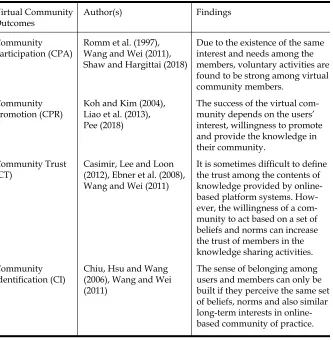
Several studies (e.g. Romm, Pliskin, & Clarke, 1997; Wang & Wei, 2011; Liao et al., 2013) have shed light on the online-based community of practice by looking at virtual community outcome factors. The importance of the virtual community outcomes correspond to the success of the knowledge sharing activity. The characteristics and member interaction are themselves not enough if these factors are not followed by the active participation, promotion, interpersonal trust and identification within groups. Many researchers have pointed out the essence of the virtual community in fostering the process of knowledge sharing intention in online-based community of practice. Table 1 illustrates.
2.3 Knowledge Sharing
perceived learning activity. Third, the availability of the market is clear and fourth, there is interaction among the members.
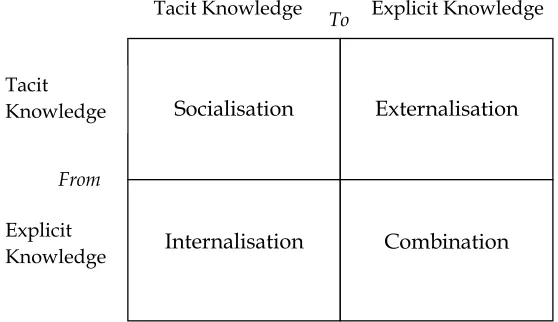
Referring to the modes of knowledge sharing as proposed by Nonaka, (1994) (Figure 1), it can be seen that the third mode of the SECI (socialisation, externalisation, combination and internalisation) model is a “combination” involving the use of the social process to combine different bodies of explicit knowledge held by individuals. On a similar note, some scholars believe that the act of knowledge sharing is based on the social exchange theory since the outcome of the exchange process leads to a behaviour change. According to the social exchange theory, an individual would commonly weigh the potential benefits and risks Table 1: Prior Studies on the Online-Based Community of Practice
Virtual Community Author(s) Findings Outcomes
Community Romm et al. (1997), Due to the existence of the same Participation (CPA) Wang and Wei (2011), interest and needs among the
Shaw and Hargittai (2018) members, voluntary activities are found to be strong among virtual community members.
Community Koh and Kim (2004), The success of the virtual com-Promotion (CPR) Liao et al. (2013), munity depends on the users’
Pee (2018) interest, willingness to promote and provide the knowledge in
their community.
Community Trust Casimir, Lee and Loon It is sometimes difficult to define (CT) (2012), Ebner et al. (2008), the trust among the contents of
Wang and Wei (2011) knowledge provided by online-based platform systems. How-ever, the willingness of a com-munity to act based on a set of beliefs and norms can increase
the trust of members in the
knowledge sharing activities.
Community Chiu, Hsu and Wang The sense of belonging among Identification (CI) (2006), Wang and Wei users and members can only be
(2011) built if they perceive the same set of beliefs, norms and also similar
long-term interests in
Virtual Community of Practice (CoP): Knowledge Sharing in the Wikipedia Community
of the social relationship prior to interaction. In the context of the virtual CoP, the likelihood of individuals sharing the information is higher when they are able to maximise the benefits obtained from sharing the knowledge (Bettiol, Di Maria, & Grandinetti, 2012; Molm, 1997). According to Nonaka (1994), the individual exchange and the combined knowledge can be done through exchange mechanisms such as meetings or telephone conversations. Presently, the model of communication has been progressively upgraded by more sophisticated technologies and knowledge management repository approaches (Massingham, 2014). The explosive Internet diffusion, for instance, has boosted the proliferation of virtual communities (Liao et al., 2013). The combination of people and technology platforms is today prolific, in the form of online-based platform communities such as the Wikipedia (Shaw & Hargittai, 2018). The reconfiguration of existing information as seen in current technological platforms, enable the members to maintain the virtual community either by adding, re-categorising or re-contextualising the data and information more easily. Figure 1 demonstrates.
2.4 Research Model and Hypothesis Development
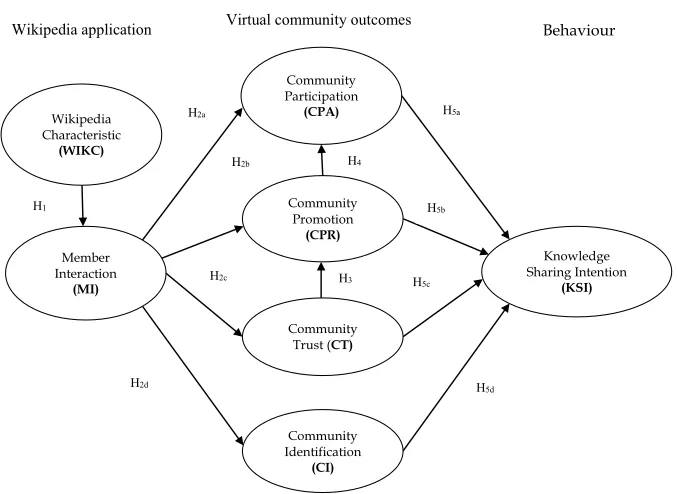
The model used to illustrate the relationship between Wikipedia appli-cation, the virtual community outcomes and the behaviour in knowledge sharing is displayed in Figure 2. It is adopted from Wang and Wei (2011). This model is composed of seven factors which are Figure 1: Modes of Knowledge Creation
Source: Nonaka, 1994.
Socialisation Externalisation
Internalisation Combination
Tacit Knowledge To Explicit Knowledge
Tacit Knowledge
Explicit Knowledge
expected to show the relationship between the dimensions of the Wikipedia application, the virtual community outcomes and the behaviour in knowledge sharing. It can be seen that the Wikipedia application has two factors: Wiki characteristics (WIKC) and member interaction (MI). The virtual community outcomes at the manifestation of the community of practice in the online-based community have four factors: community participation (CPA), community promotion (CPR), community trust (CT) and community identification (CI). The last of this, the behaviour is depicted by the usage of knowledge sharing intention (KSI) among the members.
2.4.1 The Association between Wikipedia Characteristic, Member Interaction, and Community of Outcomes
Hansen, Berente and Lyytinen (2009) had explored the Wikipedia as a platform for rational discourse and as a manifestation of communicative actions. It was noted that in more developed discussions, interactions Figure 2: The Proposed Model of Virtual Community Outcomes
Source: Wang & Wei, 2011.
Wikipedia Characteristic
(WIKC)
Member Interaction
(MI)
Community Participation
(CPA)
Community Promotion
(CPR)
Community
Trust (CT)
Community Identification
(CI)
Knowledge Sharing Intention
(KSI)
Wikipedia application Virtual community outcomes Behaviour
H5d H1
H2a
H2b
H2c
H2d
H4
H3
H5a
H5b
Virtual Community of Practice (CoP): Knowledge Sharing in the Wikipedia Community
among users and members in the virtual community of practice such as the Wikipedia can be classified as a combination of between people-to-people interaction and as a codification of from people-to-document (see Nonaka’s (1994) modes of knowledge creation). Moreover, the procedure of knowledge circulation among members is conducted through the mechanism of many-to-many people. The related infor-mation is easily and timely distributed among members. Therefore, the characteristic of the virtual CoP such as Wikipedia creates a huge impact in stimulating high level participation and interaction among members. Besides the interaction itself, interpersonal connection in terms of many-to-many relationship, is conjectured to be positive if members carefully recognise the importance and legitimacy of online-based community practices (Wasko & Faraj, 2000). This will eventually lead to virtual community outcomes that drive the variation in the behaviour of the members. Also, the perceived ease of use of the application is considered as the determinant factor of member interaction (Romm et al., 1997). The interpersonal relationship among members is expected to increase community participation, community promotion, community trust and community identification among the members. Based on the a priori
explanation of the relationship between the Wikipedia characteristics and member interaction and virtual community outcomes, this study thus postulates that:
H1: Wikipedia characteristics (WIKC) among the members are positively related to member interaction (MI).
H2a: Member interaction (MI) in the Wikipedia community is positively related to community participation (CPA).
H2b: Member interaction (MI) in the Wikipedia community is positively related to community promotion (CPR).
H2c: Member interaction (MI) in the Wikipedia community is positively related to community trust (CT).
H2d: Member interaction (MI) in the Wikipedia community is positively related to community identification (CI).
2.4.2 The Association between Virtual Community Outcomes and Knowledge Sharing Intention
takes place in physical learning and knowledge sharing environments, trust is important for maintaining and sustaining the virtual CoP. In the virtual environment, there is no guarantee that the information or knowledge shared is valid and genuine. Therefore, trust is necessarily important for the group where the existence of trust will eventually increase member promotion. When there is a strong level of trust, mem-bers are more likely to promote the virtual community or to invite new potential knowledge contributors (Kim et al., 2011). With more proactive and aggressive members promoting the virtual community to new knowledge contributors, an increase in community participation is likely to happen. Intensive postings, for example, would help in promoting the virtual community. With more members and new contributors viewing the postings, ideas and knowledge are disseminated quickly. This too increases community participation. The more people participate as contributors, the more the knowledge is shared among the community. Based on the above arguments, this study postulates that:
H3: Community trust (CT) in the Wikipedia community is posi-tively related to community promotion (CPR) of the virtual community.
H4: Community promotion (CPR) in the Wikipedia community is positively related to community participation (CPA) of the virtual community.
H5a: Community participation (CPA) in the Wikipedia community is positively related to the knowledge sharing intention (KSI) of the virtual community.
H5b: Community promotion (CPR) in the Wikipedia community is positively related to the knowledge sharing intention of the virtual community.
H5c: Community trust (CT) in the Wikipedia community is posi-tively related to the knowledge sharing intention (KSI) of the virtual community.
Virtual Community of Practice (CoP): Knowledge Sharing in the Wikipedia Community
experiences with other members (Arnett, German, & Hunt, 2003). Based on these arguments, this study postulates that:
H5d: Community identification (CI) in the Wikipedia community is positively related to the knowledge sharing intention (KSI).
3. Research Methodology
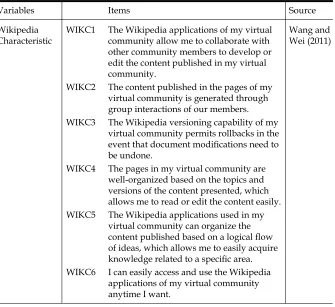
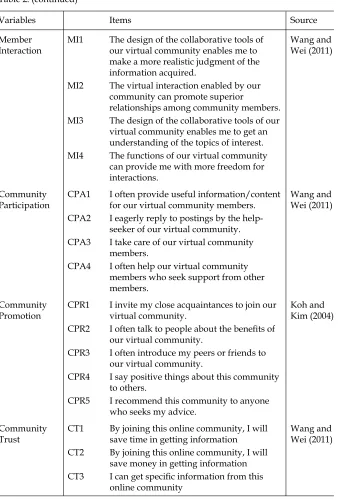
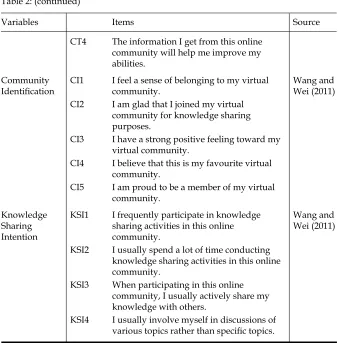
This study employs a quantitative technique using the questionnaire survey as a data collection approach. To test the research framework of the questionnaire, items were adopted from previous literature (Koh & Kim, 2004; Wang & Wei, 2011). The five-point Likert scale is used to measure the variables. The operationalisation of these variables is depicted in Table 2.
Table 2: Variable Measurements
Variables Items Source
Wikipedia WIKC1 The Wikipedia applications of my virtual Wang and Characteristic community allow me to collaborate with Wei (2011)
other community members to develop or edit the content published in my virtual community.
WIKC2 The content published in the pages of my virtual community is generated through group interactions of our members. WIKC3 The Wikipedia versioning capability of my
virtual community permits rollbacks in the event that document modifications need to be undone.
WIKC4 The pages in my virtual community are well-organized based on the topics and versions of the content presented, which allows me to read or edit the content easily. WIKC5 The Wikipedia applications used in my
virtual community can organize the content published based on a logical flow of ideas, which allows me to easily acquire knowledge related to a specific area. WIKC6 I can easily access and use the Wikipedia
Table 2: (continued)
Variables Items Source
Member MI1 The design of the collaborative tools of Wang and Interaction our virtual community enables me to Wei (2011)
make a more realistic judgment of the information acquired.
MI2 The virtual interaction enabled by our community can promote superior
relationships among community members. MI3 The design of the collaborative tools of our
virtual community enables me to get an understanding of the topics of interest. MI4 The functions of our virtual community
can provide me with more freedom for interactions.
Community CPA1 I often provide useful information/content Wang and Participation for our virtual community members. Wei (2011)
CPA2 I eagerly reply to postings by the help-seeker of our virtual community. CPA3 I take care of our virtual community members.
CPA4 I often help our virtual community members who seek support from other members.
Community CPR1 I invite my close acquaintances to join our Koh and
Promotion virtual community. Kim (2004)
CPR2 I often talk to people about the benefits of our virtual community.
CPR3 I often introduce my peers or friends to our virtual community.
CPR4 I say positive things about this community to others.
CPR5 I recommend this community to anyone who seeks my advice.
Community CT1 By joining this online community, I will Wang and Trust save time in getting information Wei (2011)
CT2 By joining this online community, I will save money in getting information CT3 I can get specific information from this
Virtual Community of Practice (CoP): Knowledge Sharing in the Wikipedia Community
The target population of this study were students who use the Wikipedia. Our sampling frame comprises undergraduate management students attached to the Dipartimento di Scienze Economiche e Aziendali (DSEA), “Marco Fanno”, the University of Padua – (UNIPD, Italy), and the Departemen Manajemen, Fakultas Ekonomi dan Bisnis (FEB), the University of Bengkulu (UNIB, Indonesia). Currently, the University of Padua in Italy has 38,495 undergraduate students while the University of Bengkulu has around 7,927 undergraduate students. More precisely, we report the total number of students that is 600 active undergraduate students in the management studies at the University of Padua and 400 active undergraduate students at the University of Table 2: (continued)
Variables Items Source
CT4 The information I get from this online community will help me improve my abilities.
Community CI1 I feel a sense of belonging to my virtual Wang and
Identification community. Wei (2011)
CI2 I am glad that I joined my virtual community for knowledge sharing purposes.
CI3 I have a strong positive feeling toward my virtual community.
CI4 I believe that this is my favourite virtual community.
CI5 I am proud to be a member of my virtual
community.
Knowledge KSI1 I frequently participate in knowledge Wang and Sharing sharing activities in this online Wei (2011) Intention community.
KSI2 I usually spend a lot of time conducting knowledge sharing activities in this online
community.
KSI3 When participating in this online community, I usually actively share my knowledge with others.
Bengkulu. To systematically collect the samples, we pick every third student who was registered in the faculty’s student database. The reason for using the students as the targeted respondents are as follows: First, university students are more easily available and accessible. Second, it is less expensive when engaging university students whilst seeking research respondents from outside the university will be more difficult in terms of time and finances. Third, the undergraduate students are predominantly familiar with using the Internet and one of the most accessed web pages they use to collect information is the Wikipedia page.
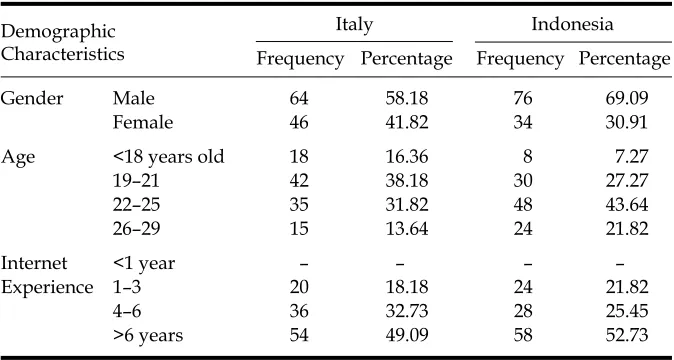
A total of 333 students were then approached through the email. Upon obtaining their consent for participation, 220 questionnaires were distributed through several social media such as WhatsApp’s, email, Messenger and Facebook, depending on the preference of the respondents. The respondents were then equally distributed into two groups – Italians and Indonesians. Table 3 depicts the demographic profiles of the respondents.
Demographic Characteristics
Table 3: Demographic Profiles of Respondents in Two Countries
Italy Indonesia Frequency Percentage Frequency Percentage
Gender Male 64 58.18 76 69.09
Female 46 41.82 34 30.91
Age <18 years old 18 16.36 8 7.27
19–21 42 38.18 30 27.27
22–25 35 31.82 48 43.64
26–29 15 13.64 24 21.82
Internet <1 year – – – –
Experience 1–3 20 18.18 24 21.82
4–6 36 32.73 28 25.45
>6 years 54 49.09 58 52.73
Virtual Community of Practice (CoP): Knowledge Sharing in the Wikipedia Community
4. Results and Discussion
The structural equation modelling (SEM), using AMOS and a two-stage model estimation was applied, in line with Anderson & Gerbing (1988). The confirmatory factor analysis was conducted, followed by the structural model analysis.
4.1 Measurement Model Analysis
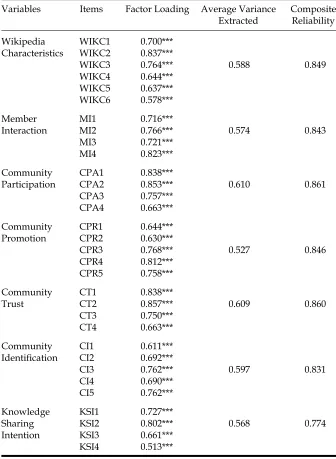
A measurement model encompassing all the variables of interest was evaluated. Two psychometric tests, the convergent validity and discriminant validity, were performed. The convergent validity was conducted to ensure that multiple items used to measure the variables are in agreement. In line with Hair, Hult, Ringle and Sarstedt (2016), the convergent validity was assessed based on factor loadings, composite reliability and average variance extracted (AVE). As indicated in Table 4, all the items’ loading have significant values and are between the range of 0.513 and 0.838. This fulfils the requirement of this study (Bagozzi, Yi, & Singh, 1991). The composite reliability values ranged from 0.774 to 0.866 which exceeded the recommended values of 0.7 (Hair et al., 2016). Additionally, the AVE values of all the variables are in the range of 0.502 to 0.611 which exceeded the recommended value of 0.5 (Hair et al., 2016).
Following the convergent validity, Fornell and Larcker’s (1981) approach is used to assess the discriminant validity. All the scales appeared to have a substantially higher square root of the AVE values, in comparison to their correlation with other variables. This substantiates the discriminant validity, as displayed in Table 5. Based on this, it is deduced that the variables and items used in the measurement model are suitable to be used to test the structural model and the associated hypotheses.
4.2 Structural Model Analysis
Table 4: Convergent Validity
Variables Items Factor Loading Average Variance Composite Extracted Reliability Wikipedia WIKC1 0.700***
Characteristics WIKC2 0.837***
WIKC3 0.764*** 0.588 0.849
WIKC4 0.644*** WIKC5 0.637*** WIKC6 0.578***
Member MI1 0.716***
Interaction MI2 0.766*** 0.574 0.843
MI3 0.721***
MI4 0.823*** Community CPA1 0.838***
Participation CPA2 0.853*** 0.610 0.861
CPA3 0.757*** CPA4 0.663*** Community CPR1 0.644*** Promotion CPR2 0.630***
CPR3 0.768*** 0.527 0.846
CPR4 0.812*** CPR5 0.758***
Community CT1 0.838***
Trust CT2 0.857*** 0.609 0.860
CT3 0.750*** CT4 0.663***
Community CI1 0.611***
Identification CI2 0.692***
CI3 0.762*** 0.597 0.831
CI4 0.690*** CI5 0.762*** Knowledge KSI1 0.727***
Sharing KSI2 0.802*** 0.568 0.774
Intention KSI3 0.661***
KSI4 0.513***
Virtual Community of Practice (CoP): Knowledge Sharing in the Wikipedia Community
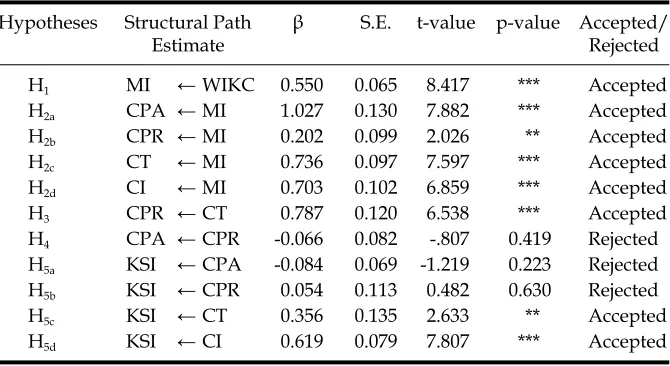
direct effects, as specified by the research model, is further evaluated. Table 6 illustrates.
The results revealed that the effects of the Wikipedia characteristics (β = 0.55, p < 0.001) on member interaction is positive and significant, thereby supporting H1. This is consistent with previous findings (Wasko & Faraj, 2000). The Wikipedia characteristics served as a knowledge Table 5: Discriminant Validity
Variables WIKC MI CPA CPR CT CI KSI
WIKC 0.766
MI 0.619 0.757
CPA 0.588 0.752 0.781
CPR 0.645 0.626 0.601 0.725
CT 0.678 0.736 0.637 0.650 0.780
CI 0.600 0.732 0.645 0.680 0.660 0.772
KSI 0.539 0.685 0.654 0.557 0.648 0.677 0.753
Note: WIKC = Wikipedia Characteristics, MI = Member Interaction, CPA = Community Participation, CPR = Community Promotion, CT = Community Trust, CI = Community Identification, KSI = Knowledge Sharing Intention.
Table 6: Path Estimate among Variables in the Structural Equation Modeling
Hypotheses Structural Path β S.E. t-value p-value Accepted/ Estimate Rejected H1 MI ← WIKC 0.550 0.065 8.417 *** Accepted
H2a CPA ← MI 1.027 0.130 7.882 *** Accepted
H2b CPR ← MI 0.202 0.099 2.026 ** Accepted
H2c CT ← MI 0.736 0.097 7.597 *** Accepted
H2d CI ← MI 0.703 0.102 6.859 *** Accepted
H3 CPR ← CT 0.787 0.120 6.538 *** Accepted
H4 CPA ← CPR -0.066 0.082 -.807 0.419 Rejected
H5a KSI ← CPA -0.084 0.069 -1.219 0.223 Rejected
H5b KSI ← CPR 0.054 0.113 0.482 0.630 Rejected
H5c KSI ← CT 0.356 0.135 2.633 ** Accepted
H5d KSI ← CI 0.619 0.079 7.807 *** Accepted Note: *** The estimate is significant at the 0.01 level; ** the estimate is significant at the
platform which enabled the respective individuals to exhibit their expertise and capabilities. This is accomplished through knowledge sharing in the respective entries, thereby providing a good prospect for members to interact. Since members using Wikipedia have a choice of using a virtual account or to remain anonymous when they contribute to the contents, there is a possibility that there would be higher member interactions (Yang & Lai, 2011) in the Wikipedia platform. The reason is because these members would have higher levels of confidence in displaying their competencies and to communicate.
The effects of member interaction on community participation (β = 1.03, p < 0.001), community promotion (β = 0.20, p < 0.05), community trust (β = 0.74, p < 0.001), and community identification (β = 0.70, p < 0.001) are all positive and significant, thereby supporting H2a, H2b, H2c and H2d. In addition, community trust is found to have a significant positive relationship on community promotion, thereby supporting H3. These findings are expected and they are also in line with the results reported by Qu and Lee (2011). This outcome indicates that highly interactive members who are attached to Wikipedia are more likely to participate and to promote the virtual community to others (Feng & Morrison, 2007). They perceive themselves as members as a result of their sense of belonging to the community.
Virtual Community of Practice (CoP): Knowledge Sharing in the Wikipedia Community
appear to trust the contents of the entries in Wikipedia may also exhibit a higher level of willingness to share the knowledge even though Wikipedia has no expert review mechanism. In most cases, individuals revise the entries when they believe that the original entries are inaccurate (Yang & Lai, 2011). It is further speculated that members’ overall trust towards the Wikipedia entries may be related to their individual experience and expertise. A user of the Wikipedia with increased community identification is more prone towards showing positive behaviours; he is more likely to have frequent exchanges of information and experiences with others.
4.3 Differences between Italian and Indonesian Samples
Following the structural model analysis of the two groups of samples, a multi-group analysis is performed to analyse the differences between the Italian and Indonesian samples. As indicated in Figure 3, there are significant differences between the two groups with regards to the relationship between member interaction and community promotion, and community participation and knowledge sharing. Within the Italian context, member interaction is found not to influence community promotion while community participation do not eventually lead to knowledge sharing. In contrast, the Indonesian samples are more likely to promote the virtual community platform when there is greater interaction between the members; participation in the virtual community will lead to higher intention to share knowledge.
tool helps to achieve a shared goal of the society. Due to these reasons, individuals of the collectivistic society such as Indonesia are, thus, more incline to participate and share the knowledge through the virtual community even if the information posted may not benefit them. In comparison, being in a high uncertainty avoidance culture, people in Italy may prefer stability, predictability and resistance. Therefore, they would feel discomfort when they feel that their future is uncertain. In this regard, they tend not to circulate any knowledge and information if they themselves are not confident and certain about the credibility and quality of the information shared through Wikipedia. Figure 3 illustrates. Figure 3: Path Analysis Output of Virtual Community Outcomes for Both
Sample Groups (Italian and Indonesian Groups)
Note: The bold number is the path estimate for Italian group of sample and the non-bold is for Indonesian.
Wikipedia Characteristic (WIKC) Member Interaction (MI) Community Participation (CPA) Community Promotion (CPR)
Community Trust (CT)
Community Identification (CI) Knowledge Sharing Intention (KSI)
Wikipedia Application Virtual Community Outcomes Behaviour
H1 0.544*** 0.530*** H2a 1.501*** 0.260*** H2b 0.247 0.240** H2c 1.100*** 0.488*** H2d 0.767***
0.755*** H5d
Virtual Community of Practice (CoP): Knowledge Sharing in the Wikipedia Community
5. Conclusion and Implications
The purpose of this study is to investigate the relationship between Wikipedia characteristics, member interaction, virtual community outcomes and knowledge sharing intention. Results generated from this study suggest that virtual community outcomes depend on the Wikipedia characteristics and member interaction. Increased interaction and Wikipedia characteristics brought about a strong identity within the community and further enhanced promotion, trust and participation. Nevertheless, since the Wikipedia has less or infrequent member interactions as compared to other general virtual community platforms, its promotion may not lead to participation nor the willingness of members to share knowledge substantially. The findings generated from this study show a variation between the Italian and Indonesian samples which could be attributed to their difference in cultural values and behaviours. Unlike the Indonesian students, the Italian students are only willing to promote the Wikipedia community if they feel that the quality of the information posted is relevant and if they have a good relationship with Wikipedia. Originating from a Western country, the Italian respondents may expect to see a more comprehensive and complete answer in the Wikipedia platform. Therefore, they would perceive any incomplete answers or contents as incapable of being considered for discussions, unlike their Indonesian contemporaries.
on the entries made by contributors. This can ensure information completeness and accuracy through “collective wisdom”. The credibility of the Wikipedia entries may involve an individual’s trust towards the Wikipedia contents which may be related to the contributors’ experience, thoughts and expertise.
While this study has offered an insight into the use of the Wikipedia platform as a knowledge sharing medium, several limitations were detected. The first of these is the generalisability of the results due to the use of only two groups of samples from two countries. Future research needs to consider collecting data from several other countries and from more diverse respondents with different educational backgrounds. Doing so will be able to shed light on whether users of the online-based (virtual) community of practice from different geographical locations share a similar propensity on knowledge sharing intentions. The second limitation is that the survey is confined to undergraduate students in two universities in Italy and Indonesia only. Future research should be extended to evaluate the perspective of other users and members since they too are important and relevant parties in the development of the online community of practice such as the Wikipedia. Future research may consider measuring and evaluating the different behaviors of users and members while using the online community of practice as alternative platforms of the physical community of practice.
Overall, this study also poses a challenge for future researchers to create more sophisticated assessment tools to measure how and why the perception of users and members may determine the sustainability of online-based community of practice. We believe that by delineating the effect of online-based community of practice, the behaviour of users and members, in terms of knowledge sharing intention, and by displaying the mediating role of online-based community of practice and knowledge sharing intention, future studies will be able to elaborate through more systematic procedures how the pattern of online-based community of practice can be developed.
References
Anderson, J.C.J., & Gerbing, D.D.W. (1988). Structural equation modeling in practice: A review and recommended two-step approach. Psychological
Bulletin, 103(3), 411-423. http://dx.doi.org/10.1037/0033-2909.103.3.411
Virtual Community of Practice (CoP): Knowledge Sharing in the Wikipedia Community
Knowledge Management, 7(1), 64-77. http://dx.doi.org/10.1108/13673270
310463626
Arnett, D.B., German, S.D., & Hunt, S.D. (2003). The identity salience model of relationship marketing success: The case of nonprofit marketing. Journal of
Marketing, 67(2), 89-105. http://dx.doi.org/10.1509/jmkg.67.2.89.18614
Bagozzi, R.P., Yi, Y., & Singh, S. (1991). On the use of structural equation models in experimental designs: Two extensions. International Journal of Research in
Marketing, 8(2), 125-140. http://dx.doi.org/10.1016/0167-8116(91)90020-8
Balasubramanian, S., & Mahajan, V. (2001). The economic leverage of the virtual community. International Journal of Electronic Commerce, 5(3), 103-138. http://dx.doi.org/10.1080/10864415.2001.11044212
Barker, R. (2015). Management of knowledge creation and sharing to create virtual knowledge-sharing communities: A tracking study. Journal of
Knowledge Management, 19(2), 334-350.
http://dx.doi.org/10.1108/JKM-06-2014-0229
Bettiol, M., Di Maria, E., & Grandinetti, R. (2012). Codification and creativity: Knowledge management strategies in KIBS. Journal of Knowledge
Management, 16(4), 550-562. http://dx.doi.org/10.1108/13673271211246130
Black, E.W. (2008). Wikipedia and academic peer review: Wikipedia as a recognised medium for scholarly publication? Online Information Review, 32(1), 73-88. http://dx.doi.org/10.1108/14684520810865994
Bruns, A., & Humphreys, S. (2005, October). Wikis in teaching and assessment: The M/Cyclopedia project. Paper presented at the 2005 International Symposium on Wikis, San Diego, California, USA. http://dx.doi.org/10.1145/1104973. 1104976
Casimir, G., Lee, K., & Loon, M. (2012). Knowledge sharing: Influences of trust, commitment and cost. Journal of Knowledge Management, 16(5), 740-753. http://dx.doi.org/10.1108/13673271211262781
Chiu, C.-M., Hsu, M.-H., & Wang, E.T.G. (2006). Understanding knowledge sharing in virtual communities: An integration of social capital and social cognitive theories. Decision Support Systems, 42(3), 1872-1888. http://dx.doi. org/10.1016/j.dss.2006.04.001
Chiu, C.-M., Wang, E.T.G., Shih, F.-J., & Fan, Y.-W. (2011). Understanding knowledge sharing in virtual communities: An integration of expectancy disconfirmation and justice theories. Online Information Review, 35(1), 134-153. http://dx.doi.org/10.1108/14684521111113623
Di Maria, E., & Finotto, V. (2008). Communities of consumption and made in Italy. Industry and Innovation, 15(2), 179-197. http://dx.doi.org/10.1080/ 13662710801954583
Ebner, M., Kickmeier-Rust, M., & Holzinger, A. (2008). Utilizing wiki systems in higher education classes: A chance for universal access? Universal Access in
the Information Society, 7(4), 199-207.
Elrufaie, E., & Turner, D.A. (2005, April). A Wiki paradigm for use in IT courses. Paper presented at the International Conference on Information Tech-nology: Coding and Computing, Las Vegas, USA. http://dx.doi.org/ 10.1109/ITCC.2005.54
Feng, R., & Morrison, A.M. (2007). Quality and value network marketing travel clubs. Annals of Tourism Research, 34(3), 588-609. http://dx.doi.org/ 10.1016/j.annals.2007.01.006
Fornell, C., & Larcker, D. (1981). Evaluating structural equation models with unobservable variables and measurement error. Journal of Marketing
Research, 18(1), 39-50. http://dx.doi.org/10.2307/3151312
Gray, B. (2004). Informal Learning in an Online Community of Practice. Journal of Distance Education, 19(1), 20-35.
Gray, D.E., & Gabriel, Y. (2018). A community of practice or a working psychological group? Group dynamics in core and peripheral community participation. Management Learning, 49(4), 395-412. http://dx.doi. org/10.1177/1350507618761774
Hafeez, K., Alghatas, F.M., Foroudi, P., Nguyen, B., & Gupta, S. (2018). Knowledge sharing by entrepreneurs in a virtual community of practice (VCoP). Information Technology and People. http://dx.doi.org/10.1108/ITP-09-2016-0202
Hair Jr, J.F., Hult, G.T.M., Ringle, C., & Sarstedt, M. (2016). A primer on Partial Least Squares Structural Equation Modeling (PLS-SEM). Thousand Oaks, CA: SAGE Publications.
Hansen, S., Berente, N., & Lyytinen, K. (2009). Wikipedia, critical social theory, and the possibility of rational discourse. The Information Society, 25(1), 38-59. http://dx.doi.org/10.1080/01972240802587562
Hendriks, P. (1999). Why share knowledge? The influence of ICT on the motivation for knowledge sharing. Knowledge and Process Management, 6(2), 91-100. http://dx.doi.org/10.1002/(SICI)1099-1441(199906)6:2<91::AID-KPM54>3.0.CO;2-M
Hofstede, G. (1998). Attitudes, values and organizational culture: Disentangling the concepts. Organization Studies, 19(3), 477-493. http://dx.doi.org/ 10.1177/017084069801900305
Jansen, B.J., Sobel, K., & Cook, G. (2011). Classifying ecommerce information sharing behaviour by youths on social networking sites. Journal of
Informa-tion Science, 37(2), 120-136. http://dx.doi.org/10.1177/0165551510396975
Jensen, M.B., Johnson, B., Lorenz, E., & Lundvall, B.Å. (2007). Forms of knowl -edge and modes of innovation. Research Policy, 36(5), 680-693. http://dx. doi.org/10.1016/j.respol.2007.01.006
Johnson, C.M. (2001). A survey of current research on online communities of practice. The Internet and Higher Education, 4(1), 45-60. http://dx.doi. org/10.1016/S1096-7516(01)00047-1
Virtual Community of Practice (CoP): Knowledge Sharing in the Wikipedia Community
college students. Computers in Human Behavior, 27(1), 365-372. http://dx. doi.org/10.1016/j.chb.2010.08.015
Koh, J., & Kim, Y.-G. (2004). Knowledge sharing in virtual communities: An e-business perspective. Expert Systems with Applications, 26(2), 155-166. http://dx.doi.org/10.1016/S0957-4174(03)00116-7
Korfiatis, N.T., Poulos, M., & Bokos, G. (2006). Evaluating authoritative sources using social networks: An insight from Wikipedia. Online Information
Review, 30(3), 252-262. http://dx.doi.org/10.1108/14684520610675780
Lee, H.-Y., Ahn, H., & Han, I. (2007). VCR: Virtual community recommender using the technology acceptance model and the user’s needs type. Expert
Systems with Applications, 33(4), 984-995. http://dx.doi.org/10.1016/j.eswa.
2006.07.012
Leuf, B., & Cunningham, W. (2001). The wiki way: Quick collaboration on the web. Upper Saddle River, NJ, USA: Addison Wesley.
Liao, C., To, P.-L. & Hsu, F.-C. (2013). Exploring knowledge sharing in virtual communities. Online Information Review, 37(6), 891-909. http://dx.doi.org/ 10.1108/OIR-11-2012-0196
Lin, H.-C. (2014). An investigation of the effects of cultural differences on physicians’ perceptions of information technology acceptance as they relate to knowledge management systems. Computers in Human Behavior, 38(September), 368-380. http://dx.doi.org/10.1016/j.chb.2014.05.001 Lin, H.-C., & Ho, W.-H. (2018). Cultural effects on use of online social media for
health-related information acquisition and sharing in Taiwan. International
Journal of Human–Computer Interaction, 34(11), 1063-1076. http://dx.doi.org
/10.1080/10447318.2017.1413790
Massingham, P. (2014). An evaluation of knowledge management tools: Part 1 – managing knowledge resources. Journal of Knowledge Management, 18(6), 1075-1100. http://dx.doi.org/10.1108/JKM-11-2013-0449
Md Rasli, A., & Wan Mohd, W.M. (2007). Project performance framework: The role of knowledge management and information technology infrastructure.
Asian Journal of Business and Accounting , 1(2), 39-64.
Molm, L.D. (1997). Coercive power in social exchange. Cambridge, UK: Cambridge University Press.
Nonaka, I. (1994). A dynamic theory of organizational knowledge creation.
Organization Science, 5(1), 14-37. http://dx.doi.org/10.1287/orsc.5.1.14
Parker, K.R., & Chao, J.T. (2007). Wiki as a teaching tool. Interdisciplinary Journal
of Knowledge and Learning Objects, 3(1), 57-72.
Pee, L.G. (2018). Community’s knowledge need and knowledge sharing in Wikipedia. Journal of Knowledge Management, 22(4), 912-930. http://dx.doi. org/10.1108/JKM-09-2017-0412
Qu, H., & Lee, H. (2011). Travelers’ social identification and membership behaviors in online travel community. Tourism Management, 32(6), 1262-1270. http://dx.doi.org/10.1016/j.tourman.2010.12.002
accuracy, breadth, and depth in historical articles. Reference Services Review, 36(1), 7-22. http://dx.doi.org/10.1108/00907320810851998
Romm, C., Pliskin, N., & Clarke, R. (1997). Virtual communities and society: Toward an integrative three phase model. International Journal of
Information Management, 17(4), 261-270.
http://dx.doi.org/10.1016/S0268-4012(97)00004-2
Schumacker, R.E., & Lomax, R.G. (2010). A beginner’s guide to structural equation
modeling (3rd ed). Mahwah, New Jersey: Lawrence Erlbaum Associates.
Schwen, T.M., & Hara, N. (2003). Community of practice: A metaphor for online design? The Information Society, 19(3), 257-270. http://dx.doi.org/10.1080/ 01972240309462
Shaw, A., & Hargittai, E. (2018). The pipeline of online participation inequalities: The case of Wikipedia editing. Journal of Communication, 68(1), 143-168. http://dx.doi.org/10.1093/joc/jqx003
Stats, I.W. (2018). Top 20 countries with the highest number of Internet users. Retrieved from https://www.internetworldstats.com/top20.htm
Trkman, M., & Trkman, P. (2009). A wiki as intranet: A critical analysis using the Delone and McLean model. Online Information Review, 33(6), 1087-1102. http://dx.doi.org/10.1108/14684520911011025
Wang, C.M., & Turner, D. (2004). Extending the wiki paradigm for use in the classroom. In Proceedings of the International Conference on Information Technology: Coding Computing, ITCC (Vol. 1, pp. 255-259).
Wang, W.-T., & Wei, Z.-H. (2011). Knowledge sharing in wiki communities: An empirical study. Online Information Review, 35(5), 799-820. http://dx.doi. org/10.1108/14684521111176516
Wasko, M.M., & Faraj, S. (2000). “It is what one does”: Why people participate and help others in electronic communities of practice. The Journal of
Strategic Information Systems, 9(2–3), 155-173. http://dx.doi.org/10.1016/
S0963-8687(00)00045-7
Wenger, E. (2003). Communities of practice: Learning, meaning and identity. Cambridge, UK: Cambridge University Press.
Wenger, E., & Trayner-Wenger, B. (2015). Communities of practice: A brief
introduction. Retrieved from http://wenger-trayner.com/wp-content/
uploads/2015/04/07-Brief-introduction-to-communities-of-practice.pdf Wikipedia. (2017). Wikipedia: Size of Wikipedia. Retrieved from https://en.wiki
pedia.org/wiki/Wikipedia:Size_of_Wikipedia#cite_notestats.wikimedia-1 WMF Analytics. (2018). Wikipedia Statistics: Contributors. Retrieved from https://
stats.wikimedia.org/EN/TablesWikipediansContributors.htm
Yang, H.-L., & Lai, C.-Y. (2011). Understanding knowledge-sharing behaviour in Wikipedia. Behaviour & Information Technology, 30(1), 131-142. http:// dx.doi.org/10.1080/0144929X.2010.516019