competence performance. So in this issue the multi teaching approaches need to be designed to develop students in various abilities.
REFERENCES
Jin, Y. (1998). General or Vocational? The Tough Choice in the Chinese Education Policy, International journal of Educational Development18 (4) (July): 289-304
Darwin, S (2003). The Changing Context of Vocational Education: Implication for Institutional Vocational Learning. Institution Journal of Training ResearchVol.5 No.1
International Labor Office (ILO) (2002). Learning and Training for Work in theKnowledge Society, ILO Geneva.
Jandhyala B G (2002). Vocational Education and Training in Asia. The Handbook on Educational Research in Asia Pacific Region
Psaharopolous, G and Loxley, W (1985). Diversified Secondary Education and Development. Baltimore Ellstrom, P. E. (2001) Integrating Learning and Work: Problems and Prospects, Human Resource
Development Quarterly,12(4): 421-435.
Larsen K & Istance D (2001)Lifelong Learning for all. OECD Observer March 30 2001 UNESCO (2002), Learning Throughout Life: Challenges for the 21st Century, UNESCO Publishing, France
Weber, J. M., and Puleo, N. F. (1988). A Comparison of Instructional Approaches Used in Secondary Vocational and Nonvocational Classrooms.Journal of Vocational Education Research 13:49-70 Mimi Mohaffyza and Rashid Rajuddin (2010). Integrating Student’s Cognitive Learning with Learning
Styles in Building Construction Course. UTM: Skudai
Felder,R. Silverman L.K.(1988). Learning and teaching styles in engineering education. Journal in Engineering Education, 78 (7), 674-681
Thomas F. H., Amit, J.S., (2007). Using learning styles instruments to enhance student learning.Journal of Innovative Education, 5, 1
Dar-Chin, R., Tsu-Chun, S., Yi-Ping, L, Chang, M. H. (2006): Development and Teaching Approaches of Technical and Vocational Education Curricula, 9th International Conference in Engineering Education
Jin, w. (2001). Path to Knowledge-based Economy, Taipei: Commonwealth Publishing Group Zhan, D. L (2001). Knowledge-based Economy and Education, Taipei: Shi-Da Book Store
Bloom, B. S (1956). Taxonomy Educational Objectives :Book 1 Cognitive Domain. Longman Inc: New York
Krathwohl, D. R. (2002). A Revision of Bloom’s Taxonomy: An Overview. Theory Into Practice: The Ohio State University
Bryans, P. and Smith, R. (2000) Beyond Training: Reconceptualising Learning at Work, Journal of Workplace Learning, 12(6): 228-235.
Lang, D. and Wittig-Berman, U. (2000) Managing Work-Related Learning for Employee and
PROBLEM BASED LEARNING IN MANAGEMENT AND
CLINICAL ENGINEERING COURSE
Nur Azah Hamzaid, Mohd Faiz Md Saaid and Shuhaibul Fadzly Mansor, Department of Biomedical Engineering, Faculty of Engineering, University of Malaya,
Malaysia
Azman Hamid
Next Level Technologies (M) Sdn Bhd. [email protected]
ABSTRACT
This paper addressed student perceptions and opinion of the problem based learning method, as well as the empirically collected data on students' learning outcomes on a Biomedical Engineering course, i.e. Management and Clinical Engineering. Pure lecture delivery with absence of practical intervention was deemed insufficient to provide appropriate means to achieve the course objectives. Therefore, a Mock Company assignment was introduced in this course as a problem based learning application aimed to aid the achievement of the program outcome while improving the attainment of the course objectives. The students were divided into groups to form individual mock company. Each mock company formed their organization post for each member, and came up with a business plan for a new project to be presented for fund approval by the panels, made up of the course instructors and invited lecturers from the clinical engineering industry and hospital practitioners. The company discussion progress and performance were monitored by the instructors through the formal university e- learning platform throughout the semester with occasional response and suggestions. The panels identified the expected lack of business and management knowledge but this was counteracted by the reasonably successful business plan produced independently by all companies’ At the end of the semester, through questionnaires, 69.6% of the 56 students agreed that this mock company assignment was useful in achieving the course objectives and should be conducted in the following years. Students who performed weakly in this assignment also demonstrated lower performance in all evaluations including by traditional means (p = 0.01), although there were no direct associations amongst the problem-based and the traditional evaluations (r < 0.66). The students’ responses also reflected their readiness to perform more independent learning approaches, despite them expressing the lack of clear scope and guideline, which is the nature of a problem-based learning experience.
1. INTRODUCTION
Problem based learning has been widely used as a method of delivery amongst higher learning institutions to provide greater understanding and effective learning (Hmelo-Silver, 2004), while enhancing the integrating of related knowledge (Lou, 2011). It was of common understanding that the general culture of higher degree student to score high marks in the courses, at least in science based courses, is at worst by regurgitating the content of their lecture and tutorials, or by strictly following the procedures of a lab technique, which is contrary to the idea of “learning” itself. There is little or no indication that the students actually “digest” the information for real life practices through the traditional method of delivery and assessment. Through a problem-based method, students are allowed to feel the ”fear” of not performing strictly to what is ”required”, therefore they may reject the delivery method with the argument that they do not learn much or anything at all (Lou, 2011).This may stem from the inability of the students to gauge their required knowledge (Langendyk, 2006). However, for some of the problems in Biomedical Engineering there might not be a definite right or wrong answer, thus a problem-based learning might be the most suitable approach. Unlike guided self-learning approach, a problem-based learning method involves minimal guidance and loose instructions (Newstetter, 2010). Students are expected to identify the problems themselves and come up with a solution based on their self exploration. This method might or might not work based on the amount and nature of guidance provided (Kirschner, Sweller, and Clark, 2006).
Management and Clinical Engineering is a compulsory course offered to final year Biomedical Engineering students of a university in Malaysia. The delivery method of the course was traditionally content-based, teacher-centered approach. It involves 14 weeks of lectures by industrial representatives and hospital practitioners. Each lecture provides thorough information on multiple aspects of clinical engineering. However, pure lectures without any practical aspect were seen to be insufficient to provide appropriate means to achieve the course objectives (CO), which are (i) To describe healthcare technology management and clinical engineering (CO1); (ii) To describe the use of ICT in healthcare technology management (CO2); (iii) To explain technology assessment, risk management, patient & medical device safety (CO3); (iv) To identify medical devices standards, regulations and emerging technology (CO4); and especially (v) To analyze the problems of healthcare technology management and clinical engineering (CO5) (Department of Biomedical Engineering U.o.M, 2010).
Increasingly, there is a highlighted need to match the education outcomes to industry needs (Friedman, 1996). Therefore, this course was supplemented with the mock company assignment to facilitate the achievement of the department’s program educational outcome that is "to produce confident graduates with biomedical engineering competency and with soft-skills to become effective managers and leaders for the nation and for humanity" as well as one of the program outcome breakdown which is the “ability to function effectively as a leader with management and entrepreneurship skills as well as an active member in a multi-disciplinary team” (Department of Biomedical Engineering U.o.M, 2010).
1. INTRODUCTION
Problem based learning has been widely used as a method of delivery amongst higher learning institutions to provide greater understanding and effective learning (Hmelo-Silver, 2004), while enhancing the integrating of related knowledge (Lou, 2011). It was of common understanding that the general culture of higher degree student to score high marks in the courses, at least in science based courses, is at worst by regurgitating the content of their lecture and tutorials, or by strictly following the procedures of a lab technique, which is contrary to the idea of “learning” itself. There is little or no indication that the students actually “digest” the information for real life practices through the traditional method of delivery and assessment. Through a problem-based method, students are allowed to feel the ”fear” of not performing strictly to what is ”required”, therefore they may reject the delivery method with the argument that they do not learn much or anything at all (Lou, 2011).This may stem from the inability of the students to gauge their required knowledge (Langendyk, 2006). However, for some of the problems in Biomedical Engineering there might not be a definite right or wrong answer, thus a problem-based learning might be the most suitable approach. Unlike guided self-learning approach, a problem-based learning method involves minimal guidance and loose instructions (Newstetter, 2010). Students are expected to identify the problems themselves and come up with a solution based on their self exploration. This method might or might not work based on the amount and nature of guidance provided (Kirschner, Sweller, and Clark, 2006).
Management and Clinical Engineering is a compulsory course offered to final year Biomedical Engineering students of a university in Malaysia. The delivery method of the course was traditionally content-based, teacher-centered approach. It involves 14 weeks of lectures by industrial representatives and hospital practitioners. Each lecture provides thorough information on multiple aspects of clinical engineering. However, pure lectures without any practical aspect were seen to be insufficient to provide appropriate means to achieve the course objectives (CO), which are (i) To describe healthcare technology management and clinical engineering (CO1); (ii) To describe the use of ICT in healthcare technology management (CO2); (iii) To explain technology assessment, risk management, patient & medical device safety (CO3); (iv) To identify medical devices standards, regulations and emerging technology (CO4); and especially (v) To analyze the problems of healthcare technology management and clinical engineering (CO5) (Department of Biomedical Engineering U.o.M, 2010).
Increasingly, there is a highlighted need to match the education outcomes to industry needs (Friedman, 1996). Therefore, this course was supplemented with the mock company assignment to facilitate the achievement of the department’s program educational outcome that is "to produce confident graduates with biomedical engineering competency and with soft-skills to become effective managers and leaders for the nation and for humanity" as well as one of the program outcome breakdown which is the “ability to function effectively as a leader with management and entrepreneurship skills as well as an active member in a multi-disciplinary team” (Department of Biomedical Engineering U.o.M, 2010).
It has also been established that learning is driven by the need to solve complex problems, and the element of uncertainty and setbacks are always core to realistic
management and science (Newstetter, 2010). To enhance the traditional delivery approach we have introduced a Mock Company assignment as a problem based learning approach, aimed to aid the achievement of the program outcome while improving the attainment of the course objectives. The use of e-learning platform was introduced to provide means for continuous and effective involvement throughout the learning experience (Baturay, and Bay, 2010).
Therefore, this paper aimed to investigate the learning outcome achievement of the students after their exposure to problem based learning. This paper described the effectiveness of adopting this method of delivery in students‟ performance and its relation to the students‟overall achievement of the subject.
2. METHODS
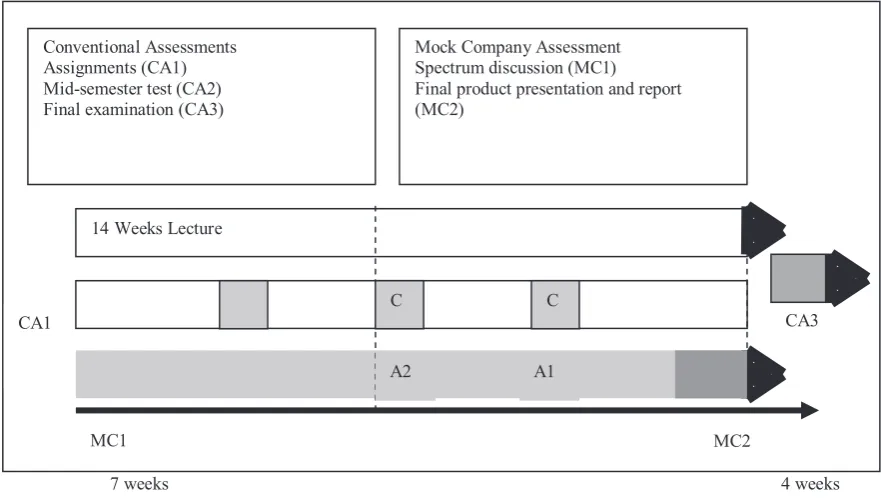
This study was conducted by having the conventional and mock company assessments be conducted in parallel with the 14 weeks lectures, as illustrated in Figure 1. Students were not separated into control or intervention group, therefore all students (N=56) underwent the same learning and assessment experience. The method of assessment were blinded to the students either conventional or mock company assessment intervention. All students went through the course as naturally as any other courses offered throughout the semester. Students‟performance was analyzed by their intervention group at the end of the semester to identify the effects of the intervention method onto their overall performance, which included the conventional assessment methods.
The mock company assignment was introduced to the 2011 final semester students of biomedical engineering students as a mean for the students to apply several aspects of the course content while achieving all course objectives in one assignment. All students undergo the same lectures by invited lecturers from the clinical engineering industry and hospital practitioners. The students also underwent traditional methods of evaluation, i.e. through assignments, a test, and final exams, while being evaluated through the mock company assignment, i.e. by e-platform discussion as well as a final company business proposal presentation and report.
The students were divided into 6 groups of 10 students early in the semester, which formed their individual mock company. The team members were pre-selected by the course coordinator based on their probed interest in clinical engineering and management field. Each mock company formed their organization post for each member, and came up with a business plan for a new project to be presented for fund approval by the panels, made up of the course instructors and invited lecturers.
e-learning platform, throughout the semester with occasional response and suggestions. All companies were expected to be independent in searching for information sources to produce successful business plan.
At the end of the semester each “company” submitted their business proposal report and presented their project proposal in front of the panels. The evaluation criteria during the presentation day was based on the product or idea (15%), which includes the product value, feasibility, consumer need and marketability; the group’s mock company presentation (15%), report (10%), and the manner in which they handle the question and answer session (10%). Marks were given accordingly while each panel member decided whether or not to approve funding to each company’s proposed project.
The students’ learning outcome achievement was evaluated through their whole semester marks from their assignments, mid semester test and final examinations, as well as their mock company activity and final presentation. All marks were normalized to a score of 10 to ease comparison amongst them. Correlation analysis were conducted to determine associations between variables, and one-way ANOVA with Bonferroni post-hoc test were conducted to identify significant differences between the mock company groups (p<0.05).
7 weeks 4 weeks
Figure 1. Assessments were conducted throughout the 14 weeks course in parallel with the lectures. Student performance analyses were done at the end of the semester.
Conventional Assessments Assignments (CA1) Mid-semester test (CA2) Final examination (CA3)
Mock Company Assessment Spectrum discussion (MC1)
Final product presentation and report (MC2)
14 Weeks Lecture
C C
CA1
A2 A1
MC2 MC1
learning platform, throughout the semester with occasional response and suggestions. All companies were expected to be independent in searching for information sources to produce successful business plan.
At the end of the semester each “company” submitted their business proposal report and presented their project proposal in front of the panels. The evaluation criteria during the presentation day was based on the product or idea (15%), which includes the product value, feasibility, consumer need and marketability; the group’s mock company presentation (15%), report (10%), and the manner in which they handle the question and answer session (10%). Marks were given accordingly while each panel member decided whether or not to approve funding to each company’s proposed project.
The students’ learning outcome achievement was evaluated through their whole semester marks from their assignments, mid semester test and final examinations, as well as their mock company activity and final presentation. All marks were normalized to a score of 10 to ease comparison amongst them. Correlation analysis were conducted to determine associations between variables, and one-way ANOVA with Bonferroni post-hoc test were conducted to identify significant differences between the mock company groups (p<0.05).
7 weeks 4 weeks
Figure 1. Assessments were conducted throughout the 14 weeks course in parallel with the lectures. Student performance analyses were done at the end of the semester. Conventional Assessments
Assignments (CA1) Mid-semester test (CA2) Final examination (CA3)
Mock Company Assessment Spectrum discussion (MC1)
Final product presentation and report (MC2)
14 Weeks Lecture
C C
CA1
A2 A1
MC2 MC1
CA3
3. RESULTS
3.1 Student Performance in Mock Company Assignment
All six companies (group A, B, C, D, E, F) successfully presented their business proposals and reports. During their presentation, their projects were commented on, scrutinized and evaluated by the panels who had read their proposals beforehand.
The best project proposed was a commercialization of a Ventricular Assist Device (VAD) by group F. This „company‟ assumed they had gone through the research and development stage and was ready for the VAD development and production for the Malaysian market. Group F received approved funding by all panels for their innovative and highly useful product.
Group A was awarded the Best Market Research prize by the panels for their thorough consideration of the market need for a more appropriate management and maintenance of the haemodialysis machine. This group had visited Pantai Hospital haemodialysis centre and conducted interview with the hospital staffs in charge to identify the real problem to be overcome as their proposed project. Their proposed project was considered very timely and practical.
Other companies proposed IT based consulting of medical equipment management (group B), a tester and analyzer developer and servicing provider (group C), medical devices research development and consulting services (group D), and a prosthetic limb consulting service (group E).
The panels identified the expected lack of business knowledge amongst these biomedical engineering students, but this was counteracted by the reasonably successful business plan produced by all companies based on their independent effort.
3.2 Quantitative Assessment
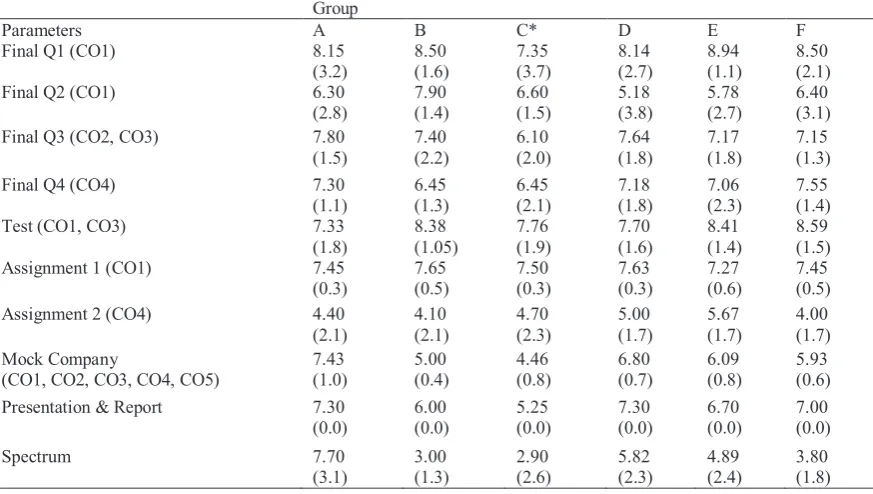
Scores were categorized according to their 6 company groups (A to F), as in Table 1. Each assessment method was identified to address the respective COs, as presented by CO1 through CO5. From Table 1, it can be observed that CO5, which is “To analyze the problems of healthcare technology management and clinical engineering” can only be best assessed through the practical method of the mock company assignment, as the students had to analyze real problems in the industry which otherwise cannot be achieved through textbook and lecture notes regurgitation.
3.3 Overall Course Performance and its relation to Mock Company Assignment
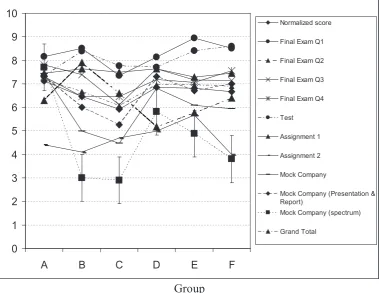
was categorized according to their mock company assignment group, it can be observed that the group with the lowest Mock Company achievement, either from their e-learning utilization or final product presentation and report, demonstrated relatively lower performance in other criteria of evaluation. These included the final exam questions, test, and assignments, which were poorly correlated with the mock company project. This fact was also illustrated in Figure 2 where group C, the least performing group in terms of the company assignment reflected generally lower scores in other assessments.
This may suggest associative attainment of course outcome between the mock company assignment and other evaluations, due to their overlapping COs (Table 1).
Table 1: Normalized student performance on all course evaluation components
Group
Parameters A B C* D E F
Final Q1 (CO1) 8.15
(3.2) 8.50(1.6) 7.35(3.7) 8.14(2.7) 8.94(1.1) 8.50(2.1) Final Q2 (CO1) 6.30
(2.8) 7.90(1.4) 6.60(1.5) 5.18(3.8) 5.78(2.7) 6.40(3.1) Final Q3 (CO2, CO3) 7.80
(1.5) 7.40(2.2) 6.10(2.0) 7.64(1.8) 7.17(1.8) 7.15(1.3) Final Q4 (CO4) 7.30
(1.1) 6.45(1.3) 6.45(2.1) 7.18(1.8) 7.06(2.3) 7.55(1.4) Test (CO1, CO3) 7.33
(1.8) 8.38(1.05) 7.76(1.9) 7.70(1.6) 8.41(1.4) 8.59(1.5) Assignment 1 (CO1) 7.45
(0.3) 7.65(0.5) 7.50(0.3) 7.63(0.3) 7.27(0.6) 7.45(0.5) Assignment 2 (CO4) 4.40
(2.1) 4.10(2.1) 4.70(2.3) 5.00(1.7) 5.67(1.7) 4.00(1.7) Mock Company
(CO1, CO2, CO3, CO4, CO5) 7.43(1.0) 5.00(0.4) 4.46(0.8) 6.80(0.7) 6.09(0.8) 5.93(0.6) Presentation & Report 7.30
(0.0) 6.00(0.0) 5.25(0.0) 7.30(0.0) 6.70(0.0) 7.00(0.0)
Spectrum 7.70
(3.1) 3.00(1.3) 2.90(2.6) 5.82(2.3) 4.89(2.4) 3.80(1.8)
was categorized according to their mock company assignment group, it can be observed that the group with the lowest Mock Company achievement, either from their e-learning utilization or final product presentation and report, demonstrated relatively lower performance in other criteria of evaluation. These included the final exam questions, test, and assignments, which were poorly correlated with the mock company project. This fact was also illustrated in Figure 2 where group C, the least performing group in terms of the company assignment reflected generally lower scores in other assessments.
This may suggest associative attainment of course outcome between the mock company assignment and other evaluations, due to their overlapping COs (Table 1).
Table 1: Normalized student performance on all course evaluation components
Group
Parameters A B C* D E F
Final Q1 (CO1) 8.15
(3.2) 8.50(1.6) 7.35(3.7) 8.14(2.7) 8.94(1.1) 8.50(2.1) Final Q2 (CO1) 6.30
(2.8) 7.90(1.4) 6.60(1.5) 5.18(3.8) 5.78(2.7) 6.40(3.1) Final Q3 (CO2, CO3) 7.80
(1.5) 7.40(2.2) 6.10(2.0) 7.64(1.8) 7.17(1.8) 7.15(1.3) Final Q4 (CO4) 7.30
(1.1) 6.45(1.3) 6.45(2.1) 7.18(1.8) 7.06(2.3) 7.55(1.4) Test (CO1, CO3) 7.33
(1.8) 8.38(1.05) 7.76(1.9) 7.70(1.6) 8.41(1.4) 8.59(1.5) Assignment 1 (CO1) 7.45
(0.3) 7.65(0.5) 7.50(0.3) 7.63(0.3) 7.27(0.6) 7.45(0.5) Assignment 2 (CO4) 4.40
(2.1) 4.10(2.1) 4.70(2.3) 5.00(1.7) 5.67(1.7) 4.00(1.7) Mock Company
(CO1, CO2, CO3, CO4, CO5) 7.43(1.0) 5.00(0.4) 4.46(0.8) 6.80(0.7) 6.09(0.8) 5.93(0.6) Presentation & Report 7.30
(0.0) 6.00(0.0) 5.25(0.0) 7.30(0.0) 6.70(0.0) 7.00(0.0)
Spectrum 7.70
(3.1) 3.00(1.3) 2.90(2.6) 5.82(2.3) 4.89(2.4) 3.80(1.8)
Data in Mean (SD), all marks were normalized over score of 10. * indicates significant difference p=0.01 amongst group Normalized Score (/10)
0 1 2 3 4 5 6 7 8 9 10
A B C D E F
Normalized score
Final Exam Q1
Final Exam Q2
Final Exam Q3
Final Exam Q4
Test
Assignment 1
Assignment 2
Mock Company
Mock Company (Presentation & Report)
Mock Company (spectrum)
Grand Total
Group
Figure 2. Normalized score against mock company groups. Variables: 1-Assignment 1, 2-1-Assignment 2, 3- Mid Semester Test, 4- Final Exam Question 1, 5- Final Exam Question 2, 6- Final Exam Question 3, 7 Final Exam Question 4, 8-Mock Company Report & Presentation, 9- Spectrum participation, 10-Overall Mock Company score, 11- Grand total of the course.
3.4 E-Learning (Spectrum) Utilization
Spectrum scores indicated the extent of students‟ participation in discussing the mock company assignment outside the class hours. The quality and frequency of their discussions were monitored by three independent course instructors. Apart from discussing the company product and direction, students also utilized Spectrum by uploading reference materials, reports, figures and other materials to aid the assignment completion.
4. DISCUSSION
In overall, only 69.6% of the students agreed that this mock company assignment was useful in achieving the course objectives and should be conducted in the following years, while 7.1% of them thought that the assignment did not agree so.
Several aspects of the mock company assignments were brought up by the students through their evaluation response. Through an open ended question, 33.9% of the students mentioned that the assignment “. Prepared them for the industry environment” and 10.7% of them said that “this whole semester assignment provided them a good platform of working in a group”. Other advantages of the mock company assignment are the “new experience to undergraduate students” and they “achieved more learning outcome” (5.4%). Other comments by the students regarding this activity were “encouraged students to be independent”, “explore Clinical engineering in greater depth” and “encouraged students to present their own ideas”.
Improvement areas identified by the students through another open ended question were mainly “the insufficient guideline of the assignment” (23.2%), causing them to “spend too much of their crucial final year time”17.9% of the students preferred to have more activities and assignments be embedded in the weekly 3 hour lecture periods, as opposed to separation of full lectures and independent mock company assignments. They would also prefer direct visits to company to learn a company establishment (12.5%) rather than this assignment. The students also suggested “smaller company groups” (5.4%), “to set a clearer or just a single scope such as winning one tender” (3.6%).
The problems or concerns addressed by the students were valid as in they do not have strong and sufficient prior knowledge before starting the assignment, as the lecture delivery was conducted in parallel to their mock company assignment. Therefore, the foundation of a successful problem based learning approach, which is prior knowledge, was compromised from the start (Kirschner, Sweller, and Clark, 2006).
As a conclusion, majority of the students agreed that the mock company problem based learning approach is beneficial and should be sustained for the coming years as part of the course assignment. The Students’ responses also reflected their readiness to perform more independent learning approaches, despite them expressing the lack of clear scope and guideline. This suggested that the students are still very much used to conventional learning method of being spoon-fed of most information needed, and to perform well during exams and marks are still their priority. In future, it might be more effective and beneficial if the groups were given tender preparation mock company assignment, instead of an open-ended business proposal. This might closer emulate the Clinical Engineering job scope and better guideline and assistance can be provided by the instructors.
5. REFERENCES
4. DISCUSSION
In overall, only 69.6% of the students agreed that this mock company assignment was useful in achieving the course objectives and should be conducted in the following years, while 7.1% of them thought that the assignment did not agree so.
Several aspects of the mock company assignments were brought up by the students through their evaluation response. Through an open ended question, 33.9% of the students mentioned that the assignment “. Prepared them for the industry environment” and 10.7% of them said that “this whole semester assignment provided them a good platform of working in a group”. Other advantages of the mock company assignment are the “new experience to undergraduate students” and they “achieved more learning outcome” (5.4%). Other comments by the students regarding this activity were “encouraged students to be independent”, “explore Clinical engineering in greater depth” and “encouraged students to present their own ideas”.
Improvement areas identified by the students through another open ended question were mainly “the insufficient guideline of the assignment” (23.2%), causing them to “spend too much of their crucial final year time”17.9% of the students preferred to have more activities and assignments be embedded in the weekly 3 hour lecture periods, as opposed to separation of full lectures and independent mock company assignments. They would also prefer direct visits to company to learn a company establishment (12.5%) rather than this assignment. The students also suggested “smaller company groups” (5.4%), “to set a clearer or just a single scope such as winning one tender” (3.6%).
The problems or concerns addressed by the students were valid as in they do not have strong and sufficient prior knowledge before starting the assignment, as the lecture delivery was conducted in parallel to their mock company assignment. Therefore, the foundation of a successful problem based learning approach, which is prior knowledge, was compromised from the start (Kirschner, Sweller, and Clark, 2006).
As a conclusion, majority of the students agreed that the mock company problem based learning approach is beneficial and should be sustained for the coming years as part of the course assignment. The Students’ responses also reflected their readiness to perform more independent learning approaches, despite them expressing the lack of clear scope and guideline. This suggested that the students are still very much used to conventional learning method of being spoon-fed of most information needed, and to perform well during exams and marks are still their priority. In future, it might be more effective and beneficial if the groups were given tender preparation mock company assignment, instead of an open-ended business proposal. This might closer emulate the Clinical Engineering job scope and better guideline and assistance can be provided by the instructors.
5. REFERENCES
Baturay, M.H. and Bay, O. F. (2010). The effects of problem-based learning on the classroom community perceptions and achievement of web-based education students. Computers & Education, 55(1): p. 43-52.
Department of Biomedical Engineering, U.o.M. (2010). Prospectus for Undergraduate Bachelor of Biomedical Engineering 2010: Kuala Lumpur.
Friedman, M.H. (1996). Biomedical engineering education and industry: Matching the product to the customer. Medical & Biological Engineering & Computing, 34(1): p. N1-N3.
Hmelo-Silver, C.E. (2004) Problem-based learning: What and how do students learn? Educational Psychology Review, 16(3): p. 235-266.
Kirschner, P.A., J. Sweller, and R.E. Clark. (2006). Why minimal guidance during instruction does not work: An analysis of the failure of constructivist, discovery, problem-based, experiential, and inquiry-based teaching. Educational Psychologist, 41(2): p. 75-86.
Langendyk, V. (2006). Not knowing that they do not know: self-assessment accuracy of third-year medical students. Medical Education, 40(2): p. 173-179.
Lou, S. J. (2011). The impact of problem-based learning strategies on STEM knowledge integration and attitudes: an exploratory study among female Taiwanese senior high school students. International Journal of Technology and Design Education, 21(2): p. 195-215.