NonPAS: A Program for Nonlinear Analysis of Flexible
Pavements
Ali Reza Ghanizadeh
1,*, Arash Ziaie
21,2
Department of Civil Engineering, Sirjan University of Technology, 78137 Sirjan, Iran
Received ...; accepted ..., available online ...
1.
Introduction
Up to now several computer programs have been developed for flexible pavement analysis and design. Each of these programs has been developed according to requirements of their developers and do not warranty needs of other users. For this reason, each of the countries and organizations which aim to use M-E pavement design methods, develop their own software based on specific local conditions and their empirical calibrated models. The first step for implementation of an M-E pavement design method is the analysis of pavement and computation of critical responses of pavement under various loadings. Consequently, developing such a program is essential for using M-E pavement design methods, which is the next horizon of pavement design in Iran and other developing countries. The simplest method for the study of stress, strain and deflection in flexible pavements under a circular load is considering the pavement system as a homogeneous half space and then analyzing it using the half-space theory of Boussinesq in 1885 [1]. Two general methods may be used for more realistic analysis of flexible pavement, including multi-layered theory method and finite element method (FEM). Currently, most of the programs are employing multi-layered theory to analyze pavement structure and compute the critical responses. Some of these programs like CHEVRON,
DAMA, KENLAYER, ELSYM5 and BISAR
are so popular and have been served for many years. During recent years, most flexible pavement analysis programs use FEM method for nonlinear analysis of
pavement structure [2-5]. A few multi-layered pavement analysis programs also have the ability to consider the nonlinear characteristics of granular materials such as Kenlayer and Everstress. These two programs are capable of modeling the nonlinear behavior of granular material using only K-θ and Bilinear models [6-7]. Modeling of pavement using multi-layered theory is simpler than finite element method. Analyses of pavement using layered theory by the computer system requires less time compared with the finite element method. On the other hand, for the amateur users, working with programs based on multi layer elastic theory is simpler than finite element method [7]. In this research work, a comprehensive computer program was developed for analyzing flexible pavements. The developed program has the capability of modeling pavement materials using five different nonlinear models. Effect of utilizing different nonlinear models on critical responses of pavement is also explored.
2.
Constitutive models for unbound granular
materials
The response of a granular soil sample under repeated loading during construction phase and initial trafficking tends to shake down to the elastic response. The amount of plastic deformations decrease with the increase in load repetitions until the response is essentially elastic. These observations have led researchers in the pavement community to simulate the behavior of granular materials as elastic or resilient materials [8].
Abstract: The primary step in design of a pavement using Mechanistic-Empirical (M-E) method is the analysis of pavement and calculation of the critical responses of pavement under various loadings. This confirms the need for developing pavement analysis software as an analytical base of the M-E method. To this end, NonPAS program has been developed for linear and nonlinear analysis of flexible pavements. Developed program allows nonlinear analysis of flexible pavements using five nonlinear models, including K-θ, Uzan, Uzan-Witczak, MEPDG 2002 and Bilinear models. Nonlinear Analysis of flexible pavements by utilizing these constitutive models provides a more accurate modeling of granular material behavior. Developed program can be used to analyze a pavement system consists of maximum of 10 layers, which is subjected to a maximum of six circular loads. NonPAS program allows for calculating the responses at 400 different points of pavement. In order to validate the results of linear and nonlinear analysis, responses obtained from NonPAS have been compared with responses obtained using Kenlayer program. Results show very good agreement between responses, which are obtained using both linear and nonlinear analysis and approve that developed program can be used with high reliability for the purposes of pavement analysis and design
.
The concept of a resilient modulus of a material was originally introduced by Seed et al. in 1962 [9]. Seed et al. defined resilient modulus, Mr, as the ratio of applied dynamic deviator stress, d, to the resilient or recovered strain, r, under a transient dynamic pulse load given by
r d r
M / . Repeated load triaxial test is commonly employed to quantify the resilient modulus of granular materials and cohesive soils. The resilient response of granular materials and fine-grained soil is stress dependent (resilient modulus is not constant, but depends on the repeated stress state). Several Models have been developed over the years that combine applied stresses and material characteristics to describe the nonlinear behavior of granular materials under traffic loading. The K-θ model has been the most famous for characterizing the resilient response of the granular bases and subbase materials [10]. The resilient modulus (MR) is given as
follows:
2
1 K
R K
M (1)
where
θ = First invariant of stress tensor = σ1+ σ2+σ3
σ1= Major principal stress.
σ2= Intermediate principal stress
σ3 = Minor principal stress/confining pressure
K1, K2 = Regression analysis constants obtained from
experimental data.
Uzan (1985) observed that the K-θ model did not summarize measured data well when shear stresses were significant, and proposed a three parameter model [11]. This model is given as
3 2 1 K d K R K
M (2)
where | |1 3
d = The deviator stress in a triaxial test configuration
K1, K2,and K3 = material constants
Witczak and Uzan (1988) proposed a modification to the Uzan model by replacing the deviator stress term in Eq. (2) by an octahedral shear stress term [12]. This octahedral shear stress model also considers the dilation effect that takes place when a pavement element is subjected to a large principal stress ratio 1/3. This
model is called Universal Model and is given as follows:
3 2 1 K oct K R K
M
(3) where
oct
=Octahedral shear stress
K1, K2, and K3 = Multiple regression constants evaluated
from resilient modulus test data.
In MEPDG 2002 Guide, resilient modulus is estimated using a generalized constitutive model for Level 1 analysis for the nonlinear stress-dependent modeling of both the unbound aggregates and fine-grained soils [13]. The difference in material behavior
predicted by Universal and MEPDG 2002 were only found in the regression variables and both of them give same values for resilient modulus [14]. The MEPDG 2002 Guide model is as follows:
3 1 1 2 k a oct K a a R p p p K M (4) where
τoct= Octahedral shear stress
pa = Atmospheric pressure
K1, K2, and K3 = multiple regression constants evaluated
from resilient modulus test data.
Typically, fine-grained soil modulus decreases in proportion to the increasing stress levels thus showing stress-softening type behavior. The constitutive relationships are primarily established between the resilient modulus and the deviator stress. For a fine grained subgrade layer, the bilinear model has been the most commonly used resilient modulus model [15]. This bilinear soil model is given as follows:
d d R d d R K K K K M K K K K M 2 2 4 1 2 2 3 1 ) ( ) ( (5) where
K1, K2, K3, and K4 =model parameters obtained from
regression analyses of resilient modulus test
Among the models presented, the MEPDG 2002 Guide model has been also used for modeling the nonlinear behavior of unbound RAP base, asphalt treated base and cement treated base materials [16-19].
3.
NonPAS Program
In this research work, a comprehensive computer program was developed for analyzing flexible pavements. The developed program has the capability of modeling pavement materials using five different nonlinear models. Effect of using different nonlinear models on critical pavement responses has been explored. In design of NonPAS program, it has attempted to provide a user-friendly environment for pavement analysis purpose. Furthermore, it has tried to develop the program based on modular programming because of the possibility of future development plan and its conversion to M-E design software. Inputs for this program include:
General settings, including the selection of the unit system (SI or Imperial), the maximum number of iterations for nonlinear analysis, and the maximum acceptable error for convergence of nonlinear analysis.
Layer's specifications, including the number of layers, elastic modulus, Poisson's ratio, thickness, density, layer type (linear or nonlinear), nonlinear behavior of layer, coefficients of nonlinear model and the depth of stress points for calculation of resilient modulus in each layer.
dual), axles distance, wheels distance, contact pressure and contact radius. In cases of nonlinear analysis, nonlinear properties including coordinate of stress point, and the slope of stress distribution are defined.
Evaluation points, including the number and coordinates of points in X-Y plan and also the number and depth of points to estimate the desired responses. Results of pavement analysis, including stresses, strains and deflections in three main directions, shear stresses, principle stresses and strains, maximum shear stress, octahedral shear stress, octahedral shear strain and maximum horizontal principle are computed in different response points. These results can be saved in a text file.
Fig. 1 NonPAS User Interface.
4.
Validation of linear elastic analysis using
Kenlayer Program
The Kenlayer program is one of the most well-known program in field of pavement analysis and design which is developed by Yang H. Huang at the University of Kentucky. This program has the capability of linear, nonlinear and viscoelastic analysis of flexible pavements under multiple loading [7]. Previous researches showed that responses computed by this program are comparable with other pavement analysis program including both FEM and layered analysis programs such as ILLIPave, MICHPave, ELSYM 5, Bisar and etc [7].
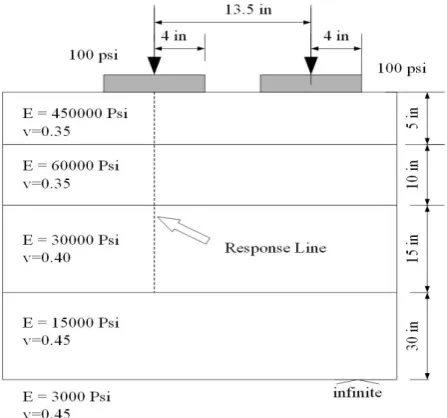
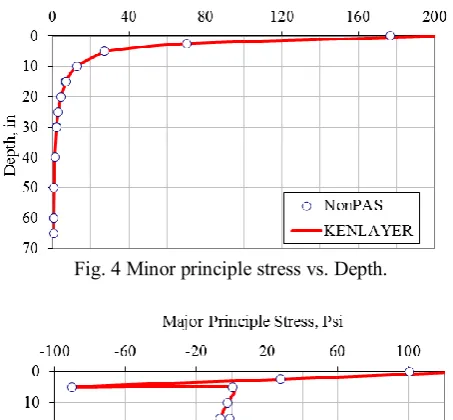
For validation of NonPAS program for linear elastic analysis of flexible pavements, a typical five layered pavement system was considered and analyzed under the effect of dual wheel load using both NonPAS and Kenlayer, and then results were compared. Specification of each layer of pavement section is represented in Fig. (2). The wheel contact area was assumed to be circular with radius of 4 inches and pressure of 100 psi. Distance between dual wheels was also assumed as 13.5 in. Results for linear elastic analysis of pavement at the center of contact area using both NonPAS and Kenlayer have been presented in Fig. (3) to (7)
As can be seen, computed responses using NonPAS show good agreement with kenlayer responses. Just in case of surface responses (depth of zero), the computed responses using Kenlayer and NonPAS did not match completely.
The Kenlayer program computes the vertical stress at the center of the wheel as 139.20 Psi and NonPAS computes this response as 100.53 Psi. The actual amount of this response (vertical stress under the wheel load) is equal to 100 Psi. This can be explained by shortcoming of Kenlayer program in computation of accurate responses at the top of pavements as mentioned by another research [21].
Fig. 2 Pavement section for validation of linear elastic responses.
The accuracy of NonPAS program has been improved by a more accurate algorithm for numerical computation of the following Hankel inversion semi-infinite integration:
dm H
a m J m R
H qa
R 1( . )
0 *
(6)
where R* is the response due to the vertical load of
0( / )
mJ mr H
, m is the constant of integration, Ris the response due to the vertical load of q, a is the radius of contact load, H is the distance from the surface to the upper boundary of the lowest layer, J0 is a Bessel function
of the first kind and of order zero and J1 is a Bessel
function of the first kind and of order one.
Fig. 4 Minor principle stress vs. Depth.
Fig. 5 Major principle stress vs. Depth.
Fig. 6 Minor principle strain vs. Depth.
Fig. 7 Major principle strain vs. Depth.
5.
Comparison of computed responses with
Kenlayer results
For validation of results which are computed using NonPAS Program, a typical three layered pavement system was analyzed using both NonPAS and Kenlayer, and then results were compared. Specification of each layer of pavement section is represented in Fig. (8). As can be seen, granular base and subgrade have been modeled using K-θ and bilinear nonlinear behavioral model respectively. Material constants for these two layers have been shown in Fig. (8). Contact area was assumed to be circular with radius of 6 inches and pressure of 80 psi. For increasing accuracy of nonlinear analysis, base layer was divided to six layers with the same thickness of 2 inches for each sub layer. The stress point for computation of resilient modulus of subgrade soil has been assumed one inch in depth from the surface of subgrade soil. Two values were assumed for the slope of load distribution (SLD) as 0 and 0.5.
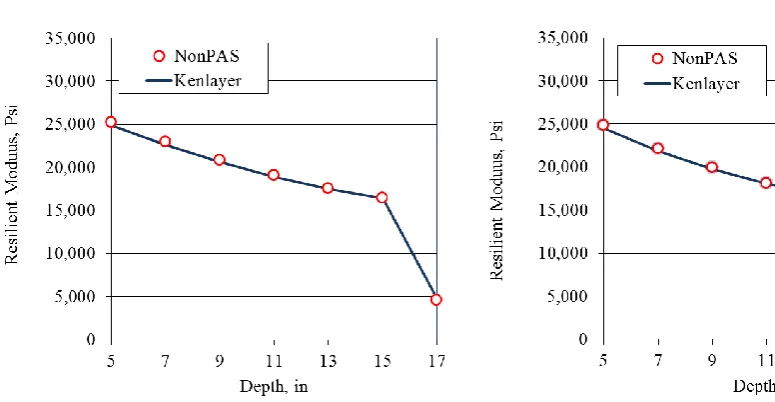
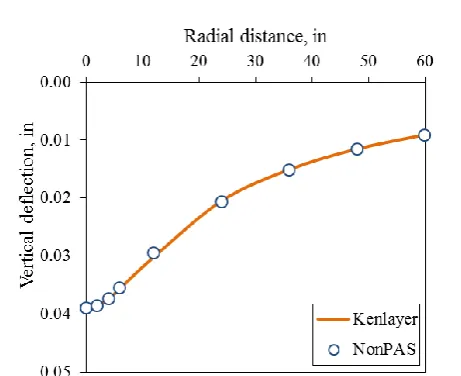
Since the performance of pavement is usually predicted using the critical responses of pavement, here, only these responses are compared to show the correspondence of results of Kenlayer and NonPAS. Critical responses were assumed as surface vertical deflections, radial stresses and strains at the center of loading at different depths, and also vertical stresses and strains at the center of loading at different depths. Final resilient moduli computed by NonPAS and Kenlayer are given in Fig. (9) and (10). Nonlinear analysis results at the center of contact area, assuming SLD=0, have been demonstrated in Fig. (11) to (15). As can be seen, the computed results using both programs match very well. Resilient modulus correspondence in various depths results in same responses.
Fig. 9 Resilient modulus vs. Depth (SLD=0.0).
Fig. 11 Vertical stress vs. depth (SLD=0.0).
Fig. 13 Radial strain vs. depth (SLD=0.0).
Fig. 10 Resilient modulus vs. Depth (SLD=0.5).
Fig. 12 Vertical strain vs. depth (SLD=0.0).
Fig. 15 Surface deflection vs. radial distance (SLD=0.0).
6.
Comparison of computed results using
different nonlinear model
In order to compare the results of nonlinear analysis using different nonlinear models, pavement system shown in Fig. (16) was analyzed using three different nonlinear models. Subgrade soil was modeled using bilinear model and according to the parameters shown in Fig. (16). Granular base was modeled using three models, including K-θ, Uzan and MEPDG. Constant coefficients for each of these models have been obtained using dynamic triaxial tests, which were conducted by Hopkins et al. (2001) based on a sample of the crashed stone base material [20]. Calibration results for each of the models are given in Table (1). Hopkins et al used deviator stress instead of octahedral shear stress for calibration of MEPDG Model.
Fig. 16 Assumed configuration for pavement structure and loading.
Loading was considered to be a tandem Axel with dual wheels. Contact area and contact pressure of all wheels was assumed to be constant and same as what shown in the Fig. (16). Stress points were considered in the intermediate position of the wheels and in different
depths. In order to analysis more accurately, the base layer was divided into six sub-layers each of them had two inches thick, and the stress point was assumed at the center of each of these sub-layers. For computation of subgrade resilient modulus, stress point assumed one inch in depth from the surface of subgrade soil. As can be seen, computed responses using NonPAS show good agreement with Kenlayer responses.
Table 1: Nonlinear coefficients for different models. Model
Name K1 K2 K3 R2
K-θ 5646 0.5452 - 0.954
Uzan 4636.43 0.7467 -0.2202 0.994 MEPDG 5070.02 0.7418 -0.2394 0.996
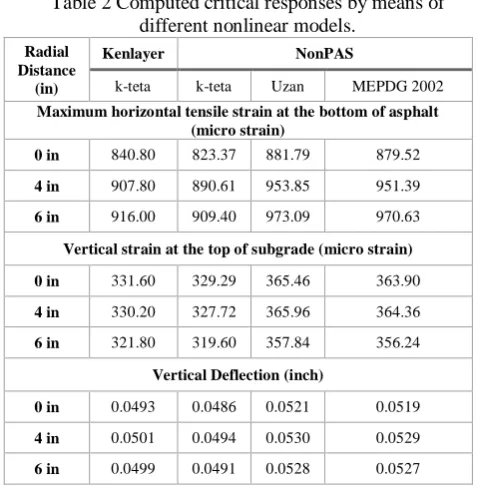
Resilient moduli obtained using any of the models at different depths have been shown in Fig. (17). As evidence, the results of the K-θ model does not show a good agreement with two other models and resilient modulus obtained from Uzan and MEPDG is less than the resilient modulus obtained from the K-θ model. Considering that the only possible alternative for modeling coarse grained material in Kenlayer program is K-θ model, the results of the analysis using Kenlayer have been given only for K-θ model. Critical responses of pavement including maximum horizontal tensile strain at the bottom of asphalt layer, maximum vertical compressive strain at the top of subgrade and also surface deflection at three different distanced from the center of one of wheels in direction of dual wheels are given in table (2).
Fig. 17 Computed resilient modulus at different depths using different models.
deviator stress. Table (2) illustrates that the computed critical responses using these three models do not match exactly. Due to higher precision of Uzan and MEPDG, these two models are recommended for nonlinear modeling of coarse aggregate materials. These two models can represent the behavior of coarse aggregate under different stress state better than K-θ model. Unlike the Kenlayer program that only allows nonlinear modeling of coarse aggregate materials using K-θ Model, NonPAS program has the capability of modeling these materials using other nonlinear models and can provide enough accuracy to estimate pavement responses.
Table 2 Computed critical responses by means of different nonlinear models.
Radial Distance
(in)
Kenlayer NonPAS
k-teta k-teta Uzan MEPDG 2002
Maximum horizontal tensile strain at the bottom of asphalt (micro strain)
0 in 840.80 823.37 881.79 879.52
4 in 907.80 890.61 953.85 951.39
6 in 916.00 909.40 973.09 970.63
Vertical strain at the top of subgrade (micro strain) 0 in 331.60 329.29 365.46 363.90
4 in 330.20 327.72 365.96 364.36
6 in 321.80 319.60 357.84 356.24
Vertical Deflection (inch)
0 in 0.0493 0.0486 0.0521 0.0519
4 in 0.0501 0.0494 0.0530 0.0529
6 in 0.0499 0.0491 0.0528 0.0527
7.
Summary
NonPAS program has been developed for linear and nonlinear analysis of flexible pavements. It allows nonlinear modeling of coarse and fine aggregate materials in flexible pavements using five different nonlinear models, including k-θ, uzan, uzan-witczak, MEPDG 2002 and bilinear model. Computed responses using NonPAS show good agreement with Kenlayer responses. In case of vertical deflections, the computed responses using these two programs do not match completely. This may be explained by shortcoming of Kenlayer program in computation of accurate responses at the surface of pavements as mentioned by other researchers. NonPAS program can compute the responses at the surface of pavement more accurately than kenlayer, which is so important for predicting of top-down cracking, that is the result of tensile strain at the top of surface layer. It can be mentioned that the NonPAS program can be used as a reliable program for linear and nonlinear analysis of flexible pavements, and its computational algorithm can be used in developing Mechanistic-Empirical pavement design software.
References
[1] Boussinesq, J.: Applications des potentials a l'etude de l'equilibre et du mouvement des solides elastique. Gauthier-Villars, Paris, (1885).
[2] Kim, M., Tutumluer E., and Kwon J., Nonlinear pavement foundation modeling for three-dimensional finite-element analysis of flexible pavements, International Journal of Geomechanics, volume 9, no. 5, (2009), pp. 195-208.
[3] Mojarrad, H., Three dimensional nonlinear finite element analysis of airport pavements. North Carolina State University, Ph.D Dissertation, (2011).
[4] Sadrnejad, S.A., Ghanizadeh, A.R., and Fakhri, M., Evaluation of three constitutive models to characterize granular base for pavement analysis using finite element method. Journal of Applied Sciences Research, volume 5, no. 7, (2011), pp. 778-786.
[5] Maharaj, D. and Gill, S., The behavior of flexible pavement by nonlinear finite element method. International Journal of Latest Research in Science and Technology, volume 3, no. 1, (2014), pp. 53-57. [6] Sivaneswaran, N., Pierce, L., and Mahoney, J. Everstress Version 5.0: Layered elastic analysis program. Olympia, Washington State Department of Transportation, (2001).
[7] Huang, Y. H., Pavement analysis and design. 2nd edition, Prentice–Hall. Inc., New Jersey, (2004). [8] Hjelmstad, K., and Taciroglu, E., Analysis and
implementation of resilient modulus models for granular solids. Journal of Engineering Mechanics, volume 126, no. 8, (2000), pp. 821-830.
[9] Seed, H. B., Chan, C., and Lee, C., Resilience characteristics of subgrade soils and their relation to fatigue failures in asphalt pavements. Proc., International Conference on the Structural Design of Asphalt Pavements. Supplement, (1962), pp.77-113.
[10]Hicks, R. G., and Monismith, C. L., Factors influencing the resilient response of granular materials. Highway Research Record, volume 345, (1971), pp.15-31.
[11]Uzan, J., Characterization of granular material. Transportation Research Record, volume 1022, (1985), pp. 52-59.
[12]Witczak, M., and Uzan, J., The universal airport pavement design system. Report I of V: Granular material characterization, University of Maryland, USA, (1988).
[13]NCHRP: Guide for mechanistic–empirical design of new and rehabilitated pavement structures, Final Report for Project 1-37A. Washington, DC: National Cooperative Research Program, (2004). [14]Kim, M., Tutumluer, E., and Kwon, J.: Nonlinear
[15]Thompson, M. R., and Robnett, Q. L., Resilient properties of subgrade soils. Transportation Engineering Journal, volume 105, no. 1, (1979), pp. 71-89.
[16]He, W., Laboratory evaluation of unbound rap as a pavement base material. M.S. Thesis, University of Tennessee, Knoxville, (2006).
[17]Li, P., Characterization and implementation of stress dependent resilient modulus of asphalt treated base for flexible pavement design, Ph.D Dissertation, University of Alaska, Fairbanks, (2013).
[18]Jitsangiam, P., & Nikraz, H., Mechanical behaviours of hydrated cement treated crushed rock base as a road base material in Western Australia.
International Journal of Pavement Engineering. volume 10, no. 1, (2009), pp. 39-47.
[19]Puppala, A. J., Hoyos, L. R., & Potturi, A. K. Resilient moduli response of moderately cement-treated reclaimed asphalt pavement aggregates. Journal of Materials in Civil Engineering, volume 23, no. 7, (2011), pp. 990-998.
[20]Hopkins, Tommy C., Tony L. Beckham, Charlie Sun, and Bixian Ni., Resilient modulus of Kentucky soils, Research report KTC-01-07/SPR-163-95-1F, (2001).