An Improved MOEA/D for QoS Oriented Multimedia
Multicasting with Network Coding
Zhaoyuan Wang
School of Information Scienceand Technology Southwest Jiaotong University
Chengdu 611756, China
wang_zhaoyuan
@foxmail.com
Huanlai Xing
∗ School of Information Scienceand Technology Southwest Jiaotong University
Chengdu 611756, China
[email protected]
Tianrui Li
School of Information Science and Technology Southwest Jiaotong University
Chengdu 611756, China
[email protected]
Yan Yang
School of Information Science and Technology Southwest Jiaotong University
Chengdu 611756, China
[email protected]
Rong Qu
School of Computer Science The University of Nottingham Nottingham, NG8 1BB, UK
[email protected]
ABSTRACT
Recent years witness a significant growth in multimedia ap-plications. Among them, a stream of applications is real-time and requires one-to-many fast data transmission with stringent quality-of-service (QoS) requirements, where mul-ticast is an important supporting technology. In particular, with more and more mobile end users requesting real-time broadband multimedia applications, it is of vital importance to provide them with satisfied quality of experience. As net-work coding can offer higher bandwidth to users and ac-commodate more flows for networks than traditional rout-ing, this paper studies the multicast routing problem with network coding and formulates it as a multi-objective opti-mization problem. As delay and packet loss ratio (PLR) are two important performance indicators for QoS, we consider them as the two objectives for minimization. To address the problem above, we present a multi-objective evolutionary al-gorithm based on decomposition (MOEA/D), where an all population updating rule is devised to address the problem of lacking feasible solutions in the search space. Experi-mental results demonstrate the effectiveness of the proposed algorithm and it outperforms a number of state-of-the-art algorithms.
Keywords
multicast, multimedia, multi-objective optimization, network coding, quality-of-service
∗Corresponding author
1.
INTRODUCTION
In recent years, a tremendous growth in multimedia appli-cations has been witnessed. Statistical data show that, in a minute, around 150,000,000 GB data are transmitted in the Internet. Among them, about 90% belong to multimedia applications [1, 2]. With the rapid development in mobile Internet, increasingly more people enjoy their media time on mobile devices, which accounts for about 20% of the total media time. Hence, to efficiently support those multimedia applications, data transmission services with high quality-of-service (QoS) are in urgent need by end users, especially those accessing Internet via mobile devices. Parameters e.g. data transmission rate, delay, and packet loss ratio are im-portant performance indicators for QoS. In nature, end users look for multimedia applications with satisfied QoS guaran-tees. Multicast is a one-to-many communications technol-ogy with multiple receivers simultaneously requesting the same information sent from a single source. This technolo-gy can well support multimedia applications with multiple end users involved, such as video conferencing, IPTV, inter-active online games. However, multicast employing store-and-forward forwarding cannot guarantee the theoretically maximized throughput [3].
Fortunately, network coding can always help the multicast achieve the theoretical maximum throughput, which is par-ticularly suitable to support real-time broadband data trans-mission, i.e. this technology is ideal for real-time multime-dia multicast scenarios with stringent QoS requirements [4]. On the other hand, when employed in multicast, network coding involves coding operations performed at a subset of intermediate nodes in the network. As coding operations are complicated mathematical operations, e.g. calculations over some finite field, network coding based multicast (NCM) not only consumes additional computing and buffering re-sources, but also could cause serious network performance deterioration [5], including the end-to-end delay and packet loss ratio. Hence, it is a nature way to think of how to con-sume as less network resources as possible while exploiting
MOBIMEDIA 2015, May 25-27, Chengdu, People's Republic of China Copyright © 2015 ICST
all benefits the NCM brings to the existing network infras-tructure.
A considerable amount of research efforts have been dedi-cated to optimize the NCM routing problem. For example, the network coding resource minimization problem, which is for minimizing the involved computing resource, has drawn a lot of research attention [6, 7, 8, 9, 10, 11, 12]. Moreover, as coding and link costs both incur during the NCM, some researchers study the trade-off between them using multiob-jective optimization approaches [13, 14]. In [15], Xing and Qu minimize the total cost and end-to-end delay simultane-ously, where the cost is a weighted sum of the coding and link costs. However, to the best of our knowledge, there has not been any research carried out from the perspective of supporting NCM with multiple QoS metrics met. Since end users are in urgent need for satisfied QoS multimedia appli-cations, this paper investigates a QoS oriented bi-objective NCM scenario, where the average end-to-end delay and the average packet loss ratio are the two objectives for mini-mization, respectively.
Evolutionary algorithms (EAs) usually obtain promising so-lutions in a single run within a short time due to the population-based parallel computing framework. Hence, when used for addressing network routing selection problems with multiple (often conflicting) objectives, EAs are often considered as an efficient candidate optimizer. Among those multi-objective EAs, multi-objective evolutionary algorithm based on de-composition (MOEA/D) [16] has received a considerable amount of research attention because of its excellent opti-mization performance. MOEA/D decomposes a given MOP into a number of scalar sub-problems by conventional aggre-gation approaches, and the sub-problems are solved simul-taneously by evolving a population of solutions. It has been proved that MOEA/D obtains promising optimization per-formance with much lower computational complexity than well-known MOEAs, e.g., NSGA-II [17] and SPEA2 [18], which makes it an ideal optimizer for handling the problem concerned.
In this paper, a QoS oriented bi-objective optimization prob-lem in the context of NCM is studied. We adapt MOEA/D for the proposed problem, where a new scheme is integrated into the basic MOEA/D framework and thus able to en-hance the searching procedure. This feature is referred to as all population updating rule, where a newly generated solution is used to update the most suitable one among all sub-problems. The experimental results illustrate the supe-riority of the proposed MOEA/D over several of the state-of-the-art MOEAs.
2.
PROBLEM FORMULATION
A communications network can be modeled as a directed graphG= (V, E), whereV andEare the node and link sets, respectively. Assume each link e∈ E has a unit capacity. Those with larger capacity are represented by parallel links, each with a unit capacity. In a NCM scenario, there is a source nodes∈V, a set of receiversT ={t1, ..., td},tk∈V,
and an expected data rateR. We need to find a subgraph consisting of multiple link-disjoint paths (i.e. paths without common link), where each path is originated from the source
s and terminated at one of the receivers, e.g. tk. In this
subgraph, different data flows may pass through different areas. Such subgraph is referred to as NCM subgraph [10].
The following lists some notations used in the paper:
• s: the source node inG(V, E);
• T ={t1, ..., td}: set of receivers, where d=|T|is the
number of receivers;
• R: the expected data rate (an integer) at whichs ex-pects to transmit toT;
• r(s, tk): the practical data rate from the source to
re-ceivertk∈T within the NCM subgraph;
• pi(s, tk): thei-th path froms to tk within the NCM
subgraph, wheretk∈T andi= 1, ..., R;
• delay(pi(s, tk)): the end-to-end transmission delay on
pi(s, tk);
• plr(pi(s, tk)): the packet loss ratio (PLR) onpi(s, tk).
The task in the paper is to construct a feasible NCM sub-graph with the data rate requirement satisfied and two ob-jectives simultaneously minimized, as follows.
Minimize
Davg=1d d
P
k=1
max{delay(pi(s, tk))|i= 1,2, ...R}
Pavg= 1d d
P
k=1
max{plr(pi(s, tk))|i= 1,2, ...R}
(1)
s.t. r(s, tk)≥R,∀tk∈T (2)
where, Davg is the average transmission delay of the NCM
subgraph; Pavg is the average PLR of the NCM subgraph.
Constraint 2 defines that the obtained data rate from source
sto each receiver must be no less thanR. Optimal solutions to the problem concerned are a set of nondominated solu-tions, known as the Pareto-optimal front (PF) [19]. Given any two solutionsx1 andx2, we sayx2 is dominated byx1
if either {Davg(x1) < Davg(x2), Pavg(x1) ≤ Pavg(x2)} or {Davg(x1)≤Davg(x2), Pavg(x1)< Pavg(x2)}holds.
3.
THE PROPOSED MOEA/D
First of all, the chromosome representation and objective evaluation are introduced. Then, a performance enhancing scheme, i.e. the all population updating rule, is described. Finally, the overall structure of the proposed MOEA/D is given in detail.
3.1
Chromosome representation and objective
evaluation
used in NCM routing problems [9, 10, 11, 12, 15]. More details can be found in [15].
To evaluate a solution in all objectives, the first task is the feasibility checking and the second one is the calculation of objective values. As we know, each solutionx corresponds to a certain subgraph. Goldberg algorithm [20] is used to verify if the associated subgraph of x meets the data rate requirement. If yes,x is feasible; otherwise, it is infeasible. For a feasible solution, we computeDavg and Pavg of the
corresponding subgraph, according to formula 1.
3.2
All population updating rule
In MOEA/D, the traditional way of updating the popula-tion is that, when a promising solupopula-tion is generated, it is used to replace not only the best-so-far solution to the corre-sponding problem but also those to the neighboring sub-problems. As the problem concerned in the paper is of hard constraint, there are many infeasible solutions in the search space. Although feasible solutions are urgently needed to guide the search towards the true PF, it is quite difficult to obtain them. If a better solution is generated and adopted to update only the neighboring sub-problems, all associated best-so-far solutions could be replaced, which would lead to premature convergence and deteriorated optimization per-formance. Moreover, due to the problem nature, coding operations could seriously affect the delay and/or PLR. In other word, solutions with a few different links, whose sub-graphs may be quite similar, might be far from each other in the search space. Therefore, a solution generated from one problem may be more suitable for a far-away sub-problem. Inspired by this idea, we propose the all popula-tion updating rule, extending the neighborhood range to all single-objective optimization problems (SOPs). In this way, a newly generated solution can be used to update the most appropriate SOP and the search is thus well guided to ex-plore promising areas in the search space. When a promising solution is generated, instead of multiple SOPs, a single SOP where the fitness quality improvement is the most significant is updated. With the features above, MOEA/D gains better performance as observed in Section 4. Moreover, details of the proposed solution updating rule can be found in Step 2.3, Subsection 3.3.
3.3
Overall procedure
In MOEA/D, the first step is to convert a MOP into a num-ber of scalar optimization sub-problems (each with a single objective) by using different decomposition methods [16]. This paper adopts Tchebycheff approach for decomposition as it is the most commonly-used and able to help MOEA/D gain decent optimization performance. To be specific, a MOP is decomposed into multiple SOPs as the following shows:
Minimize : g(x|λ, z∗) = max1≤i≤m{λi|fi(x)−zi∗|}
Subject to : x∈Ω (3)
wheremis number of objectives,λ= (λ1, ..., λm) is a weight
vector and
m
P
i=1
λi = 1, and fi(x) is the the i-th objective
value ofx. z∗={z∗1, ..., z ∗
m}is the reference point, wherez
∗
i
is the best-so-far value of thei-th objective.
Letλ1, ..., λN be N weight vectors, each associated with a
SOP. If all of them are properly selected, the obtained best solutions can provide a good approximation to the true PF. In addition, Euclidean distances among those weight vec-tors are used to define the neighborhood relationship for the SOPs. For two SOPs, if the Euclidean distance between their weight vectors is small, it indicates the optimal solu-tions to one SOP and those to the other form similar PFs in the objective space (i.e. decision space). Hence, SOPs with closer Euclidean distances are regarded neighbors. In MOEA/D, SOPs are solved in a collaborative manner, where useful information is shared within neighborhoods.
The procedure of the proposed MOEA/D is described below.
Input:
• The multi-objective optimization problem.
• A stopping criterion.
• W: the number of the weight vectors in the neighbor-hood of each weight vector.
• pc: the crossover probability.
• pm: the mutation probability.
Global structure:
• A population ofN search pointsx1, ..., xN∈Ω, where
xjis the solution of thej-th sub-problem.
• z={z1, ..., zm}.
• An external population (EP), which stores nondomi-nated solutions found during the search.
Procedure:
Step 1: Initialization: Step 1.1: Set EP = Φ.
Step 1.2: Compute the Euclidean distances between any two weight vectors and then work out theW closest weight vectors to each weight vector. Forj= 1, ..., N, set B(j) ={j1, ..., jW}. λj1, ...,λjW are theW closest weight
vectors toλj.
Step 1.3: Employ initialization scheme in [15] to gen-erate initial populationx1, ..., xN.
Step 1.4: Initializez={z1, ..., zm}, wherezi= min(fi(xj)),
1≤i≤m,0≤j≤N.
Step 2: Update:
Forj= 1, ..., N
Step 2.1: Reproduction:
Randomly select two indexes k and l from B(j) and generate a new solution y by performing crossover and mutation toxk andxl.
Step 2.2: Update of reference point: Fori= 1, ..., mIffi(y)< zi, setzi=fi(y).
Step 2.3: All population updating rule:
Find an indexh so that max{g(xh|λh, z)−g(y|λh, z)}
has the largest value. Then setxh=y.
Step 2.4: Update of EP:
Remove those solutions from EP that are dominated by f(y). Addf(y) to EP if no vector of EP dominatesf(y).
Step 3: Stopping Criteria:
If stopping criteria is met, stop the search and output EP. Otherwise, go toStep 2.
4.
EXPERIMENTS AND ANALYSIS
In this section, we first introduce the test instances and per-formance metrics for evaluating the proposed MOEA/D. Af-ter that, we study the effectiveness of the proposed all pop-ulation updating rule. Finally, we compare the proposed MOEA/D with several state-of-the-art MOEAs in terms of the optimization performance.
4.1
Test instances
We evaluate the performance of the proposed algorithm on 8 random instances which are widely used in the literature [9, 10, 11, 12, 15]. These instances are all available at http://www.cs.nott.ac.uk/ rxq/benchmarks.htm and more details can be found in [11]. In addition, the delay and the PLR on each link are random numbers, uniformly distribut-ed in the range [2ms, 10ms] and [1×10−5,5×10−5], respec-tively. All experiments are run on a computer with Windows 8 OS, Intel(R) Core(TM) i7-3740QM CPU 2.7 GHz and 8 GB RAM.
4.2
Performance measures
LetP Fref be a reference set of nondominated solutions of
the true PF and P Fknown be the set of nondominated
so-lutions obtained by an algorithm. Soso-lutions inP Fref are
expected to be uniformly distributed in the objective space along the true PF. Note that true PFs are usually not known for highly complex multi-objective optimization problems including the problem concerned in this work. To determine a reference setP Fref, we combine the best-so-far solutions
obtained by all algorithms in all runs and select the nondom-inated solutions as the reference set. This has been widely adopted in evaluating multi-objective algorithms in the lit-erature.
To thoroughly evaluate the performance of the proposed al-gorithm, the following performance measuring metrics are employed throughout the experiments.
(1) Generational distance (GD): GD measures the average distance from the obtained nondominated solution setP Fknown
to the reference setP Fref, defined as:
GD=
v u u t
P
v∈P Fknown
d(v, P Fref)
|P Fknown|
(4)
where d(v, P Fref) is the Euclidean distance between
solu-tion v in P Fknown and its nearest solution in P Fref. A
smaller GD indicates the obtained PF is closer to the true PF.
(2) Inverted generational distance (IGD): IGD is defined dis-tance (in the objective domain) between solutionv inP Fref
and its nearest solution inP Fknown, defined as:
IGD=
P
v∈P Fref
d(v, P Fknown)
|P Fref|
(5)
This metric measures both the diversity and the convergence of an obtained nondominated solution set. A lower IGD indicates a better overall performance of an algorithm.
(3) Maximum spread (MS): this metric reflects how well the true PF is covered by the nondominated solutions in P Fknown through the hyperboxes formed by the extreme
function values observed in P Fref and P Fknown, as shown
in
M S=
v u u t
1 m
m
X
i=1
(min(f
max
i , Fimax)−max(fimin, Fimin)
Fmax
i −Fimin
)
2
(6) where m is the number of objectives; fimax and fimin are
the maximum and minimum values of thei-th objective in P Fknown, respectively; and Fimax and Fimin are the
maxi-mum and minimaxi-mum values of the i-th objective in P Fref,
respectively. A larger MS shows the obtained PF has a bet-ter spread.
(4) Average Computational Time (ACT) consumed by an algorithm over 20 runs. This metric is a direct indication of the computational time of an algorithm.
(5) Student’s t-test [11, 21] to compare two algorithms (A and B) in terms of the IGD values obtained in 20 runs. In this paper, two-tailed t-test with 38 degrees of freedom at a 0.05 level of significance is used. The t-test result can show if the performance of A is better than, worse than, or equivalent to that of B from the aspect of statistics.
4.3
The effectiveness of the all population
up-dating rule
We evaluate the effectiveness of the proposed solution up-dating rule by running two variants of MOEA/D, i.e. tra-ditional MOEA/D (A1) and MOEA/D with the proposed solution updating rule (A2).
Table 1 shows the experimental results collected in terms of GD, IGD and MS. It is observed that A2 algorithm per-forms better than A1, in terms of the GD, IGD and MS. The results clearly show that the proposed updating rule can significantly improve the optimization performance of MOEA/D. With the new updating rule, one reproduced so-lution is used to update the most suitable SOP among all SOPs. This rule rationally utilizes new solutions and help-s to avoid prematurity. Hence, A2 outperformhelp-s A1 in all instances.
4.4
The overall performance evaluation
We evaluate the overall performance of the proposed MOEA/D by comparing it with several distinguished MOEAs, i.e. S-PEA2 and NSGA-II. The following list the parameter set-tings for each algorithm.
Table 1: Experimental results in terms of GD, IGD and MS (best results are in bold)
Network GD IGD MS
A1 A2 A1 A2 A1 A2
Rnd-1 0.000 0.000 0.000 0.000 1.000 1.000
Rnd-2 0.000 0.000 0.000 0.000 1.000 1.000
Rnd-3 0.000 0.000 0.000 0.000 1.000 1.000
Rnd-4 0.112 0.073 2.031 0.173 0.416 0.829
Rnd-5 0.294 0.190 0.934 0.195 0.687 0.914
Rnd-6 0.068 0.000 0.159 0.000 0.919 1.000
Rnd-7 0.027 0.006 0.099 0.008 0.827 0.958
Rnd-8 0.649 0.249 1.003 0.187 0.700 0.811
• NSGA-II:N= 50, pc= 0.9 andpm= 1/l.
• Proposed MOEA/D:N= 50, pc= 0.9 andpm= 1/l.
To make a fair comparison, each algorithm runs 200 gener-ations. The results of GD, IGD, MS and ACT are shown in Table 2.
It is clearly seen that, the proposed MOEA/D gains the best performance regarding GD, IGD and MS. The nondominat-ed solutions obtainnondominat-ed by our MOEA/D are closer to the op-timal solutions along the true PF and are more diversified in terms of their locations in the objective space. Besides, smaller ACT also indicates that the proposed MOEA/D has lower computational complexity than NSGA-II and SPEA2.
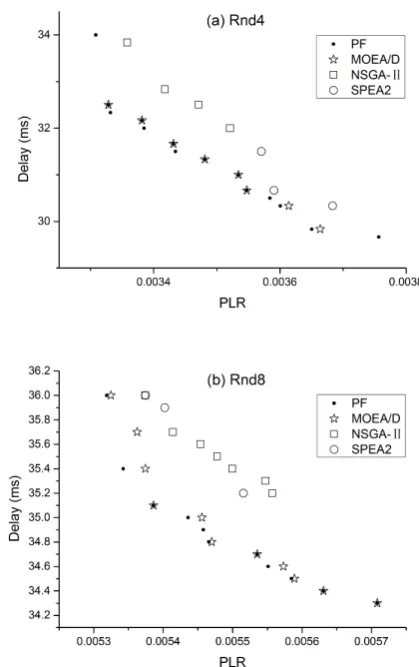
Figure 1 illustrates the best PFs obtained in a single run by NSGA-II, SPEA2 and the proposed MOEA/D, respec-tively, where the true PF is marked by small and solid dots. Due to space limitation, we select two instances, Rnd4 and Rnd8 as an example. Clearly, compared with NSGA-II and SPEA2, the proposed MOEA/D owns better PF which is a nice approximation to the true PF. On the other hand, as we can see, there is a significant gap between the true PF and those of NSGA-II and SPEA2. Therefore, Figure 1 al-so demonstrates that the proposed MOEA/D has promising optimization performance regarding the PF obtained.
To further support our observation, we compare the IGD values of the three algorithms by using Student’st-test. Ta-ble 3 shows that our algorithm outperforms the others in most of the instances.
5.
CONCLUSIONS
This paper formulates a QoS oriented multicast routing prob-lem based on network coding so as to well support real-time broadband multimedia applications. We consider three im-portant performance metrics in the problem, where the av-erage transmission delay and the avav-erage packet loss ratio are two objectives to be minimized simultaneously and the data rate (i.e. bandwidth) is a hard constraint. We adapt MOEA/D for the problem above and propose a problem-specific solution updating rule, i.e. the all population updat-ing rule, to improve the optimization performance. In this rule, each new solution is used to update the most suitable sub-problem. The experimental results demonstrate that the proposed MOEA/D performs significantly better than traditional MOEA/D, SPEA2 and NSGA-II with respect to
Figure 1: Example of the PFs obtained by different algorithms. (a) Rnd4 network. (b) Rnd8 network.
a number of widely used performance measures, i.e. invert-ed generational distance, generational distance, maximum spread and average computation time.
6.
ACKNOWLEDGMENTS
This work was supported in part by NSFC (No.61401374), the Fundamental Research Funds for the Central Universi-ties (No.2682014RC23), the Project-sponsored by SRF for ROCS, SEM, Southwest Jiaotong University, China and The University of Nottingham, UK.
7.
REFERENCES
[1] Xiao Wu, Chong-Wah Ngo, Yi-Ming Zhu, and Qiang Peng. Boosting web video categorization with contextual information from social web.World Wide Web, 15(2):197–212, 2012.
[2] Xiao Wu, Yi-Jie Lu, Qiang Peng, and Chong Wah NGO. Mining event structures from web videos.IEEE Multimedia, 18(1):38–51, Jan 2011.
[3] S-YR Li, Raymond W. Yeung, and Ning Cai. Linear network coding.IEEE Transactions on Information Theory, 49(2):371–381, 2003.
Table 2: Comparisons of different algorithms (best results are in bold)
Algorithm GD IGD
Rnd1 Rnd2 Rnd3 Rnd4 Rnd5 Rnd6 Rnd7 Rnd8 Rnd1 Rnd2 Rnd3 Rnd4 Rnd5 Rnd6 Rnd7 Rnd8 SPEA2 0.000 0.038 0.000 0.802 0.294 0.088 0.053 0.989 0.000 0.016 0.000 3.625 2.791 2.767 0.254 2.440 NSGA-II 0.000 0.000 0.015 0.277 0.110 0.035 0.035 1.125 0.000 0.000 0.009 0.530 0.279 0.023 0.099 2.149 MOEA/D 0.000 0.000 0.000 0.073 0.059 0.000 0.006 0.249 0.000 0.000 0.000 0.173 0.195 0.000 0.008 0.187
Algorithm MS ACT(sec.)
Rnd1 Rnd2 Rnd3 Rnd4 Rnd5 Rnd6 Rnd7 Rnd8 Rnd1 Rnd2 Rnd3 Rnd4 Rnd5 Rnd6 Rnd7 Rnd8 SPEA2 1.000 0.987 1.000 0.461 0.820 0.919 0.889 0.693 3648 6819 11249 25891 43177 21422 98731 126541 NSGA-II 1.000 1.000 0.991 0.798 0.889 0.935 0.910 0.673 6302 10418 22219 27539 46811 33156 81218 122446 MOEA/D 1.000 1.000 1.000 0.829 0.914 1.000 0.958 0.811 2643 3766 8651 8240 18653 9031 21808 50186
Table 3: Result oft-test
Network Rnd-1 Rnd-2 Rnd-3 Rnd-4 Rnd-5 Rnd-6 Rnd-7 Rnd-8
MOEA/D↔SPEA2 ∼ + ∼ + + + + +
MOEA/D↔NSGA-II ∼ ∼ + + ∼ + + +
Raymond W. Yeung. Network information flow.IEEE Transactions on Information Theory, 46(4):1204–1216, 2000.
[5] Michael Langberg, Alexander Sprintson, and Jehoshua Bruck. The encoding complexity of network coding.
IEEE/ACM Transactions on Networking (TON), 14(SI):2386–2397, 2006.
[6] Minkyu Kim, Muriel M´edard, Varun Aggarwal, U-M O’Reilly, Wonsik Kim, Chang Wook Ahn, and Michelle Effros. Evolutionary approaches to
minimizing network coding resources. InINFOCOM 2007. 26th IEEE International Conference on Computer Communications. IEEE, pages 1991–1999. IEEE, 2007.
[7] Minkyu Kim, Varun Aggarwal, Una-May O Reilly, Muriel M ˜Al’dard, and Wonsik Kim. Genetic representations for evolutionary minimization of network coding resources. InApplications of
Evolutionary Computing, pages 21–31. Springer, 2007. [8] Huanlai Xing, Yuefeng Ji, Lin Bai, and Yongmei Sun. An improved quantum-inspired evolutionary algorithm for coding resource optimization based network coding multicast scheme.AEU-International Journal of Electronics and Communications, 64(12):1105–1113, 2010.
[9] Huanlai Xing and Rong Qu. A population based incremental learning for delay constrained network coding resource minimization. InApplications of Evolutionary Computation, pages 51–60. Springer, 2011.
[10] Huanlai Xing and Rong Qu. A compact genetic algorithm for the network coding based resource minimization problem.Applied Intelligence, 36(4):809–823, 2012.
[11] Huanlai Xing, Rong Qu, Graham Kendall, and Ruibin Bai. A path-oriented encoding evolutionary algorithm for network coding resource minimization.Journal of the Operational Research Society, 65:1261–1277, 2013. [12] Huanlai Xing, Rong Qu, Lin Bai, and Yuefeng Ji. On minimizing coding operations in network coding based multicast: an evolutionary algorithm.Applied
Intelligence, 41(3):820–836, 2014.
[13] Minkyu Kim, Muriel M´ledard, Varun Aggarwal, and, Una-May O’Reilly. On the coding-link cost tradeoff in multicast network coding. InMilitary
Communications Conference, 2007. MILCOM 2007. IEEE, pages 1–7, Oct 2007.
[14] Minkyu Kim, Muriel M´ledard, and Una-May O’Reilly., Network coding and its implications on optical networking. InOptical Fiber Communication - incudes post deadline papers, 2009. OFC 2009. Conference on, pages 1–3. Optical Society of America, March 2009. [15] Huanlai Xing and Rong Qu. A nondominated sorting
genetic algorithm for bi-objective network coding based multicast routing problems.Information Sciences, 233:36–53, 2013.
[16] Qingfu Zhang and Hui Li. Moea/d: A multiobjective evolutionary algorithm based on decomposition.IEEE Transactions on Evolutionary Computation,
11(6):712–731, 2007.
[17] Kalyanmoy Deb, Amrit Pratap, Sameer Agarwal, and TAMT Meyarivan. A fast and elitist multiobjective genetic algorithm: Nsga-ii.IEEE Transactions on Evolutionary Computation, 6(2):182–197, 2002. [18] Eckart Zitzler, Marco Laumanns, and Lothar Thiele.
Spea2: Improving the strength pareto evolutionary algorithm. Technical report, 2001.
[19] Kalyanmoy Deb. Introduction to evolutionary multiobjective optimization. pages 59–96. Springer, 2008.
[20] Andrew V. Goldberg.A new max-flow algorithm. Laboratory for Computer Science, Massachusetts Institute of Technology, 1985.