
Filtering Nonlinear Feedback Shift Registers
using Welch-Gong Transformations for Securing
RFID Applications
Kalikinkar Mandal
∗and Guang Gong
Department of Electrical and Computer Engineering
University of Waterloo
Waterloo, Ontario, N2L 3G1, CANADA
Abstract
Pseudorandom number generators play an important role to provide security and privacy on radio frequency identification (RFID) tags. In particular, the EPC Class 1 Generation 2 (EPC C1 Gen2) standard uses a pseudorandom number generator in the tag identification protocol. In this paper, we first present a pseudorandom number generator family, we call it the filtering nonlinear feedback shift register using Welch-Gong (WG) transformations (filtering WG-NLFSR) and propose an instance of this family for EPC C1 Gen2 RFID tags. We then investigate the periodicity of a sequence generated by the filtering WG-NLFSR by considering the model, named nonlinear feedback shift registers using Welch-Gong (WG) transformations (WG-NLFSR). The periodicity of WG-NLFSR sequences is investigated in two ways. First, we perform the cycle decomposition of WG-NLFSR recurrence relations over different finite fields by computer simulations where the nonlinear recurrence relation is composed of a characteristic polynomial and a WG transformation module. Second, we conduct an empirical study on the period distribution of the sequences generated by the WG-NLFSR. The empirical study shows that a sequence with period bounded below by the square root of the maximum period can be generated by the WG-NLFSR with high probability for any initial state. Furthermore, we study the cycle structure and randomness properties of a composited recurrence relation and its sequences, respectively over finite fields.
Keywords: Nonlinear feedback shift registers, pseudorandom sequence generators, stream ciphers, WG-7 stream cipher, RFID
1. Introduction
A pseudorandom sequence generator is a heart of a
stream cipher, which is used for generating a
random-looking binary keystream that is used to encrypt a
binary message stream by XORing the plaintext with
the keystream in a bit by bit fashion to produce the
ciphertext. In practice, linear and nonlinear feedback
shift registers (LFSRs/NLFSRs) have been widely used
∗Corresponding author.[email protected]
as basic building blocks for constructing stream ciphers.
For instance, well-known stream ciphers, namely Grain,
Trivium and Mickey in the eSTREAM project use
NLFSRs as their building blocks [5].
The randomness properties of a sequence generated
by an LFSR have been well studied and understood
[6,7], however, the randomness properties of a sequence
generated by an arbitrary NLFSR are not known
and hard to determine. As an example, the cycle
decomposition or cycle structure of an arbitrary NLFSR
is not well understood and it is hard to determine
1
on Security and Safety
Research Article
Received on 01 November 2015, accepted on 26 February 2015, published on 08 December 2016
Copyright © 2016 K. Mandal and G. Gong, licensed to EAI. This is an open access article distributed under the terms of
the Creative Commons Attribution licence (http://creativecommons.org/licenses/by/3.0/), which permits unlimited use,
distribution and reproduction in any medium so long as the original work is properly cited.
EAI
European Alliance for InnovationEAI Endorsed Transactions on
Security and Safety
11 2015 - 12 2016 |Volume3|Issue 7 |e3
the number of cycles and the lengths of the cycles
in a cycle decomposition of an NLFSR. In the theory
of NLFSRs, the cycle decomposition of NLFSRs is an
important property to investigate first, since each cycle
can be considered as a sequence and the cycles’ lengths
determine the periods of the sequences.
Several pseudorandom number generators have been
proposed in the literature for EPC Class 1 Generation 2
RFID tags [1,14,16,20]. Cheet al.’s proposal [1] consists
of an oscillator-based true random number generator
(TRNG) and an LFSR of 16-stage where the TRNG
is implemented using an analog circuit. In their design,
one true random bit is added to each component of an
LFSR generated 16-bit pseudorandom number. Due to
having the linear structure, the PRNG has been attacked
by Melia-Segui et al. [16] with high success probability
(n+1)
8n , wherenis the length of the LFSR. To avoid such
an attack, Melia-Segui et al. [16] proposed a design by
employing eight primitive polynomials to an LFSR where
in each clock cycle one primitive polynomial is chosen
based on a true random number generator. In [20],
Peris-Lopezet al.proposed a PRNG namedLAMEDfor RFID
tags, which can generate 32-bit random numbers as well
as 16-bit random numbers. The internal state ofLAMED
is 64-bit including a 32-bit key and a 32-bit IV.LAMED
always outputs a 32-bit random number, a 16-bit number
is obtained by dividing 32-bit number into two equal
halves and XORing these two halves together. Recently,
Mandal et al.[14, 15] designed a PRNG namedWarbler
based on nonlinear feedback shift registers for RFID tags.
In their design, three NLFSRs are used, two of them work
over the binary field and the other one is defined over a
finite field. The internal state of Warbler consists of 65
bits and 16-bit random numbers are produced by taking
disjoint sequences of 16 bits.
In this paper, we present a family of pseudorandom
sequence generators, we call it the filtering nonlinear
feedback shift registers using Welch-Gong (WG)
trans-formations (henceforth called filtering WG-NLFSR). In
particular, the filtering WG7-NLFSR is an instance of
this family developed for EPC C1 Gen2 RFID tags
and is composed of a nonlinear feedback shift register
of length 23 and a WG transformation module over
the field F27. Due to the nonlinear state update of the
filtering WG-NLFSR, the period of a sequence generated
by the filtering WG-NLFSR is not known in general.
For the first time, we investigate the periodicity of
a sequence generated by the filtering WG-NLFSR by
considering the model, named nonlinear feedback shift
registers using Welch-Gong (WG) transformations
(WG-NLFSR). The design of the WG-NLFSR was inspired
by the key initialization phase of the WG cipher, which
was submitted to the eSTREAM project [5, 19]. In
the WG-NLFSR, the nonlinear recurrence relation is
composed of a primitive polynomial and a nonlinear
WG permutation. Due to the nonlinear property of the
recurrence relation, the WG-NLFSR will be resistant
to the powerful cryptanalytic attacks such as algebraic
attacks, cube attacks, correlation attacks, and discrete
fourier transformation attacks. Another objective of this
paper is to study the periodicity of an output sequence
produced by the NLFSR. The periodicity of
WG-NLFSR sequences is investigated in two steps. Firstly, we
perform the complete cycle decomposition for different
nonlinear recurrence relations by computer simulations.
It is observed that, for a proper selection of a
charac-teristic polynomial, a sequence with period greater than
the square root of the maximum period can be generated
by the WG-NLFSR. Secondly, we conduct an empirical
study for investigating the period distribution of
WG-NLFSR sequences. In the empirical study, we consider
different WG-NLFSR recurrence relations over different
finite fields and compute the probability distribution for
different cases. Our empirical study shows that, with
high probability, the WG-NLFSR generates sequences
with periods bounded below by the square root of
the maximum period. Furthermore, we study the cycle
decomposition of a composited recurrence relation and
the randomness properties of a sequence produced by a
composited recurrence relation over finite fields.
The remainder of the paper is organized as follows.
In Section 2, we define some terms and notations that
will be used in the paper. In Section 3, we describe
a general model of the filtering WG-NLFSR and a
pseudorandom number generator, the filtering
WG7-NLFSR. In Section 4, we study the periodicity of
the WG-NLFSR sequences by performing the cycle
decomposition of WG-NLFSR recurrence relations and
by conducting an empirical study on the period
2
EAI
European Alliancefor Innovation
EAI Endorsed Transactions on
Security and Safety
distribution of WG-NLFSR sequences. Finally, in Section
5, we conclude the paper.
2. Preliminaries
In this section, we define the terms and notations that
will be used in this paper to describe the filtering
WG-NLFSR.
Notations:
- F2={0,1}: the Galois field with 2 elements.
- F2t : a finite field with 2telements, which is defined
by α with g(α) = 0, where g(x) be a primitive
polynomial of degreet over the fieldF2.
- p(x) =c0+c1x+· · ·+cn−1xn−1+xn : a
charac-teristic polynomial over F2t.
- N = 2nt−1 : the maximum period of a nonzero
sequence generated by ann-stage NLFSR overF2t.
- S={(x0, x1, ..., xn−1)|xi∈F2t} : the set of all
states of the WG-NLFSR with|S|=N+ 1.
The Welch-Gong (WG) Transformation
Let Tr(x) =x+x2+x22+· · ·+x2t−1 be the trace
function mapping from F2t to F2. Let t be a positive
integer with t mod 36= 0 and 3k≡1 mod t for some
integer k. We define the function h from F2t to F2t by
h(x) =x+xq1+xq2+xq3+xq4 and the exponents are
given by q1= 2k+ 1, q2= 22k+ 2k+ 1, q3= 22k−2k+
1, q4= 22k+ 2k−1.Then the function, fromF2t toF2t,
defined as
WGP(x) =h(x+ 1) + 1
is known as theWG permutationand the function, from
F2t toF2, defined by
W G(x) = Tr(WGP(x)), x∈F2t
is known as the WG transformation [9]. The WG
transformation has good cryptographic properties such
as high nonlinearity, algebraic degree, and at least
1-order resiliency for a proper choice of basis. Moreover, a
WG sequence has high linear complexity.
For the basic definition of randomness properties of
sequences, the reader is referred to [7].
3. The Filtering WG-NLFSR
In this section we first give a general description of
the filtering WG-NLFSR, which has two components
including a characteristic polynomial and a WG
trans-formation module. Then we present a pseudorandom
number generator named the filtering WG7-NLFSR for
EPC C1 Gen 2 RFID tags.
3.1. General Description of the Filtering
WG-NLFSR
The filtering WG-NLFSR is a family of word-oriented
pseudorandom sequence generators, where an internal
state consists of n cells, each of which contains t bits.
The total number of bits in an internal state of the
filtering WG-NLFSR isn·t. Moreover, the internal state
is updated by a nonlinear recurrence relation, which is
composed of a characteristic polynomial and a nonlinear
WG permutation over F2t. A block diagram of the
filtering WG-NLFSR is provided in Figure1.
Let a ={ai}i≥0, ai∈F2t be a sequence generated
by the n-stage nonlinear recurrence relation, which is
defined as
an+k=c0ak+· · ·+cn−1an−1+k+ WGP(an−1+k),
ai∈F2t, k≥0, (1)
where WGP(x) is the WG permutation and
(a0, a1, ..., an−1) is the initial state. The filtering
WG-NLFSR sequence {bi} is defined by bi =W G(ai),
whereW G(x) is the WG transformation.
WG
... ...
a0
a1
an-1
γ
Figure 1. Architecture of the Filtering WG-NLFSR
It is not hard to show that the period of{bi}produced
by the filtering WG-NLFSR is the same as the period of
a. We note that the output sequencea cannot directly
be used without applying the filter function because after
3
EAI
European Alliancefor Innovation
EAI Endorsed Transactions on
Security and Safety
n clock cycles one can have access to the internal state
of the NLFSR, which allows an attacker to generate the
whole sequence for a key.
3.2. The Filtering WG7-NLFSR
We now give the mathematical details of the filtering
WG7-NLFSR which is similar to the WG-7 stream cipher
[12]. The main difference between the WG-7 stream
cipher and the filtering WG7-NLFSR is that the
WG-7 stream cipher uses the nonlinear feedback only at
the initialization phase, but the filtering WG7-NLFSR
always uses the nonlinear feedback function. The filtering
WG7-NLFSR is composed of a nonlinear feedback shift
register of length 23 and the WG transformation over
the finite fieldF27. The finite fieldF27 is defined by the
primitive polynomialt(x) =x7+x+ 1 over
F2.
Let h(x) =x+x33+x39+x41+x104. Then, the
nonlinear WG permutation with decimation 3, fromF27
toF27, is defined byWGP7(x3) =h(x3+ 1) + 1, and the
WG transformation overF27 is defined as
WG7(x) = Tr(WGP7(x3)) = Tr(x3+x9+x21+x57+x87),
x∈F27
where Tr(x) =x+x2+x4+x8+x16+x32+x64is the
mapping fromF27toF2. We denote by{ai}the sequence
generated by the following NLFSR, which is defined as
ai+23=γai+ai+11+WGP7(ai+22), ai∈F27 (2)
where p(x) =x23+x11+γ is a primitive polynomial
over F27 and t(γ) = 0. A binary filtering WG-NLFSR
sequence {si} is produced by filtering through the WG
transformationWG7, i.e.,si =WG7(ai), i≥0.
The key length and the IV length of the filtering
WG7-NLFSR are 80 bits and 81 bits, respectively.
We represent an 80-bit key as K0,1,...,79 and an
81-bit initial vector as IV0,1,...,80. The key and
an IV are loaded into the NLFSR as follows.
For 0≤j≤10,a2j= (K7j,7j+1,7j+2,7j+3, IV7j,7j+1,7j+2)
anda2j+1= (K7j+4,7j+5,7j+6, IV7j+3,7j+4,7j+5,7j+6) and
a22= (K77,78,79, IV77,78,79,80). After loading the key and
the IV, the filtering WG7-NLFSR is run for 46 clock
cycles without any output. At 47-th clock cycle, the
filtering WG7-NLFSR outputs the first bit.
Due to the nonlinear WG permutation WGP7(x) in
recurrence relation (2), the period of the sequence {ai}
is not known in general. In Section 4, we will see a
general investigation of the periodicity of a sequence
produced by a nonlinear recurrence relation of the
above type. As the keystream bits are generated by
purely nonlinear feedback function, it will be resistant to
powerful cryptanalytic attacks such as algebraic attacks,
correlation attacks, cube attacks and discrete fourier
transformation attacks [2,3,8, 17].
The mathematical functions used in the filtering
WG7-NLFSR are the same as the functions used
in the WG-7 stream cipher and the nonlinear WG
permutation feedback does not increase any extra
cost (as it is implemented for the key initialization),
the implementation will be the same as the
WG-7 stream cipher. For details of the WG-WG-7 stream
cipher implementation, we refer the reader to [12]. For
easy reference, we reproduce the comparison of the
implementations given in [12] in Table 8 in Appendix
A, which indicates a microcontroller implementation
comparison of the WG-7 stream cipher with other
ciphers. The implementation includes the 4-bit MARC4
ATAM893-D microcontroller (a in Table 8) and the
8-bit AVR microcontroller ATmega8 (b in Table 8) from
Atmel.
3.3. Application of the Filtering WG7-NLFSR
The EPCglobal Class 1 Generation 2 (EPC C1 Gen2)
is an RFID standard. The tag identification protocol
in the EPC C1 Gen2 standard uses a couple of 16-bit
random numbers for identifying low cost passive RFID
tags. Passive RFID tags get power from the reader at
the beginning of the communication. Most of the existing
random number generators are based on an LFSR and a
true random number generator. Moreover, a true random
number generator consumes more power, occupies more
area and the throughput is low. For such
resource-constrained environments, the filtering WG7-NLFSR
can be used as a pseudorandom number generator for
generating 16-bit random numbers. The 16-bit random
numbers are generated by taking disjoint 16-bit sequence
from the filtering WG7-NLFSR sequence{si}. Based on
the implementation given in [11,12], it is confirmed that
4
EAI
European Alliancefor Innovation
EAI Endorsed Transactions on
Security and Safety
the filtering WG7-NLFSR is a suitable candidate for
RFID tags.
4.
Period Analysis of the WG-NLFSR
In order to study the periodicity of a filtering
WG-NLFSR sequence, we need to investigate the
period property of a sequence produced by recurrence
relation (1). We redefine the nonlinear recurrence
relation over the fieldF2tas follows. Leta={ai}i≥0, ai∈
F2t be a sequence generated by an n-stage nonlinear
recurrence relation, which is defined as
an+k=c0ak+· · ·+cn−1an−1+k+ WGP(an−1+k),
ai∈F2t, k≥0, (3)
where WGP(x) is the WG permutation, t mod 36=
0, and (a0, a1, ..., an−1) is the initial state. We call
the nonlinear recurrence relation (3) an WG-NLFSR
recurrence relation. A block diagram of the
WG-NLFSR sequence generation is shown in Figure 2. Note
that an WG-NLFSR recurrence relation is uniquely
determined by the characteristic polynomial p(x) and
the WG permutation. For a fixed WG permutation,
the recurrence relation is different if the characteristic
polynomial is different.
WGP
... ...
a0 a1 an-1
γ
Figure 2. Architecture of the WG-NLFSR
Due to the nonlinear term WGP(·) in the recurrence
relation (3), the period of the sequence a is not equal
to the period of the polynomial p(x). In particular,
the period of a depends on three parameters: the
characteristic polynomial p(x), the WG permutation
WGP(x), and the initial state. To investigate the period
of sequencea, we need to study the cycle decomposition
of the recurrence relation.
Remark 1.In recurrence relation (3), any permutation
over a finite field F2t can be used. We here used
WG permutation as a WG transformation has excellent
cryptographic properties and it can be used for both
feedback and filtering purposes.
4.1. Cycle Decomposition of the WG-NLFSR
It is not hard to show that the recurrence relation (3)
generates sequences with no branch. Thus, the recurrence
relation breaks the whole state space S into a finite
number of disjoint cycles, which is known as the
cycle decomposition of the recurrence relation [6]. We
denote by Ω the cycle decomposition of the recurrence
relation (3), where Ω ={C1, C2,· · ·, Cr} withS=C1∪
C2∪ · · · ∪Cr and Ci∩Cj =φ, 1≤i6=j ≤r. For an
arbitrary recurrence relation, the value of r is not
determined. Let Li =|Ci| be the number of states in
Ci, i= 1,2, ..., r. Using any state of Ci, all states in Ci
can be generated by recurrence relation (3). Thus,Cican
be considered as a sequence with periodLi. (For details
of cycle decompositions, see [6].)
Proposition 1.Let p(x) =c0+c1x+c2x2+· · ·+
cn−1xn−1+xn and q(x) =d0+d1x+d2x2+· · ·+
dn−1xn−1+xn be two polynomials over the field
F2t. Two characteristic polynomials p(x) and
q(x) in recurrence relation (3) have the same
cycle decomposition with identical cycle lengths if
di=c2 k
i , 0≤k≤t−1, 0≤i≤n−1.
Proof. The WG-NLFSR recurrence relation is given by
an+k=c0ak+c1ak+1+· · ·+cn−1an−1+k+ WGP(an−1+k).
Let{Ci, i= 1,2, ..., r}be the cycle decomposition of the
recurrence relation for p(x). By taking 2k-th power on
both sides of the above recurrence relation, we obtain
a2nk+k= (c0ak)2 k
+ (c1ak+1)2 k
+· · ·+ (cn−1an−1+k)2 k
+ (WGP(an−1+k))2 k
,
which has the same cycle decomposition as the original
one for all initial states. Let di=c2
k
i , 0≤i≤n−1
andsj=a2 k
j , j≥0 (0≤k≤t−1). Then we rewrite the
5
EAI
European Alliancefor Innovation
EAI Endorsed Transactions on
Security and Safety
above equation as
sn+k=d0sk+d1sk+1+· · ·+dn−1sn−1+k+ WGP(sn−1+k),
which is the recurrence relation corresponding to the
characteristic polynomial q(x). Hence, the polynomial
p(x) and q(x) have the same cycle decomposition with
identical cycle lengths.
Example 1.Characteristic polynomials p(x) =
1 +α14x+α21x2+x3andq(x) = 1 +α7x+α26x2+x3
in Eq. (3) have the same cycle decomposition
Ω(p) = Ω(q) ={23779,6710,2276,1,1,1}, where α
is a primitive element ofF25 defined α5+α3+ 1 = 0.
We perform computer simulations for investigating the
cycle structure of recurrence relation (3). By considering
recurrence relation (3) over fieldsF25 andF27, we present
the cycle decompositions for different characteristic
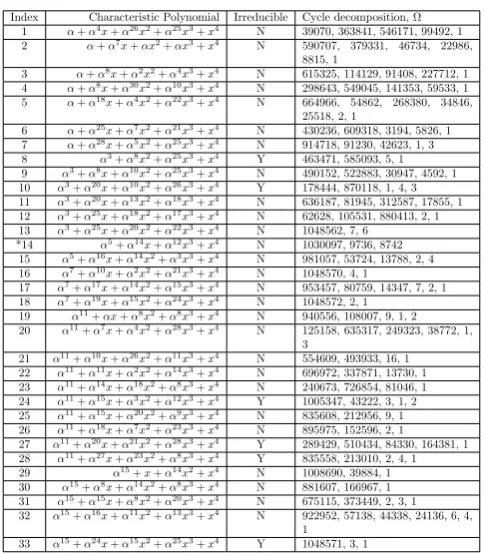
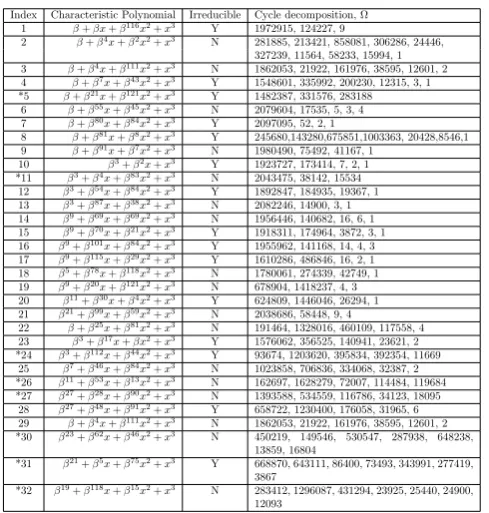
polynomials in Tables 1 - 4, where Y denotes YES
and N denotes NO. For smaller length cycles, we
only provide distinct smaller length cycles in the cycle
decompositions. In tables, the primitive elements α, β
and the WG transformations over fieldsF25 andF27 are
defined in Section 4. The computer simulations show
that for a fixed WGP(x) and a proper selection of a
characteristic polynomial, a sequence with period lower
bounded by √N can be generated by the recurrence
relation (3), where a proper selection of a characteristic
polynomial is meant by a characteristic polynomial in
the recurrence relation (3) for which the lengths of all
cycles are greater than or equal to√N. It is noticed that
the long period of a sequence generated by recurrence
relation (3) does not depend on the irreducibility of
the characteristic polynomial. In the recurrence relation,
there exists a hidden relation between the coefficients
of a characteristic polynomial and the exponents of the
WG permutation and that hidden relation can determine
a construction of a nonlinear feedback function, which
will generate a sequence with a bounded period.
Unfortunately, we are not yet able to explore the hidden
relation.
4.2. Period Distribution of the WG-NLFSR
In this section, we conduct an empirical study on
the period distribution of the recurrence relation (3)
Table 1. Complete cycle decompositions of the WG-NLFSR forn= 3overF25
Index Characteristic Polynomial Irreducible Cycle decomposition, Ω
1 1 +α14x+α21x2+x3 N 23779, 6710, 2276, 1
2 α4+α17x+α19x2+x3 N 32762, 1, 4
3 α20+α2x+α25x2+x3 Y 15236, 14762, 2769
4 1 +α7x+α26x2+x3 N 23779, 6710, 2276, 1
5 α3+α26x+α9x2+x3 N 32750, 4, 2, 3, 1
6 α5+α20x+α15x2+x3 Y 32754, 4, 3, 5, 1
7 α7+α16x+α18x2+x3 Y 32762, 4, 1
Table 2. Complete cycle decompositions of the WG-NLFSR forn= 4overF25
Index Characteristic Polynomial Irreducible Cycle decomposition, Ω
1 α+α4x+α26x2+α25x3+x4 N 39070, 363841, 546171, 99492, 1
2 α+α7x+αx2+αx3+x4 N 590707, 379331, 46734, 22986,
8815, 1
3 α+α8x+α2x2+α4x3+x4 N 615325, 114129, 91408, 227712, 1
4 α+α8x+α30x2+α10x3+x4 N 298643, 549045, 141353, 59533, 1
5 α+α18
x+α4 x2
+α22 x3
+x4
N 664966, 54862, 268380, 34846,
25518, 2, 1
6 α+α25
x+α7 x2
+α21 x3
+x4
N 430236, 609318, 3194, 5826, 1
7 α+α28x+α5x2+α25x3+x4 N 914718, 91230, 42623, 1, 3
8 α3+α8x2+α25x3+x4 Y 463471, 585093, 5, 1
9 α3+α8x+α10x2+α25x3+x4 N 490152, 522883, 30947, 4592, 1
10 α3
+α20 x+α10
x2 +α26
x3 +x4
Y 178444, 870118, 1, 4, 3
11 α3+α20x+α13x2+α18x3+x4 N 636187, 81945, 312587, 17855, 1
12 α3+α25x+α18x2+α17x3+x4 N 62628, 105531, 880413, 2, 1
13 α3+α25x+α20x2+α22x3+x4 N 1048562, 7, 6
*14 α5
+α14 x+α12
x3 +x4
N 1030097, 9736, 8742
15 α5+α16x+α14x2+α3x3+x4 N 981057, 53724, 13788, 2, 4
16 α7+α10x+α2x2+α21x3+x4 N 1048570, 4, 1
17 α7
+α17 x+α14
x2 +α15
x3 +x4
N 953457, 80759, 14347, 7, 2, 1
18 α7
+α19 x+α15
x2 +α24
x3 +x4
N 1048572, 2, 1
19 α11+αx+α8x2+α8x3+x4 N 940556, 108007, 9, 1, 2
20 α11+α7x+α4x2+α28x3+x4 N 125158, 635317, 249323, 38772, 1,
3
21 α11+α10x+α26x2+α11x3+x4 N 554609, 493933, 16, 1
22 α11
+α11 x+α2
x2 +α14
x3 +x4
N 696972, 337871, 13730, 1
23 α11
+α14 x+α18
x2 +α8
x3 +x4
N 240673, 726854, 81046, 1
24 α11+α15x+α3x2+α12x3+x4 Y 1005347, 43222, 3, 1, 2
25 α11+α15x+α20x2+α9x3+x4 N 835608, 212956, 9, 1
26 α11
+α18 x+α7
x2 +α23
x3 +x4
N 895975, 152596, 2, 1
27 α11+α20x+α21x2+α28x3+x4 Y 289429, 510434, 84330, 164381, 1
28 α11+α27x+α23x2+α8x3+x4 Y 835558, 213010, 2, 4, 1
29 α15+x+α14x2+x4 N 1008690, 39884, 1
30 α15
+α8 x+α14
x2 +α8
x3 +x4
N 881607, 166967, 1
31 α15+α15x+α8x2+α20x3+x4 N 675115, 373449, 2, 3, 1
32 α15+α16x+α11x2+α13x3+x4 N 922952, 57138, 44338, 24136, 6, 4,
1
33 α15+α24x+α15x2+α25x3+x4 Y 1048571, 3, 1
by considering the recurrence relation for different
characteristic polynomials. In the cycle decomposition
we have observed many characteristic polynomials for
which the recurrence relation can generate sequences
with periods bounded below by √N, where N is the
maximum period. However, we do not know the relation
between the WG permutation and such characteristic
polynomials in general. We here intend to study the
probability distribution of period of at least√N. That
is, we want to compute what the success probability
is that for any initial state of the recurrence relation,
the WG-NLFSR can generate a sequence with period
lower bounded by√N. The main goal of performing this
6
EAI
European Alliancefor Innovation
EAI Endorsed Transactions on
Security and Safety
Table 3. Complete cycle decompositions of the WG-NLFSR forn= 5overF25
Index Characteristic Polynomial Irreducible Cycle decomposition, Ω 1 α+α18x2+α10x3+α14x4+x5 N 24934939, 8057211, 501740, 60539, 2
2 α+α21x2+α26x3+α20x4+x5 N 33324081, 215923, 14354, 6, 67
3 α+αx+α5x2+α21x3+α5x4+x5N 23683815, 9430226, 180678, 255311, 4401
4 α+α28x2+α19x3+α19x4+x5 Y 33137436, 416935, 29, 23, 1, 6
5 α+x+αx2+α22x3+α9x4+x5 N 33509677, 42891, 1740, 118, 2, 1
6 α+αx+x2+α5x3+α20x4+x5 N 32438885, 802371, 136113, 154148, 22912, 1
7 α+α4x2+α8x3+α18x4+x5 N 20018544, 12576215, 661370, 252630, 45560,
111, 1
8 α+α5x2+α24x3+x4+x5 N 31853496, 1026340, 616630, 10591, 46360,
1001, 13
9 α+α6x2+α28x3+α4x4+x5 N 27060025, 539828, 5044304, 853141, 57062,
70, 1
10 α+α13x2+α14x3+α4x4+x5 N 1614083, 26744592, 5172342, 23352, 59, 2, 1
11 α+α16x2+α2x3+α24x4+x5 N 26604921, 60903, 5881770, 980844, 25982, 4,
7
12 α+α18x2+α20x3+α24x4+x5 N 13669238, 17126821, 2416848, 289074, 52395,
54, 1
13 α+x+α11x3+α15x4+x5 Y 29770970, 2699894, 1000613, 62602, 20324,
23, 5
14 α+x+x2+α5x3+α18x4+x5 N 9244135, 9425167, 10061666, 4589985,
233472, 1, 5
15 α+x+x2+α22x3+α13x4+x5 Y 32786392, 758058, 9835, 132, 11, 2, 1
16 α+x+αx2+α16x3+α20x4+x5 N 33188710, 351685, 13861, 166, 6, 2, 1
17 α+x+α4x2+α28x3+α18x4+x5 Y 33554268, 45, 17, 2, 1, 29, 3
*18 α+x+α11x2+α25x3+α19x4+x5 N 1711633, 17174871, 11626420, 2069636,
659633, 275686, 36552
19 α+x+α12x2+α30x3+α20x4+x5 N 26385451, 704023, 262540, 3728330, 2474077,
8, 2
20 α+x+α13x2+αx3+α17x4+x5 N 31083249, 2470874, 281, 11, 6, 9, 1
21 α+x+α16x2+α20x3+α30x4+x5 N 32645326, 634069, 54804, 88483, 74357,
57391, 1
22 α+x+α19x2+α27x3+α12x4+x5 N 30290671, 609570, 384964, 554062, 1570249,
144914, 1
*23 α+x+α25x2+αx3+α27x4+x5 N 6758906, 19951473, 853356, 5840681, 5929,
75633, 68453
24 α+α8x2+α21x3+α13x4+x5 N 31959770, 1594335, 112, 173, 7, 17, 9, 1
25 α+x+α2x2+α12x3+α20x4+x5 N 14631594, 17557700, 1270630, 23428, 50395,
20669, 11, 2
26 α+x+α3x2+α10x3+α10x4+x5 N 8613690, 17190010, 7681297, 17715, 34521,
17155, 41, 1
27 α+x+α17x2+α10x3+α9x4+x5 N 31934521, 1487357, 11327, 64353, 56840, 28,
3, 1
28 α+x+α21x2+α16x3+α29x4+x5 Y 11545515, 21015426, 720059, 240858, 32564,
3, 2, 1
29 α+αx+α3x2+x3+α12x4+x5 N 20341385, 6807881, 4023518, 1776187,
598917, 6539, 2, 1
Table 4. Complete cycle decompositions of the WG-NLFSR forn= 3overF27
Index Characteristic Polynomial Irreducible Cycle decomposition, Ω
1 β+βx+β116x2+x3 Y 1972915, 124227, 9
2 β+β4x+β2x2+x3 N 281885, 213421, 858081, 306286, 24446,
327239, 11564, 58233, 15994, 1
3 β+β4x+β111x2+x3 N 1862053, 21922, 161976, 38595, 12601, 2
4 β+β7x+β43x2+x3 Y 1548601, 335992, 200230, 12315, 3, 1
*5 β+β21x+β121x2+x3 Y 1482387, 331576, 283188
6 β+β55x+β45x2+x3 N 2079604, 17535, 5, 3, 4
7 β+β80x+β84x2+x3 Y 2097095, 52, 2, 1
8 β+β81x+β8x2+x3 Y 245680,143280,675851,1003363, 20428,8546,1
9 β+β91x+β7x2+x3 N 1980490, 75492, 41167, 1
10 β3+β2x+x3 Y 1923727, 173414, 7, 2, 1
*11 β3+β4x+β83x2+x3 N 2043475, 38142, 15534
12 β3+β54x+β84x2+x3 Y 1892847, 184935, 19367, 1
13 β3+β87x+β38x2+x3 N 2082246, 14900, 3, 1
14 β9+β69x+β69x2+x3 N 1956446, 140682, 16, 6, 1
15 β9+β70x+β21x2+x3 Y 1918311, 174964, 3872, 3, 1
16 β9+β101x+β84x2+x3 Y 1955962, 141168, 14, 4, 3
17 β9+β115x+β29x2+x3 Y 1610286, 486846, 16, 2, 1
18 β5+β78x+β118x2+x3 N 1780061, 274339, 42749, 1
19 β9+β20x+β121x2+x3 N 678904, 1418237, 4, 3
20 β11+β30x+β4x2+x3 Y 624809, 1446046, 26294, 1
21 β21+β99x+β59x2+x3 N 2038686, 58448, 9, 4
22 β+β25x+β81x2+x3 N 191464, 1328016, 460109, 117558, 4
23 β3+β17x+βx2+x3 Y 1576062, 356525, 140941, 23621, 2
*24 β3+β112x+β44x2+x3 Y 93674, 1203620, 395834, 392354, 11669
25 β7+β46x+β84x2+x3 N 1023858, 706836, 334068, 32387, 2
*26 β11+β53x+β13x2+x3 N 162697, 1628279, 72007, 114484, 119684
*27 β27+β28x+β90x2+x3 N 1393588, 534559, 116786, 34123, 18095
28 β27+β48x+β91x2+x3 Y 658722, 1230400, 176058, 31965, 6
29 β+β4x+β111x2+x3 N 1862053, 21922, 161976, 38595, 12601, 2
*30 β23+β62x+β46x2+x3 N 450219, 149546, 530547, 287938, 648238,
13859, 16804
*31 β21+β5x+β75x2+x3 Y 668870, 643111, 86400, 73493, 343991, 277419,
3867
*32 β19+β118x+β15x2+x3 N 283412, 1296087, 431294, 23925, 25440, 24900, 12093
empirical study is that it can convey a general behavior
of this type of recurrence relations.
Procedure for Computing the Success Probability for
Period ≥√N. We calculate the probability
distribu-tion of period as follows. For an WG-NLFSR recurrence
relation, we perform the complete cycle decomposition
by computer simulations. We first compute the complete
cycle decompositions for different characteristic
polyno-mials with the same WG permutation, where different
characteristic polynomials are chosen randomly. Then,
using the cycle decomposition we calculate the expected
success probability and the standard deviation (SD) of
the period greater than or equal to √N. We note that
the success probability is equal to one when the lengths
of all the cycles are greater than or equal to √N. The
details of the success probability calculation is described
in the following procedure.
Let D be a random variable which represents the
number of distinct characteristic polynomials of the same
degree. For each characteristic polynomial, the success
probability of the period greater than or equal to√N is
computed as follows:
Algorithm 1 Computing success probability
1: Compute {C1, C2, ..., Cr}, which is the cycle
decomposition of the characteristic polynomial with
Li=|Ci|, i= 1,2, ..., r.
2: Add allLj’s which are less than
√
Nand let the sum
beLsum.
3: The success probability of the period bounded below
by√N for any initial state is 1−Lsum
N .
We then compute the expectation and standard
deviation (SD) for the period ofDsuccess probabilities.
Let Dmean and DSD be the expectation and standard
deviation, respectively. Then, we use the histogram with
(Dmean, DSD) to represent the probability distribution
of the period. In the following subsection, we present the
experimental results by the above procedure.
Period Distribution of the WG-NLFSR over the Field
F25 and F27. In this subsection, we compute the
expected success probability of period by the above
Procedure 1 for the recurrence relation of lengthn= 3,4
and 5 over the field F25 and for the recurrence relation
7
EAI
European Alliancefor Innovation
EAI Endorsed Transactions on
Security and Safety
of lengthn= 3,4 over the fieldF27. In Table5, the WG
permutations over fieldsF25 andF27 are defined.
Table 5. Parameter descriptions
t Primitive element ofF2t Primitive Polynomial WG permutations
5 α α5+α3+ 1 = 0 WGP5(x) =x+ (x+ 1)5+ (x+ 1)13+ (x+ 1)19+ (x+ 1)21
7 β β7+β+ 1 = 0 WGP7(x) =x+ (x+ 1)33+ (x+ 1)39+ (x+ 1)41+ (x+ 1)104
We consider the n-stage recurrence relation (3) with
WGP5(x) and WGP7(x) as the WG permutation over
the fieldF25andF27, respectively. Our simulation results
for n= 3,4 and 5 over the field F25 are given in
Table 6. Similarly, the simulation results for n= 3 and
4 over F27 are given in Table 7. In Tables 6 and 7, we
provide the number of characteristic polynomials (D),
the expected success probability (Dmean), the standard
deviation (DSD), and the maximum value of the sum
of all smaller length cycles which are less than √N
(Lsum). In addition, the average number of cycles in
the cycle decomposition of the WG-NLFSR recurrence
relation is presented. Our experimental results show that
the numerical value for the average number of cycles is
very close to the average number of cycles generated
by the random sampling (let rs denote the expected
number of cycles generated by the random sampling,
thenrs≈lnN, see [6]).
Table 6. The summary of simulation results overF25
Length,n Max period,N D Dmean DSD Lsum Avg.#of cycles rs
3 215−
1 31744 0.9945 0.0039 1011 10.51 10.38
4 220−1 197296 0.9990 0.00069 6394 13.95 13.86
5 225−1 66888 0.9998 0.00012 35828 17.44 17.32
For n= 3, the success probability of period lower
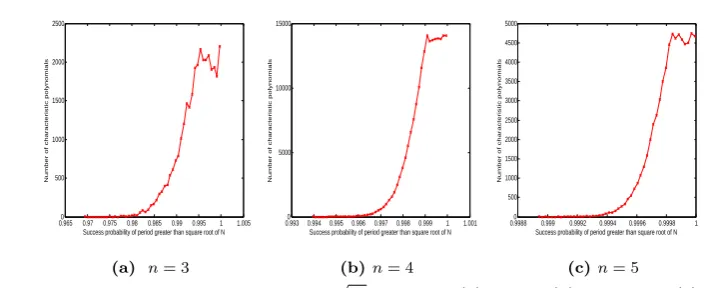
bounded by √N is depicted in Figure 3a in the form
of a histogram. In figures, the x-axis represents the
success probability values and the y-axis represents the
number of characteristic polynomials that have been
taken. In the histogram, it can be observed that for
most characteristic polynomials the recurrence relation
produces sequences with period of at least√N when the
success probability is greater than 0.985. The empirical
result for n= 3 in Table 6 says that if an arbitrary
characteristic polynomial is chosen in the WG-NLFSR
recurrence relation with WGP5(x), then, with expected
probability 0.9945, the recurrence relation can generate
a sequence with period lower bounded by√N.
Table 7. The summary of simulation results overF27
Length,n Max period,N D Dmean SD Lsum Avg.#of cycle rs
3 221−1 294912 0.9993 0.00049 35828 14.49 14.55
4 228−
1 7337 0.9999 0.00004 82216 19.38 19.41
In a similar fashion, the probability distributions of
period forn= 4 and 5 overF25 in Figures3band3c, and
n= 3 and 4 over F27 in Figures 4aand4b are depicted
in the form of a histogram along with the expected
success probability. Forn= 4 and 5, the expected success
probabilities of the period are given by 0.990 and 0.9998,
respectively, which are greater than the expected success
probability for n= 3.
The empirical analysis shows that with a high
probability the WG-NLFSR can generate a sequence
with period at least√Nfor a large length of the NLFSR.
In particular, with very high probability, the filtering
WG7-NLFSR can generate a sequence with period at
least 280.5.
4.3. Increasing the Period of a Sequence by the
Composition of FSRs
In this section, we study the cycle decomposition of a
composited recurrence relation, which is composed of a
NLFSR-WG recurrence relation and a linear recurrence
relation. In particular, we take the characteristic
polynomial of the linear recurrence relation to be
the primitive polynomial for producing a maximum
length cycle in the cycle decomposition. The randomness
properties such as the period and linear complexity of a
sequence generated by a composited recurrence relation
are discussed.
Composition of two FSRs over a Finite Field. Let
g(y0, y1, ..., ym−1, ym) = 0 and f(x0, x1, ..., xn−1, xn) =
0 be a linear recurrence relation and a WG-NLFSR
recurrence relation, respectively and which are given by
f(x0, ..., xn−1, xn) =xn+c0x0+c1x1+· · ·+cn−1xn−1
+W GP(xn−1),
g(y0, ..., ym−1, ym) =ym+d0y0+d1y1+· · ·+dm−1ym−1,
di, ci∈F2t
where φ(x) =d0+d1x+· · ·+dm−1xm−1+xm is a
primitive polynomial overF2t. Thecompositionoff and
8
EAI
European Alliancefor Innovation
EAI Endorsed Transactions on
Security and Safety
0.9650 0.97 0.975 0.98 0.985 0.99 0.995 1 1.005 500
1000 1500 2000 2500
Success probability of period greater than square root of N
Number of characteristic polynomials
(a) n= 3
0.9930 0.994 0.995 0.996 0.997 0.998 0.999 1 1.001 5000
10000 15000
Success probability of period greater than square root of N
Number of characteristic polynomials
(b)n= 4
0.99880 0.999 0.9992 0.9994 0.9996 0.9998 1
500 1000 1500 2000 2500 3000 3500 4000 4500 5000
Success probability of period greater than square root of N
Number of characteristic polynomials
(c)n= 5
Figure 3. Distribution of the period≥√N fort= 5, (a)n= 3, (b)n= 4and (c)n= 5
0.996 0.9965 0.997 0.9975 0.998 0.9985 0.999 0.99950 1 1.0005 0.2
0.4 0.6 0.8 1 1.2 1.4 1.6 1.8 2x 10
4
Success probability of period greater than square root of N
Number of characteristic polynomials
(a)n= 3
0.99960 0.9997 0.9997 0.9998 0.9998 0.9999 0.9999 1 50
100 150 200 250 300 350 400 450 500
Success probability of period greater than square root of N
Number of characteristic polynomials
(b)n= 4
Figure 4. Distribution of the period≥√N fort= 7, (a) n= 3, (b) n= 4
g, denoted byf◦g, is defined as [18]
f◦g=yn+m+l0y0+l1y1+· · ·+lm+n−1ym+n−1+
W GP(ym+n−1+d0yn−1+· · ·+dm−1ym+n−2)
where
l0=c0d0
l1=c0d1+c1d0
l2=c0d2+c1d1+c2d0
.. .
lm+n−1= (cm−1+dn−1).
Note that f ◦g and g◦f are not the same in general.
The following proposition states a relation between the
cycle decomposition off and the cycle decomposition of
f◦g.
Proposition 2.Let Ω(f) ={Ci: 1≤i≤M} be the
cycle decomposition of feedback function f with vi=
gcd(|Ci|,2tm−1) (6=|Ci|). Then the cycle
decomposi-tion of f◦g is given by Ω(f◦g) ={Li: 1≤i≤2M+
1}(⊃Ω(f)) with |Li|=|Ci|, 1≤i≤M and |LM+1|=
2tm−1 ( = order of g) and |LM+1+i|= (2tm−1)·
|Ci|
vi , 1≤i≤M, where all |Li|, i= 1,2, ...,2M+ 1 are
distinct.
Proof. The proof follows from Theorem 3.14-15 (a) in
Section 3 of [18].
The linear complexities of the sequences generated
by the recurrence relation f ◦g= 0 are given in the
following proposition.
Proposition 3.Let Ω(f) ={Ci: 1≤i≤M} be the
cycle decomposition of feedback function f with vi=
gcd(|Ci|,2tm−1) (6=|Ci|). Then the linear complexities
of the sequences in Ω(f◦g) ={Li: 1≤i≤2M+ 1}are
given by {LCi: 1≤i≤2M+ 1}, where |LCi| is the
linear complexity of sequence Li, i= 1,2, ..., M and
|LCM+1|=m, and|LCM+i+1|=|LCi|+m, 1≤i≤M.
Example 2.Finite field F25 is defined by
α5+α3+ 1 = 0. Let f(x0, x1, x2, x3) =x3+α20x0+
α2x
1+α25x2+W GP5(x2) = 0, g(y0, y1, y2) =
y2+α3y0+α4y1= 0, order(g) = 210−1. Ω(f) =
{15236,14762,2769,1}, |Ω(f)|= 4 and Ω(f◦g) =
{15236,14762,2769,1023,15586428,1372866,944229,1},
|Ω(f◦g)|= 8. The cycle of length 1 is for the zero
sequence and the cycle of length 1023 is for the
m-sequence generated by the recurrence relation ofg.
Note that by performing the composition operation
between a linear feedback shift register and a nonlinear
feedback shift register, we can increase the lengths of the
sequences.
5. Conclusions and Future Work
In this paper, we presented a family of pseudorandom
number generators named the filtering WG-NLFSR and
9
EAI
European Alliancefor Innovation
EAI Endorsed Transactions on
Security and Safety
the filtering WG7-NLFSR for EPC C1 Gen2 RFID tags.
Due to the nonlinear feedback for the state update,
the filtering WG7-NLFSR will be resistant to the
powerful cryptanalytic attacks. In order to investigate
the periodicity of a filtering WG7-NLFSR sequence, we
introduced the WG-NLFSR, which generates sequences
over the finite field. The periodicity of WG-NLFSR
sequences is investigated by performing the complete
cycle decomposition of the WG-NLFSR recurrence
relations and by conducting an empirical study on the
period distribution of WG-NLFSR sequences. In the
cycle decomposition, we observed that there are many
characteristic polynomials in which the cycle lengths are
close to the maximum period or bounded below by √N
and we listed some characteristic polynomials over the
fieldsF25 andF27. We conducted an empirical study on
the period distribution of the WG-NLFSR over the field
F25 and F27 for different lengths of the shift registers.
The empirical study reveals that, with high probability,
the filtering WG7-NLFSR can generate sequences with
periods bounded below by 280.5. To the best of our
knowledge, this is the first study in the literature on
the cycle decomposition and the distribution of a period
of a sequence generated by the nonlinear feedback shift
register over an extension field. Finally, we studied the
randomness properties of the sequences produced by a
composited recurrence relation over a finite field.
As a future work, we investigate the randomness
properties, especially the linear complexity of a filtering
sequence produced by a composited recurrence relation
of WG-NLFSR.
References
[1] Che W. and Deng H. and Tan X. and Wang J. (2008)
A Random Number Generator for Application in RFID
Tags, In Networked RFID Systems and Lightweight
Cryptography, Chapter 16, pp. 279 – 287, Springer-Verlag.
[2] Courtois N. and Meier W. (2003) Algebraic Attacks
on Stream Ciphers with Linear Feedback, Advances in
Cryptology-Eurocrypt’03,, Vol. 2656, LNCS, pp. 345-359, Springer-Verlag.
[3] Dinur I. and Shamir A. (2009) Cube Attacks
on Tweakable Black Box Polynomials, Advances
in Cryptology-EUROCRYPT’09, LNCS, pp. 278–299, Springer-Verlag.
[4] EPCglobal (2008) EPC Radio-Frequency Identification
Protocol Class-1 Generation-2 UHF RFID for
Commu-nication at 860-960 MHz, http://www.epcglobalinc.
org/.
[5] The eStream Project. http://www.ecrypt.eu.org/
stream/.
[6] Golomb S.W. (1981) Shift Register Sequences, Aegean Park Press, Laguna Hills, CA, USA.
[7] Golomb S.W. and Gong G. (2004) Signal Design for Good Correlation: For Wireless Communication,
Cryptography, and Radar, Cambridge University Press, New York, USA.
[8] Gong G. and Rønjom S. and Helleseth T. and Hu H. (2011) Fast Discrete Fourier Spectra Attacks on Stream
Ciphers,IEEE Transactions on Information Theory, Vol
57, No. 8, pp. 5555 – 5565.
[9] Gong G. and Youssef A. (2002) Cryptographic
Properties of the Welch-Gong Transformation Sequence
Generators,IEEE Transactions on Information Theory,
Vol. 48, No. 11, pp. 2837 – 2846.
[10] Juels A. (2006) RFID Security and Privacy: A
Research Survey, IEEE Journal on Selected Areas in
Communications (J-SAC), Vol. 24, No. 2, pp. 381 – 394.
[11] Lam C. and Aagaard M. and Gong G. (2011)
Hardware Implementations of Multi-output Welch-Gong
Ciphers, CACR Technical Report, http://www.cacr.
math.uwaterloo.ca/.
[12] Luo Y. and Chai Q. and Gong G. and Lai
X. (2010) WG-7: A Lightweight Stream Cipher
with Good Cryptographic Properties, IEEE Global
Communications Conference– GLOBECOM, pp. 1 – 6. [13] Mandal K. and Gong G. (2013) Filtering Nonlinear
Feed-back Shift Registers Using Welch-Gong Transformations for Securing RFID Applications, QSHINE 2013, LNICS,
Vol. 115, pp. 643 – 657.
[14] Mandal K. and Fan X. and Gong G. (2012) Warbler:
A Lightweight Pseudorandom Number Generator for
EPC Class 1 Gen 2 RFID Tags, Proceedings of Radio
Frequency Identification System Security: RFIDsec’11 Asia (Cryptology and Information Security), Vol. 8, pp. 73 – 84.
[15] Mandal K. and Fan X. and Gong G. (2013) Warbler: A Lightweight Pseudorandom Number Generator for EPC
Class 1 Gen 2 Passive RFID Tags, International Journal of RFID Security and Cryptography, Vol. 2, Issues 1 - 4,
pp. 82 – 91.
[16] Melia-Segui J. and Garcia-Alfaro J. and
Herrera-Joancomarti J. (2010) Analysis and Improvement of a
Pseudorandom Number Generator for EPC Gen2 Tags,
10
EAI
European Alliancefor Innovation
EAI Endorsed Transactions on
Security and Safety
In Proceedings of the 14th International conference on Financial Cryptography and Data Security, FC’10, pp. 34 – 46, Springer-Verlag.
[17] Meier W. and Staffelbach O. (1989) Fast Correlation
Attacks on Certain Stream Ciphers, Journal of
Cryptology, pp. 159 – 176.
[18] Mykkeltveit J. and Siu M.-K. and Tong P. (1979) On the Cycle Structure of Some Nonlinear Shift Register
Sequences. Information and Control Vol. 43, No. 2, pp. 202 – 215
[19] Nawaz Y. and Gong G. (2008) WG: A Family of Stream Ciphers with Designed Randomness Properties,
Information Science, Vol. 178, No. 7, pp. 1903 – 1916. [20] Peris-Lopez P. and Hernandez-Castro J.C. and
Estevez-Tapiador J.M. and Ribagorda A. (2009) LAMED - A PRNG for EPC Class-1 Generation-2 RFID
Specification,Computer Standard Interfaces, Vol. 31, pp.
88 – 97.
[21] Ranasinghe D.C. and Cole P.H. (2008) An
Evalu-ation Framework, In Networked RFID Systems and
Lightweight Cryptography, pp. 157 – 167, Springer-Verlag.
Appendix A.
We here present the performance comparison table for
the WG-7 stream cipher from [12].
Table 8. Comparison of WG-7 and other lightweight ciphers [12]
a Cipher Cost of Resources Init. Thru.put
[cycles] [bits/sec]
Code EXP/RET
PRESENT@2MHz 841 25/4 230 2,297
HB@2MHz 1,532 9/7 22,949 5543
[email protected] 1,386
WG-7@2MHz 1,097 7/4 10,084 9,852
[email protected] 2,463
b Flash SRAM
AES@8MHz 6,664 88 7,149 81,432
Salsa20@8MHz 3,842 258 318 83,688
XTEA@8MHz 820 0 – 51655
PRESENT@8MHz 2,398 528 – 53,361
Size+HB@8MHz 1,308 0 14,735 34,934
Speed+HB@8MHz 10,918 0 8,182 91,494
GRAIN@8MHz 778 20 107,366 12,966
TRIVIUM@8MHz 424 36 775,726 12,030
WG-7@8MHz 1,100 0 10074 280,087
11
EAI
European Alliancefor Innovation
EAI Endorsed Transactions on
Security and Safety


![Table 8. Comparison of WG-7 and other lightweightciphers [12]](https://thumb-us.123doks.com/thumbv2/123dok_us/8429778.1697365/11.595.312.544.211.386/table-comparison-wg-lightweightciphers.webp)
